
Loading
Warhawk Division is a gaming community. This is a unit document, not a government or military publication.Warhawk Division is an independent gaming community, for entertainment purposes only. It is not affiliated with, sponsored by, or endorsed by Bohemia Interactive, the United States Department of Defense, or any military organization. Arma Reforger is a trademark of its respective owner. Printed from warhawkdivision.com.
Week 8 content
0 of 14 done
Slide 1 of 14
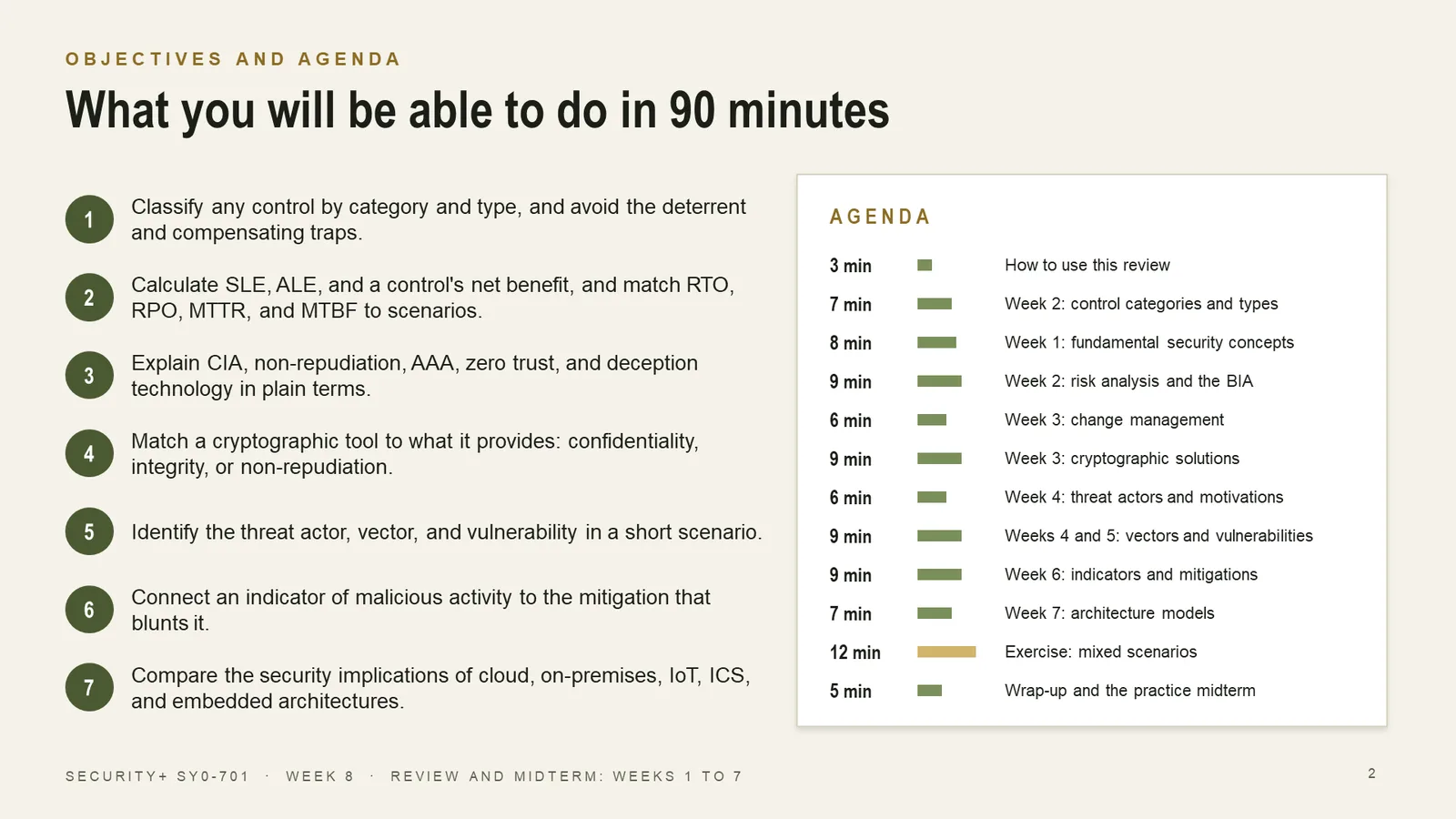
Exam objectives: 1.1 Compare and contrast various types of security controls. 1.2 Summarize fundamental security concepts. 1.3 Explain the importance of change management processes and the impact to security. 1.4 Explain the importance of using appropriate cryptographic solutions. 2.1 Compare and contrast common threat actors and motivations. 2.2 Explain common threat vectors and attack surfaces. 2.3 Explain various types of vulnerabilities. 2.4 Given a scenario, analyze indicators of malicious activity. 2.5 Explain the purpose of mitigation techniques used to secure the enterprise. 3.1 Compare and contrast security implications of different architecture models. 5.2 Explain elements of the risk management process.
3 min
This week is a review of weeks 1 to 7, and it ends with a 25-question practice midterm. The midterm covers all of domain 1 (general security concepts), all of domain 2 (threats, vulnerabilities, and mitigations), objective 3.1 (architecture models), and the risk analysis from week 2.
Each section below is a summary, not a reteach. Read it, then read the exam traps at the end of each one. Those traps are where most lost points come from: not from forgetting a term, but from picking a nearly right answer over the best one.
A good way to work:
Keep your study list. The lab this week turns it into a plan.
7 min
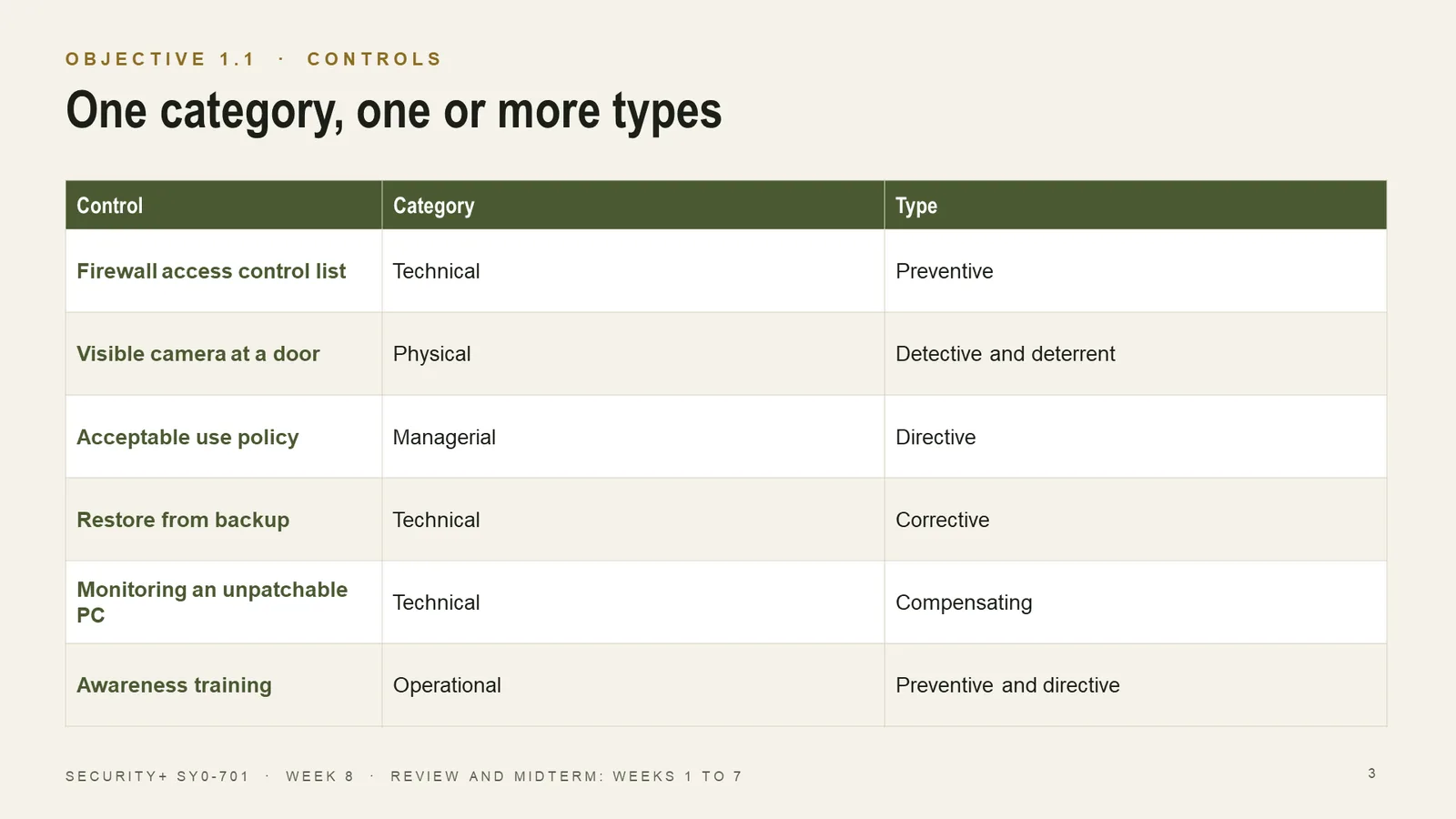
A category says how a control is carried out. There are four: technical (systems and software), managerial (governance, such as policies and risk assessments), operational (people carrying out processes, such as training and guard duty procedures), and physical (locks, fences, badge readers).
A type says what a control does:
A control has one category and can serve more than one type.
Watch out
Exam traps. Directive is a type, not a category, so it never answers "which category." Deterrent is not preventive: a sign does not stop anyone. Compensating does not mean weak: it means a substitute chosen because the primary control cannot be used. And training is operational, while the policy that requires it is managerial.
8 min
Watch out
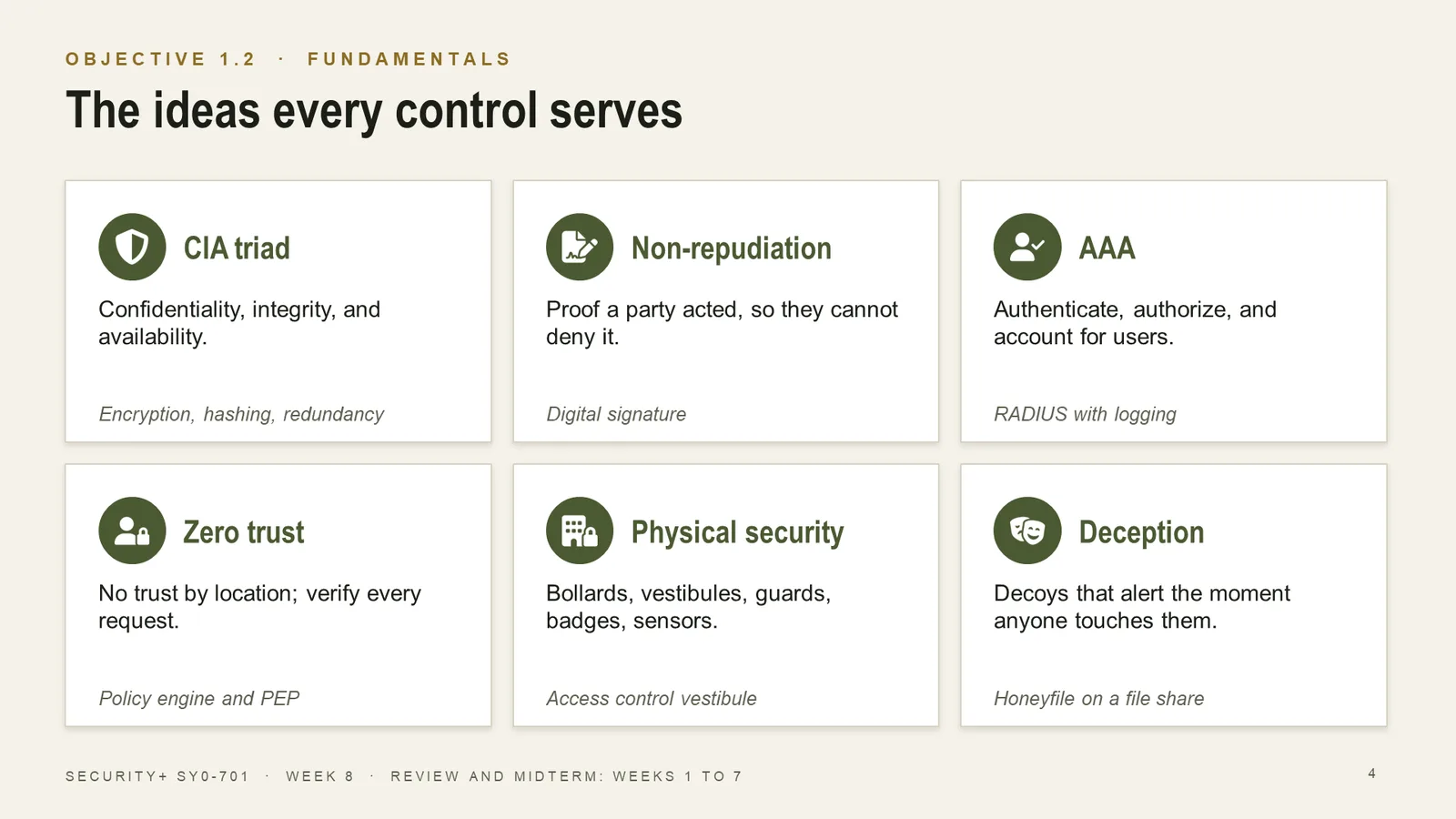
Exam traps. Hashing serves integrity, not confidentiality. Accounting is logging, not billing. In zero trust the policy engine makes the decision and the enforcement point carries it out at the resource.
9 min
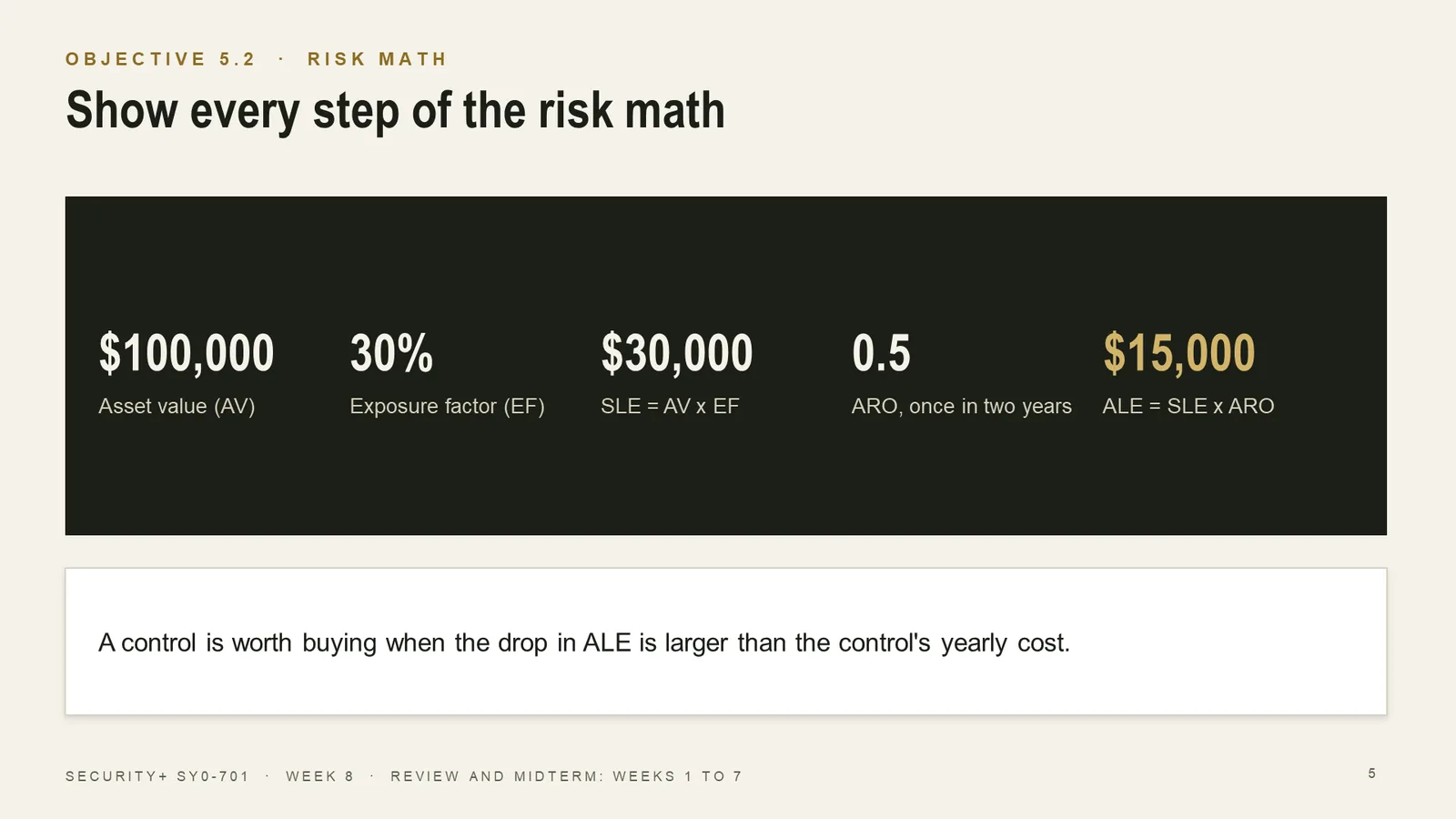
The formulas are short. Learn them cold.
On the slide: $100,000 x 0.30 = $30,000 SLE, and $30,000 x 0.5 = $15,000 ALE.
Treatment strategies: mitigate (add controls), transfer (insurance or contract; accountability stays), accept (a documented decision, often an exemption or exception), and avoid (stop the activity). Risk appetite is the overall stance (expansionary, neutral, conservative); risk tolerance is how far one risk may drift before action. The risk register lists each risk with an owner, rating, treatment, and key risk indicator.
Business impact analysis:
| Term | Meaning |
|---|---|
| RPO | Most data loss you can accept, measured back from the incident |
| RTO | Target time to restore the function, measured forward |
| MTTR | Average time to repair |
| MTBF | Average time a component runs between failures |
Watch out
Exam traps. ARO is not a percentage of loss. Transfer does not move accountability. RPO is about data, RTO is about time to recover. A higher MTBF is better; a lower MTTR is better.
6 min
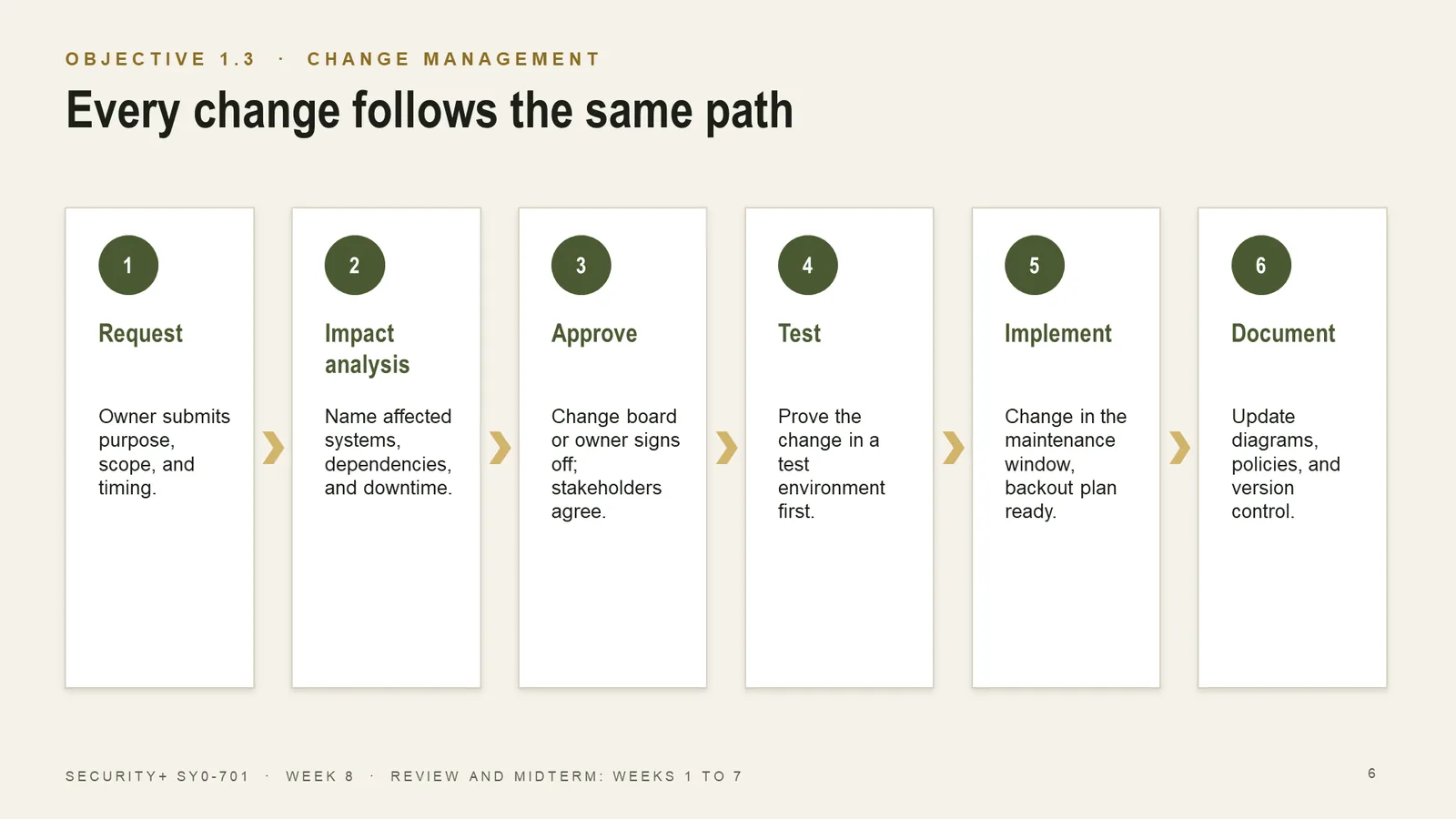
Change management exists because many outages and security gaps are self-inflicted. A good process has these business processes:
Technical implications to record: allow lists and deny lists that may need updates, restricted activities, downtime, service and application restarts, legacy applications that may not tolerate the change, and dependencies between systems.
Documentation: update diagrams, policies, and procedures, and use version control so you can see what changed and roll it back.
Watch out
Exam traps. A backout plan is not the same as a backup: it is the procedure to undo the change. A change that skips approval is a security event even if nothing breaks. When a shared component changes and other systems fail, the missed implication is dependencies.
9 min
Watch out
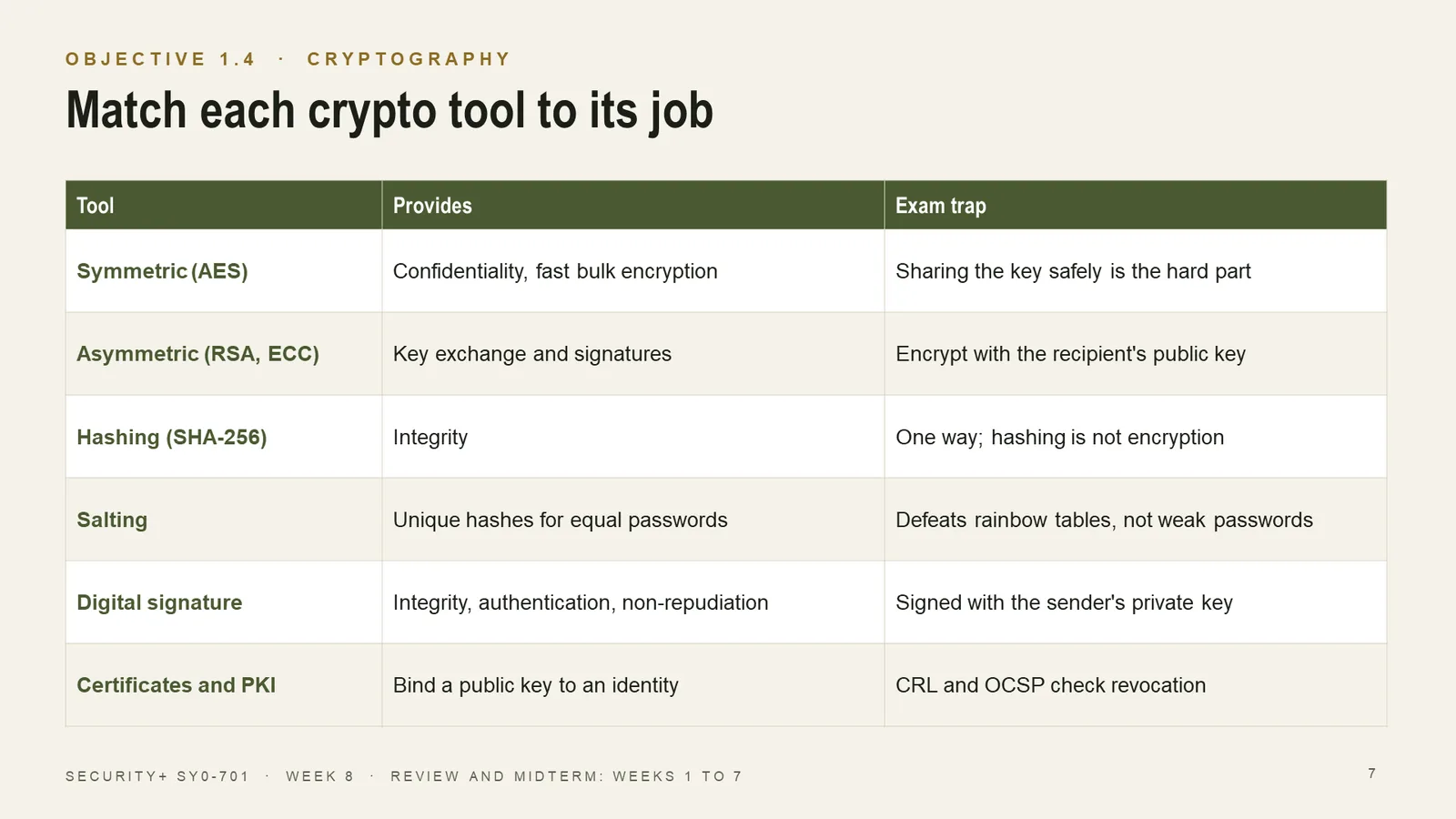
Exam traps. Hashing is not encryption. A larger key length is stronger for the same algorithm. A TPM is built into the device; an HSM is a separate appliance. Salting does not make a weak password strong; it only stops precomputed attacks.
6 min
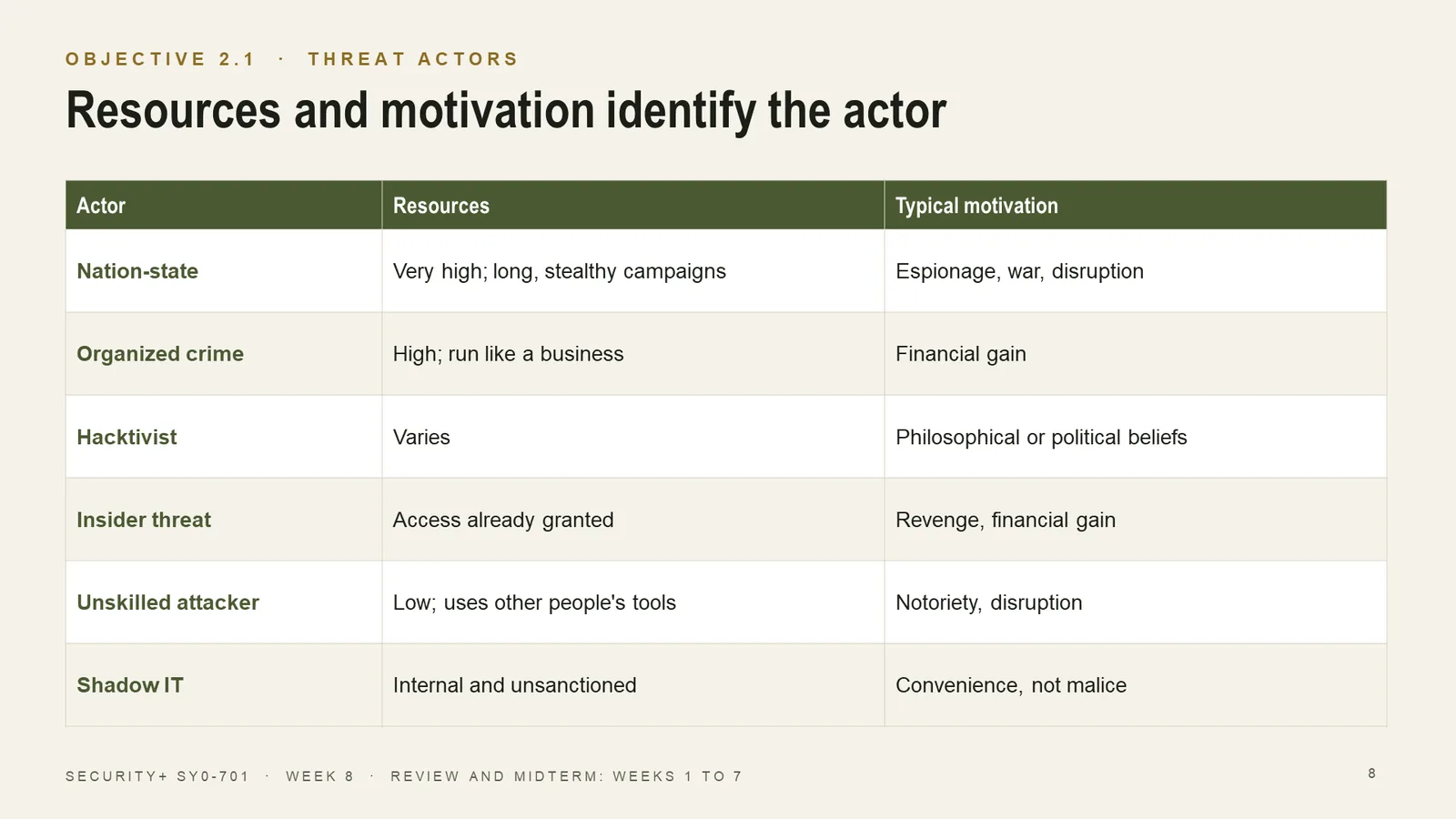
Six actors are on the exam: nation-state, unskilled attacker, hacktivist, insider threat, organized crime, and shadow IT.
Tell them apart by their attributes:
Then by motivation: data exfiltration, espionage, service disruption, blackmail, financial gain, philosophical or political beliefs, ethical reasons, revenge, disruption or chaos, and war.
A useful habit: read the scenario for money, ideology, or access. Money points to organized crime. Ideology points to a hacktivist. Existing access points to an insider. Long-term stealth and state interest point to a nation-state.
Watch out
Exam traps. Shadow IT is a threat actor even without malice: unsanctioned systems are unmanaged risk. An insider does not have to be an employee; contractors and vendors with access count. A hacker who breaks in and then reports the flaw is usually described by motivation (ethical), not as an authorized tester.
9 min
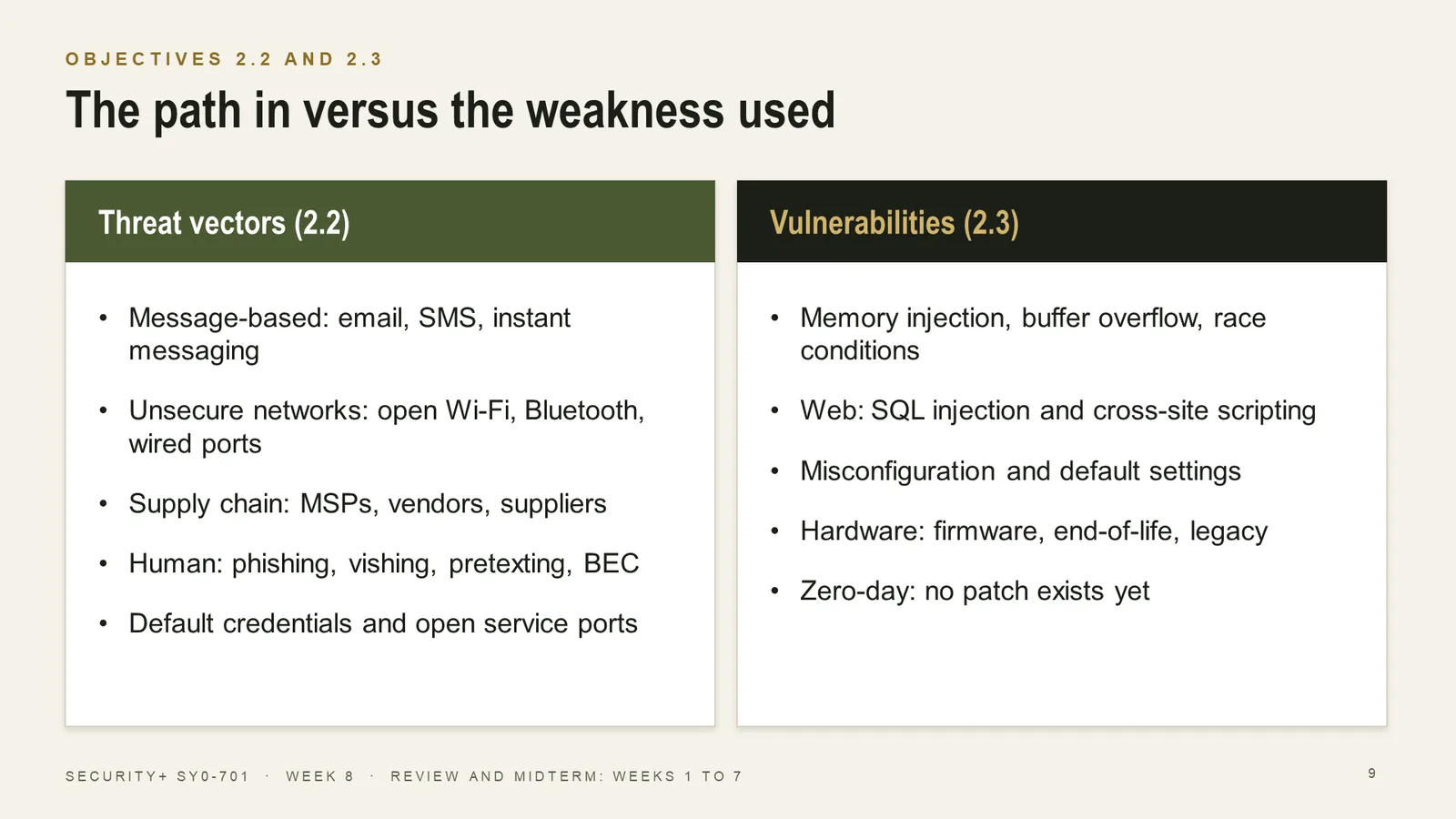
A threat vector is the route an attacker uses. An attack surface is the sum of those routes for an organization. Objective 2.2 lists: message-based (email, SMS, instant messaging), image-based, file-based, voice call, removable devices, vulnerable software (client-based versus agentless), unsupported systems and applications, unsecure networks (wireless, wired, Bluetooth), open service ports, default credentials, the supply chain (managed service providers, vendors, suppliers), and human vectors: phishing, vishing, smishing, misinformation and disinformation, impersonation, business email compromise, pretexting, watering hole, brand impersonation, and typosquatting.
A vulnerability is the weakness the route reaches. Objective 2.3 lists:
Watch out
Exam traps. Vishing is voice, smishing is SMS. A watering hole compromises a site the targets already visit; typosquatting registers a look-alike domain. End-of-life means no more patches, which makes it a vulnerability even if nothing is broken today.
9 min
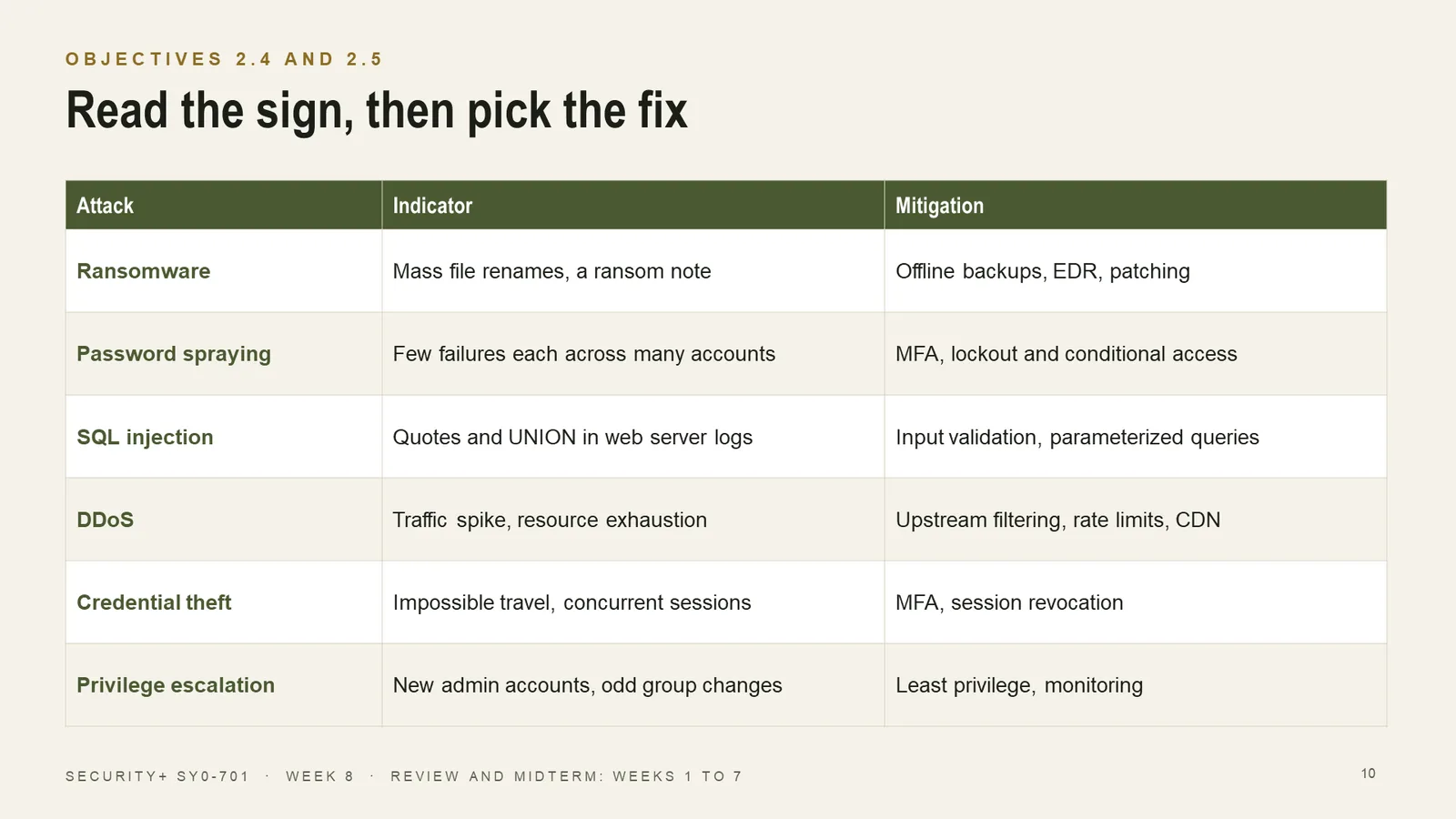
Objective 2.4 asks you to recognize an attack from its signs.
Objective 2.5 gives the mitigations: segmentation, access control (ACLs, permissions), application allow list, isolation, patching, encryption, monitoring, least privilege, configuration enforcement, decommissioning, and hardening techniques: encryption, installing endpoint protection, host-based firewall, host-based IPS, disabling ports and protocols, default password changes, and removing unnecessary software.
Watch out
Exam traps. A worm spreads by itself; a virus needs a user or host file. A logic bomb waits for a trigger such as a date. Missing logs are an indicator, because attackers clear them. When a scenario asks how to limit spread, the answer is usually segmentation or isolation.
7 min
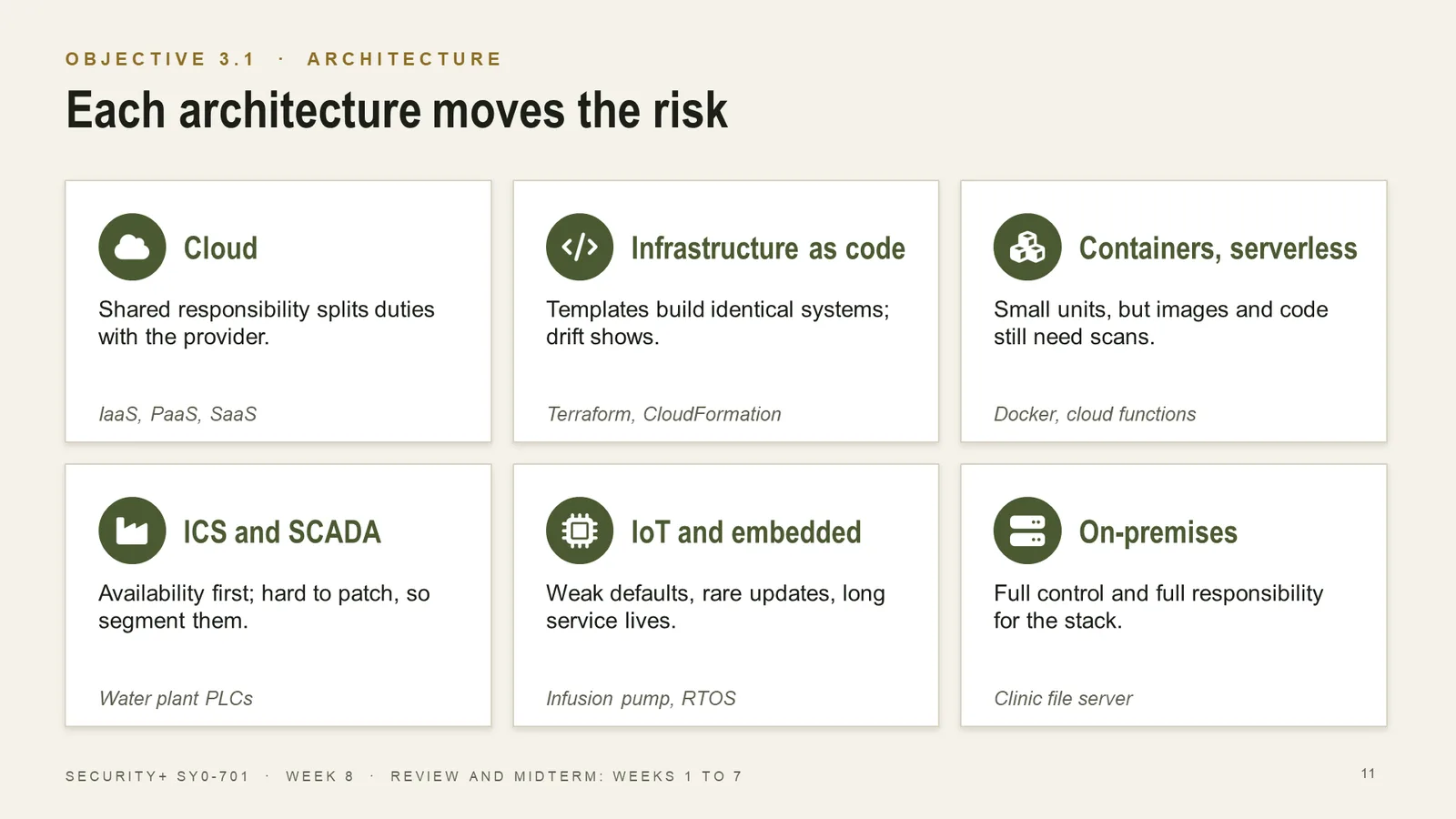
Objective 3.1 asks how each architecture changes security.
Considerations to weigh for any model: availability, resilience, cost, responsiveness, scalability, ease of deployment, risk transference, ease of recovery, patch availability, inability to patch, power, and compute.
Watch out
Exam traps. Moving to the cloud transfers some tasks, not accountability. For ICS and SCADA, availability and safety come first, so the usual answer is segmentation and monitoring, not "patch immediately."
12 min
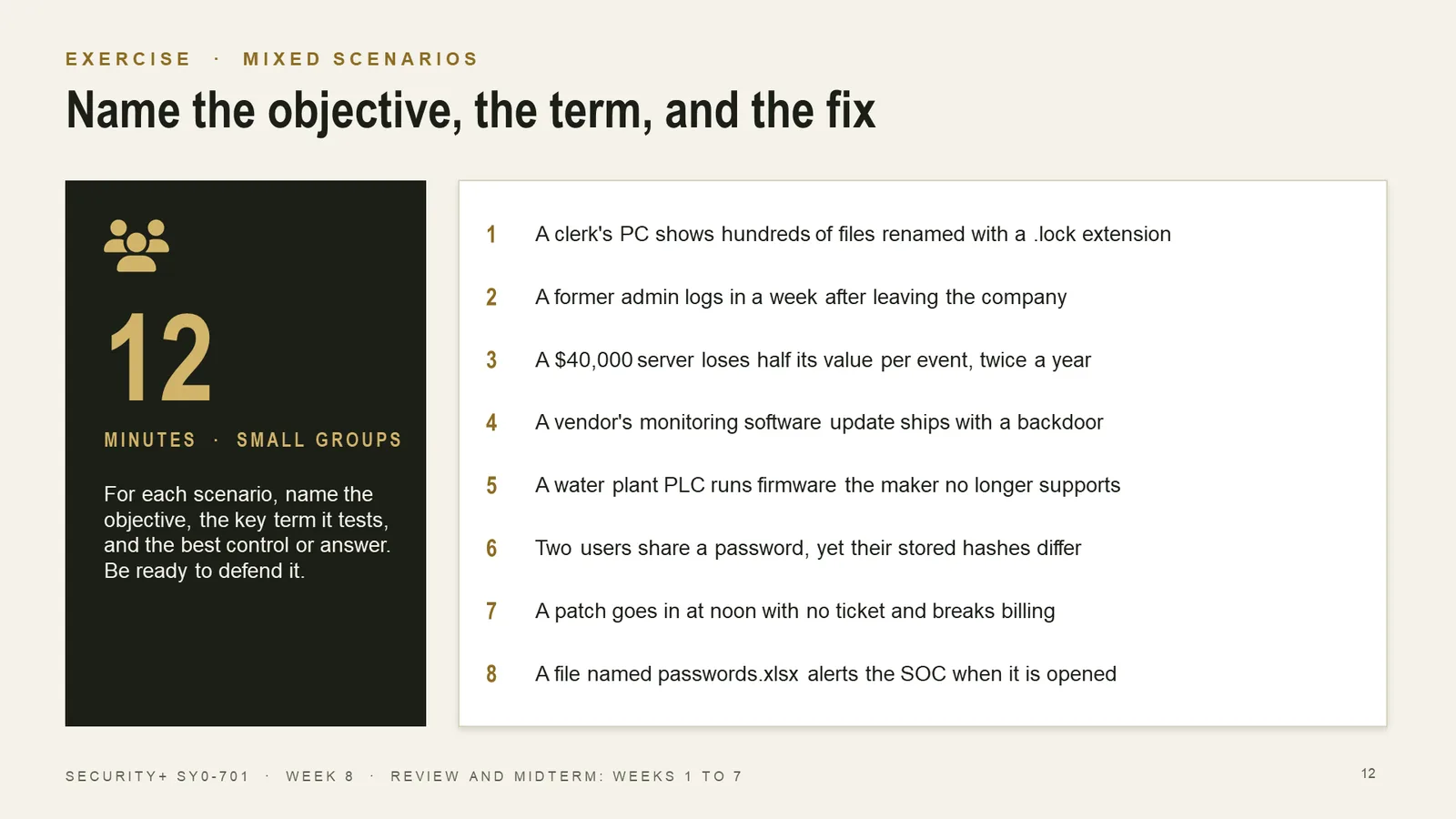
Work in a small group, or alone if you are studying on your own. Give yourself 10 minutes. For each scenario, write three things: the objective it tests, the key term, and the best control or answer.
Write your answers before opening the worked answers.
5 min
You have now covered about 40 percent of the exam's weight. Before you take the practice midterm, check these four habits:
Take the 25 questions below in one sitting, about 25 minutes, with no notes. Score it, then write the objective number next to every miss. A score of 20 or better (80 percent) means you are on track; anything lower tells you exactly which objectives to review before the graded midterm. Answer the five review questions first if you want a warm-up.
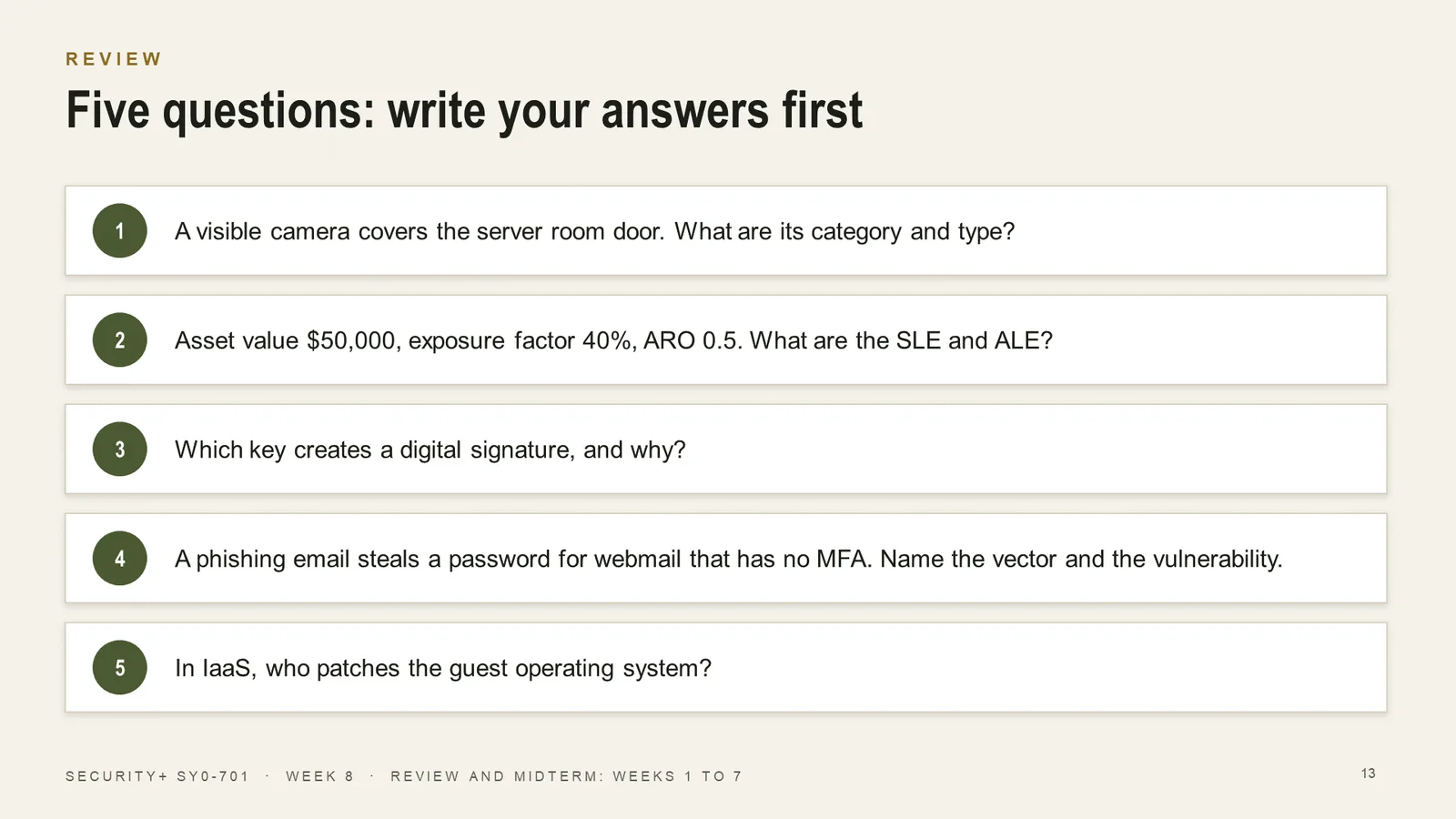
Write your answers to the five review questions first, then open each one to check it.
Physical category. Detective, because it records events, and deterrent, because a visible camera discourages attempts.
SLE = $50,000 x 0.40 = $20,000. ALE = $20,000 x 0.5 = $10,000 a year.
The sender's private key. Only the sender holds it, so anyone with the sender's public key can verify the signature, which gives integrity, authentication, and non-repudiation.
The vector is message-based (email phishing). The vulnerability is the missing MFA on webmail, a weak authentication configuration that lets a stolen password work alone.
The customer. In IaaS the provider secures the physical hosts, network, and hypervisor; the customer is responsible for the operating system, applications, and data.
60 min
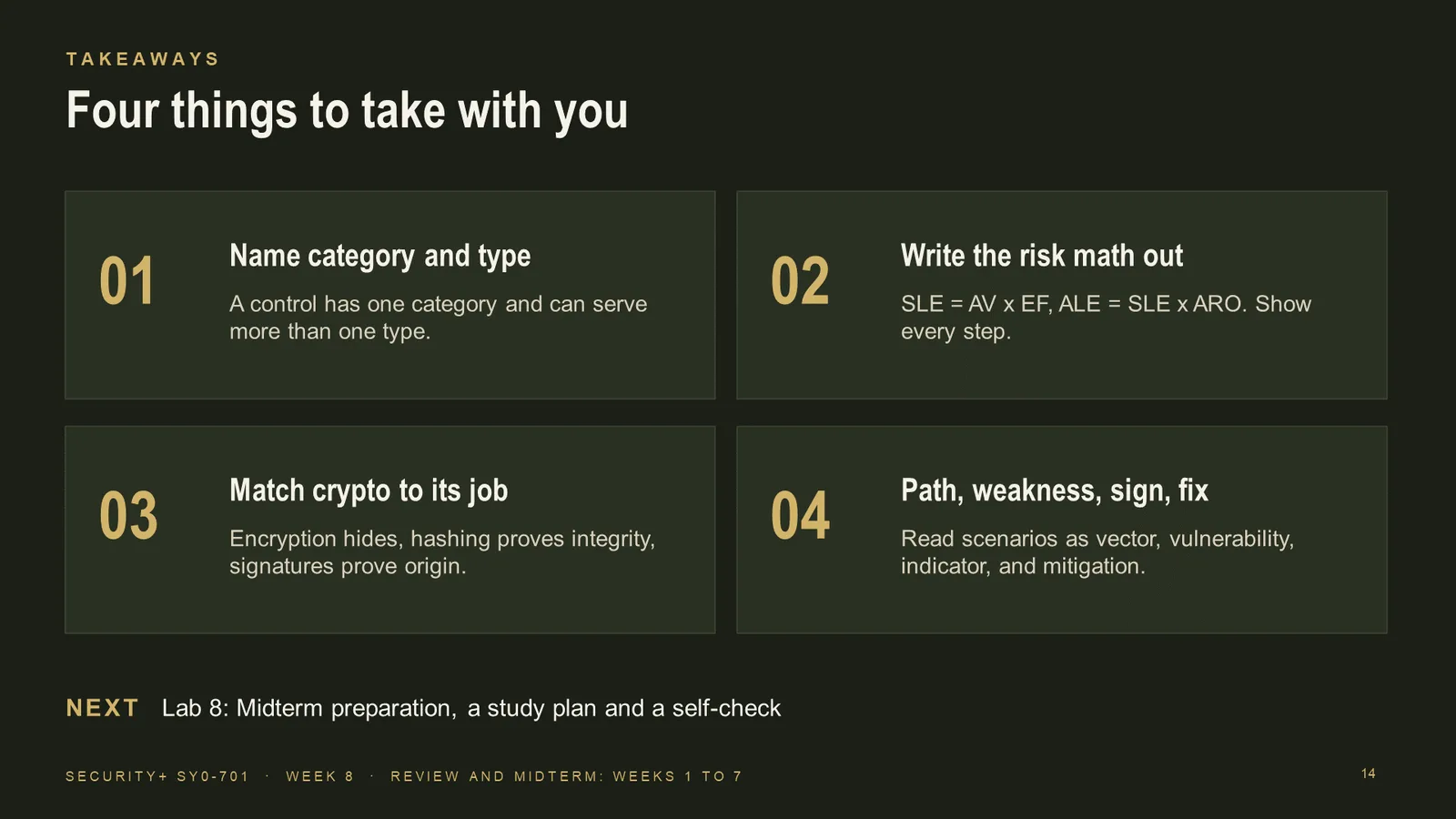
01 Name category and type
A control has one category and can serve more than one type.
02 Write the risk math out
SLE = AV x EF, ALE = SLE x ARO. Show every step.
03 Match crypto to its job
Encryption hides, hashing proves integrity, signatures prove origin.
04 Path, weakness, sign, fix
Read scenarios as vector, vulnerability, indicator, and mitigation.
You need your scored practice midterm, your notes from weeks 1 to 7, and a copy of the CompTIA SY0-701 exam objectives. No lab VMs are needed this week.
Lab steps · 0 of 8 complete (0%)
Your miss table, the color-coded objectives checklist, the definitions for red and yellow items, the worked risk math, and the study calendar, as one document.