
Loading
Warhawk Division is a gaming community. This is a unit document, not a government or military publication.Warhawk Division is an independent gaming community, for entertainment purposes only. It is not affiliated with, sponsored by, or endorsed by Bohemia Interactive, the United States Department of Defense, or any military organization. Arma Reforger is a trademark of its respective owner. Printed from warhawkdivision.com.
Week 7 content
0 of 14 done
Slide 1 of 14
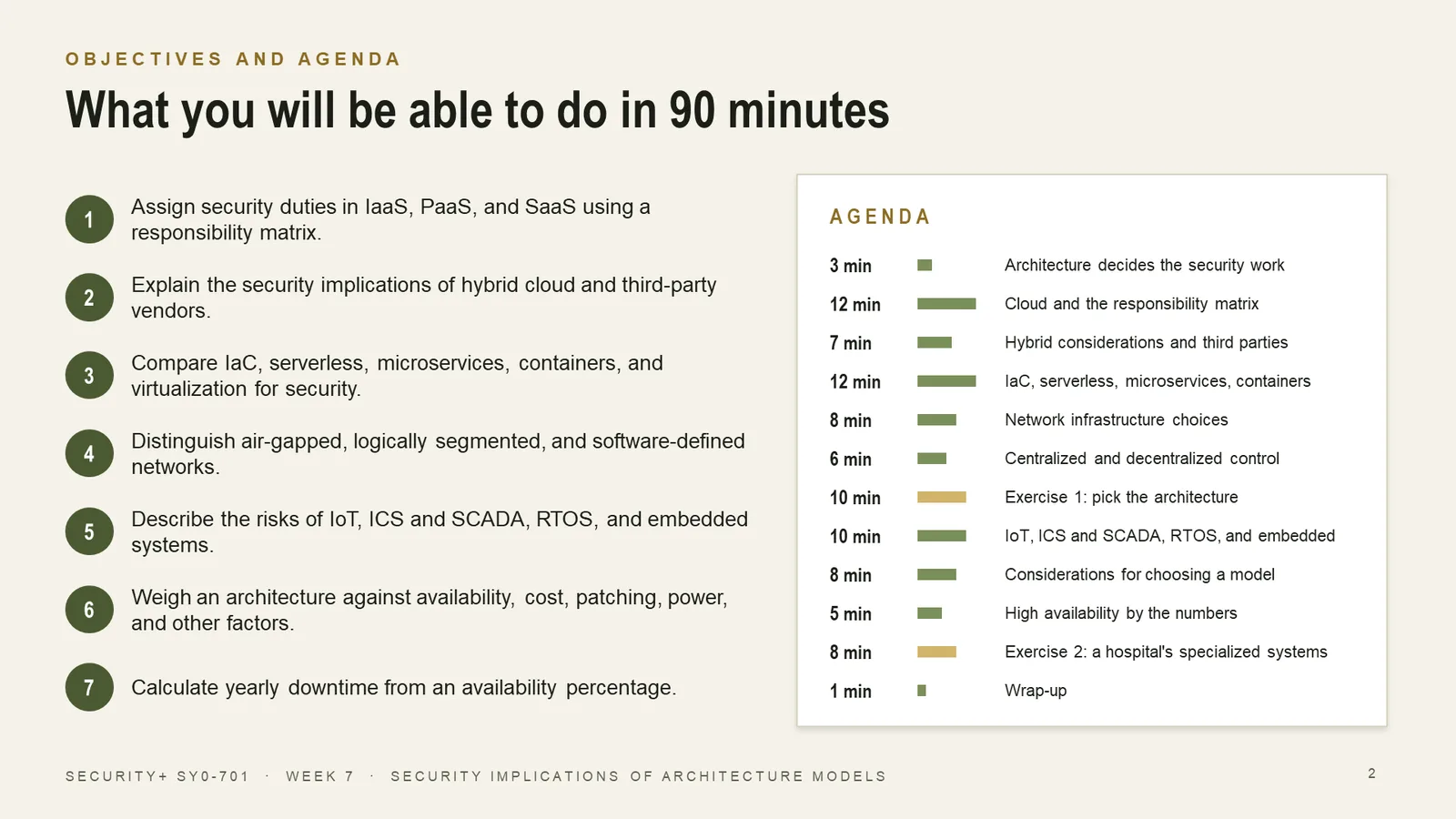
Exam objectives: 3.1 Compare and contrast security implications of different architecture models.
3 min
Weeks 4 to 6 covered threats, vulnerabilities, and attacks. Domain 3 asks a different question: how should we build systems so those attacks do less harm?
An architecture model is the overall way a system is built and run: on premises or in the cloud, on virtual machines or containers, as one large application or many small services. Each model changes three things that matter to security:
Objective 3.1 asks you to compare and contrast these models, so the exam will usually describe a need and ask which model fits, or describe a model and ask about its security implication. As you read, keep one question in mind for each model: if something goes wrong here, whose job is it to fix it?
12 min
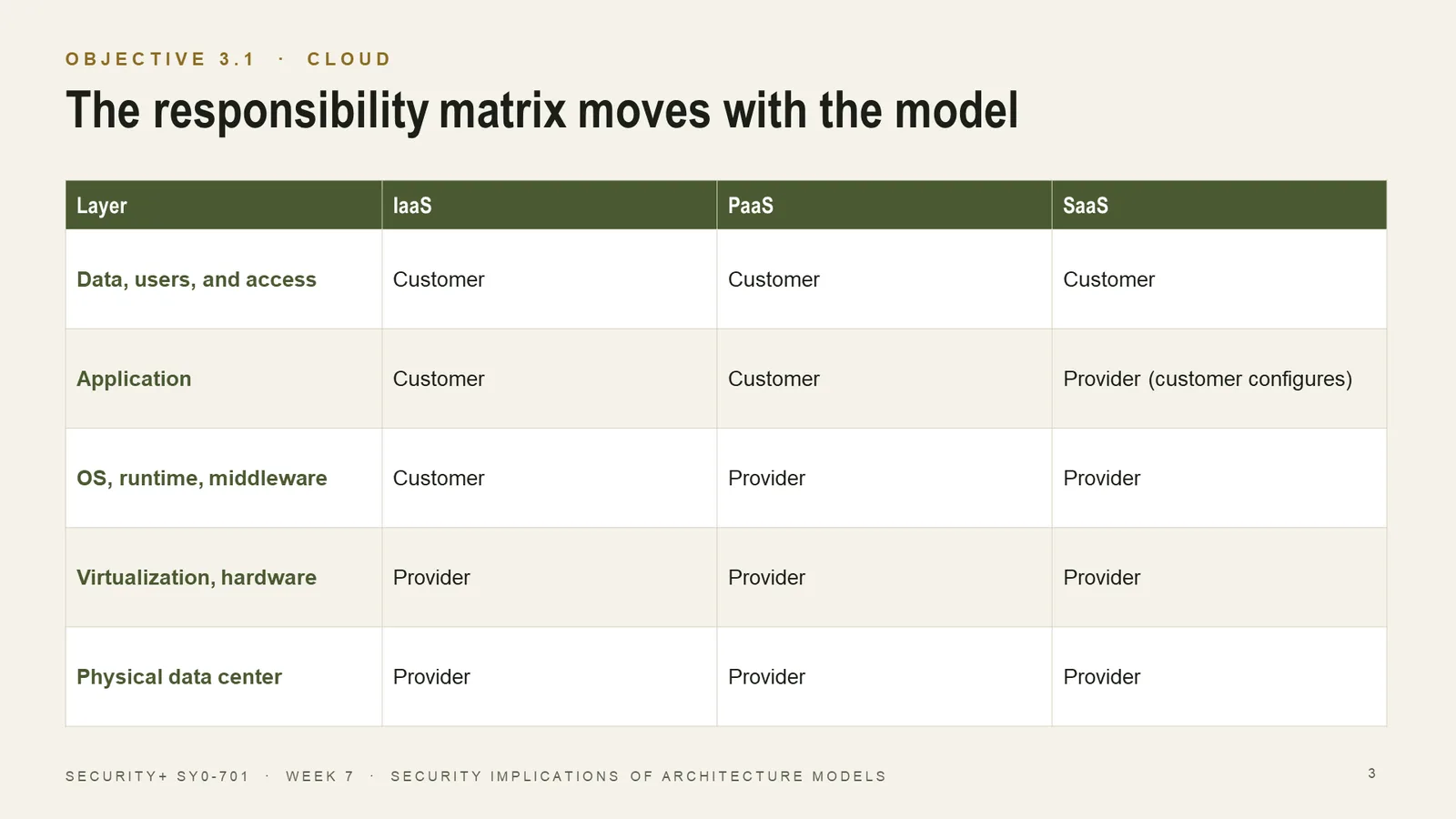
Cloud services come in three main models.
The responsibility matrix, often called the shared responsibility model, shows who secures each layer. The provider always owns physical security of the data center and the hardware. The customer always owns its data, its user accounts and access decisions, and the configuration it chooses. In between, the line moves up as you go from IaaS to SaaS.
Example: a dental practice moves its scheduling to a SaaS product. The provider patches the servers and the application. The practice still decides who gets an account, whether MFA is on, who can export patient lists, and what happens to an account when someone quits.
Providers publish their own matrices, and the details differ by provider and service. Read the one for each service you buy rather than assuming.
Watch out
The exam trap: moving to the cloud never transfers responsibility for data and access. If a SaaS account without MFA is taken over, that is the customer's failure, not the provider's.
Tip
"Shared" cells are where breaches happen. Network controls in IaaS, for example, are split: the provider supplies security groups, and the customer must configure them correctly.
7 min
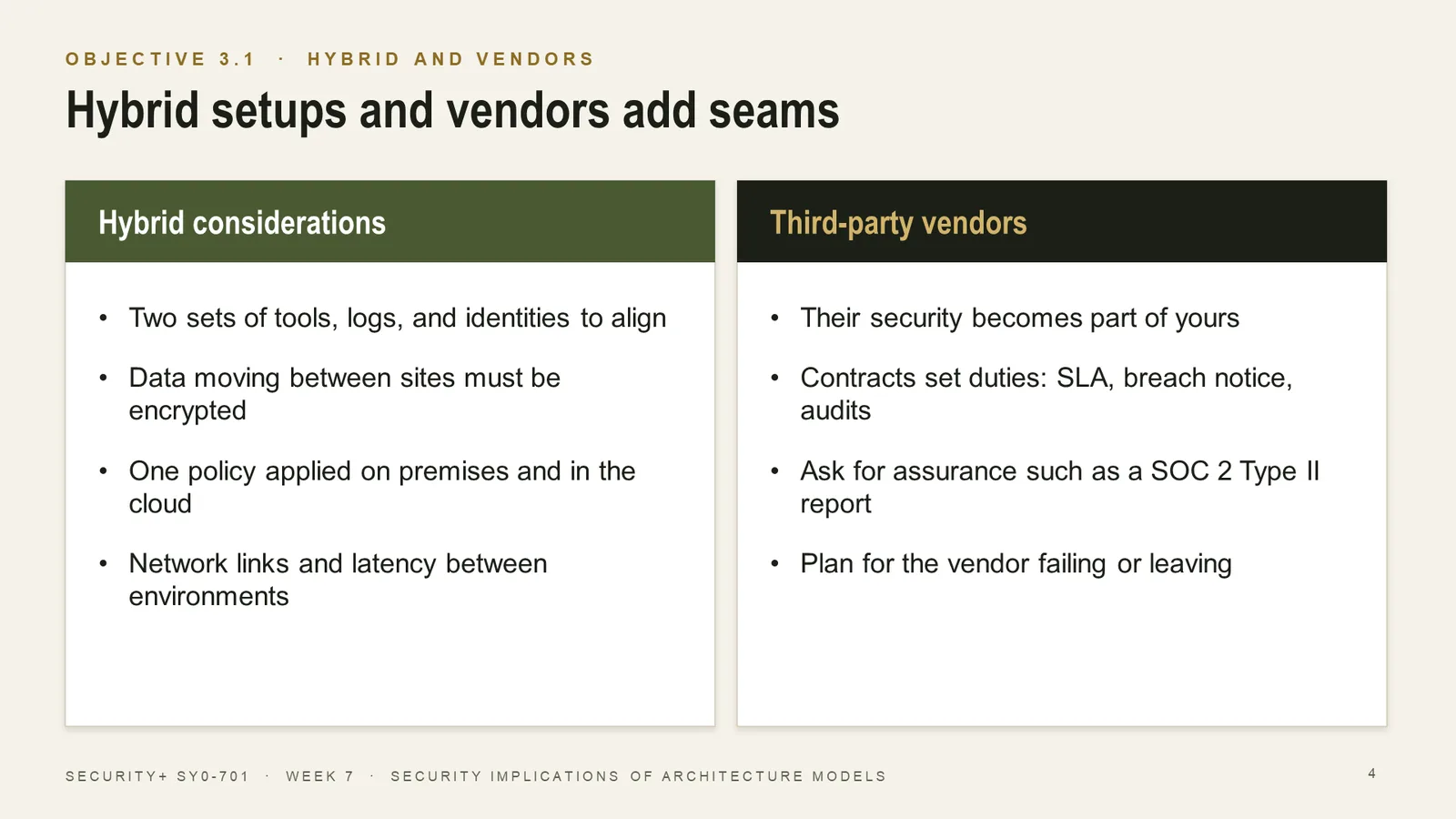
A hybrid environment combines on-premises systems, or a private cloud, with one or more public clouds. Most organizations end up hybrid, and the security challenge is consistency across the seam.
Third-party vendors include the cloud provider itself, plus MSPs, software vendors, and anyone else who runs part of your environment. Their weaknesses become yours, as you saw with supply chain vulnerabilities in week 5. Manage that in writing:
12 min
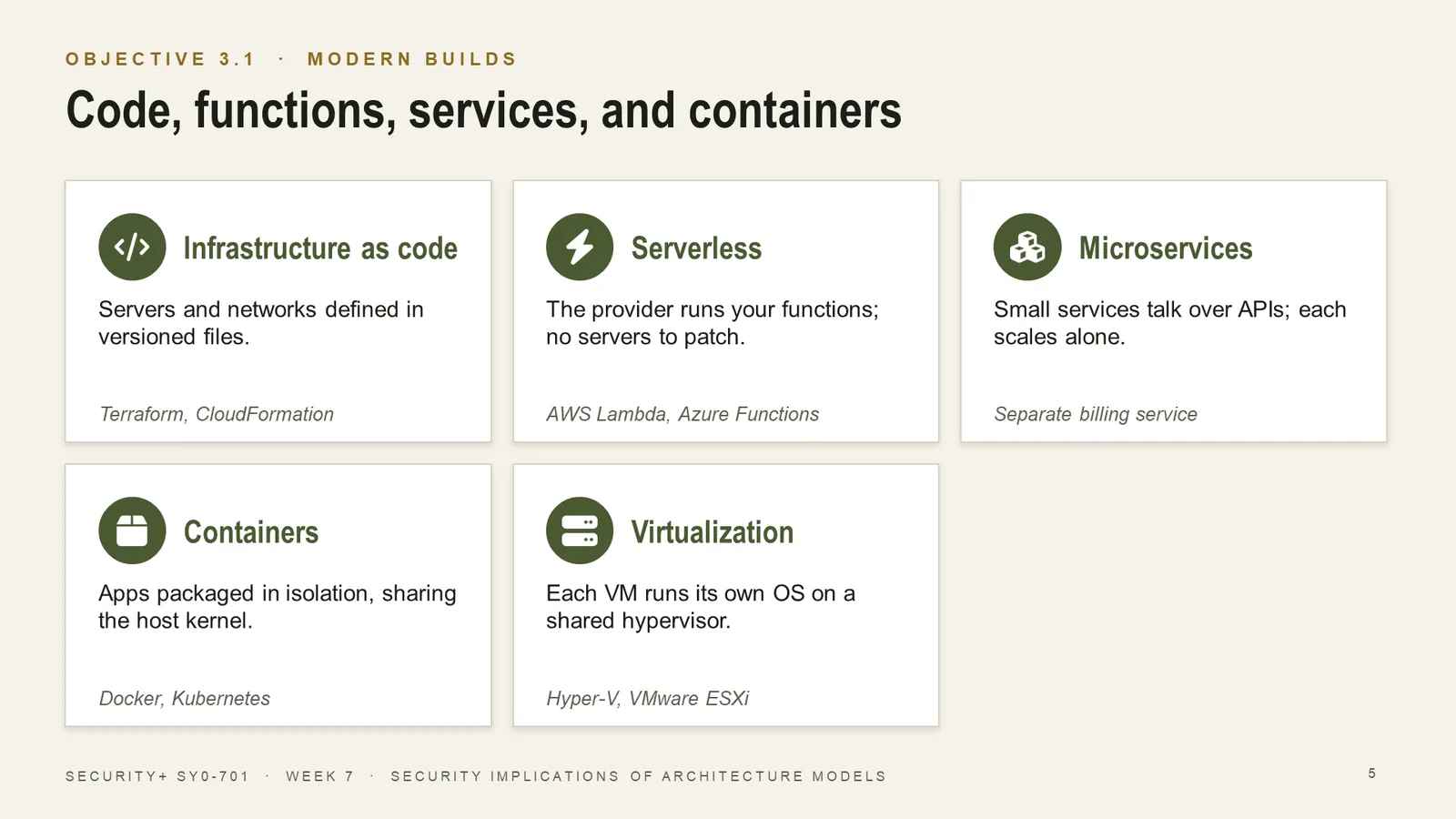
Infrastructure as code (IaC) defines servers, networks, and settings in files that tools such as Terraform or AWS CloudFormation turn into real infrastructure. Security benefits: every build is identical, changes go through version control and review, and drift from the defined state can be detected. Risks: one bad template deploys the same mistake everywhere, and secrets such as keys are often committed into the files. Scan templates before they run, and keep secrets in a vault.
Serverless computing runs your functions on demand; the provider manages the servers, OS, and scaling. You have no servers to patch, but you still own the code, the function's permissions, and its inputs. The common failures are overprivileged function roles and untrusted event data treated as safe. Visibility is also limited, since you cannot install your own agents.
Microservices split one application into small services that talk over APIs and can be deployed and scaled separately. A failure or breach in one service can be contained, but the number of APIs grows, and each needs authentication, authorization, and logging. Service-to-service traffic should be authenticated too, often with mutual TLS, and an API gateway gives one place to enforce rules.
Containerization packages an application with its libraries into an image that runs the same anywhere, using tools such as Docker and Kubernetes. Containers share the host's kernel, so they are lighter than VMs but less isolated: a kernel flaw affects every container on the host. Scan images for vulnerabilities, use minimal trusted base images, and do not run containers as root.
Virtualization runs full VMs, each with its own OS, on a hypervisor. A Type 1 (bare-metal) hypervisor runs directly on hardware; a Type 2 runs on a host OS. VMs isolate more strongly than containers, but watch for VM sprawl, forgotten VMs nobody patches, and VM escape from week 5.
8 min
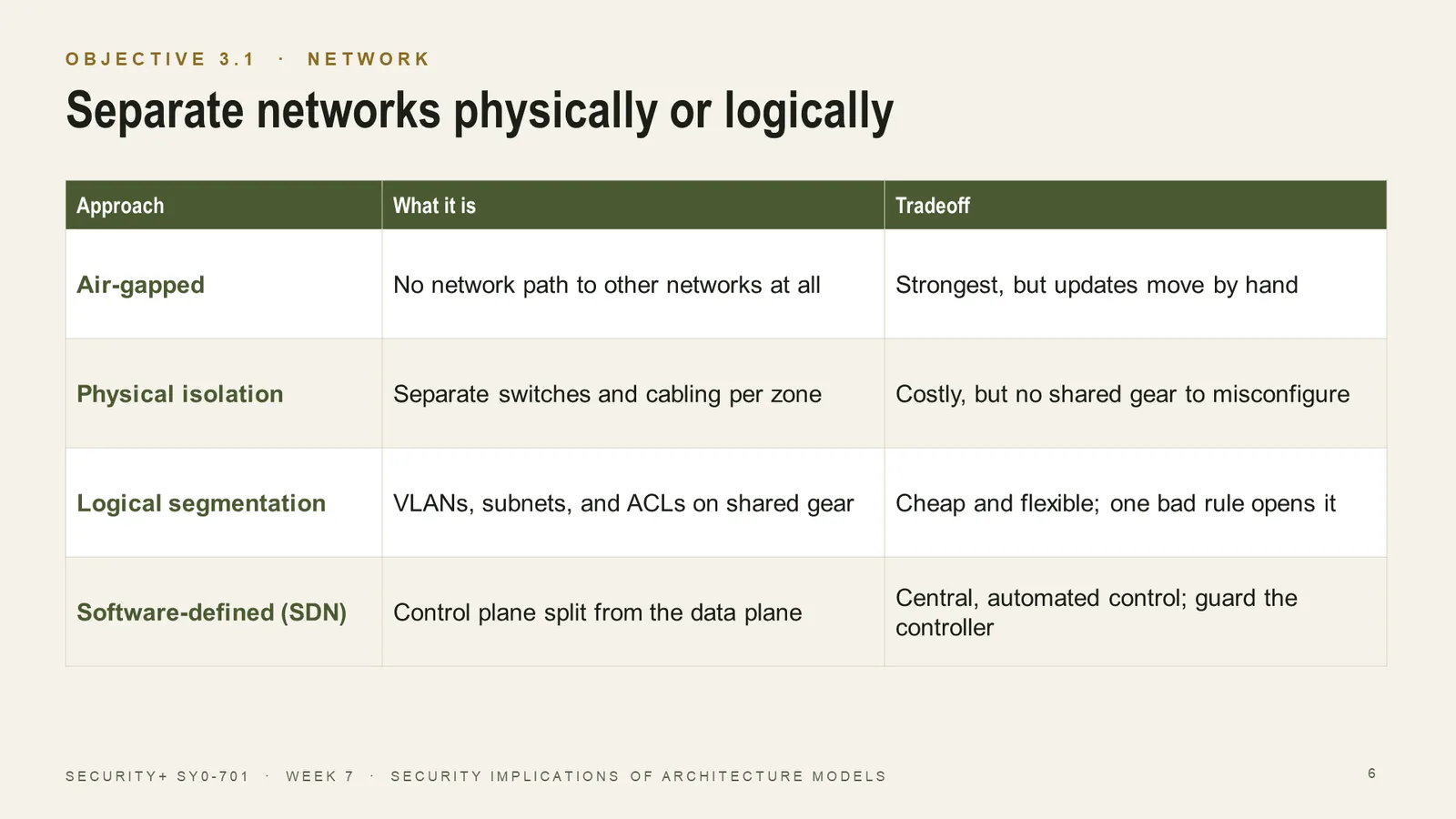
How you separate networks is one of the biggest architecture decisions.
On-premises architecture means you own and run the hardware in your own facilities. You control everything, which also means you are responsible for everything, from the locks on the server room to the backup power.
Tip
If a question says a system has no connection to any other network, the answer is air-gapped. If it says VLANs or ACLs, it is logical segmentation.
6 min
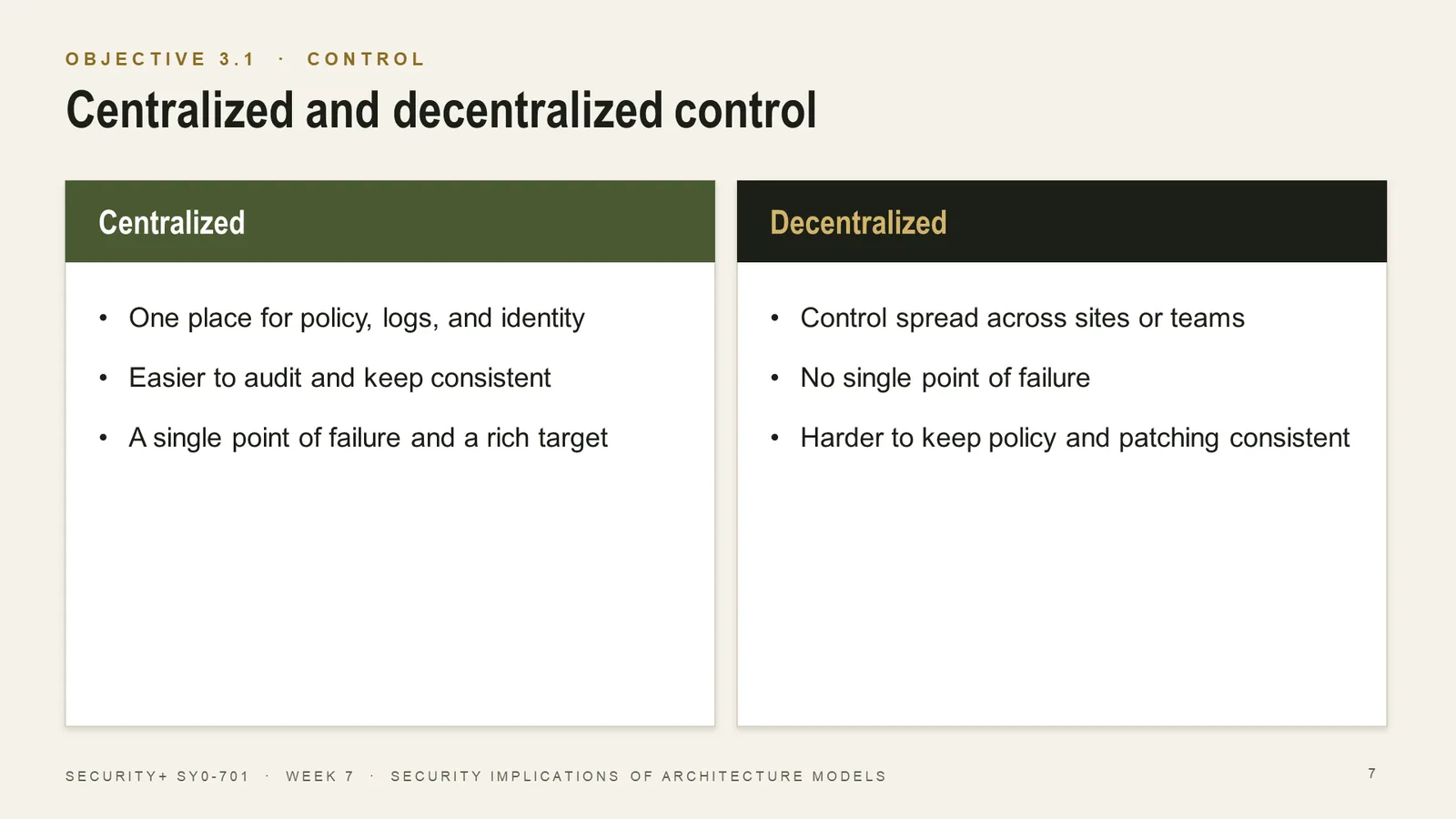
A centralized architecture runs policy, identity, logging, and management from one place. A single identity provider, one SIEM, and one firewall management console are centralized designs.
A decentralized architecture spreads control across sites, business units, or nodes. A school district where each school runs its own servers, or a blockchain, are decentralized.
Many organizations mix the two: central identity and logging, with local operation. The security goal is to centralize what must be consistent, such as identity, policy, and monitoring, and to build in redundancy so the central pieces are not single points of failure.
Tip
On the exam, "single point of failure" points to centralized; "harder to manage consistently" points to decentralized.
10 min
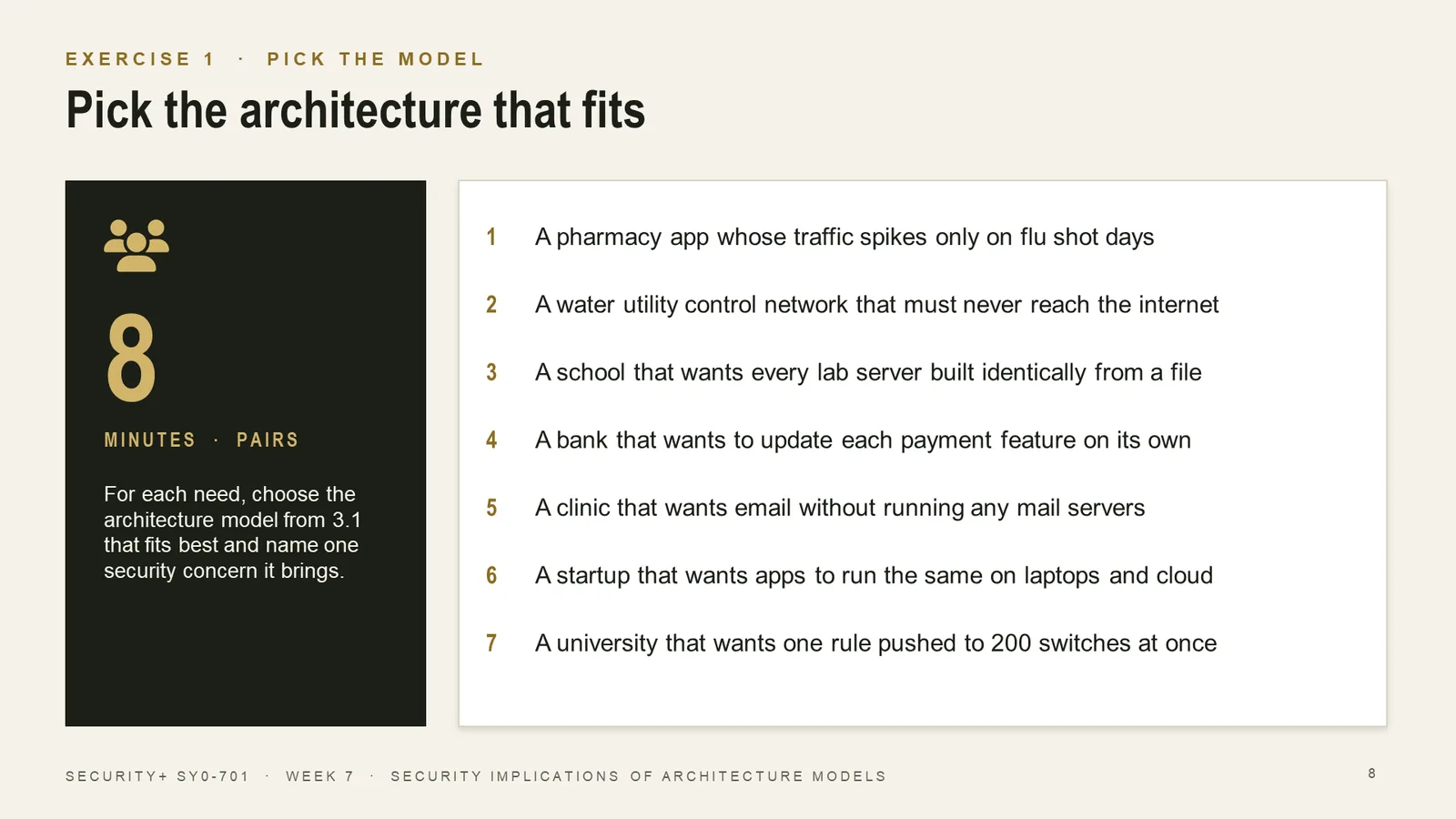
With a partner, take eight minutes. For each need, choose the architecture model from objective 3.1 that fits best, and name one security concern it brings. More than one answer can be defended; your reasoning matters.
10 min
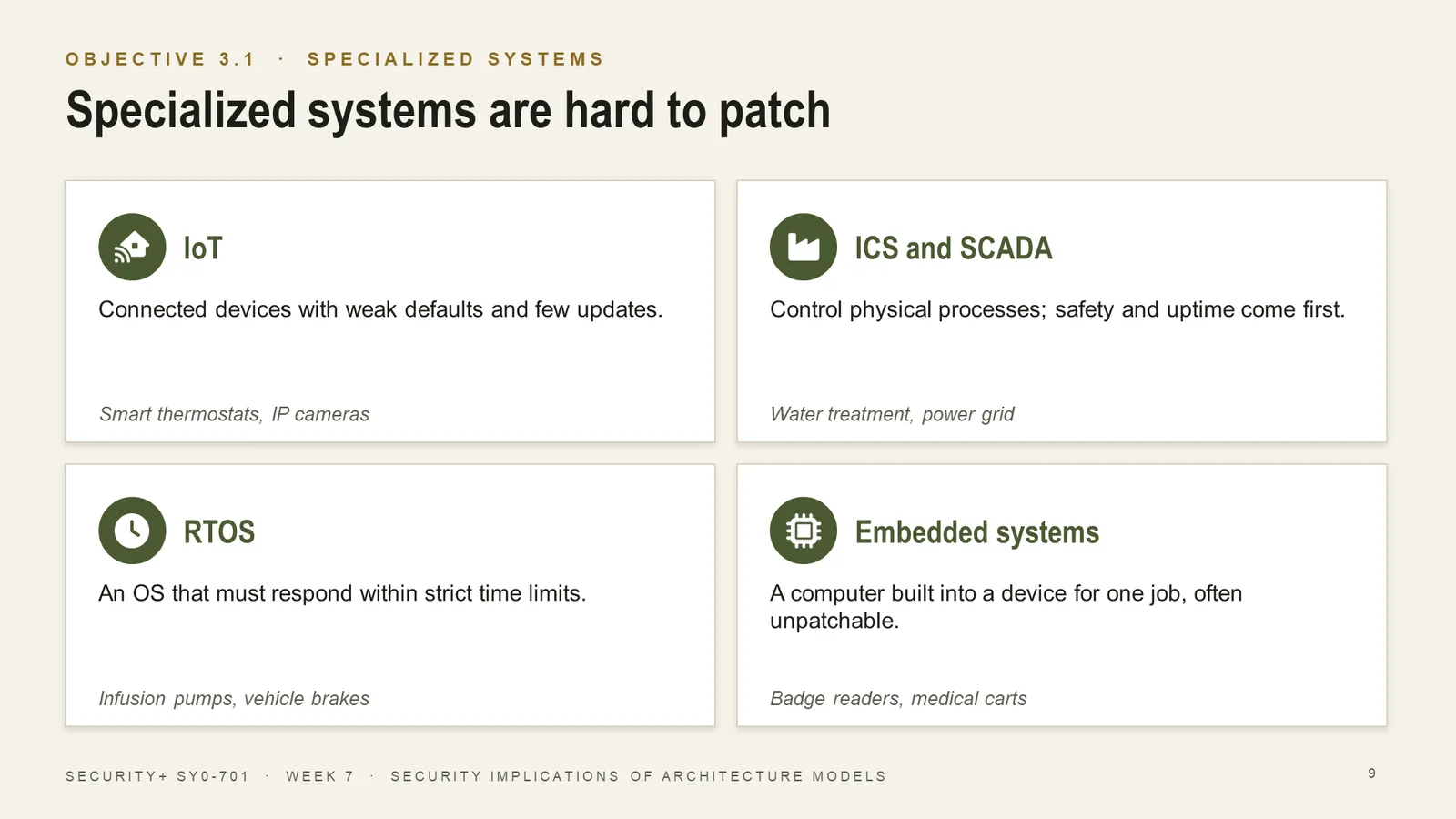
Specialized systems control things in the physical world. They are hard to secure for the same few reasons: they last for decades, they have little power or processing headroom, and their vendors control the software.
Because patching is slow or impossible, protection is mostly compensating controls: put these devices on isolated segments, allow only the traffic they need, change default credentials, monitor their network behavior, and buy from vendors who commit to updates.
Watch out
For ICS and SCADA, the usual CIA order flips: availability and safety outrank confidentiality.
8 min
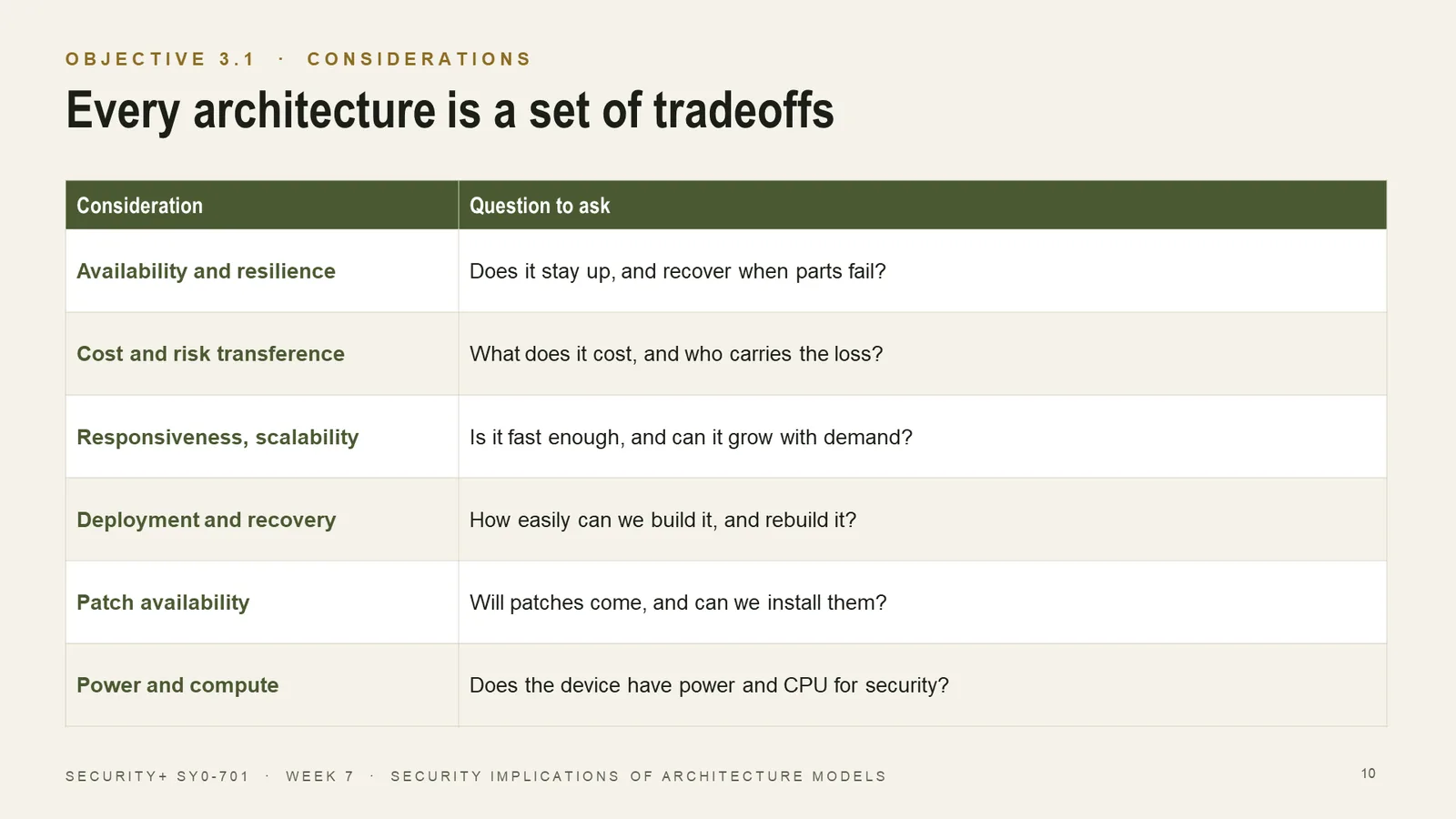
Objective 3.1 lists the considerations used to compare architectures. Learn each as a question.
No model wins on all twelve. The job is to pick the one whose weaknesses you can live with, and add controls for the rest.
5 min
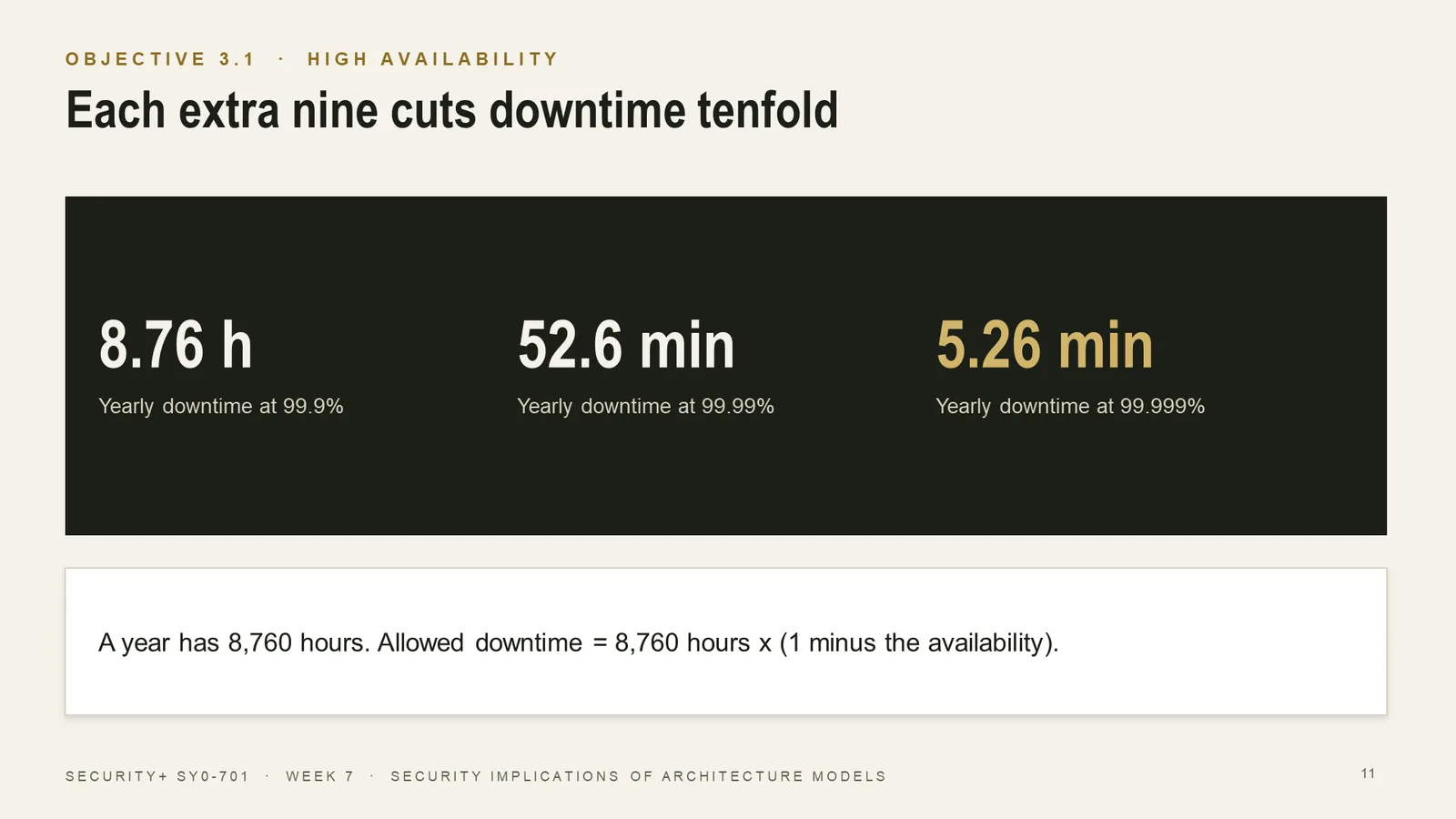
High availability (HA) means designing a system to keep running despite failures, with little or no downtime. It is achieved through redundancy: more than one server, power supply, network path, or site, so no single failure stops the service.
Availability is usually stated as a percentage, often in "nines." A year has 8,760 hours.
| Availability | Allowed downtime per year |
|---|---|
| 99.9% (three nines) | 8,760 x 0.001 = 8.76 hours |
| 99.99% (four nines) | 8,760 x 0.0001 = 0.876 hours, about 52.6 minutes |
| 99.999% (five nines) | about 5.26 minutes |
Each extra nine costs more, because it needs more redundant equipment, sites, and staff. A clinic's scheduling system may be fine at three nines; an emergency department's systems need more.
Tip
Read a provider's SLA carefully: the remedy for missing the target is usually a service credit, not compensation for your losses. That is limited risk transference.
8 min
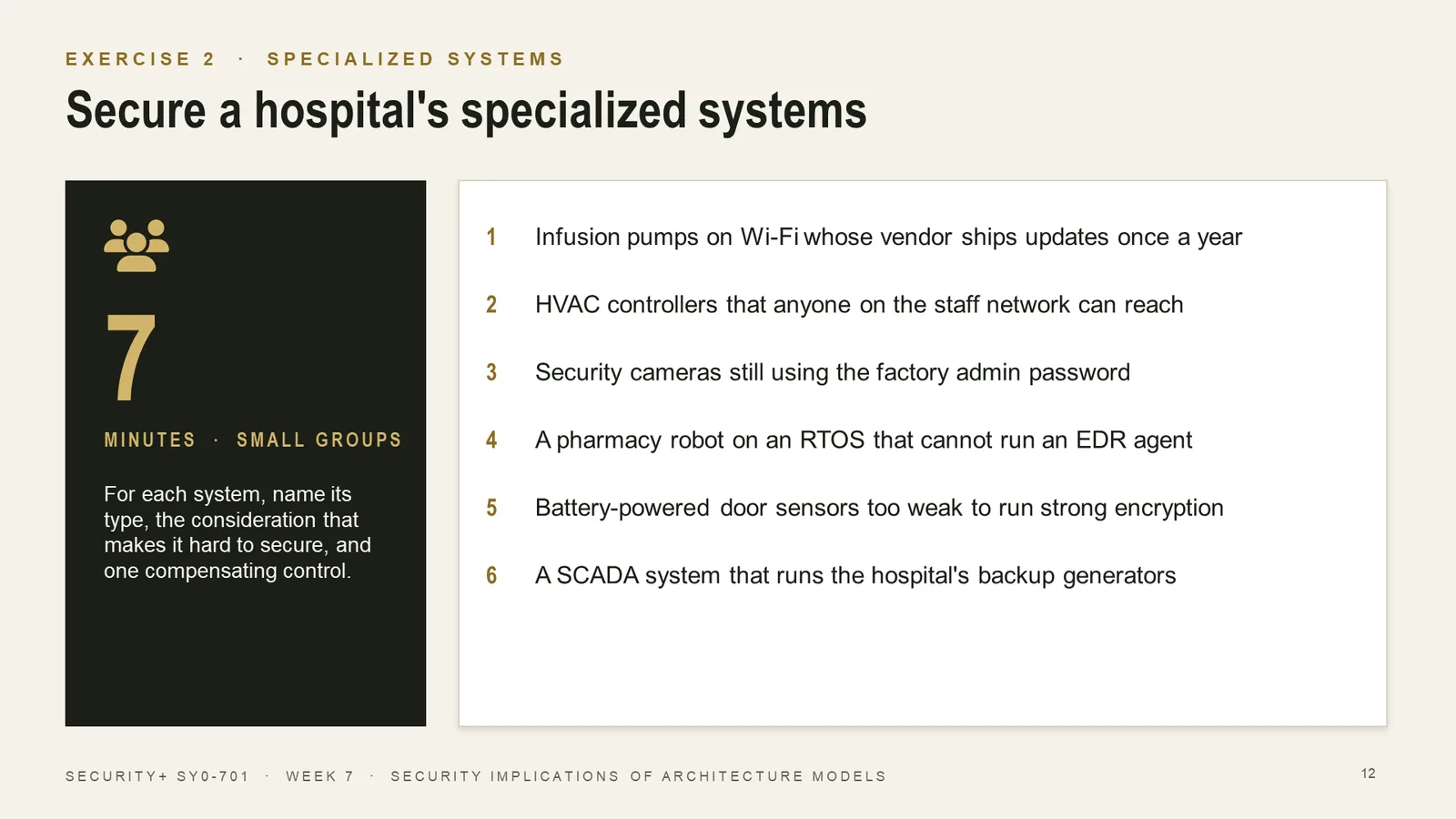
A regional hospital has asked you to review systems its IT team cannot manage like ordinary PCs. In groups, take each system and name its type, the consideration from objective 3.1 that makes it hard to secure, and one compensating control.
Notice the pattern: when you cannot fix the device, you control the network around it.
1 min
Architecture decides who does the security work and where attacks can land.
Answer the five review questions, then take the quiz.
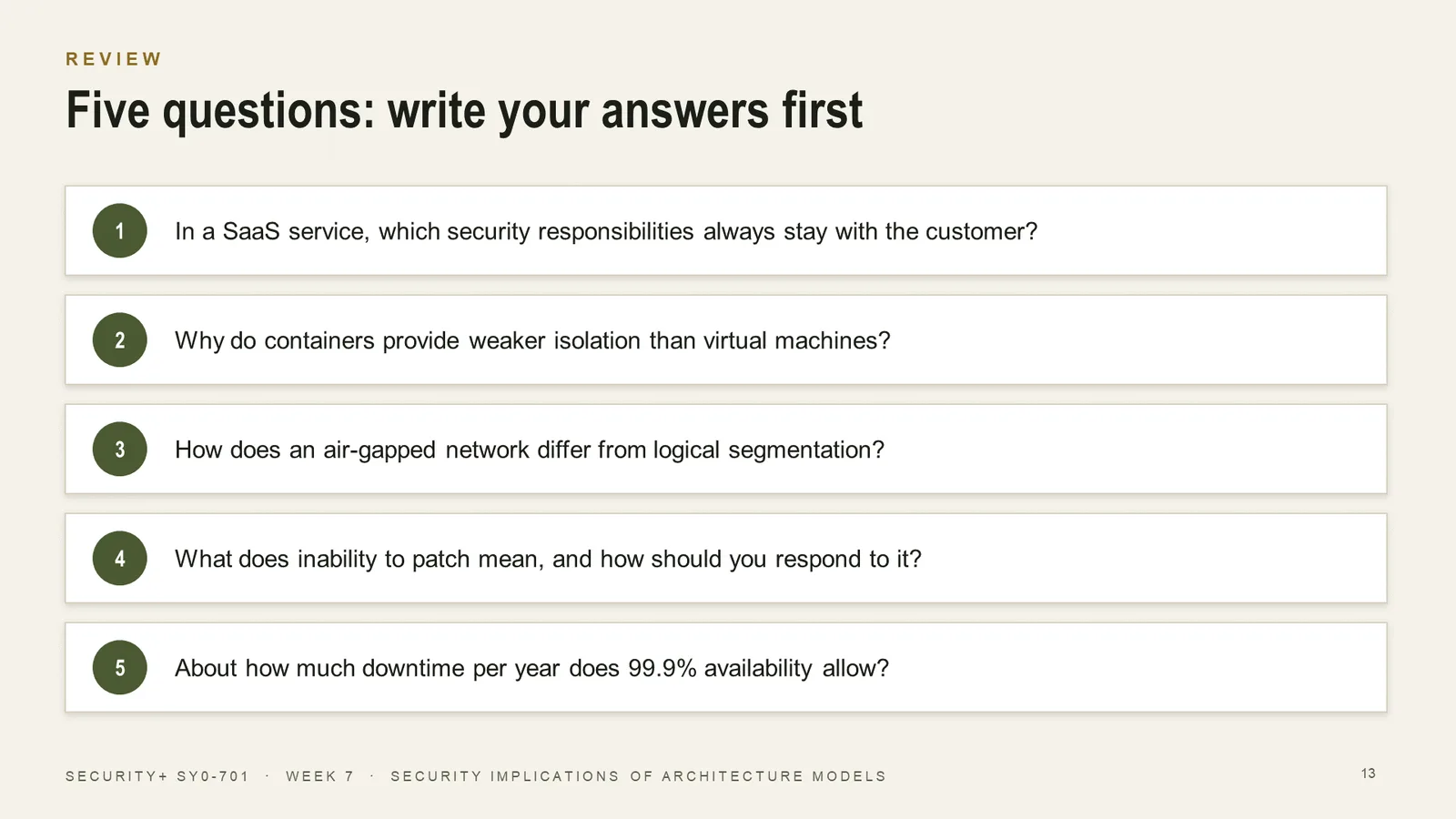
Write your answers to the five review questions first, then open each one to check it.
Its data, user accounts, access decisions, and the configuration it chooses, such as enabling MFA and setting sharing rules.
Containers share the host's operating system kernel, so a kernel flaw or container escape can affect every container on the host. Each VM runs its own OS on a hypervisor.
An air-gapped network has no network connection to any other network. Logical segmentation separates traffic on shared hardware with VLANs, subnets, and ACLs.
A system that cannot take patches, such as an embedded medical device or a legacy controller. Respond with compensating controls: isolation, restricted access, monitoring, and a replacement plan.
About 8.76 hours: 8,760 hours in a year x 0.001.
60 min
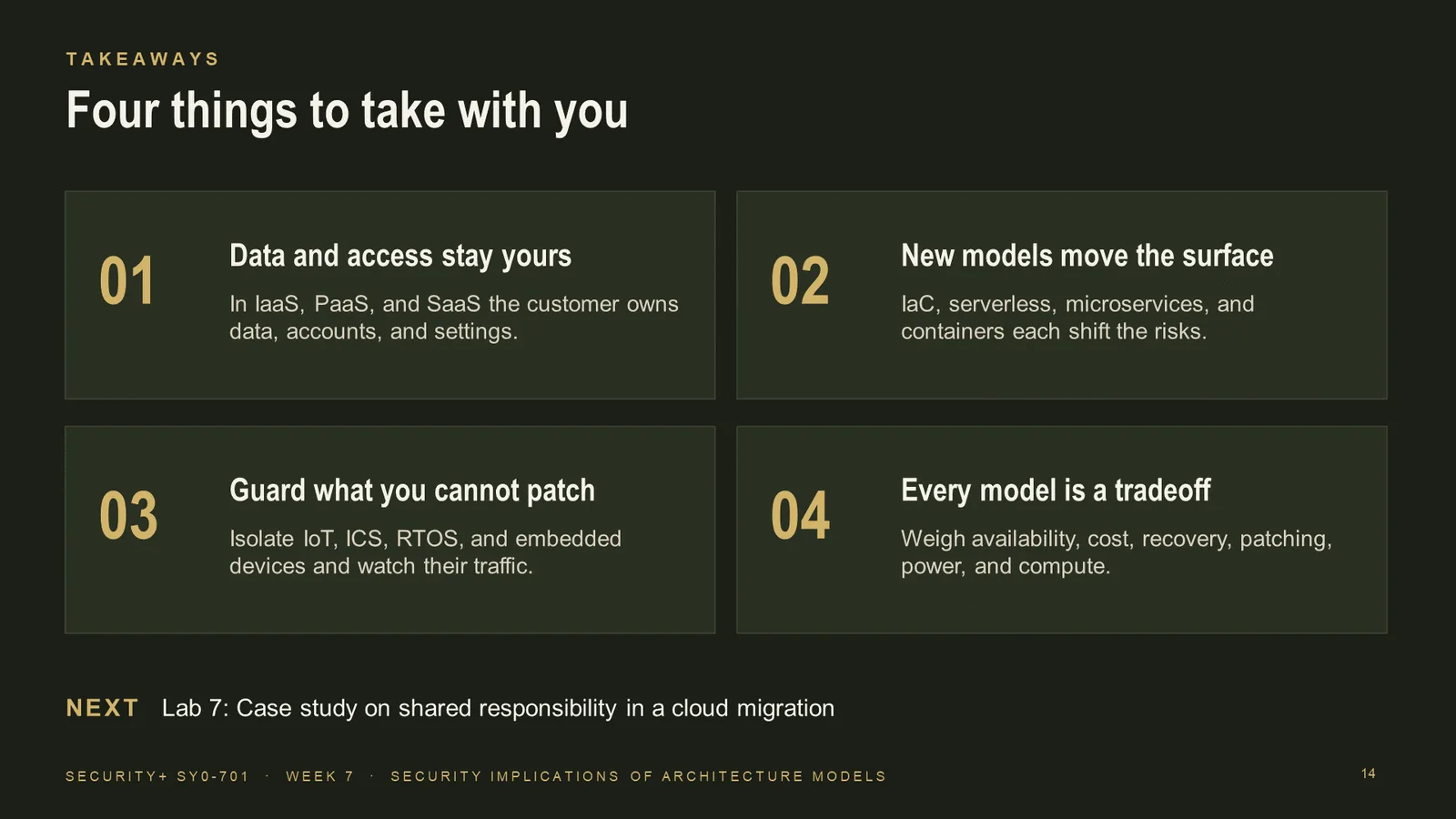
01 Data and access stay yours
In IaaS, PaaS, and SaaS the customer owns data, accounts, and settings.
02 New models move the surface
IaC, serverless, microservices, and containers each shift the risks.
03 Guard what you cannot patch
Isolate IoT, ICS, RTOS, and embedded devices and watch their traffic.
04 Every model is a tradeoff
Weigh availability, cost, recovery, patching, power, and compute.
This is a written exercise; no tools or network access are needed. Work alone or in pairs as your instructor directs, using the responsibility matrix and considerations from this week's lesson.
Lab steps · 0 of 8 complete (0%)
One document with your responsibility matrix, gap list, vendor requirements, hybrid notes, considerations rating, and the one-page memo. Keep it: it informs the control recommendations in project milestone 2.