
Loading
Warhawk Division is a gaming community. This is a unit document, not a government or military publication.Warhawk Division is an independent gaming community, for entertainment purposes only. It is not affiliated with, sponsored by, or endorsed by Bohemia Interactive, the United States Department of Defense, or any military organization. Arma Reforger is a trademark of its respective owner. Printed from warhawkdivision.com.
Week 13 content
0 of 13 done
Slide 1 of 14
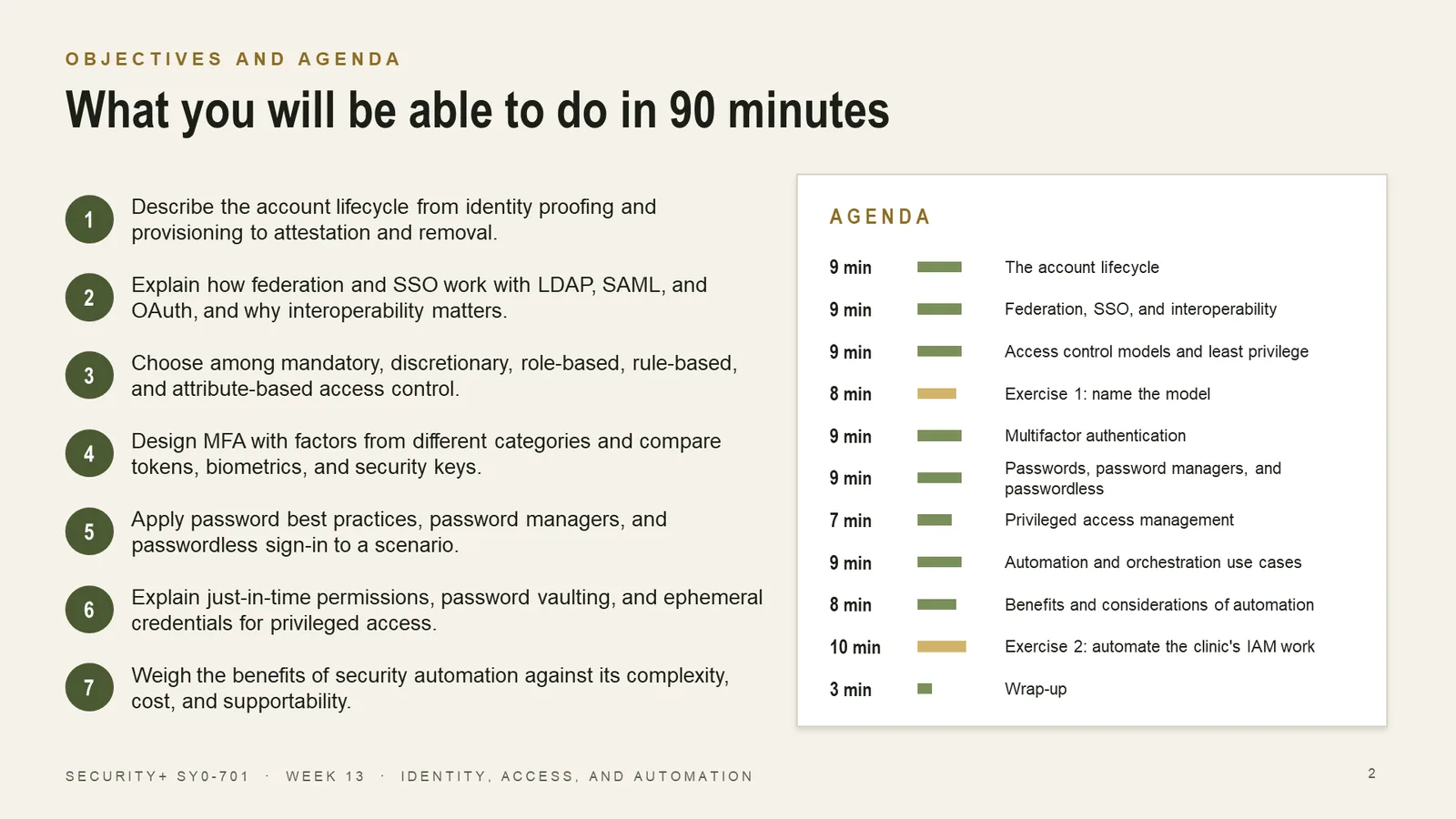
Exam objectives: 4.6 Given a scenario, implement and maintain identity and access management. 4.7 Explain the importance of automation and orchestration related to secure operations.
9 min
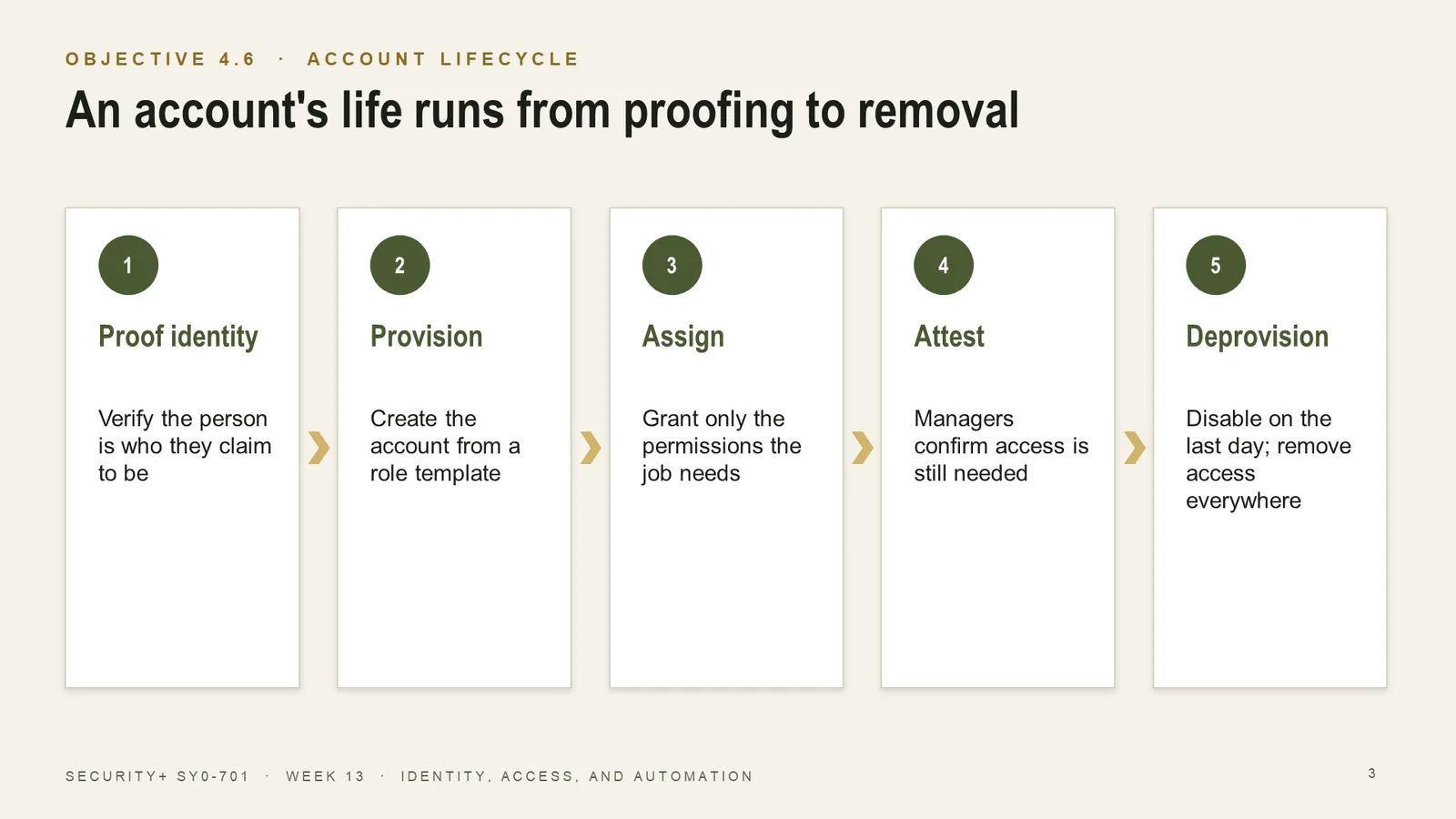
Identity and access management (IAM) is about giving the right people the right access for the right length of time. It follows each person through a lifecycle.
Watch out
Orphaned accounts, still active after the person left, are a favorite attacker target. Deprovisioning is the stage most often done late or partly.
9 min
Single sign-on (SSO) lets a user sign in once and reach many applications without signing in again. Users have fewer passwords to manage, and IT can turn off access everywhere by disabling one account. The risk is that one stolen login opens everything, so SSO must be paired with MFA.
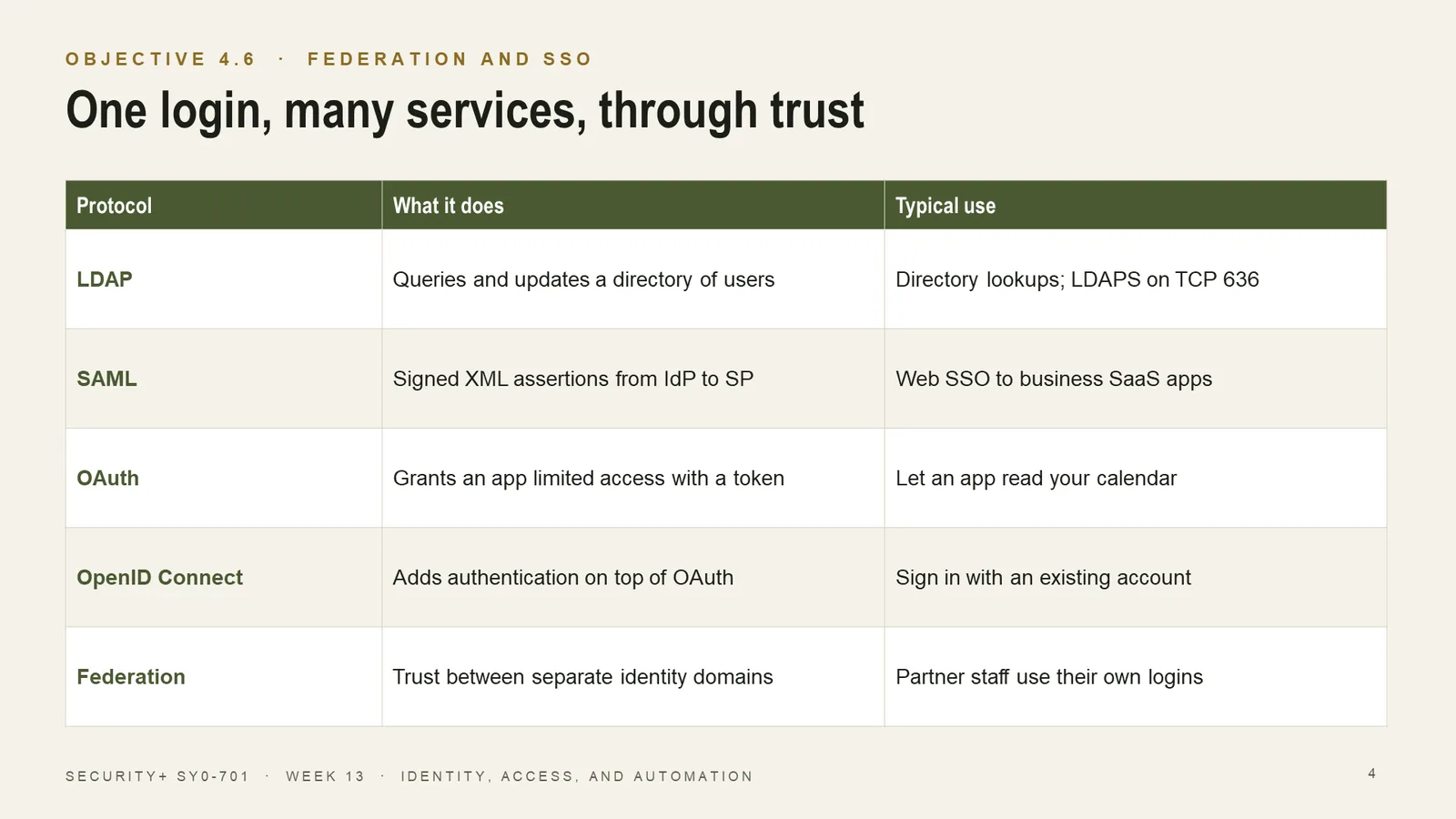
Federation extends SSO across organizations. An identity provider (IdP) authenticates the user, and a service provider (SP), such as a SaaS application, trusts the IdP's word. A partner's staff can use their own company login to reach your portal, and you never store their passwords.
The protocols:
Interoperability is why these are open standards: a clinic's Microsoft or Google identity can sign staff into a scheduling vendor's app because both speak SAML or OpenID Connect.
Tip
OAuth alone answers what an app may do, not who the user is. If the question is about delegated access to data, think OAuth. If it is about web SSO with XML assertions, think SAML.
9 min
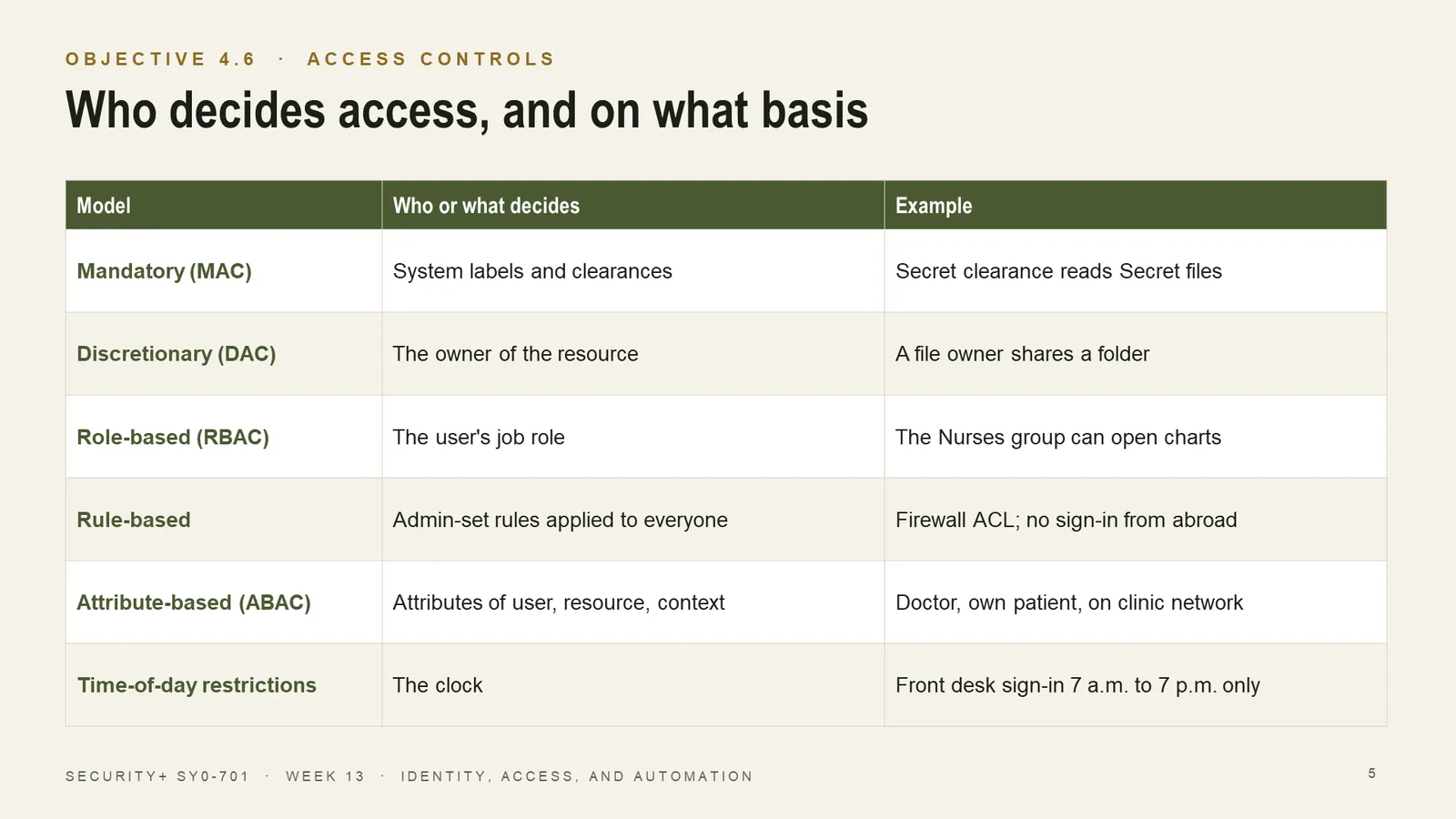
An access control model describes who or what decides whether a subject can use a resource.
Least privilege applies across every model: give each account only the access needed for its job, and only for as long as needed. It limits what a stolen account or a careless mistake can damage.
Tip
Listen for the decider. Labels and clearances: MAC. The owner: DAC. The job: RBAC. A rule for everyone: rule-based. Several attributes at once: ABAC.
8 min
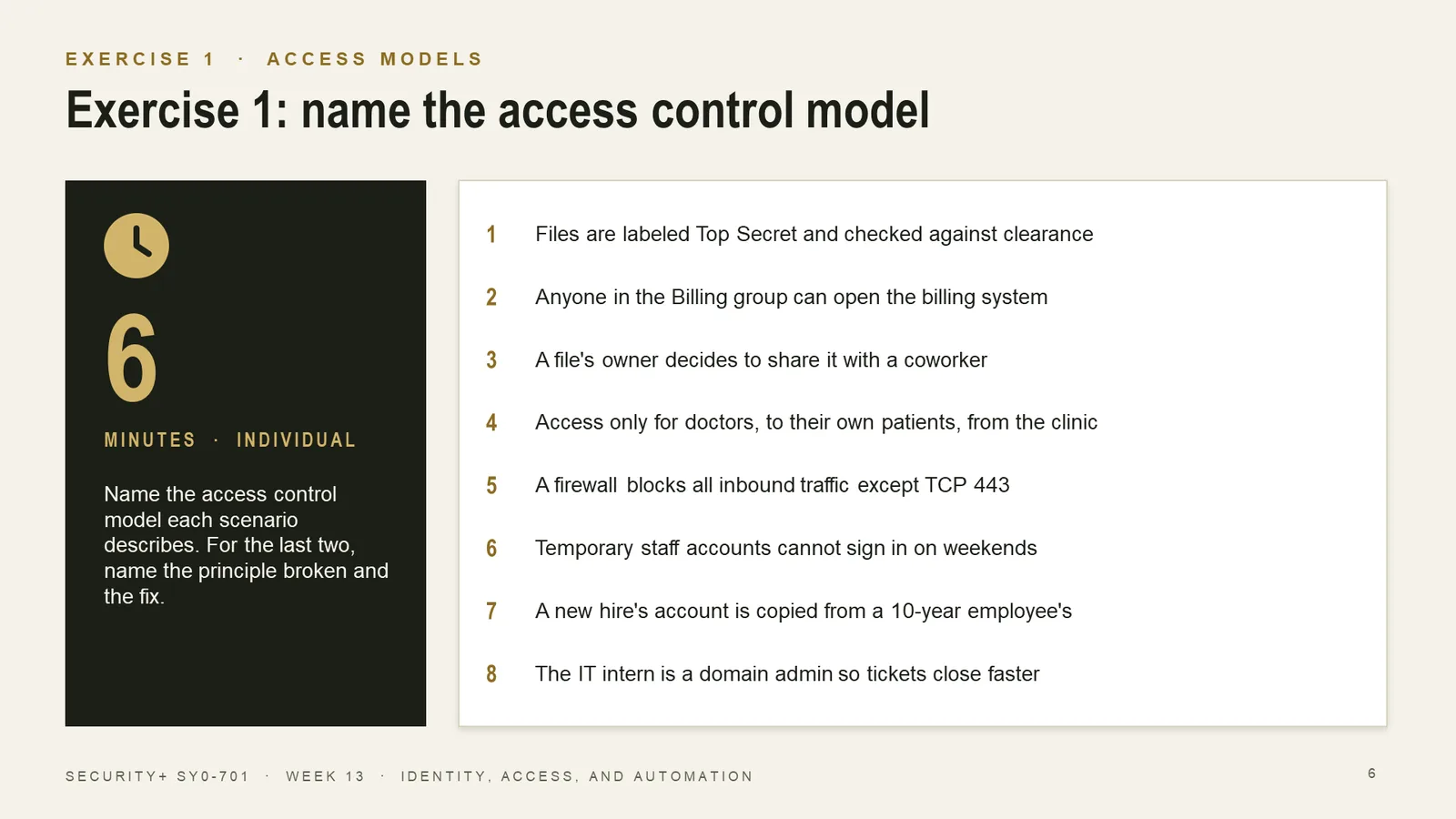
Work alone for six minutes. For items 1 to 6, name the access control model. Items 7 and 8 describe accounts at Lakeside Family Clinic; for those, name the principle that is broken and how you would fix it.
Write each answer with a one-line reason before you open the worked answers.
9 min
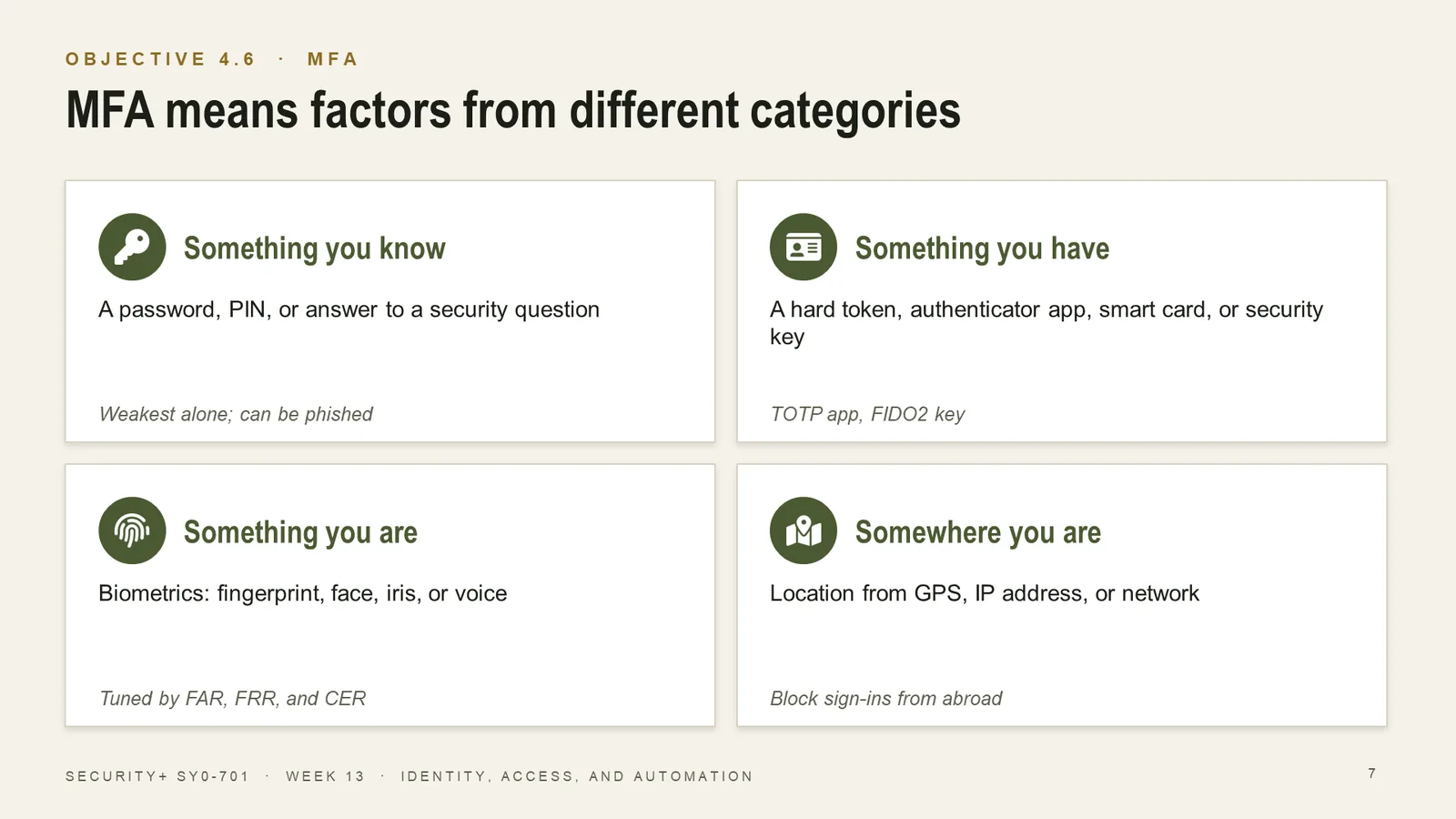
Multifactor authentication (MFA) requires factors from at least two different categories:
A password plus a security question is still single-factor: both are something you know.
MFA implementations:
Watch out
Push notifications can be abused by MFA fatigue, also called push bombing: the attacker sends prompts until a tired user taps approve. Number matching, where the user types a number shown on the login screen, reduces this.
9 min
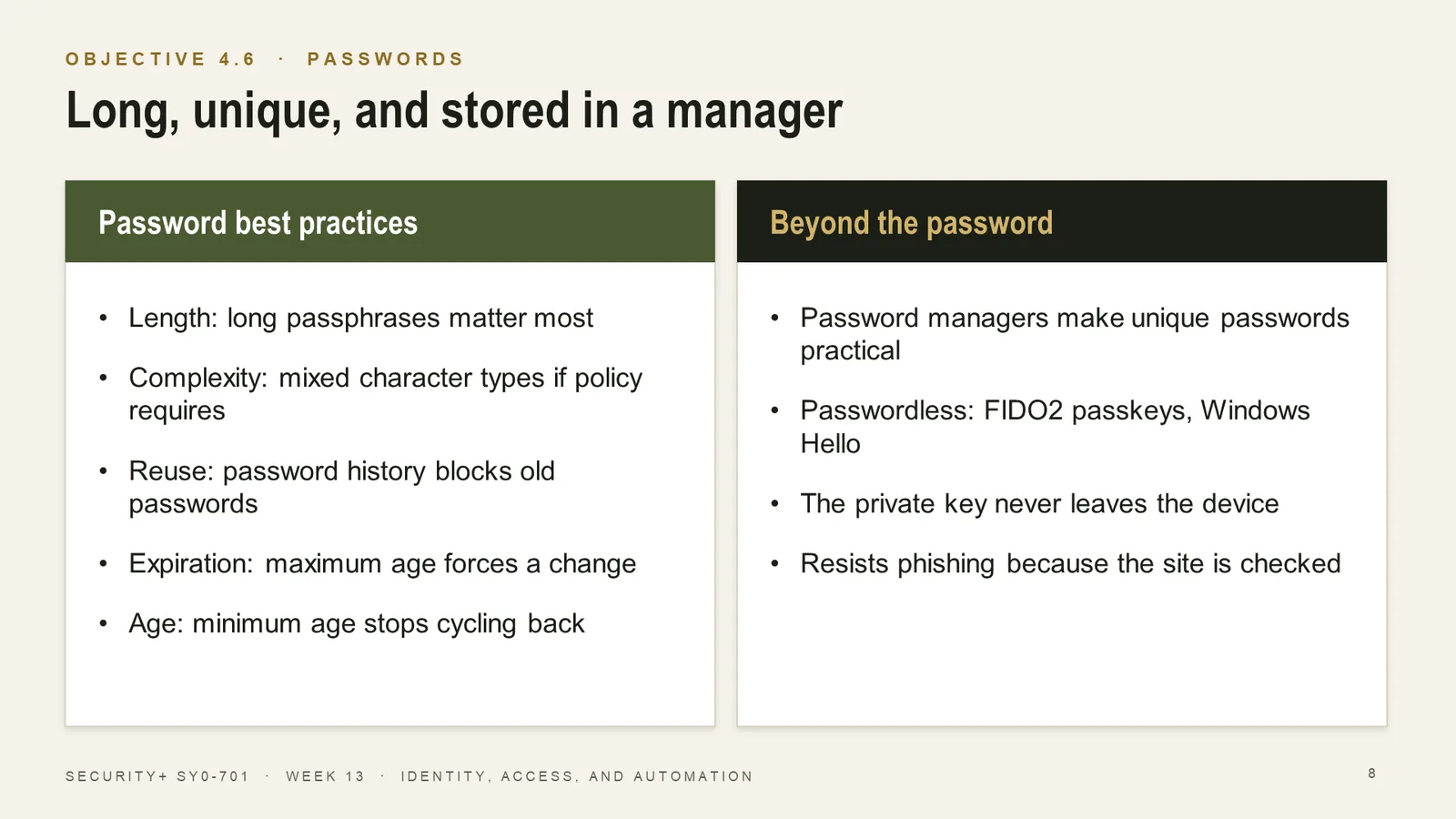
Security+ names five password best practices:
Watch out
Current NIST guidance in SP 800-63B favors long passwords, screening new passwords against lists of breached ones, and changing passwords when there is evidence of compromise rather than on a fixed schedule. Know both views: the exam may still ask what expiration and age settings do.
Password managers store a unique, random password for every site in an encrypted vault protected by one strong master password and MFA. They make the no-reuse rule practical and will not fill a password into a look-alike phishing site.
Passwordless authentication removes the shared secret. With FIDO2 passkeys or Windows Hello for Business, the device holds a private key, unlocked by a PIN or biometric, and the server holds only the public key. Nothing reusable crosses the network or sits in a server database to be stolen, and the key is bound to the real site, so it resists phishing. The PIN that unlocks it stays on the device.
7 min
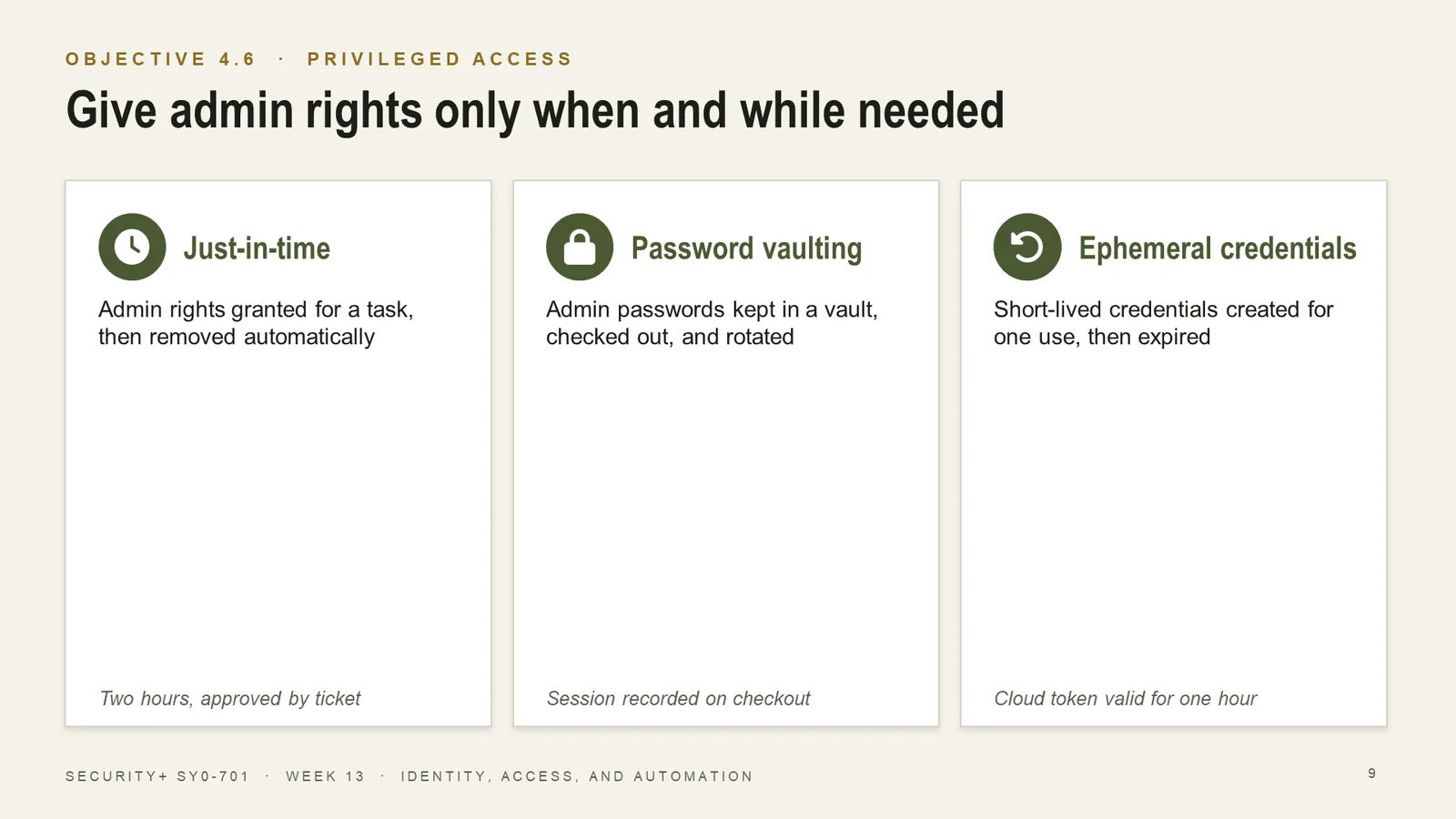
Privileged accounts, such as domain admins, root, firewall admins, and cloud owners, can change everything, so attackers hunt for them first. Privileged access management (PAM) tools reduce how long those rights exist and who knows the passwords.
These work together. At a small clinic, the outside IT provider could request JIT admin rights through a ticket, check the firewall password out of a vault for that session, and have it rotate automatically afterward.
Tip
Rights granted for a limited time: just-in-time. Passwords stored, checked out, and rotated: vaulting. Credentials that exist only for one use: ephemeral.
9 min
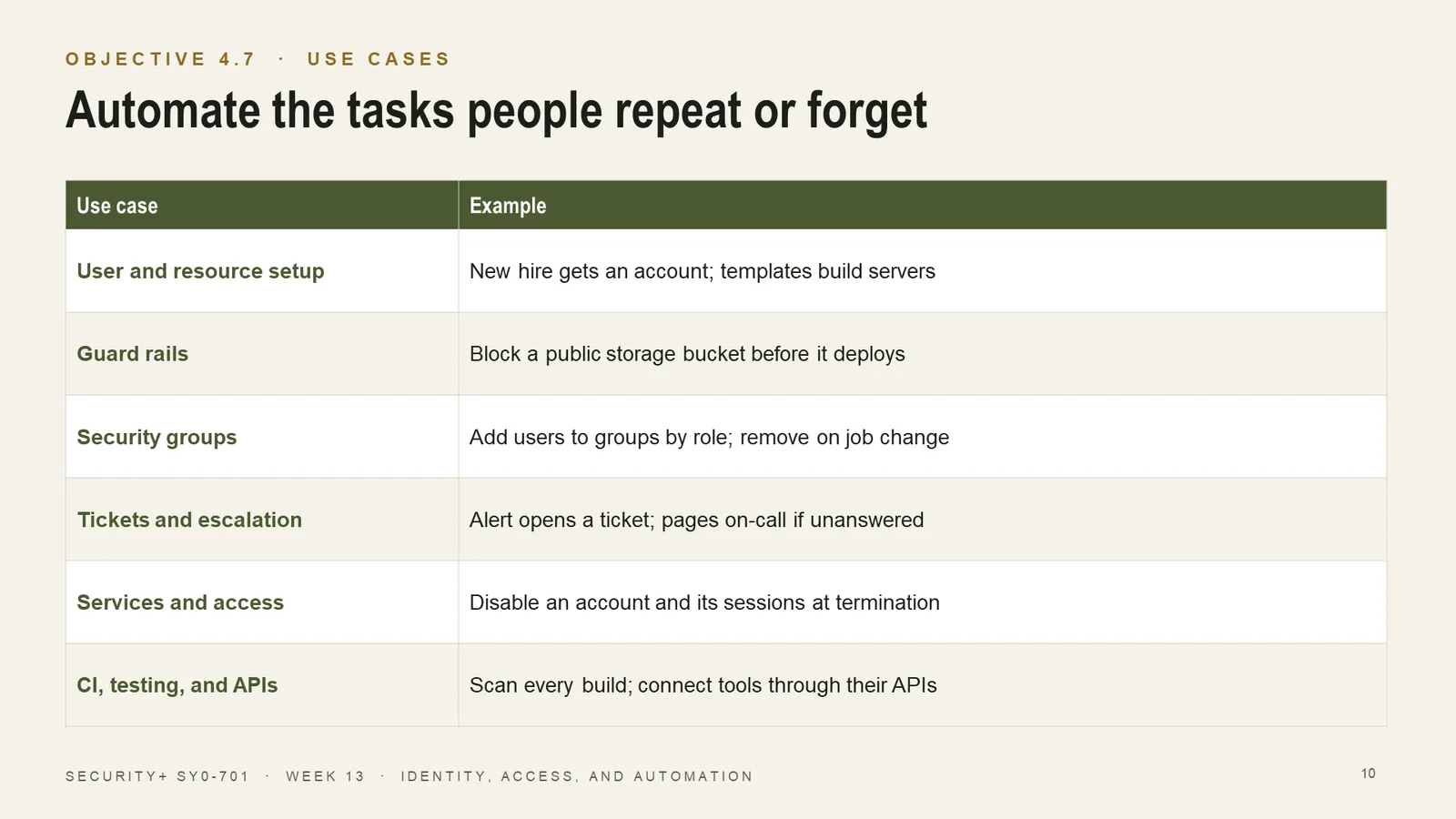
Automation has a machine do one task without a person, such as a script that disables an account. Orchestration connects many automated tasks across systems into a workflow, such as a termination that disables the account, revokes sessions, removes groups, and opens a ticket to collect the laptop. Objective 4.7 lists these use cases:
A good first candidate for automation is any task that is repetitive, rule-based, and harmful when forgotten, such as deprovisioning.
8 min
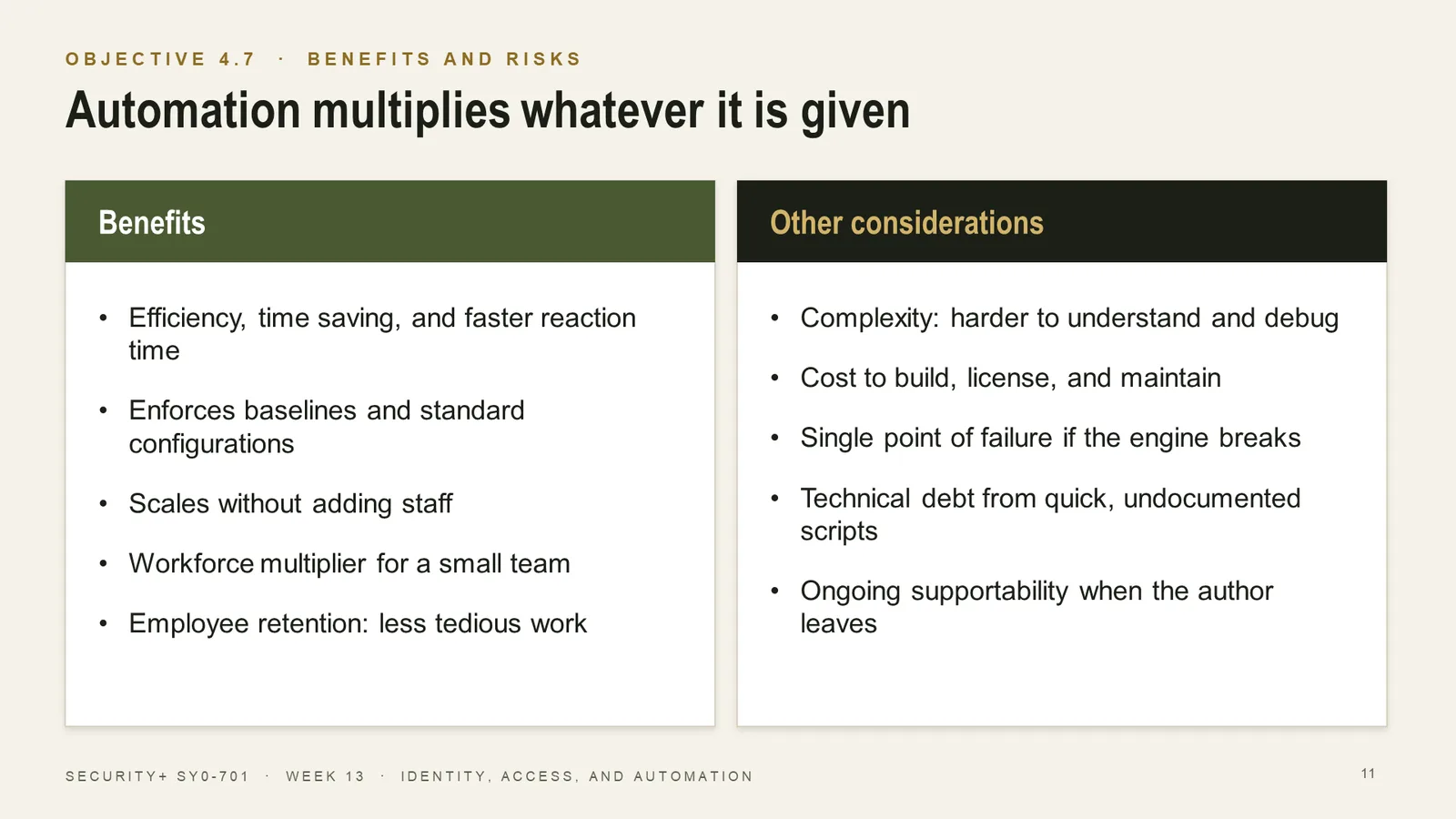
Benefits listed in the objective:
Other considerations:
Watch out
Automation repeats mistakes as fast as it repeats good work. A wrong role mapping in a provisioning script gives every new hire the wrong access. Test automation like any other change, and keep a manual fallback.
10 min
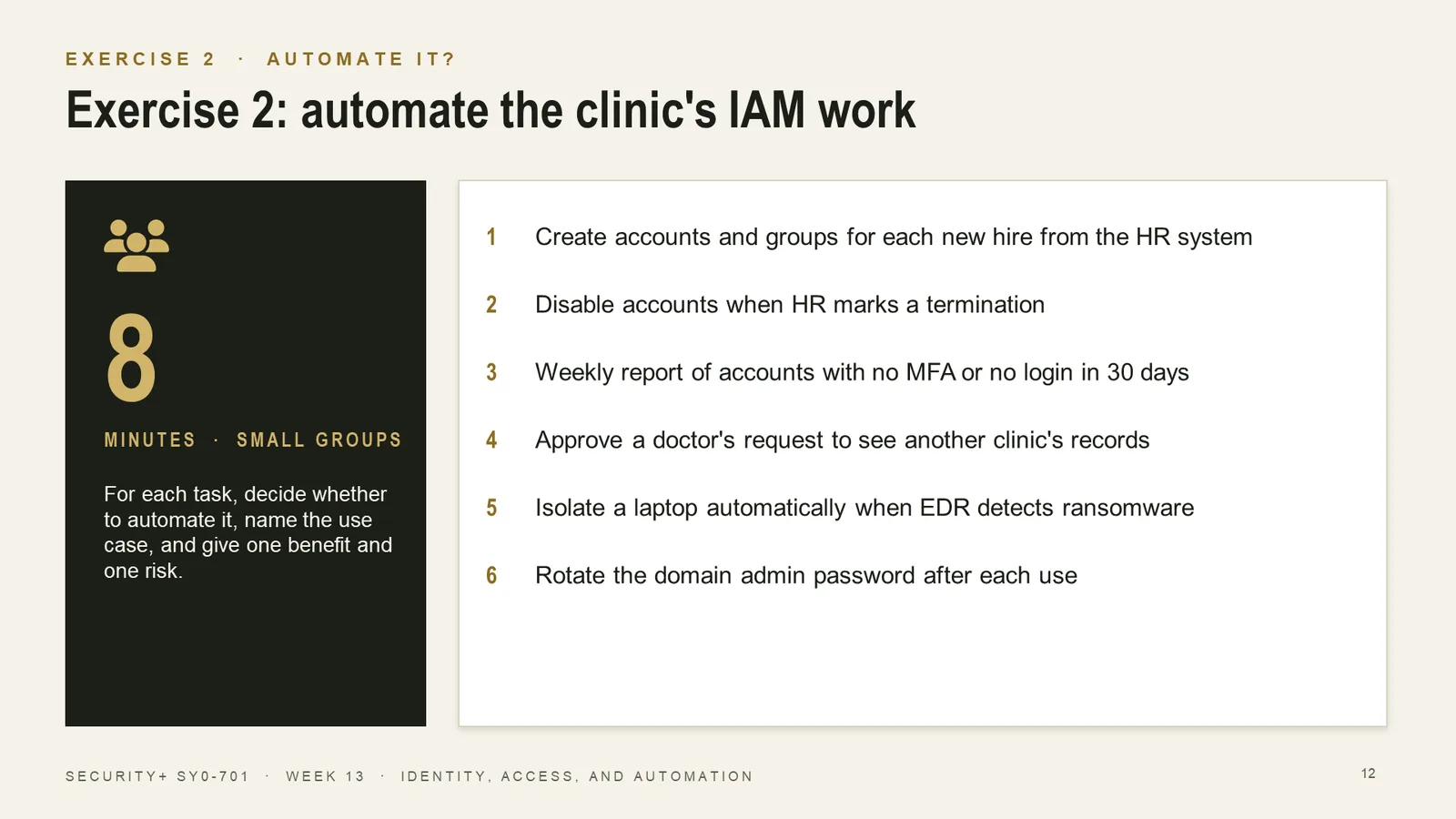
In small groups, take eight minutes. Lakeside Family Clinic has a two-person IT team and wants to automate some identity work. For each task, decide whether to automate it fully, partly, or not at all. Name the objective 4.7 use case, and give one benefit and one risk.
Be ready to defend the one task you would not automate fully.
3 min
Identity is now the front line. Objective 4.6 follows each person from identity proofing through provisioning, permission assignment, attestation, and deprovisioning. SSO and federation let one strong login reach many services through LDAP, SAML, OAuth, and OpenID Connect. Access control models answer who decides: labels for MAC, the owner for DAC, the job for RBAC, rules for rule-based, and many attributes for ABAC, all under least privilege. MFA needs factors of different kinds, passwords should be long and unique and kept in a manager, passwordless removes the shared secret, and PAM keeps admin rights short-lived.
Objective 4.7 shows how automation and orchestration keep all of that consistent, and why it must be documented, tested, and owned.
Answer the review questions and take the quiz. Next week we turn to incident response and investigation.
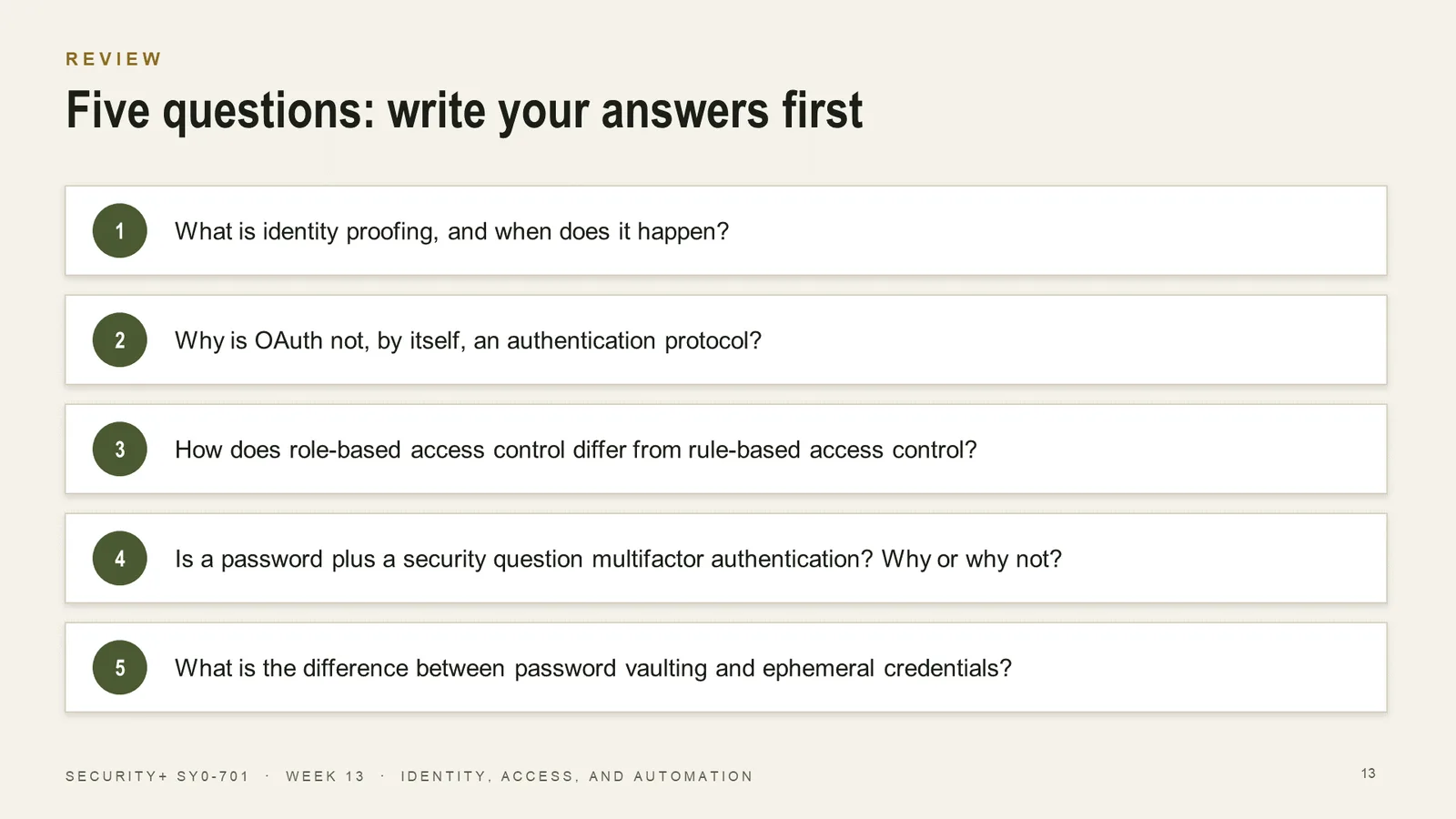
Write your answers to the five review questions first, then open each one to check it.
Verifying that a person is who they claim to be, such as by checking a government ID against HR records. It happens before an account or credential is issued.
OAuth delegates authorization: it gives an app a token for limited access to data. It does not define how to prove who the user is. OpenID Connect adds that layer.
RBAC grants access according to the user's job role or group. Rule-based applies administrator-set rules to everyone, such as time, location, or address rules, regardless of role.
No. Both are something you know, so it is one factor used twice. MFA needs factors from different categories.
Vaulting stores long-lived privileged passwords, controls checkout, and rotates them after use. Ephemeral credentials are created for one session or task and expire on their own.
60 min
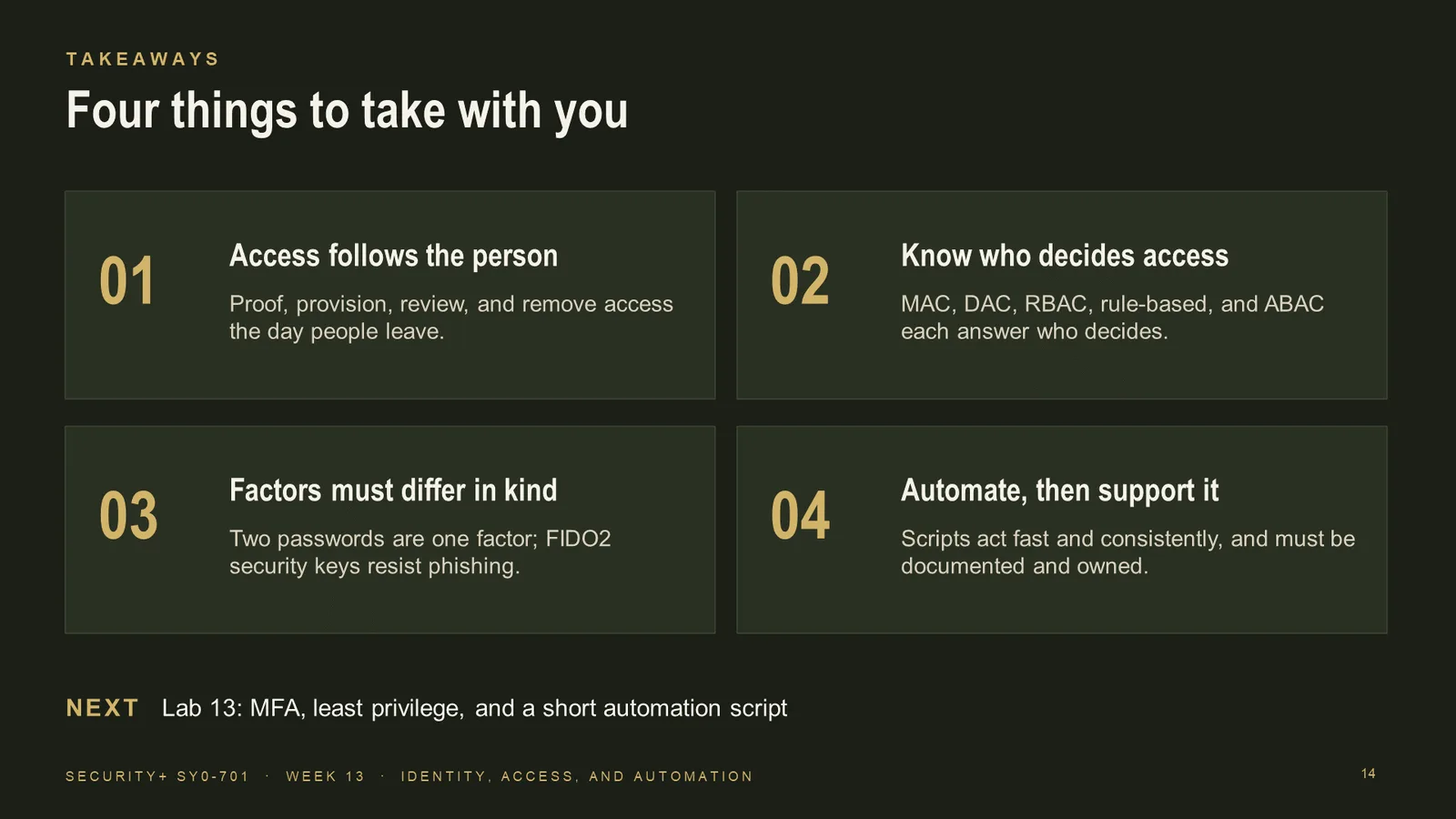
01 Access follows the person
Proof, provision, review, and remove access the day people leave.
02 Know who decides access
MAC, DAC, RBAC, rule-based, and ABAC each answer who decides.
03 Factors must differ in kind
Two passwords are one factor; FIDO2 security keys resist phishing.
04 Automate, then support it
Scripts act fast and consistently, and must be documented and owned.
Use your Ubuntu lab VM, the Windows VM if you have it, and any authenticator app on your phone. Take a snapshot first and keep a second terminal session open while you change SSH and PAM settings, because a mistake can lock you out. Work only in your own lab.
Lab steps · 0 of 8 complete (0%)
A short report with screenshots of the group and permission checks, the SSH login asking for a verification code, your script's source code, and its output before and after you acted on it.