
Loading
Warhawk Division is a gaming community. This is a unit document, not a government or military publication.Warhawk Division is an independent gaming community, for entertainment purposes only. It is not affiliated with, sponsored by, or endorsed by Bohemia Interactive, the United States Department of Defense, or any military organization. Arma Reforger is a trademark of its respective owner. Printed from warhawkdivision.com.
Week 2 content
0 of 13 done
Slide 1 of 13
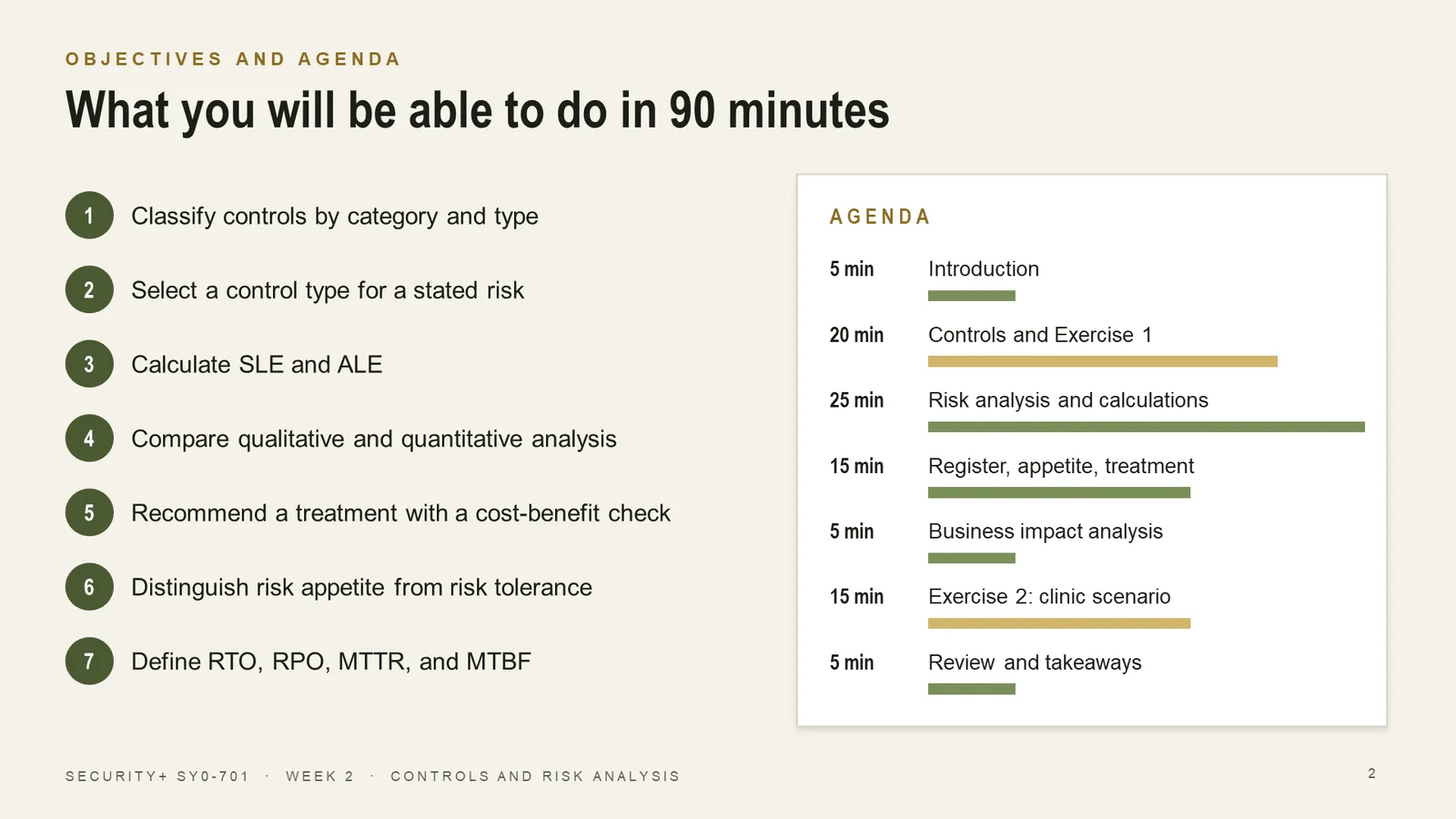
Exam objectives: 1.1 Compare and contrast various types of security controls. 5.2 Explain elements of the risk management process.
5 min
Controls reduce risk, and risk analysis tells you which controls are worth their cost. Every security decision you will make sits on those two ideas.
Picture a company that spends $50,000 a year on a tool that protects against a $5,000 problem. Nothing about the tool is wrong. The decision is. This lesson gives you the vocabulary to name a control precisely, and the arithmetic to show whether it earns its keep.
Before you go on, think of a time you saw a control fail. Was it a bad control, or the wrong type of control for the problem? Keep that example in mind; you will classify it in a few minutes.
4 min
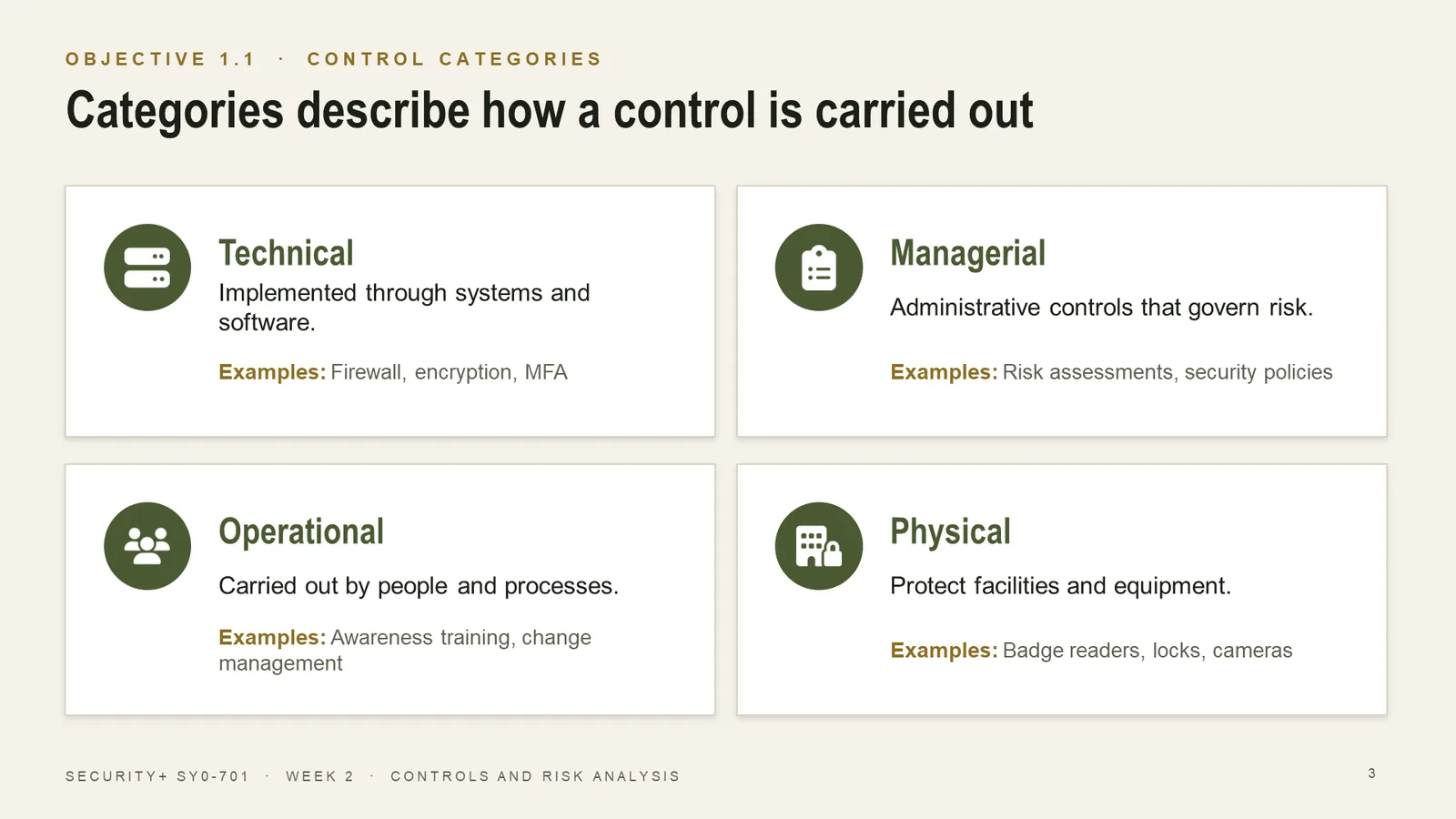
A category describes how a control is carried out. Security+ uses four.
| Category | What it is | Examples |
|---|---|---|
| Technical | Implemented through systems and software | Firewall, encryption, MFA |
| Managerial | Administrative controls that govern risk | Risk assessments, security policies |
| Operational | Carried out by people and processes | Awareness training, change management |
| Physical | Protect facilities and equipment | Badge readers, locks, cameras |
A common mistake is to think controls are only technology. A written policy is a control. So is a guard, a lock, and a training program.
Tip
A policy that says laptops must be encrypted is managerial. The encryption software that does it is technical. Same goal, two controls, two categories.
4 min
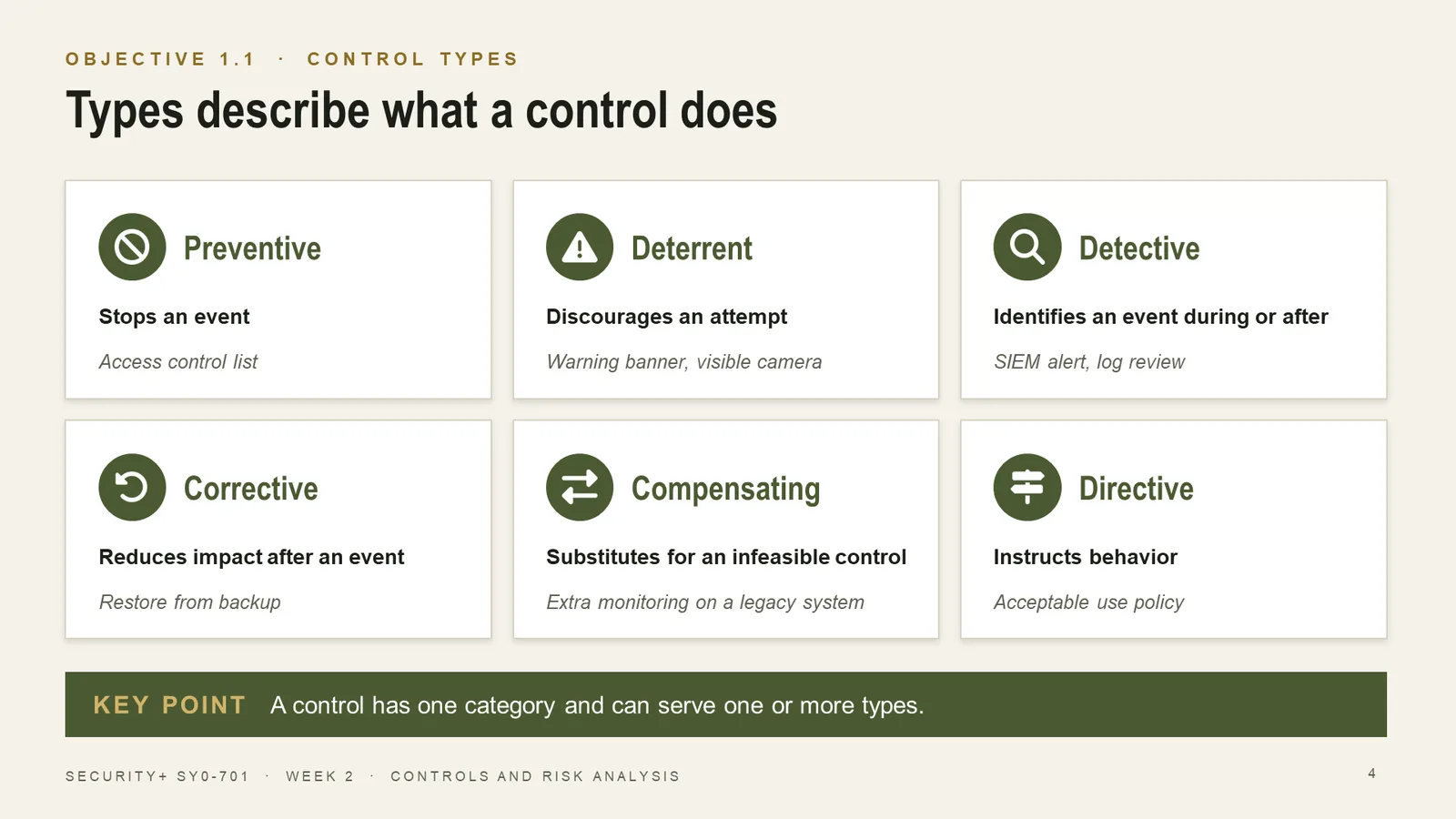
A type describes what a control does. It is a separate dimension from category.
The key rule: a control has one category and can serve one or more types. A camera at the data center door is physical, and it is both detective and deterrent.
Two traps show up on the exam. Preventive and deterrent are not the same: preventive actually stops the event. And compensating does not mean weaker; it means a substitute chosen because the primary control is not possible.
12 min
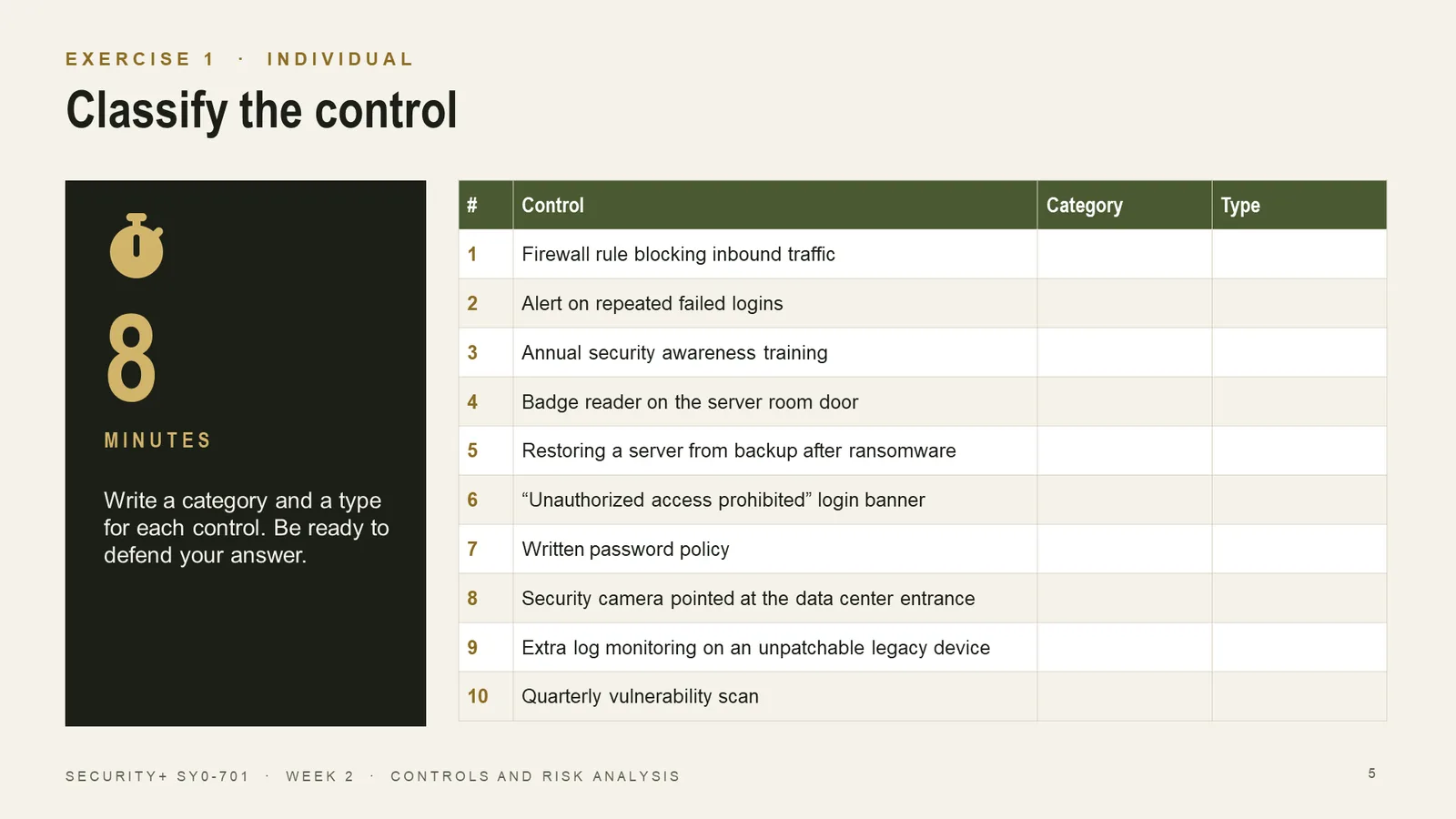
Give yourself eight minutes. For each control in the list below, write down a category and a type before you open the answers. If you are with a class, compare answers with a partner and defend each one.
| Control | Category | Type | Why |
|---|---|---|---|
| Firewall rule blocking inbound traffic | Technical | Preventive | A system enforces it and it stops the traffic before it arrives. |
| Alert on repeated failed logins | Technical | Detective | It identifies an event while it happens. It does not stop the attempt. |
| Annual security awareness training | Operational | Preventive (also directive) | People carry it out. It aims to stop mistakes and tells staff how to behave. |
| Badge reader on the server room door | Physical | Preventive | It protects a facility and blocks entry without a valid badge. |
| Restoring a server from backup after ransomware | Technical | Corrective | It reduces impact after the event. |
| “Unauthorized access prohibited” login banner | Technical | Deterrent (also directive) | It discourages an attempt. It does not block one. |
| Written password policy | Managerial | Directive | A governing document that instructs behavior. |
| Security camera pointed at the data center entrance | Physical | Detective (also deterrent) | It records events, and a visible camera discourages attempts. |
| Extra log monitoring on an unpatchable legacy device | Technical | Compensating | It substitutes for patching, which is not feasible. |
| Quarterly vulnerability scan | Technical | Detective | It finds weaknesses that already exist. Managerial is a fair answer if you argue it as part of the assessment program. |
A different answer can still be right if you can justify it.
10 min
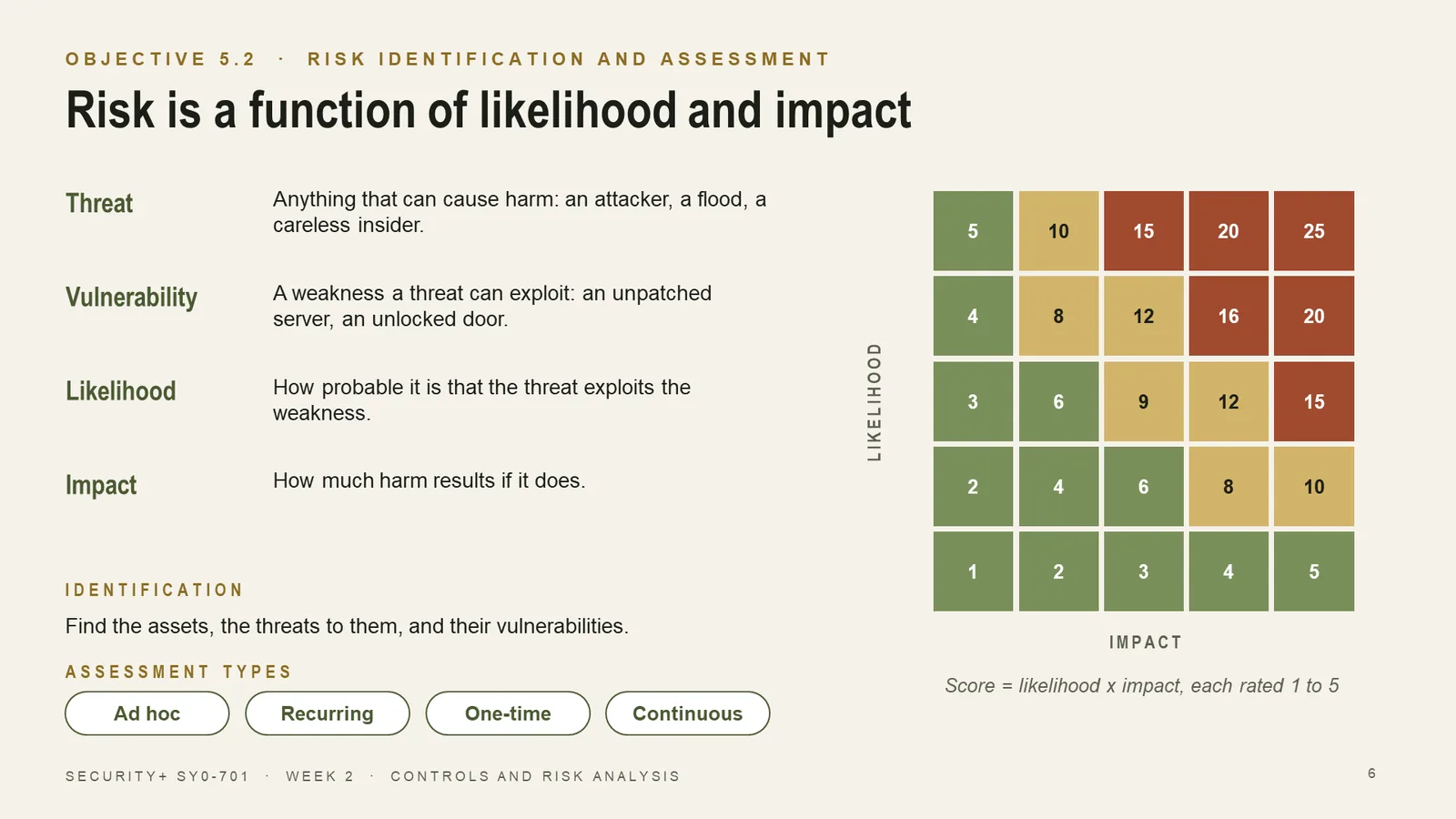
A threat is anything that can cause harm: an attacker, a flood, a careless insider. A vulnerability is a weakness a threat can exploit: an unpatched server, an unlocked door. Likelihood is how probable it is that the threat exploits the weakness, and impact is how much harm results if it does.
Risk is a function of likelihood and impact. Many teams rate each from 1 to 5 and multiply, which gives the heat map on the slide. A laptop full of patient records with no encryption might rate likelihood 3 and impact 5, a score of 15, in the red.
Risk identification finds the assets, the threats to them, and their vulnerabilities. A risk assessment can be:
15 min
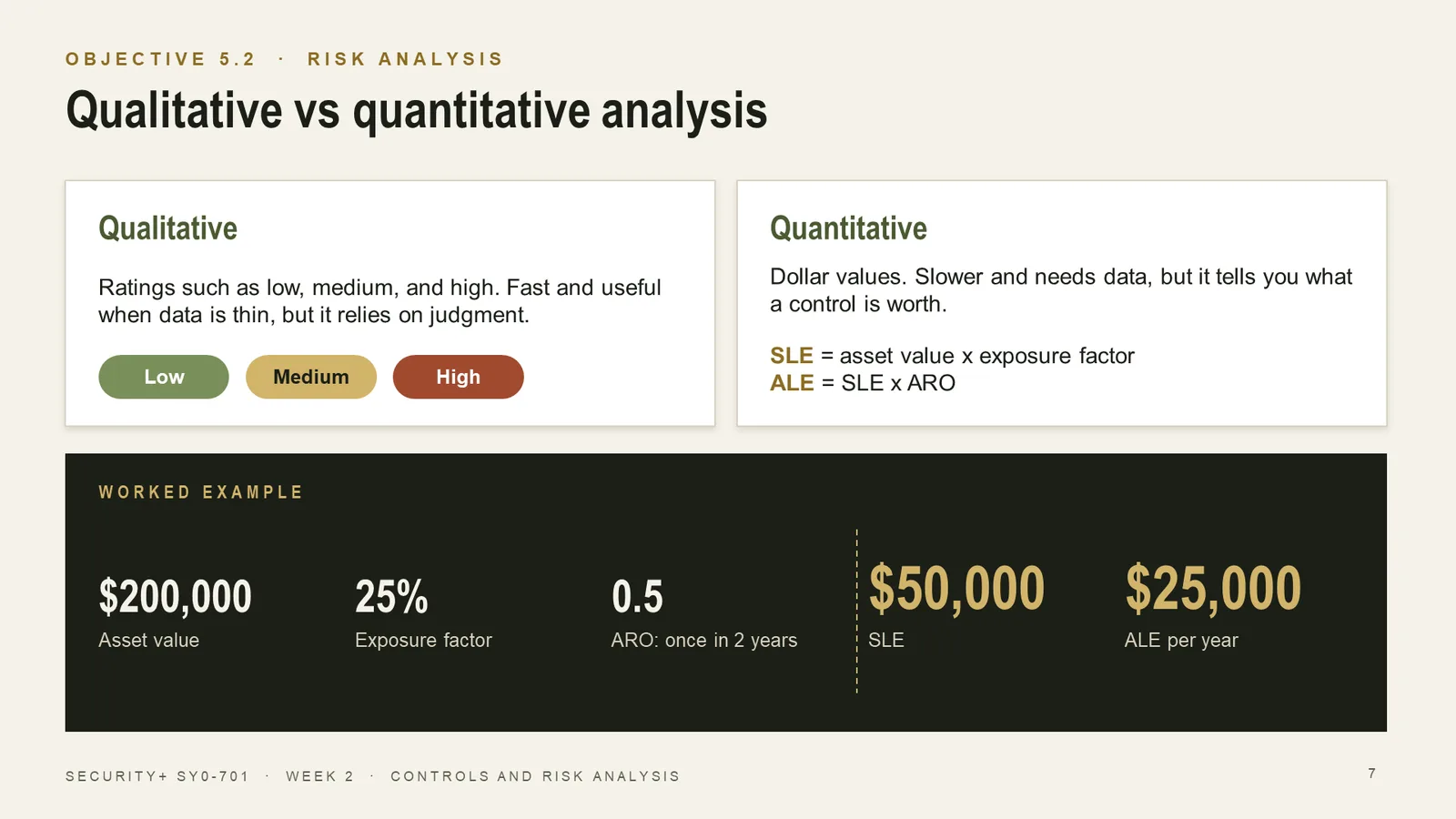
Qualitative analysis rates risk with words such as low, medium, and high. It is fast and useful when data is thin, but it relies on judgment.
Quantitative analysis puts dollar values on risk, so you can compare a risk with what a control costs. Four terms do the work:
Worked example. Try it before reading the answer. An asset is worth $200,000, one event costs 25% of it, and the event is expected once every two years (ARO 0.5).
Watch out
ARO is a frequency, not a percentage of loss. And quantitative is not always better: when the data is thin, a precise-looking dollar figure is false precision.
7 min
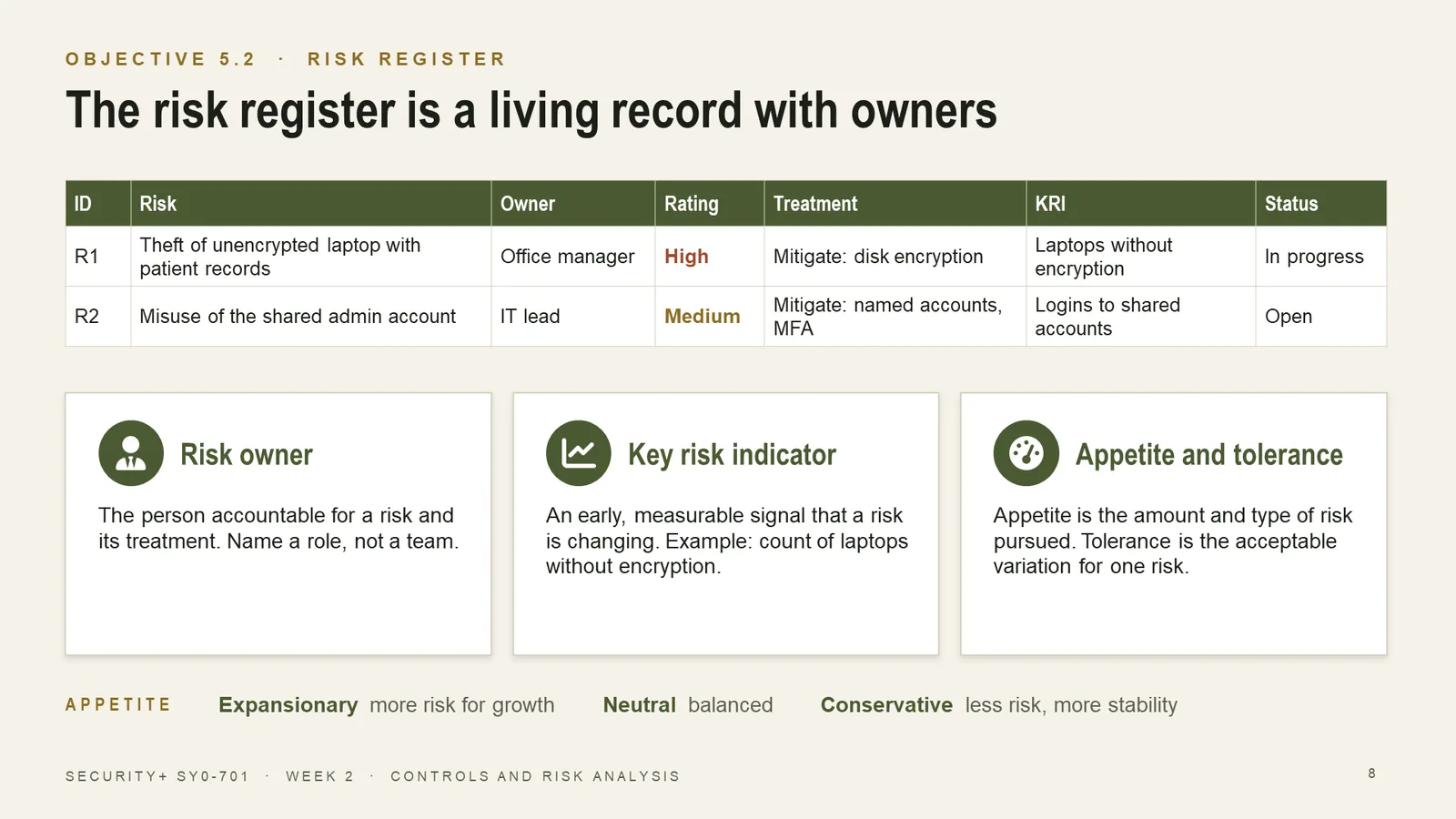
A risk register is a living list of risks. Each entry has an owner, a rating, a treatment, and a status, and it changes as the risk does.
Risk appetite is the amount and type of risk an organization is willing to pursue overall. It is usually described as expansionary (more risk for growth), neutral, or conservative (less risk, more stability). Risk tolerance is how far a single risk may vary from that level before someone must act. Appetite is the stance; tolerance is the allowed drift.
Risk reporting closes the loop. On a set schedule, the security team reports the top risks to leadership: how each one has changed, which KRIs crossed a threshold, what treatment is under way or overdue, and what decision is needed. Write it for a reader who is not technical, in terms of likelihood, impact, and cost.
8 min
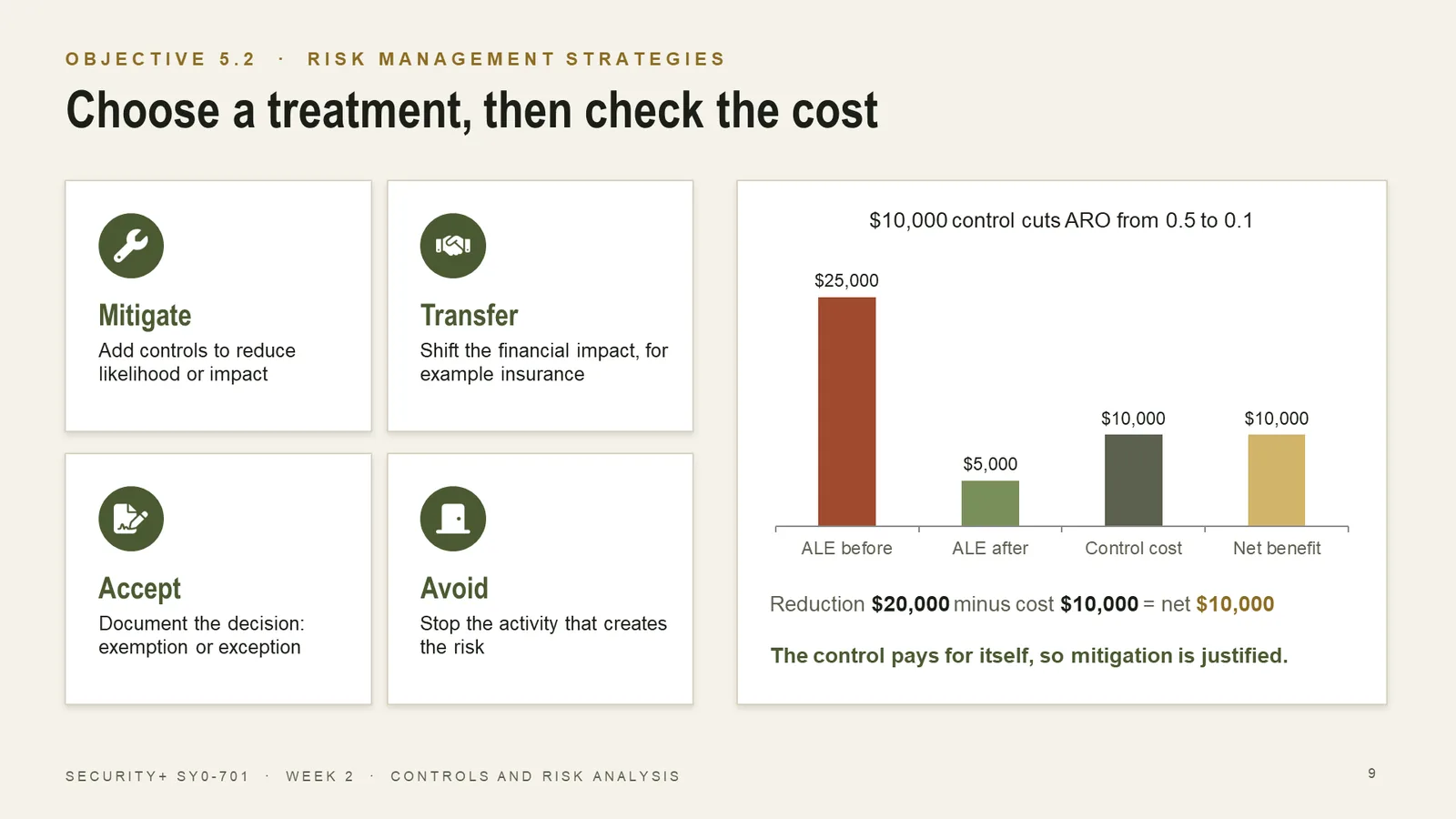
Once a risk has an owner, the owner chooses one of four strategies:
Check the cost. Take the risk from the worked example, with an ALE of $25,000. A control costs $10,000 a year and cuts the ARO from 0.5 to 0.1.
The control pays for itself, so mitigation is justified. Net benefit = ALE reduction minus annual control cost.
5 min
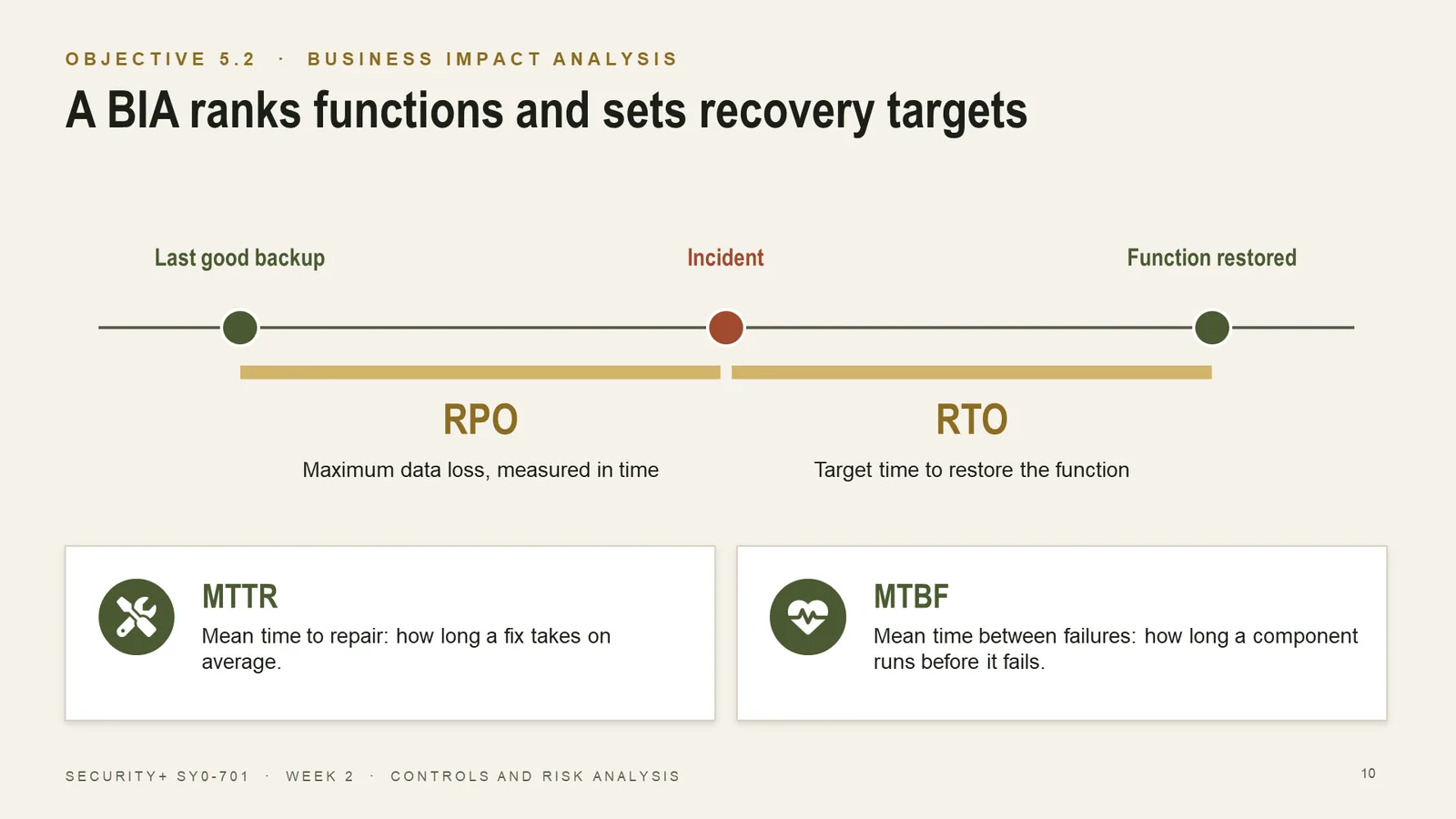
A business impact analysis (BIA) ranks business functions by how critical they are and sets recovery targets for each.
If a clinic backs up every four hours, its RPO can be no better than four hours of lost records. If it must be seeing patients again within eight hours, that is its RTO.
15 min
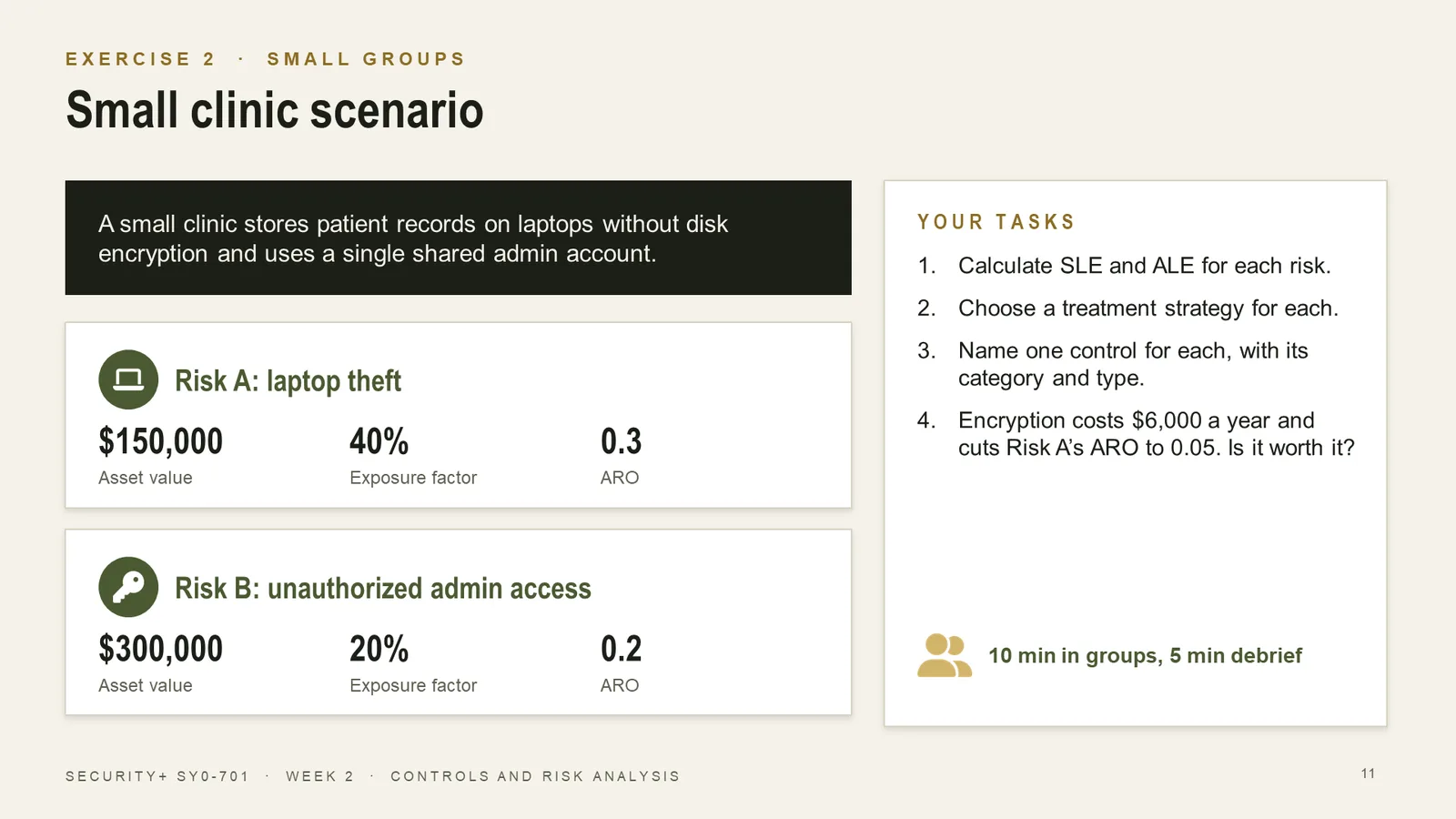
A small clinic stores patient records on laptops without disk encryption and uses a single shared admin account.
| Risk A: laptop theft | Risk B: unauthorized admin access | |
|---|---|---|
| Asset value | $150,000 | $300,000 |
| Exposure factor | 40% | 20% |
| ARO | 0.3 | 0.2 |
Work it on paper or in the handout before opening the answers.
Risk A, laptop theft. SLE = $150,000 x 0.40 = $60,000. ALE = $60,000 x 0.3 = $18,000. With encryption, ALE = $60,000 x 0.05 = $3,000, a reduction of $15,000. After the $6,000 cost, the net benefit is $9,000 a year, so the control is justified. Strategy: mitigate. Control: full disk encryption (technical, preventive).
Risk B, unauthorized admin access. SLE = $300,000 x 0.20 = $60,000. ALE = $60,000 x 0.2 = $12,000. Strategy: mitigate. Controls: individual accounts with MFA (technical, preventive) and periodic access reviews (managerial, detective).
Notice: both risks have the same SLE, yet Risk A has the higher ALE because it happens more often. Frequency matters as much as size.
5 min
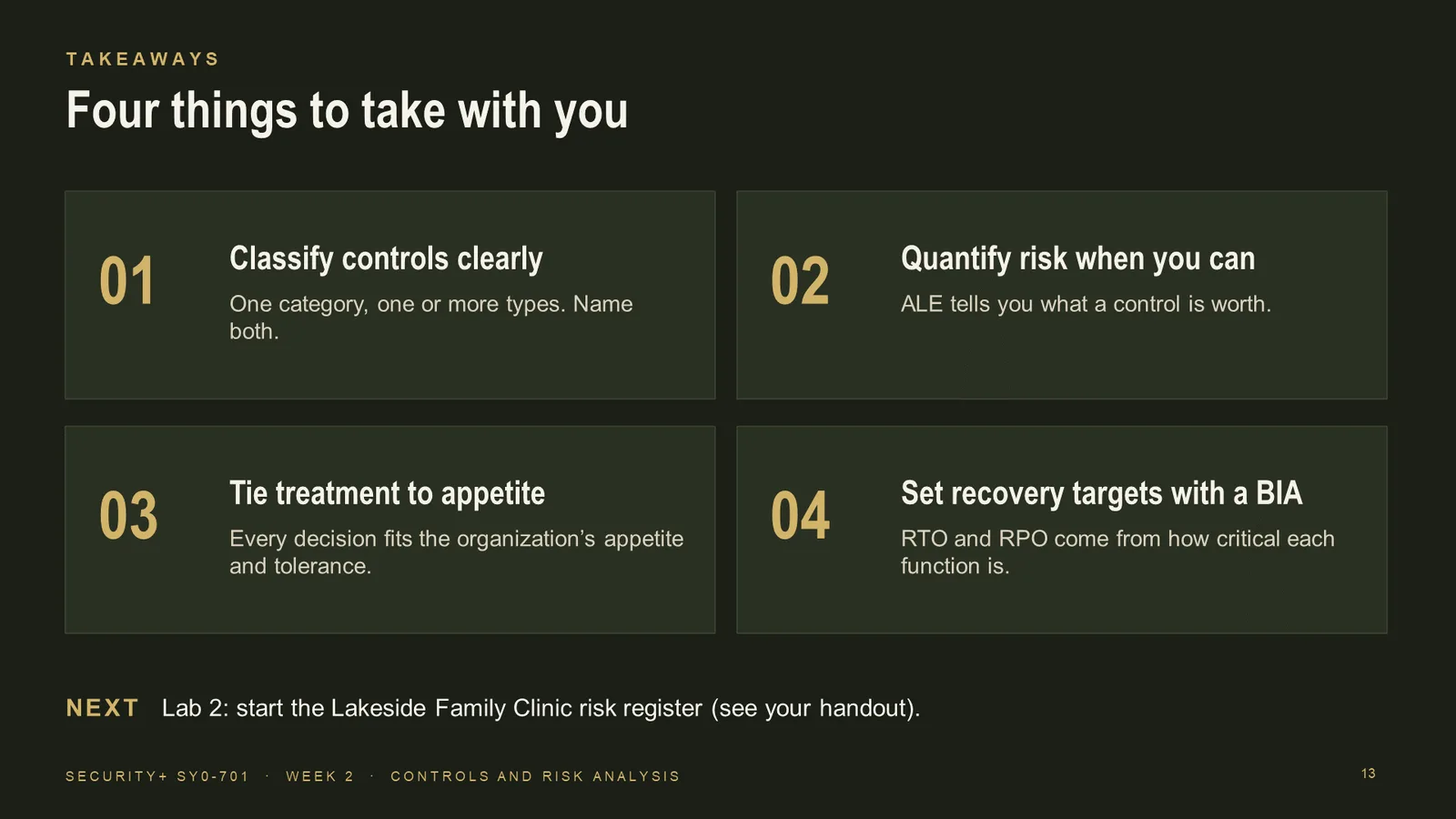
Four ideas carry this week. Classify controls clearly: one category, one or more types, and name both. Quantify risk when you can: ALE tells you what a control is worth, and a cost-benefit check tells you whether to buy it. Tie treatment to appetite: every mitigate, transfer, accept, or avoid decision should fit the organization's appetite and tolerance, and an accepted risk is always written down. Set recovery targets with a BIA: RTO and RPO come from how critical each function is, not from what the backup tool happens to do.
The lab that follows starts the register you will build all semester for Lakeside Family Clinic.
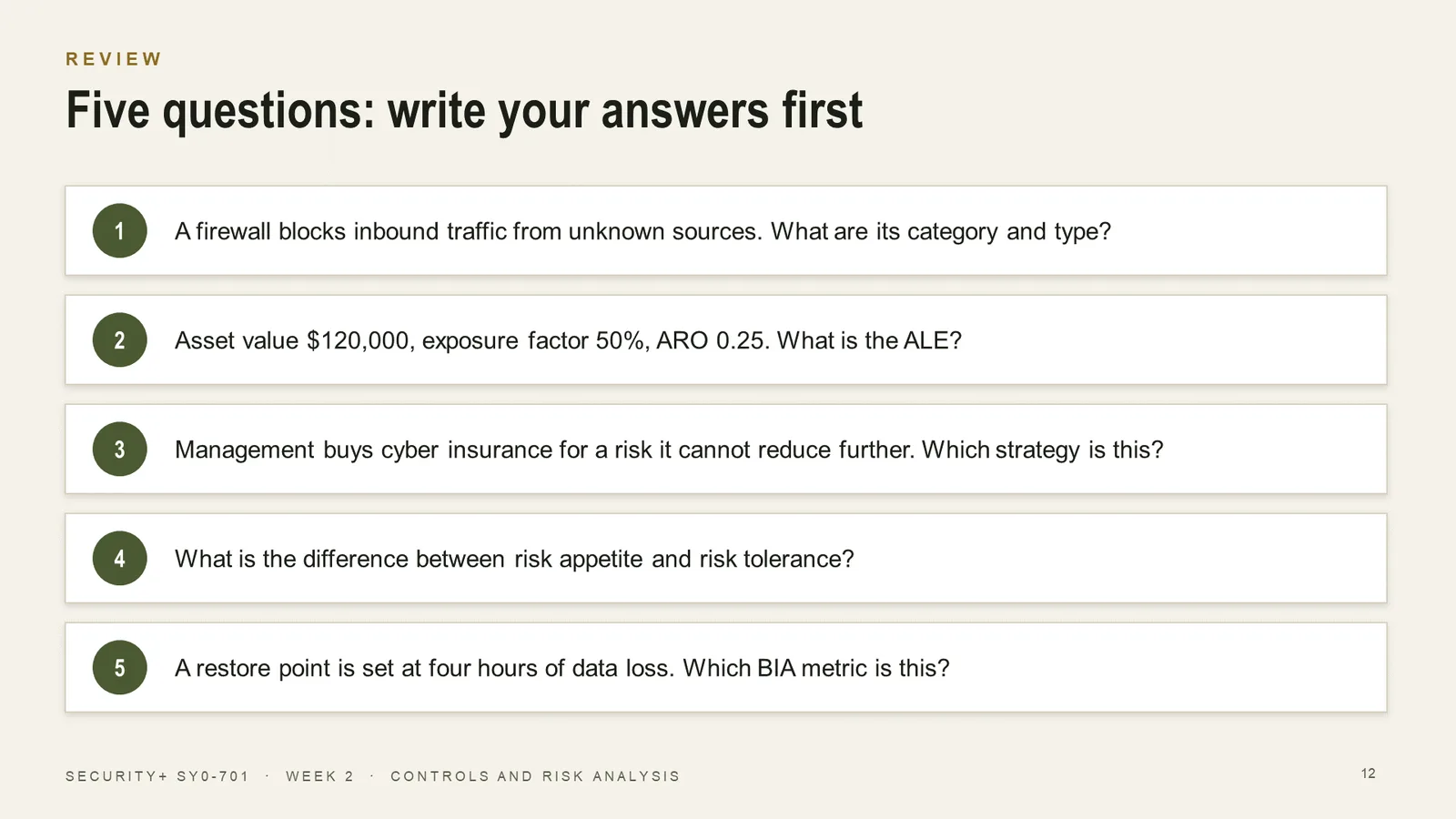
Write your answers to the five review questions first, then open each one to check it.
Technical, preventive.
SLE = $120,000 x 0.50 = $60,000. ALE = $60,000 x 0.25 = $15,000.
Transfer.
Appetite is the amount and type of risk the organization is willing to pursue. Tolerance is the acceptable variation around that level for a specific risk.
RPO, the recovery point objective.
60 min
01 Classify controls clearly
One category, one or more types. Name both.
02 Quantify risk when you can
ALE tells you what a control is worth.
03 Tie treatment to appetite
Every decision fits the organization's appetite and tolerance.
04 Set recovery targets with a BIA
RTO and RPO come from how critical each function is.
Week 2 interactive lab
Verdict: Cost-effective safeguard (ALE before minus ALE after minus ACS).
5x5 Risk Heat Map (L3 x I2)
Any spreadsheet program. Lakeside Family Clinic is a fictional 25-person clinic: patient records on staff laptops without disk encryption, one shared administrator account, a file server in a closet whose key hangs on a hook beside the door, and backups to an external drive that stays plugged in.
Lab steps · 0 of 6 complete (0%)
The spreadsheet, with one sentence per risk explaining the treatment choice. Example row: R1, a thief steals an unencrypted laptop holding patient records, office manager, 3, 5, 15, mitigate, laptops without encryption.