
Loading
Warhawk Division is a gaming community. This is a unit document, not a government or military publication.Warhawk Division is an independent gaming community, for entertainment purposes only. It is not affiliated with, sponsored by, or endorsed by Bohemia Interactive, the United States Department of Defense, or any military organization. Arma Reforger is a trademark of its respective owner. Printed from warhawkdivision.com.
Week 10 content
0 of 14 done
Slide 1 of 14
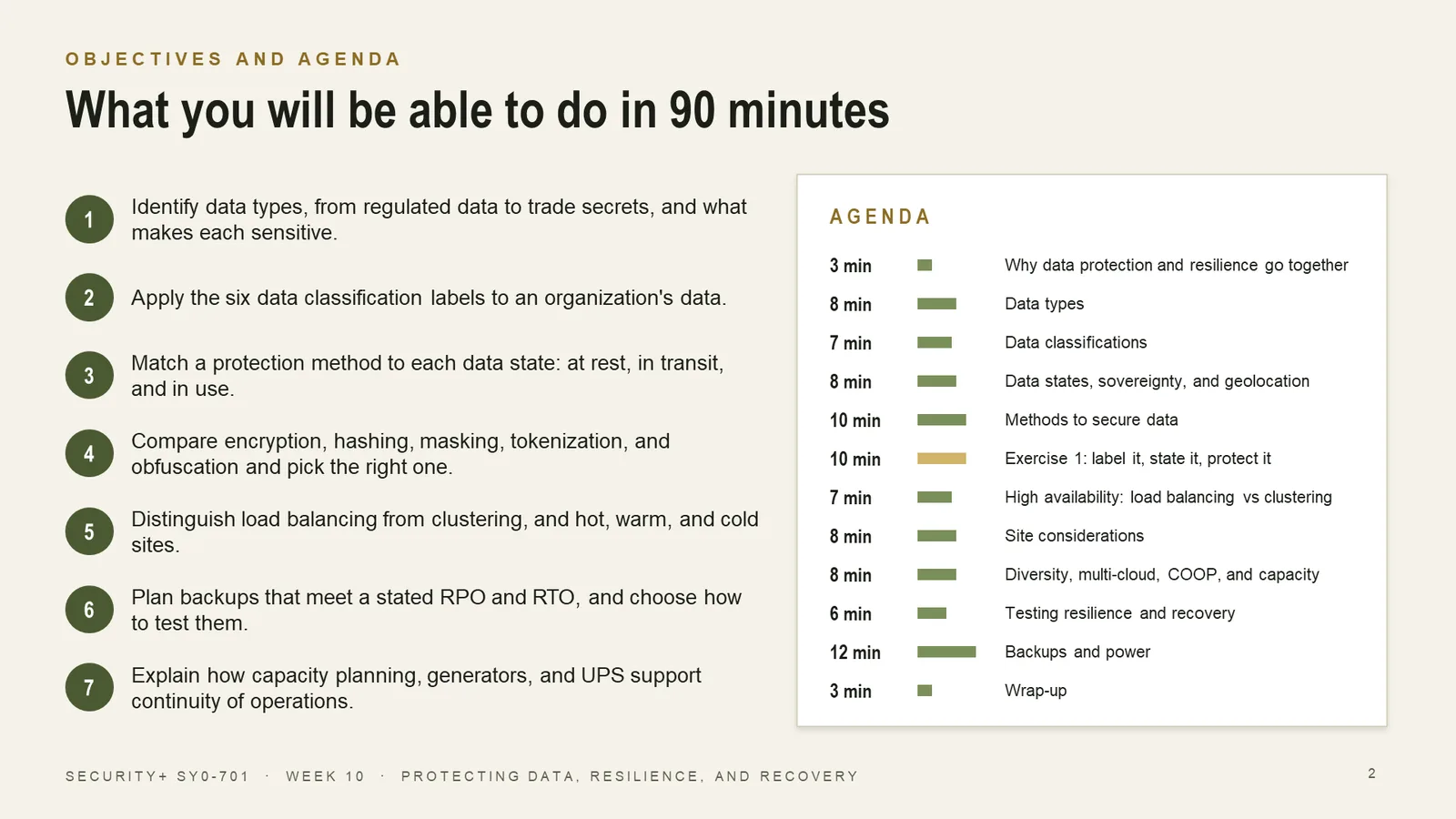
Exam objectives: 3.3 Compare and contrast concepts and strategies to protect data. 3.4 Explain the importance of resilience and recovery in security architecture.
3 min
Security is often described with the CIA triad, and this week covers both ends of it. Objective 3.3 is mostly about confidentiality: knowing what data you have, labeling it, and making it useless to anyone who steals it. Objective 3.4 is mostly about availability: making sure the systems and data survive hardware failures, disasters, and ransomware.
The two depend on each other. A clinic that encrypts every record but cannot restore them after ransomware has lost its data just as surely as one that was breached. A clinic with perfect backups sitting unencrypted on a shelf has protected availability and given away confidentiality.
Tie this week back to week 2. The RPO and RTO you set in a business impact analysis become real here: backup frequency decides whether you can meet the RPO, and your recovery site and restore process decide whether you can meet the RTO.
Keep the Lakeside Family Clinic in mind. It holds patient records, card payments, contracts, and staff files, and it cannot see patients when its EHR is down.
8 min
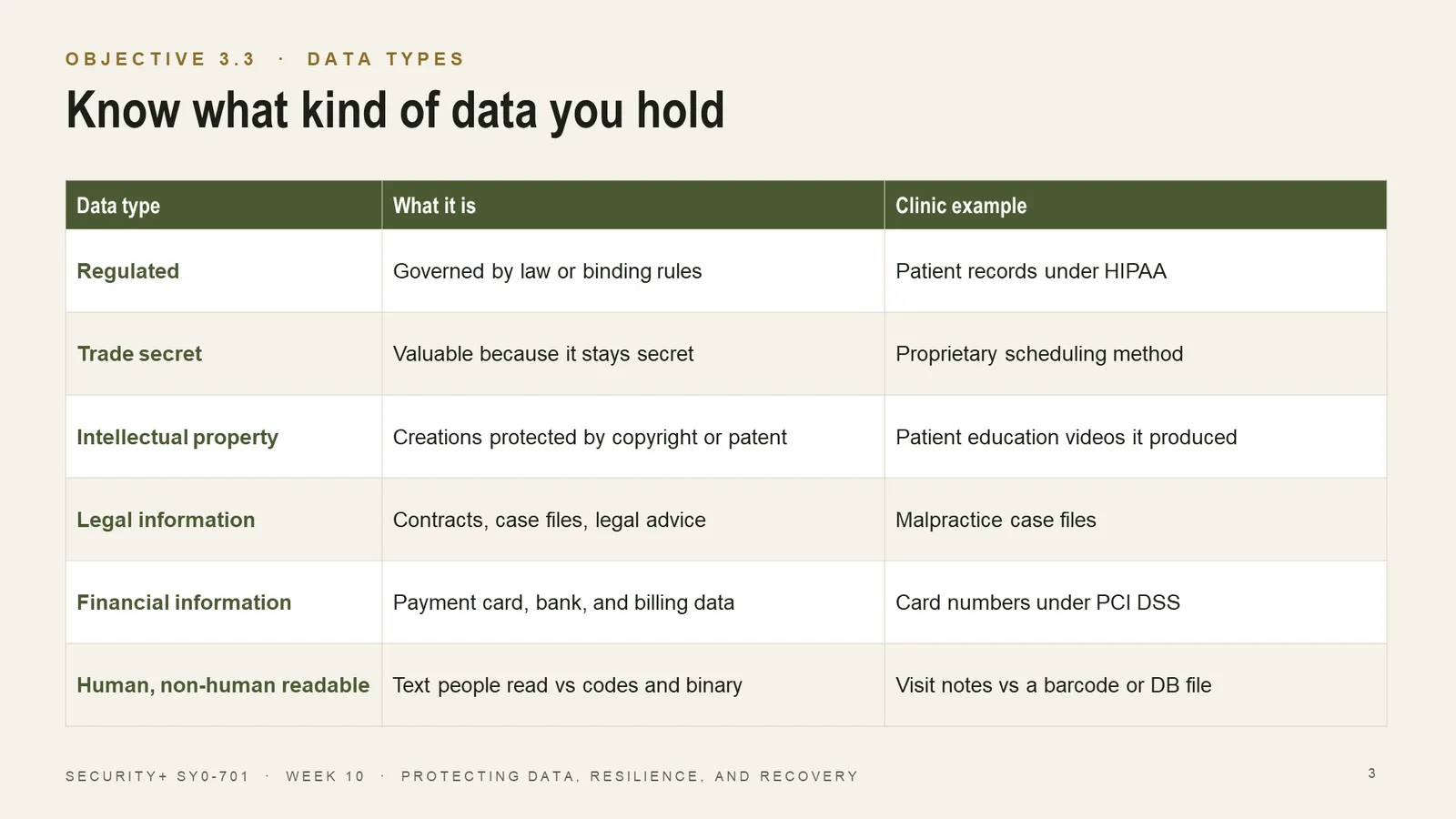
Before you can protect data, you need to know what kind it is. Objective 3.3 lists these data types:
One record can belong to several types. A patient bill is regulated, financial, and personal at once, and it takes the strictest rules among them.
Watch out
Exam trap: non-human-readable does not mean safe. A barcode or a database file can be decoded by anyone with the right tool. Protect it by its content, not its format.
7 min
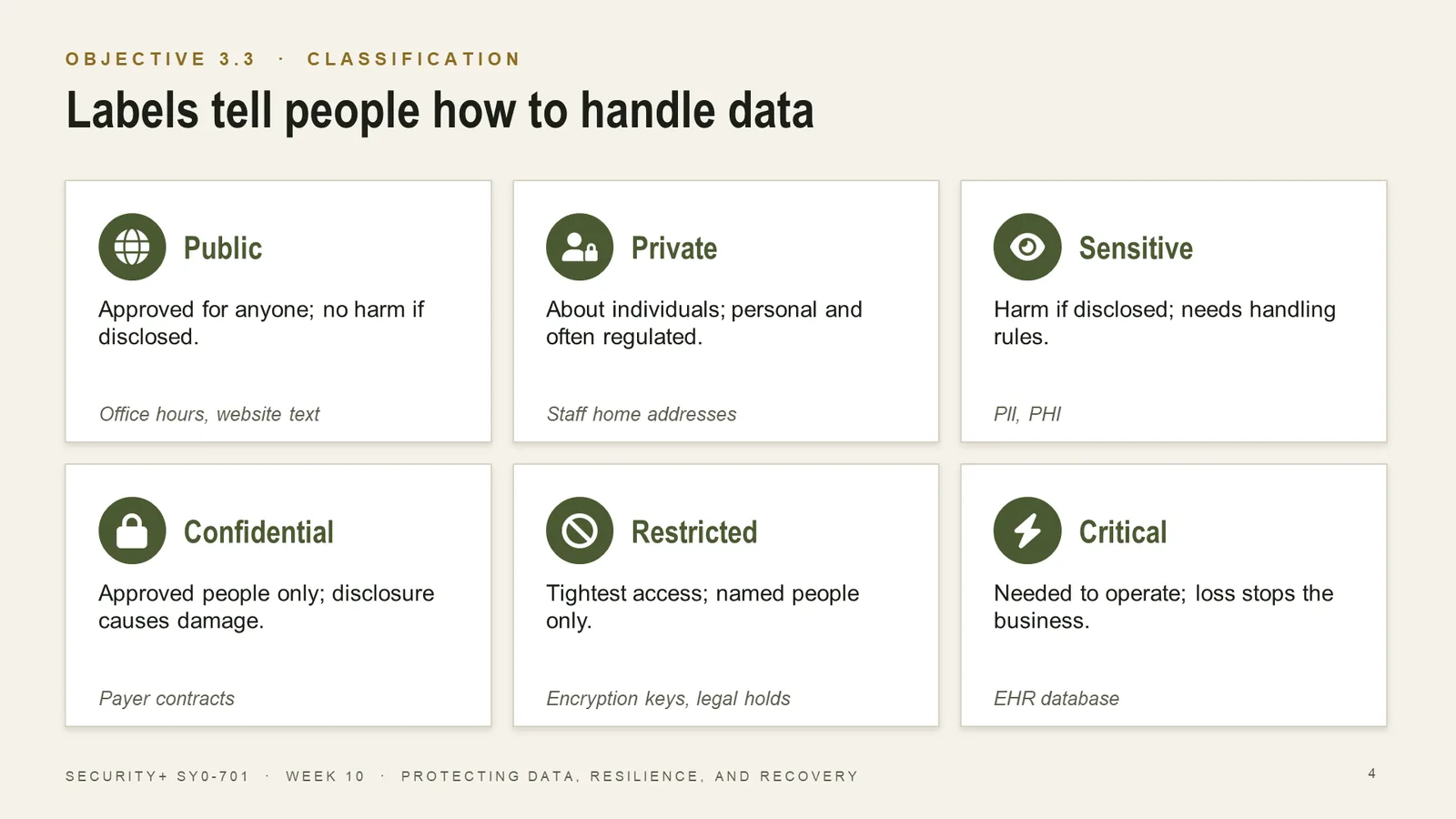
Classification assigns a label to data so everyone knows how to handle it. The label decides who may access the data, where it may be stored, how it may be sent, and how it must be destroyed. A data owner, usually a business leader rather than IT, assigns the label.
Objective 3.3 lists six labels:
| Label | Meaning | Lakeside example |
|---|---|---|
| Public | Approved for release; no harm if disclosed | Office hours, services list |
| Private | About individuals; personal information | Staff home addresses, patient contact details |
| Sensitive | Would cause harm if disclosed; needs special handling | PII, PHI |
| Confidential | For authorized people only; disclosure damages the organization | Payer contracts, internal audits |
| Restricted | The tightest tier; access by name only | Encryption keys, data under legal hold |
| Critical | Essential to operations; loss or unavailability stops the business | EHR database, scheduling data |
Organizations pick their own scheme and number of levels. A government uses top secret, secret, and confidential; a clinic might use only public, internal, and confidential. What matters is that each label maps to clear handling rules.
Tip
Critical describes how much the business depends on the data, which is mostly an availability question. The other labels describe how damaging disclosure would be. The same EHR database is both confidential and critical, so it needs encryption and strong backups.
8 min
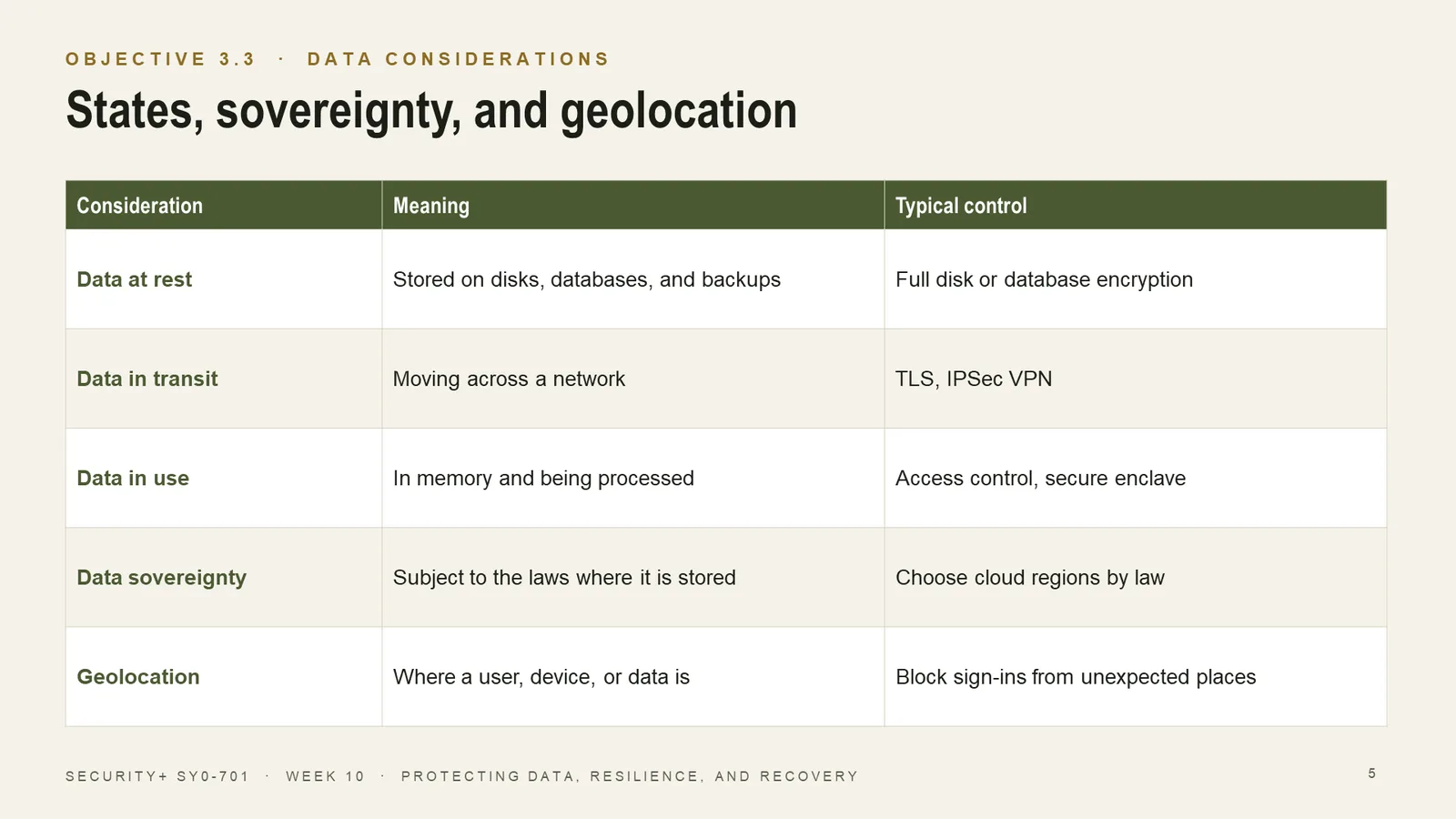
Data exists in three states, and each needs its own protection.
Two geographic considerations:
Watch out
Exam traps. Full disk encryption protects data at rest only while the device is powered off; once the drive is unlocked at boot, the data is readable on the running system, even behind a lock screen. TLS protects data in transit only between the two endpoints, not after it lands. Sovereignty is about law; geolocation is about location.
10 min
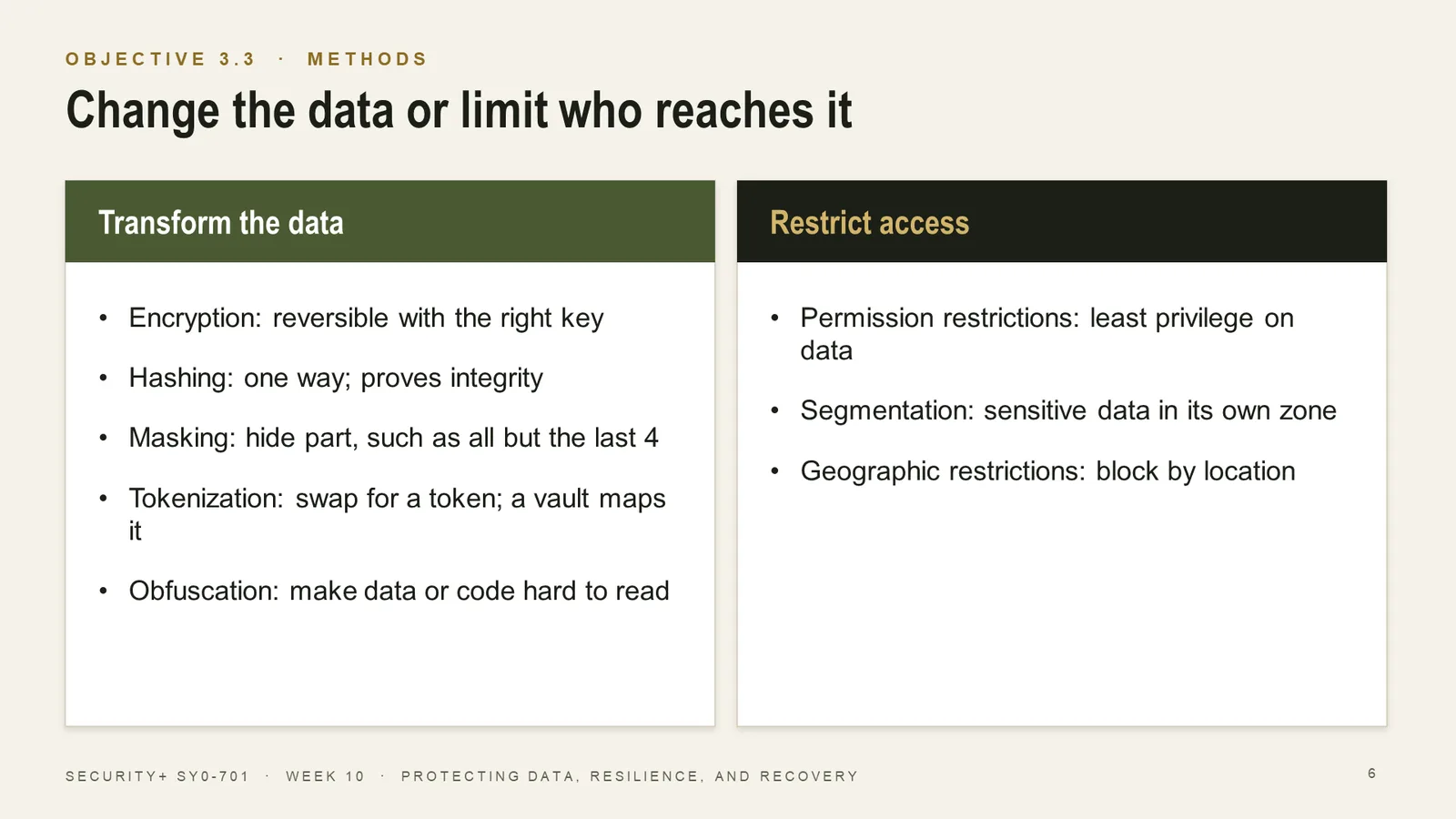
Objective 3.3 lists eight methods. Five change the data itself; three restrict who can reach it.
Methods that transform the data:
Methods that restrict access:
Watch out
Exam traps. Tokenization vs encryption: an encrypted value can be decrypted with a key; a token can only be looked up in the vault. Masking vs tokenization: masking hides part of the value for display; tokenization replaces the whole value for storage and processing.
10 min
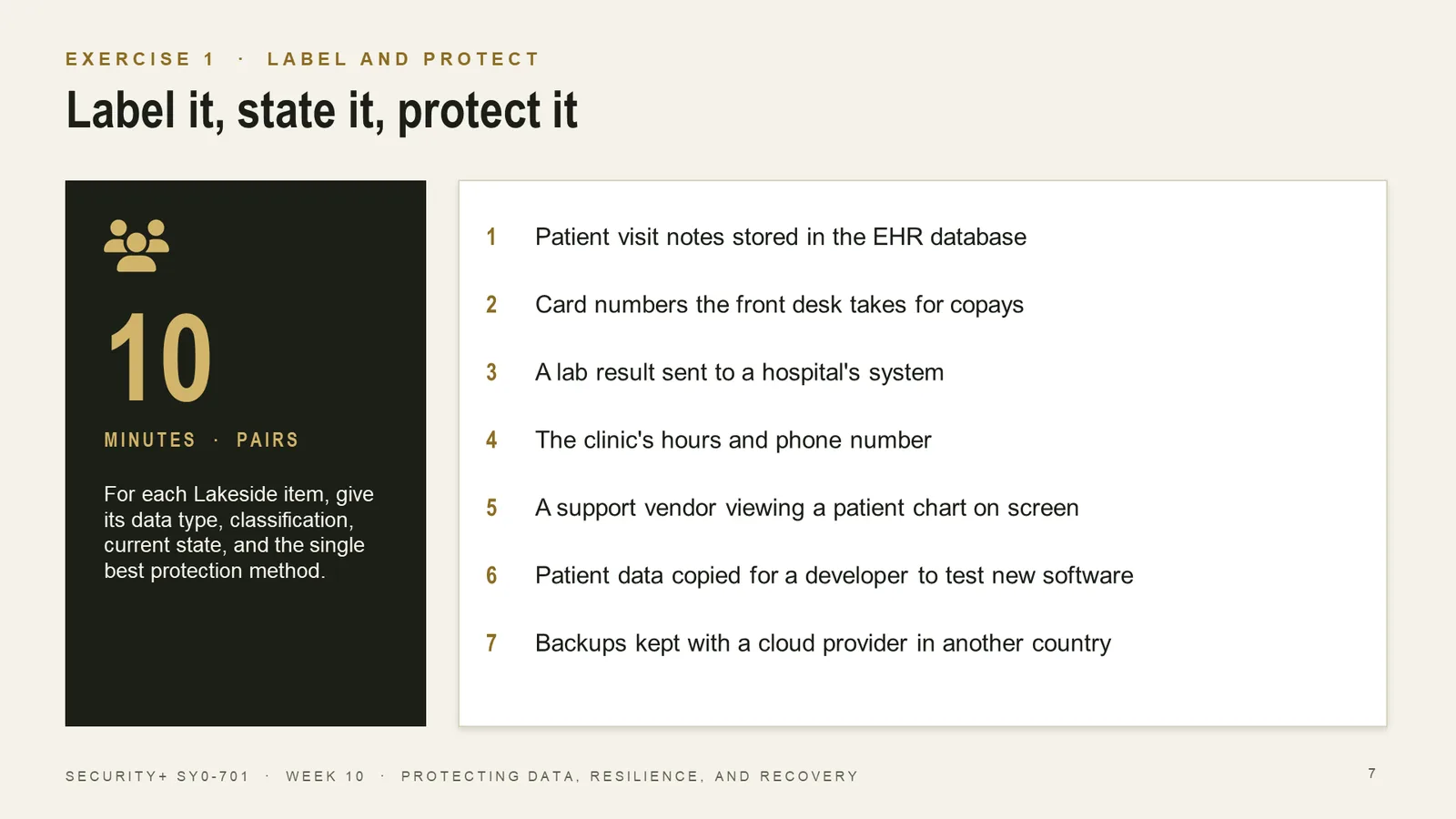
Work with a partner for 8 minutes. For each Lakeside item, write the data type, a classification label, the data's current state, and the single best protection method.
| # | Item |
|---|---|
| 1 | Patient visit notes stored in the EHR database |
| 2 | Card numbers the front desk takes for copays |
| 3 | A lab result sent to a hospital's system |
| 4 | The clinic's hours and phone number |
| 5 | A support vendor viewing a patient chart on screen |
| 6 | Patient data copied for a developer to test new software |
| 7 | Backups kept with a cloud provider in another country |
Write your answers before opening the worked answers.
7 min
High availability (HA) means designing a service to keep running when a component fails. Availability is often stated as a percentage of uptime; each extra "nine" (99.9, 99.99) costs much more than the last. The core idea is to remove single points of failure.
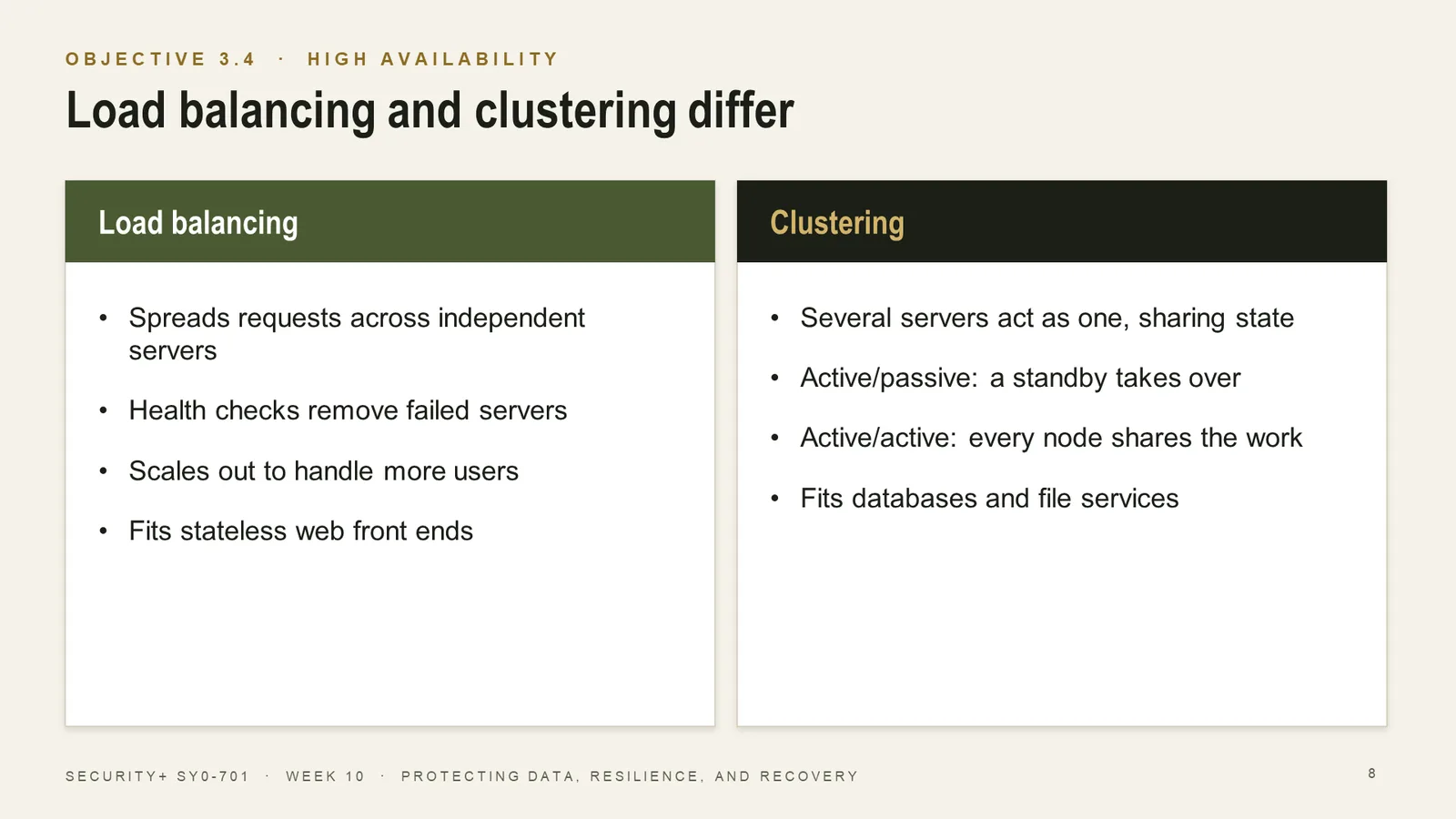
Load balancing puts a load balancer in front of several independent servers that each run the same service. It spreads requests among them and uses health checks to stop sending traffic to a server that fails. It also scales: add servers to handle more users. It works best for stateless services, such as web front ends, where any server can answer any request.
Clustering makes several servers act as one system, usually with shared storage or replicated state.
Clustering fits stateful services such as databases and file servers, where every node must see the same data.
At Lakeside, the patient portal's two web servers sit behind a load balancer. The EHR database runs as an active/passive cluster, so a failed server does not lose the data.
Watch out
Exam trap: a load balancer is itself a single point of failure unless it is deployed in a pair. And high availability is not a backup: a cluster happily replicates a deleted table or a ransomware-encrypted file to every node.
8 min
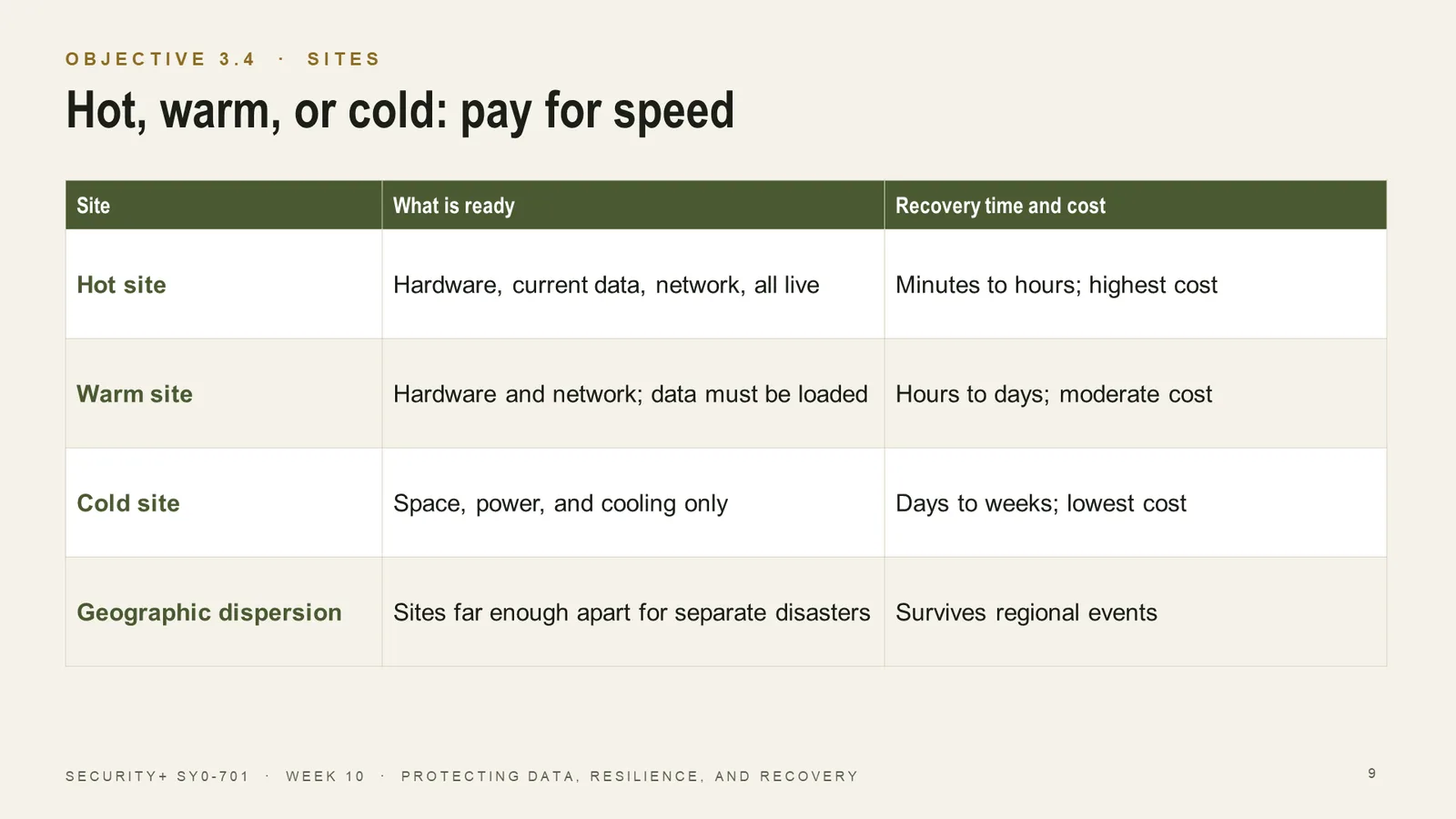
When the primary site is lost to fire, flood, or a long outage, operations move to a recovery site. The three classic types trade cost against recovery speed:
Match the site to the RTO from the business impact analysis. If Lakeside's EHR must be back within four hours, a cold site cannot meet that target at any price.
Geographic dispersion means placing sites far enough apart that one disaster cannot hit both: different flood plains, power grids, and storm paths. A recovery site across the street protects against a building fire, not a hurricane.
Cloud services change the math. A small clinic can keep a "hot" copy of its systems in a cloud region hundreds of miles away for far less than a second building, which is why many small organizations now use the cloud as their recovery site.
Tip
On the exam, the fastest recovery is a hot site, the cheapest is a cold site, and the warm site is the answer when the scenario balances cost against a recovery time of a day or two.
8 min
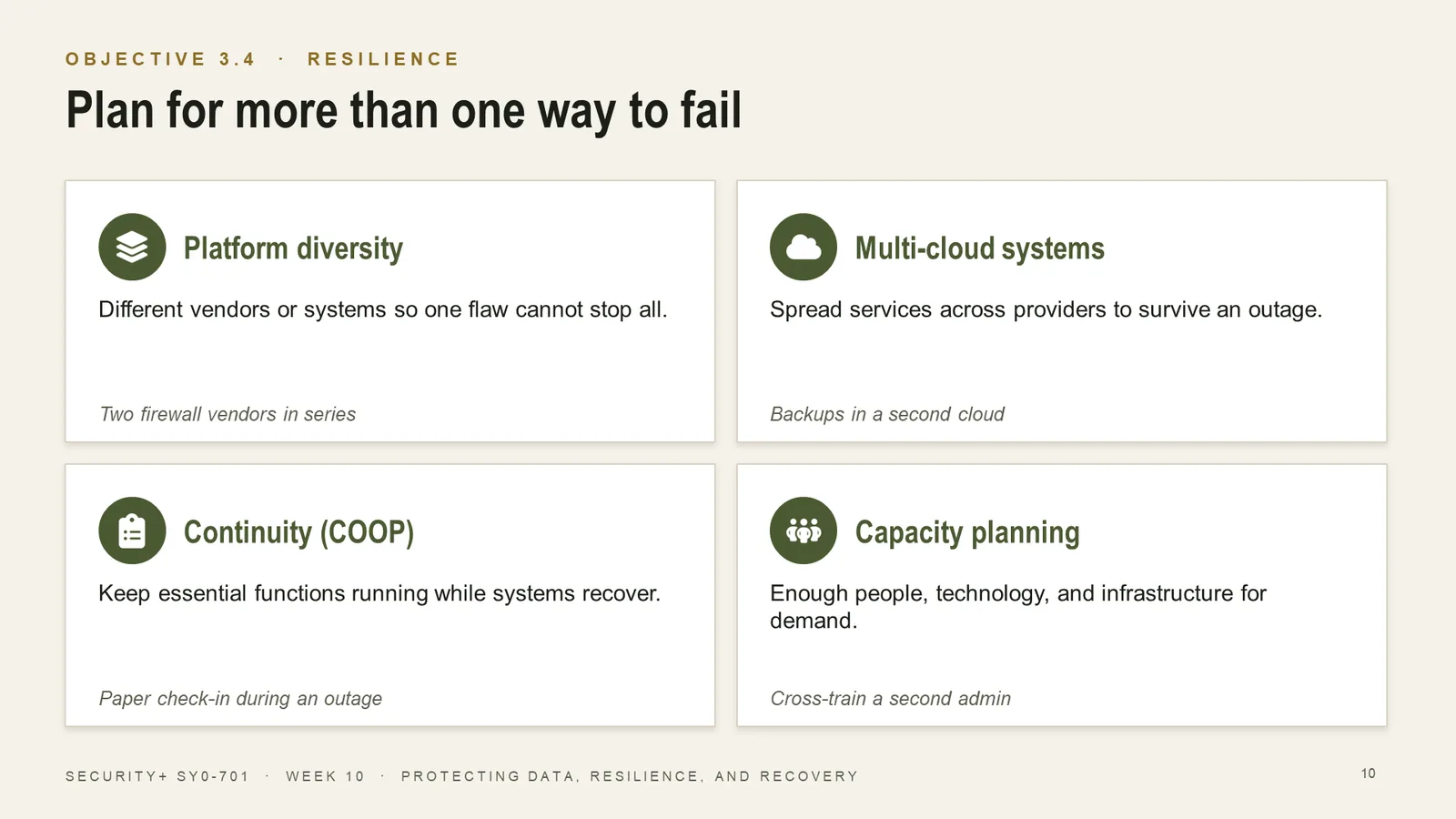
Redundancy only helps if the redundant parts do not fail together. Four ideas from 3.4 address that.
Tip
COOP is about keeping the business functioning; disaster recovery is about restoring the IT systems. A COOP plan can work with no computers at all.
6 min
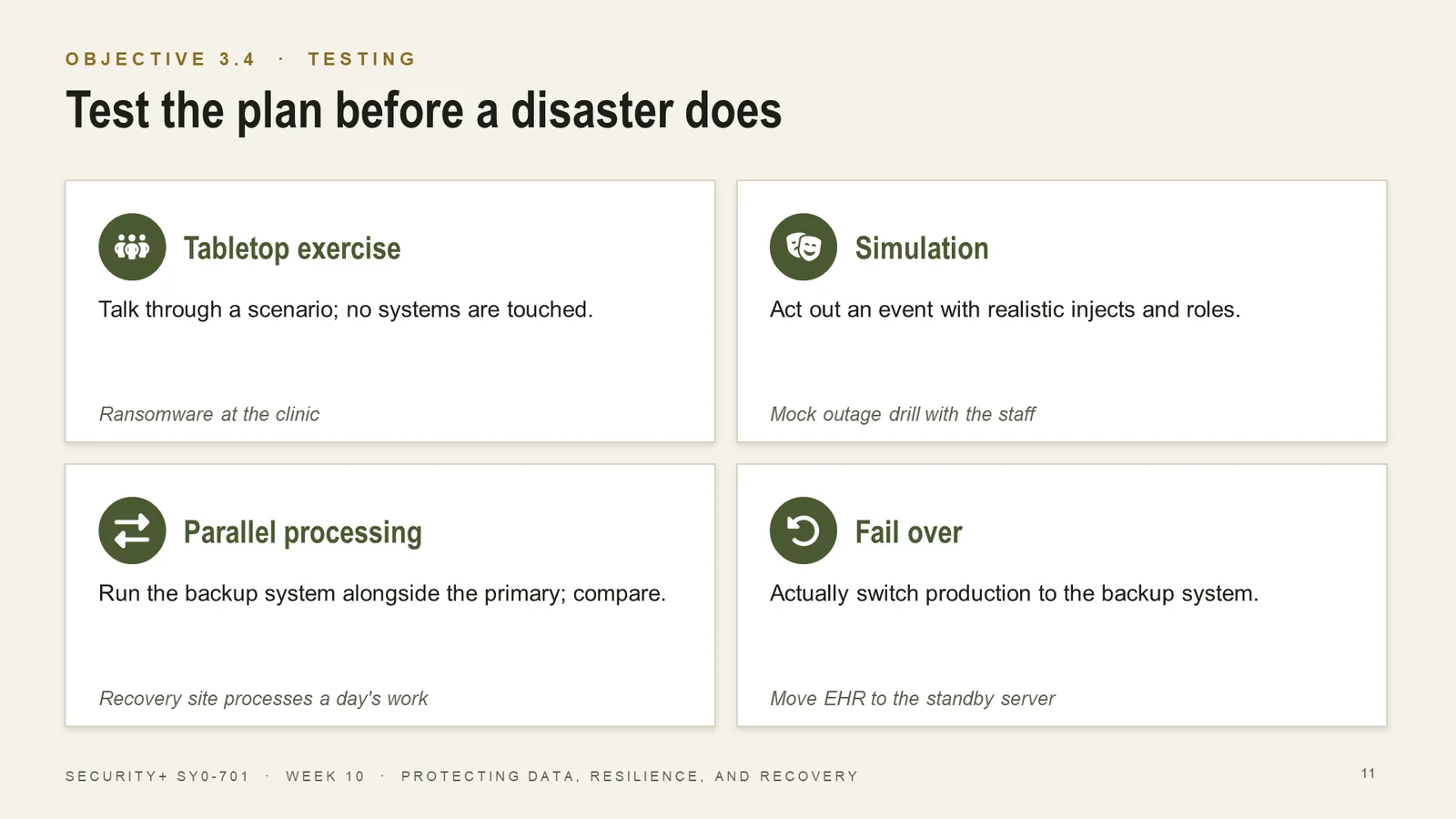
A recovery plan that has never been tested is a hypothesis. Objective 3.4 lists four kinds of tests, from least to most disruptive:
Record each test's results, the problems found, and the fixes, and update the plan. Test again after any major change.
Watch out
Exam trap: parallel processing keeps the primary running, while a fail over test moves production off it. If the scenario says operations must not be interrupted, pick tabletop, simulation, or parallel processing.
12 min
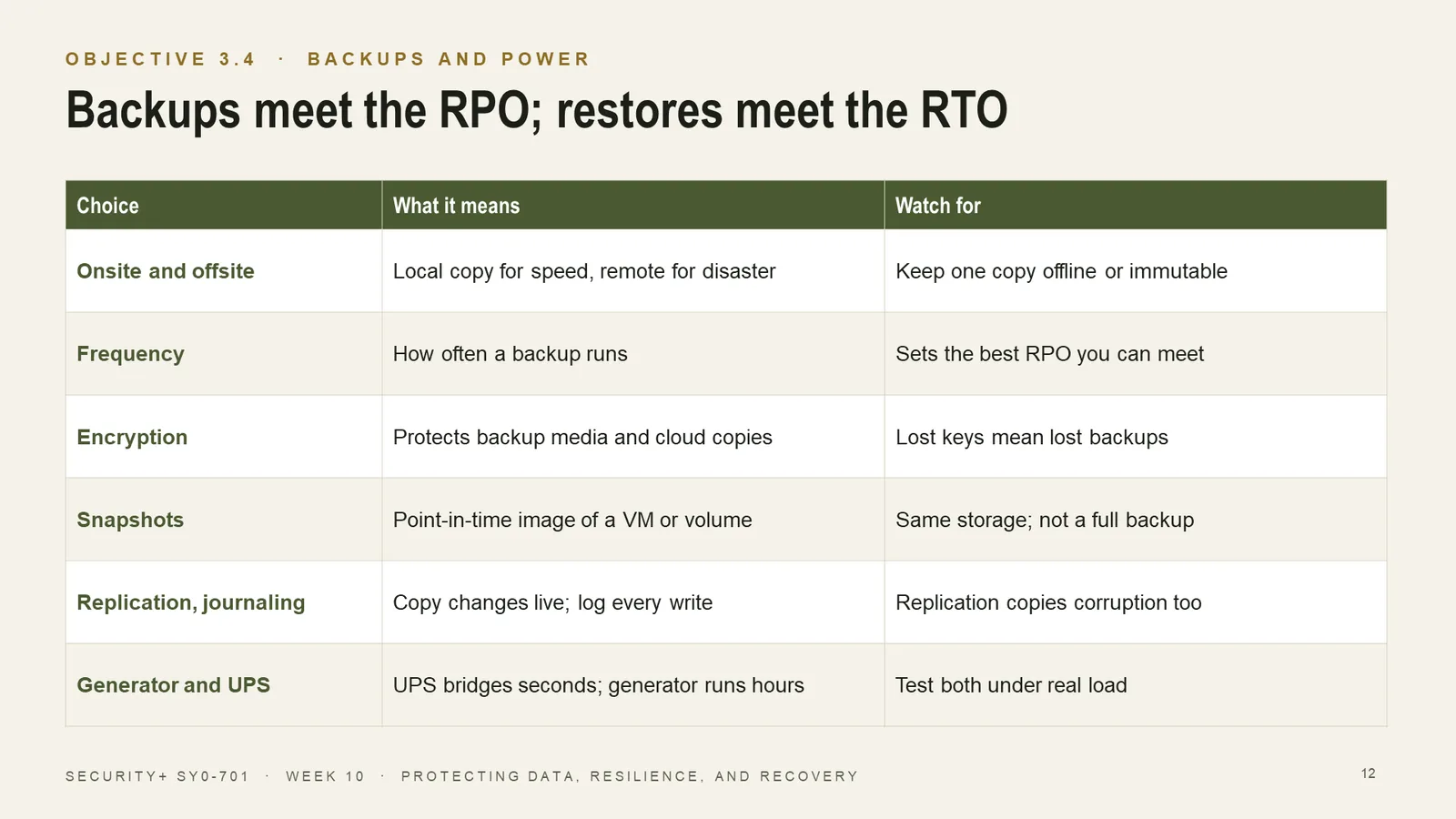
Backups are the last line of defense against ransomware, deletion, and corruption.
Power keeps everything else running:
Watch out
Exam traps. Replication and RAID are not backups. A UPS is for short outages and clean shutdowns; a generator is for long ones. Backup frequency drives RPO; restore speed drives RTO.
3 min
This week pairs two objectives that make the same point from different sides: protecting data is not finished until you can also get it back.
Answer the five review questions and take the quiz before the lab. In Lab 10 you will back up a lab VM's records folder, destroy it on purpose, and time the restore against a stated RPO and RTO.
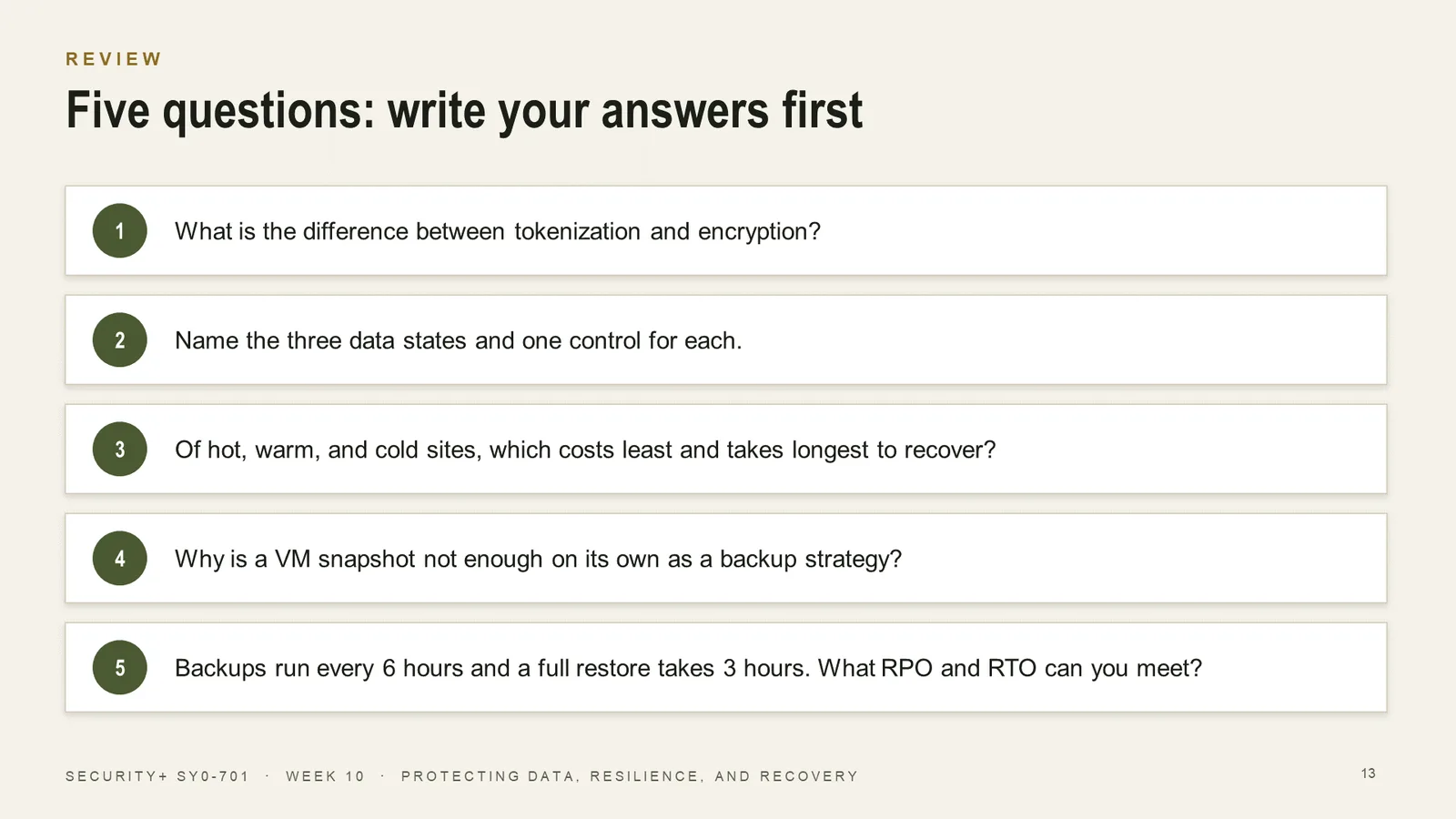
Write your answers to the five review questions first, then open each one to check it.
Encryption transforms data with an algorithm and key, and the key reverses it. Tokenization replaces the value with a random token that has no mathematical link to it; the real value can only be retrieved by looking the token up in a secured vault.
At rest: full disk or database encryption. In transit: TLS or an IPSec VPN. In use: access control, least privilege, or a secure enclave.
A cold site. It provides only space, power, cooling, and connectivity, so equipment must be brought in and everything restored.
A snapshot usually lives on the same storage and platform as the original, so a storage failure, site disaster, or ransomware attack can destroy both. A separate copy, ideally offsite and offline or immutable, is still needed.
An RPO of 6 hours at best, since up to 6 hours of changes can be lost. An RTO of about 3 hours at best, plus the time to detect the problem and decide to restore, so a realistic RTO is longer.
60 min
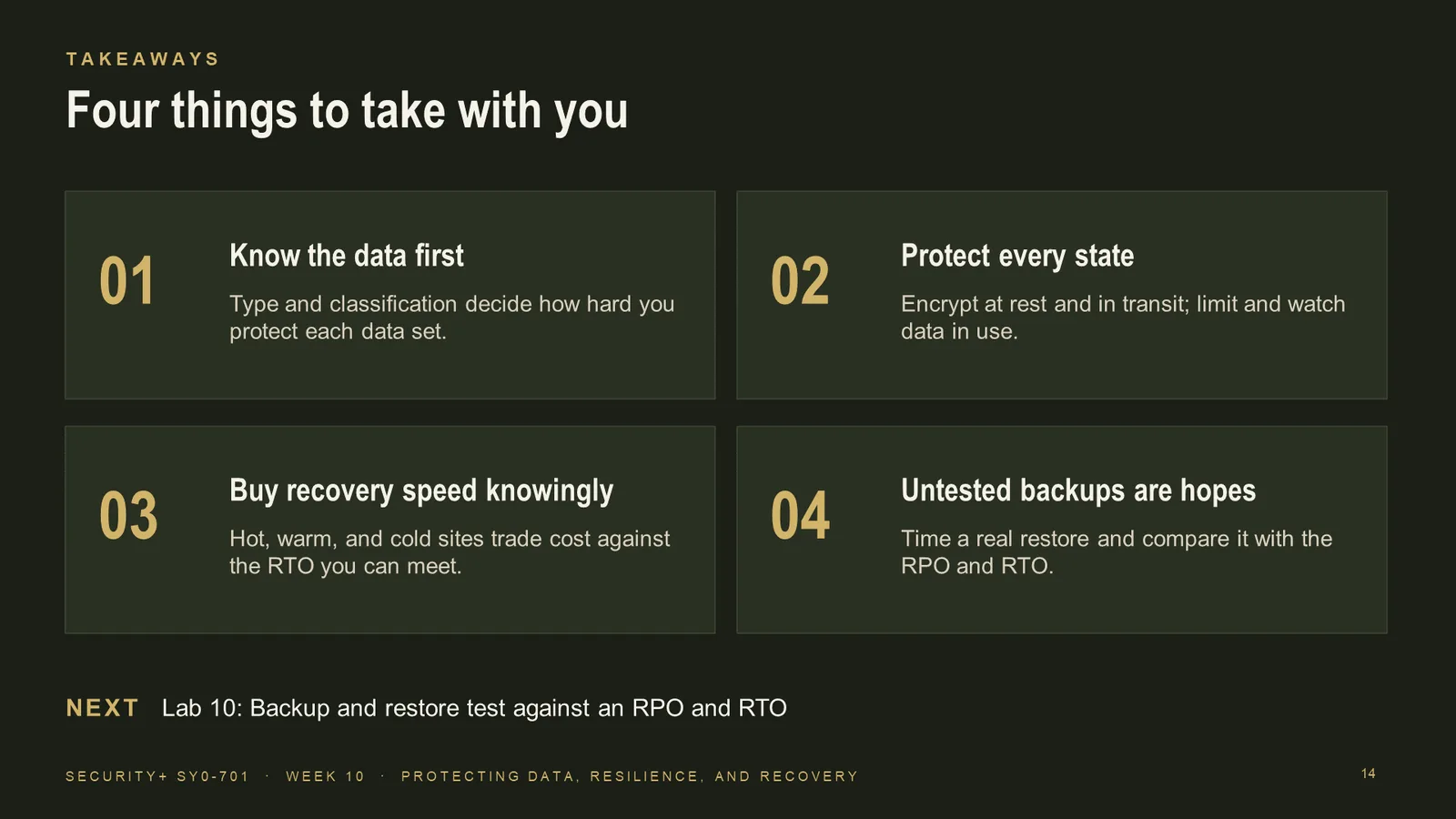
01 Know the data first
Type and classification decide how hard you protect each data set.
02 Protect every state
Encrypt at rest and in transit; limit and watch data in use.
03 Buy recovery speed knowingly
Hot, warm, and cold sites trade cost against the RTO you can meet.
04 Untested backups are hopes
Time a real restore and compare it with the RPO and RTO.
You need the Linux VM from Lab 1, VirtualBox or VMware, and about 10 GB of free disk space. Work only on lab VMs; step 5 deletes data on purpose.
Lab steps · 0 of 9 complete (0%)
A one to two page report with the targets, timestamps, measured recovery times for both methods, the sha256sum -c result, the measured data loss, and your proposed schedule.
tar extraction does not?