
Loading
Warhawk Division is a gaming community. This is a unit document, not a government or military publication.Warhawk Division is an independent gaming community, for entertainment purposes only. It is not affiliated with, sponsored by, or endorsed by Bohemia Interactive, the United States Department of Defense, or any military organization. Arma Reforger is a trademark of its respective owner. Printed from warhawkdivision.com.
Week 16 content
0 of 12 done
Slide 1 of 13
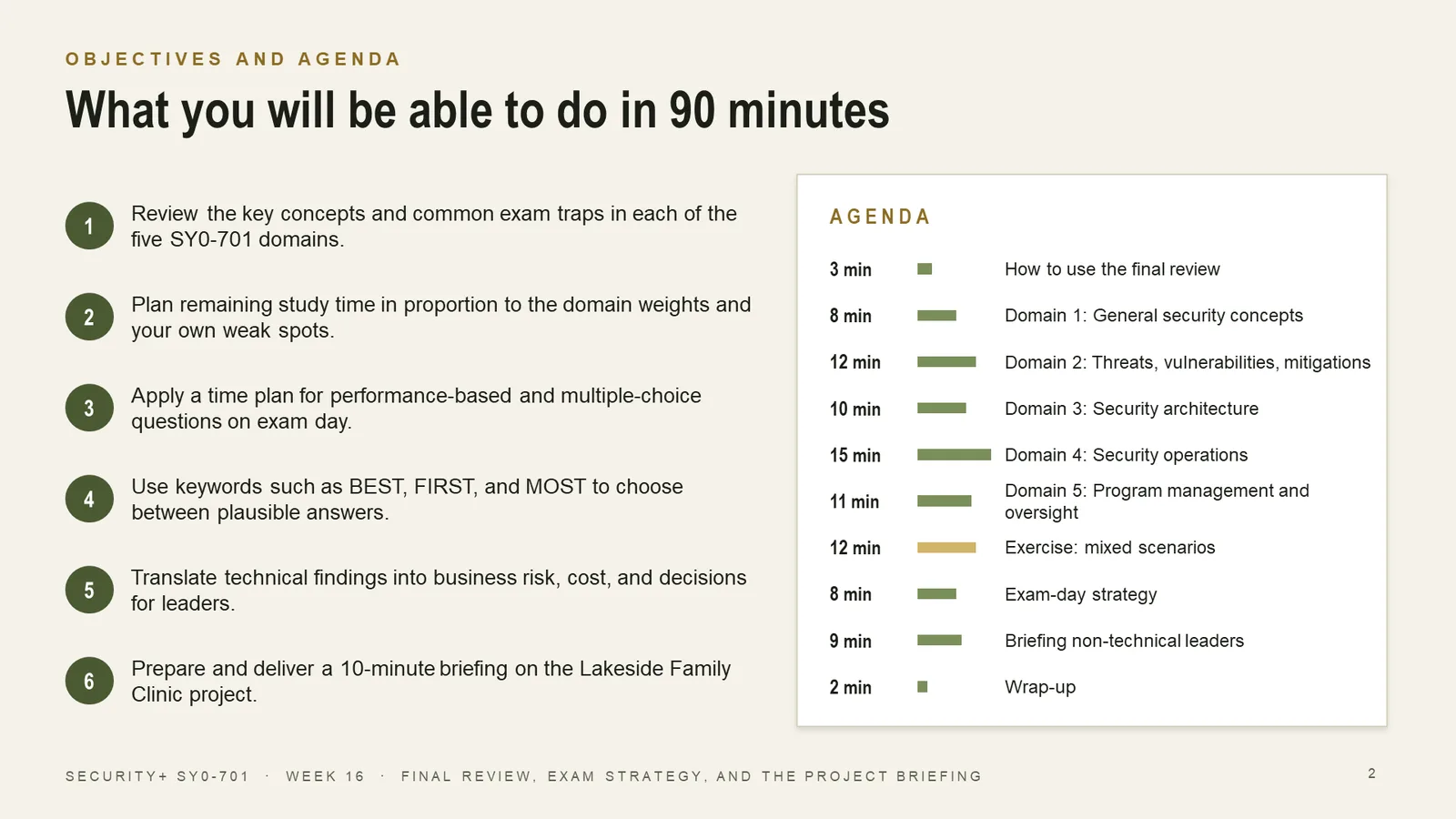
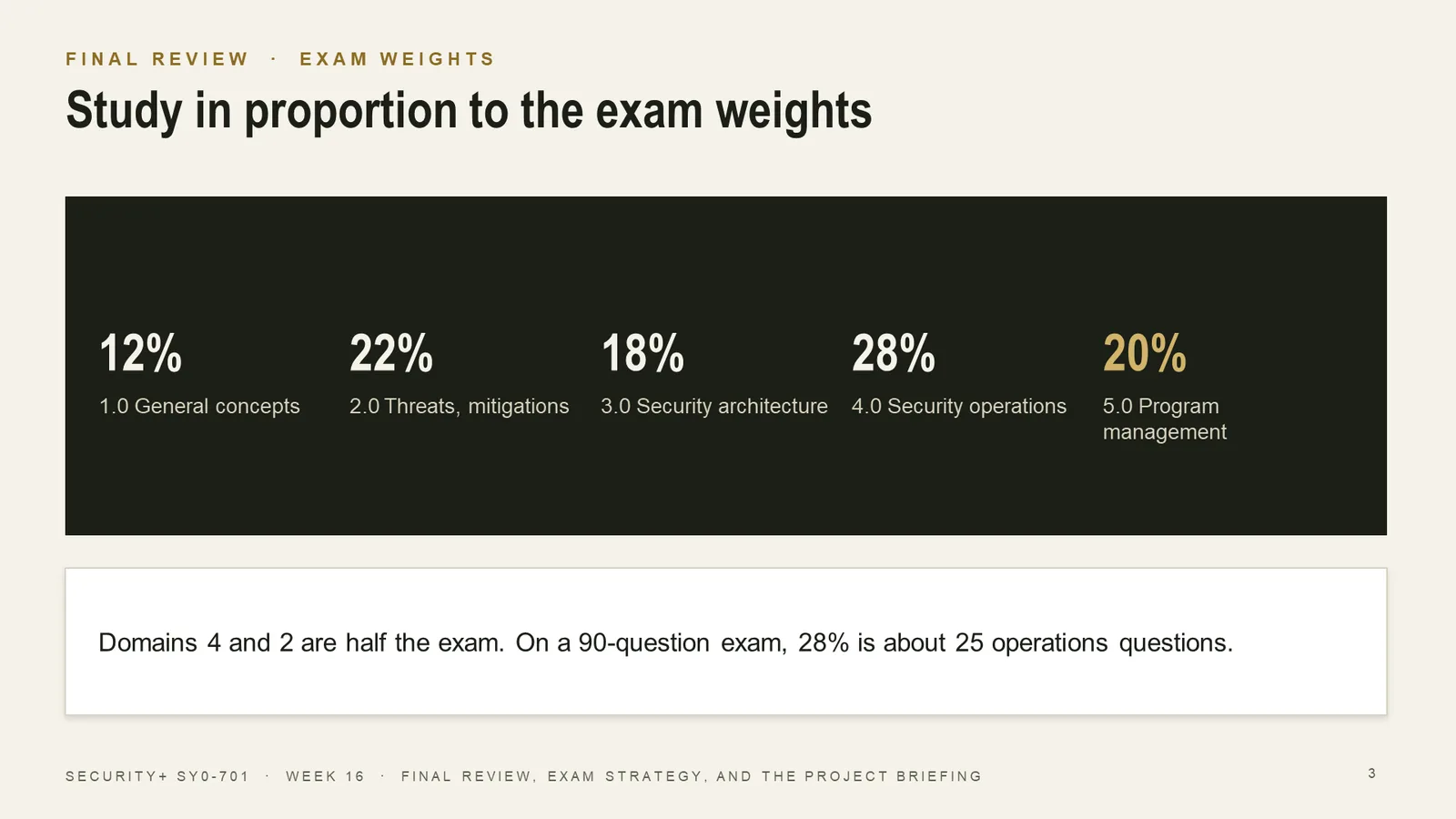
Exam objectives: 1.0 General Security Concepts (12%) 2.0 Threats, Vulnerabilities, and Mitigations (22%) 3.0 Security Architecture (18%) 4.0 Security Operations (28%) 5.0 Security Program Management and Oversight (20%)
3 min
This week pulls the whole course together. The real exam weights its five domains unevenly, and your study time should follow the same weights.
| Domain | Weight | About this many of 90 questions |
|---|---|---|
| 1.0 General Security Concepts | 12% | 11 |
| 2.0 Threats, Vulnerabilities, and Mitigations | 22% | 20 |
| 3.0 Security Architecture | 18% | 16 |
| 4.0 Security Operations | 28% | 25 |
| 5.0 Security Program Management and Oversight | 20% | 18 |
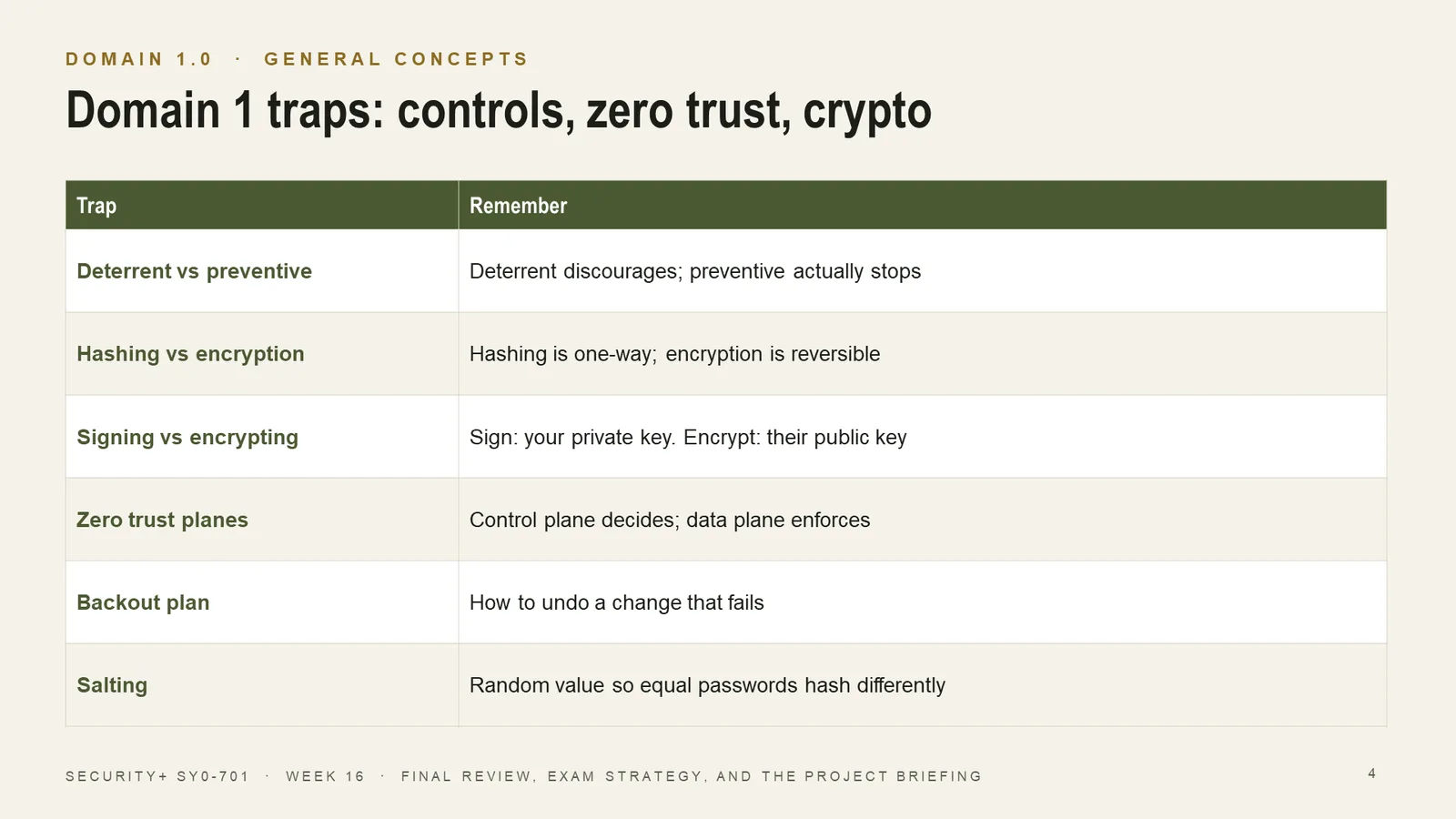
Each domain section below gives a short summary and the traps that cost students the most points. Read each one, then cover the right column of the slide table and see whether you can state the rule from memory. Anything you cannot state is on your study list.
The practice final at the end has 30 questions in the same proportions: about 4, 7, 5, 8, and 6 per domain. Take it timed, at one minute per question, and score it by domain, not just in total. A total of 80 percent can hide a domain at 50 percent.
The last part of the lesson turns to your project briefing. Security staff who can explain risk to leadership get their recommendations funded; those who cannot often do not.
8 min
Domain 1 is the vocabulary the rest of the exam assumes. It has four objectives.
1.1 Security controls. Categories (technical, managerial, operational, physical) say how a control is carried out; types (preventive, deterrent, detective, corrective, compensating, directive) say what it does. A control has one category and can serve several types.
1.2 Fundamental concepts. The CIA triad (confidentiality, integrity, availability), non-repudiation, and AAA (authentication, authorization, accounting). A gap analysis compares where you are with where you need to be. Zero trust separates a control plane (adaptive identity, threat scope reduction, policy-driven access control, the policy engine, and the policy administrator) from a data plane (subjects and systems, implicit trust zones, and the policy enforcement point). Physical security includes bollards, access control vestibules, fencing, lighting, and sensors. Deception uses honeypots, honeynets, honeyfiles, and honeytokens.
1.3 Change management. Approval, ownership, stakeholders, impact analysis, test results, a backout plan, a maintenance window, and an SOP, plus technical effects such as allow and deny lists, restarts, downtime, legacy applications, dependencies, and updated documentation.
1.4 Cryptography. Symmetric encryption uses one shared key and is fast (AES). Asymmetric encryption uses a key pair (RSA, ECC) and solves key exchange. Hashing is one-way and proves integrity; salting defeats precomputed tables, and key stretching slows guessing. A digital signature is made with the sender's private key and verified with the sender's public key. Certificates bind a public key to an identity, and revocation is checked with a CRL or OCSP. A TPM is a chip in one device; an HSM is a dedicated device that protects many keys. Obfuscation includes steganography, tokenization, and data masking.
Watch out
To send someone a confidential message, encrypt with their public key. To sign, use your private key. Mixing these up is the most common Domain 1 miss.
12 min
Domain 2 is 22 percent of the exam and covers who attacks, how, and what stops them.
2.1 Threat actors and motivations. Nation-states have the most resources and seek espionage or disruption. Organized crime wants money. Hacktivists want attention for a cause. Insider threats already have access. Unskilled attackers use other people's tools. Shadow IT is staff using unapproved systems. Motivations include data exfiltration, financial gain, espionage, revenge, and disruption.
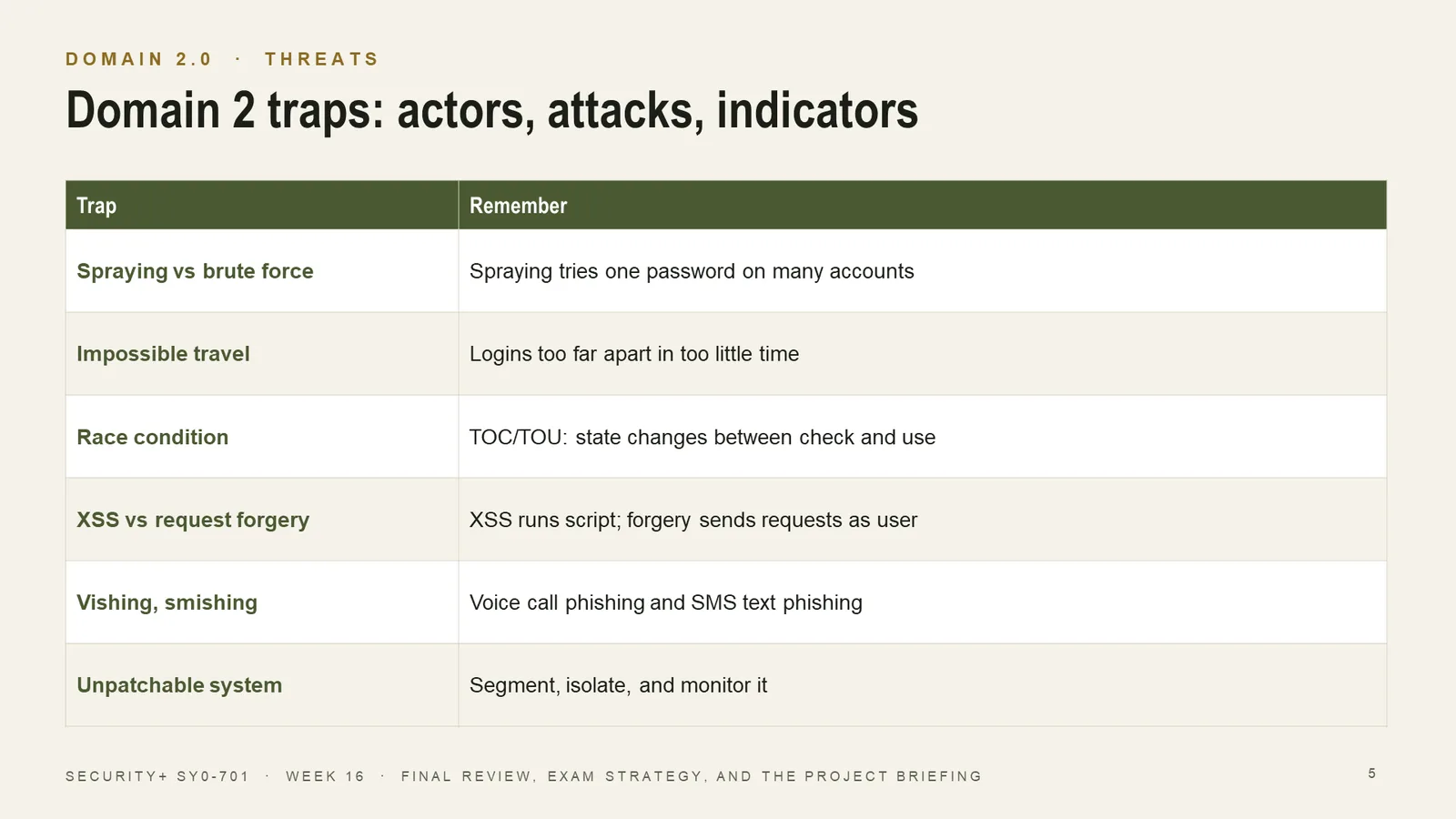
2.2 Threat vectors and attack surfaces. Message-based vectors (email, SMS, instant messaging), voice calls, removable devices, vulnerable or unsupported software, unsecure networks, open ports, default credentials, and the supply chain. Human vectors: phishing, vishing (voice), smishing (SMS), business email compromise, pretexting, impersonation, watering hole attacks, brand impersonation, and typosquatting.
2.3 Vulnerabilities. Memory injection, buffer overflow, race conditions (TOC/TOU), malicious updates, SQL injection and cross-site scripting, firmware and end-of-life hardware, VM escape and resource reuse, cloud misconfiguration, supply chain, weak cryptography, sideloading and jailbreaking, and zero-days.
2.4 Indicators of malicious activity. Malware (ransomware, trojans, worms, spyware, rootkits, logic bombs, keyloggers), network attacks (DDoS, DNS attacks, on-path, credential replay), application attacks (injection, privilege escalation, request forgery, directory traversal), and password attacks: spraying tries a few common passwords against many accounts, while brute force tries many passwords against one. Indicators include account lockouts, concurrent sessions, impossible travel, unusual resource consumption, out-of-cycle logging, and missing logs.
2.5 Mitigation techniques. Segmentation, access control lists and permissions, application allow lists, isolation, patching, encryption, monitoring, least privilege, configuration enforcement, decommissioning, and hardening: disable unused ports and services, change default passwords, and install endpoint protection, host-based firewalls, and HIPS.
Tip
When a question describes a system that cannot be patched, look for segmentation or isolation plus monitoring. Those are the compensating answers.
10 min
Domain 3 asks you to design environments that resist attack and recover from failure.
3.1 Architecture models. Know the cloud responsibility matrix: the provider secures more in SaaS, the customer more in IaaS. Know infrastructure as code, serverless, microservices, containers, virtualization, IoT, ICS/SCADA, embedded systems, and real-time operating systems. Air-gapped networks are physically isolated; VLANs and SDN segment logically. Weigh availability, resilience, cost, scalability, ease of recovery, and whether a system can be patched at all.
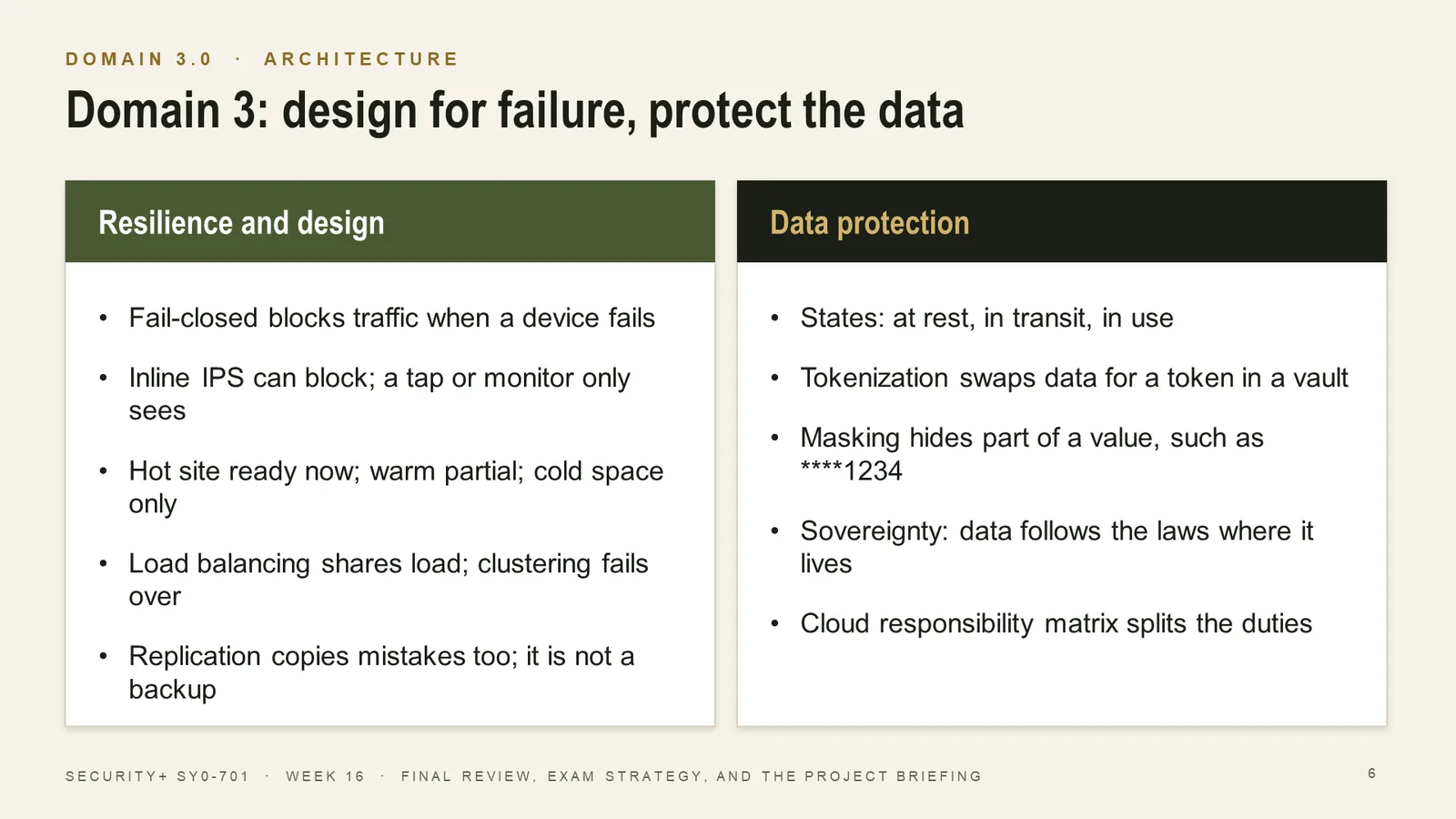
3.2 Secure infrastructure. Place devices by security zone and attack surface. A fail-open device lets traffic through when it fails, which favors availability; fail-closed blocks it, which favors security. An inline IPS can block; a tap or monitor sensor only sees copies. Know jump servers, proxies, load balancers, 802.1X with EAP for port security, WAFs, UTMs, next-generation firewalls (layer 7), VPNs with TLS or IPsec, SD-WAN, and SASE.
3.3 Data protection. Data types (regulated, trade secret, intellectual property, legal, financial) and classifications (sensitive, confidential, public, restricted, private, critical). States: at rest, in transit, in use. Data sovereignty means data is subject to the laws of the country where it is stored. Methods: geographic restrictions, encryption, hashing, masking (hide part of the value), tokenization (swap the value for a token mapped in a secure vault), obfuscation, segmentation, and permission restrictions.
3.4 Resilience and recovery. High availability through load balancing (sharing load) or clustering (standby nodes take over). Sites: hot (ready now), warm (equipment in place, needs data and setup), cold (space and power only). Geographic dispersion, platform diversity, multi-cloud, continuity of operations, and capacity planning for people, technology, and infrastructure. Test with tabletops, failover, simulation, and parallel processing. Backups: onsite and offsite, frequency, encryption, snapshots, replication, and journaling. Power: a UPS for short gaps, generators for long ones.
Watch out
Replication copies mistakes and ransomware almost instantly. It improves availability, but it is not a backup.
15 min
Domain 4 is 28 percent of the exam, the largest. It has nine objectives, so study it in chunks.
4.1 Baselines and hardening. Establish, deploy, and maintain secure baselines, often from CIS Benchmarks. Harden workstations, servers, network devices, mobile devices, cloud, ICS, and IoT. Wireless: WPA3, RADIUS with 802.1X, site surveys and heat maps. Mobile: MDM with BYOD, COPE, or CYOD. Applications: input validation, secure cookies, static code analysis, code signing, sandboxing.
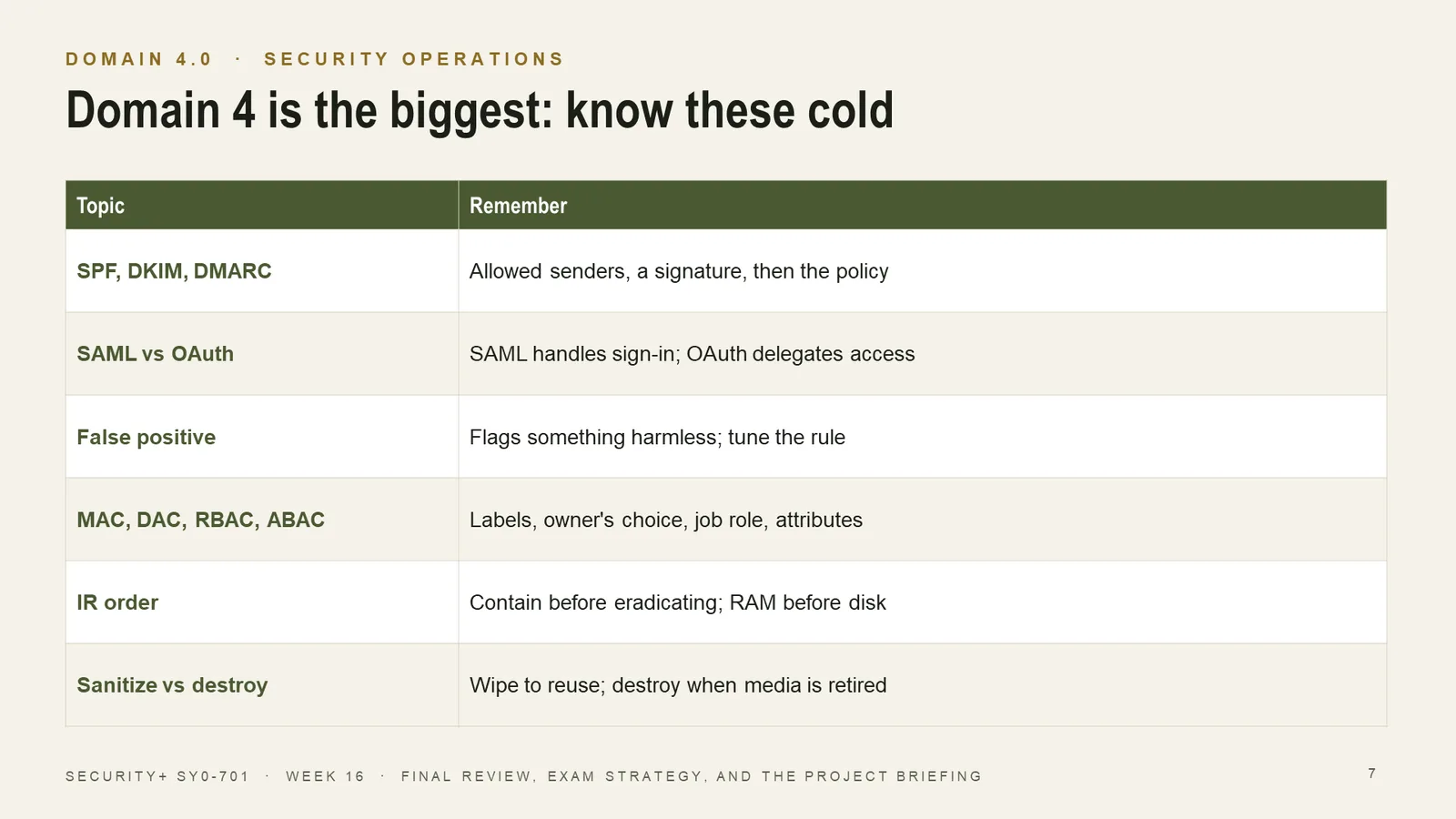
4.2 Asset management. Acquisition, assignment of owners and classification, inventory, and disposal: sanitize media you will reuse, destroy media you retire, and get a certificate of destruction from vendors.
4.3 Vulnerability management. Identify (scans, static and dynamic analysis, threat feeds, pen tests, bug bounties), analyze (confirm, rule out false positives, prioritize with CVSS and CVE), respond (patch, insure, segment, add compensating controls, or grant an exception), validate by rescanning, and report.
4.4 and 4.5 Monitoring and enterprise capabilities. Log aggregation, alerting and alert tuning, SIEM, SCAP, agent and agentless tools, NetFlow, SNMP traps, DLP. Firewall rules and ACLs, screened subnets, IDS/IPS, web and DNS filtering, Group Policy and SELinux, file integrity monitoring, NAC, EDR/XDR, and user behavior analytics. Email: SPF lists allowed sending servers, DKIM signs messages, DMARC tells receivers what to do when checks fail.
4.6 Identity and access management. Provisioning and deprovisioning, identity proofing, federation, SSO with LDAP, SAML, and OAuth, MFA, passwordless, and privileged access management with just-in-time access, vaulting, and ephemeral credentials. Access models: MAC (labels), DAC (owner decides), RBAC (job role), rule-based, ABAC (attributes), time-of-day restrictions, and least privilege.
4.7 Automation and orchestration. Provisioning, guardrails, ticketing, and CI/CD. Benefits are speed and consistency; risks are complexity, cost, a single point of failure, and technical debt.
4.8 and 4.9 Incident response and data sources. The seven phases, tabletops and simulations, root cause analysis, threat hunting, legal hold, chain of custody, order of volatility, and matching each log to the question it answers.
Tip
FIRST in an incident question usually means containment once the incident is confirmed, and RAM before disk when collecting evidence.
11 min
Domain 5 is 20 percent of the exam and the least technical, which makes it easy to underestimate.
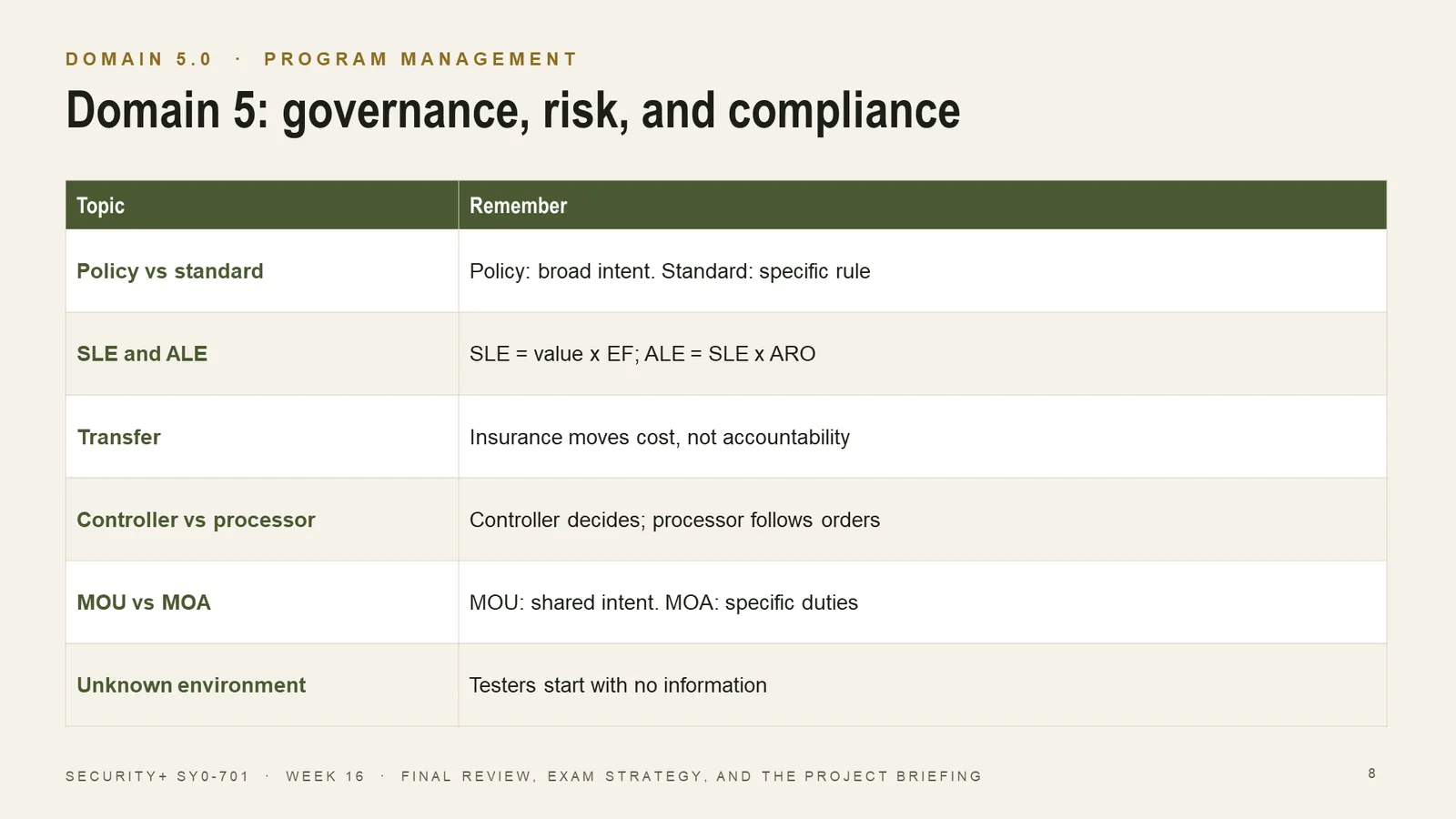
5.1 Governance. Policies (AUP, information security, business continuity, disaster recovery, incident response, SDLC, change management), standards (password, access control, physical security, encryption), procedures (change management, onboarding and offboarding, playbooks), and guidelines. Boards, committees, government entities, and centralized or decentralized structures. Owners, controllers, processors, and custodians or stewards.
5.2 Risk management. Identification; assessments that are ad hoc, recurring, one-time, or continuous; qualitative and quantitative analysis. SLE = asset value x EF and ALE = SLE x ARO. The risk register with owners, key risk indicators, and thresholds. Appetite (expansionary, neutral, conservative) and tolerance. Strategies: transfer, accept (with exemptions and exceptions), avoid, and mitigate. BIA metrics: RTO, RPO, MTTR, and MTBF.
5.3 Third-party risk. Due diligence and conflicts of interest; right-to-audit clauses, evidence of internal audits, independent assessments, and supply chain analysis; questionnaires, rules of engagement, and ongoing monitoring. Agreements: SLA, MOA, MOU, MSA, WO/SOW, NDA, and BPA.
5.4 Compliance. Internal and external reporting; fines, sanctions, reputational damage, loss of license, and contractual impacts. Due diligence and due care, attestation and acknowledgement, and automation. Privacy: the data subject, controller vs processor, ownership, data inventory and retention, and the right to be forgotten.
5.5 Audits and assessments. Internal (compliance, audit committee, self-assessments) and external (regulatory, examinations, assessments, independent third-party audits). Penetration tests: physical, offensive, defensive, and integrated; known, partially known, and unknown environments; passive and active reconnaissance.
5.6 Security awareness. Phishing campaigns, recognizing and reporting phishing, risky, unexpected, and unintentional behavior, user training topics, initial and recurring training, and program development and execution.
Watch out
Transfer moves the financial impact, not accountability. If cyber insurance pays after a breach, regulators still hold the clinic responsible.
12 min
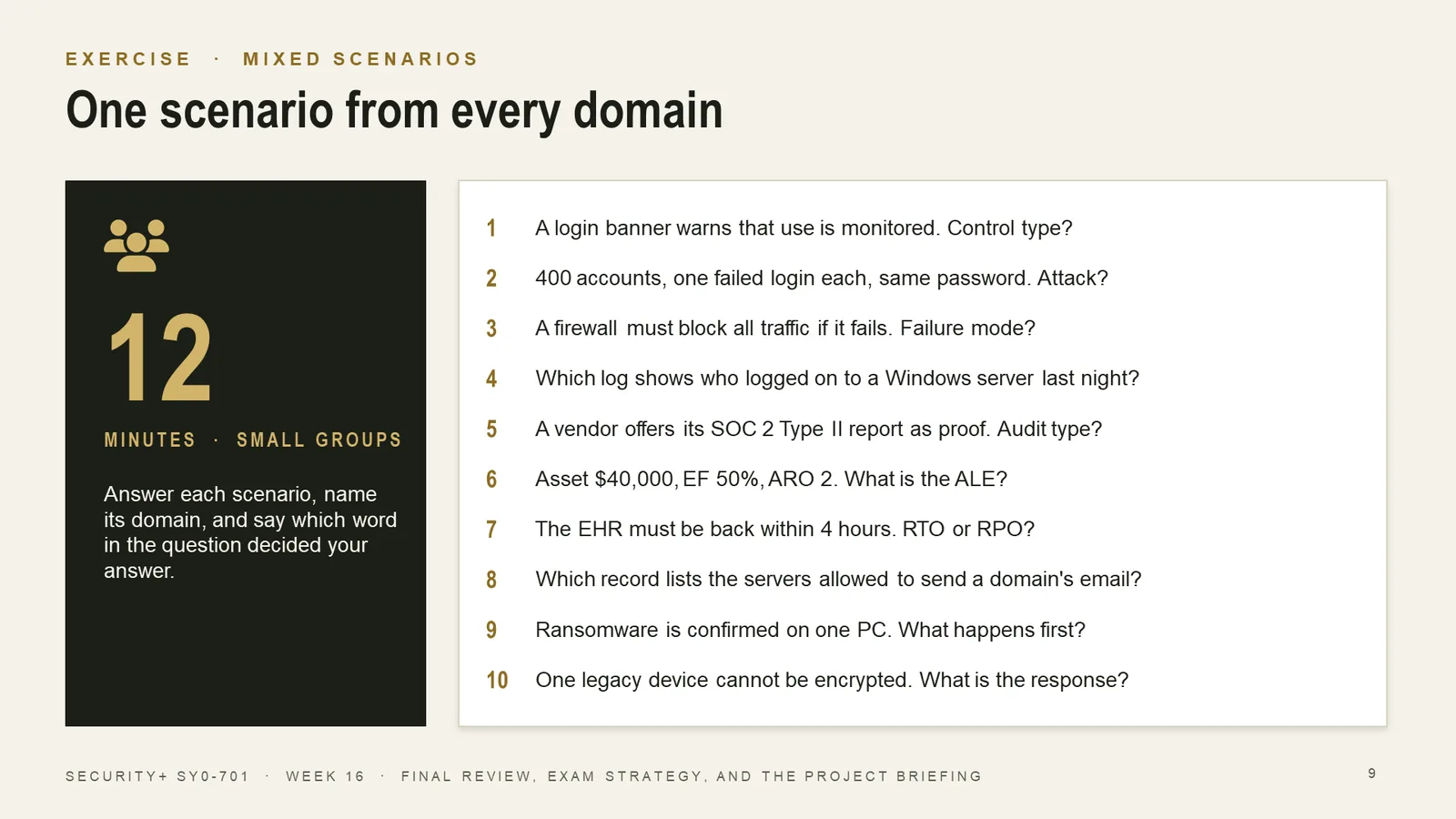
Work in small groups for twelve minutes. Each scenario comes from a different part of the exam. For each one, give the answer, name the domain, and identify the word in the question that decided it.
| # | Answer | Domain | Deciding word |
|---|---|---|---|
| 1 | Deterrent (also directive) | 1.0 | "warns": it discourages but cannot stop anyone |
| 2 | Password spraying | 2.0 | "many accounts, same password" |
| 3 | Fail-closed | 3.0 | "block all traffic" |
| 4 | OS-specific security log (Windows Security log, event 4624) | 4.0 | "logged on" |
| 5 | Independent third-party audit; the report is an attestation | 5.0 | "SOC 2" from an outside CPA firm |
| 6 | SLE = $40,000 x 0.5 = $20,000; ALE = $20,000 x 2 = $40,000 | 5.0 | "ALE" |
| 7 | RTO | 3.0 and 5.0 | "running again within": time to restore |
| 8 | SPF, published as a DNS TXT record | 4.0 | "allowed to send" |
| 9 | Isolate the PC from the network and leave it powered on | 4.0 | "confirmed" and "first": containment |
| 10 | A compensating control, such as isolating the device and adding monitoring, recorded as a documented exception | 1.0 and 5.0 | "cannot be" |
Debrief points.
8 min
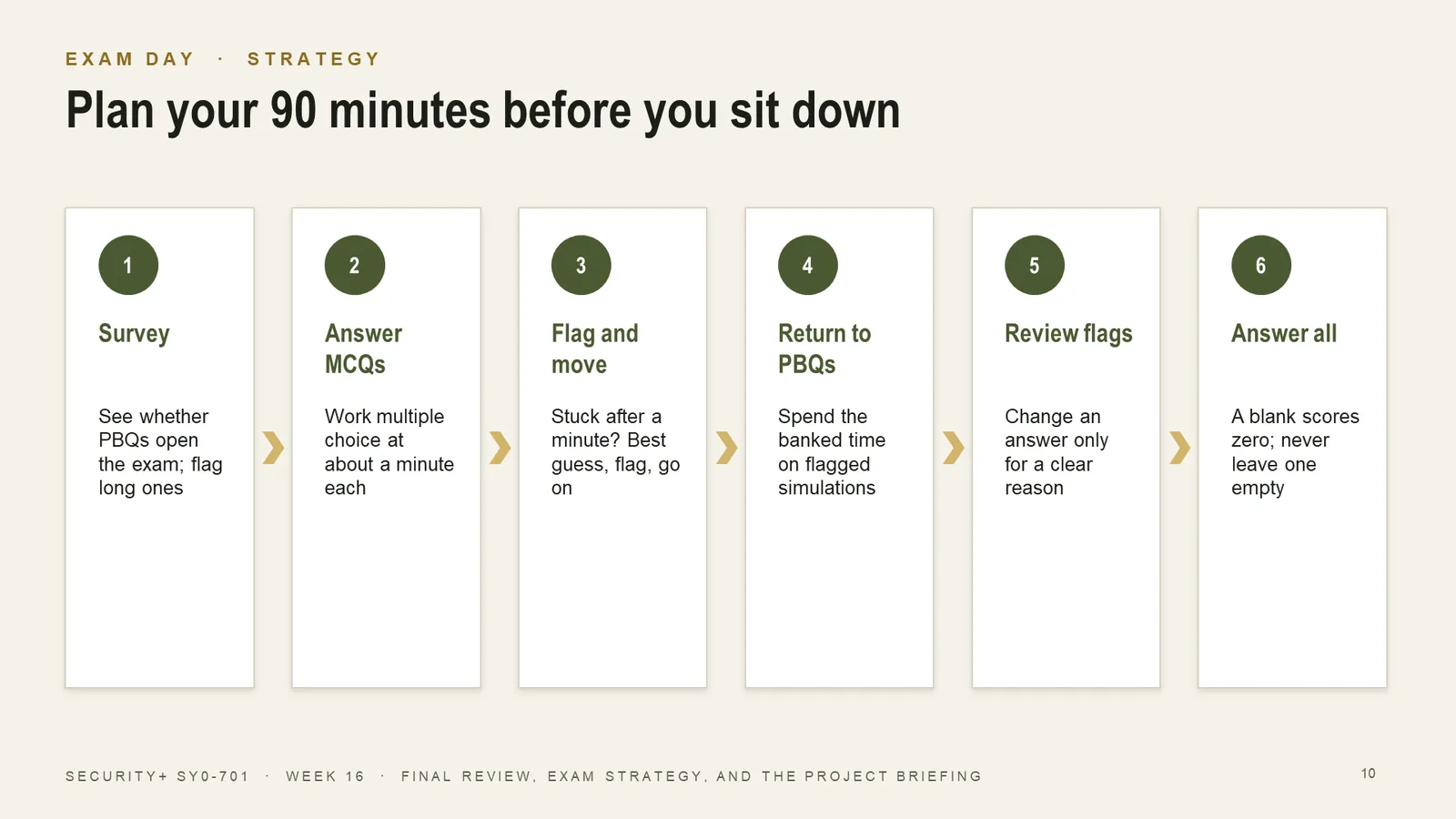
The SY0-701 exam has at most 90 questions in 90 minutes, and the passing score is 750 on a scale of 100 to 900. Some questions are performance-based questions (PBQs): you drag items into place, build firewall rules, read logs, or match attacks to controls. They often appear at the start and can take five to ten minutes each.
A plan that works for many students:
Read like an examiner. In a long scenario, read the last sentence first so you know what you are looking for. Watch the keywords: BEST means more than one answer may work, so pick the most complete; FIRST asks about order; MOST likely asks about probability. Answer the way the exam objectives describe the topic, not the way your own workplace happens to do it.
Before exam day. Book the exam for two to four weeks after this course. Check the testing center or online proctoring rules, have the required ID ready, and sleep the night before. Last-minute cramming hurts recall more than it helps.
Tip
Do one full timed run first: 90 questions, 90 minutes, no notes. Score it by domain to see where your last study hours should go.
9 min
Your project ends with a 10-minute briefing to Lakeside's leadership: the owner-physicians and the practice manager. They are smart, busy, and not technical. They want answers to four questions: how bad is it, what will it cost, what do you need from us, and what happens if we do nothing?
Start with the bottom line. The first minute states your conclusion and your request. For example: "The clinic's biggest risk is a ransomware attack that would stop patient care for days. Three changes costing about $22,000 in the first year sharply reduce that risk. We are asking for your approval today."
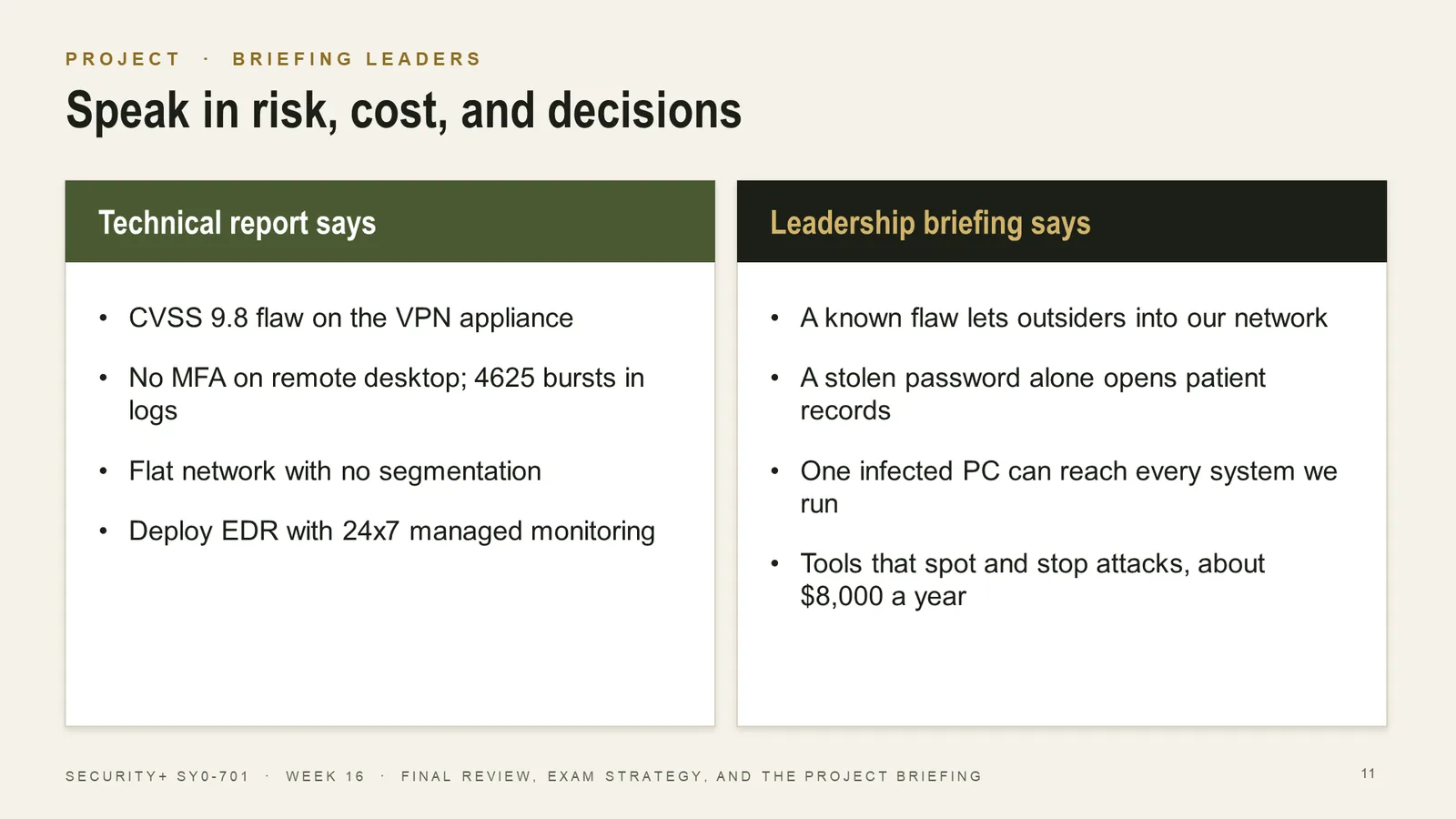
Translate every finding into business terms.
Limit the asks. Present three to five prioritized recommendations, each with its cost, effort, owner, and the risk it reduces. Offer options where they exist: do it now, phase it in, or accept the risk with a signed exception.
Prepare for questions. Expect "Has this happened to clinics like us?", "What does our insurance cover?", and "What is the cheapest thing we can do this month?" If you do not know an answer, say so and promise a follow-up. Never bluff.
Avoid unexplained acronyms, tool names, fear-based language, and blame. Leaders tune out alarms and act on clear trade-offs. Your report holds the technical evidence; the briefing exists to get a decision.
Tip
Try your slides on someone outside the field. If after two minutes they cannot tell you the top risk and the decision you need, simplify.
2 min
You have now covered every objective in the SY0-701 exam. The pattern across all five domains is the same: name the concept precisely, recognize it in a scenario, and choose the control or action that fits the situation best.
In the time before the exam, study by weight and by weakness. Domains 4 and 2 together are half the exam, and your practice final, scored by domain, shows where your own gaps are. For each weak domain, go back to that week's review questions and quiz, and redo the exercises without looking at the answers first.
For the project, the report and the briefing are the same work for two audiences. The report gives the evidence; the briefing asks for a decision. Keep the briefing short, plain, and honest about cost and risk.
The skills you practiced in this course, from writing a risk register to running a tabletop exercise, are the daily work of entry-level security staff. Book the exam while the material is fresh.
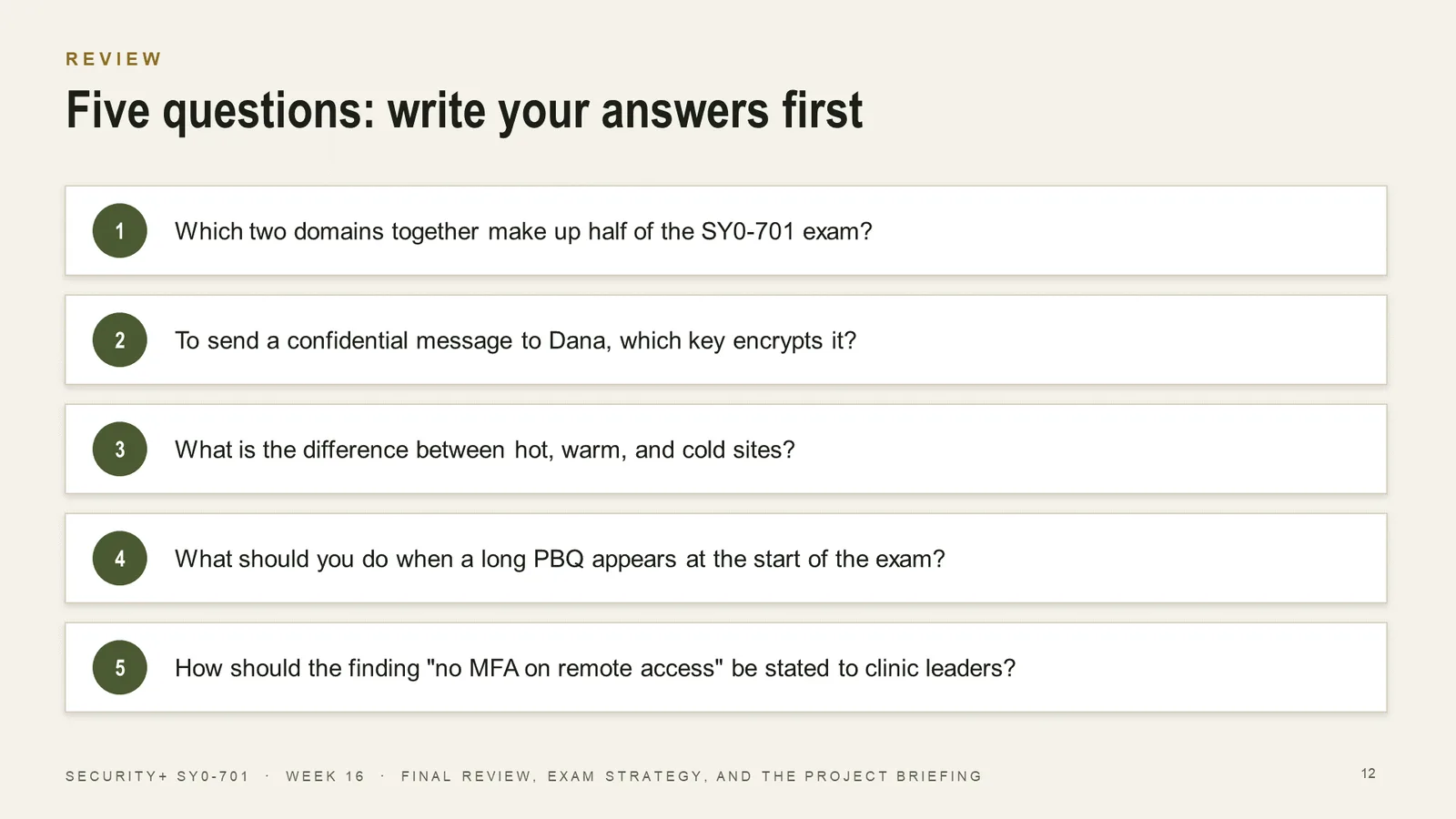
Write your answers to the five review questions first, then open each one to check it.
Domain 4.0, Security Operations (28%), and Domain 2.0, Threats, Vulnerabilities, and Mitigations (22%).
Dana's public key. Only Dana's private key can decrypt the message.
A hot site is ready to take over almost immediately. A warm site has some equipment in place but needs current data and setup. A cold site has space and power only.
Flag it, answer the multiple-choice questions, and return with the time you banked. Do as much of it as you can and never leave it blank.
In business terms: a stolen password alone lets an outsider reach patient records from anywhere, followed by the cost to fix it and the decision you need from them.
60 min
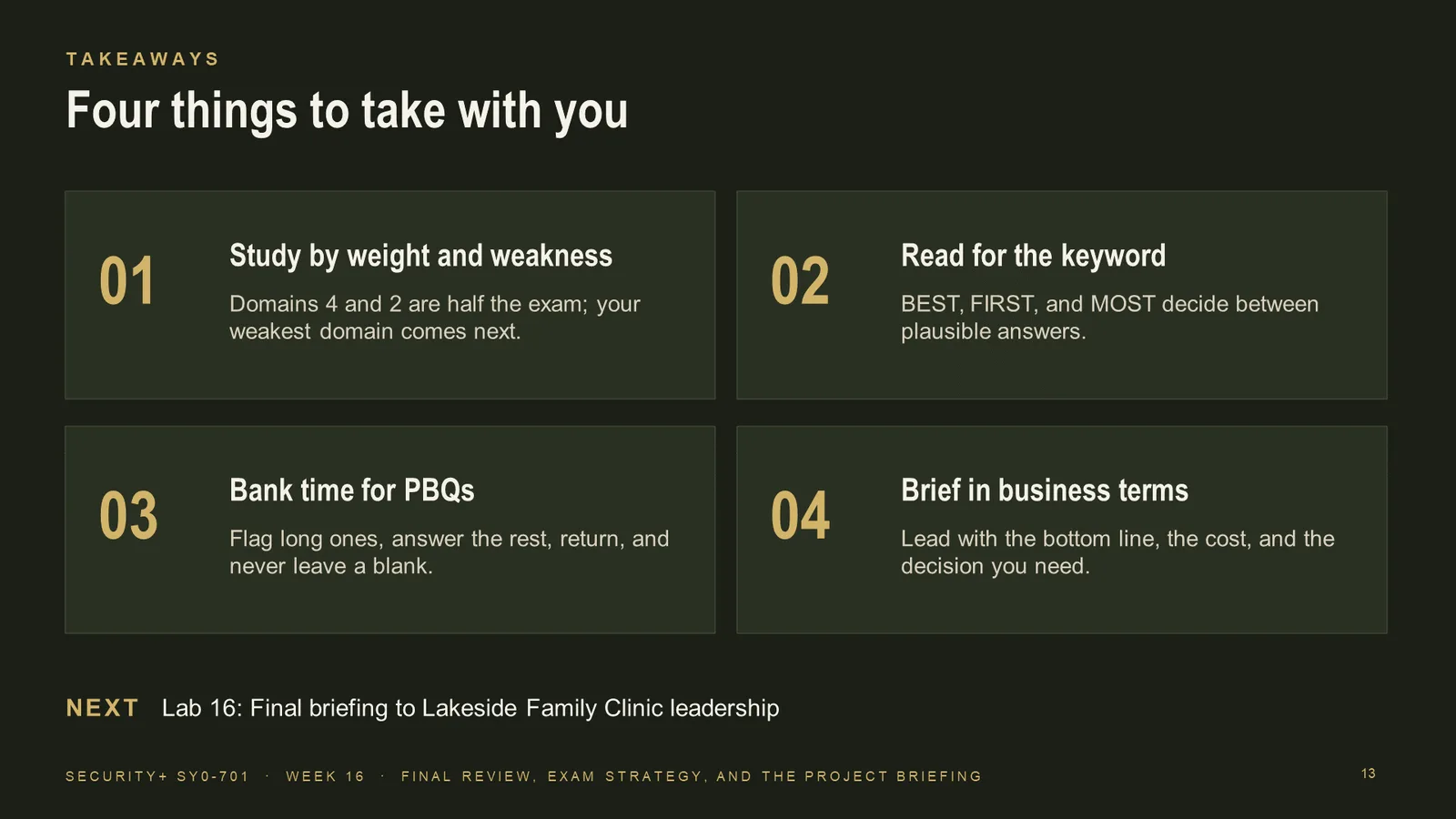
01 Study by weight and weakness
Domains 4 and 2 are half the exam; your weakest domain comes next.
02 Read for the keyword
BEST, FIRST, and MOST decide between plausible answers.
03 Bank time for PBQs
Flag long ones, answer the rest, return, and never leave a blank.
04 Brief in business terms
Lead with the bottom line, the cost, and the decision you need.
You need your final project report, presentation software, and a timer. The instructor and two classmates act as the clinic's leadership panel: an owner-physician, the practice manager, and the clinic's outside accountant.
Lab steps · 0 of 8 complete (0%)
Your slide deck (eight slides or fewer), a one-page leave-behind summary for the panel, and a half-page reflection on the questions you received and what you would change. Submit them with your final project report.