
Loading
Warhawk Division is a gaming community. This is a unit document, not a government or military publication.Warhawk Division is an independent gaming community, for entertainment purposes only. It is not affiliated with, sponsored by, or endorsed by Bohemia Interactive, the United States Department of Defense, or any military organization. Arma Reforger is a trademark of its respective owner. Printed from warhawkdivision.com.
Week 4 content
0 of 13 done
Slide 1 of 14
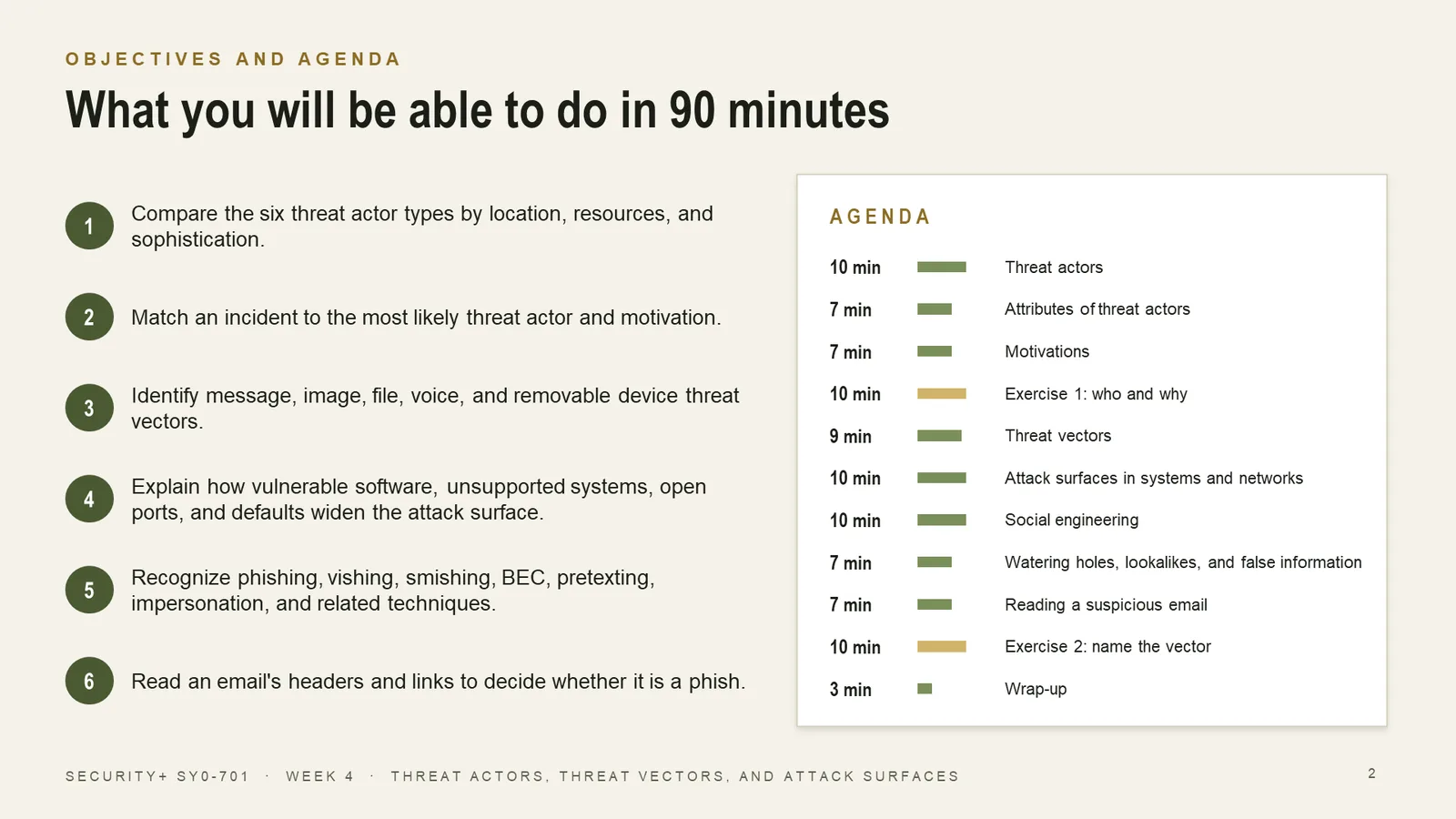
Exam objectives: 2.1 Compare and contrast common threat actors and motivations. 2.2 Explain common threat vectors and attack surfaces.
10 min
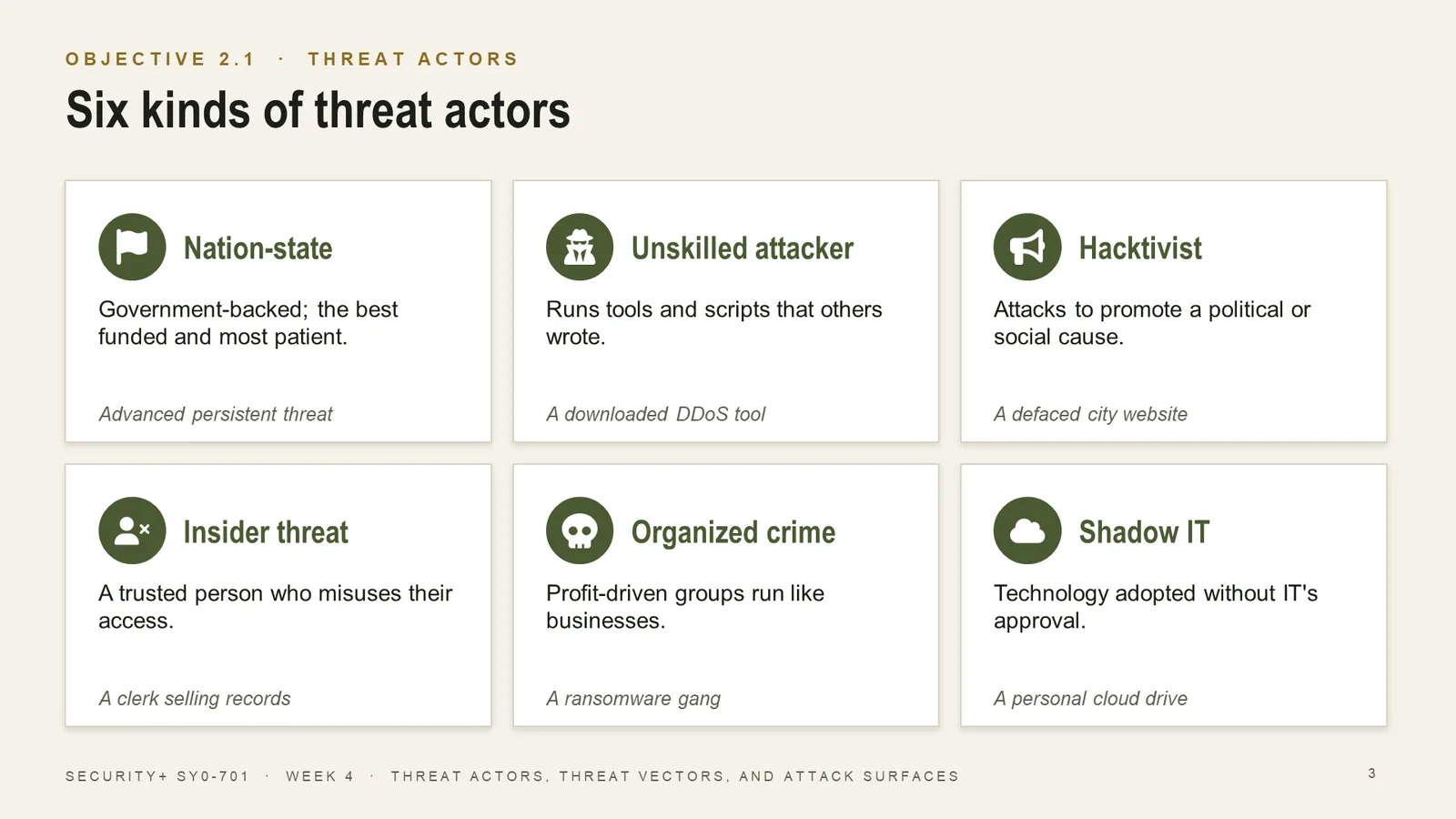
A threat actor is the person or group behind an attack. The exam names six.
Tip
Shadow IT is on the exam's list of threat actors even though it is rarely malicious. If a question describes unapproved technology adopted to get work done, the answer is shadow IT, not insider threat.
7 min
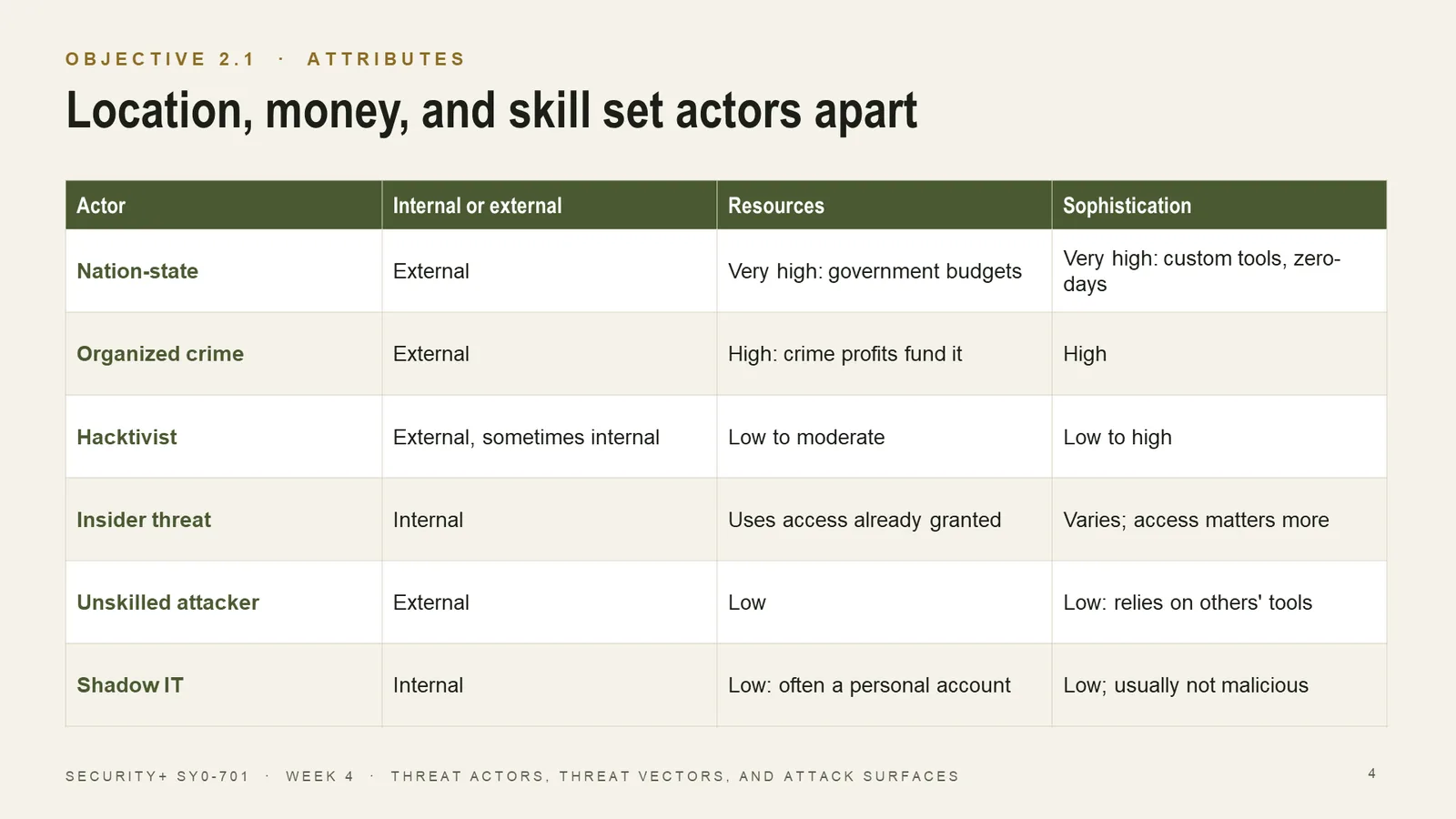
The exam compares actors on three attributes.
Internal or external. An internal actor is inside the organization: an employee, a contractor, or shadow IT. An external actor is outside it and must first find a way in. Internal actors start with access, which is why they can do so much harm with little skill.
Resources and funding. Money buys time, people, and tools. A nation-state can fund a team for years. An organized crime group reinvests ransom payments. A hacktivist group often depends on volunteers, and an unskilled attacker usually works alone with free tools.
Level of sophistication and capability. This is what the actor can actually do: write custom malware, find new vulnerabilities, stay hidden for months. Nation-states sit at the top. Unskilled attackers sit at the bottom. Hacktivists vary widely, and some groups are very capable.
These attributes guide defense. A 25-person clinic cannot stop a determined nation-state, and it is rarely the target of one. It is a likely target for organized crime, which wants anything it can encrypt and ransom, and it is exposed to insiders and shadow IT every day. So the clinic's money goes first to backups, MFA, patching, phishing defense, and access reviews.
Watch out
Do not assume external means more dangerous. Questions often describe an insider who does serious damage with no technical skill at all, because the organization gave them the access.
7 min
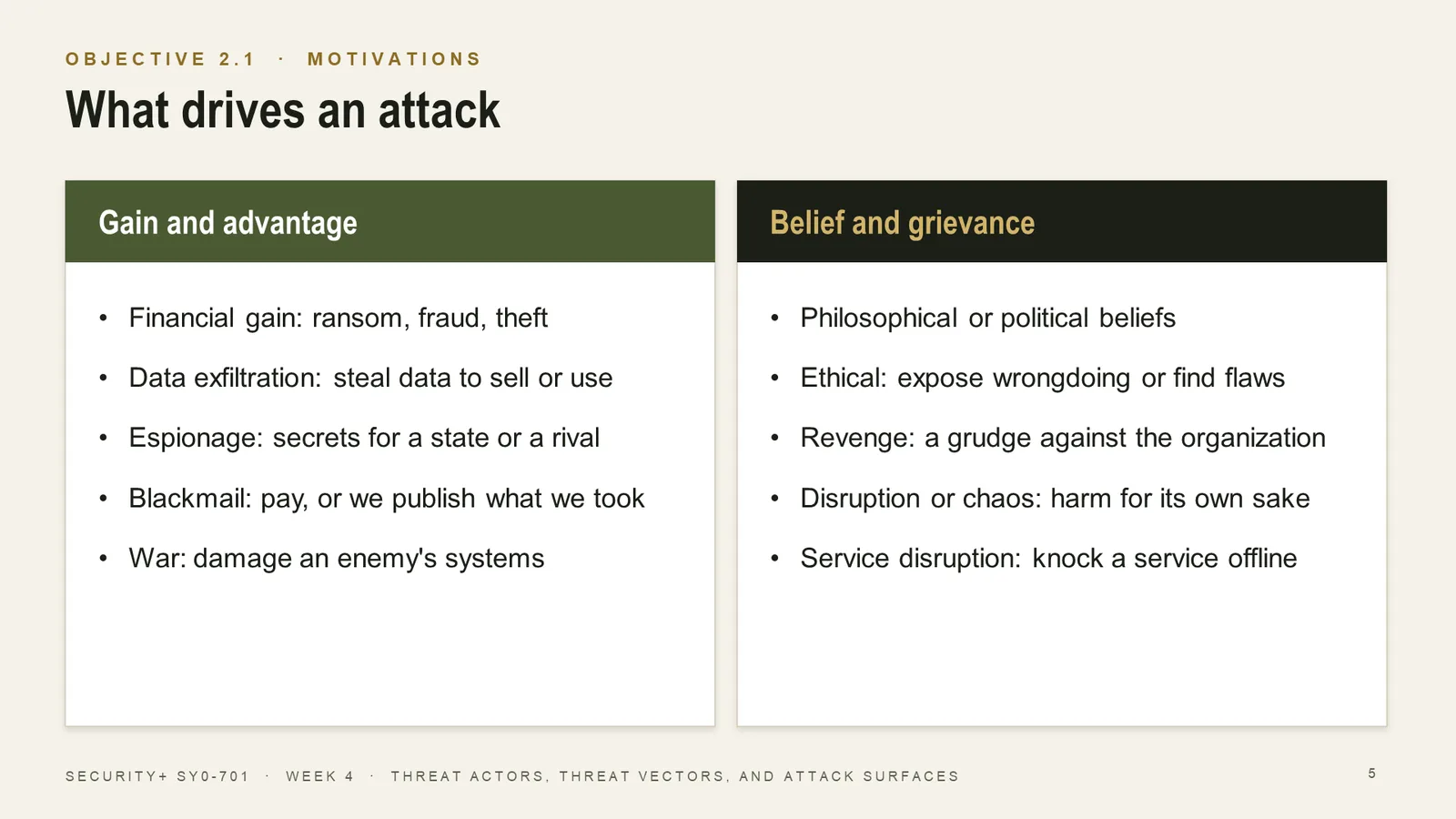
Motivation tells you what an attacker will go after. The exam lists ten.
One attack can serve several motives. Double extortion ransomware is financial gain, data exfiltration, and blackmail at once. When a question asks for the main motivation, look for the clue in the scenario: a ransom note, a political message, a firing.
10 min
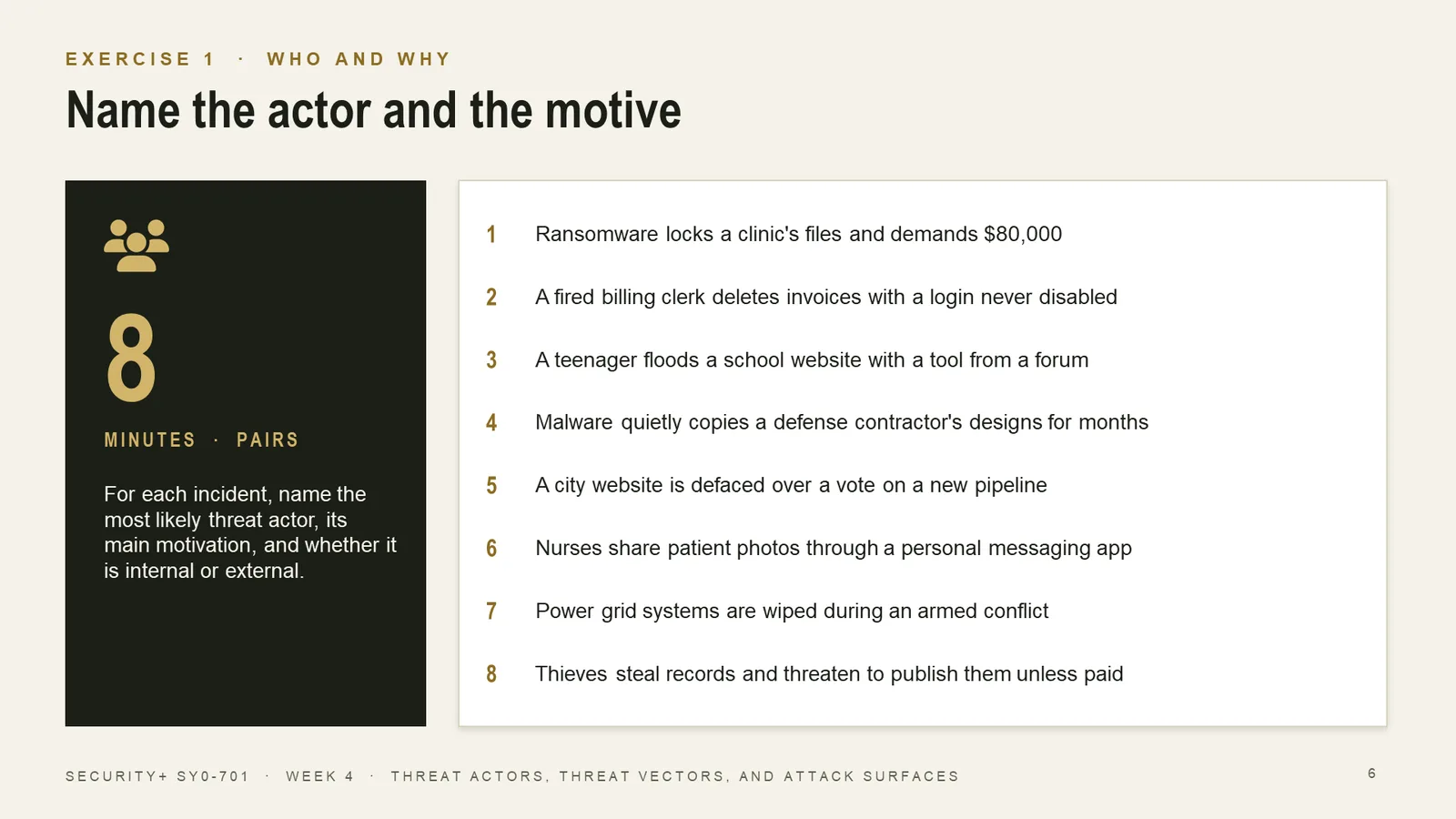
Work with a partner for eight minutes. For each incident, name the most likely threat actor, its main motivation, and whether it is internal or external. Point to the clue in the scenario that supports your answer.
Write your answers before opening the worked answers.
9 min
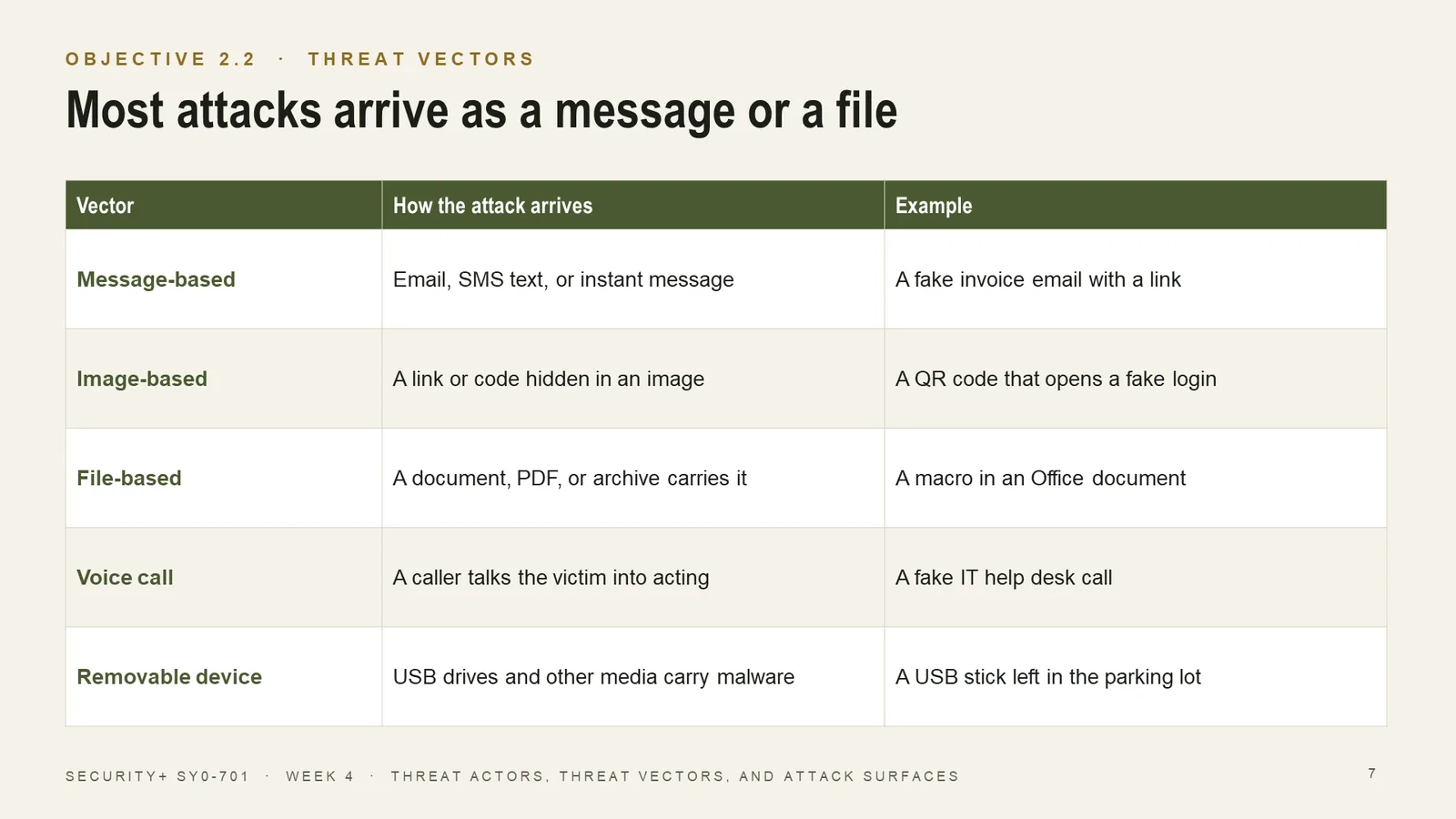
A threat vector is the path an attacker uses to reach a target. The attack surface is everything an attacker could reach: every system, service, account, and person exposed to a vector. Security work shrinks the attack surface and watches the vectors that remain.
Tip
Controls follow the vector: email filtering and link scanning for messages, attachment sandboxing for files, a call-back procedure for voice requests, and blocking or controlling USB storage for removable devices.
10 min
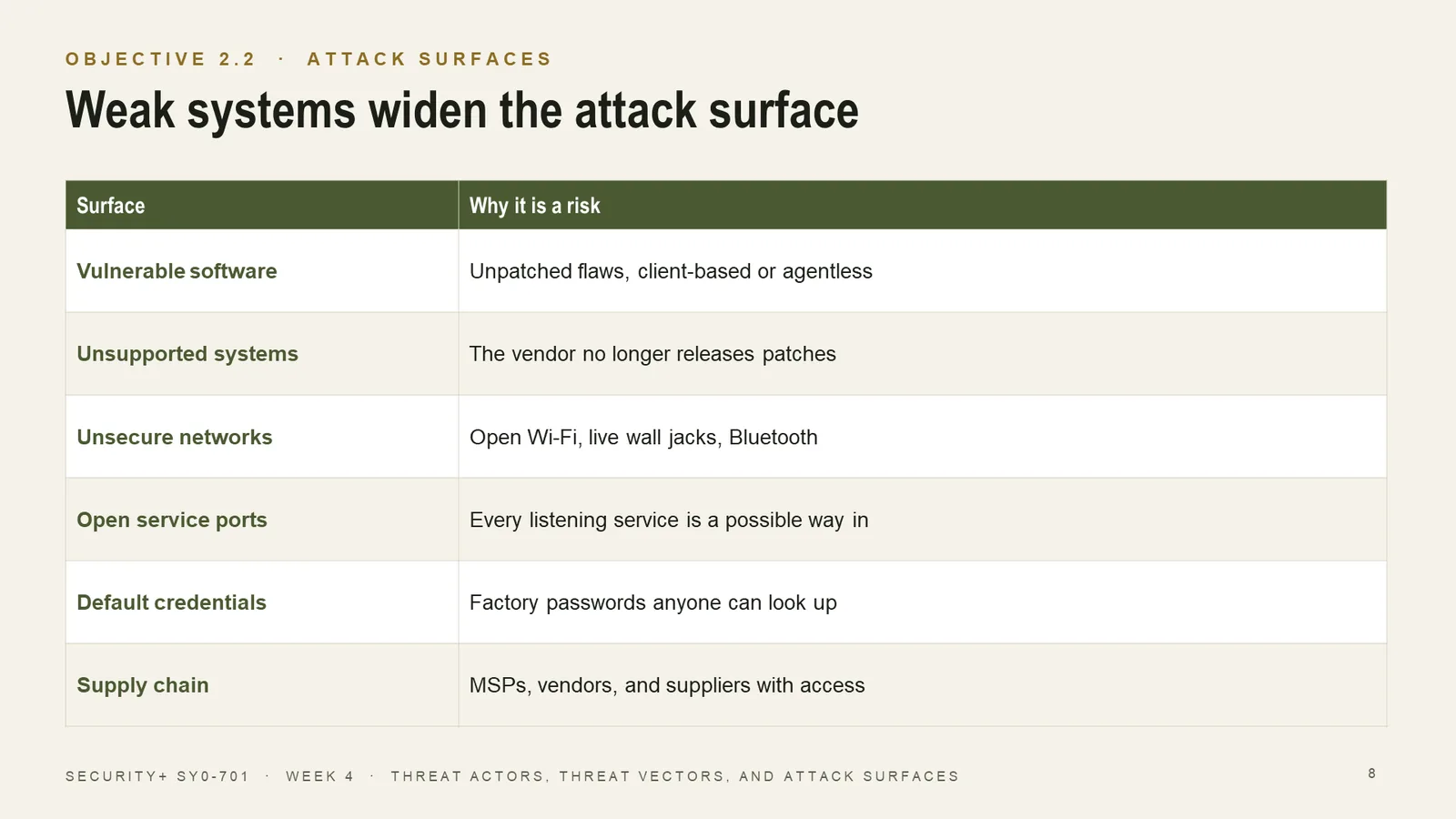
Weak systems add attack surface.
Vulnerable software. Any unpatched flaw is a way in. The exam contrasts two models. Client-based software is installed on each device, so every installed copy must be patched, and a malicious or vulnerable executable lives on every endpoint. Agentless software installs nothing on the device; the user reaches it through a browser or the system is managed remotely. There is less to patch on endpoints, but a flaw on the central server affects every user at once.
Unsupported systems and applications. Once a vendor ends support, no more security patches come, so every new flaw stays open forever. Windows 10 reached end of support in October 2025, yet many small offices still run it. If an old system cannot be replaced, isolate it and monitor it as a compensating control.
Unsecure networks.
Open service ports. Every listening port is a service an attacker can try. Remote Desktop exposed to the internet on port 3389 is a common ransomware entry point. Close what is not needed and filter the rest.
Default credentials. Routers, cameras, and printers ship with known usernames and passwords that are published in manuals. The Mirai botnet spread through devices that still used them. Change defaults before a device goes on the network.
Supply chain. Attackers go through someone you trust. Managed service providers (MSPs) hold remote access to many clients at once. Vendors ship software updates that can be poisoned, as in the 2020 SolarWinds Orion attack. Suppliers provide hardware that can be counterfeit or tampered with.
7 min
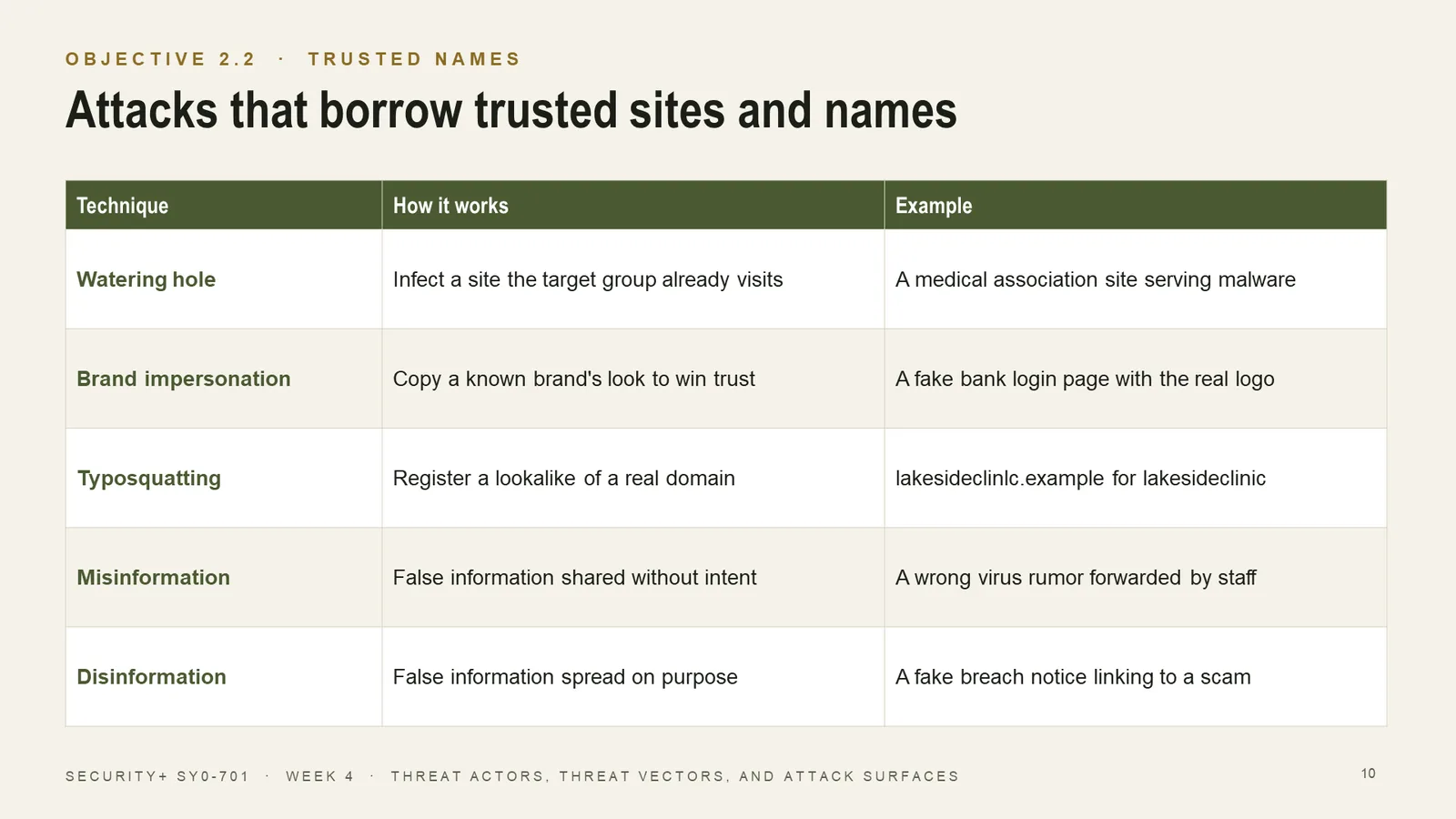
Some attacks borrow trust from something familiar.
Watch out
The difference between misinformation and disinformation is intent, not content. Both are false. Disinformation is deliberate.
Controls include web filtering and DNS filtering that block newly registered and lookalike domains, registering common misspellings of your own domain, keeping browsers patched against watering hole exploits, and teaching staff to reach important sites through bookmarks rather than links.
7 min
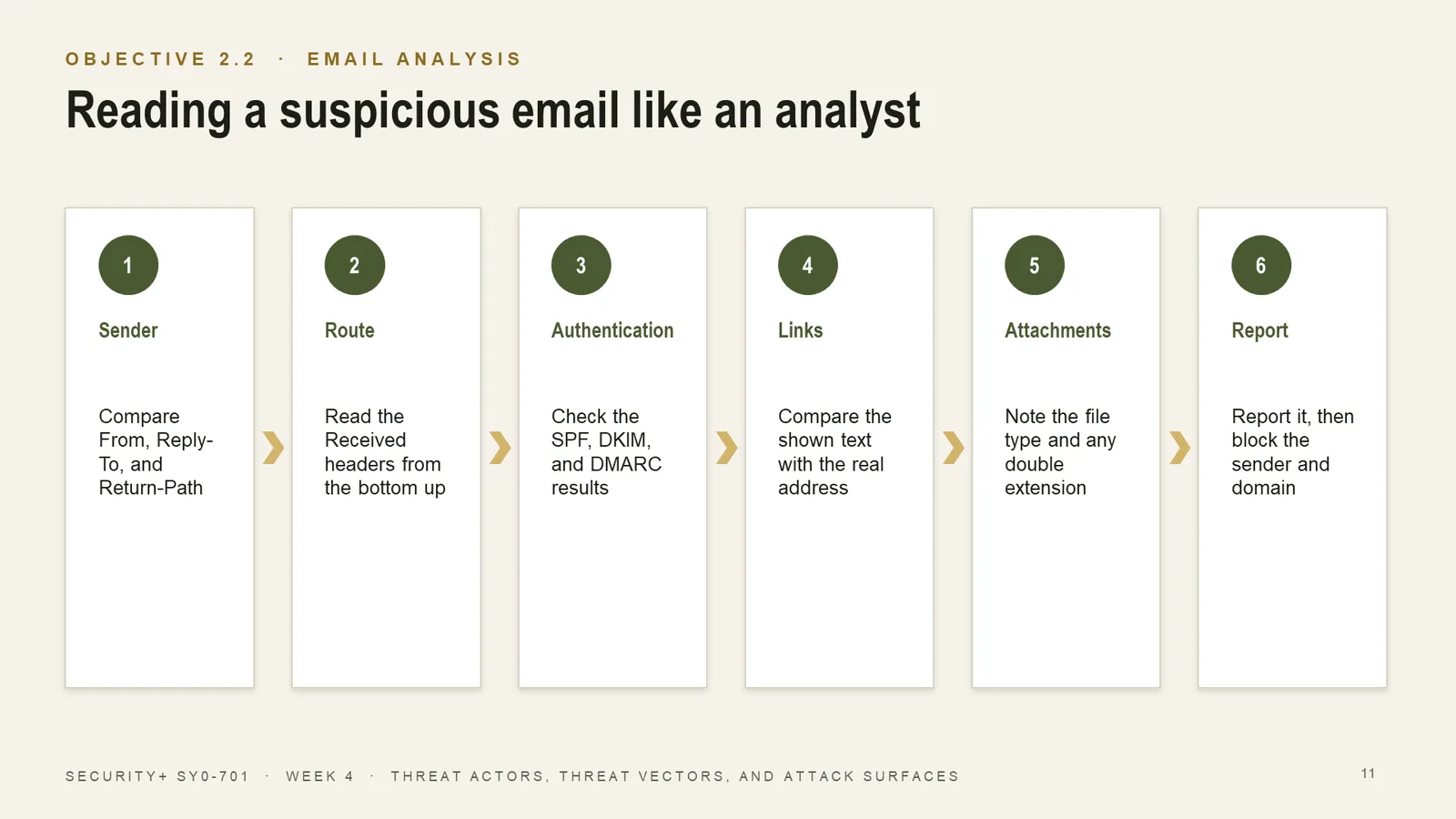
Analysts look past what an email shows to what its headers record. Here is part of a sample header sent to Lakeside's office manager:
| Header | Value |
|---|---|
| From | Lakeside Billing, billing@lakesideclinic.example |
| Reply-To | payments@lakeside-billing.example |
| Return-Path | bounce@mailer.cheap-host.example |
| Authentication-Results | spf=fail; dkim=none; dmarc=fail |
| Subject | URGENT: invoice overdue, pay today |
What to check:
When you write up a link, defang it, for example hxxps://lakeside-billing[.]example, so nobody clicks it by accident.
10 min
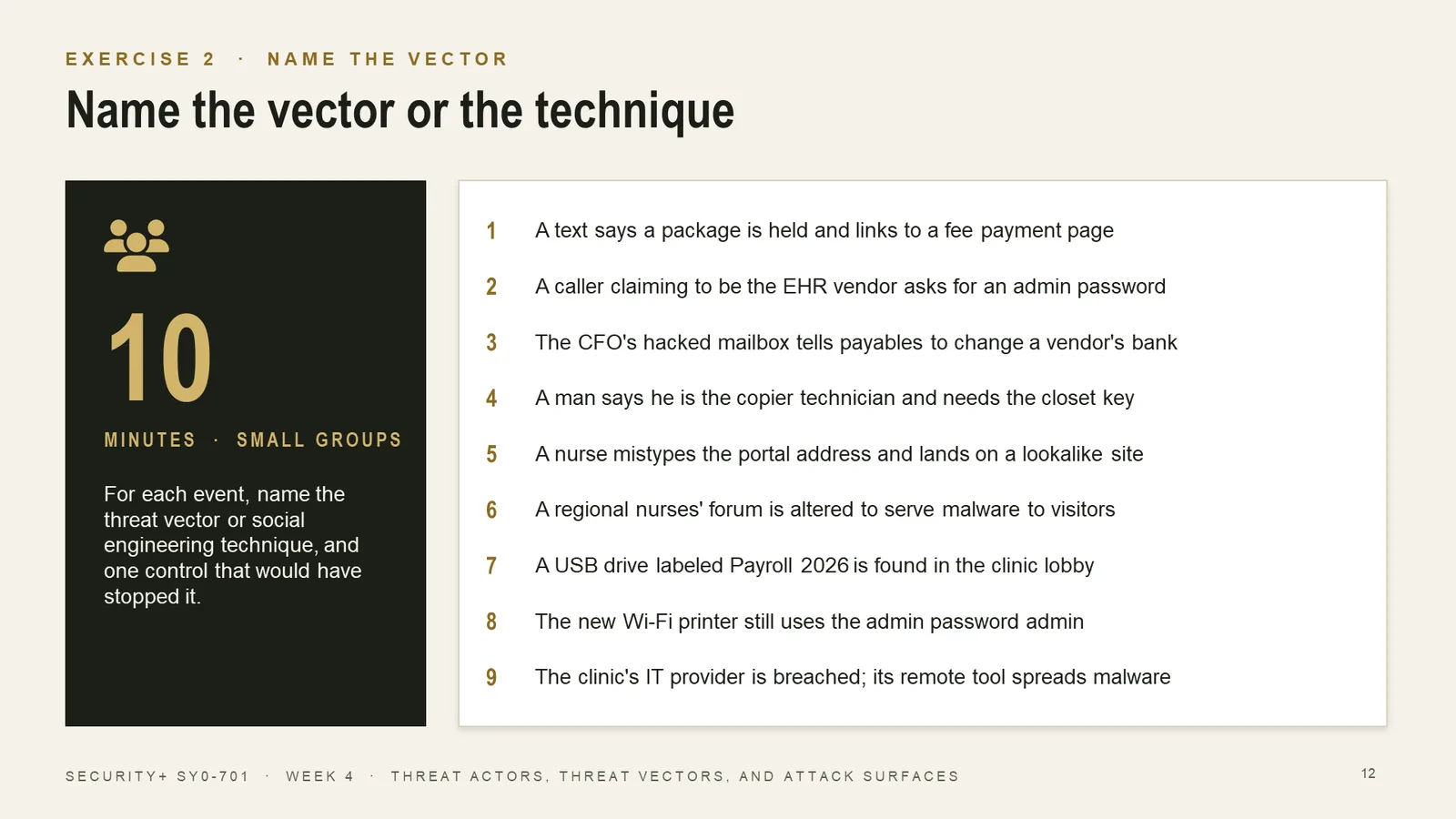
In a small group, take ten minutes. For each event at or near Lakeside Family Clinic, name the threat vector or social engineering technique, and one control that would have stopped it. Several events fit more than one term; give the best one and your reason.
Write your answers before opening the worked answers.
3 min
This week looked at attacks from the attacker's side.
Next week moves from how attackers get in to the weaknesses they exploit once they arrive: the vulnerability types in objective 2.3.
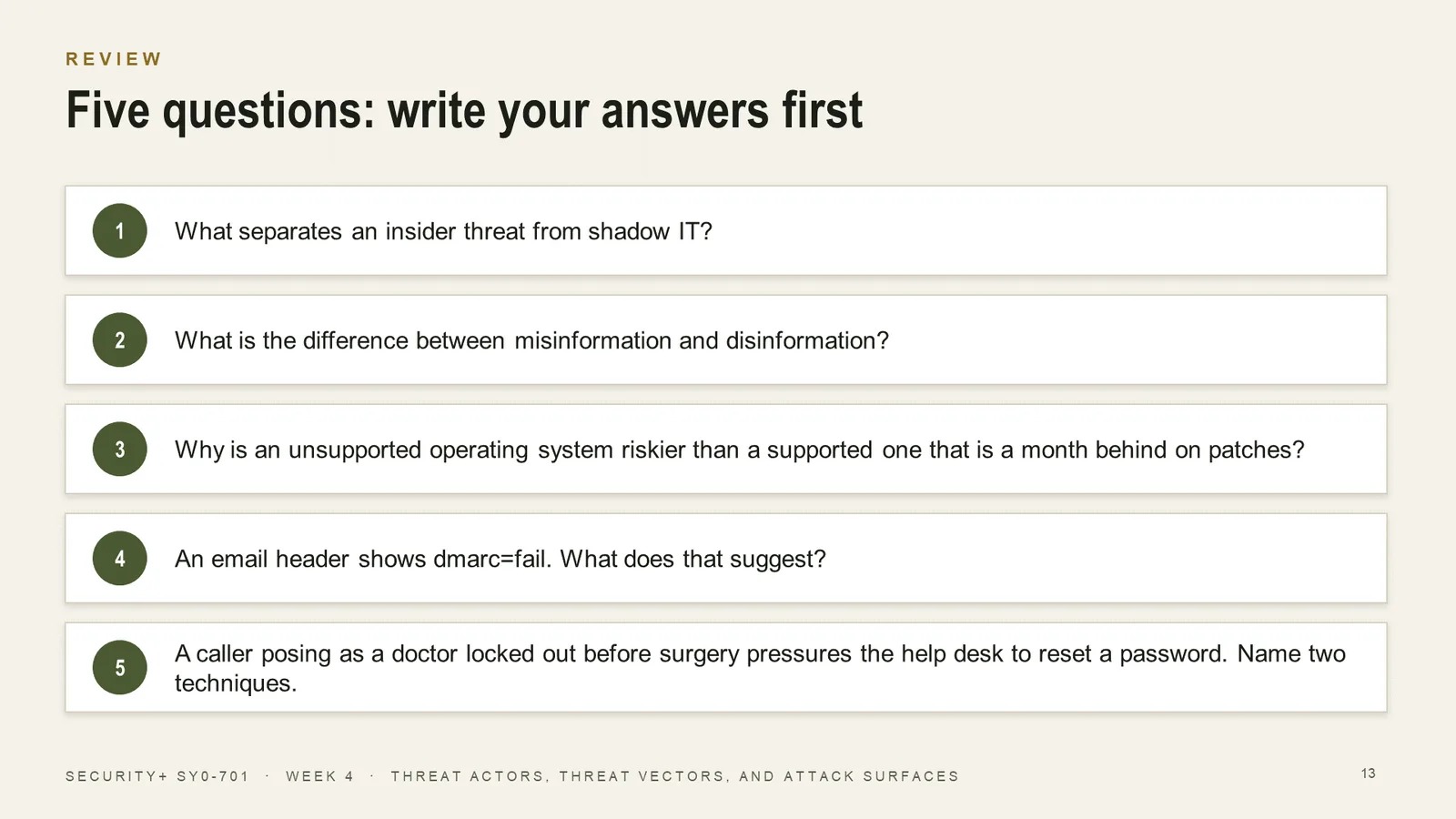
Write your answers to the five review questions first, then open each one to check it.
An insider threat misuses access the organization granted, on purpose or through carelessness. Shadow IT is technology adopted without IT's approval, usually with good intentions, that creates unmanaged risk.
Both are false. Misinformation is shared without intent to deceive. Disinformation is spread on purpose to mislead.
The unsupported system will never receive another patch, so every new vulnerability stays open. The supported one can still be patched.
Neither SPF nor DKIM passed for the domain shown in the From address, so the sender is likely spoofed.
Vishing (a voice call) and pretexting (the made-up story), with impersonation of the doctor.
60 min
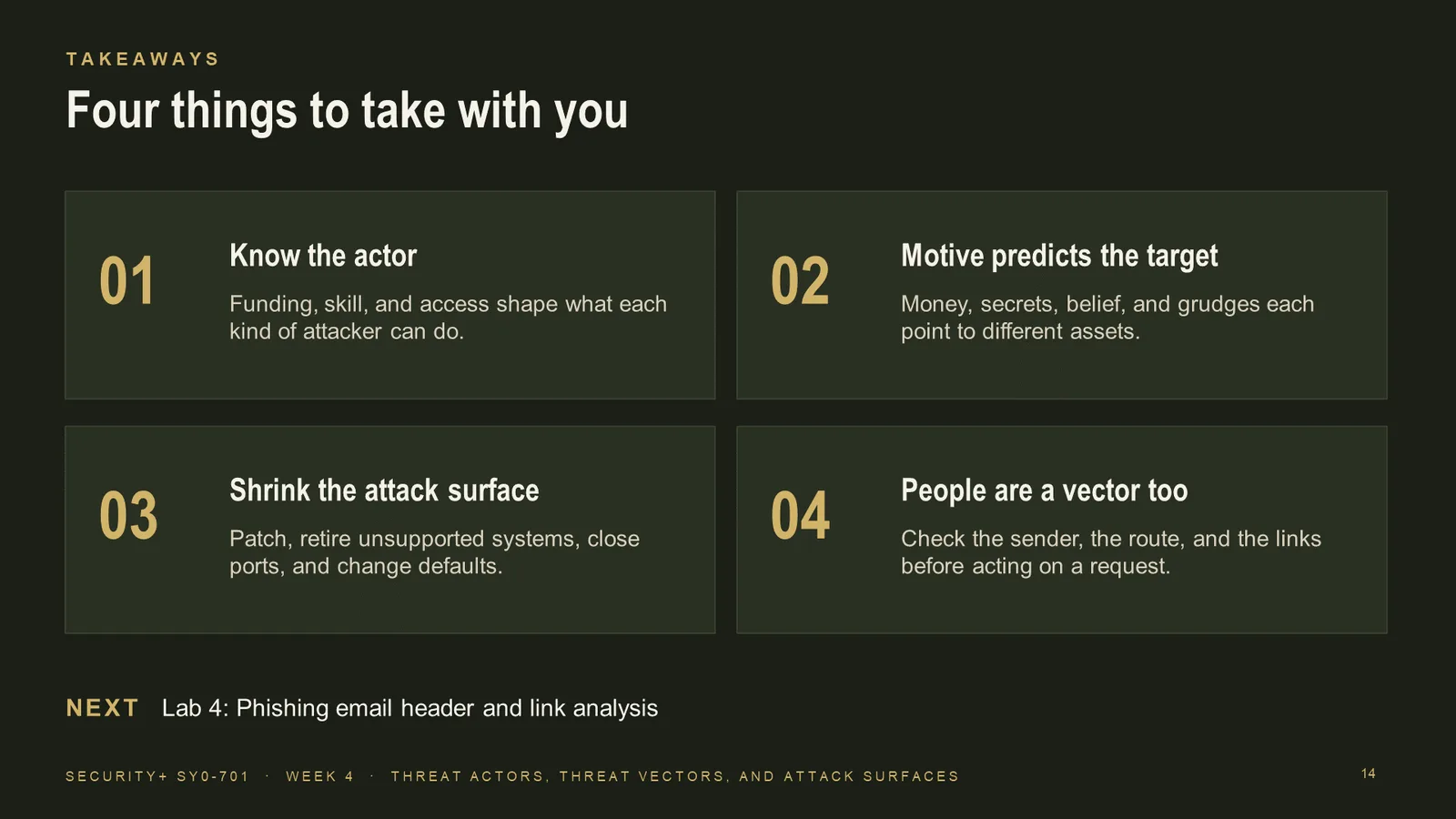
01 Know the actor
Funding, skill, and access shape what each kind of attacker can do.
02 Motive predicts the target
Money, secrets, belief, and grudges each point to different assets.
03 Shrink the attack surface
Patch, retire unsupported systems, close ports, and change defaults.
04 People are a vector too
Check the sender, the route, and the links before acting on a request.
Week 4 interactive lab
Suspicious message: “URGENT: Re-verify your Warhawk Division SSO”
Select every genuine phishing indicator below (watch out for benign headers), then check your triage.
Use the Linux VM from Lab 1 on its host-only network, and the sample email file for this lab, sample-phish.eml (download it on your host computer and copy it into the VM through a VirtualBox shared folder, or briefly switch the VM's adapter to NAT to download it and switch it back afterward), which is a harmless sample built for the course. Never open the sample in a mail client, never visit any link in it, and do not look up or visit live phishing sites; all analysis is done by reading text.
Lab steps · 0 of 9 complete (0%)
A one-to-two page analysis report: a table of the header fields you examined and what each showed, the defanged links with your assessment of each, your verdict with at least five supporting indicators, and three recommendations for the clinic.
07 Social engineering
10 min
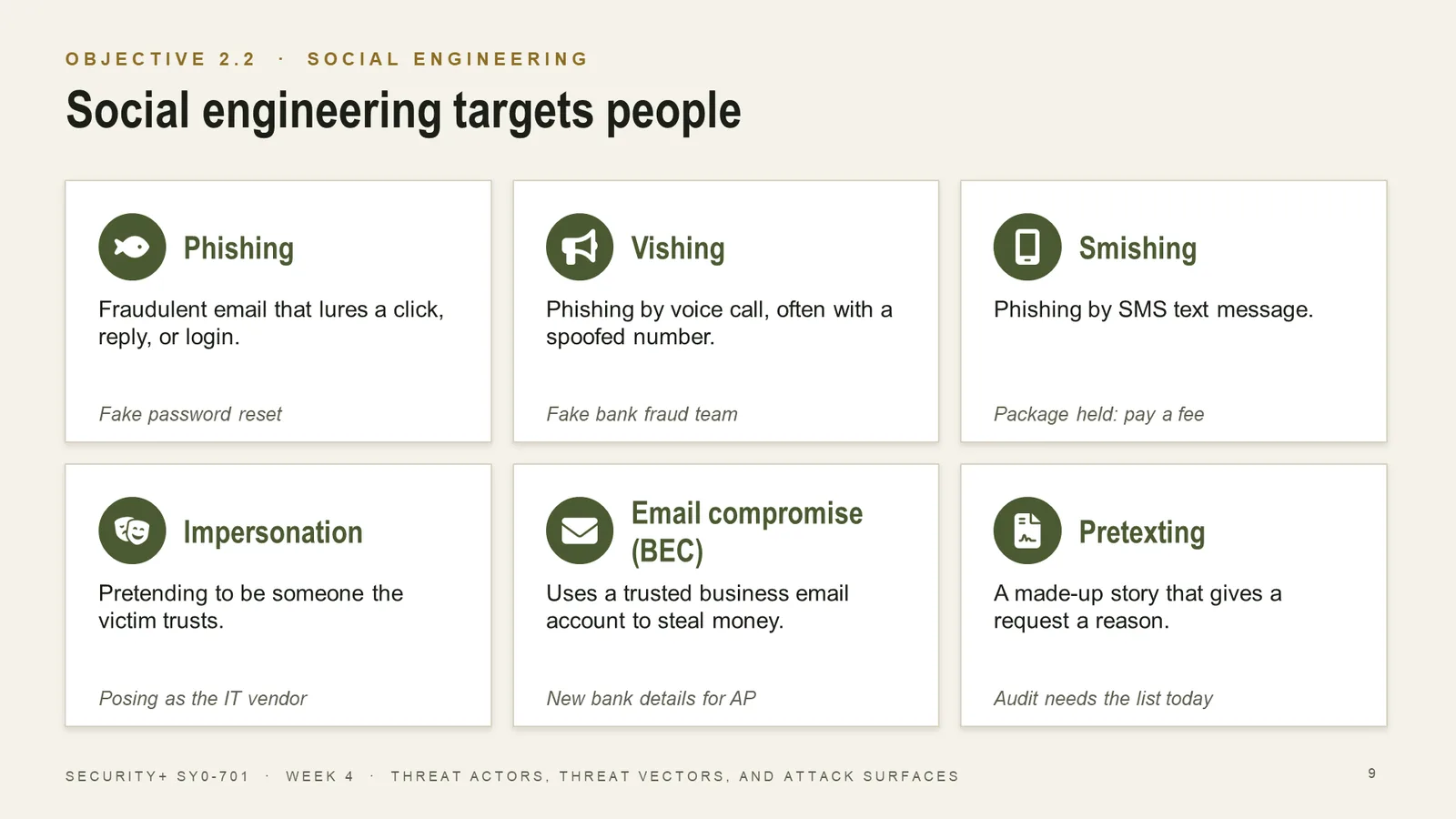
Social engineering manipulates people into giving up information, access, or money. It works because it targets trust, helpfulness, and fear rather than software flaws.
These techniques often combine. A caller impersonates the EHR vendor (impersonation) with a story about an urgent update (pretext) over the phone (vishing).
Warning signs run through all of them: claimed authority, urgency, secrecy, and a request to skip normal steps.
Tip
The strongest control against BEC is a process, not a tool: any change to payment details is confirmed by calling a phone number already on file, never one in the email.