Articles & BlogBy Trapper W. Brown10 min read
An electromagnetic pulse, or EMP, is a sudden burst of electromagnetic energy. The kind people worry about comes from a nuclear weapon set off very high above the ground. Nobody below is hurt by blast, heat or fallout. What reaches the surface is a pulse that can push damaging surges into power lines and electronics over a very wide area.
Why should you care? Because the subject is surrounded by two kinds of bad information. One says a single weapon would end modern life and kill most Americans. The other says the whole idea is fiction. The official record supports neither. The physics is real. The size of the damage to a modern country is uncertain, and serious experts disagree by a wide margin. The good news is that what a household can do about it is the same short list that covers an ice storm, a hurricane or a long regional blackout.
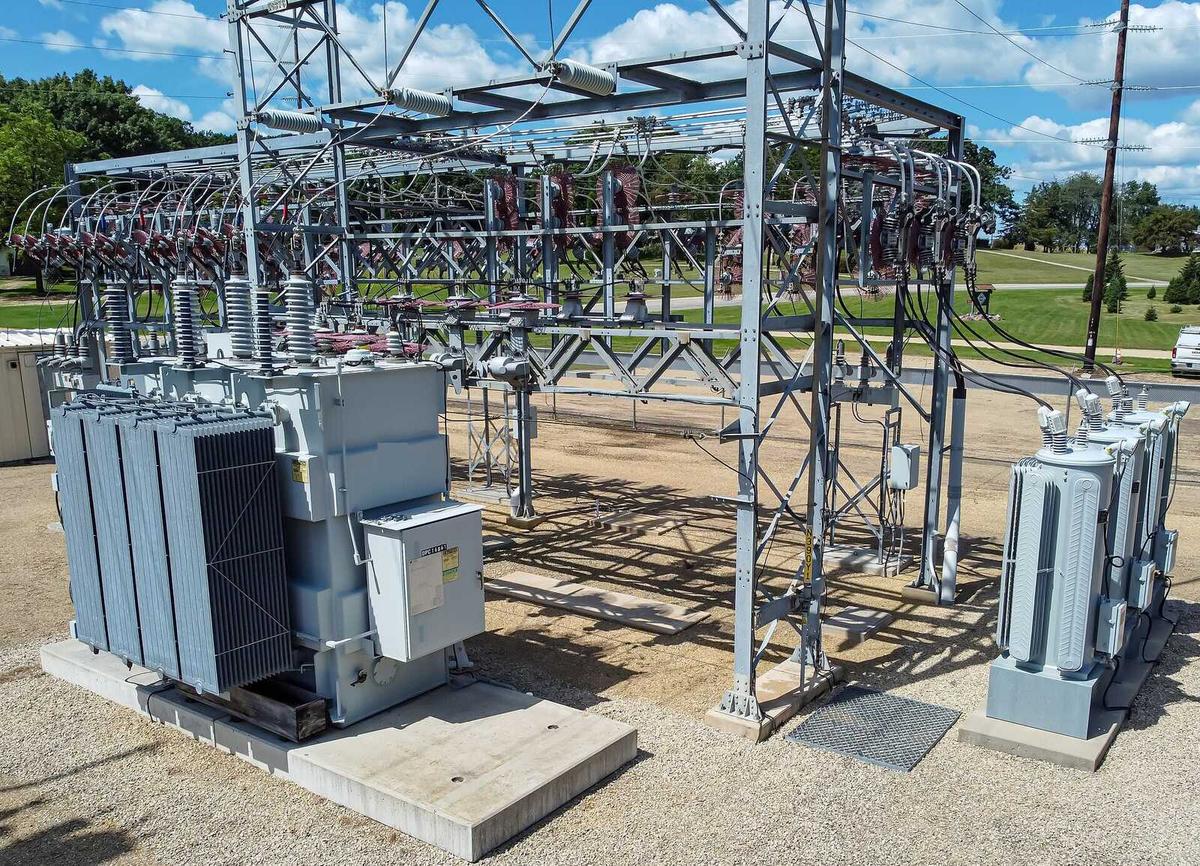 Large transformers and the long lines connected to them are the part of the grid that EMP and solar storm studies worry about most. Photo by Wikideas1, CC0, via Wikimedia Commons.
What is a high-altitude EMP?
Executive Order 13865, signed in March 2019, gives the government's working definition. A high-altitude EMP, or HEMP, is a human-made pulse "that occurs when a nuclear device is detonated at approximately 40 kilometers or more above the surface of Earth." The order also names a natural cousin, the geomagnetic disturbance driven by eruptions on the sun.
The pulse arrives in three parts. The Congressional EMP Commission's 2004 report describes them, and engineers call them E1, E2 and E3.
- E1 is the fast part. It rises in a few billionths of a second, far quicker than lightning. The Commission calls it an "electromagnetic shock" that upsets or damages electronic controls, sensors, communications gear and computers across the whole area at almost the same instant.
- E2 resembles lightning in its timing. The Commission says equipment already protected against lightning should mostly cope, with one catch: E2 arrives a fraction of a second after E1 may have damaged those very protections.
- E3 is slow and long. It pushes currents into long conductors, above all high-voltage transmission lines, and through them into the large transformers at each end. A big solar storm does the same thing.
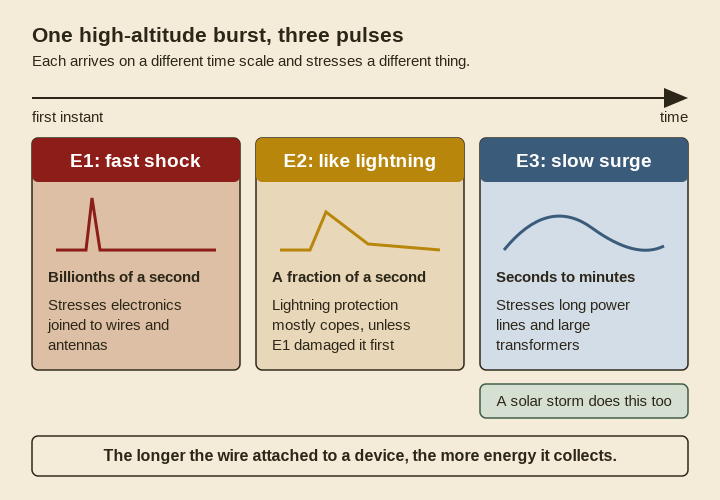 One event, three pulses: each arrives on a different time scale and stresses a different part of the system.
One idea ties the three together. A wire acts as an antenna. The longer the wire attached to a device, the more of the pulse it collects and delivers.
What does history actually show?
The best real-world evidence is a United States test called Starfish Prime. At about 11 p.m. Hawaii time on 8 July 1962, a 1.4 megaton device was detonated 400 kilometers above Johnston Atoll in the Pacific. Hawaii was roughly 1,400 kilometers away.
What happened there is the most quoted EMP damage on record. A 1989 Sandia National Laboratories study went back through the utility records. About 30 strings of streetlights on Oahu failed, which was about 1 percent of the streetlights then in service. The cause was blown fuses, and the study concluded the damage was produced by the pulse. The failed circuits were built and pointed in ways that made them vulnerable, which is why most strings kept working. A 2010 report prepared for Oak Ridge National Laboratory adds that burglar alarms and air raid sirens went off and a microwave telecom system went out.
The Soviet Union ran its own high-altitude tests over land the same year. According to the Oak Ridge report, a Russian scientist presented the results in 1994: those tests knocked out a long above-ground communication line and a buried one more than 600 kilometers from the burst, damaged power line insulators, and caused diesel generators to fail.
Read fairly, the 1962 record says two things. The effect is real and reaches hundreds of kilometers, and the damage in Hawaii was scattered and partial. The Oak Ridge report adds the caution that matters most: there is no experience with modern systems. Everything since rests on simulators, calculations and judgment.
What did the EMP Commission conclude, and what do critics say?
Congress set up a commission to study the threat in its 2001 defense authorization act. Its 2004 executive report called EMP "one of a small number of threats that can hold our society at risk of catastrophic consequences," with the electric grid as the main path. Its 2017 report warned that an extended blackout "could result in the death of a large fraction of the American people" through disease, starvation and social breakdown.
The most extreme figure in circulation, 90 percent of Americans dead within a year, has a specific origin. At a House Armed Services Committee hearing on 10 July 2008, a congressman described a novel in which that happens and asked whether it was realistic. The Commission's chairman answered, "We think that is in the correct range," and added that the country has no experience with such a loss. It was an opinion given in testimony, and the figure does not appear in the Commission's published reports.
Other experts have reached much milder conclusions.
- The Electric Power Research Institute, the utility industry's research body, published a study in 2019, done with experts from the Department of Energy, the Defense Threat Reduction Agency and national laboratories. It estimated that a strong E1 pulse could disrupt or damage roughly 5 to 15 percent of the digital protective relays at transmission line terminals, that E2 should not damage the transmission system, and that E3 could cause a regional blackout across several states. It did not expect immediate, widespread transformer loss, and said its findings did not support the belief in nationwide blackouts lasting years.
- Physicist Yousaf Butt, writing in The Space Review in 2010, argued that the damage from a small, crude weapon would probably be limited to an area about the size of a state. He quoted another analyst, Philip Coyle, who said the Commission seemed to treat calculations of extreme effects "as if they were a proven fact."
- The Government Accountability Office, Congress's auditor, reported in 2018 that there was general agreement that more research was needed.
So the honest range runs from a blackout across several states to a national catastrophe. The camps do share some ground: both recommend protecting the grid's control equipment and large transformers, and that work also guards against solar storms.
What has the government done?
Executive Order 13865 made EMP resilience national policy. It told the Department of Homeland Security to share threat information, the Department of Energy to research how pulses couple into the grid, and the Department of Commerce to forecast the natural kind. The GAO had reported in 2016 that Homeland Security, Energy and the Federal Energy Regulatory Commission had already acted on some of the Commission's 2008 recommendations.
Homeland Security published EMP protection guidelines for critical equipment in February 2019, arranged in four levels from cheap habits to heavy shielding. On the natural side, the North American Electric Reliability Corporation, which writes the grid's mandatory reliability standards, has a standard named TPL-007 for systems with transformers above 200 kilovolts. It sets requirements for how the transmission system must perform in a geomagnetic storm. The GAO found in 2018 that all 13 electricity suppliers it contacted said they were following the storm operating procedures then required, while only 3 of 11 had studied HEMP on their own networks.
The natural cousin: a severe solar storm
The sun can produce the slow E3 effect by itself, with no E1.
- 1859. The Carrington Event, which NOAA calls the largest geomagnetic storm in recorded history. Telegraph equipment sparked and started fires.
- 1989. On 13 March a storm collapsed the power grid in Quebec within 90 seconds. NOAA says six million people lost power for nine hours.
- May 2024. The first storm in more than 20 years to reach G5, the top of NOAA's scale. NASA's review lists high-voltage lines tripping, transformers overheating and GPS-guided tractors veering off course in the Midwest.
The Commission's 2017 report says many consider a repeat of 1859 inevitable, and it cites a NASA estimate of 10 to 12 percent per decade. I think this is the stronger reason to prepare.
What would likely fail, and what would not?
| More at risk | Why | Less at risk | Why |
|---|---|---|---|
| The power grid | Long lines collect E3, and relays and controls face E1 | Small devices switched off and unplugged | No long wire to collect energy |
| Anything plugged into the wall or a long cable | The cord is the antenna | Battery radios | Homeland Security calls them "relatively resilient" |
| Phone and internet networks | They run on grid power and backup batteries | Cars that are parked and off | See the tests below |
| Water, fuel and card payments | All depend on electricity | Simple tools with no electronics | Nothing to upset |
The Commission tested vehicles in a simulator for its 2008 report: 37 cars built between 1986 and 2002, at field strengths up to about 50 kilovolts per meter.
| Engine stalled, restarted | 3 |
|---|---|
| Dashboard electronics damaged | 1 |
| Minor glitch only | 25 |
| No effect at all | 8 |
Source: EMP Commission, Critical National Infrastructures report, 2008
No car that was switched off during the test was affected. Three running cars stalled and had to be restarted. Of 18 trucks, three stalled, and one of those needed a tow. The picture of every vehicle on the highway going dead for good does not come from the Commission's own data. One honest caveat: those vehicles are now more than 20 years old, and the report itself notes the trend toward more electronics in each new generation.
How does a household prepare?
Ready.gov asks every household to keep supplies for several days. Homeland Security's EMP guidelines ask organizations for one week at the basic level and 30 days at higher levels. My rule for a home is two weeks.
- Water. Ready.gov's figure is one gallon per person per day. For a family of four over two weeks, that is 56 gallons. "Emergency Water: Storing It, Finding It and Making It Safe," "Building a Two Week Food Supply Without Wasting Money" and "First Aid When Help Is Delayed" cover those subjects in full.
- Cash. Ready.gov warns that outages can close banks and ATMs.
- Paper. Printed copies of IDs, insurance policies, prescriptions and phone numbers.
- A battery or hand-crank radio. The guidelines say handheld or car radios may be the main way to hear official instructions.
- Fuel. Ready.gov's space weather page says to keep the car's tank at least half full, because gas pumps need electricity.
Spare electronics in a metal container. A Faraday enclosure is a closed shell of conducting metal. An arriving pulse drives currents in the shell and not in what is inside. The Homeland Security guidelines describe the cheap version: put a spare device in a plastic or paper bag, then wrap it completely in heavy-duty aluminum foil with overlapping seams, two layers if you can. An ordinary shiny food-storage bag gives little protection, and a metal trash can is unreliable unless the gaps around its lid are sealed.
Keep this in proportion. The same document says small handheld electronics are "relatively immune to EMP effects, unless they have long antennas or power cords attached," and calls Faraday protection "of secondary importance." Wrapping a spare radio and flashlight costs almost nothing. No box is guaranteed.
Surge protectors. The guidelines recommend at least a lightning-rated protector on anything that stays plugged in, and for charging small devices one that responds within 10 billionths of a second. A protector reduces a surge. It does not make a plugged-in device safe. The surest protection is the free one, and Ready.gov gives it as general outage advice: disconnect appliances and electronics to avoid damage from surges.
Community. Take two cases. A person living alone needs one neighbor who will knock on the door. A street of 20 homes that knows who owns a generator, who is a nurse and who is 85 is better off than 20 well-stocked strangers.
For staying in touch when the networks are down, see "A Family Emergency Communications Plan for When Phones Fail," "Setting Up a Civilian Handheld Radio Such as a Baofeng" and "Meshtastic and Open Source Mesh Networks: Texting Without a Cell Tower."
What to remember
- A high-altitude EMP is real physics. Its three parts stress fast electronics, lightning protection and long power lines in turn.
- In 1962 the damage in Hawaii was scattered: about 1 percent of streetlights, some alarms and a telephone link.
- Experts disagree widely on what would happen today. The 90 percent casualty figure came from hearing testimony about a novel, and a 2019 industry study found regional blackouts possible, not years of national darkness.
- A severe solar storm produces the slow part of the same effect and has blacked out a province before.
- Long wires are the risk. Cars that were switched off came through the Commission's tests unaffected.
- Two weeks of water, food, cash, paper records and a battery radio cover this and every other long outage.
Start with the water and the radio this week. Then read "A Family Emergency Communications Plan for When Phones Fail" and fill in the card.