Articles & BlogBy Trapper W. Brown10 min read
A handheld two-way radio is a small transmitter and receiver that talks straight to other radios, with no cell tower and no internet in between. The low-cost imported kind, of which Baofeng is the best known name, can tune a wide stretch of the airwaves.
Here is why you should read the rules before you charge the battery. In the United States, the price of a radio has nothing to do with whether you may transmit with it. Listening is open to everyone. Transmitting depends on which slice of spectrum you use, which license you hold, and whether that exact radio was approved for that slice. A radio in a drawer that nobody is licensed or practiced to use is a flashlight with extra steps.
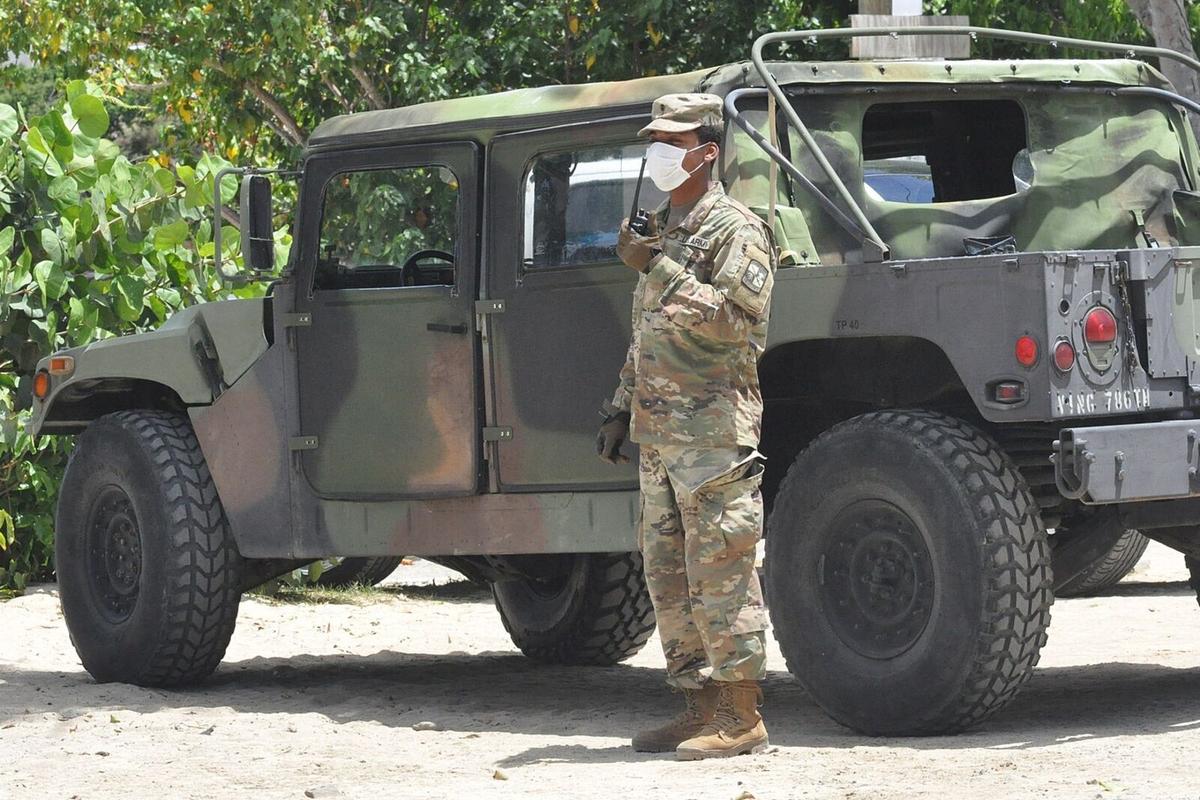 A handheld radio is simple to hold and harder to use well, which is why practice matters more than the purchase. Photo by Spc. Deneesha Smith, Virgin Islands National Guard, public domain, via Wikimedia Commons.
What does the law say before you press the button?
Listening. Federal law restricts intercepting and repeating other people's radio messages, but the same section says it does not apply to broadcasts meant for the general public, to distress traffic, or to transmissions by amateur and citizens band operators (47 U.S.C. 605). So you can listen to ham radio operators, weather broadcasts and marine distress calls all day with no license at all.
Transmitting on the amateur (ham) bands. You need an amateur license from the Federal Communications Commission (FCC). The entry class is called Technician. The rules require one written test of 35 questions, and 26 correct answers pass (47 CFR 97.503). The rule lists three written elements and nothing else, so there is no Morse code test. Volunteer examiners give the exam. The license normally runs 10 years, and the FCC application fee is $35. A Technician may use, among others, the two bands these handhelds cover: 144 to 148 MHz and 420 to 450 MHz.
GMRS. The General Mobile Radio Service is a licensed service around 462 and 467 MHz. There is no exam. One adult, 18 or older, applies, pays the same $35 fee, and gets a license that normally runs 10 years. The rule lets the license holder allow immediate family members to operate under it, and the list is generous: spouse, children, grandchildren, stepchildren, parents, grandparents, stepparents, brothers, sisters, aunts, uncles, nieces, nephews and in-laws (47 CFR 95.1705).
FRS. The Family Radio Service shares 22 channels with GMRS and needs no individual license. The catch is in the hardware rules. An FRS radio must be built so it cannot transmit on any other frequency, its antenna must be a permanent part of the radio, and its power is capped at 2 watts on most channels and half a watt on channels 8 to 14 (47 CFR 95.567 and 95.587).
MURS. The Multi-Use Radio Service is five VHF channels (151.820, 151.880, 151.940, 154.570 and 154.600 MHz), limited to 2 watts, with no individual license.
Now the part that surprises people. The Part 95 rules say no one may operate a transmitter in these personal services unless it is certified for that service, and that using one that is not "voids the user's authority to operate" (47 CFR 95.335). A radio that can also transmit on ham frequencies cannot be certified for GMRS at all. On 24 September 2018 the FCC's Enforcement Bureau published an advisory (DA 18-980) saying it had seen a growing number of low-cost two-way radios on sale that do not comply with its rules. Its advice to buyers was to make sure a device "is either labeled as FCC-compliant or operates solely within amateur frequencies."
Put plainly: a wide-open imported handheld is, at best, a ham radio for a licensed ham. Typing an FRS or GMRS frequency into it does not make it an FRS or GMRS radio. If your family wants license-free or family-license radios, buy ones certified for those services and look for the FCC ID on the label.
Watch out
Transmitting where you are not authorized is not a harmless shortcut. The 2018 advisory notes that some of these radios can be modified to transmit on public safety channels, and it warns of substantial fines. Program your radio so it cannot transmit anywhere you are not allowed to.
What about the emergency exception?
Two short rules in the amateur service get quoted a lot. One says no rule prevents an amateur station from using any means of radio communication to meet essential needs "in connection with the immediate safety of human life and immediate protection of property when normal communication systems are not available" (47 CFR 97.403). The other covers a station in distress.
They are written about amateur stations. They cover life and property in immediate danger, with normal systems unavailable. They do not cover practice, testing, checking in on a friend, or a crisis that might happen later. GMRS has its own narrow version: a license holder may let anyone use the station to pass an emergency message. I think the honest summary is this: nobody will fault a call that saves a life, and nothing in these rules lets an unlicensed person rehearse.
How do these radios work?
VHF and UHF. Most of these handhelds cover two ranges. VHF (very high frequency) is the 2 meter ham band near 146 MHz. UHF (ultra high frequency) is the 70 centimeter band near 446 MHz, and GMRS sits just above it. Both travel roughly in straight lines, which is why hills and concrete matter more than watts.
Channels versus frequencies. An FRS radio shows channel 1. A ham radio shows 146.520. A channel is only a nickname for a frequency plus a few settings. Programming a radio means filling its memory slots with those nicknames so you can stop typing numbers.
Simplex. Radio to radio, both on the same frequency. The national simplex calling frequency on 2 meters is 146.52 MHz, according to the band plan of the American Radio Relay League (ARRL), the national association for amateur radio.
Repeaters. A repeater is a radio on a tower or hilltop that listens on one frequency and instantly retransmits what it hears on another. Two handhelds that cannot hear each other across a valley can both reach the hilltop.
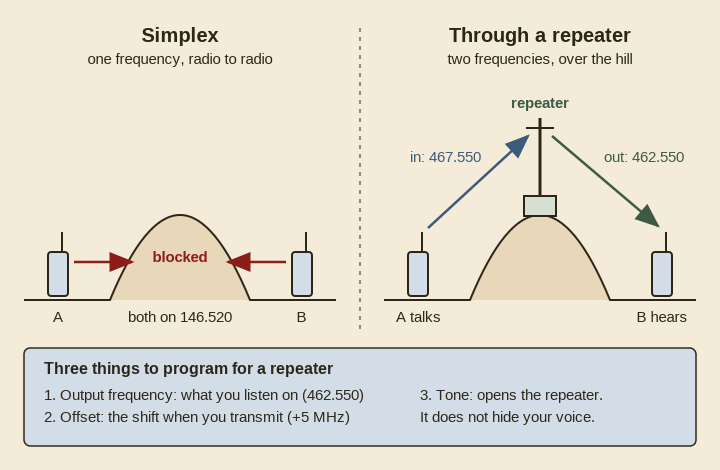 Simplex is one frequency and a clear path. A repeater uses two frequencies and a high spot to get over the hill.
Offset. Because the repeater hears on one frequency and talks on another, your radio must do the reverse: listen on the repeater's output, then shift when you press the button. The size of the shift is the offset. GMRS gives a clean example from the rule book. A repeater transmits on 462.550 MHz, and handhelds reach it on 467.550 MHz, so the offset is plus 5 MHz. On the 2 meter ham band, the ARRL band plan pairs inputs such as 146.34 with outputs such as 146.94, a gap of 0.6 MHz.
Tone. Most repeaters ignore a signal unless it carries a quiet, low-pitched tone under the voice. The common system is CTCSS (Continuous Tone-Coded Squelch System). The tone is a key that opens the repeater. It does not make anything private. Anyone on the frequency still hears you.
How do you program one?
There are two ways. The keypad works for a single frequency in the field and is worth learning once. For anything more, use a programming cable and CHIRP, which its own site describes as "a free, open-source tool for programming your radio." The site says it supports 757 radio models and can pull data from sources such as RepeaterBook, a repeater directory that lists amateur and GMRS repeaters.
A sensible first session, with the radio's transmit side left alone until you are licensed:
- Read the radio's existing memory into CHIRP and save that file untouched as a backup.
- Find the repeaters near you through a local club (ARRL keeps a club finder) or a repeater directory. Enter each one's output frequency, offset direction and tone.
- Add the seven weather channels as receive-only memories.
- Write the result back to the radio, then print the list and tape it inside the kit.
Which service fits your household?
| FRS | GMRS | MURS | Amateur (Technician) | |
|---|---|---|---|---|
| License | None | One license, no exam, covers immediate family | None | One per person, 35-question exam |
| FCC fee and term | None | $35, 10 years | None | $35, 10 years |
| Where | 22 channels, 462 and 467 MHz | 30 channels, 462 and 467 MHz | 5 VHF channels | 144 to 148 and 420 to 450 MHz, and more |
| Handheld power | 2 W, or 0.5 W on channels 8 to 14 | 5 W on shared 462 channels; up to 50 W for mobiles on main channels | 2 W | Minimum needed, far higher limits |
| Repeaters | No | Yes | No | Yes |
| Radio must be | Certified FRS, fixed antenna | Certified GMRS | Certified MURS | Any, used by a licensee |
Take two households. A family of four that wants radios for a campground, a caravan of two cars and a neighborhood check-in is well served by certified FRS or GMRS sets. One $35 GMRS license covers all four of them for 10 years. A single curious adult who wants to learn how radio works, reach repeaters across a county, and join a local emergency net should take the Technician exam. The ARRL keeps a list of exam sessions and clubs.
Antenna, battery and power
The short, stiff antenna that ships with a budget handheld is a compromise chosen for pocket size. A longer antenna made for the band you use often improves both hearing and being heard, and it costs less than a spare battery. This applies to ham radios only. FRS antennas are fixed by rule.
Keep one battery in the radio and one charged spare, and top them up every few months. Find out before you need to whether yours can charge from a car or a power bank, which matters when the wall outlets are dead.
Use low power when it works. The amateur rules require the minimum power needed (47 CFR 97.313), and low power stretches the battery.
Can it hear NOAA weather radio?
NOAA Weather Radio is a network of more than 1,000 transmitters that broadcasts warnings, watches and forecasts around the clock. The National Weather Service lists seven frequencies: 162.400, 162.425, 162.450, 162.475, 162.500, 162.525 and 162.550 MHz. A handheld whose receiver covers that range can hear the broadcast. One widely sold model's specification, for example, lists reception from 136 to 174 MHz. Check your manual.
What a two-way handheld will not do is wake you up. A dedicated weather receiver built to the Public Alert standard has a tone alarm, a battery backup, and a feature called SAME that limits alerts to the counties you choose. The Weather Service says basic receivers start around $20.
How far will it reach, and what is it good for?
Think in sight lines. Over flat ground, the horizon for a person holding a radio at about 1.7 meters (5.5 feet) is roughly 4.7 kilometers away, or 2.9 miles. Trees, houses and hills cut it down fast, sometimes to a few blocks in a dense neighborhood. Height is what adds range. From a ridge 100 meters up, the same horizon is about 36 kilometers, or 22 miles, which is the whole reason repeaters live on hills.
On the air, manners are simple. Listen before you talk. Keep it short. Hams give their call sign at the end of a contact and at least every 10 minutes. GMRS users identify at the end and every 15 minutes. Codes and ciphers meant to hide meaning are not allowed on the amateur bands, and nothing you say there is private.
In an emergency, a handheld is good for short-range coordination: car to car, house to house, searcher to searcher. It is good for reaching a repeater that still has backup power. It will not reach your sister three states away, it does not replace a call to 911, and it does nothing for a household that has not agreed on a channel and a time to listen. That agreement belongs in the family plan, which "A Family Emergency Communications Plan for When Phones Fail" covers. For text messages without a license, see "Meshtastic and Open Source Mesh Networks: Texting Without a Cell Tower."
What to remember
- Anyone may listen. Transmitting depends on the service, your license, and whether that radio is certified for that service.
- Technician ham license: 35 questions, no Morse code, $35 FCC fee, 10 years. GMRS: no exam, $35, 10 years, covers your immediate family.
- A wide-band imported handheld is not a legal FRS or GMRS radio, whatever frequency you type into it. The FCC said so in a 2018 enforcement advisory.
- The emergency rules cover immediate danger to life or property. They do not cover practice.
- Repeaters need three things programmed: the output frequency, the offset and the tone.
- Range follows line of sight. Height beats power.
Start by listening. Program the weather channels and your local repeaters as receive-only, find the nearest club's weekly net, and follow along for a few weeks. By the time the license arrives, the radio will already make sense.