Articles & BlogBy Trapper W. Brown10 min readCurrent to 12 November 2026
A two week food supply sounds like a bunker project. It is really a deeper pantry: fourteen days of food your household already eats, stored where you can reach it, and replaced as you use it. Nothing in it is special, and none of it should ever be thrown away unopened.
The reason to have one is ordinary. Storms close roads, power fails, a paycheck is late, or everyone in the house has the flu and nobody wants to shop. A full shelf turns each of those from a problem into an inconvenience. The trick is building it without spending money on food that expires in the back of a closet.
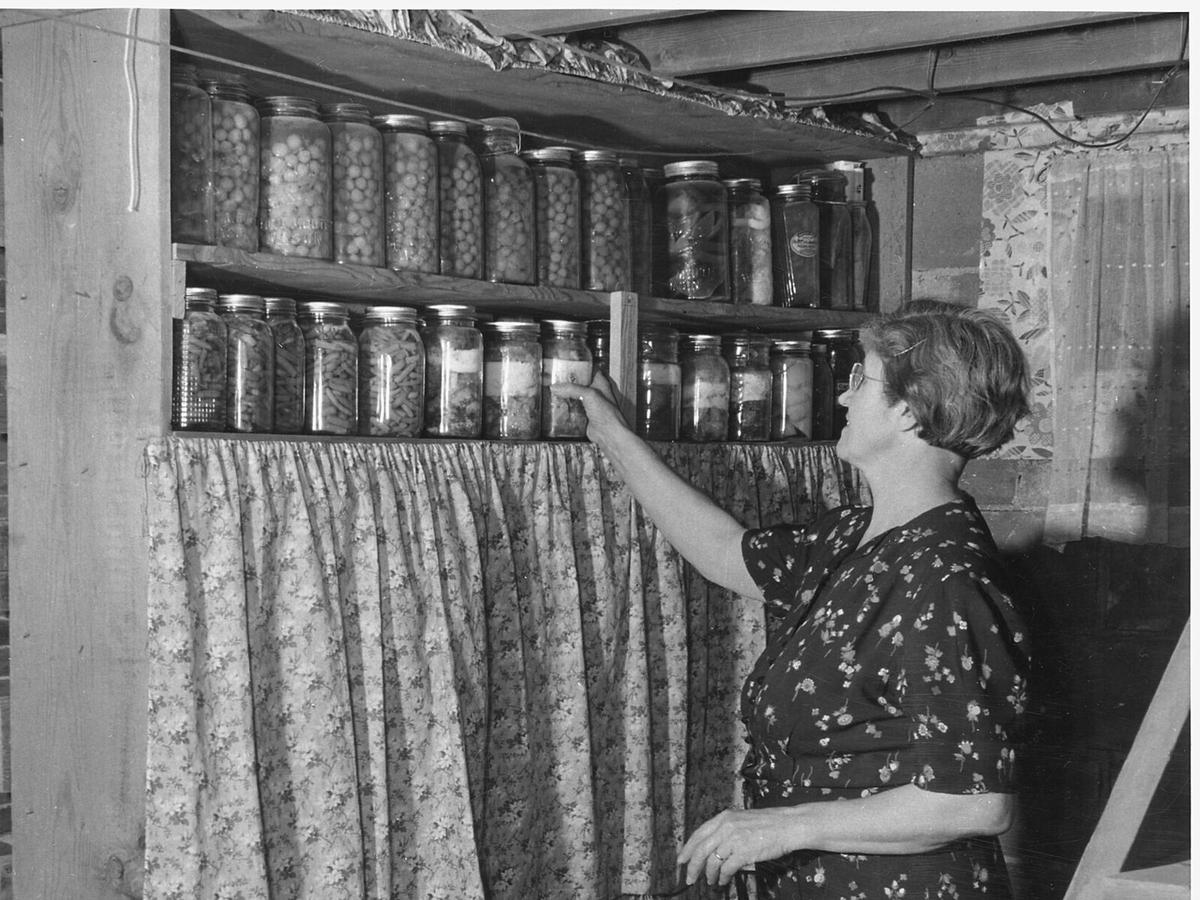 A Kansas basement shelf in April 1941. The idea is old: keep more than this week's food, and use the oldest jar first. Photo by Irving Rusinow, US National Archives, public domain, via Wikimedia Commons.
What do the agencies say to keep?
The official advice comes in two sizes. Ready.gov, the federal preparedness site, says to store at least a several-day supply of non-perishable food. The American Red Cross is more specific: a 3-day supply if you have to evacuate, and a 2-week supply for home. An emergency booklet published by FEMA with the Red Cross says that even though an emergency is unlikely to cut off your food for two weeks, you should consider keeping a supply that will last that long.
All three agree on the kind of food. Non-perishable means it keeps without a refrigerator. The FEMA booklet says the best choices need no refrigeration, water, special preparation or cooking, and that familiar foods matter because they lift morale in a stressful week. Ready.gov's list includes ready-to-eat canned meats, fruits and vegetables, peanut butter, dried fruit, protein or fruit bars, canned juice, shelf-stable milk, and a few comfort foods.
The same booklet makes the point that saves the most money: you may not need to buy anything special. The canned goods, dry mixes and staples already on your shelves count.
Store what you eat, and eat what you store
This is the whole method. Buy extra of the shelf-stable food you already cook with. Put the new package behind the old one. Cook from the front. Shops call this first in, first out, and the FEMA booklet uses the same phrase.
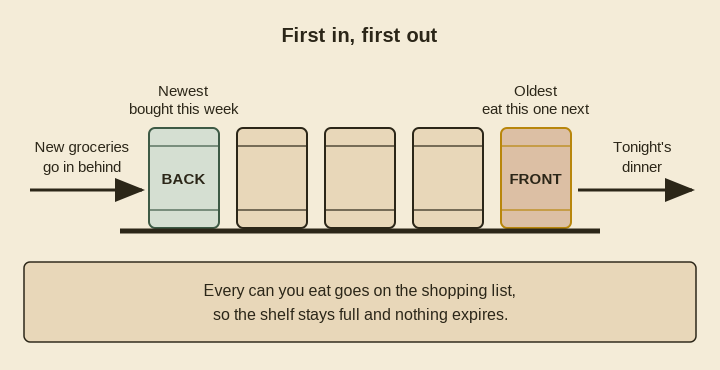 New food goes in at the back and dinner comes off the front, so the supply is always fresh.
A supply run this way costs money once. After that you are only replacing what you ate, which you would have bought anyway. Compare that with a case of freeze-dried meals nobody likes: paid for, stored for years, then thrown out. I think the surest sign of a good emergency shelf is that it looks like a normal one.
Write the purchase month on the lid with a marker. The booklet suggests dating everything, and it makes the oldest item easy to spot.
How much is two weeks, in plain terms?
Count meals first. One person eats 42 meals in 14 days, and a family of four eats 168. List what you would actually serve: 14 breakfasts, 14 lunches, 14 dinners, plus snacks.
Then check the energy. The Food and Drug Administration uses 2,000 calories a day as a general guide for nutrition advice, and says your own needs may be higher or lower depending on age, sex, height, weight and activity. So 14 days for one adult is about 28,000 calories. Every package lists calories per serving and servings per container. Multiply the two, add up the shelf, and you know where you stand. The FEMA booklet notes that healthy adults can get by on half their usual food for an extended period, so falling a little short is not a crisis. It says children and pregnant women should not be rationed.
Balance matters more as the days go on. As a rule of thumb, each day should have a starch (rice, pasta, oats, crackers), a protein (canned fish, chicken or beans, peanut butter), a fruit or vegetable (canned or dried), and some fat. The booklet's own advice is to eat at least one well-balanced meal a day. It also warns that if water is short, salty food will make you thirsty.
A six week shopping plan
Here is one way to build the shelf for one person without a big bill. The quantities are made-up examples to show the pattern. Adjust them to what you eat.
| Week | Add to the cart (example for one person) | What it covers |
|---|---|---|
| 1 | Large canister of oats, jar of peanut butter, 2 cartons shelf-stable milk | Most breakfasts |
| 2 | 6 cans of beans, 4 cans of tuna or chicken | Protein for lunches and dinners |
| 3 | 2 pounds of rice, 2 pounds of pasta, 3 jars of pasta sauce | Starch for dinners |
| 4 | 8 cans of vegetables, 6 cans of fruit | Something from a plant each day |
| 5 | 6 cans of soup or chili, crackers, dried fruit, nuts | No-cook lunches and snacks |
| 6 | Cooking oil, salt, coffee or tea, a comfort food, a manual can opener | The things that make it a meal |
A family of four follows the same six weeks with roughly four times the amounts, or spreads the plan over twelve weeks. Buy on sale and in the sizes you will finish. Our guide How to Manage Your Money When Everything Costs More covers the budget side, and Easy Meals to Prep at Home, for One Person and for a Family shows how to turn these same ingredients into dinners, which is how the shelf gets rotated.
Two things on that list are easy to forget. A manual can opener is on the Ready.gov, FEMA and Red Cross lists alike, since the electric one is no help in an outage. And rice, pasta and oats need water and heat. Keep a share of the shelf as food you can eat straight from the can.
Do the dates on the package mean the food is unsafe?
Mostly, no. The US Department of Agriculture's Food Safety and Inspection Service (FSIS) says that except for infant formula, federal rules do not require dates on food, and the dates are about quality. In its words, a "Best if Used By" date is not a purchase or safety date. If the date passes at home, the food should still be safe and wholesome if it has been handled properly, until spoilage is evident. FSIS adds that USDA estimates 30 percent of the food supply is lost or wasted at the retail and consumer levels, and that confusion over dates is one cause.
Infant formula is the exception. FSIS says not to buy or use it after its "Use-By" date.
| Food | Shelf life, unopened | Notes |
|---|---|---|
| Low-acid canned goods: meat, poultry, soups, beans, corn, peas, carrots | 2 to 5 years | After opening, 3 to 4 days in the refrigerator |
| High-acid canned goods: tomatoes, fruit, juices, pickles | 12 to 18 months | After opening, 5 to 7 days in the refrigerator |
| Rice and dried pasta | 2 years | Cooked, 3 to 4 days in the refrigerator |
| Tuna and other seafood in pouches | 18 months | After opening, 3 to 4 days in the refrigerator |
| Commercially packaged jerky | 12 months | Home-dried: 1 to 2 months |
Those figures are from the FSIS shelf-stable food chart, as of 12 November 2026. For anything not on it, the FoodKeeper database on FoodSafety.gov, developed by FSIS with Cornell University and the Food Marketing Institute, lists storage times food by food.
Where you store food changes how long it lasts. FSIS says to keep cans in a cool, clean, dry place, with temperatures below 85 degrees Fahrenheit best, and never above the stove, under the sink, or in a damp garage or basement.
Which cans to throw away. The can itself tells you more than the date does. FSIS gives these rules:
- Small dent, otherwise sound: the food should be safe.
- Deep dent: discard. A deep dent is one you can lay your finger into. Discard any can with a deep dent on a seam.
- Rust: surface rust that rubs off with a finger or paper towel is not serious. Discard heavily rusted cans, which can have tiny holes.
- Bulging, leaking, or spurting liquid when opened: never use it.
Watch out
A swollen can may hold the bacteria that cause botulism, a serious form of food poisoning. FSIS says not to even taste food from a leaking, bulging or badly dented can, or one with a foul odor. Double bag it and put it in the outside trash.
How do you cook, and what about the refrigerator, when the power is out?
Cooking. Ready.gov is blunt: charcoal grills and camp stoves are for outdoor use only. The reason is carbon monoxide, a gas with no color or smell that fuel-burning appliances give off. The Centers for Disease Control and Prevention (CDC) says more than 400 Americans die each year from unintentional carbon monoxide poisoning not linked to fires, and more than 100,000 visit an emergency department. Its rules: never burn charcoal indoors, never use a portable gas camp stove indoors, and never heat the house with a gas oven. The same goes for a generator: never inside the home or garage, even with doors and windows open, and more than 20 feet from windows, doors and vents.
You may not need to cook at all. Ready.gov notes that commercially canned food can be eaten straight from the can without warming.
The refrigerator and freezer. Eat the perishable food first, and keep the doors shut. FoodSafety.gov, the federal food safety site, gives the times:
- A refrigerator keeps food safe for up to 4 hours without power if the door stays closed. After that, discard meat, poultry, fish, eggs and leftovers.
- A full freezer holds a safe temperature for about 48 hours, and a half-full one for about 24.
- Frozen food can be refrozen if it still has ice crystals or is at 40 degrees or below.
- Never taste food to decide whether it is safe.
Some things survive: hard cheeses, butter, uncut fresh fruit and vegetables, bread, peanut butter and jelly are all marked "keep" on the site's chart.
Babies, pets, allergies and medical diets
A supply has to feed the people who actually live in the house.
- Babies. Ready.gov lists infant formula, bottles and baby food. Watch the "Use-By" date on formula, and remember that powdered formula needs safe water.
- Pets. The agencies list pet food and extra water. Rotate it like everything else.
- Allergies. Stock the safe versions of staples. They can be hard to find in a hurry.
- Medical diets. Someone who eats low-sodium, gluten-free or diabetic-friendly food needs that food on the shelf. Ask the clinician or dietitian who manages the diet what a two week supply should hold.
The FEMA booklet also singles out toddlers and older adults, who may need softer or simpler food than the rest of the house.
Where does it go in a small apartment?
One person in a studio. Forty-two meals is less space than it sounds: by my estimate, two grocery bags of cans and one of dry goods. They fit in a low box under the bed, on the floor of a closet, or on the top shelf nobody uses. Keep them away from the stove and the sink cabinet, as FSIS advises. Stack by type, oldest on top or in front.
A family of four. At 168 meals the supply needs a real home: one bookshelf in a hallway, or two shelves in a pantry. Use the same rule on a larger scale. New groceries go to the back, and whoever cooks pulls from the front. A list taped inside the door, with a mark for each item used, becomes next week's shopping list.
In both homes the food sits beside the water. Our guide Emergency Water: Storing It, Finding It and Making It Safe covers that half, and the series pieces on go bags and on staying home versus leaving explain when a 3-day kit is the better tool.
What to remember
- Aim for two weeks at home, built from food you already eat.
- New in the back, old in the front. Every item you use goes on the shopping list.
- Spread the buying over six weeks or more. Count meals, then check calories on the labels.
- A "Best if Used By" date is about quality. Infant formula is the exception.
- Throw out cans that bulge, leak, are heavily rusted or deeply dented.
- Charcoal and camp stoves stay outdoors. A closed refrigerator is good for 4 hours.
Start this week by buying two extra cans of something you ate last week, and put them behind the ones already there.