Articles & BlogBy Trapper W. Brown10 min readCurrent to 12 November 2026
First aid is the care a bystander gives until trained help takes over. On a normal day that gap is short. In a storm, on a trail, or when every ambulance is busy, it can be much longer, and the person standing there is the help for that stretch.
This guide collects what the main training organizations teach for the problems that cannot wait. It is education, and it does not replace a class or a 911 call: take a hands-on course, such as Red Cross First Aid and CPR, Stop the Bleed or Wilderness First Aid, and in a real emergency call 911 first and follow the dispatcher. Each step below is attributed to the organization that teaches it, as of 12 November 2026.
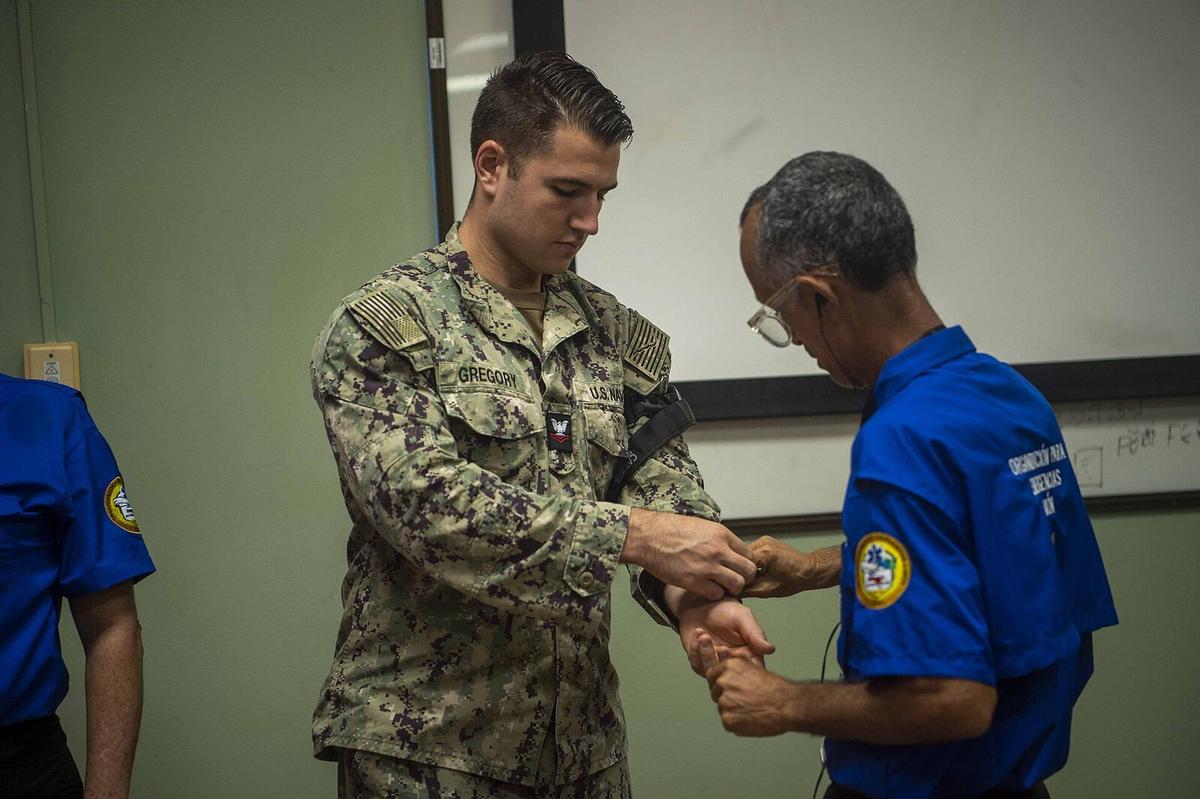 Tourniquet practice at a Stop the Bleed course in 2025. The skill takes an hour to learn in a class. Photo by the US Navy (Petty Officer 2nd Class Thomas Boatright), public domain, via Wikimedia Commons.
What comes first?
The Red Cross opens every one of its first aid pages with the same steps. Check that the scene is safe. Form a first impression and get the person's consent to help. Check for signs and symptoms. Call 911 and get equipment if the person needs emergency treatment. Then give care.
Two points in that list are easy to skip. Safety comes before care, because a second victim helps nobody. And the call comes before the care. My rule when others are present: point at one person and tell them to call.
For someone who seems unresponsive, the Red Cross check is "shout-tap-shout": shout their name, tap the shoulder, shout again, and take no more than 10 seconds over it.
How do you stop severe bleeding?
Bleeding comes first because it is fast. The American College of Surgeons, which runs the Stop the Bleed program, says a person can die within minutes after losing a significant amount of blood. The Red Cross gives two ways to recognize life-threatening bleeding: the amount is about half a soda can or more (less for a small child), or the blood is flowing continuously or spurting.
Stop the Bleed teaches three techniques, used after calling for help and making sure the scene is safe: apply direct pressure to the wound, pack the wound with gauze or clothing, and apply a tourniquet if appropriate.
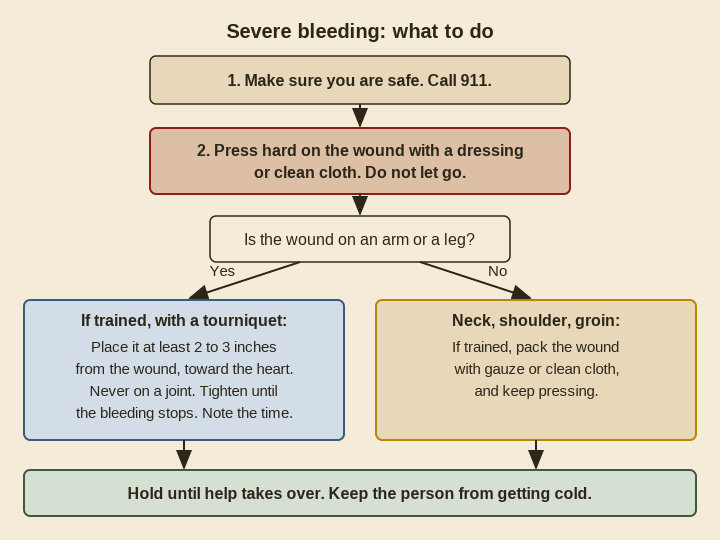 Pressure first, in every case. The tourniquet and packing steps are taught hands-on in a Stop the Bleed class.
Direct pressure. The Red Cross steps: find the source of the bleeding. Place a dressing on the wound. Apply steady, firm pressure directly over it, with the injured part on a firm, flat surface. Hold until the bleeding stops, a tourniquet is on, someone relieves you, or you are too exhausted to continue. If blood soaks through, do not lift the first pad. You may add one on top. If an object is stuck in the wound, do not pull it out. Press around it.
Tourniquet. A tourniquet is a strap tightened around a limb until blood stops flowing past it. The Red Cross lists it, for trained people, for life-threatening bleeding on an arm or leg. A Department of Homeland Security poster from the Stop the Bleed campaign gives the placement: at least 2 to 3 inches from the wound, between the wound and the heart. It may go over clothing. Do not put it over a joint such as an elbow, knee, wrist or ankle. Tighten it as much as you can, twist the rod until the bleeding stops, secure the rod, and note the time it went on.
Packing. For life-threatening bleeding from the scalp, neck, shoulder, groin or back, or from a limb when there is no tourniquet, the Red Cross lists wound packing for those trained in it.
The Stop the Bleed course takes about an hour and, the College says, is typically free. Nearly 5 million people had taken it as of April 2025.
What if someone collapses, or cannot breathe?
Collapse. If a person is unresponsive and not breathing, or only gasping, the Red Cross says to call 911, start CPR and use an AED right away. CPR is pressing on the chest to keep blood moving when the heart has stopped. An AED is the automated defibrillator kept in many public buildings. It gives spoken instructions.
For bystanders, the American Heart Association (AHA) teaches Hands-Only CPR, which is CPR without mouth-to-mouth breaths. It is meant for people who see a teen or adult suddenly collapse outside a hospital, and it has two steps:
- Call 911, or send someone to do it.
- Push hard and fast in the center of the chest.
The AHA's guidance for adult compressions is 100 to 120 a minute, to a depth of at least 2 inches for an average adult. The association says immediate CPR can double or triple the chances of survival after cardiac arrest.
Choking. The Red Cross signs of a blocked airway are a weak cough or none, high-pitched noises or silence, and being unable to cough, speak or cry. If the person can still cough, encourage them to keep coughing and stay with them. If they cannot, the Red Cross steps for an adult or child are:
- Stand to the side and slightly behind. Bend the person forward and give 5 back blows between the shoulder blades with the heel of your hand.
- Give 5 abdominal thrusts: a fist just above the navel, covered by your other hand, pulling inward and upward.
- Repeat 5 and 5 until the person can cough, cry or speak, or becomes unresponsive.
If they become unresponsive, lower them to a firm, flat surface and begin CPR. For someone who is pregnant or too large to reach around, the Red Cross says to give chest thrusts instead. The steps for an infant are different.
Unresponsive but breathing. The Red Cross says to place the person in the recovery position: on their side, so that vomit or blood drains out of the mouth and the airway stays clear. If you suspect a head, neck or back injury, leave them as you found them.
Burns, breaks and sprains
Burns. The Red Cross treatment is cool, clean, running water, as soon as possible, for 5 to 20 minutes. For a chemical or electrical burn its figure is at least 15 minutes, and for an electrical burn make sure the power is off before you approach. Take off clothing or jewelry at the burn unless it is stuck. Do not use ice, which the Red Cross says may damage the skin further, or butter and other greasy things, which hold the heat in. Do not use an adhesive bandage. Cover the burn loosely with a clean, dry, non-adhesive dressing.
Which burns need a hospital? The Red Cross list includes any burn on the face, hands, feet, joints or genitals, any burn larger than your palm, burns that blister, and any burn on a child.
Breaks and sprains. You usually cannot tell them apart, and the Red Cross says not to try: treat all such injuries as potential fractures. Its care steps:
- Have the person rest the part without moving or straightening it.
- If the skin is not broken, apply a cold pack wrapped in a thin, dry towel for no more than 20 minutes, then wait 20 minutes before applying it again.
- If there is an open wound, apply direct pressure to control the bleeding.
- Do not apply heat.
Call 911 for a limb that is bent or deformed, bone showing through skin, numbness or coldness below the injury, or any injury to the head, neck, spine, pelvis or upper leg.
How do you recognize shock, stroke and a heart attack?
All three are 911 calls. What a bystander adds is recognizing them early.
| Condition | Signs the Red Cross lists | What to do while waiting |
|---|---|---|
| Shock: the body's organs are not getting enough blood | Rapid, weak heartbeat. Rapid breathing. Pale, gray, cool or moist skin. Confusion or restlessness. Nausea. Great thirst | Treat the cause, such as bleeding. Lay the person flat. Keep them warm. Give nothing to eat or drink |
| Stroke: blood flow to part of the brain is cut off | FAST: Face drooping on one side. Arm weak or drifting down. Speech slurred. Time to call 911 | Note the time the signs started. Stay with the person |
| Heart attack: blood flow to part of the heart is blocked | Chest pain or pressure lasting more than 3 to 5 minutes, or that goes and returns. Pain spreading to arm, neck, jaw, back or stomach. Trouble breathing. Nausea, sweating | Have them stop and rest. Loosen tight clothing. Be ready to start CPR |
For shock with no injury, the Red Cross adds raising the feet 6 to 12 inches. The American Stroke Association now teaches a longer version, B.E. F.A.S.T., which adds sudden loss of balance and sudden changes in vision. The Red Cross says prompt care may reduce the disability a stroke leaves.
For a heart attack, the Red Cross says signs differ from person to person. Women may have milder chest symptoms with shortness of breath, nausea, back pain or extreme fatigue. Its care steps include aspirin for a person who is awake, can swallow and is allowed to take it, and its page gives the amounts. It also says never to drive the person to the hospital yourself.
Too cold or too hot
Hypothermia is a dangerously low body temperature. The Centers for Disease Control and Prevention (CDC) lists shivering, confusion, fumbling hands, slurred speech and drowsiness in adults, and says a temperature below 95 degrees Fahrenheit needs medical attention immediately. Its first steps:
- Get the person into a warm room or shelter.
- Remove any wet clothing.
- Warm the center of the body first: chest, neck, head and groin.
- Warm drinks can help. Do not give alcohol.
If the person is unresponsive, the CDC says to perform CPR, even if the person appears dead.
Heat stroke is the opposite emergency. The National Weather Service signs are confusion, slurred speech, a body temperature above 103 degrees, hot skin and loss of consciousness. The CDC's workplace guidance says to call 911, stay with the person, move them to a shaded, cool area and remove outer clothing, and cool them quickly with cold water or an ice bath if possible, or cold wet cloths on the skin. The Weather Service adds: do not give fluids.
When should you move someone?
Usually you should not. The Red Cross rule is to leave an injured person in the position found unless you must move them for safety, to perform CPR or to control bleeding. If a head, neck or back injury is possible, tell them not to move and to answer your questions out loud. Do not remove a helmet, or take an infant or child out of a car seat, unless you need to give CPR.
What belongs in the kit, and on the list?
The Red Cross publishes a kit list for a family of four. It includes 25 adhesive bandages in assorted sizes, 2 absorbent compress dressings, 10 sterile gauze pads in two sizes, 2 roller bandages, adhesive cloth tape, 2 triangular bandages, antibiotic ointment and antiseptic wipes, hydrocortisone ointment, 2 packets of aspirin, an instant cold compress, 2 pairs of nonlatex gloves, a breathing barrier, an emergency blanket, an oral thermometer and tweezers. It says to check the kit regularly and replace anything used or out of date. One person in an apartment can keep the same list in smaller numbers. I think a tourniquet earns a place once you have taken the class that teaches it.
The Red Cross also says to add personal items such as medications and emergency phone numbers, and its home supply list calls for a 7-day supply of medicines. Add one sheet of paper. The Red Cross teaches responders to ask a responsive person about symptoms, allergies, medications and medical conditions. Write those down for each person in the house, with the prescriber's phone number, and keep a copy in the kit and one in a wallet. A person who cannot speak can still hand over a piece of paper.
What to remember
- Make the scene safe, call 911, then give care. Send a specific person to make the call.
- Severe bleeding: press hard and do not let go. A tourniquet goes at least 2 to 3 inches from the wound, toward the heart, and never on a joint.
- Collapse without normal breathing: call 911 and push hard and fast in the center of the chest.
- Burns get cool running water. Possible fractures get rest and a wrapped cold pack.
- Stroke: FAST, and note the time. Heart attack and shock: 911, rest and warmth.
- Do not move an injured person unless staying is more dangerous.
Book a class this month. Our guide Lost or Stranded Outdoors: The Priorities That Keep You Alive covers the outdoor setting where these skills are most likely to be needed for a long wait.