Articles & BlogBy Trapper W. Brown8 min readCurrent to 13 November 2026Facts only
As of 13 November 2026, the OpenSSH project has released version 10.6p2 with what its release notes call "a critical security workaround," and the Cybersecurity and Infrastructure Security Agency (CISA) has added the flaw to its list of vulnerabilities known to be used in attacks. The flaw is tracked as CVE-2026-123158. A CVE number is a public ID that lets everyone refer to the same flaw.
OpenSSH is an implementation of SSH, the protocol used to log in to another computer over a network. The part that accepts logins is called sshd. According to the official record, on one kind of Linux system sshd could accept a wrong password. This article reports what the official sources say, and nothing past that. Check the pages in the Sources list for changes, because advisories are often revised.
 A password check is the lock on a remote login. Photo by Estormiz, CC0, via Wikimedia Commons.
What did OpenSSH announce?
Portable OpenSSH 10.6p2 was released on 5 November 2026. The release notes say: "This release contains a critical security workaround that affects Linux systems that use the musl libc and PAM disabled."
Two terms need explaining. A C library, or libc, is the basic toolbox of functions that nearly every program on a Linux system borrows from. The OpenSSH project's post about this flaw names two of them, glibc and musl. PAM, short for Pluggable Authentication Modules, is a separate system that a Linux machine can use to check passwords.
The security entry in the notes reads: "avoid password authentication bypass that is exploitable through sshd(8) that affects some Linux systems when built and run with PAM support disabled." It continues: "We consider the root cause of this bug to be outside sshd, but it is exploitable via sshd and can be avoided there." The notes credit the report to Özgün Kültekin of Wakefield.
The same day, OpenSSH developer Damien Miller posted to the project's mailing list under the subject "urgent security release: 10.6p2." The post says the project "learned of the problem yesterday." It also says where the flaw does not exist: "This vulnerability does not exist on non-Linux systems, Linux/glibc systems and Linux systems that use PAM for password authentication."
Which systems are affected?
The CVE record, published by MITRE on 5 November 2026, describes the affected software as "sshd in OpenSSH before 10.6p2 on Linux, when musl libc is used without PAM." It adds: "An example of a platform using musl libc without PAM is Alpine Linux."
Alpine Linux describes itself on its website as a "lightweight Linux distribution based on musl libc and busybox." Its own advisory, dated 5 November 2026, says a system is affected only if all of the following are true:
- It runs Alpine's
openssh-serverpackage, "which is built without PAM," or theopenssh-server-pampackage withUsePAM no. PasswordAuthenticationisyes, which the advisory calls "the OpenSSH default, unless you changed it."- The machine has an account whose password field is
*. The advisory describes this as "an account with no password set, which is normal for key-only accounts." - At least one local account has a password hash that starts with
$5$or$6$. A hash is the scrambled form in which a password is stored.
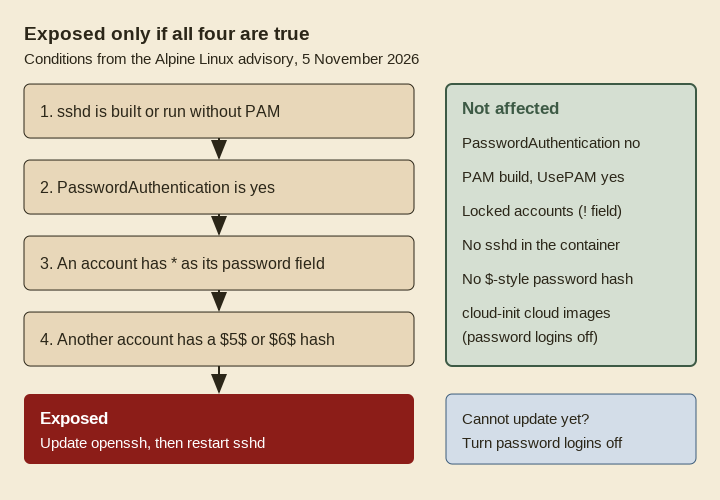 The conditions and exclusions as the Alpine Linux advisory lists them. Data: Alpine Linux, 5 November 2026. Diagram by Warhawk Division.
The advisory lists the affected releases as "every Alpine release we checked, 3.21 through 3.24 and edge, and the older releases that no longer receive regular updates (3.16 to 3.20)."
It also lists who is not affected. That list includes systems with PasswordAuthentication no, systems using openssh-server-pam with UsePAM yes, "Docker and other container users that do not run sshd in the container," and cloud images configured through cloud-init, "which writes PasswordAuthentication no."
The advisory has a separate warning for Alpine's official "tiny-cloud" images from 3.18.11 through 3.24.3. It says they are "safe on first boot" and "become exploitable as soon as any $6$ hash exists on the machine."
How does the bypass work?
This section gives only the level of detail the official pages give.
The CVE record says the flaw is "related to misinterpretation of whether a string is intended to be a password hash."
Alpine's advisory explains the cause. When sshd is built without PAM, it checks a password by running it through a C library function called crypt() and comparing the result with the stored password field. The advisory says that musl's version of that function "returns the string * as an error indicator" when the password is too long, and that * "is also exactly what the stored field contains for every account with no password, so the 'hash' matches and the login succeeds."
On how hard the flaw is to use, the sources also differ in tone. The CVE record carries a severity score of 8.1 out of 10, rated "High," from MITRE, on the Common Vulnerability Scoring System (CVSS), and that score lists the attack complexity as "High." The Alpine advisory says of an affected machine: "It takes one connection, works every time, and needs no retries."
Is it being used in attacks?
CISA says so. On 9 November 2026 it added four vulnerabilities to its Known Exploited Vulnerabilities (KEV) Catalog "based on evidence of active exploitation." One is CVE-2026-123158, which CISA lists as "OpenBSD OpenSSH Unexpected Status Code or Return Value Vulnerability." The catalog describes it this way: "OpenBSD OpenSSH on Linux contains an unexpected status code or return value vulnerability that could allow for authentication bypass."
The catalog entry gives federal civilian agencies a due date of 12 November 2026. It lists "Known Ransomware Campaign Use" as "Unknown." The deadline comes from Binding Operational Directive 26-04, dated 10 June 2026, which CISA says "applies only to FCEB agencies," meaning Federal Civilian Executive Branch agencies. CISA adds that it "encourages all organizations to adopt risk-based vulnerability management and prioritize remediation of KEV Catalog vulnerabilities."
What do the sources not say?
- None of the pages I read names who is carrying out attacks, who was attacked, or how many systems were affected.
- CISA's alert does not describe the evidence of exploitation it relied on.
- The OpenSSH notes say the root cause is "outside sshd." They do not name another project as responsible, and this article does not draw that conclusion.
- The Alpine advisory says "No CVE identifier had been assigned at the time of writing." The CVE record shows the number was reserved and published on 5 November 2026, the same date as the advisory.
- I could not confirm from an official page which other distributions, if any, ship OpenSSH in the affected combination. The CVE record names Alpine only as "an example."
What to do
This section repeats the official instructions. It is general information. If you run servers for an organization, your own security team and your distribution's advisory are the authorities.
If you do not run an SSH server on Linux with musl and without PAM, the OpenSSH mailing list post says the vulnerability "does not exist" on your system. If you are not sure what your distribution uses, check its security page.
If you run sshd on Alpine Linux, the Alpine advisory says: "update openssh now and restart sshd." It gives these commands:
apk upgrade -U -a
rc-service sshd restart
The first command updates every installed package. The second restarts the SSH server. The advisory stresses the restart: "Upgrading the package alone does not replace the running daemon."
The advisory says Alpine 3.21.10, 3.22.8, 3.23.8 and 3.24.4 contain the fixed package. It lists these fixed openssh versions:
| Alpine branch | Fixed openssh version |
|---|---|
| edge | 10.6_p2-r0 |
| 3.24 | 10.3_p1-r2 |
| 3.23 | 10.2_p1-r1 |
| 3.22 | 10.0_p1-r11 |
| 3.21 | 9.9_p2-r1 |
| 3.20 | 9.7_p1-r6 |
| 3.19 | 9.6_p1-r3 |
| 3.18 | 9.3_p2-r4 |
| 3.17 | 9.1_p1-r7 |
| 3.16 | 9.0_p1-r6 |
If you cannot update yet, the advisory says to "at least disable password logins: set PasswordAuthentication no in your sshd configuration and restart sshd." It warns: "Before you start, make sure your SSH key login works, and keep your current session open until you have tested a new login." The OpenSSH mailing list post gives the same direction in stronger words, telling operators of affected systems to "set PasswordAuthentication=no or disable SSH for these systems IMMEDIATELY." The site's article "SSH: Logging In to Another Machine Safely" explains key logins.
To check for past logins, the Alpine advisory says to look in /var/log/messages for sshd lines reading "Accepted password for" an account that has no password. It says: "If you cannot rule out a login, treat the machine as compromised."
Federal civilian agencies have their own instruction in the KEV entry, which begins: "Apply mitigations in accordance with vendor instructions."
What to remember
- OpenSSH 10.6p2, released 5 November 2026, works around a password login bypass tracked as CVE-2026-123158.
- The project says the flaw does not exist on non-Linux systems, on Linux with glibc, or on Linux systems that use PAM for passwords.
- Alpine Linux is the one platform the CVE record names, and Alpine's advisory lists four conditions that must all be true.
- CISA added the flaw to its exploited list on 9 November 2026. No official page I read names an attacker or a victim.
- The official fix is to update and restart
sshd. The official stopgap is to turn password logins off.
The site's article "How to Read a Security Advisory Without Panicking" covers how to read pages like these. For this flaw, the pages to watch are the Alpine advisory, the OpenSSH release notes and the CISA catalog entry, all linked below.
Sources (9)
- OpenSSH, "Release Notes" (OpenSSH 10.6p2), 5 November 2026
- OpenSSH, "Portable OpenSSH 10.6p2" release announcement, 5 November 2026
- Damien Miller, openssh-unix-dev mailing list, "urgent security release: 10.6p2", 5 November 2026
- Alpine Linux, "Security advisory: openssh-server password authentication bypass", 5 November 2026
- CVE Program, "CVE-2026-123158" record (machine-readable), published 5 November 2026
- NIST National Vulnerability Database, "CVE-2026-123158" (machine-readable), last modified 10 November 2026
- CISA, "CISA Adds Four Known Exploited Vulnerabilities to Catalog", 9 November 2026
- CISA, "Known Exploited Vulnerabilities Catalog", version 2026.11.13
- CISA, "BOD 26-04: Prioritizing Security Updates Based on Risk", 10 June 2026