Articles & BlogBy Trapper W. Brown11 min read
For the adult son or daughter who wants to help a parent without taking over. By the end you will know which schemes cost the most, what three protective tools do and do not allow, and who to call on the day something goes wrong.
A retired parent is a target for the same reason a bank is: that is where the money is. Savings built over forty years, a paid-off house and a long credit history are worth a criminal's time.
In 2025, people aged 60 and over filed 201,266 complaints with the FBI's Internet Crime Complaint Center (IC3) and reported losing $7.748 billion, according to IC3's annual report. That is an average of $38,500 each, and 12,444 of them lost more than $100,000. The Federal Trade Commission (FTC) keeps a separate count from its own reports. It puts reported fraud losses by people 60 and over at about $3 billion in 2025, up from about $600 million in 2020. Both are counts of what people reported. The FTC says its numbers "likely include only a fraction of older adults harmed by fraud."
 The most useful protection starts as a conversation at a table like this one. Photo by Rhoda Baer, National Cancer Institute, public domain, via Wikimedia Commons.
Is your parent really more at risk?
Not in the way most people assume. The FTC's 2025-2026 report to Congress, "Protecting Older Consumers," found that older adults reported losing money to fraud at a 14% lower rate than younger adults. About 74% of the fraud reports older adults filed said no money was lost. They spot a great many scams and walk away.
The difference is what happens on the day one works. The FTC's median reported loss for people 60 and over was about $900, and for people 80 and over it was $2,000, "far higher than any other age group." (The median is the middle value: half lost more, half lost less.) Losses of more than $100,000 were only 6% of older adults' loss reports and 70% of the money they reported losing.
So the goal is narrow: make sure one bad afternoon cannot empty an account.
Which schemes take the most money?
IC3 sorts complaints by crime type. For people 60 and over in 2025, six types account for most of the reported losses.
| Crime type, as IC3 names it | Reported losses, 60 and over, 2025 | What it looks like |
|---|---|---|
| Investment | $3,519,296,354 | A stranger or an ad offers a sure return, often in cryptocurrency |
| Tech/Customer Support | $1,040,730,043 | A pop-up or caller says the computer or an account has a problem |
| Confidence/Romance | $584,032,745 | An online friendship or romance that turns to requests for money |
| Business Email Compromise | $568,048,472 | A faked or hijacked email redirects a real payment |
| Government Impersonation | $413,206,251 | A caller claims to be from an agency and demands payment |
| Personal Data Breach | $324,470,413 | Personal information is taken and misused |
| Investment | $3,519M |
|---|---|
| Tech and customer support | $1,041M |
| Confidence and romance | $584M |
| Business email compromise | $568M |
| Government impersonation | $413M |
| Personal data breach | $324M |
Source: FBI Internet Crime Complaint Center, 2025 IC3 Annual Report
The FTC's report names investment scams, government impersonation and business impersonation as the top three by money lost. Reported losses by older adults to investment scams "jumped 42%" in 2025 to more than $1 billion.
The FTC also measures which scams older adults fall for more often than younger people, after adjusting for population. Tech support scams lead by a wide margin: older adults were "over four times (324%) more likely" to report a loss. Prize, sweepstakes and lottery scams come next at 112% more likely, then romance scams at 48%.
How the scam arrives depends on age. Older adults as a group reported the most money lost to fraud that began on social media. For people 80 and over it was the telephone. "Text and Phone Scams: The Fake Bank, the Fake Delivery, the Fake Grandchild" on this site covers the phone stories in detail, and "Deepfakes and Voice Cloning: The Family Code Word" covers the call that sounds like a grandchild.
How does the money actually leave?
The large losses in these reports tend to end the same way: the person moves the money personally, because someone has told them a story.
One story the FTC report describes is the false alarm. A caller or a message says there is a security problem with an account. People told the FTC "they were directed to transfer money, mail cash, or deposit cash into Bitcoin ATMs to keep it 'safe.'" The largest losses to government impersonators, the report says, were on scams that used the names of the FTC itself, the FBI and the Social Security Administration.
The payment method is the tell. The FTC found that older adults lost the most through bank transfers, with cryptocurrency second. Gift cards were the most common way older adults paid in tech support, romance, family impersonation and prize scams. IC3's figures agree on cryptocurrency: $4,347,081,557 of the losses reported by people 60 and over in 2025 involved it.
The FTC and its partners boiled this down to three lines for World Elder Abuse Awareness Day in June 2026. They are worth reading aloud:
- "Never ever will someone from the government say: 'Your money isn't safe. Move it to protect it.' Only a scammer will."
- "Never ever will someone from the government threaten to suspend your government benefits if you don't pay immediately. Only a scammer will."
- "Never ever will someone from the government demand that you pay with a payment app, cryptocurrency, wire transfers, or gift cards."
What three tools put a second set of eyes on the money?
They give very different amounts of power to the helper. Start with the one that gives the least.
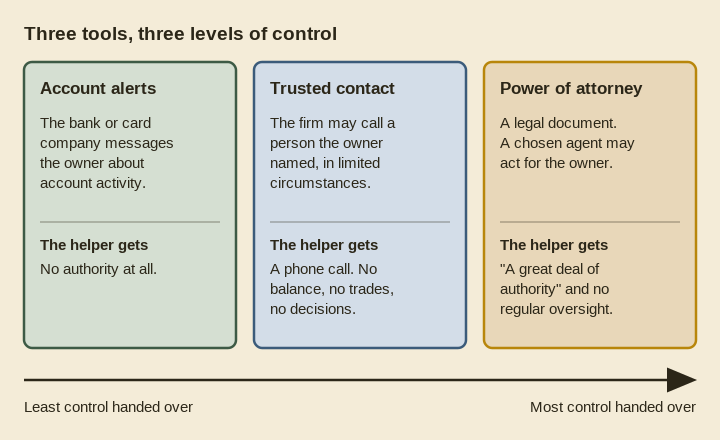 Alerts, a trusted contact and a power of attorney hand over very different amounts of control.
Account alerts. The Federal Deposit Insurance Corporation (FDIC) puts monitoring first in its advice on elder financial abuse: "Closely monitor your credit card and bank account activity," and report anything suspicious to the bank immediately.
Alerts make that practical. Many banks and card issuers will send a text or an email when a large withdrawal, a transfer or a new payee appears. What is offered differs from one institution to the next, so the useful step is to sit down with your parent and the bank's app or a branch employee and ask three questions. Which alerts exist? What dollar amount triggers them? Can a second person receive a copy?
An alert moves no money and gives away no control. It only shortens the time between a bad transfer and someone noticing.
A trusted contact. A trusted contact is a person an account owner names so that the financial firm has someone to call. A joint bulletin from the Securities and Exchange Commission, the Financial Industry Regulatory Authority (FINRA) and state securities regulators, dated 25 August 2025, describes it as "like an emergency contact." A brokerage firm may reach that person "in limited circumstances, such as if your investment professional has trouble reaching you or has a reasonable belief that your account might be exposed to possible financial exploitation."
The limits are the point. The bulletin says naming a trusted contact:
- "does not give that person any authority to learn about your account balance, execute trades or engage in any other transactions in your account;"
- "does not give that person any authority to make decisions about your account; and"
- "does not make that person a power of attorney, legal guardian, trustee or executor."
The contact must be 18 or older, there can be more than one, and the owner can change them at any time.
Banks and credit unions may offer the same thing. The Consumer Financial Protection Bureau (CFPB) calls it an "emerging practice" and gives an example. Lara lists her adult daughter as a trusted contact at her credit union. The credit union sees a large withdrawal that is out of character, calls Lara and emails her, and gets no answer. It then reaches the daughter, who says Lara has had a health crisis and cannot use her phone. The daughter can now visit and go to the branch with her mother. She still cannot get any account information without Lara's consent.
The CFPB adds one caution: it "may be advisable to name a trusted contact who does not also currently have control over your finances."
A power of attorney. This is the strong tool, and it is a legal matter. What follows is the CFPB's description, not legal advice. For a real document, your parent should talk to a lawyer licensed in their state.
The CFPB defines a power of attorney as "a legal document that allows someone else to act on your behalf." The person chosen is called an agent. A power of attorney made for planning ahead is generally "durable," which the CFPB explains as "it continues to be effective even if you become incapacitated." Without one, it says, a relative "might have to go to court to have a guardian appointed," a process that "can be lengthy, expensive, and very public."
The CFPB is direct about the risk: "It gives someone else a great deal of authority over your finances without regular oversight." It lists the forms abuse can take, including an agent who spends the money on themself. Its safeguards are to appoint only "someone you really trust," to tell other family members and financial advisers that the document exists, and to consider a clause requiring the agent to "regularly report to another person." It also notes that the choice is not permanent: "you can revoke or cancel your POA."
How do you raise it without starting a fight?
The FTC's answer is simple: talk about scams as news, not as a verdict on anyone. Its alert of 30 July 2026 says, "One of the best ways to fight fraud is to talk about it. When you know scammers' tactics, they're easier to spot and avoid."
The agency's Pass It On campaign is built on the same idea. Its report says the campaign treats older adults "as part of the solution," giving them material to pass to family and friends. A few approaches that follow from it, offered as my own suggestions:
- Trade stories. Show a scam text you received and ask what they have been getting.
- Make it mutual. Name each other as trusted contacts. A request that runs in both directions is not a judgment.
- Agree one rule. For example: no money moves because of a call, text or pop-up until one other person has heard about it. The Postal Inspection Service gives the same advice in four words: "Consult with a friend."
What do you do the day money goes missing?
Speed matters more than anything else here. IC3's elder fraud page lists the steps in order.
- Call the bank. IC3 says to contact the bank and other financial institutions "to safeguard your accounts," and, if a wire was sent, to request a recall. Doing so "as quickly as possible may reduce or eliminate your financial losses." This is not a formality. The FTC's report says IC3's Recovery Asset Team, which asks banks to freeze money sent to scammers, started that process for 3,900 incidents in 2025 and froze $679 million of the $1.16 billion reported lost in them.
- Protect the credit file. IC3 says to contact the three credit bureaus. "Credit Freezes and Identity Theft: A Step by Step Guide" on this site walks through it.
- Report it. File at ic3.gov and at ReportFraud.ftc.gov. If an identity was stolen, IC3 also points to IdentityTheft.gov.
- Get help filing. The Department of Justice runs the National Elder Fraud Hotline for fraud against anyone 60 or older: 833-FRAUD-11 (833-372-8311), Monday to Friday, 10 a.m. to 6 p.m. Eastern. For a brokerage account, FINRA's Securities Helpline for Seniors is 844-574-3577.
Watch out
After a loss, expect a second wave. The FTC warns that refund and recovery scammers "buy lists of people who've already been scammed," and says: "Never pay up front for a refund." The Justice Department's hotline page carries its own alert that scammers have posed as hotline staff.
What to remember
- People 60 and over reported $7.748 billion in losses to IC3 in 2025. Investment and tech support scams took the most.
- Older adults report losing money less often than younger adults. The danger is the size of a single loss.
- A demand to move money to keep it safe, or to pay by gift card, cryptocurrency or wire, is the mark of a scam.
- Alerts and a trusted contact add a second set of eyes and hand over no control. A trusted contact cannot see balances or make decisions.
- A power of attorney gives real authority and carries real risk. Read the CFPB's page and see a lawyer.
- If money moves, call the bank first, then report to ic3.gov and ReportFraud.ftc.gov. The Elder Fraud Hotline is 833-372-8311.
Pick the smallest step and do it this week: ask your parent which alerts are switched on at their bank, and offer to be the name on the trusted contact form. The larger conversations are easier once that one has gone well.
Sources (13)
- FBI Internet Crime Complaint Center, "2025 IC3 Annual Report"
- FBI Internet Crime Complaint Center, "Elder Fraud"
- Federal Trade Commission, "Protecting Older Consumers 2025-2026: A Report of the Federal Trade Commission", 19 October 2026
- Federal Trade Commission, "FTC Issues Annual Report to Congress on Agency's Actions to Protect Older Adults", 19 October 2026
- Federal Trade Commission, "Help fight imposter scams this World Elder Abuse Awareness Day", 15 June 2026
- Federal Trade Commission, "Talk to your friends and family to fight fraud", 30 July 2026
- Federal Trade Commission, "Have you lost money to a scam? Watch for scammers who say they can help", 3 August 2026
- FINRA, SEC and NASAA, "Investor Bulletin: Why You Should Consider Adding a Trusted Contact to Your Account", 25 August 2025
- Consumer Financial Protection Bureau, "Choosing a trusted contact person can help you protect your money", November 2021
- Consumer Financial Protection Bureau, "What is a power of attorney (POA)?", last reviewed 28 August 2026
- Federal Deposit Insurance Corporation, "Scams Targeting Older Adults", July 2025
- U.S. Postal Inspection Service, "Older Americans"
- U.S. Department of Justice, Office for Victims of Crime, "National Elder Fraud Hotline"