Articles & BlogBy Trapper W. Brown8 min read
For anyone with a phone, and for anyone who looks after someone with a phone. By the end you will know the three most common stories, why the number on your screen proves nothing, and the one rule that stops nearly all of them.
Your phone rings and the screen shows your bank's name. A calm, polite voice says there has been fraud on your account and they need to confirm a few details to stop it. It sounds like help. It may be the theft itself.
The same trick by text message is sometimes called smishing, and by voice call, vishing. You do not need the words. In the FBI's 2025 Internet Crime Complaint Center report, people aged 60 and over filed 201,266 complaints and reported $7.7 billion in losses, more than any other age group on both counts. I do not read that as carelessness. Scammers go where the savings are, and they are good at their work.
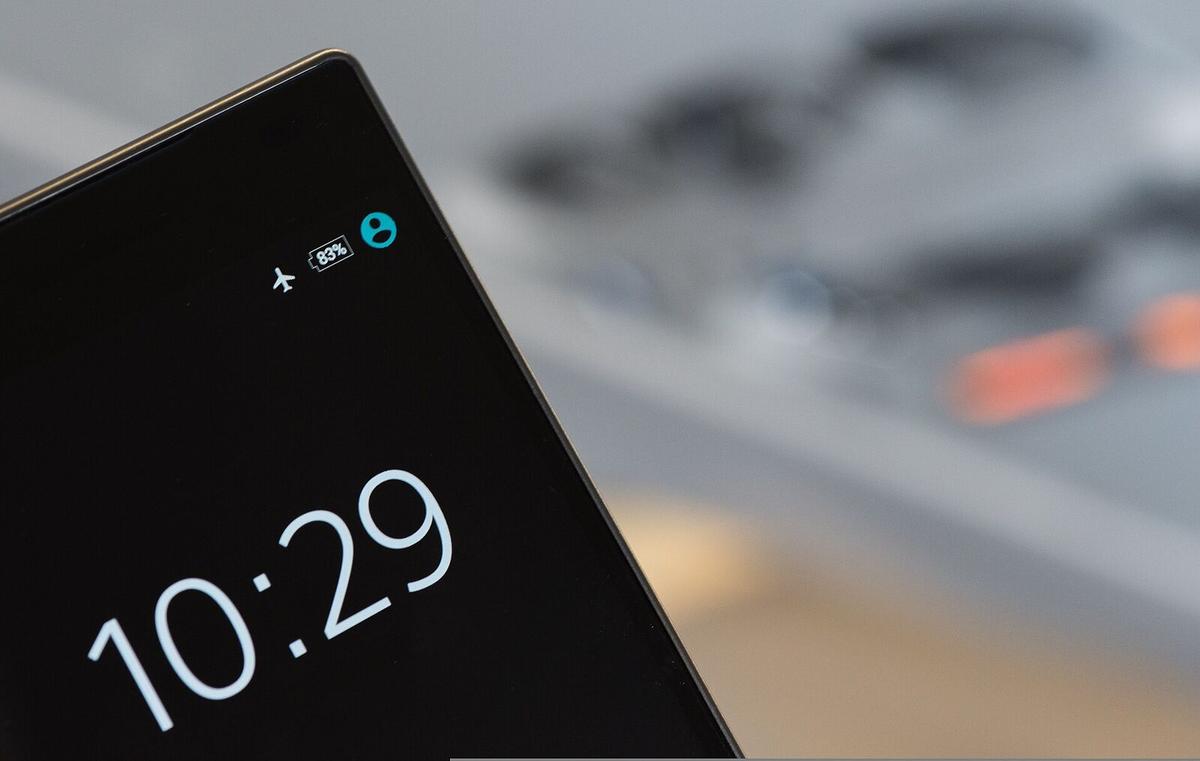 The screen shows whatever the other end sends it. Photo by Skitterphoto, CC0, via Wikimedia Commons.
Three stories you will hear
| The story | How it starts | What they are after |
|---|---|---|
| The fake bank | A text or call about suspicious activity on your account | A code, a password, or your money moved somewhere "safe" |
| The fake delivery | A text saying a package could not be delivered, with a link | Card details or a login typed into a copy of a real site |
| The fake grandchild | A call from a relative in trouble, or from a "lawyer" or "officer" | Money sent fast, and kept secret |
The fake bank. The Federal Trade Commission (FTC) lists fake alerts about suspicious activity and payment problems among the most common scam texts. Its rule is simple: real companies will not ask for information about your account by text.
The fake delivery. A fake package notice is on the same FTC list. Most of us are waiting for a parcel most of the time, so it lands.
The fake grandchild. The FTC calls these family emergency scams. The caller poses as a relative or a close friend who needs money to get out of trouble, or as a lawyer, a police officer or a doctor speaking for them. Some now use AI to copy a loved one's voice from a short audio clip, and they may know names and details from social media or a hacked email account. The FBI's 2025 report says people claimed losses of more than $5 million that year to distress scams that used voice cloning.
A fourth story is close behind: the caller from a government office. The same FBI report counts about 32,000 complaints and $798 million in losses to government impersonation in 2025. The FTC's answer is that real law enforcement and federal agencies will not call and threaten you, and that no government agency calls out of the blue to ask for sensitive information.
Why can you not trust the number on the screen?
Because the caller's side supplies it. Think of the return address on an envelope: whoever posts the letter writes it, and nobody checks. Showing a false name or number this way is called caller ID spoofing. The FTC puts it flatly: scammers can make any name or number show up on your caller ID.
That means your bank's real number can appear on your screen during a call your bank never made.
A familiar voice is no longer proof either. None of this means you should stop answering the phone. It means you need a check the caller does not control.
The hang up and call back rule
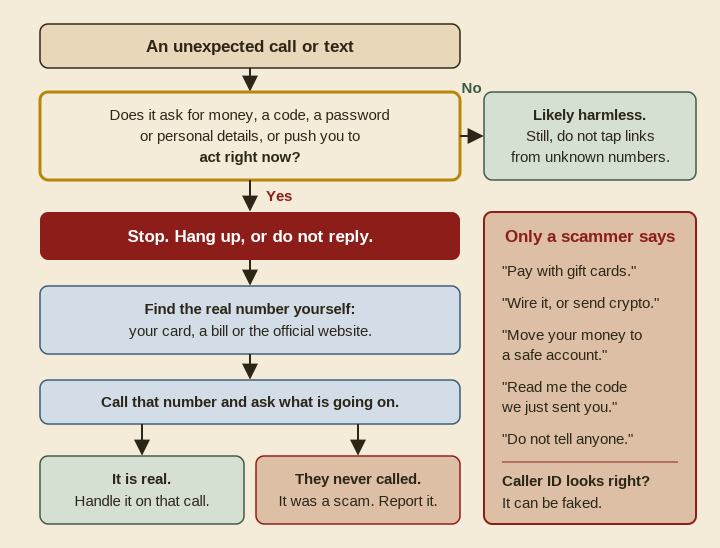 One path for every unexpected call or text. The check happens on a call that you start.
The rule has three steps.
- Hang up, or do not reply. You do not owe a stranger a polite goodbye. On a recorded call, the FTC says not to press any number, because that can bring more calls.
- Find the number yourself. Use the back of your bank card, a paper statement, or the official website with the address typed by you. Never use a number or a link the caller or the text gave you.
- Call and ask. If there is a real problem, the person who answers will see it on your account.
A real bank will not mind. The FTC's advice is to take your time and not be pressured into a decision on the spot.
For a family emergency call, the FTC's steps are the same idea: say you will call back, then ring the person on a number you already have. Ask a question only the real person could answer. And check the story with another relative, even if the caller begged you to keep it secret.
Tip
Save your bank's real phone number in your contacts today, copied from the back of your card. Then agree one thing at home: anyone who phones asking for money gets called back on the number we already have, and nobody will be offended by it.
Gift cards, wires and the "safe account"
How do they want to be paid? In ways that are hard to undo. The FTC names wire transfers, gift cards, cryptocurrency and payment apps, and adds that anyone who insists you can only pay that way is a scammer.
Gift cards deserve their own line, in the FTC's words: "Gift cards are for gifts. Only gifts. Not for payments." Scammers often name the exact card and the store, and stay on the phone while you buy it. Government agencies never demand payment by gift card.
| If you paid by | Do this at once (FTC) |
|---|---|
| Gift card | Contact the company that issued the card, ask for your money back, keep the card and the receipt |
| Wire transfer | Contact the wire transfer company and report the fraud |
| Payment app or cryptocurrency | Contact the company and ask it to reverse the payment |
| Credit or debit card | Contact the card company or bank and report a fraudulent charge |
One more request belongs on this list. A caller who tells you to move your savings into a "safe account" to protect them is describing the theft.
Watch out
Never read out a code that was just sent to your phone. Those codes exist so that you can type them into a site yourself. Someone who asks you to read one aloud is using it to sign in as you, at that moment, whatever reason they give.
Where do you report and block?
For readers in the United States, these come from the FTC's own pages:
- Copy a scam text and forward it to 7726 (SPAM). This helps your phone company block similar messages.
- Use the "report junk" or "report spam" option in your messaging app.
- Report the scam to the FTC at
ReportFraud.ftc.gov. Note the number that showed on your screen, any number they told you to call, and the date and time. - If you lost no money and only want to report the call, use
DoNotCall.gov. - For a family emergency scam, the FTC also suggests your state attorney general.
If money went out through the internet, file a complaint with the FBI at www.ic3.gov as well. That office says it will never contact you directly to ask for information or money, so treat any "recovery agent" who phones afterwards as round two.
To cut the noise, the FTC suggests the filter for unknown senders that many phones have, and asking your phone company what blocking it offers. The National Do Not Call Registry will not help here: as the FTC says, scammers do not care if you are on it.
Six things to do today
- Save the real phone numbers for your bank and your card company in your contacts
- Find the setting on your phone that filters messages from unknown senders
- Ask your phone company what call blocking or call labeling it offers
- Agree the call back rule at home, and a question only family could answer
- Forward the next scam text you get to 7726, then delete it
- Tell one older relative and one teenager the gift card rule
What to remember
- The name and number on your screen are supplied by the caller. They prove nothing.
- A familiar voice can be copied.
- Hang up, find the number yourself, call back. A real bank will not mind.
- Gift cards, wires, cryptocurrency and "safe accounts" are how scammers get paid.
- Never read out a code. Never keep a money request secret from your family.
- Report texts to 7726 and scams to
ReportFraud.ftc.gov.
Much of what makes these calls convincing is collected from what we post in public: names, relatives, travel plans. What Your Social Media Tells a Burglar covers how to trim that down, and it is the natural next read.