Articles & BlogBy Trapper W. Brown10 min readCurrent to 15 November 2026Facts only
As of 15 November 2026, federal agencies have a standing set of warnings about the scams that follow holiday shopping: a text about a package that does not exist, an online store that copies a real brand, and anyone who wants to be paid with a gift card. This article collects what the Federal Trade Commission (FTC), the U.S. Postal Inspection Service, the Cybersecurity and Infrastructure Security Agency (CISA) and the FBI's Internet Crime Complaint Center (IC3) have published, in their words, and what they say to do if money has already gone.
Two other articles on this site cover the year-round ground. "Text and Phone Scams: The Fake Bank, the Fake Delivery, the Fake Grandchild" explains why the number on your screen proves nothing and how to call back safely, and "Phishing: How to Read an Email Before You Click" shows how to inspect a link. This piece covers only what is seasonal. Official pages change, so read the versions linked under Sources before you act.
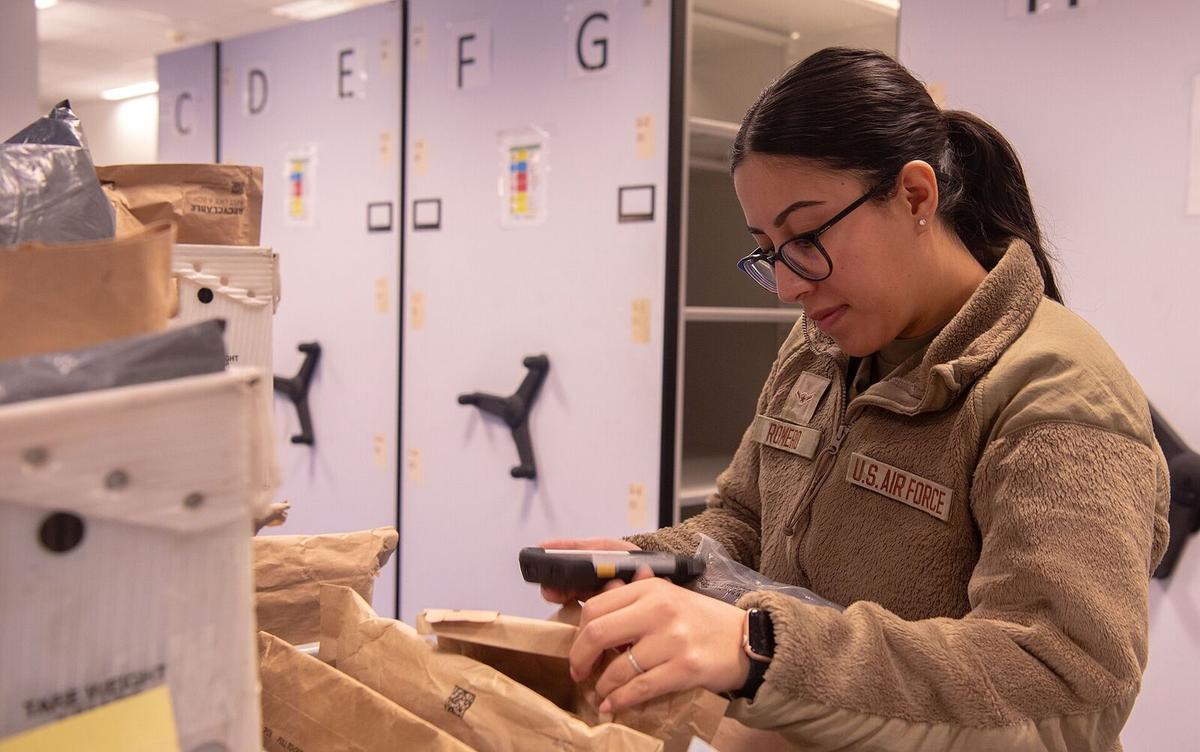 A military postal clerk scans inbound packages at Ramstein Air Base, Germany, in December 2023, when the post office there was handling nearly triple its usual mail. Photo by Airman 1st Class Olivia Sampson, U.S. Air Force, public domain, via Wikimedia Commons.
Why do the warnings come out now?
The agencies give the same reason: people are expecting packages and shopping online in a hurry. The FTC's consumer alert of 2 December 2024 says: "During the holiday season, you might expect to get more deliveries. Some might even be surprise gifts. Scammers are counting on that when they send fake delivery notifications to you by email and text, hoping you'll click." CISA's page "Holiday Online Shopping Tips" calls the season "a prime time for hackers, scammers, and online thieves."
The figures the agencies publish cover whole years, not the holiday weeks. IC3's 2025 annual report counts 56,478 complaints of what it calls non-payment and non-delivery fraud, with reported losses of $503,373,587. It defines non-delivery this way: "Payment is sent, and goods or services are never received, or are of less quality."
The FTC's alert of 27 April 2026 says people reported losing $2.1 billion in 2025 to scams that started on social media, and that "Shopping scams were the most reported scam on social media."
All of these are counts of reports that people chose to file. None is a measured total.
What does a fake tracking text look like?
The FTC's 2024 alert describes the pattern. The message "says you missed the delivery. Or it might say your item can't be delivered because you need to update your street address or zip code." It may add pressure by saying the package will go back to the sender. Then it offers the fix: "just click on a link."
The alert calls this a phishing scam, meaning a message built to trick you into handing over information. On what can follow a click, it says "scammers could get information like your usernames and passwords for your online banking, email, or social media accounts," and "They might also install malware on your computer." Malware is software written to do harm.
The Postal Inspection Service is the law enforcement arm of the U.S. Postal Service (USPS). It calls the text version smishing. Its page on package tracking text scams, last updated 19 May 2025, gives three facts a reader can hold any "USPS" message against:
- You have to ask first. "USPS will not send customers text messages or e-mails without a customer first requesting the service with a tracking number, and it will NOT contain a link."
- Tracking costs nothing. "USPS does not charge for these services!"
- The sender is a short number. "USPS utilizes the 5-digit short codes to send and receive SMS to and from mobile phones."
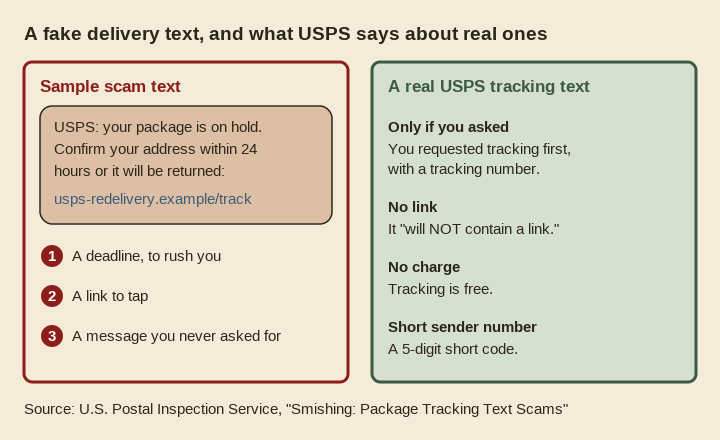 A made-up example of a fake delivery text beside the Postal Inspection Service's description of a real USPS tracking text.
That page speaks only for USPS. The FTC's instruction covers every carrier: "contact the shipping company using a phone number or website you know is real. Don't use the information in the message."
What about a package you never ordered?
A box you did not order can be part of a scam too. The FTC's alert of 20 August 2026 calls it a brushing scam, "where a scammer uses your name to leave a fake review for that package you didn't order," and adds that it "could also be a sign that someone has (or is looking to steal) your personal information."
The newer twist is a note inside with a QR code, the square barcode a phone camera reads. The FTC says scanning it "could take you to a phishing website designed to steal information like your credit card numbers, usernames, or passwords." The FBI issued its own public service announcement on this on 31 July 2025. It notes: "While this scam is not as widespread as other fraud schemes, the public should be aware of this criminal activity." Its advice is short: "Do not scan QR codes from unknown origins."
On the box itself, the FTC says: "the law says you don't need to return things you didn't order. And you don't have to pay for them, either."
How do lookalike stores work?
The FTC's alert of 25 November 2025 describes the lookalike store. Scammers "sometimes impersonate real companies and run ads for brand-name products at unusually low prices." Click the ad and it "could send you to a scammy website designed to take your money in exchange for a counterfeit item, something that looks completely different from the picture in the ad, or nothing at all."
CISA's holiday tip sheets describe the email route: "Cyber criminals will often send phishing emails" that are "designed to look like they're from retailers." Its instruction: "If you're unsure if an email is legitimate, type the URL of the retailer or other company into your web browser as opposed to clicking the link." A URL is a web address.
Both agencies mention the padlock. CISA tells shoppers to check that the address begins with "https:" and that the padlock is locked, because that means your information is encrypted in transit. The FTC's "Online Shopping" article adds the limit: an encrypted site is not proof of an honest one, because "Scammers know how to encrypt sites, too." The padlock is needed. It is not enough.
Why does the way you pay matter?
The FTC's alert of 22 July 2026 says scammers "always ask you to pay in ways that make it difficult to get your money back," and "Anyone who says you can only pay in one of these ways is probably a scammer." The ways it lists are bank transfer, wire transfer, cryptocurrency, payment app and gift card.
For an ordinary purchase the FTC says: "Pay by credit card whenever possible. Credit cards offer more protections and give you the option to dispute charges." Its "Online Shopping" article gives the deadline for a billing dispute: a letter "that reaches the company within 60 days of the day the company mailed you the first bill showing the error." CISA's tip sheet makes the same choice over a debit card: "There are laws to limit your liability for fraudulent credit card charges, but you may not have the same level of protection for your debit cards."
Gift cards get their own FTC page. It says: "No real business or government agency will ever tell you to buy a gift card to pay them." For gift cards bought as presents, the same page says to "Inspect the gift card before you buy it" and "Always keep a copy of the gift card and store receipt."
What is not known
- No agency page I read gives a count for the 2026 holiday season. The annual figures above are for 2025.
- The figures are reports. The FTC and IC3 pages do not say how many fake texts are sent or how many people lose money without reporting it.
- CISA's "Holiday Online Shopping Tips" page shows a revision date of 21 November 2023. I found no newer CISA holiday page.
- None of these pages says who is behind the messages.
What to do
These steps are the agencies' own, from the pages cited.
- A delivery message you did not expect: the FTC says, "Don't click on links in messages about an unexpected delivery," and, for something you did order, to "go to the site where you bought the item and look up the shipping and delivery status there."
- If you tapped the link in a fake USPS text: the Postal Inspection Service says, "If you have already interacted with the URL provided (even if you did not click 'submit'), please notify your financial institution."
- Report the text. Forward it to 7726. For a text that names USPS, the Postal Inspection Service also asks for an email to spam@uspis.gov. Report scams to the FTC at ReportFraud.ftc.gov and to IC3 at ic3.gov.
- If you paid, the FTC's page "What To Do if You Were Scammed" says to contact the company you used to send the money right away, say it was a scam, and ask for the payment to be reversed. Who that is depends on how you paid, as the diagram shows. The FTC is plain that "your money might be gone already," and that it is "always worth asking."
- If you gave a password, the same page says to "Create a new, strong password for the account" and "Turn on two-factor authentication."
- If you gave a Social Security number, it sends you to IdentityTheft.gov. The site's article "Credit Freezes and Identity Theft: A Step by Step Guide" covers what comes next.
- Afterward, expect a second approach. The FTC's alert of 3 August 2026 warns that refund and recovery scammers "buy lists of people who've already been scammed," and says: "Never pay up front for a refund."
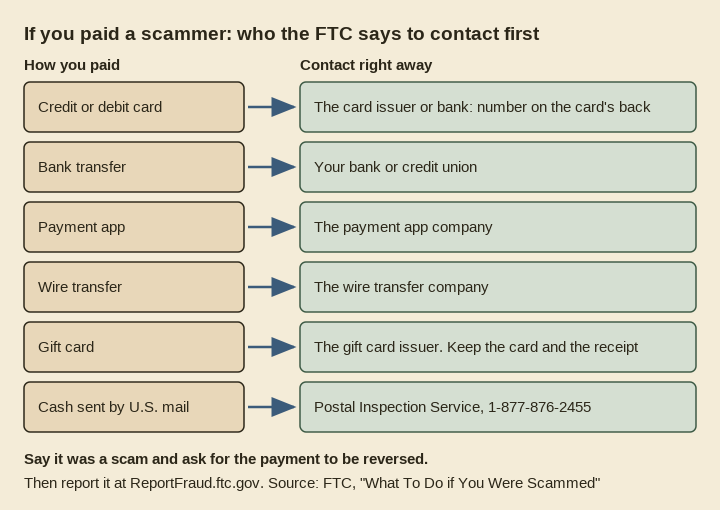 The first call depends on how the money left, according to the FTC's page What To Do if You Were Scammed.
What to remember
- The Postal Inspection Service says USPS texts come only after you request tracking, and a real one "will NOT contain a link."
- For any carrier, the FTC says to use a phone number or website you know is real, not the one in the message.
- A package you did not order may be a brushing scam. The FBI says not to scan a QR code from an unknown origin.
- The FTC says a seller who will only take a gift card, wire transfer, payment app or cryptocurrency is "probably a scam."
- If you paid, contact the company that moved the money first, then report at ReportFraud.ftc.gov.
Every quotation here comes from a page listed below, read on 15 November 2026. If any of them has changed since, the official page is the one to follow.
Sources (14)
- Federal Trade Commission, "Scammers are delivering phishing messages this holiday season", 2 December 2024
- U.S. Postal Inspection Service, "Smishing: Package Tracking Text Scams", last updated 19 May 2025
- Federal Trade Commission, "That unexpected package you got could be a brushing scam", 20 August 2026
- FBI Internet Crime Complaint Center, "Unsolicited Packages Containing QR Codes Used to Initiate Fraud Schemes", 31 July 2025
- Federal Trade Commission, "How to avoid an online shopping scam this holiday season", 25 November 2025
- Cybersecurity and Infrastructure Security Agency, "Holiday Online Shopping Tips", revised 21 November 2023
- Cybersecurity and Infrastructure Security Agency, "Holiday Online Safety Tip Sheets"
- Federal Trade Commission, "Online Shopping", May 2023
- Federal Trade Commission, "A way to spot scams: how someone asks you to pay", 22 July 2026
- Federal Trade Commission, "Avoiding and Reporting Gift Card Scams", July 2023
- Federal Trade Commission, "What To Do if You Were Scammed", June 2026
- Federal Trade Commission, "Have you lost money to a scam? Watch for scammers who say they can help", 3 August 2026
- Federal Trade Commission, "How to spot the top scams that started on social media", 27 April 2026
- FBI Internet Crime Complaint Center, "2025 IC3 Annual Report"