
Vietnam War, 1955 to 1975
Thirty Years to Saigon
Vietnam's war for independence from France became a war between two Vietnamese states, and the United States sent more than half a million troops to keep the southern one alive. This history follows the decisions on every side and shows where the count of the dead rests on one party's word.
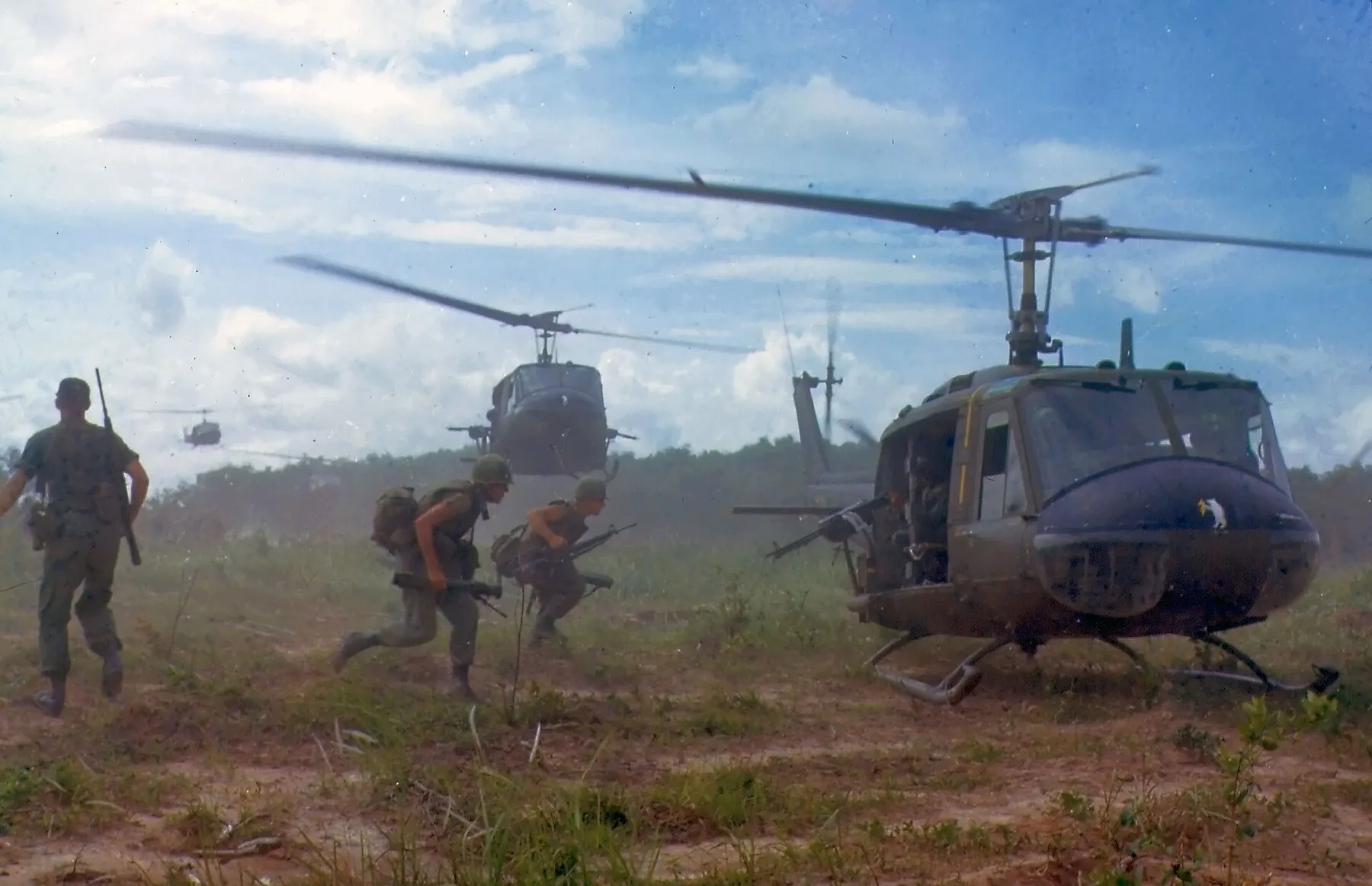
UH-1D helicopters lift soldiers of the 2nd Battalion, 14th Infantry from the Filhol rubber plantation area during Operation Wahiawa, May 16, 1966.
SFC James K. F. Dung, U.S. Army, via U.S. National Archives. Public domain. SourceWar summary
Result
North Vietnamese and NLF victory
- U.S. forces withdrew under the Paris Agreement of January 27, 1973.
- Saigon fell on April 30, 1975, and the Republic of Vietnam ceased to exist.
- Vietnam was unified under Hanoi in July 1976.
- Communist movements took power in Cambodia and Laos in 1975.
- Also known as
- American War, Resistance War Against America, Second Indochina War
- Date
- 1955 to April 30, 1975
- Location
- South Vietnam and North Vietnam, with linked wars in Laos and Cambodia
| South Vietnam and allies | North Vietnam and the NLF |
|---|---|
| Belligerents | |
|
|
| Fought for | |
| To keep South Vietnam a separate, non-Communist state, in President Johnson's 1965 words "the independence of South Viet-Nam, and its freedom from attack." | To finish the independence struggle begun against France, end the American presence, overthrow the Saigon government and reunify Vietnam. |
| Commanders and leaders | |
|
|
| Strength | |
|
|
| Military losses | |
|
|
| Civilian deaths | |
| South Vietnam: about 250,000 to 1,000,000 dead. North Vietnam: about 65,000 killed by bombing. Hanoi's 1995 figure for all Vietnamese civilians is about 2,000,000. Deaths in Laos and Cambodia are counted separately in the after action report. | |
| Also involved | |
| |
Contents
- War summary
- 1Independence declared in Hanoi1945 to 1954
- 2Partition at the 17th parallel1954 to 1960
- 3Saigon's generals overthrow Diem1960 to 1963
- 4Tonkin Gulf to Da Nang1964 to July 1965
- 5Air cavalry in the Ia Drang1965 to 1969
- 6Bombing the North and the Trail1965 to 1973
- 7Attacks on 36 provincial capitalsJanuary to April 1968
- 8My Lai reaches the American publicMarch 1968 to May 1970
- 9Nixon hands over the war1969 to January 1973
- 10Tanks at the palace gate1973 to 2023
- The arsenal
- Timeline
- After action report
- Sources
Independence declared in Hanoi
1945 to 1954
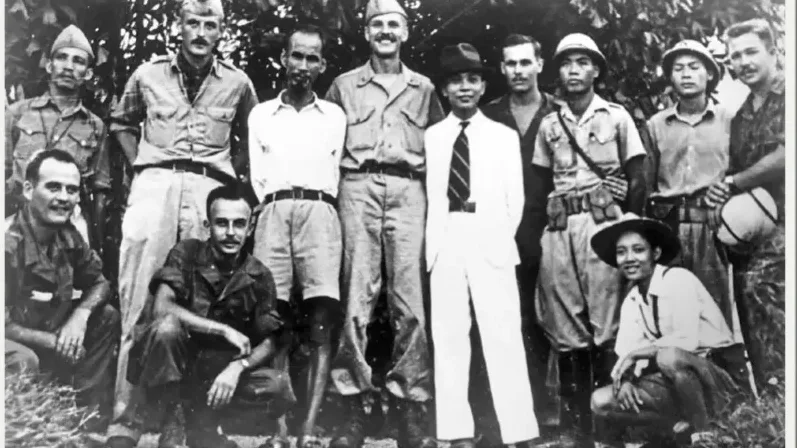
On September 2, 1945, at Ba Dinh Square in Hanoi, Ho Chi Minh read a declaration of independence for a state no foreign government recognized. Its opening borrowed from the American declaration of 1776, "All men are created equal," and then gave way to a long indictment of French colonial rule. Captain Archimedes Patti of the U.S. Office of Strategic Services (OSS), the wartime intelligence agency, watched with his team as the crowd cheered. The French read the American presence as a kind of recognition, and it angered them.
Patti was in Hanoi because Ho's movement had been useful against Japan. The Viet Minh, an independence front led by Ho and dominated by Communists, helped rescue downed American pilots and passed along information on Japanese forces in Indochina. In 1944 Ho escorted one of those pilots out of Vietnam into China, which earned him the notice of the U.S. 14th Air Force. An OSS unit called the Deer Team, under Major Allison Thomas, parachuted into the Viet Minh base area in July 1945 and taught its fighters to use bazookas, carbines and grenades. Patti's mission reached Hanoi on August 22.
“Vietnam has the right to be a free and independent country and in fact it already has been so.”
France came back to Indochina determined to hold it, and by 1946 it was at war with the government Ho had declared. As the Cold War hardened, Washington moved from working with the Viet Minh to arming their enemy, supplying France with aircraft, artillery, tanks and other equipment. The U.S. Army's history concludes that lack of equipment did not defeat the French. In its judgment they spent American aid on a strategy of set-piece battles and neglected the loyalty of the Vietnamese people.
French commanders got their set-piece battle at Dien Bien Phu, a valley in the far northwest. They occupied it in November 1953, expecting a Viet Minh move into Laos and hoping to draw the enemy into open combat. The base lay far from the coast and depended almost entirely on air supply, so the Viet Minh took the high ground, shelled the garrison and its airstrip, and dug trenches ever closer to the French positions until supplies could arrive only by parachute. Their main assault opened on March 13, 1954, and the garrison fell on May 7, as negotiators were gathering in Geneva.
The Geneva agreement of July 20, 1954, ended the fighting and split Vietnam at the 17th parallel, with the Viet Minh taking the North and French forces moving south. The conference's final declaration, issued the next day, set national elections for 1956 and described the new line in these terms.
“the military demarcation line is provisional and should not in any way be interpreted as constituting a political or territorial boundary.”
Partition at the 17th parallel
1954 to 1960
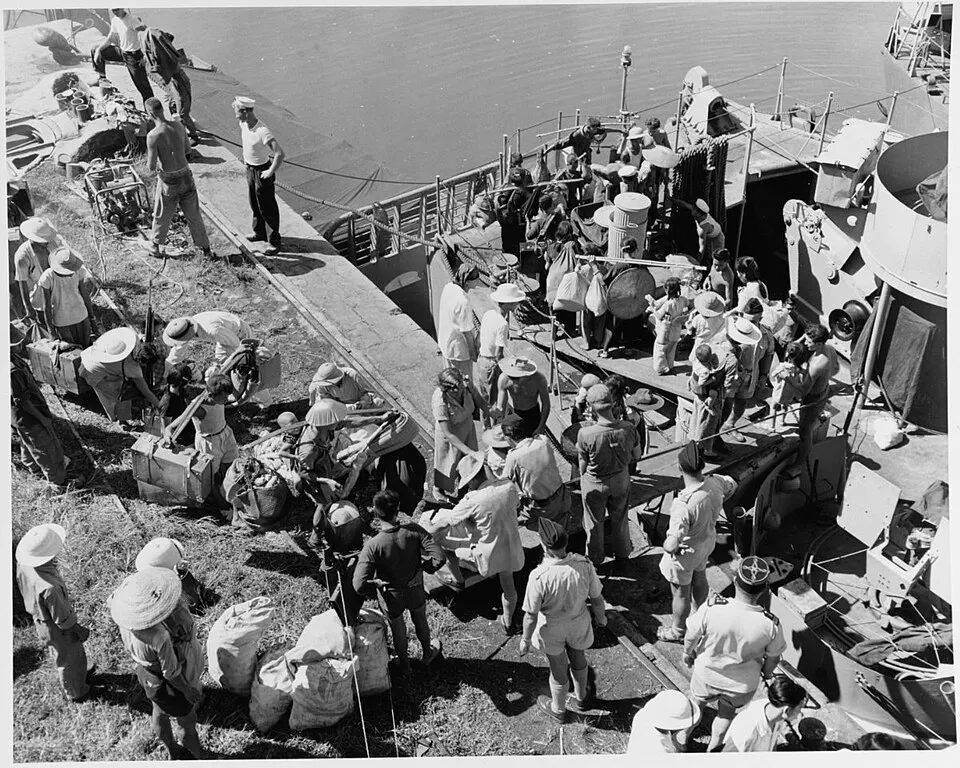
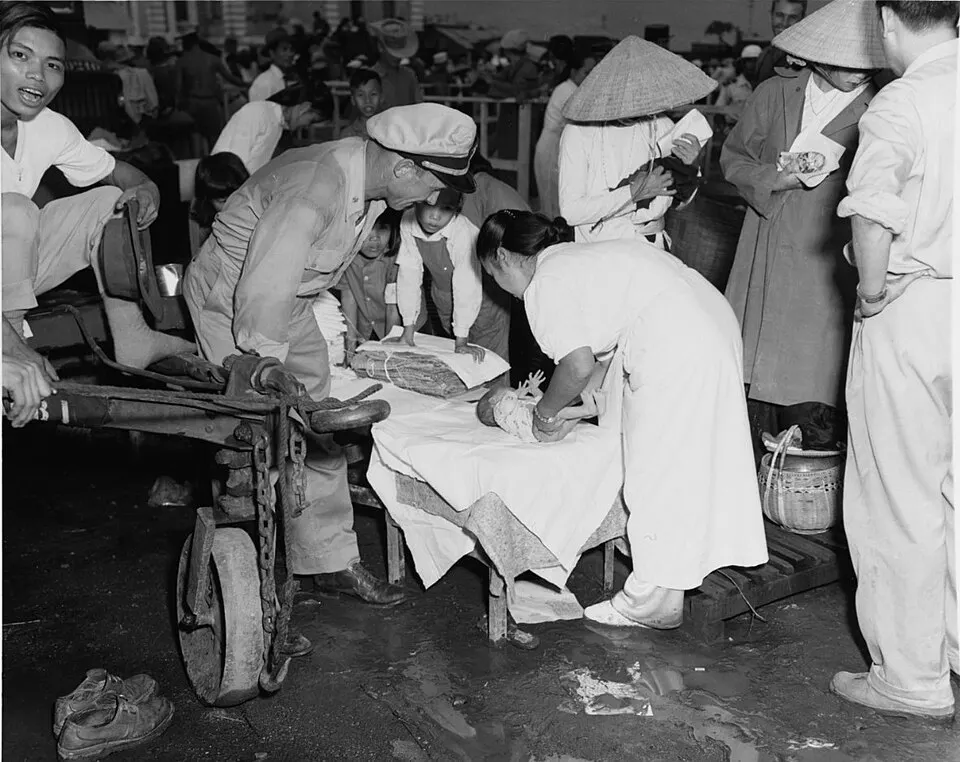
Hundreds of thousands of civilians crossed that provisional line in the months after Geneva, most of them Roman Catholics leaving the North. The U.S. Navy carried many of them from Haiphong in an operation it named Passage to Freedom, and American sailors and medical teams worked in the camps where families waited to board. About 80,000 southerners went the other way, to regroup in the North with the Viet Minh.
- Vietnam
- Laos
- Cambodia
Modern borders are shown, so Vietnam appears as one country. The red line marks the 17th parallel, the provisional military line set at Geneva in 1954. The dashed line is a simplified sketch of the Ho Chi Minh Trail network through Laos and Cambodia, which in reality was thousands of miles of parallel roads, rivers and paths.
The refugees arrived in a state run by Ngo Dinh Diem, a Roman Catholic from a mandarin family who had beaten rivals inside his own army and won a large American commitment. A referendum against the former emperor Bao Dai in October 1955 officially gave him 98.2 percent of the vote and made him head of a republic. The U.S. Embassy reported that it was difficult to believe nearly 98 percent of eligible voters had actually voted. Washington replaced Paris as trainer and supplier of his forces, at first through an advisory group of 342 Americans, and in May 1957 President Eisenhower met him at the airport in Washington.
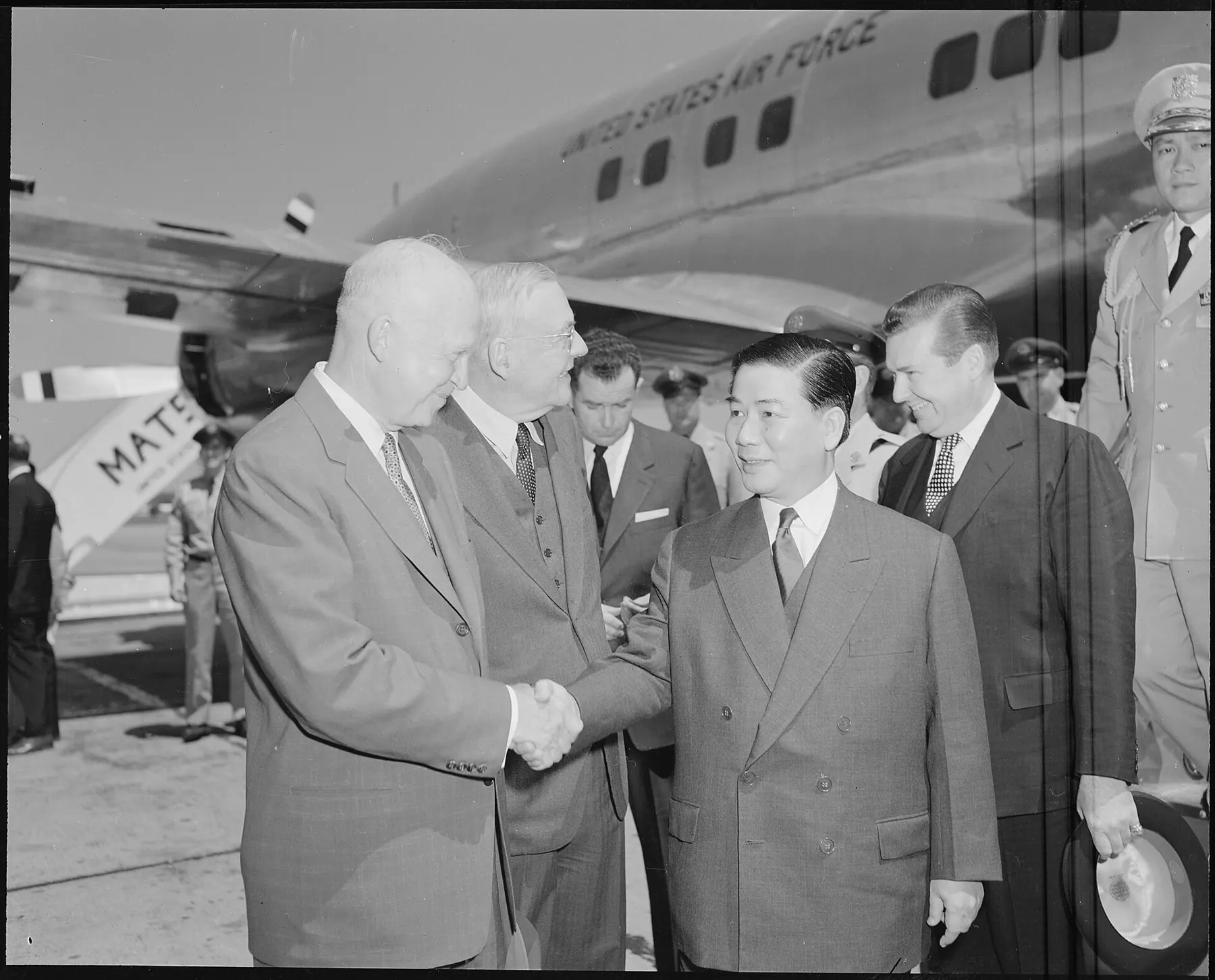
Diem refused to hold the elections Geneva had set for 1956, and some observers thought Ho popular enough in the South to defeat him.
The 1956 elections
Diem and his American backers
Undemocratic conditions in the North made a fair national contest impossible, so South Vietnam would not take part.
Hanoi and the southern Viet Minh
Geneva promised a national vote, and southern Viet Minh largely held back from armed action to prepare for it. Canceling it closed the peaceful road to unity.
Each government then turned force on its own people. A land reform campaign in the North from 1953 to 1956 took land from landlords and people accused of being landlords, and many were executed. The historian Edwin Moise first estimated about 5,000 executions and later put the number at roughly 10,000. A figure of 50,000 has circulated widely, and the historian Balazs Szalontai traces it to older Cold War sources.
Diem's campaigns against former Viet Minh in the South swept up many people who were, in the U.S. Army's words, patriots who had fought for independence and no Communists at all. The pressure nearly broke the southern party. North Vietnam's official military history, as cited by the historian Pierre Asselin, says its membership in the South fell from 50,000 to 15,000 through death and capture, and one district outside Saigon lost 994 of its 1,000 members. Southern Communists pressed Hanoi to approve armed struggle. In May 1959 the Politburo ratified Resolution 15, which called for a stronger insurgency below the 17th parallel and for sending forces south, and that year it organized a transportation unit, the 559th Group, to open a route through Laos.
Saigon's generals overthrow Diem
1960 to 1963
The National Liberation Front was formed in December 1960 by the insurgents and their allies, and its strength lay in the villages. Part-time guerrillas farmed by day and fought at night, gathered intelligence and built political networks, and their military goals at first came second to winning control of the population. By U.S. estimates the force grew from about 5,000 at the start of 1959 to about 100,000 at the end of 1964.
Hanoi fed that growth while keeping its own priorities. The Third Party Congress of 1960 ranked building socialism in the North ahead of liberating the South, a policy many southern revolutionaries resented. Many of the southerners who had regrouped in the North in 1954 now returned down the new route, and when they ran out, northern-born soldiers took their place. U.S. estimates put infiltration through the end of 1964 at about 41,000, and in that year whole North Vietnamese units began entering the South.
President Kennedy answered with advisers, Special Forces and aircraft. Some 60,000 men of the Central Highlands enlisted in a village defense program run by American Special Forces. The first U.S. helicopter company arrived in December 1961, and within three years American helicopters were supporting every South Vietnamese division and corps. The guerrillas were surprised at first and then learned to fight the machines. At the Delta village of Ap Bac in January 1963 they defeated government forces that suffered from faulty intelligence, poorly executed fire support and overcautious leadership.
The crisis that brought Diem down began in Hue. On May 8, 1963, police in Hue fired on a rally against a ban on flying the Buddhist flag, killing nine people and wounding 14. On June 11 the monk Thich Quang Duc sat down in a Saigon street after a march of more than 300 monks and nuns, was doused with gasoline by two others and set himself alight. Malcolm Browne of the Associated Press photographed him. Diem's sister-in-law, Madame Nhu, likened the death to a "barbecue." When the president's brother Ngo Dinh Nhu used martial law to attack the pagodas in August and put the blame on the army, the State Department cabled the new ambassador, Henry Cabot Lodge.
“US Government cannot tolerate situation in which power lies in Nhu's hands.”
A group of generals had concluded that Diem himself was the liability. They overthrew him on November 1, with American encouragement, and he and Nhu were murdered. Coup followed coup until June 1965, when a military group under Nguyen Van Thieu and Nguyen Cao Ky took charge.
Tonkin Gulf to Da Nang
1964 to July 1965
Late on the night of August 4, 1964, in the Gulf of Tonkin, the commander of a two-destroyer patrol, Captain John Herrick, signaled that USS Maddox alone had evaded about 10 torpedoes and that two attacking craft were sunk. The message log kept by the Navy shows how quickly that picture came apart. At 1727 Greenwich time, or 1:27 p.m. in Washington, Herrick sent a flash message to the Joint Chiefs of Staff.
“Review of action makes many reported contacts and torpedoes fired appear doubtful. Freak weather effects and overeager sonarmen may have accounted for many reports. No actual visual sightings by Maddox suggest complete evaluation before any further action.”
Half an hour earlier the U.S. Pacific commander had already recommended punitive air strikes. Carrier pilots returning from the scene reported seeing no vessels or wakes other than the two destroyers, while an officer aboard the patrol reported witnesses who had seen what looked like cockpit lights passing Maddox. President Johnson ordered the strikes.
Nobody disputes the first clash, two days earlier. On July 30, South Vietnamese naval commandos in a covert raiding program Johnson had approved struck the North Vietnamese islands of Hon Me and Hon Nieu. Maddox was 120 to 130 miles away on a surveillance patrol when North Vietnamese torpedo boats came out against it on August 2.
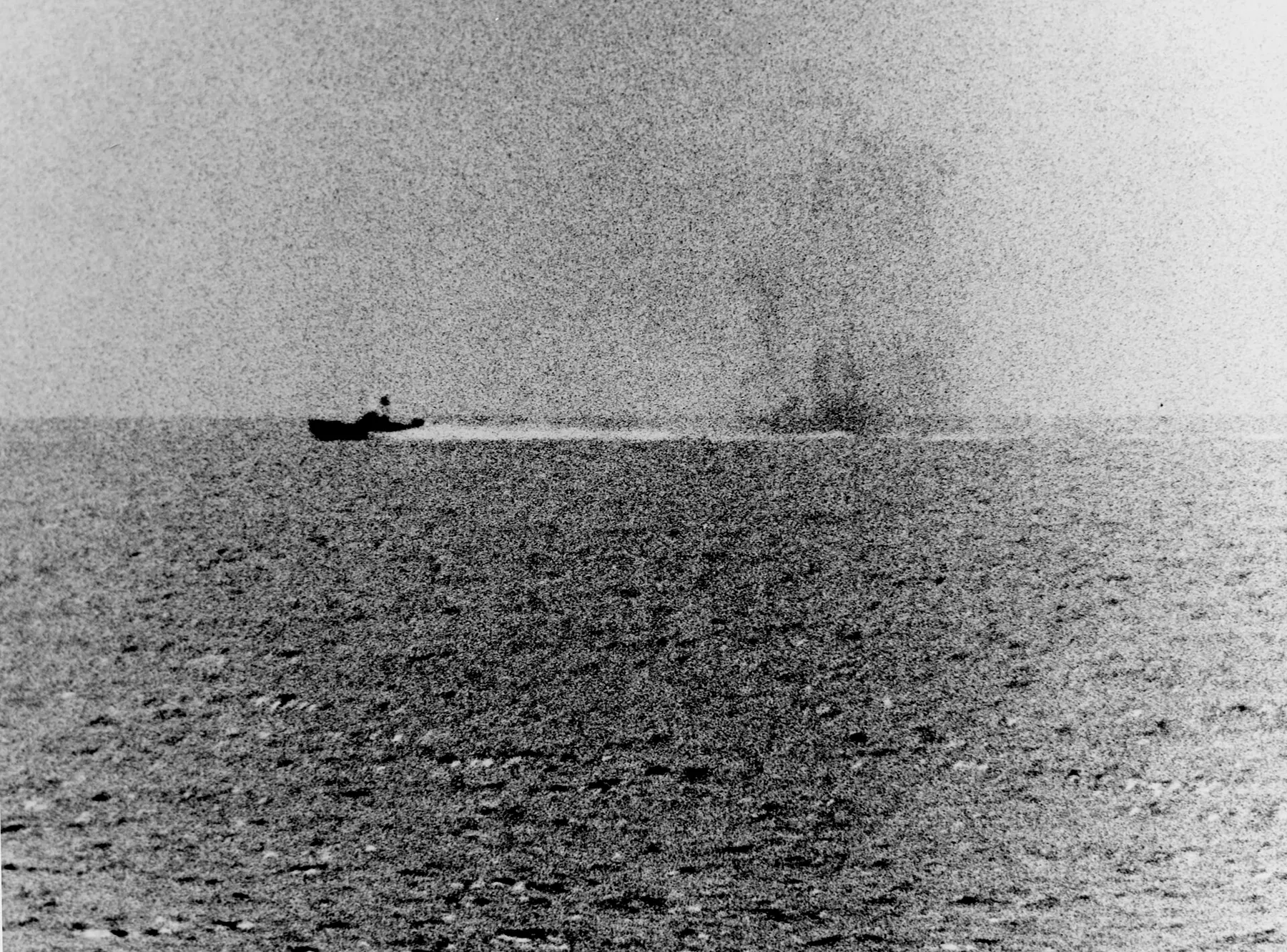
Congress passed the resolution Johnson requested on August 7, unanimously in the House and with only two senators, Wayne Morse and Ernest Gruening, opposed. The State Department's historians now record that doubts emerged about whether the second attack took place at all.
“to take all necessary measures to repel any armed attack against the forces of the United States”
Party documents opened since the war show Hanoi trying to put off the collision. On January 2, 1965, the Politburo repeated its call to prevent a resumption of war, and its leaders estimated that overhauling the party would take most of that year and perhaps part of the next. Southern insurgents did not wait. Their attack on an American camp at Pleiku on February 7 killed eight Americans and wounded more than 100, and Washington approved sustained bombing of the North. Operation Rolling Thunder began in March. Marines came ashore days later to guard the air base at Da Nang, bringing the first American armor in the country, M48 tanks of the 3d Marine Tank Battalion.
“We fight because we must fight if we are to live in a world where every country can shape its own destiny.”
Hanoi answered by organizing what it called the Anti-American Resistance for National Salvation and committing more of its resources to the South. By summer the South Vietnamese Army was losing ground, and on July 28 Johnson announced that U.S. fighting strength would rise from 75,000 to 125,000 almost immediately, with more to follow. The planned level was 175,000 by the end of the year. Johnson also decided against mobilizing the reserves, a choice with deep consequences for how the war was manned.
Air cavalry in the Ia Drang
1965 to 1969
The 1st Cavalry Division (Airmobile) reached An Khe in the Central Highlands in September 1965 with 435 helicopters. Its central machine was the Bell UH-1, the Huey, which carried infantry into clearings, brought out the wounded and, with door guns and rockets added, protected other aircraft. General William Westmoreland, the U.S. commander, intended to use such units in aggressive operations to find and destroy the enemy's main forces, and in November the division went looking for three North Vietnamese regiments after an attack on the Special Forces camp at Plei Me.
“We would be fighting a different war, for a smaller area, at a greater cost, with less effectiveness.”
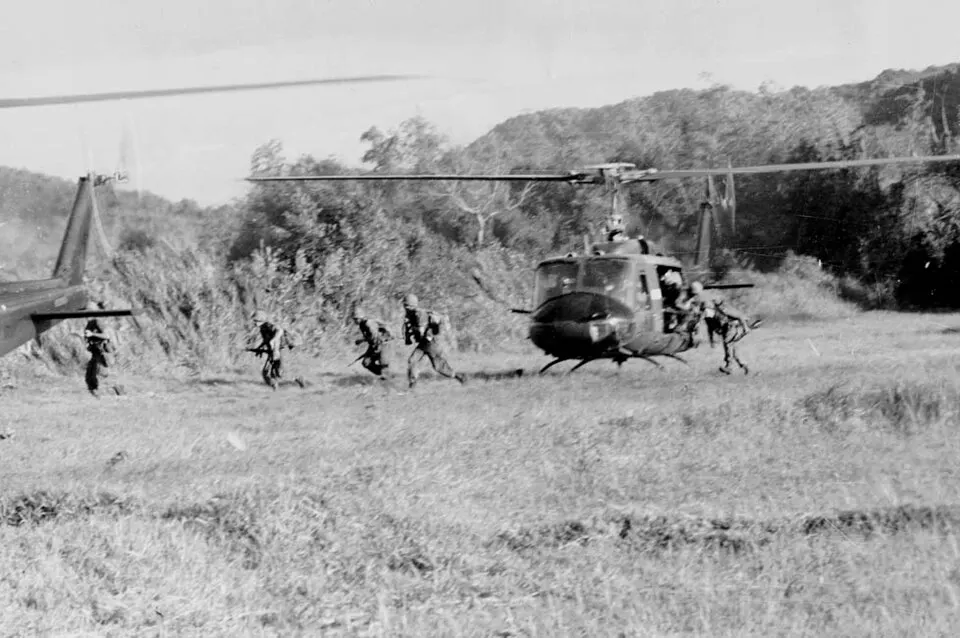
American battalions met elements of two North Vietnamese regiments at Landing Zone X-Ray, at the foot of the Chu Pong massif, on November 14. They held on with gunships, artillery, tactical aircraft and B-52 bombers flying from Guam. The toll was 79 Americans and, by American count, 600 Communist dead. Three days later and a few miles away another U.S. battalion walked into an ambush, and by nightfall 60 percent of its men were casualties and almost one in three had been killed.
Americans hailed Ia Drang as their first major triumph of the war. The Army's own account calls it a costly and problematic victory and notes that both major engagements began on North Vietnamese initiative. PAVN units had also found an answer to American firepower, "hugging" U.S. positions so closely that air and artillery could not be used without danger to the troops they were meant to help.
The ground war in numbers
- 543,000
- U.S. troops at the peak
- April 1969. The Army's history says March.
- Almost 30%
- U.S. deaths from mines, booby traps and grenades
- U.S. Army history
- 73%
- U.S. tank losses caused by mines
- November 1968 to May 1969
Away from the big battles, mines and booby traps did steady damage. A U.S. Army study attributes about 70 percent of vehicle losses and 20 percent of casualties to mines and booby traps, scattered along roads and paths in place of the artillery the insurgents lacked. American and North Vietnamese tanks met only once, at the Ben Het Special Forces camp in March 1969, when PT-76 light tanks attacked at night, M48 crews fired at their muzzle flashes and two PT-76 hulls were found the next day.
The Mekong Delta needed a different kind of force. South Vietnamese troops had captured the first Chinese-made copies of the AK-47 there on December 11, 1964, a sign of how well supplied the insurgents were becoming. By mid-1966 the U.S. Navy had Task Force 115, known as Market Time, watching the coast for supply vessels and Task Force 116, known as Game Warden, patrolling inland waterways. An Army brigade and Navy river assault groups then formed the Mobile Riverine Force, living aboard barracks ships and landing from armored craft.
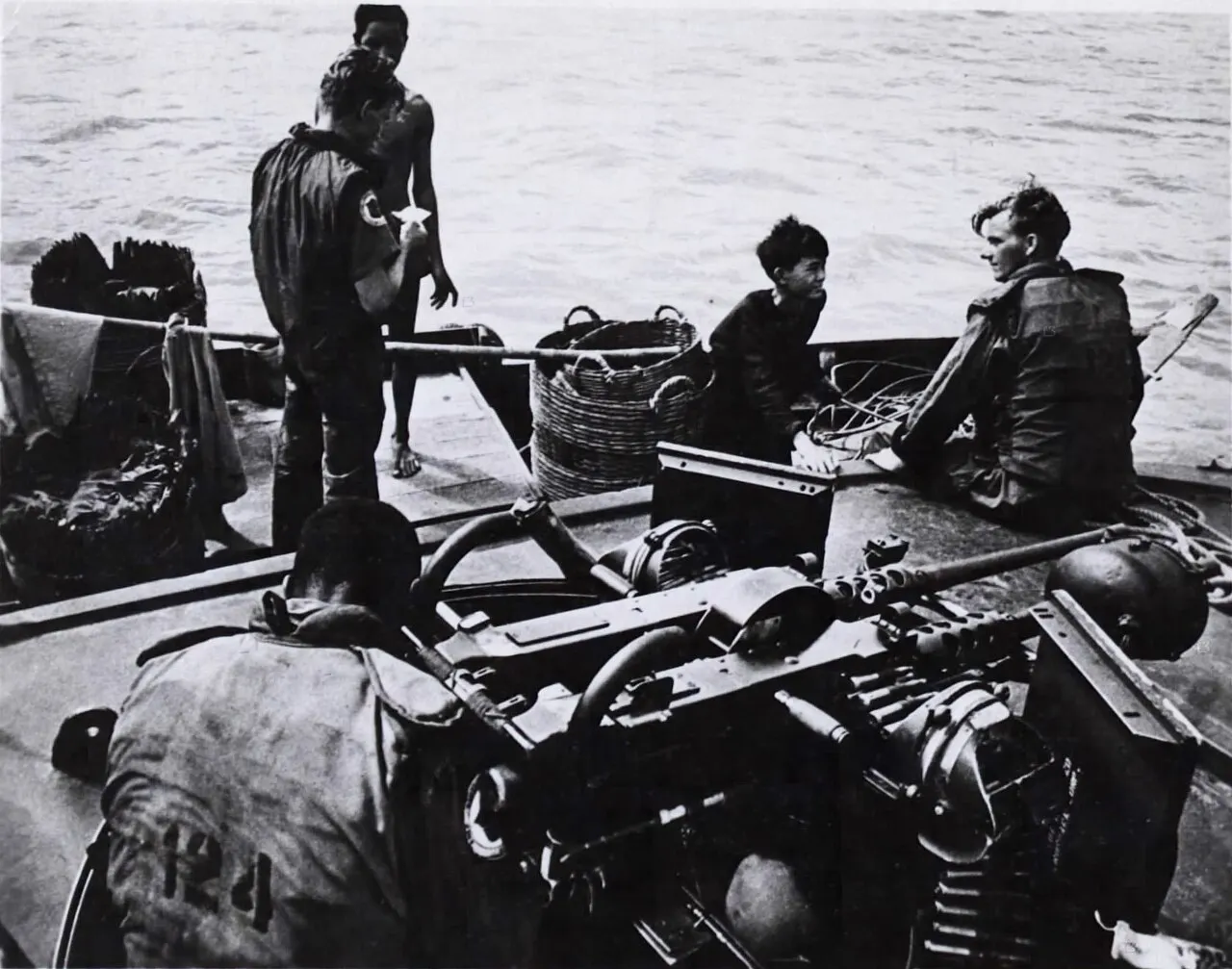
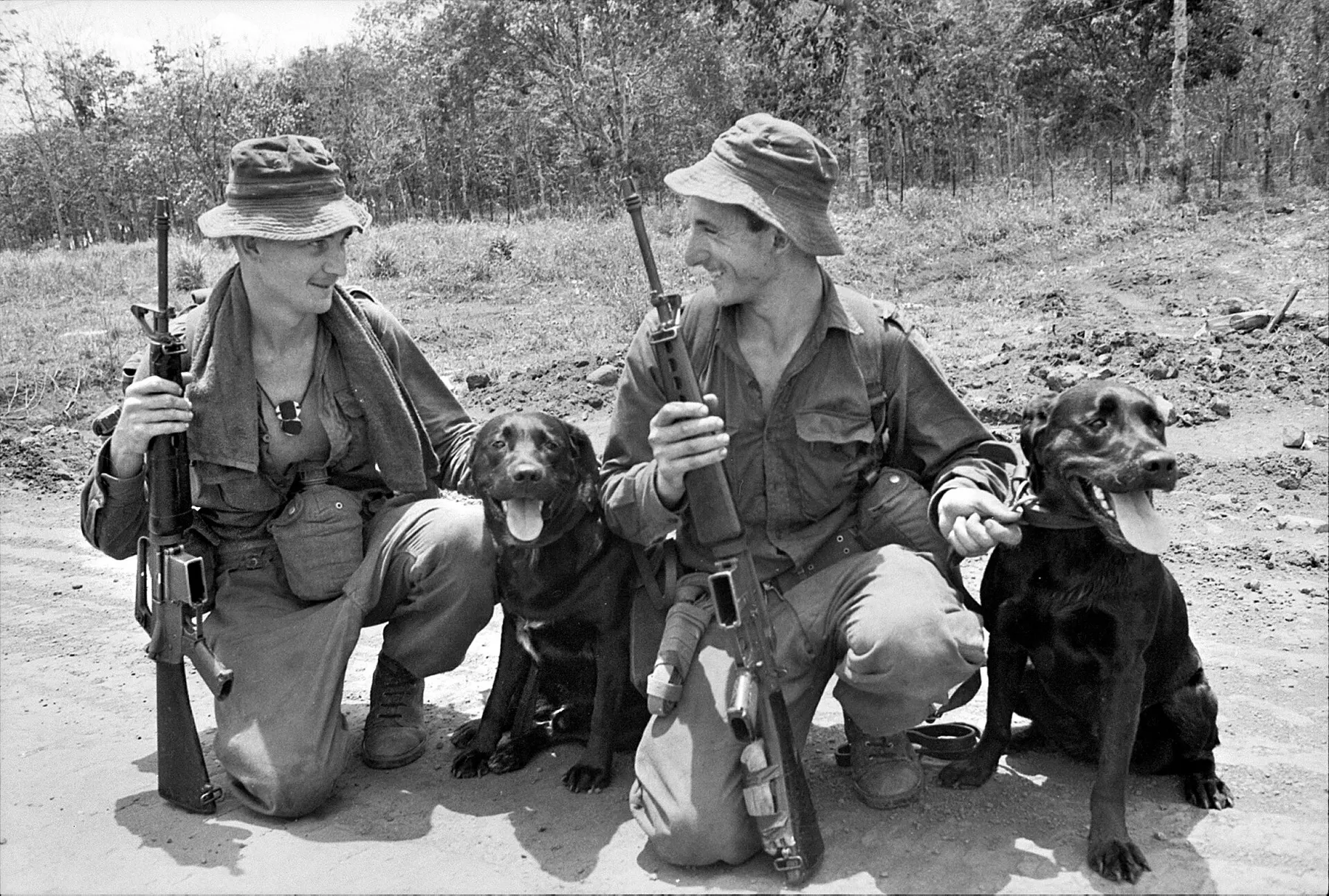
Johnson wanted other flags beside the American one and called the effort Many Flags. South Korea sent by far the most troops, and Thailand more than 11,000. Australia, which had sent advisers since 1962, committed a task force, and in August 1966 a company of 108 of its soldiers fought a force estimated at over 2,000 for four hours in a rubber plantation at Long Tan during a tropical downpour. New Zealand sent artillery and the Philippines a civic action group.
- South Korea (1968)50,003
- Thailand (1970)11,586
- Australia (1969)7,672
- Philippines (1966)2,061
- New Zealand (1969)552
Highest year-end strength for each country, 1964 to 1970. U.S. forces are excluded. Source: U.S. Army, Allied Participation in Vietnam, Table 1.
- Sent forces to South Vietnam
- Backed North Vietnam (Russia stands for the Soviet Union)
- Vietnam
Modern borders are shown. Blue marks countries that sent forces to support South Vietnam, alongside the United States, which lies off this map. Gray marks the two main outside backers of North Vietnam. The Republic of China on Taiwan and Spain sent small advisory or medical teams and are not shaded.
Bombing the North and the Trail
1965 to 1973
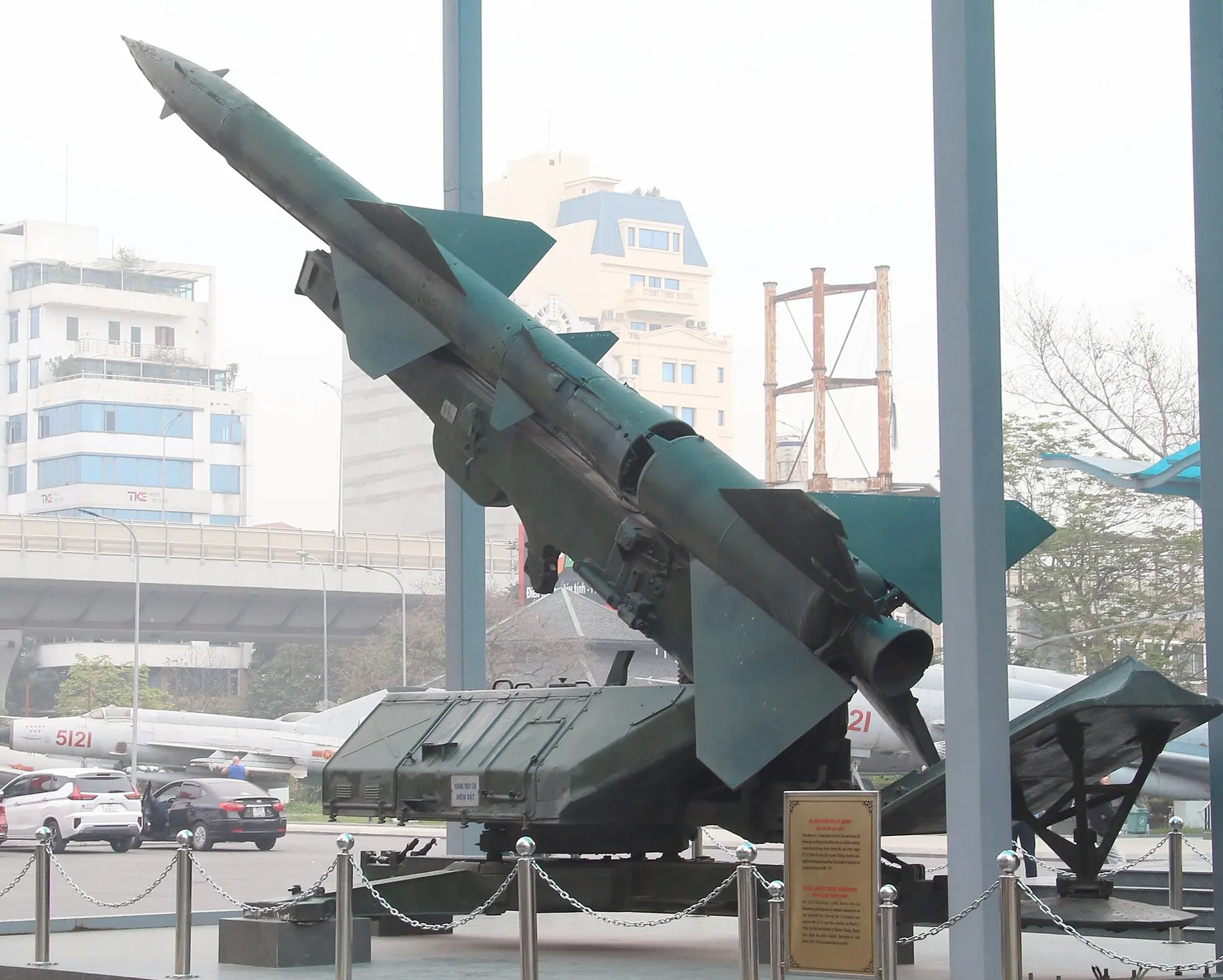
Rolling Thunder ran from March 1965 to November 1968, and its planners hoped both to cut the flow of men and supplies and to persuade Hanoi to stop. North Vietnam met it with radar, antiaircraft guns, Soviet SA-2 missiles and a small fighter force that seldom had more than 60 to 75 aircraft in service. Its pilots avoided long engagements, attacking when ground controllers gave them surprise and then breaking away.
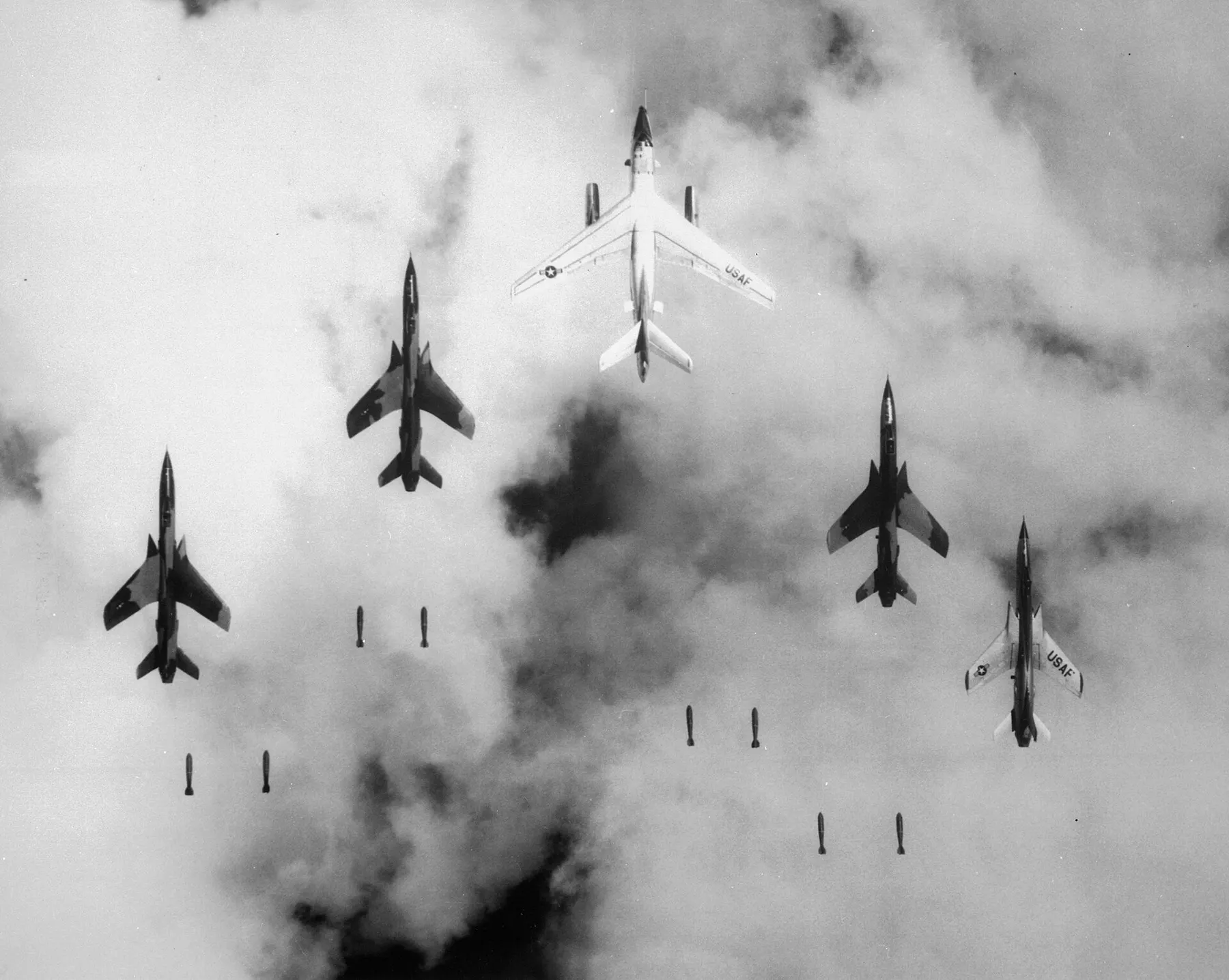
American aircrews paid heavily for the campaign. The Air Force lost 1,737 fixed-wing aircraft in combat in Southeast Asia between 1962 and 1973, more than 83 percent of them to ground fire, and 334 of the 833 F-105 Thunderchiefs ever built. The most commonly cited estimate of civilians killed by American bombing in the North over the whole war is 65,000, a figure repeated by several Western reference works. No separate Hanoi figure turned up in the sources consulted here.
Moscow and Beijing kept the defense supplied. U.S. intelligence estimated Soviet aid from 1968 through 1973 at about $1.4 billion in military and $1.8 billion in economic assistance. Vietnamese press, citing Soviet figures, says more than 6,300 Soviet officers and generals and over 4,500 enlisted men served in the North between 1965 and 1974, and that 13 died in combat. One account puts Chinese deployments there at more than 320,000 troops between 1965 and 1971, many of them engineers repairing roads and railways.
Fighter combat moved in cycles as each side studied the other. On January 2, 1967, Colonel Robin Olds's F-4 Phantoms imitated the routes, call signs and radar-jamming pods of bomb-laden F-105s, and when MiG-21s rose to meet what they took for easy targets, his crews claimed seven without loss. Air Force fighters on air-to-air missions shot down 29 MiGs between January and July that year and lost two. From August 1967, North Vietnamese ground radar began steering single MiG-21s behind American formations for one fast missile pass. In the last months of Rolling Thunder, MiGs shot down 22 Air Force aircraft at a cost of 20.
The road through Laos
Much of what the bombing was meant to stop moved through Laos. In the beginning a few tons of cargo went down the Ho Chi Minh Trail on bicycles, on pack animals and on the backs of porters, passed between about 100 way stations a day's walk apart. Trucks took over the main routes after 1965. According to Major General Dinh Duc Thieu, who ran North Vietnam's General Logistics Department, the network grew within seven years to some 4,000 miles of roads, rivers and trails, many of them parallel so that traffic could bypass a cut. He put the people working it at 30,000, and U.S. estimates ran higher.
“a river of revolutionary forces”
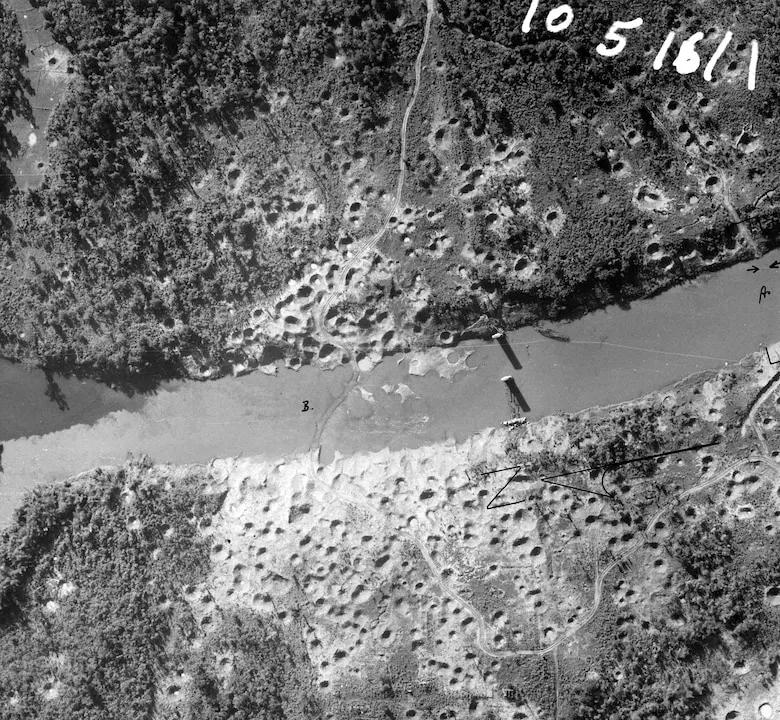
The United States seeded the Trail with electronic sensors and sent aircraft to hunt trucks, and the Air Force struggled to show what the effort achieved. Between December 1967 and March 1968, its history records, crews could verify only 12 percent of the 4,665 targets the system nominated.
A 1962 agreement at Geneva required all foreign forces to leave Laos. North Vietnam did not honor it, and American operations there continued in secret. A Central Intelligence Agency report in 1971 described support for 30,000 irregular troops, 38 percent of them under the Hmong general Vang Pao. American planes had flown 580,000 bombing runs over Laos by the time B-52s flew the last missions there on April 17, 1973. By one count more than 270 million cluster munitions were dropped, and about 30 percent failed to explode.
- Laos: 580,000 U.S. bombing runs
- Cambodia: about 500,000 tons, 1969 to 1973
- Vietnam
Modern borders are shown. Laos and Cambodia were officially outside the fight, yet both carried the Trail, foreign troops and heavy American bombing, and both had civil wars of their own.
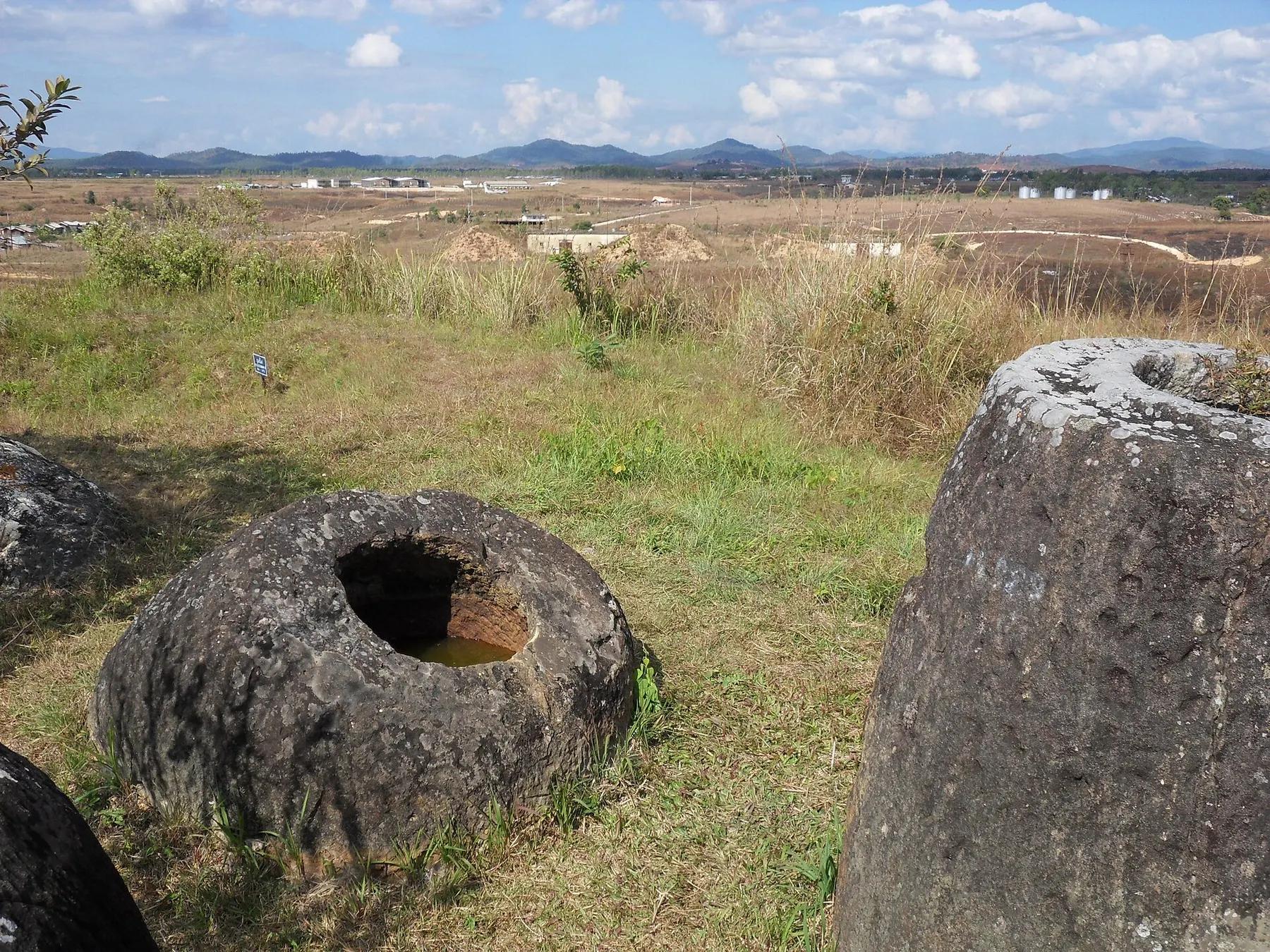
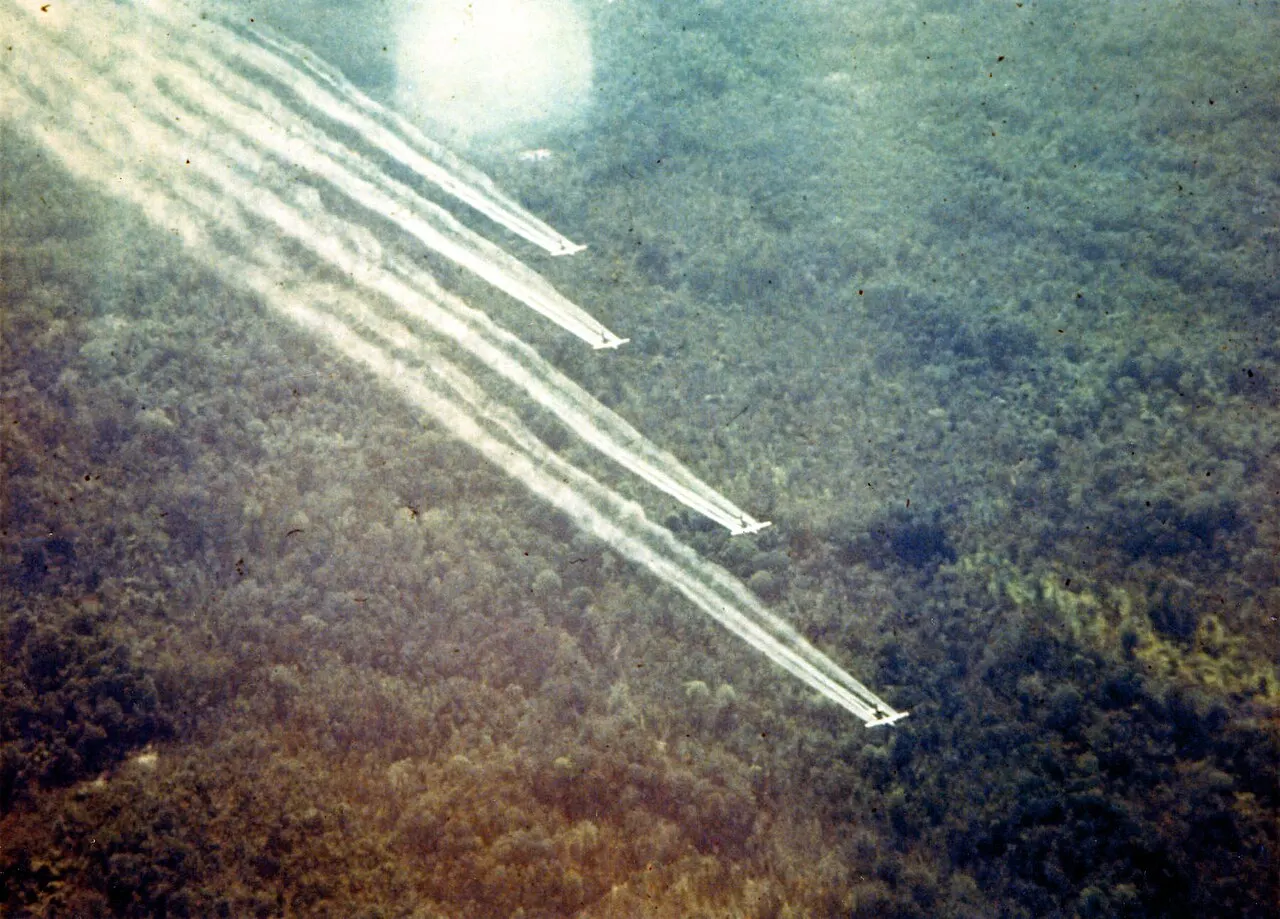
Operation Ranch Hand
Another air campaign went after the cover itself. From 1961 to 1971, U.S. aircraft sprayed herbicides to strip the foliage that hid PAVN and NLF forces. A 1978 U.S. government audit counted 18.85 million gallons applied, of which 11.22 million were Agent Orange, a mix contaminated with the dioxin TCDD, and the Congressional Research Service reports that spraying reached nearly 10 percent of South Vietnam. One scientific study estimated that 2.1 million to 4.8 million Vietnamese were directly exposed. Vietnamese advocacy groups say more than 3 million people suffer health effects, while the Congressional Research Service notes that data problems have prevented firm conclusions.
Attacks on 36 provincial capitals
January to April 1968
In January 1968 elements of three North Vietnamese divisions gathered around the Marine base at Khe Sanh, near the Laotian border, and Americans began comparing it to Dien Bien Phu. The U.S. Army's history later judged the buildup at least partly a diversion, drawing attention from the populated areas while 85,000 Communist troops prepared to strike the cities.
Combat broke out across South Vietnam on January 31, during the lunar new year. The attackers hit 36 of 44 provincial capitals, 64 of 242 district towns and five of the six autonomous cities, and in Saigon NLF troops stormed the American Embassy compound. Most attacks were crushed within days. Hanoi had counted on a general uprising, none came, and the NLF lost thousands of experienced fighters and political workers.
Who won Tet
U.S. command and Saigon
General Westmoreland argued that the enemy had suffered a major defeat and that the insurgent base in the South was seriously weakened. The attacks hardened many southerners against the NLF and let the Thieu government enact general mobilization for the first time.
Hanoi and the NLF
The planners sought a general offensive and a general uprising. The uprising failed, yet the attacks reached nearly every major town in the South and forced Washington to reassess its policy and strategy.
Hue
The old imperial capital was held longest. North Vietnamese regulars and NLF forces seized much of the city, and U.S. Marines, Army units and South Vietnamese troops needed more than three weeks to retake it, 25 days by Time's count, in the only extended urban combat of the war. House-to-house fighting and heavy firepower wrecked much of Hue.
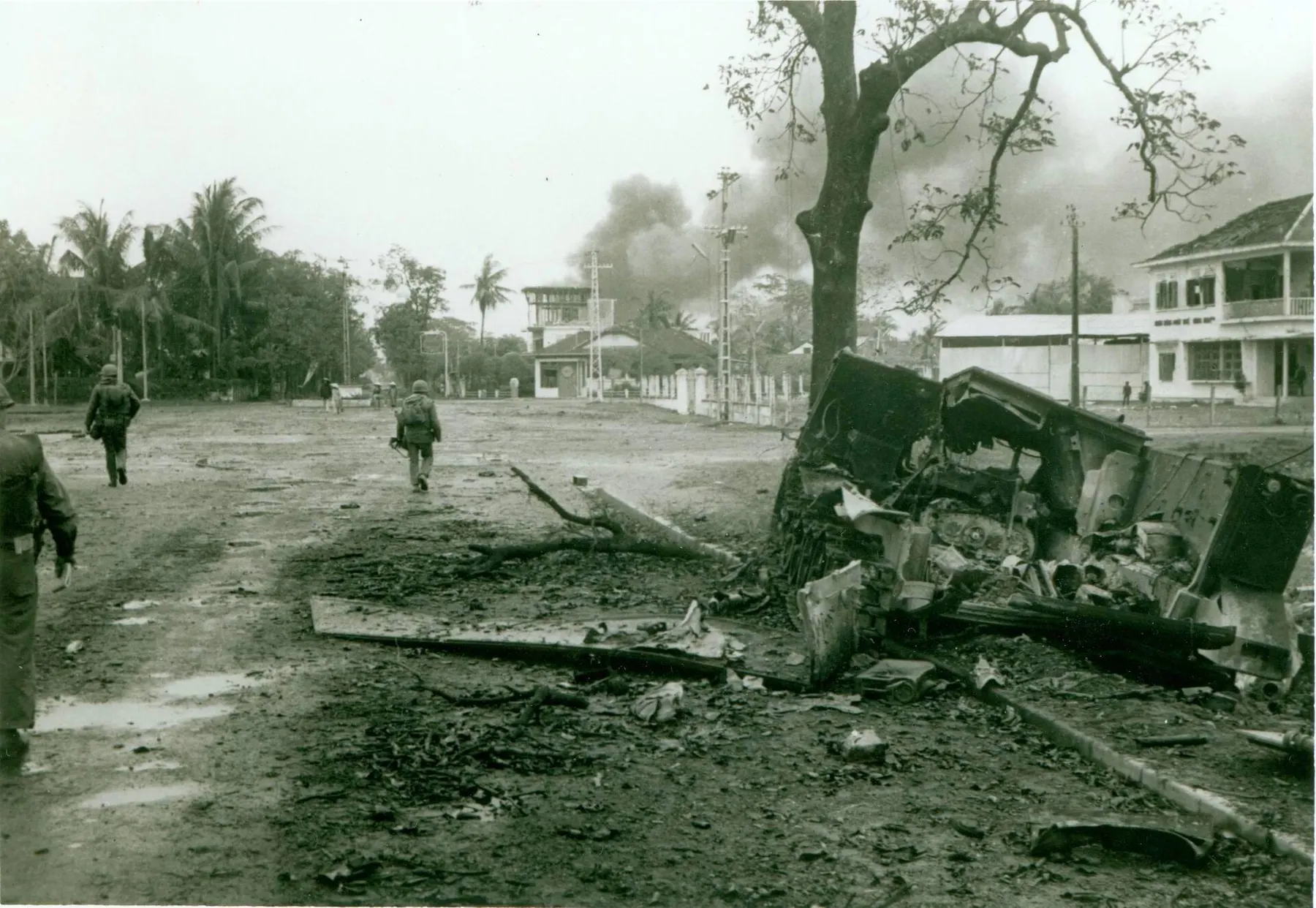
Mass graves were found in and around the city after the battle, some only in 1969, including a creek bed in Nam Hoa district. Time reported that year that some 2,300 bodies had been recovered and that about 3,500 civilians had been missing when the fighting ended. Texas Tech University's Vietnam Center says at least 3,000 people were killed this way and at least 2,000 more were never accounted for, and it describes people identified and rounded up during the occupation, many of them officials, leading citizens and their families. Some were found with their hands bound.
“After Tet, the people realized that the Viet Cong would kill them, regardless of political belief.”
Guenter Lewy cites 2,800 executed and 3,000 missing, and a compilation entry credited to Young gives official figures of 2,800 to 5,700. The American writer Gareth Porter challenged those numbers in 1974, arguing that a South Vietnamese political warfare battalion may have inflated executions by a factor of 10 or more and that many bodies found in 1969 were victims of ground fighting and American air power. Len Ackland put the executions at 300 to 400. No full count from the Vietnamese government turned up in the sources consulted here.
Khe Sanh
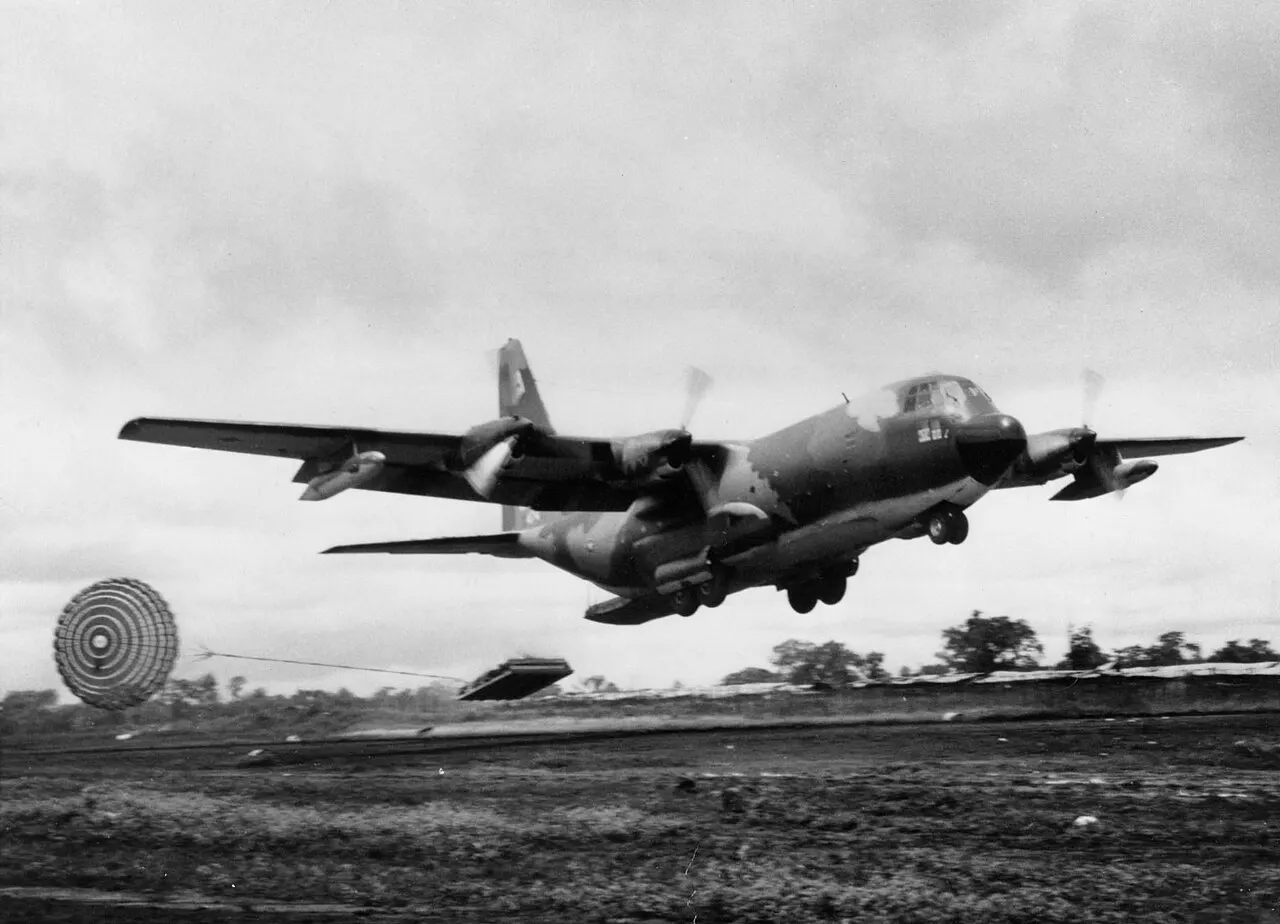
The siege of the Marine base lasted 77 days. Westmoreland answered it with the heaviest air and artillery bombardment of the war, and C-130 transports kept the garrison supplied, at times pulling pallets out by parachute as they skimmed the strip. Elements of the 1st Cavalry Division reached the base by April 8. The final Marine count of 205 killed and 1,662 wounded covers November 1967 through March 1968 and leaves out some reinforcements. The number of North Vietnamese dead found in the area was listed at 1,602, and U.S. intelligence estimates of the total ran from 10,000 to 15,000. The allies abandoned the base that summer.
Washington
The pictures from the embassy and from Hue collided with official claims of progress, and a military request for 206,000 more troops, most of them meant to rebuild the strategic reserve at home, deepened doubts about how the war was being run. On March 31, Johnson went on television to announce that he was stopping attacks on the area holding almost 90 percent of North Vietnam's population. He ended the speech by leaving the presidential race.
“Accordingly, I shall not seek, and I will not accept, the nomination of my party for another term as your President.”
My Lai reaches the American public
March 1968 to May 1970
Fifteen days before Johnson's speech, at 7:22 on the morning of March 16, nine helicopters lifted off carrying Charlie Company of Task Force Barker toward a hamlet of Son My village in Quang Ngai province that U.S. soldiers called My Lai 4. The company commander, Captain Ernest Medina, had briefed his men that they would meet an enemy battalion and that no civilians would be there. By noon hundreds of unarmed people, old men, women and children, had been killed and the hamlet destroyed. The Army's later inquiry recommended action for rape as well as murder.
Warrant Officer Hugh Thompson, flying a scout helicopter overhead, landed to get civilians out. He ordered his door gunners, Glenn Andreotta and Lawrence Colburn, to aim their guns at members of Charlie Company, helped bring 12 to 15 people to safety, and reported the killings that afternoon. The Army's first report nevertheless described a success, with 128 enemy dead.
The killings became public more than a year later, largely because a former soldier, Ronald Ridenhour, gathered eyewitness accounts and on March 18, 1969, wrote to 30 prominent figures in Washington. The freelance reporter Seymour Hersh interviewed Lieutenant William Calley at Fort Benning on November 11, and his story ran in 35 papers two days later. Lieutenant General William Peers then led an inquiry that interviewed about 400 witnesses and named 30 people who had suppressed evidence.
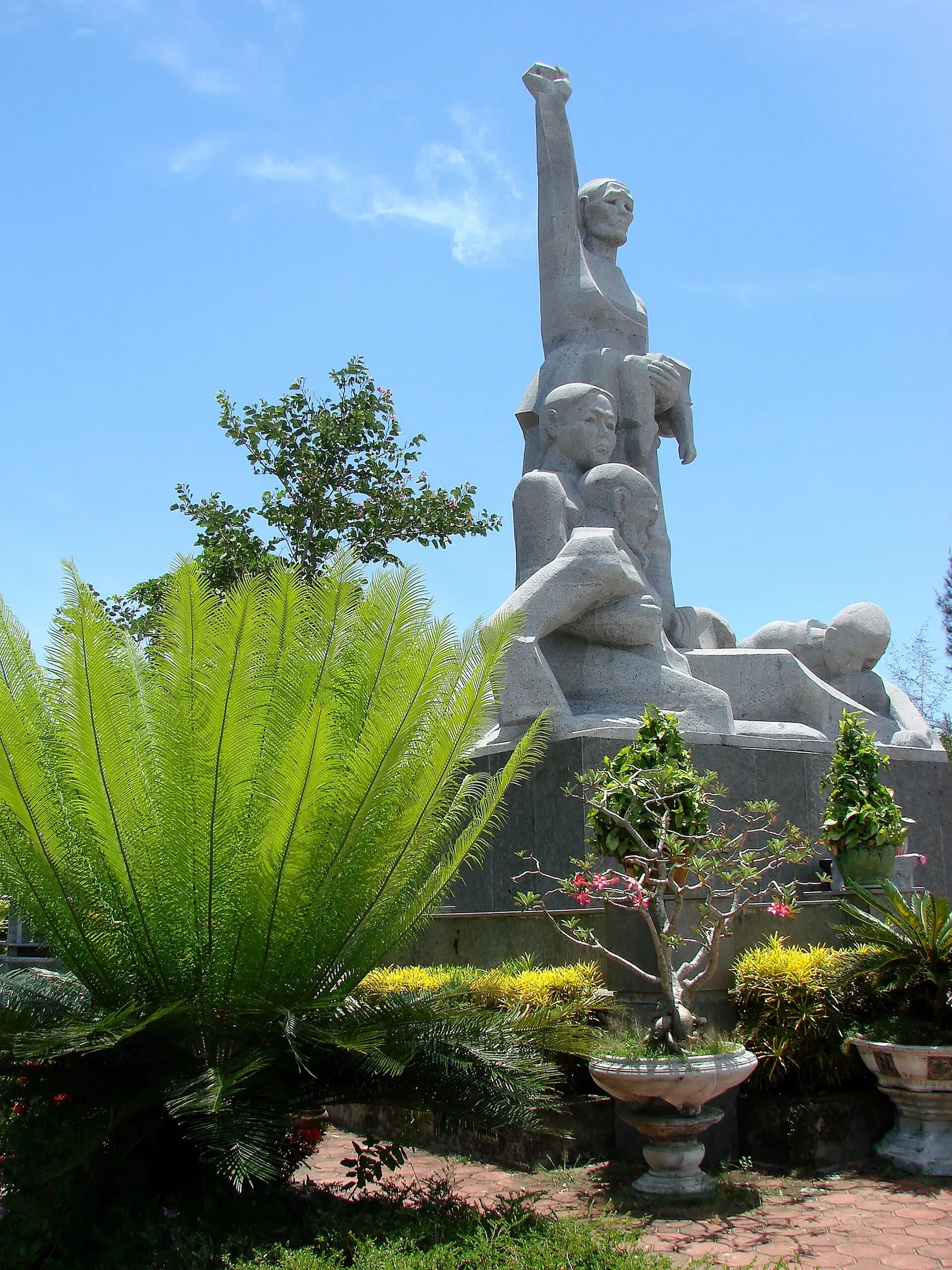
The counts of the dead differ by source. An Army census concluded that Charlie Company had killed 347 people, the Son My village chief reported 504, the number on the memorial there today, and the U.S. Army's general history, written later, says about 200. Charges were brought against 14 officers. Medina was acquitted in September 1971. Only Calley was convicted, of the premeditated murder of 22 civilians. He was sentenced to life, President Nixon ordered him moved from the stockade to house arrest, his sentence was twice reduced, and he was paroled on November 9, 1974, having spent a total of four months in a stockade.
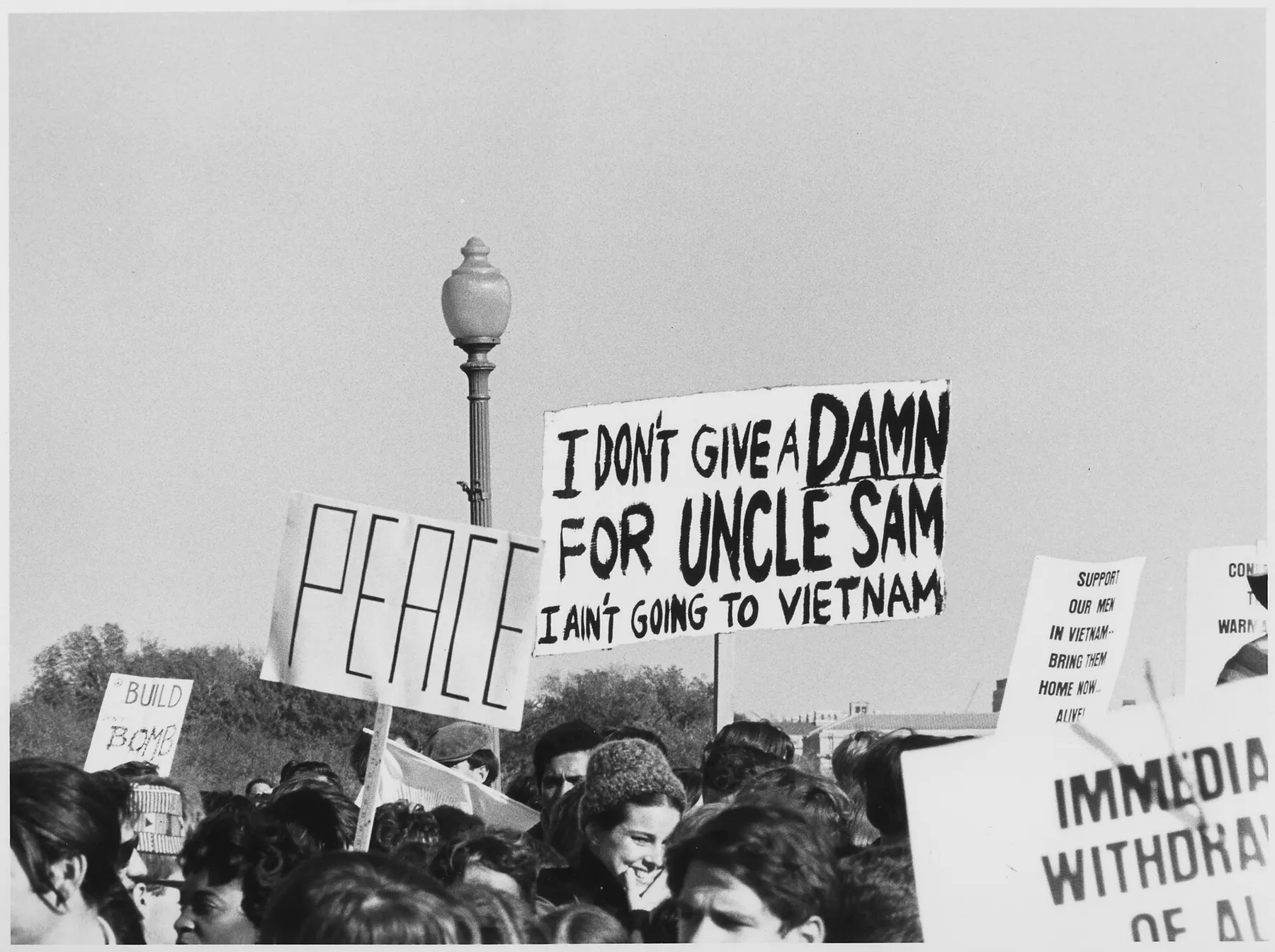
Opposition to the war was already in the streets when the story ran. Demonstrators had marched on the Pentagon on October 21, 1967, and 1968 had been the deadliest year for Americans, with 16,899 deaths in the National Archives file. Ten days before the story ran, Nixon had appealed for support to what he called the great silent majority.
“North Vietnam cannot defeat or humiliate the United States. Only Americans can do that.”
- 1964216
- 19651,928
- 19666,350
- 196711,363
- 196816,899
- 196911,780
- 19706,173
- 19712,414
- 1972759
Records in the Defense Casualty Analysis System extract, by year of death. Includes hostile and non-hostile deaths. The National Archives describes these as record counts for information, not official statistics. Source: U.S. National Archives.
More than 300,000 Americans were wounded, 153,303 of them badly enough to need hospital care, and fast helicopter evacuation and forward hospitals saved many who would have died in earlier wars. More than a decade after the fighting, 1,761 Americans were still listed as missing. By the end of the decade criticism of the war and of the military was harsh and widespread, and disenchantment was growing within the ranks.
Australia, which sent conscripts to Vietnam, had its own protests. More than 200,000 people marched there in the early 1970s, and the Australian War Memorial calls the war the country's greatest cause of social and political dissent since the conscription fights of the First World War. In South Vietnam, thousands of civilians left contested valleys for government-held areas and strained the relief services, while some officials, by the U.S. Army's account, put career and fortune above the national interest. The northern home front is harder to see, because Hanoi controlled what was reported. Its government said in 1995 that it had understated wartime losses so as not to damage public morale, according to wire reports at the time.
Nixon's decision to send troops into Cambodia in the spring of 1970 set off a new wave of protest. On May 4, Ohio National Guardsmen fired on demonstrators at Kent State University, killing four people and wounding nine, and a national student strike closed hundreds of campuses.
Nixon hands over the war
1969 to January 1973
On May 11, 1969, a battalion of the 101st Airborne Division found the 28th North Vietnamese Regiment on Hill 937 in the A Shau valley. The fight lasted 10 days and drew in three Army battalions and a South Vietnamese regiment, and the hill, known afterward as Hamburger Hill, was taken and soon abandoned. The division's commander defended the battle in one sentence.
“We found the enemy on Hill 937, and that is where we fought them.”
Nixon announced the first troop withdrawal at Midway the next month. His policy of Vietnamization aimed to hand the fighting to the South Vietnamese while Americans went home, and General Creighton Abrams, who had taken command in 1968, shifted attention toward the PAVN and NLF supply system and toward small-unit operations. After Tet, security in many rural areas improved on paper. The Phoenix program went after the Communist underground, and it mostly caught low-level cadres while senior party officials survived. Morale among American troops fell as units prepared to leave, and the Army struggled with drug abuse, racial tension and attacks on officers and sergeants known as fragging.
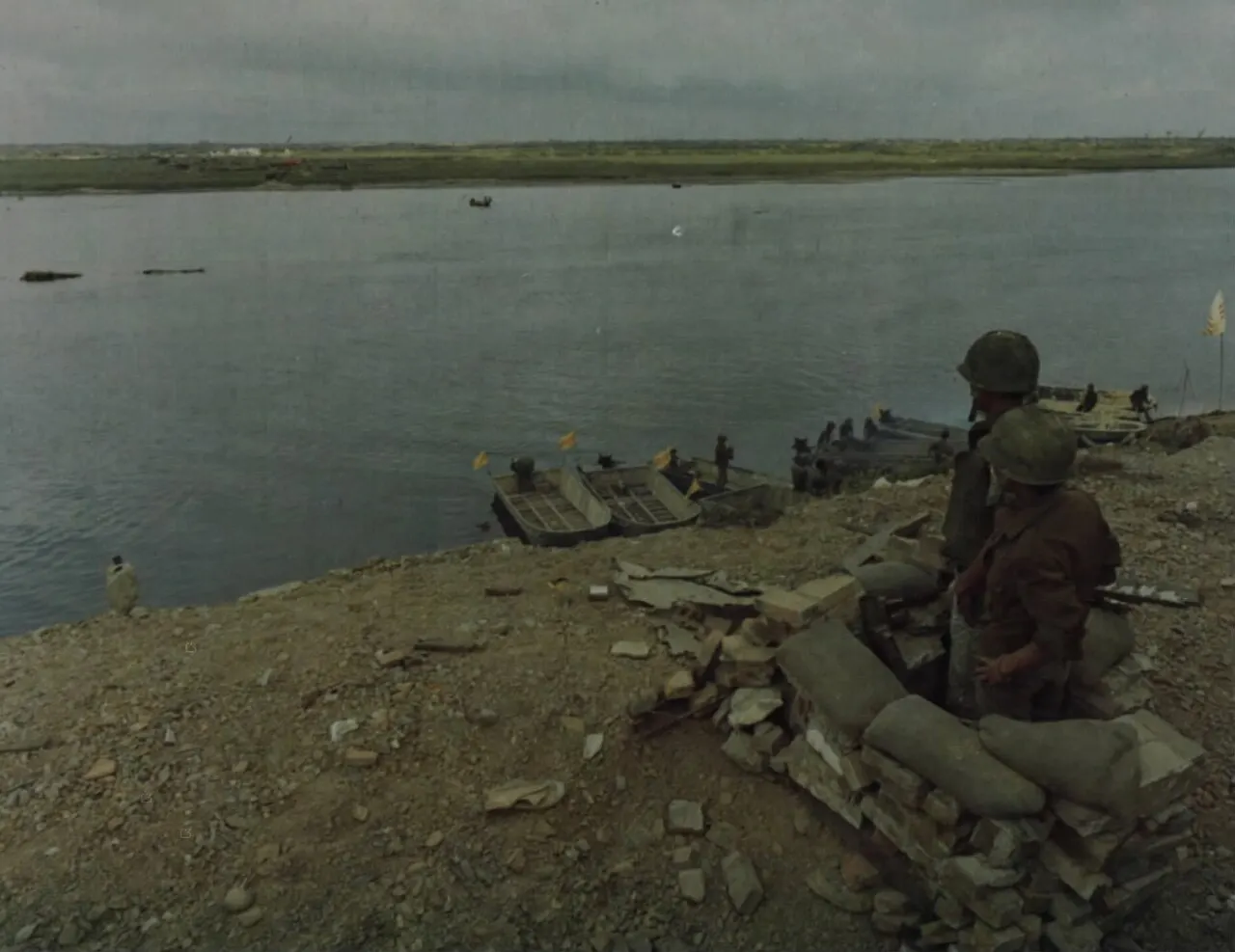
Henry Kissinger held his first private session with North Vietnamese representatives on August 4, 1969, and met the Politburo member Le Duc Tho intermittently from then on. Ho Chi Minh died that September with the war unfinished, and Le Duan's leadership carried it on.
Cambodia
American bombs had been falling on Cambodia since the Johnson years, and B-52 raids on Vietnamese sanctuaries there began in 1969. In 1970 Lon Nol overthrew Prince Norodom Sihanouk, and U.S. and South Vietnamese forces crossed the border. They found large supply dumps and missed the main PAVN and NLF forces and the headquarters they sought. Taylor Owen and Ben Kiernan first reported 2,756,941 tons dropped on Cambodia, working from U.S. Air Force data, then withdrew that figure in 2010 after other researchers found errors in the data and now put the total at about 500,000 tons for 1969 to 1973. Yale's Cambodian Genocide Program records 250,000 tonnes in the seven months before Congress halted the bombing in August 1973. Earlier estimates of civilians killed ran from 50,000 to 150,000, and Owen and Kiernan argue that the bombing drove people toward an insurgency that had enjoyed little support, helping the Khmer Rouge to power.
Lam Son 719 and the Easter Offensive
Operation Lam Son 719, in February 1971, sent South Vietnamese troops into Laos toward the Trail hub at Tchepone with American air and helicopter support and no U.S. advisers on the ground. Five North Vietnamese divisions, tanks and antiaircraft units met them. The withdrawal turned chaotic. Nearly 2,000 South Vietnamese were lost and 107 American helicopters destroyed, the most in any operation of the war.
Hanoi tried for a decision on March 30, 1972, attacking across the demilitarized zone, into the Central Highlands and toward An Loc. Only about 6,000 of the 95,000 Americans left in the country were combat troops. South Vietnamese forces held at An Loc and Kontum and eventually retook Quang Tri City, with American air and naval firepower often providing the margin, and Nixon ordered North Vietnam's harbors mined and the North bombed again under Operation Linebacker.
Kissinger and Le Duc Tho reached a settlement on October 11 and 12, 1972. President Thieu rejected it because it left North Vietnamese forces in the South and legitimized the Provisional Revolutionary Government, and the talks broke down. On December 14 Nixon ordered B-52 attacks on the North's heartland and warned Thieu that American support could end if he refused to sign. The Air Force reported 729 sorties, about 15,000 tons of bombs, some 1,240 surface-to-air missiles fired at the bombers and 15 bombers lost. A U.S. Air Force commentary gives 1,624 people killed in the North, 1,318 of them in Hanoi and 306 in Haiphong.
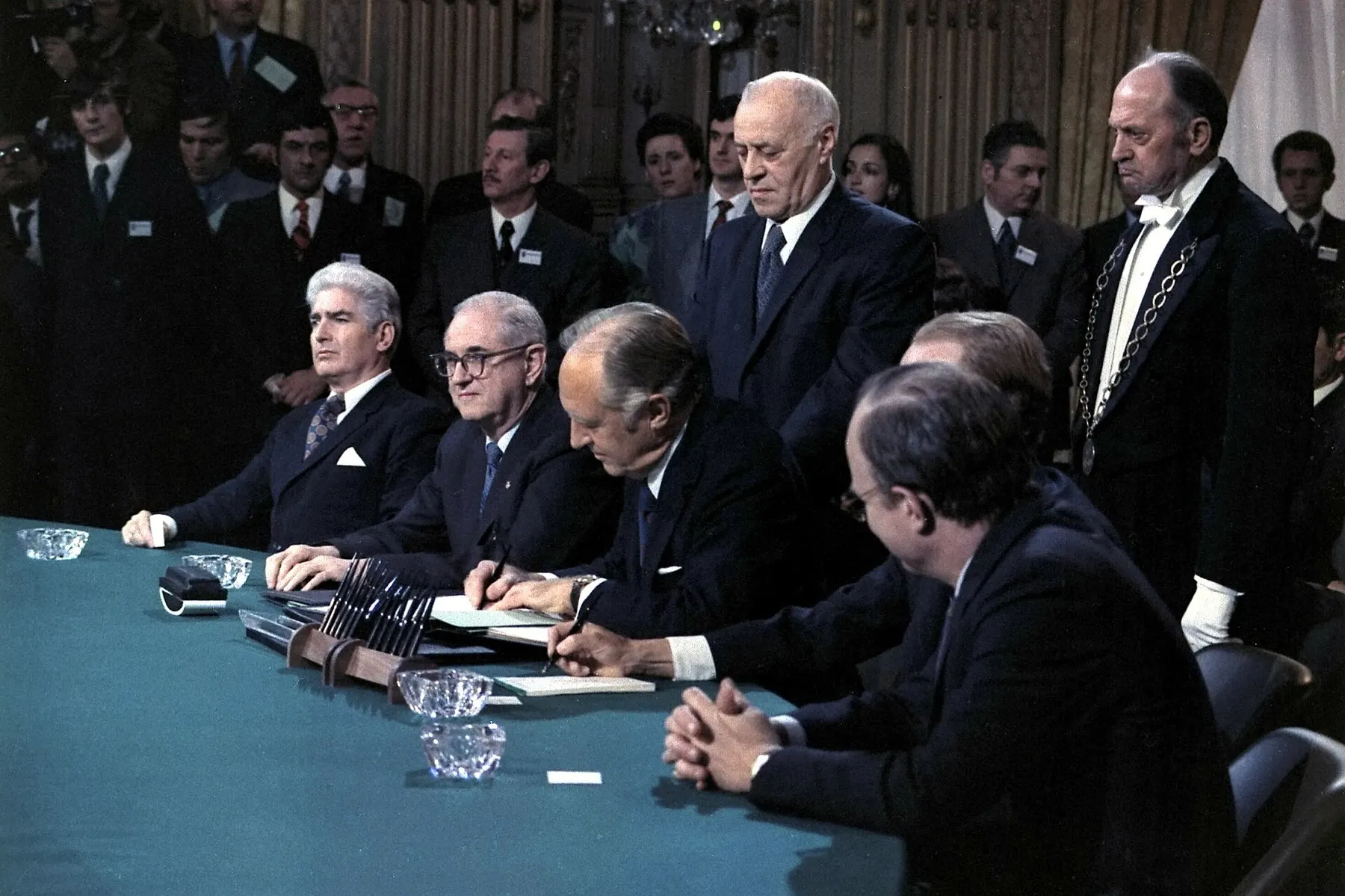
“The United States and all other countries respect the independence, sovereignty, unity, and territorial integrity of Viet-Nam as recognized by the 1954 Geneva Agreements on Viet-Nam”
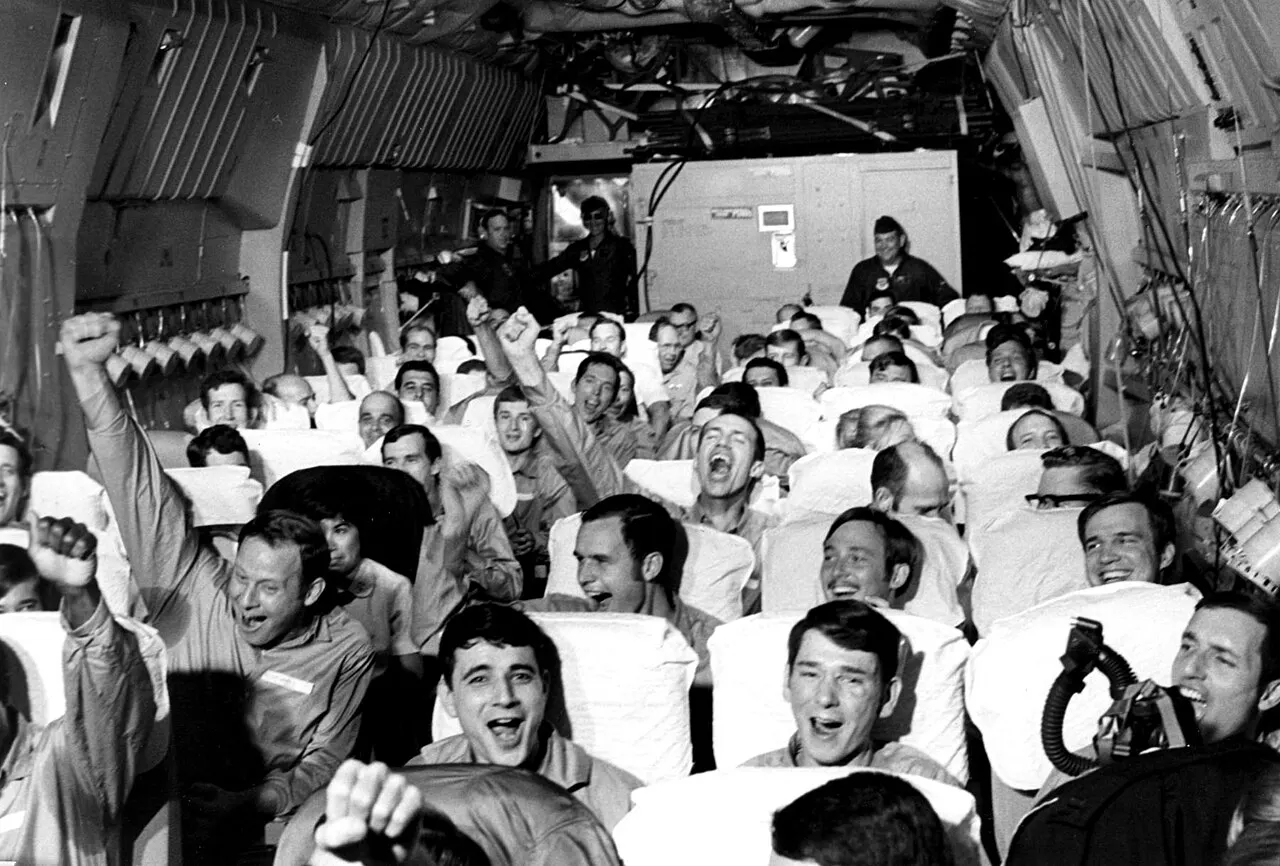
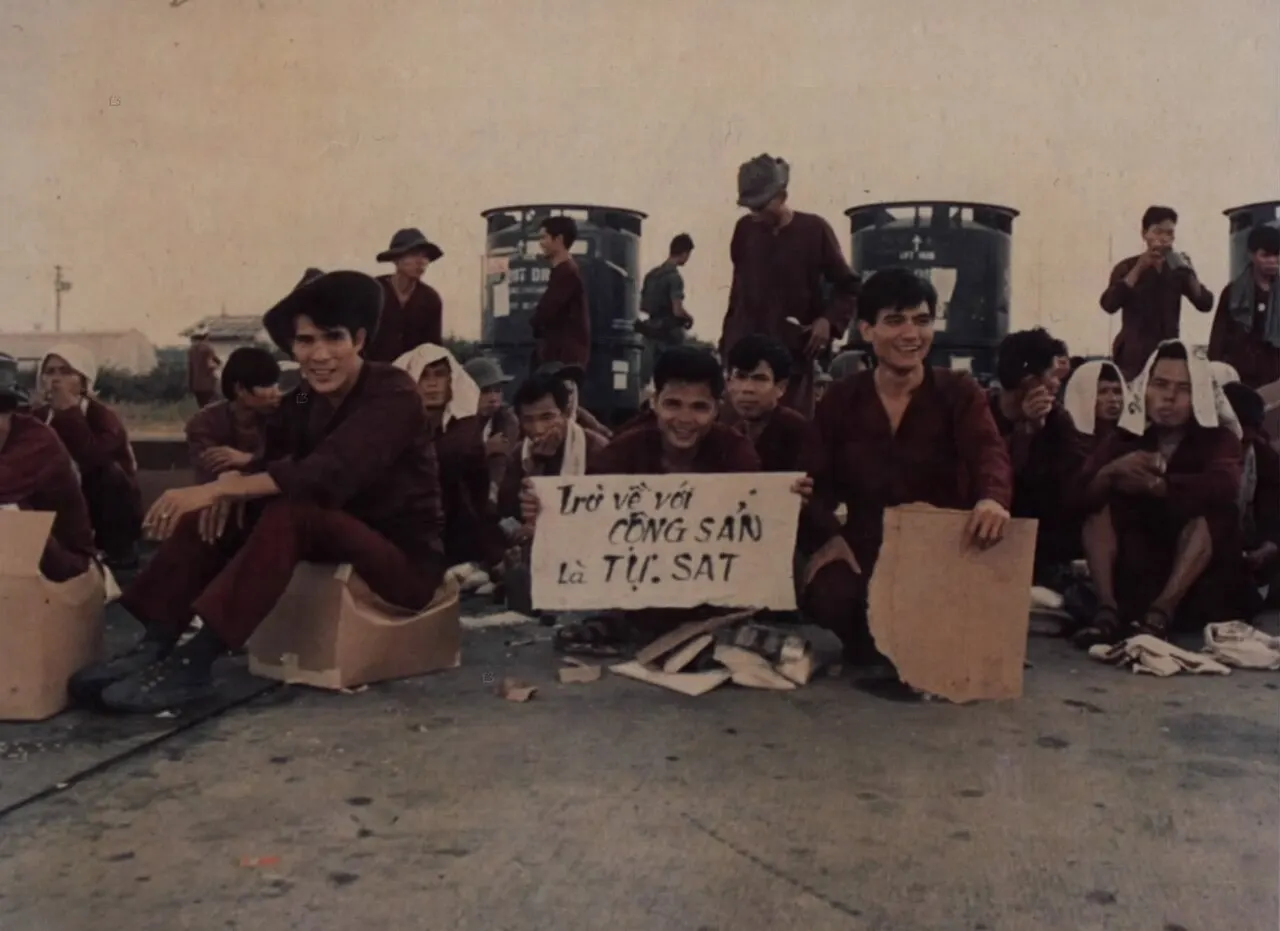
The agreement signed on January 27, 1973, let the United States leave, and 591 American prisoners were released within 60 days. Washington dropped its demand that North Vietnamese troops withdraw from the South, and Hanoi dropped its demand that Thieu be removed. Thieu signed on the strength of private assurances, among them Nixon's letter of November 14, 1972, promising that the United States would "react very strongly and rapidly" to any violation. Washington and Saigon both understood that to mean the B-52s would return.
Tanks at the palace gate
1973 to 2023
Congress was unwilling to reenter the war and Watergate had weakened the president who made the promise, so the B-52s stayed away. South Vietnam's position eroded as equipment broke down, spare parts ran short, fuel prices rose and aid was cut, and Thieu complained that he was left to fight a "poor man's war." His forces had come to depend on American logistics and firepower. North Vietnamese troops took Phuoc Long province in January 1975, the United States did not respond, and Hanoi moved on to a larger offensive in the Central Highlands.
- Vietnam
Modern borders are shown. The arrows simplify the 1975 offensive described in the U.S. Army's history: a push in the Central Highlands, a retreat to the coast that became a rout, a drive across the demilitarized zone to Hue and Da Nang, and the final advance on Saigon.
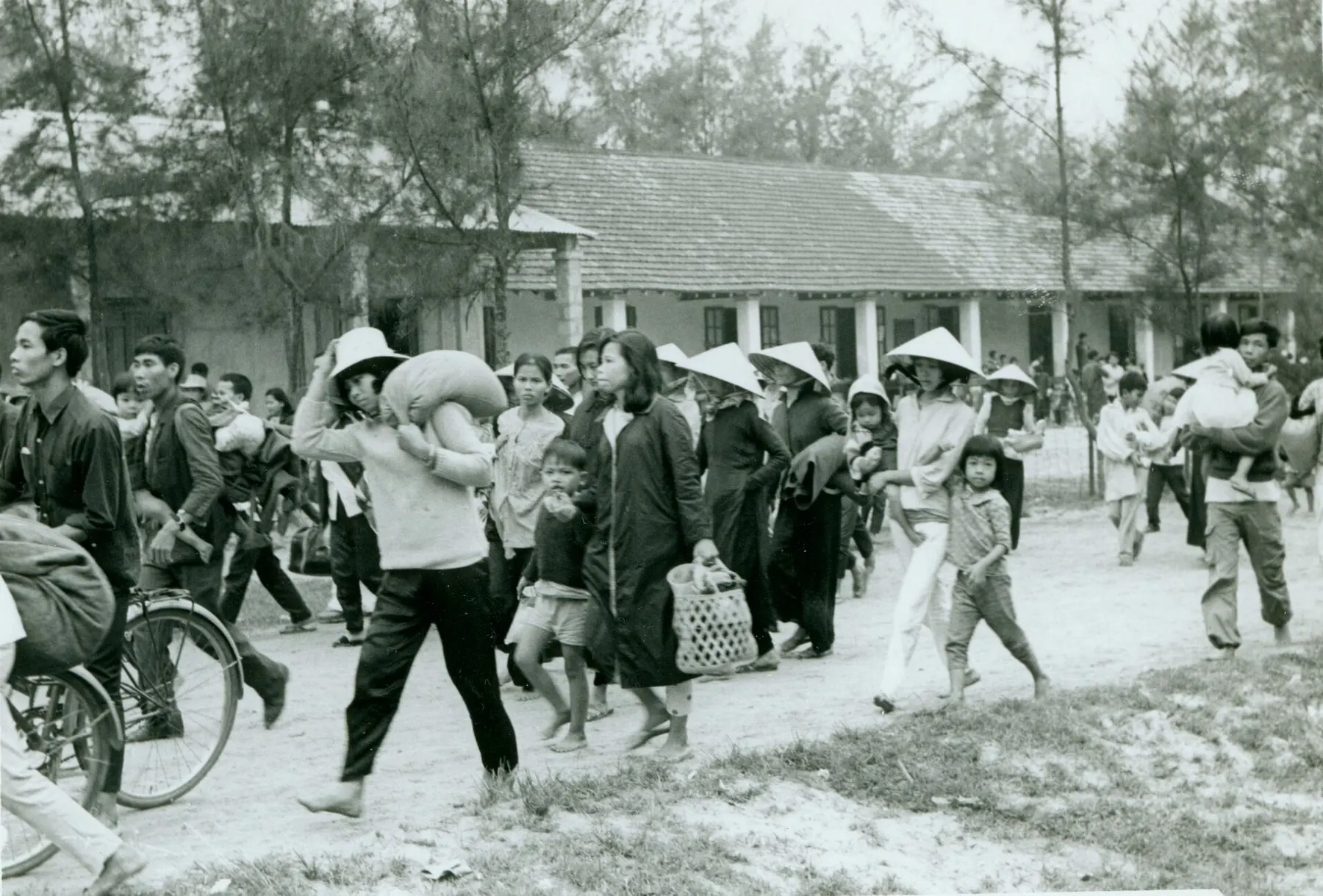
North Vietnamese forces attacked Ban Me Thuot on March 10 and held most of it within two days. Thieu ordered a retreat from the highlands to save his forces, and on March 15 senior officers abandoned Pleiku and Kontum, leaving troops and civilians to find their own way to the coast. Texas Tech's Vietnam Center says 30,000 to 40,000 people were killed or starved during the 15-day retreat, which the press called the Convoy of Tears. The flight cut off the northern provinces. Hue fell, and Da Nang filled with almost a million refugees and leaderless soldiers before it was evacuated at the end of March.
Thieu resigned on April 21, and the presidency changed hands twice in the following week before settling on General Duong Van Minh. North Vietnamese forces began shelling Tan Son Nhut air base on April 29, which ended evacuation by fixed-wing aircraft and started Operation Frequent Wind. Helicopters lifted about 7,000 people from the city to ships offshore in less than a day, some 5,500 of them Vietnamese, and sailors pushed aircraft over the side to clear deck space for more arrivals. Ambassador Graham Martin left before dawn on April 30 on President Ford's order, the last Marines left the embassy after sunrise, and hundreds of Vietnamese were left behind. Hours later North Vietnamese tanks entered the gate of the Presidential Palace and Minh surrendered unconditionally. One of the Soviet-built T-54s from that drive, number 843, now stands in a military museum in Hanoi.
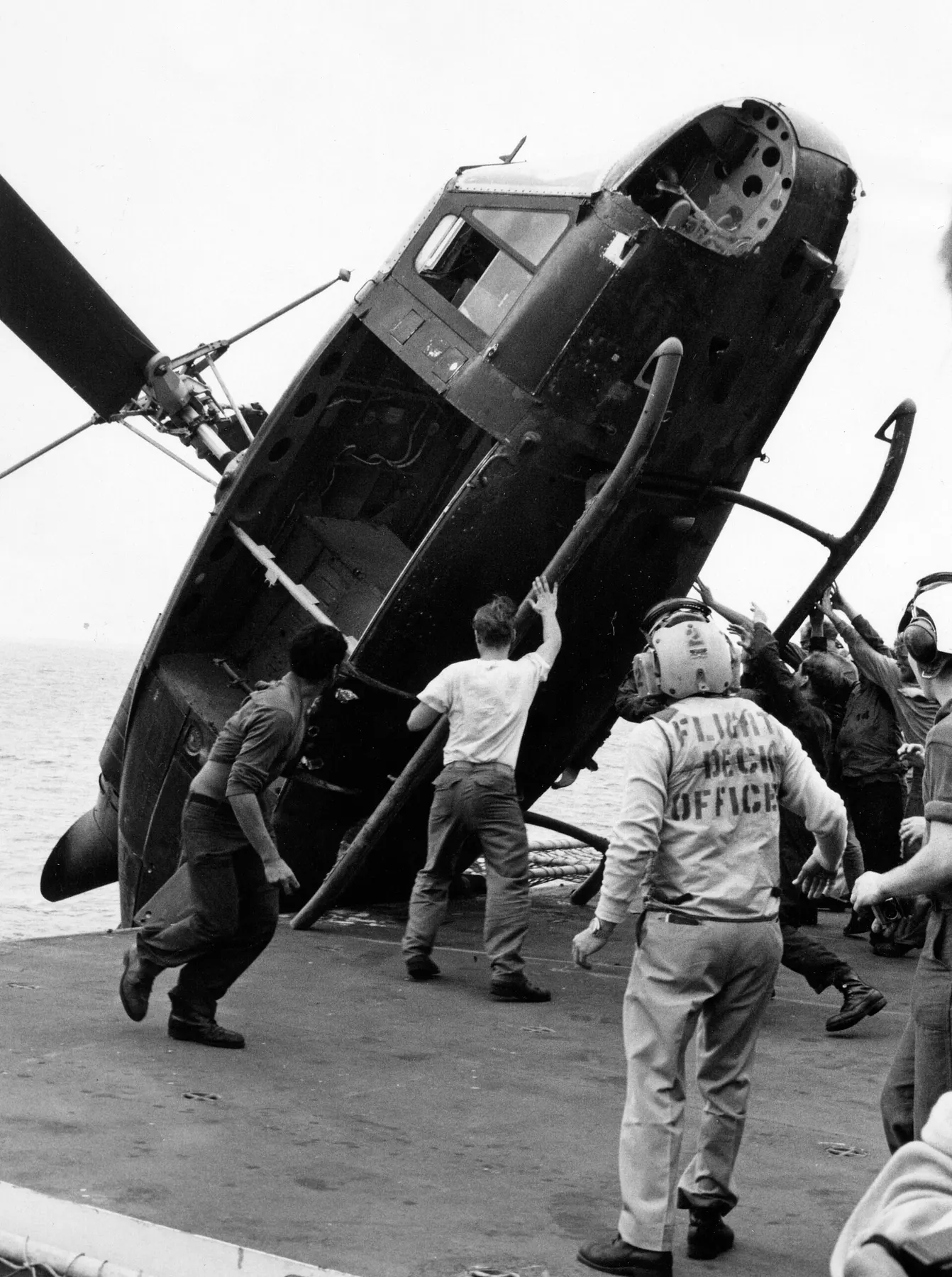
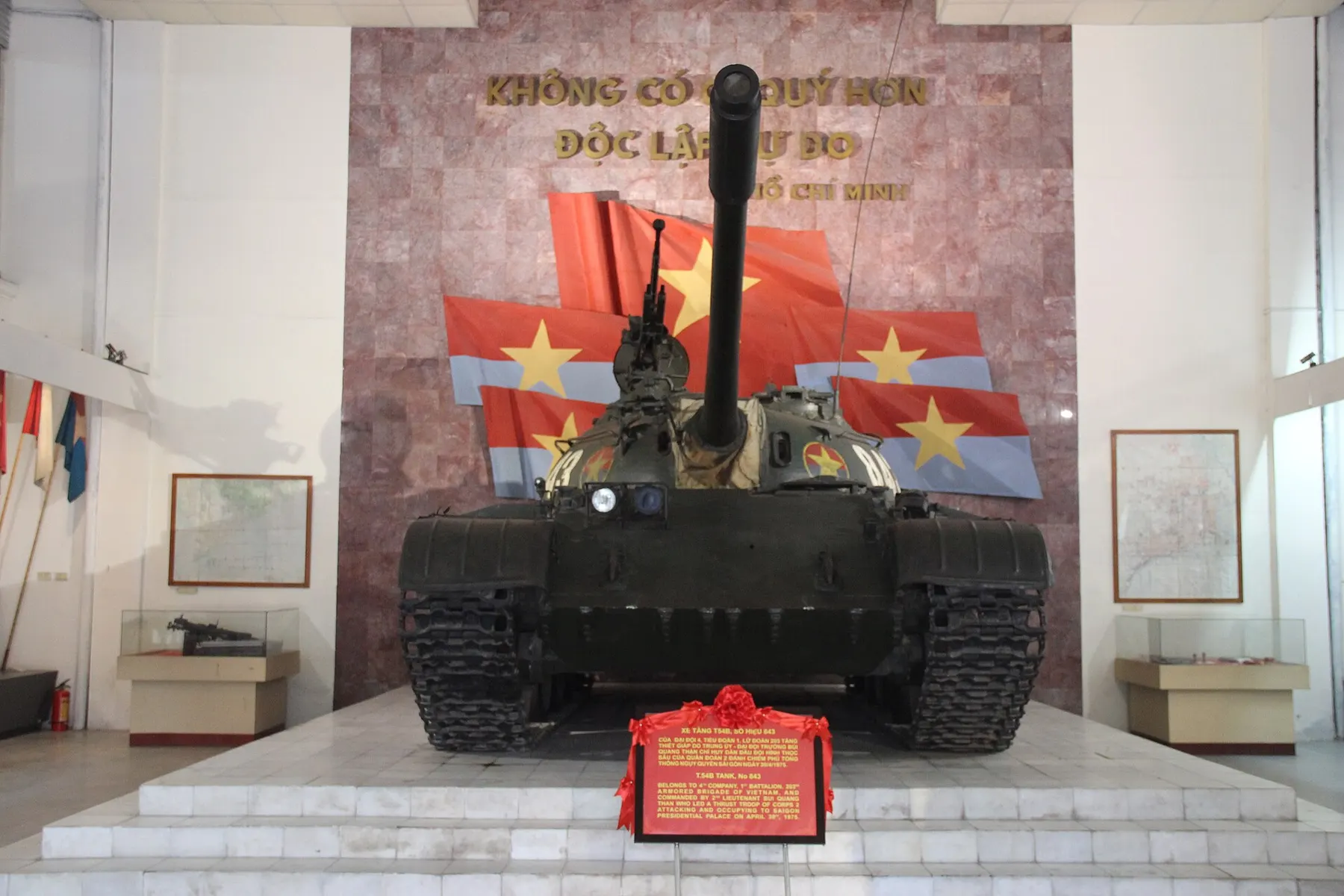
Some 140,000 Vietnamese closely tied to the old government were evacuated that spring and resettled in the United States. The neighboring wars ended the same year. The Khmer Rouge took Phnom Penh on April 17, 1975, and on December 2 the Lao king abdicated and the Pathet Lao's Lao People's Democratic Republic was proclaimed. Vietnam was formally unified in July 1976, and the NLF's provisional government lost its separate standing.
The camps
The new authorities ordered former soldiers and officials to report for what they called re-education. Hanoi told an Amnesty International delegation in December 1979 that 40,000 people had been held for long-term re-education, of whom 26,000 remained in detention. Justice Minister Phan Hien said in 1987 that close to a million had passed through camps in the weeks after the takeover, most for days or weeks, and that about 10,000 were still held by the early 1980s. Amnesty reported that most detainees were never tried and that the promised three-year limit was often ignored. Vietnamese officials told Amnesty the policy was meant to achieve reconciliation rather than vengeance against a defeated force of 1.3 million. Some who went through the camps described a different purpose.
“The general purpose of the camps was to keep us away from the people, so that when we are released, we have lost all our contacts”
The boats
People began leaving by sea. About 15,000 Vietnamese sought asylum in Southeast Asia in 1977, the number quadrupled by the end of the next year, and about 70 percent of those asylum seekers were of Chinese origin. Human Rights Watch reports that 199,945 Vietnamese fled in 1979 alone, 68,748 of them landing in Hong Kong. Local hostility grew until the principle of asylum itself came under threat, and in July 1979, 65 governments met in Geneva and raised resettlement pledges from 125,000 to 260,000. How many died at sea is not known with confidence, and published estimates differ widely.
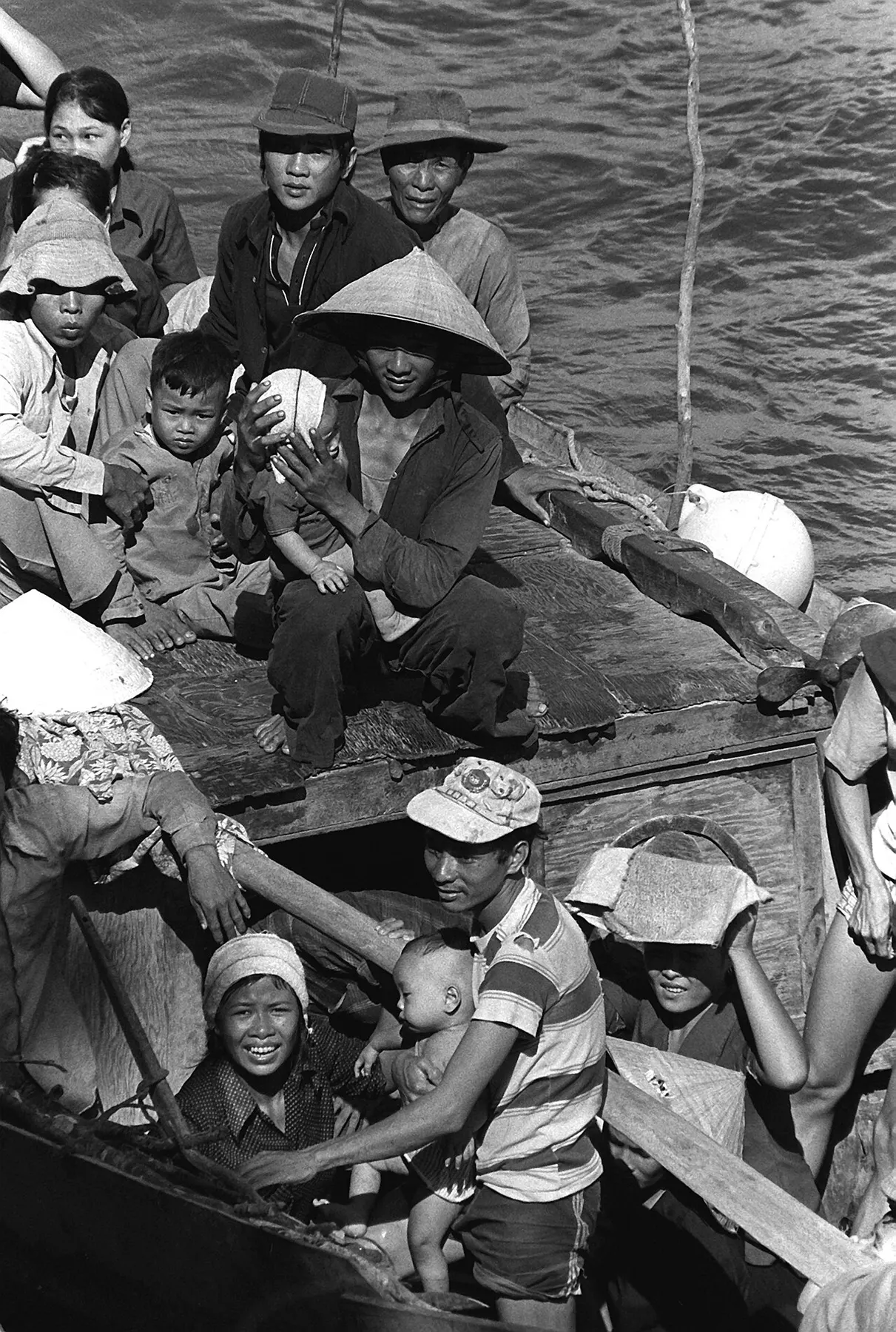
The physical remains of the war are still being cleared. Cluster munition remnants affect 15 of the 18 provinces of Laos, where they still kill people, and Washington has funded dioxin cleanup at Da Nang and other sites. A Seoul court was ruling in 2023 on what happened in a Vietnamese village in 1968. Hanoi's own count of its dead was not made public until April 3, 1995, 20 years after the tanks reached the palace, when it put the toll at 1.1 million fighters and, by the lower reading of the wire reports, about 2 million civilians.
The arsenal
The soldier
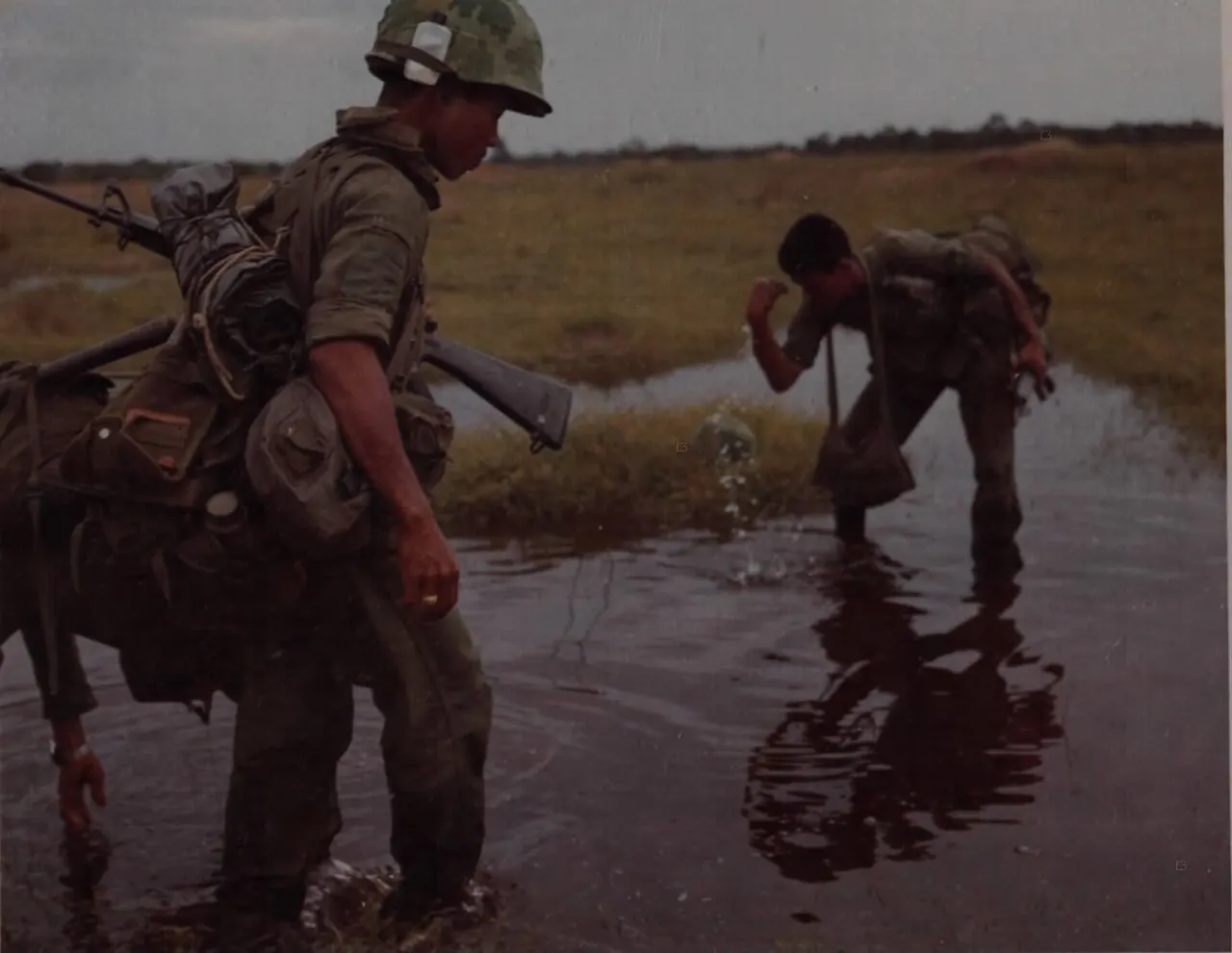
The M16 gave American infantry a light automatic rifle, and they could call on far more artillery and air support than their enemy. PAVN and NLF units answered with the AK-47 family, close-range tactics and explosive traps along trails and at doorways, which cost the Americans men without exposing anyone to return fire.
South Vietnam and allies
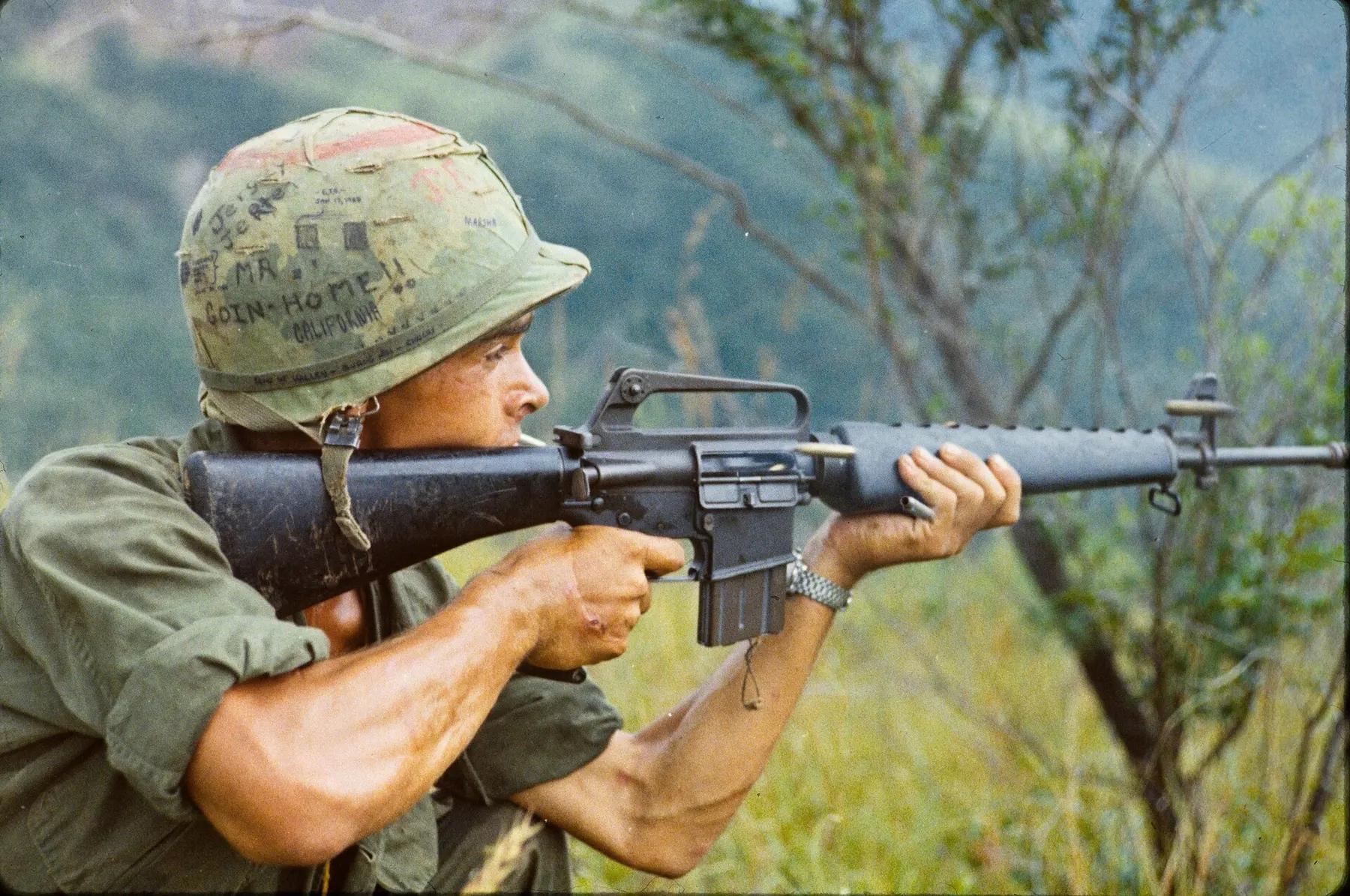
M16 rifle
Lightweight automatic rifle. U.S. forces, later South Vietnamese forces
Sent to Vietnam with the 173d Airborne Brigade in 1965. Early rifles sometimes stopped firing without warning. Modifications and training in cleaning resolved the doubts. Its ammunition weighed half as much as the 7.62mm NATO round.
Sp5 Robert C. Lafoon, U.S. Army, via U.S. National Archives. Public domain. SourceM14 rifle
Battle rifle, later sniper rifle. U.S. forces
The M16's predecessor. Accurized M14s with telescopic sights became the Army's sniper rifle in Vietnam.
M60 machine gun
General-purpose machine gun. U.S. forces
The squad's heavy firepower, also mounted on armored vehicles and, with a starlight scope, used at night out to about 300 meters.
M79 grenade launcher
40mm grenade launcher. U.S. forces
First issued in quantity in 1961 and first tested in combat in Vietnam. It reached beyond hand grenade range and was popular with troops in every kind of unit.
North Vietnam and the NLF
AK-47 pattern rifle
Assault rifle. PAVN and NLF
Chinese-made copies were first captured in the Mekong Delta on December 11, 1964, a sign that the insurgents were receiving a new family of 7.62mm weapons.
SKS carbine
Semiautomatic carbine. PAVN and NLF
Captured in the same December 1964 haul as the first AK copies and using the same M43 cartridge.
RPG-2 and RPG-7
Shoulder-fired antitank grenade launchers. PAVN and NLF
The RPG-2 with its B40 warhead was the main antiarmor weapon for years, later joined by the longer-ranged RPG-7. The Army's armor study says no adequate defense was ever found.
Mines and booby traps
Improvised and manufactured explosive devices. PAVN and NLF
Scattered as "nuisance mining" rather than in marked fields. A U.S. Army study attributes about 20 percent of American casualties and 70 percent of vehicle losses to them.
Land
U.S. planners did not expect tanks to matter in Vietnam, and General Westmoreland at first saw little use for them. Armor earned its place on road security and in breaking ambushes, and mines did it far more damage than North Vietnamese tanks. PAVN armor appeared in strength only late in the war, in Laos in 1971 and in the offensives of 1972 and 1975.
South Vietnam and allies
M48A3 Patton
Medium tank. U.S. Marines and Army, later ARVN
Marines drove the first ones ashore at Da Nang in March 1965. At Ben Het in March 1969, M48s fought the only tank-against-tank action between U.S. and North Vietnamese armor.
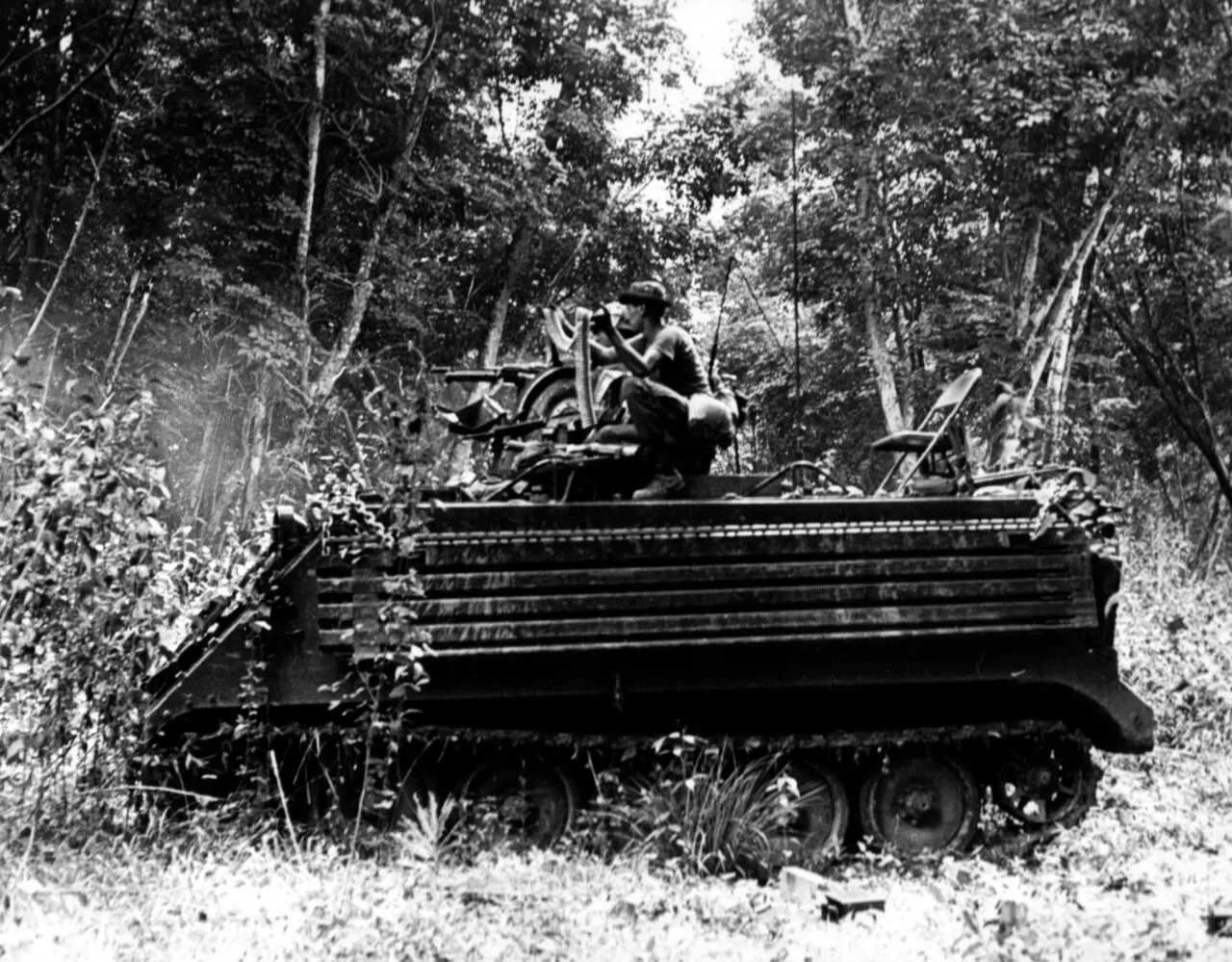
M113 and ACAV
Armored personnel carrier. ARVN and U.S. forces
South Vietnamese mechanized companies pioneered fighting from the vehicle. The Armored Cavalry Assault Vehicle, or ACAV, added guns and shields.
U.S. Army, from Mounted Combat in Vietnam. Public domain. SourceM551 Sheridan
Light armored reconnaissance vehicle. U.S. Army
One of the newly developed vehicles the Army took to Vietnam. Supplemental armor was added to Sheridans and M113s against mines.
North Vietnam and the NLF
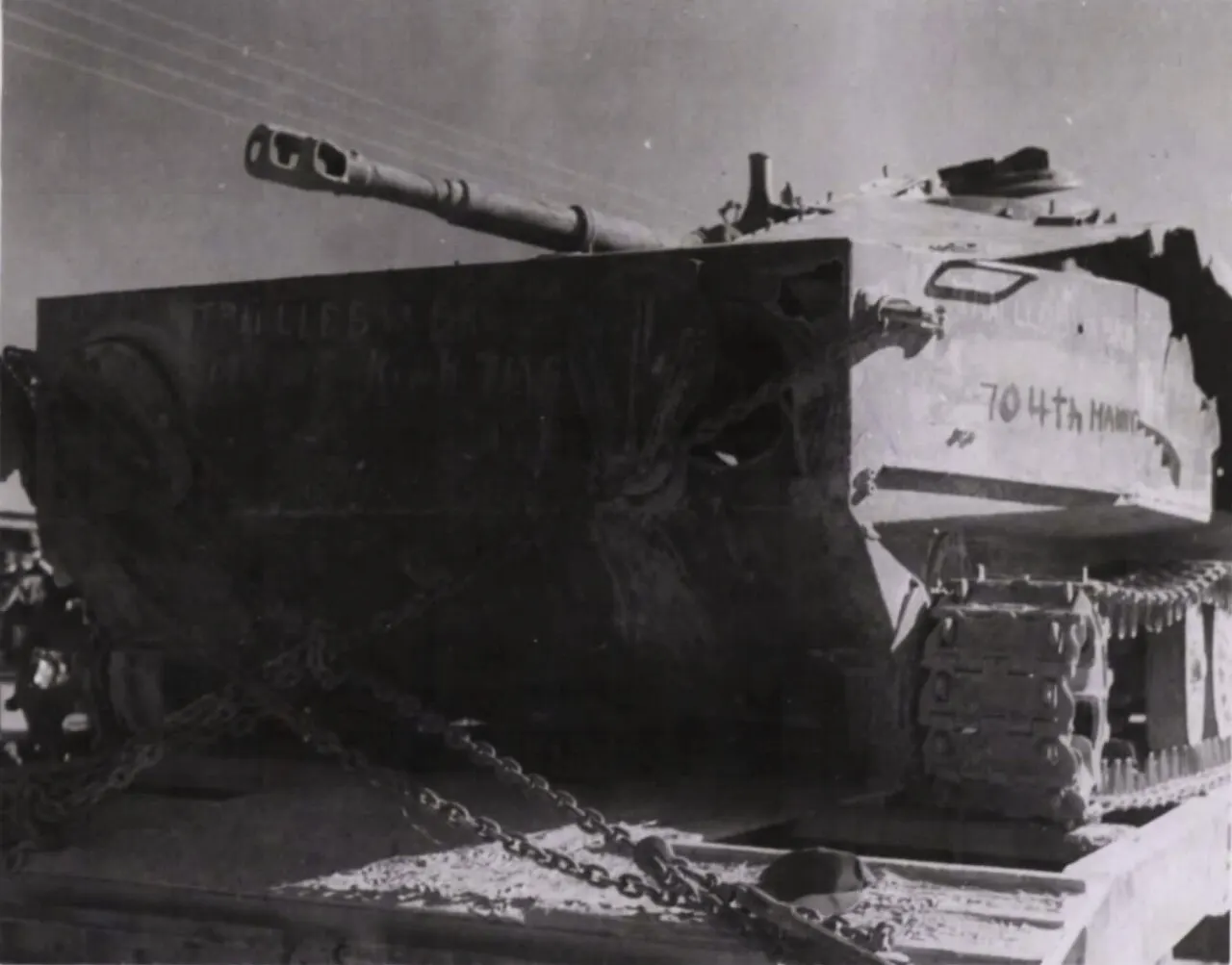
PT-76
Light amphibious tank. PAVN
Used in the attack that broke into a Special Forces camp in 1968. Two hulls were found after the Ben Het fight in 1969.
SP5 Ellis, U.S. Army, NARA 111-CCV-133-CC55936. Public domain. SourceT-54 and T-55
Soviet-built main battle tanks. PAVN
Met South Vietnamese forces in Laos in 1971, led the 1972 offensive and entered Saigon in 1975.
Gary Todd, via Wikimedia Commons. CC0. SourceAntivehicle mines
Land mines. PAVN and NLF
A study of November 1968 to May 1969 found mines caused 73 percent of U.S. tank losses and 77 percent of armored personnel carrier losses.
Air
The United States held the air over the South and had to fight for it over the North, where radar, guns, missiles and a small fighter force made every raid expensive. Helicopters gave American and South Vietnamese infantry a mobility PAVN and NLF units could not match, and Laos in 1971 showed what massed antiaircraft fire could do to them.
South Vietnam and allies
UH-1 Iroquois (Huey)
Utility helicopter. U.S. Army and allies
Replaced the older CH-21 in the early 1960s. It moved troops, carried the wounded and, armed, escorted other aircraft. Rapid evacuation by helicopter saved many lives.
SFC James K. F. Dung, U.S. Army, via U.S. National Archives. Public domain. SourceAH-1 Cobra
Attack helicopter. U.S. Army
Fitted with TOW antitank missiles in 1972, Cobras were crucial to the South Vietnamese defense of An Loc, in the Army's assessment.
CH-47 Chinook
Heavy transport helicopter. U.S. Army
Moved artillery and cargo. The Army credits it with recovering downed aircraft worth about $2.7 billion between 1965 and 1971.
F-4 Phantom II
Fighter-bomber. U.S. Air Force, Navy and Marines
671 were lost across the services, about one in every eight built. On dedicated air patrols, Air Force F-4s reached a 5.5 to 1 ratio against MiGs by one analysis.
F-105 Thunderchief
Fighter-bomber. U.S. Air Force
Designed for nuclear strike. 334 of 833 built were lost in combat, 23 to MiGs and 31 to SA-2 missiles.
Lt. Col. Cecil J. Poss, U.S. Air Force, via U.S. National Archives. Public domain. Source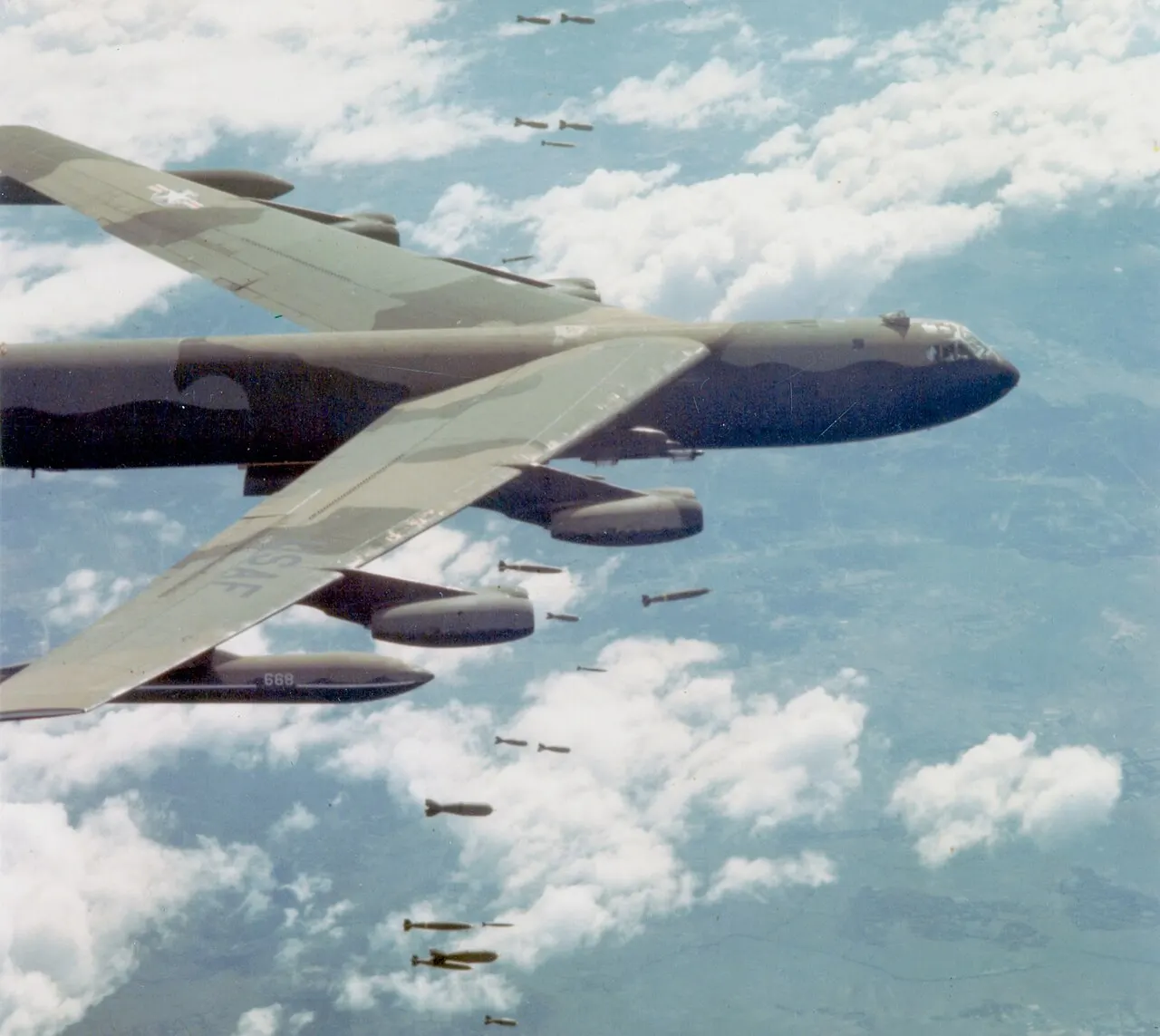
B-52 Stratofortress
Heavy bomber. U.S. Strategic Air Command
Flew from Guam in support of troops at Ia Drang in 1965. In Linebacker II it flew 729 sorties over the North and lost 15 aircraft.
U.S. Air Force, via National Museum of the U.S. Air Force. Public domain. Source
North Vietnam and the NLF
MiG-17
Subsonic fighter. North Vietnamese Air Force
Maneuverable and dangerous at close range. After heavy losses on May 10, 1972, most were withdrawn from combat.
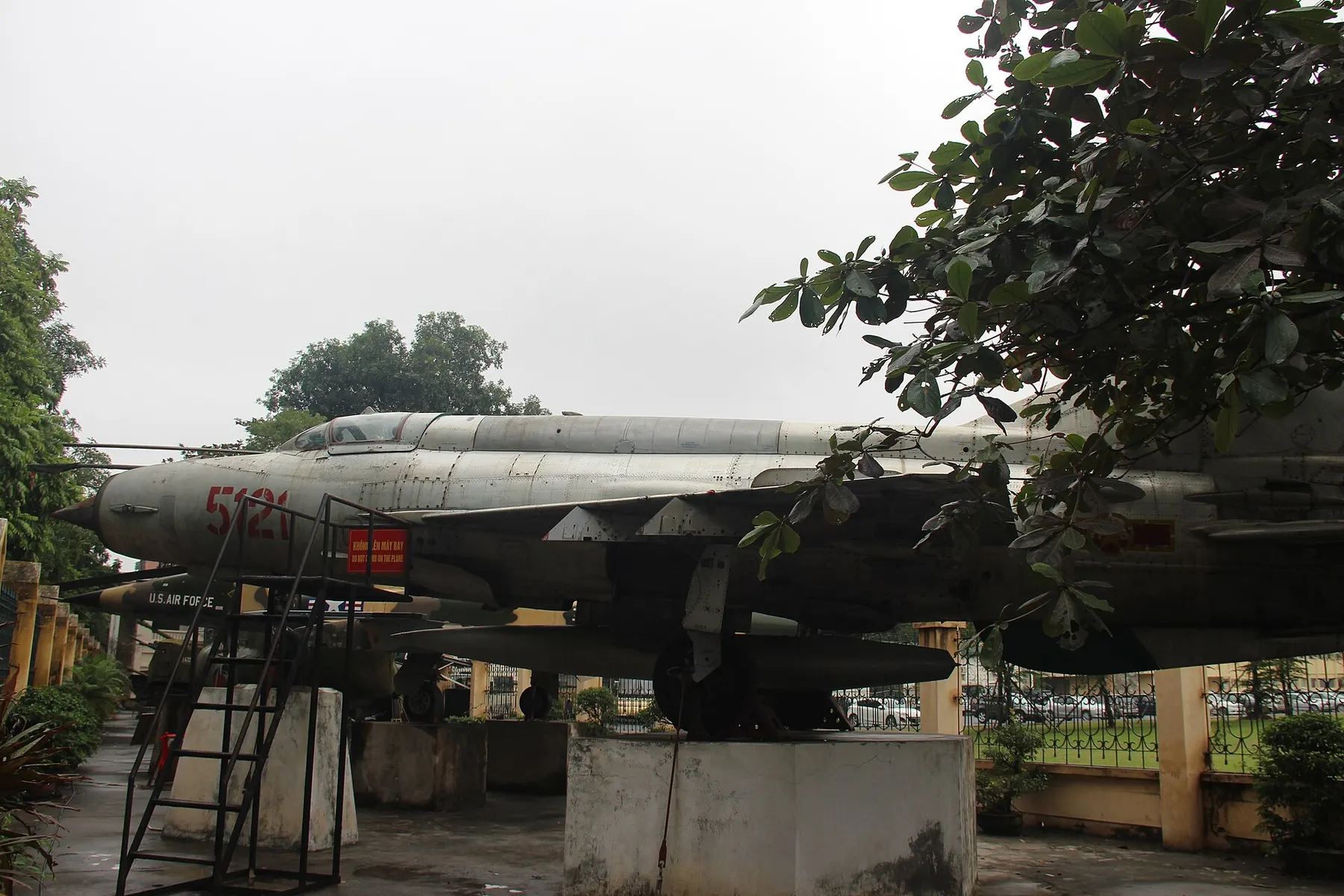
MiG-21
Supersonic interceptor. North Vietnamese Air Force
Guided by ground radar, it made fast passes from behind American formations and fired Atoll missiles.
Gary Todd, via Wikimedia Commons. CC0. SourceSA-2 Guideline
Surface-to-air missile. North Vietnamese air defense, with Soviet crews and advisers early on
A Soviet crew downed an American F-4C with one in July 1965, by Vietnamese accounts. About 1,240 were fired during Linebacker II.
kitmasterbloke, via Wikimedia Commons. CC BY 2.0. Source
Sea
North Vietnam had almost no navy to contest the sea, so the U.S. Navy struck from offshore and worked to choke coastal and river traffic while Hanoi tried to slip supplies south by water. Most of the fighting afloat took place on the rivers of the Mekong Delta.
South Vietnam and allies
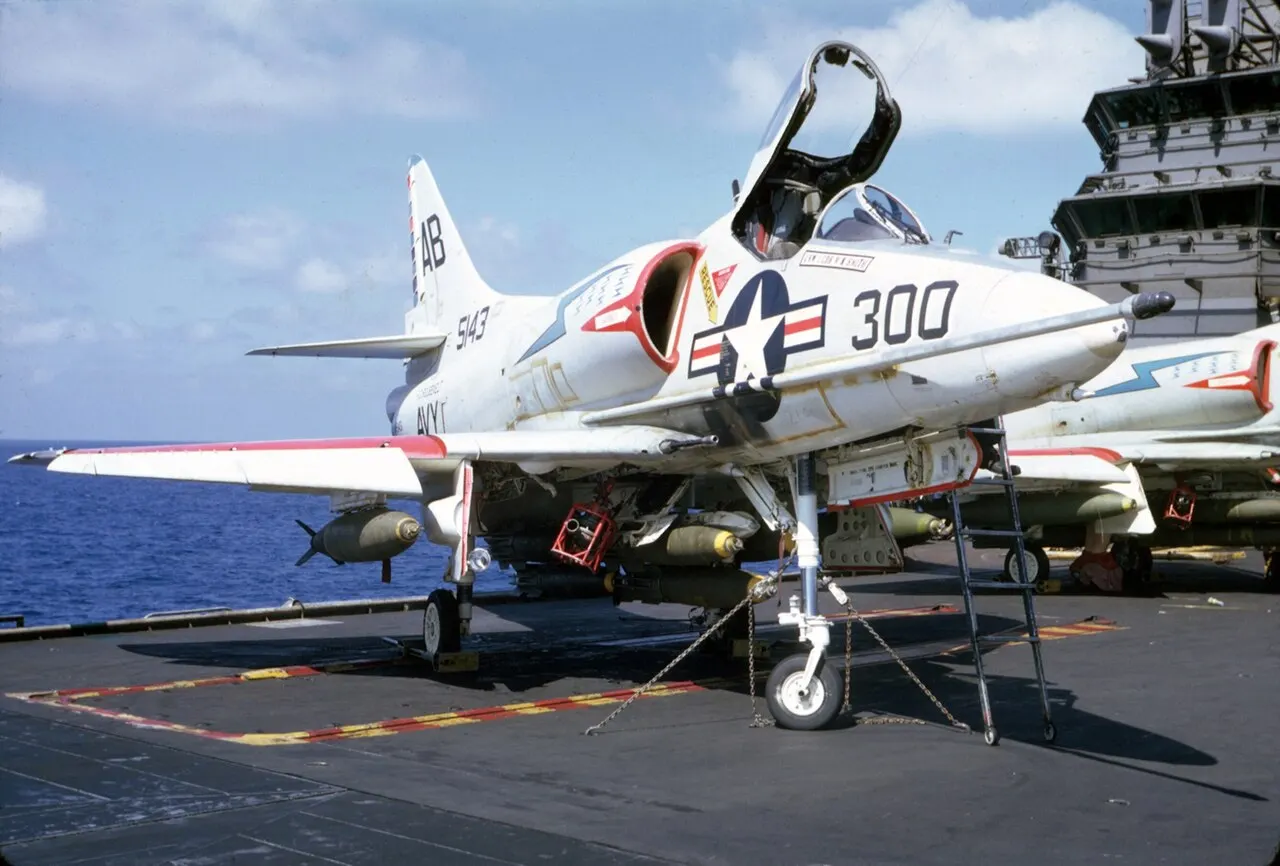
Attack carriers
Aircraft carriers. U.S. Navy
Carrier aircraft struck the North from offshore. Their approach from the sea gave North Vietnamese fighters less warning time than they had against Air Force raids.
Terry Johnson, U.S. Navy. Public domain. SourceRiver assault craft
Armored troop carriers, monitors and patrol boats. U.S. Navy and Army Mobile Riverine Force
Each river assault group was planned around 52 armored troop carriers, 10 monitors, 5 command boats and 32 assault support patrol boats.
River patrol boat (PBR)
Fast patrol boat. U.S. Navy, Task Force 116 (Game Warden)
Patrolled inland waterways to cut PAVN and NLF communications and to help defend river outposts.
JOC R. D. Moesser, U.S. Navy. Public domain. SourceMarket Time patrols
Coastal blockade. U.S. Navy, Task Force 115
Watched the coast to stop resupply of Communist forces by sea.
North Vietnam and the NLF
P-4 torpedo boat
Motor torpedo boat. North Vietnamese Navy
Three engaged USS Maddox in the Gulf of Tonkin on August 2, 1964.
Sea infiltration units
Covert supply by sea. North Vietnam
Hanoi set up a special naval unit to move people and supplies south by water alongside the Trail.
Support and strategic
Logistics decided much of this war. The United States moved vast quantities by air and sea and spent heavily on sensors and night sights, while North Vietnam built a road network under bombardment and carried by hand what trucks could not reach.
South Vietnam and allies
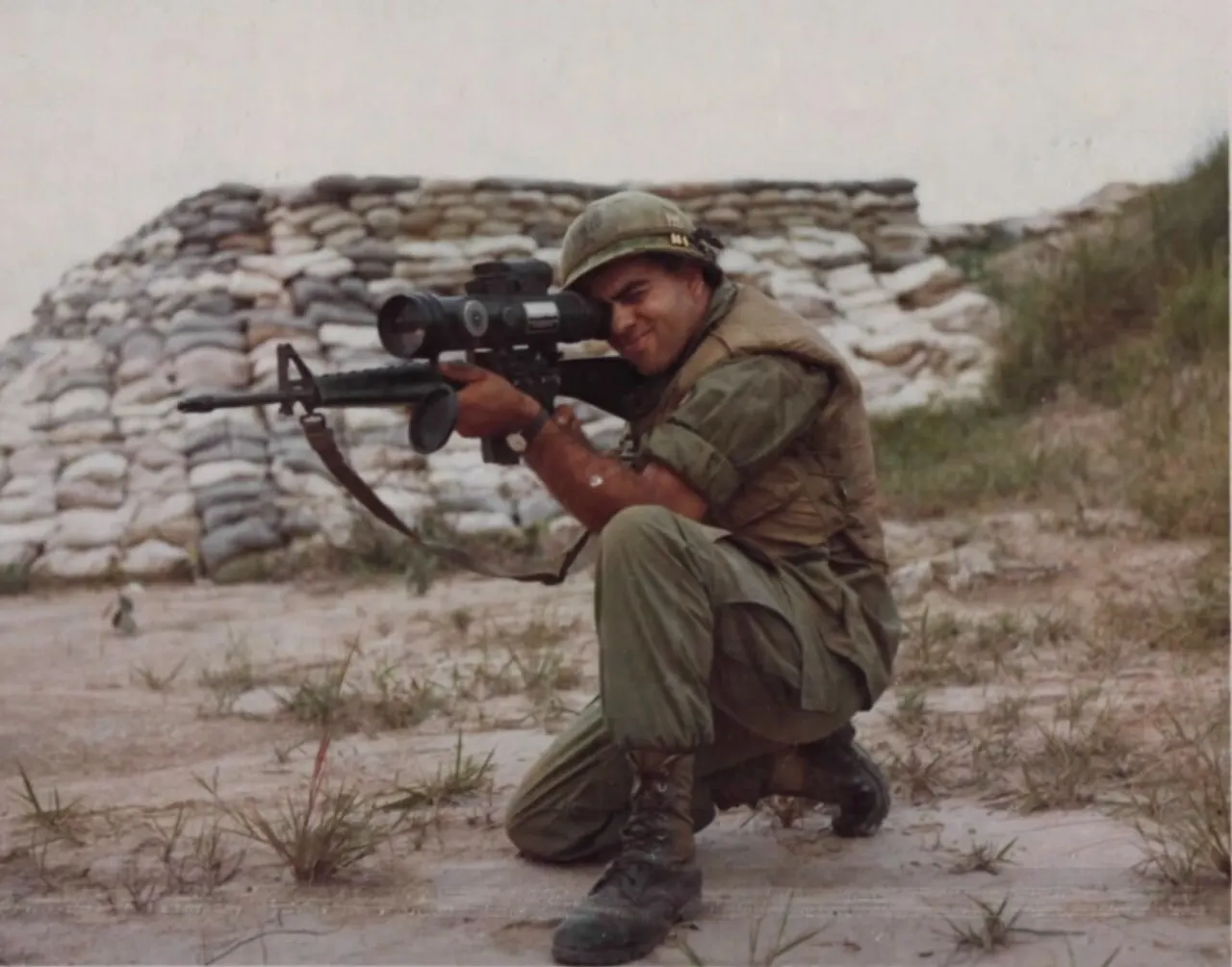
Starlight scope
Night-vision sight. U.S. forces
Weighed about 6 pounds and amplified existing light. Mounted on an M16 or M60, it allowed effective fire at night out to 300 meters.
SSG James I. Hatton, U.S. Army. Public domain. SourceTrail sensors
Electronic surveillance. U.S. Air Force
Dropped along the Trail to detect traffic. From December 1967 to March 1968, crews verified only 12 percent of the targets the system nominated.
Herbicides
Chemical defoliants. U.S. Air Force, Operation Ranch Hand
A 1978 audit counted 18.85 million gallons, including 11.22 million of Agent Orange, sprayed to remove cover.
U.S. Air Force, via National Museum of the U.S. Air Force. Public domain. SourceTactical airlift
C-130 transports. U.S. Air Force
Supplied Khe Sanh under fire, at times extracting pallets by parachute as the aircraft skimmed the runway.
U.S. Air Force, 7th Air Force. Public domain. Source
North Vietnam and the NLF
Ho Chi Minh Trail
Supply and infiltration network. North Vietnam, 559th Transportation Group
Grew to some 4,000 miles of roads, rivers and trails within seven years of 1965, according to North Vietnam's logistics chief.
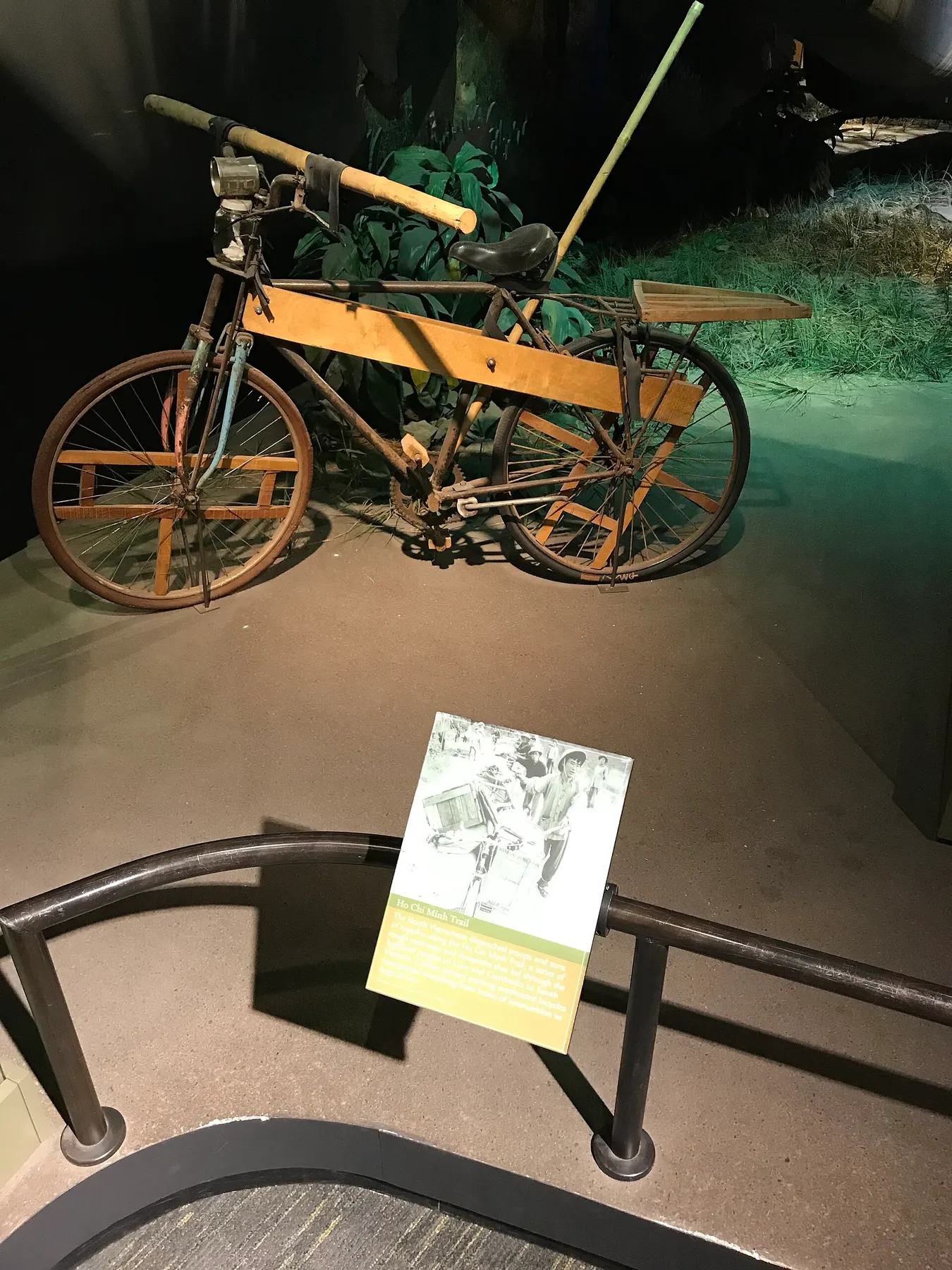
Cargo bicycles and porters
Human-powered transport. PAVN and NLF
In the Trail's early years, cargo moved on bicycles, pack animals and the backs of porters between about 100 way stations.
Gabichan2020, via Wikimedia Commons. CC BY-SA 4.0. Source
Timeline
1945
September 2. Ho Chi Minh declares independence
He reads the declaration at Ba Dinh Square in Hanoi while a U.S. intelligence team looks on.
1953
November. French occupy Dien Bien Phu
France places a garrison in a remote valley near Laos, hoping to draw the Viet Minh into open battle.
1954
May 7. Dien Bien Phu falls
The garrison is overrun about eight weeks after the main assault opened, as negotiators gather at Geneva.
July 20. Geneva cease-fire
France and the Viet Minh stop fighting and divide Vietnam at the 17th parallel, with elections due in 1956.
1955
October. Diem wins a disputed referendum
Official results give him 98.2 percent against the former emperor Bao Dai, and the U.S. Embassy doubts the turnout.
1956
Diem refuses the Geneva elections
With American support he declines a vote he says could not be fair in the North.
1959
May. Hanoi ratifies Resolution 15
The Politburo approves a stronger insurgency in the South and sets up the 559th Group to move men and supplies through Laos.
1960
December. National Liberation Front founded
Southern insurgents and their allies form a political front against the Saigon government.
1961
December. First U.S. helicopter company arrives
Within three years American helicopters are supporting every South Vietnamese division and corps.
1963
January. Defeat at Ap Bac
Insurgents defeat government forces in a Delta village, exposing faulty intelligence and overcautious leadership.
June 11. Thich Quang Duc burns himself
The monk's death in a Saigon street, photographed by Malcolm Browne of the Associated Press, follows the killing of nine people at Hue in May.
November 1. Generals overthrow Diem
The coup has American encouragement, and Diem and his brother are murdered.
1964
August 2 and 4, 1964. Gulf of Tonkin
U.S. destroyers report two attacks, the second of them doubted within hours by the patrol's own commander.
1965
March. Rolling Thunder and the Marines
Sustained bombing of the North begins, and Marines land at Da Nang days later.
November 14. Landing Zone X-Ray
The 1st Cavalry Division (Airmobile) meets North Vietnamese regiments in the Ia Drang valley.
1968
January 31. Tet Offensive
Attacks reach 36 of 44 provincial capitals and five of six autonomous cities, including Saigon and Hue.
March 16. My Lai
Soldiers of Charlie Company kill hundreds of unarmed villagers, and the first report claims 128 enemy dead.
March 31. Johnson declines to run
He limits the bombing of the North in the same televised address.
1969
April. U.S. strength peaks
About 543,000 Americans are in South Vietnam as the handover called Vietnamization takes shape.
November 13. My Lai reaches the newspapers
Seymour Hersh's story runs in 35 papers, 20 months after the killings.
1970
May. Cambodia and Kent State
U.S. and South Vietnamese forces cross into Cambodia, and on May 4 Ohio guardsmen kill four people at Kent State University.
1971
February. Lam Son 719
South Vietnamese troops drive into Laos toward Tchepone and are forced back, at a cost of 107 U.S. helicopters.
1972
March 30. Easter Offensive
North Vietnam attacks on three fronts, and U.S. air power returns in force under Operation Linebacker.
December. Linebacker II
B-52 bombers fly 729 sorties against Hanoi and Haiphong and lose 15 aircraft.
1973
January 27. Paris Agreement signed
U.S. forces leave and American prisoners come home, while North Vietnamese troops stay in the South.
1975
March 10. Ban Me Thuot attacked
The loss of the highland town sets off a retreat that gives up the northern half of South Vietnam.
April 30. Saigon falls
North Vietnamese tanks enter the Presidential Palace grounds hours after the last U.S. helicopters leave.
1976
July. Vietnam unified
The Socialist Republic of Vietnam is proclaimed while former southern officers and officials sit in re-education camps.
1979
July. Geneva refugee conference
With boat departures at a crisis point, 65 governments raise resettlement pledges from 125,000 to 260,000.
After action report
North Vietnam and the National Liberation Front won the war.
South Vietnam ceased to exist, the country was reunified under Hanoi, and the United States failed in its strategic goal of preserving a separate southern state. American forces won most of their large battles by their own measures and had left two years before the end, and the NLF's provisional government was absorbed in 1976.
- On the battlefield
- North Vietnamese forces held the field in April 1975 after destroying the South Vietnamese Army in a conventional offensive. U.S. combat forces had left two years earlier, having won most large engagements by their own measures without ending the insurgency or the flow of men from the North.
- In the political outcome
- Hanoi achieved reunification and the end of the American presence. South Vietnam ceased to exist. The NLF's provisional government lost its separate standing when the country was unified in 1976.
- How it ended
- The Paris Agreement of January 27, 1973, ended direct U.S. involvement and left North Vietnamese troops in the South. Fighting continued until North Vietnamese forces took Saigon on April 30, 1975, and formal unification followed in 1976.
Hanoi and the NLF won the war's political objective, and South Vietnam disappeared as a state after 20 years.
U.S. forces inflicted far heavier losses than they took in most recorded battles, and those battles did not produce a South Vietnamese government able to stand alone.
Estimates of Vietnamese deaths run from under 1 million to more than 3 million, and Laos and Cambodia add hundreds of thousands more.
Victory brought re-education camps and a refugee exodus, and the war's bombs and chemicals still harm people today.
Objectives, side by side
South Vietnam and allies
Not achieved
Survive as an independent, non-Communist state
It lasted two decades and collapsed about two years after U.S. forces left.
Not achieved
Preserve an independent South Vietnam and contain Communist expansion
South Vietnam fell. The Paris Agreement did secure U.S. withdrawal and the return of American prisoners.
Partly achieved
Support South Vietnam and strengthen ties with Washington
South Vietnam was lost, and the alliances with the United States survived.
North Vietnam and the NLF
Achieved
Reunify Vietnam under Hanoi and remove the American presence
Accomplished in 1975 and 1976, at a cost Hanoi later put at 1.1 million fighters.
Partly achieved
Overthrow the Saigon government and win power in the South
Saigon fell, but Tet had badly weakened the NLF, northern forces finished the war and its provisional government was absorbed in 1976.
Also involved
Achieved
Sustain North Vietnam against the United States
Their ally won with their weapons and support.
Estimated deaths
- Military
- Roughly 700,000 to 1.4 million military dead on all sides, combining the rows above
- Civilian
- Roughly 300,000 to more than 2 million Vietnamese civilians, plus large and uncertain tolls in Laos and Cambodia
The totals cannot be neatly added because sources cover different years and some count soldiers and civilians together. A 2008 BMJ survey study estimated 3.8 million violent war deaths in Vietnam from 1955 to 2002 (range 2.2 million to 5.9 million), a period that includes later wars. Each bar spans the low and high estimates on a logarithmic scale, where every step is ten times the last, so small and very large losses fit one chart.
Military
South Vietnam and allies
U.S. military
58,220
47,434 hostile deaths and 10,786 non-hostile. More than 303,000 wounded, 153,303 of them needing hospital care.
How this was counted
Individual records in the Defense Casualty Analysis System, as of 2008. This is the firmest number in the war.
U.S. National Archives, Vietnam War U.S. Military Fatal Casualty Statistics
South Vietnamese military
about 181,000 to 254,000
How this was counted
Reference works compiled by Matthew White give 220,357 (Lewy), 223,748 (Summers and a 1995 wire report) and up to 254,257. The U.S. Army says more than 200,000. An outlier of 650,000 is not used here.
Necrometrics compilation; U.S. Army, American Military History
South Korean military
about 4,400 to 5,100
10,962 wounded by one count
How this was counted
Sources give 4,407 (Lewy, Summers) to 5,099 (HistoryNet). NPR reports more than 5,000.
Australian military
523
Almost 2,400 wounded
How this was counted
The Australian War Memorial gives 523 deaths as a result of the war. Other counts give 521.
Thai military
351
1,358 wounded
How this was counted
Thai forces withdrew by February 1972.
New Zealand military
37
187 wounded by one count
How this was counted
The New Zealand Herald reports 37 military personnel and two civilians dead, and four more New Zealanders who died serving with Australian and U.S. forces. HistoryNet gives 41.
North Vietnam and the NLF
PAVN and NLF
about 444,000 to 1,100,000
Hanoi reported 600,000 wounded
How this was counted
Hanoi's 1995 figure is 1.1 million over 21 years. Western estimates include 666,000 (Lewy, Summers). The U.S. Army says nearly a million. American body counts mixed in civilians, and Lewy thought up to a third of those counted may not have been soldiers.
Civilian
South Vietnamese civilians
about 250,000 to 1,000,000
How this was counted
Lewy gives 340,000, a U.S. Senate subcommittee 430,000 and the U.S. Army "approached a half-million." Causes include all sides' firepower, assassination and mines.
Necrometrics compilation; U.S. Army, American Military History
North Vietnamese civilians
about 65,000 from bombing
How this was counted
A figure repeated in several Western reference works. Hanoi has not published a separate number that could be checked.
All Vietnamese civilians, Hanoi's figure
about 2,000,000
How this was counted
Announced April 3, 1995. Wire versions differ: some read 2 million in North and South together, while a French text reads nearly 2 million in each. This row uses the lower reading and is not added to the rows above.
1995 wire text reproduced by Grover Furr; Necrometrics compilation
Laos, all deaths
about 20,000 to 250,000
How this was counted
Soldiers and civilians together. Uppsala and PRIO records give about 20,000, a 2008 survey study 62,000 (range 28,000 to 115,000), and other authors up to 250,000.
Obermeyer, Murray and Gakidou, BMJ 2008; Necrometrics compilation
Cambodia, all deaths 1970 to 1975
about 156,000 to 600,000
How this was counted
Soldiers and civilians together, before the Khmer Rouge period. Estimates of civilians killed by U.S. bombing alone were 50,000 to 150,000.
Kill and loss ratios
A ratio compares reported losses. It depends on who did the counting, it does not measure who was right, and it often says little about who won.
About 2 to 1
Published figure
U.S. Air Force air-to-air, whole war
MiGs destroyed by the U.S. Air Force for each Air Force aircraft lost to MiGs.
137 MiGs destroyed against 67 Air Force aircraft shot down by MiGs.
Caution: Counts every aircraft type lost, including unarmed and slow planes. Vietnamese accounts credit their pilots with 218 U.S. aircraft of all services from February 1965 to November 1968 alone, so the two sides' tallies do not match.
3.8 to 1
Published figure
U.S. Air Force on air-to-air missions, whole war
MiGs destroyed per Air Force aircraft lost on air-to-air missions.
William Sayers's analysis, limited to aircraft flying air-to-air missions.
Caution: A narrower count than the one above, which is why the two differ. Small samples make it unstable.
14.5 to 1
Published figure
U.S. Air Force, January to July 1967 (Rolling Thunder)
MiGs shot down per Air Force fighter lost on air-to-air missions.
29 MiGs against 2 losses.
Caution: A short period that includes the Operation Bolo ambush. North Vietnam changed tactics soon after.
About 0.9 to 1
Calculated here
U.S. Air Force, final months of Rolling Thunder, 1968
MiGs destroyed per Air Force aircraft lost to MiGs.
20 MiGs divided by 22 Air Force aircraft: 20 / 22 = 0.91.
Caution: Reflects supersonic ambushes from behind. The dedicated combat air patrol flights in the same period held 3.5 to 1.
About 1.3 to 1
Calculated here
U.S. Air Force, February to July 1972 (start of Linebacker)
MiGs downed per Air Force aircraft lost in air combat.
24 MiGs divided by 18 aircraft: 24 / 18 = 1.33. The official history adds that June and July ran one to one.
Caution: Before the Teaball warning system, when MiG-21 ambushes were at their most effective.
About 4.3 to 1
Calculated here
U.S. Air Force, August 1972 to January 1973 (Teaball era)
MiGs destroyed per Air Force aircraft lost to MiGs.
26 MiGs divided by 6 aircraft: 26 / 6 = 4.3.
Caution: Includes MiGs shot down by bomber gunners and other crews not on air-to-air missions. At least half the losses came during a communications interruption.
4.7 to 1
Published figure
U.S. Navy air-to-air, whole war
MiGs destroyed per Navy aircraft lost in air combat, all aircraft types.
Sayers's analysis. The same source gives 6.4 to 1 for dedicated combat air patrols and 8.7 to 1 for those patrols after the Topgun school opened.
Caution: The Navy had far fewer decisive fights, and its coastal approach gave MiGs less warning than Air Force routes did. Differences between services are not simply differences in skill.
About 7.6 to 1
Calculated here
Landing Zone X-Ray, November 1965
Reported North Vietnamese dead per American killed.
600 divided by 79: 600 / 79 = 7.6.
Caution: The 600 is an American figure that cannot be checked against North Vietnamese records here. Three days later at a nearby ambush the balance was very different.
About 8 to 1
Calculated here
Dak To, November 1967
Estimated PAVN dead per soldier of the 173d Airborne Brigade killed.
1,400 divided by 174: 1,400 / 174 = 8.0.
Caution: The 1,400 is an estimate. The 174 covers only one brigade, while other U.S. and South Vietnamese units also fought there, so the true ratio was lower.
24 to 1
Published figure
South Korean Operation Hong Kil Dong, July to August 1967
Reported PAVN and NLF dead per South Korean soldier killed.
638 enemy killed over the whole operation, as reported in the U.S. Army study.
Caution: These are allied claims from official reporting. Allegations that Korean units also killed civilians make the enemy count especially hard to trust.
About 1.5 to 3.8 to 1
Calculated here
All Vietnam, whole war
PAVN and NLF dead per death among U.S., South Vietnamese and allied military forces.
Allied dead: 58,220 + 223,748 + 5,099 + 523 + 351 + 37 = 287,978. Then 444,000 / 287,978 = 1.5, and 1,100,000 / 287,978 = 3.8.
Caution: The figures cover different years and rest partly on body counts. Nearly two-thirds of the U.S. generals surveyed by Douglas Kinnard said body counts were often inflated, and the My Lai report listed 128 enemy dead among unarmed villagers. No ratio here measures which side was better.
Worked from the casualty rows on this page; Kinnard survey via History News Network
What it cost
- 2,254
- U.S. Air Force aircraft lost
- 1,737 in combat, February 1962 to October 1973
- 671
- F-4 Phantoms lost, all U.S. services
- About one in eight built
- 107
- U.S. helicopters lost in Lam Son 719
- The most in any single operation
- 580,000
- Bombing runs over Laos
- Through April 17, 1973
- About 500,000 tons
- U.S. bombs dropped on Cambodia
- 1969 to 1973, Owen and Kiernan's corrected figure
- 18.85 million gallons
- Herbicide sprayed
- 1978 U.S. audit, including 11.22 million of Agent Orange
- About 140,000
- Vietnamese evacuated in 1975
- Resettled in the United States
- 199,945
- Vietnamese who fled in 1979
- Human Rights Watch
Lessons drawn
- United States: firepower could not supply a government
- The Army's own history concludes that the massive military effort could not make up for the Saigon government's political weakness, and that the local insurgency made the final conventional victory possible.
- United States: false numbers corrode command
- False reporting and inflated body counts raised questions about the Army's professional ethics, and Douglas Kinnard's survey showed that many generals doubted the numbers they had used.
- United States: air combat needs training and warning
- Poor early results led to the Navy's Topgun school and the Air Force's Teaball warning center, and postwar analysis found that most aircraft lost to MiGs never saw the attack coming.
- North Vietnam: logistics as strategy
- The Trail, built and rebuilt under bombing, let Hanoi sustain a war far from its bases and move from guerrilla fighting to tank-led offensives.
- North Vietnam: no uprising at Tet
- The cities did not rise in 1968, and the offensives of 1972 and 1975 relied on conventional forces.
- South Vietnam: the cost of dependence
- Forces built around American logistics and air support struggled when fuel, parts and aid declined after 1973.
- U.S. Army: helicopters over defended ground
- The losses over Laos in 1971 raised doubts within the Army about airmobile operations against strong antiaircraft defenses.
Still disputed
- Could the United States have won?
- Admiral U.S. Grant Sharp, who commanded U.S. Pacific forces during Rolling Thunder, argued in his 1978 book Strategy for Defeat that limits on the bombing threw away success. The U.S. Army's general history stresses instead that no level of force could repair the political weakness of the Saigon government.
- How many Vietnamese died?
- The lowest figures in the rows on this page add up to about 940,000. Charles Hirschman, Samuel Preston and Vu Manh Loi, working from a life history survey, estimated 966,000 war deaths from 1965 to 1975, and the 2008 BMJ study found 1.7 million for the same years from World Health Survey data. Guenter Lewy's 1978 total, which includes foreign forces, is about 1.35 million. Hanoi's 1995 figures exceed 3 million, and the BMJ authors reached 3.8 million for 1955 to 2002.
- Was the second Gulf of Tonkin attack real?
- The Johnson administration reported it as fact and used it to justify the resolution. Captain Herrick questioned it within hours in his own message, and the State Department's historians record that doubts emerged about whether it took place.
- How independent was the NLF?
- The U.S. Army's history describes its command as the southern branch of the Communist Party, directly subordinate to Hanoi, while finding that southern anger at Diem swelled the insurgency. Pierre Asselin, using party documents, shows southern revolutionaries pressing the fight in 1964 while Hanoi tried and failed to rein them in.
- What happened at Hue?
- Saigon, Washington and historians including Guenter Lewy describe mass executions of thousands. Gareth Porter argued in 1974 that the figures were inflated and that many victims died in combat or under American fire, and Len Ackland put the executions at 300 to 400.
- Did the bombing work?
- Walter Boyne, writing in Air Force Magazine, credits Linebacker II with shaking Hanoi and returning it to the Paris talks. Owen and Kiernan argue that the bombing of Cambodia strengthened the Khmer Rouge, and the Air Force's own history could verify only 12 percent of the targets its Trail sensors nominated in 1967 and 1968.
- How much harm did Agent Orange do?
- One scientific study estimates that 2.1 million to 4.8 million Vietnamese were directly exposed, and Vietnamese advocacy groups cite more than 3 million people with health problems. The Congressional Research Service says data problems have prevented firm conclusions.
Sources
Figures for wars are estimates, and many are disputed. Where credible sources differ, this page gives the range and says who counts what. Maps are drawn from Natural Earth country shapes, which show today's borders.
- American Military History, Chapter 28: The U.S. Army in Vietnam, U.S. Army Center of Military History (library mirror)
- Allied Participation in Vietnam, U.S. Army, Vietnam Studies
- Mounted Combat in Vietnam, U.S. Army, Vietnam Studies
- Tactical and Materiel Innovations, U.S. Army, Vietnam Studies
- Riverine Operations 1966 to 1969, U.S. Army, Vietnam Studies
- Vietnam War U.S. Military Fatal Casualty Statistics, U.S. National Archives
- Fifty years of violent war deaths from Vietnam to Bosnia, BMJ, via PubMed Central
- Selected Death Tolls for Wars, Massacres and Atrocities, Necrometrics, compiled by Matthew White
- Hanoi's 1995 casualty announcement, wire text, Reproduced by Grover Furr, Montclair State University
- Final Declaration of the Geneva Conference, 1954, Yale Law School, Avalon Project
- Declaration of Independence of the Democratic Republic of Vietnam, Wikisource
- Tonkin Gulf Resolution, U.S. National Archives
- U.S. Involvement in the Vietnam War: The Gulf of Tonkin, U.S. Department of State, Office of the Historian
- Ending the Vietnam War, 1969 to 1973, U.S. Department of State, Office of the Historian
- Dien Bien Phu and the Fall of French Indochina, U.S. Department of State, Office of the Historian
- Address at Johns Hopkins University, American Presidency Project
- Address to the Nation on the War in Vietnam, American Presidency Project
- The Paris Accords (excerpts), Teaching American History
- Aces and Aerial Victories, U.S. Air Force
- The War Against Trucks, U.S. Air Force History and Museums Program
- The Crucible of Vietnam, Air & Space Forces Magazine
- Linebacker II, Air & Space Forces Magazine
- Andersen AFB's Legacy: Operation Linebacker II, U.S. Air Force
- The Vietnam Air War's Great Kill-Ratio Debate, HistoryNet
- These 5 Nations Joined Forces With the U.S. in Vietnam, HistoryNet
- Vietnam War 1962 to 1975, Australian War Memorial
- Vietnam War, Anzac Portal, Australian Department of Veterans' Affairs
- U.S. Agent Orange/Dioxin Assistance to Vietnam, Congressional Research Service
- Bombs Over Cambodia, Taylor Owen and Ben Kiernan, The Walrus, 2006 (tonnage later corrected)
- Making More Enemies than We Kill?, Ben Kiernan and Taylor Owen, The Asia-Pacific Journal, 2015
- Despatch on the Diem and Bao Dai referendum, Foreign Relations of the United States, 1955 to 1957
- The DESOTO Patrols and OPLAN 34A, U.S. National Security Agency
- The President's News Conference, July 28, 1965, American Presidency Project
- American War and Military Operations Casualties, Congressional Research Service
- This Day in Airpower: April 17, 1973, Air & Space Forces Magazine
- Clearing Cluster Munition Remnants: Lao PDR, Mine Action Review
- Vietnam's quiet tigers and grey ghosts, The New Zealand Herald
- Battle of Dien Bien Phu flashback, Viet Nam News
- Vietnam War (1960 to 1975), Encyclopedia.com
- Secret War in Laos, Legacies of War
- The Massacre of Hue, Time, 1969
- The Tet Offensive: Hue, Vietnam Center, Texas Tech University
- The Tet Offensive: Khe Sanh, Vietnam Center, Texas Tech University
- The 1968 Hue Massacre, D. Gareth Porter, reproduced at Montclair State University
- My Lai: Meet the Participants, PBS American Experience
- The My Lai Massacre and Courts-Martial, Famous Trials, Douglas O. Linder
- South Korea's Vietnam War massacre case forces a new reckoning, NPR
- Rule-of-law campaign promises to open up Vietnam's bamboo gulag, The Christian Science Monitor, 1987
- Report of an Amnesty International Mission to the Socialist Republic of Viet Nam, 1981, Amnesty International
- Viet Nam: Long-Term Political Prisoners, 1991, Amnesty International
- History of the Vietnamese Refugees, Vietnamese Heritage Museum
- Hong Kong: Historical Background, Human Rights Watch, 1997
- Land Reform in China and North Vietnam, Edwin E. Moise, Clemson University
- Political and Economic Crisis in North Vietnam, 1955 to 56, Balazs Szalontai, Cold War History, 2005
- In Praise of Douglas Kinnard, History News Network
- Vietnam War death toll compilation, Vancouver Island University, reproducing the Historical Atlas of the Twentieth Century
- May 4 Historical Accuracy, Kent State University
- Soviet military experts and Vietnam's air defense, Viet Nam News
- Soviet Aid to North Vietnam, GlobalSecurity.org
- China's Involvement in the War, University of Southern California, Scalar
- The OSS in Vietnam, 1945: A War of Missed Opportunities, Dixee Bartholomew-Feis, The National WWII Museum
- Hanoi and Americanization of the War in Vietnam: New Evidence from Vietnam, Pierre Asselin, Pacific Historical Review, 2005
- Telegram 243 from the Department of State to the Embassy in Vietnam, August 24, 1963, Foreign Relations of the United States, 1961 to 1963
- TWE Remembers: Thich Quang Duc's Self-Immolation, Council on Foreign Relations
- Summary of Key Messages Leading to JCS Decision to Order Reprisal Attacks, Naval History and Heritage Command
- Address to the Nation Announcing Steps To Limit the War in Vietnam, March 31, 1968, American Presidency Project
- The Fall of Saigon, Vietnam Center, Texas Tech University
- Fall of Saigon, Encyclopaedia Britannica
- Fall of Saigon: What Led to the Final, Chaotic Moments, History.com
- Chronology of Cambodian Events Since 1950, Cambodian Genocide Program, Yale University
- Background Notes: Laos, U.S. Department of State
- Xuan Loc: The Final Battle, Vietnam, 1975, James H. Willbanks, Vietnam Center, Texas Tech University