
Rhodesian Bush War, 1966 to 1979
The War With Three Names
From 1966 to 1979 Rhodesia's white minority government fought two Black nationalist armies over who would rule a landlocked country of about six million people. Most of the dead were villagers, and the three names people give the war still mark which side of it they remember.
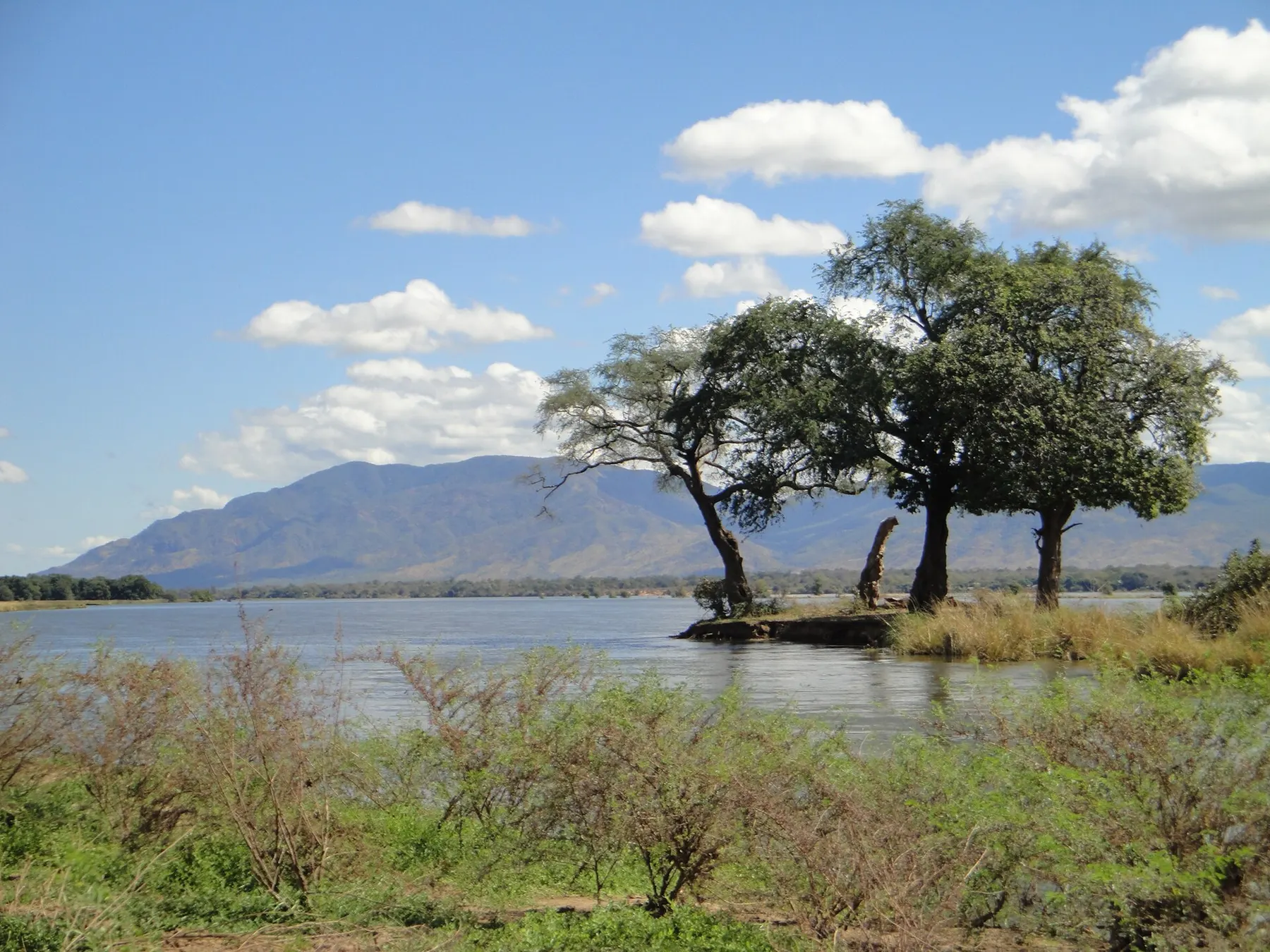
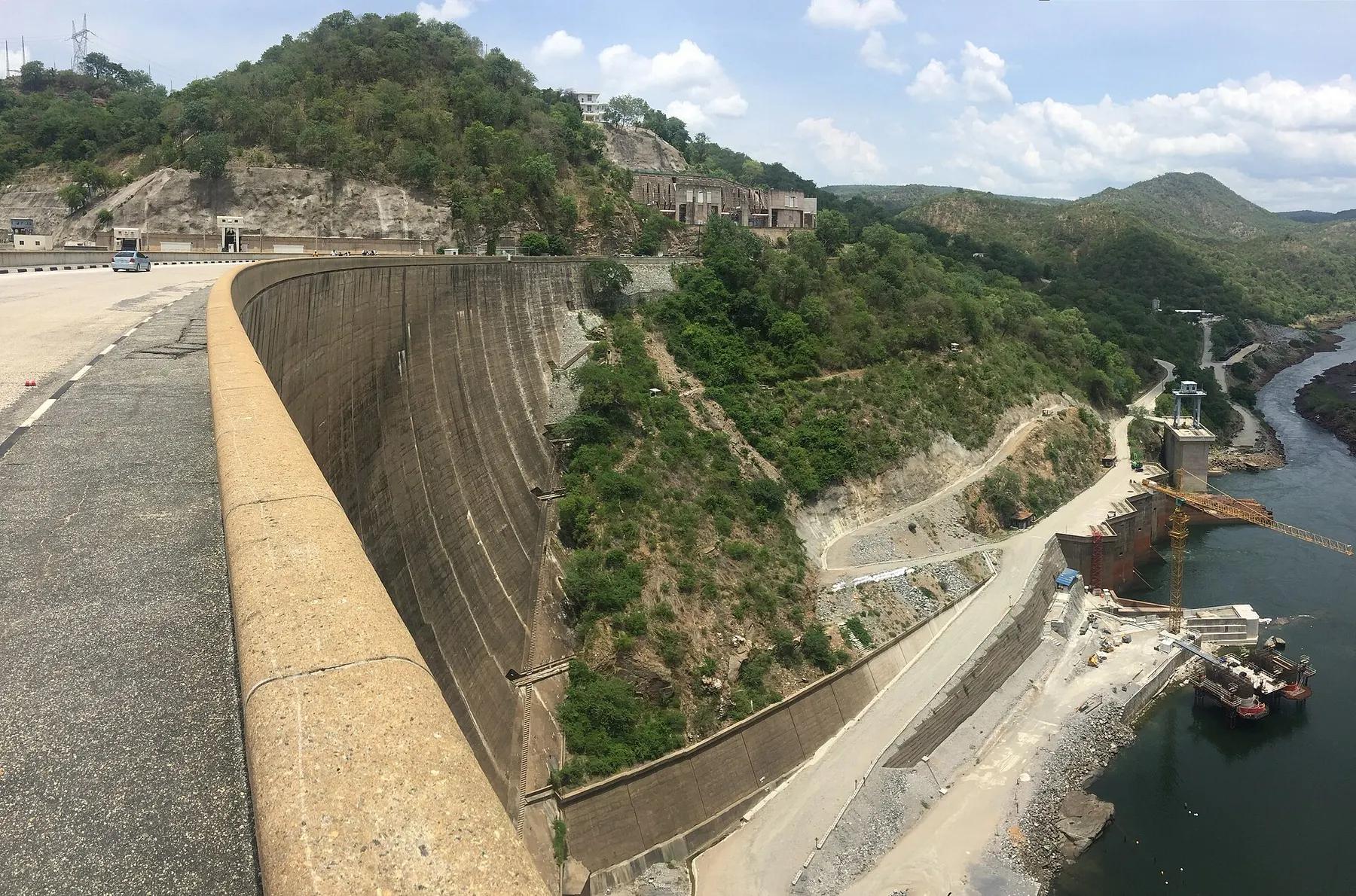
The Zambezi at Mana Pools, looking across to the escarpment on the Zambian side, photographed in 2010. The river was the northern frontier of the war, and guerrillas based in Zambia had to cross it to reach Rhodesia.
Babakathy, Wikimedia Commons. CC0. SourceWar summary
Result
Nationalist victory through negotiated settlement
- Lancaster House Agreement signed December 21, 1979; cease-fire from December 28
- Britain governed directly until independence on April 18, 1980
- ZANU-PF won 57 of 80 common-roll seats; 20 more seats stayed reserved for whites
- The new state's Fifth Brigade killed thousands of civilians in Matabeleland from 1983
- Also known as
- Second Chimurenga; Zimbabwe War of Liberation
- Date
- April 28, 1966 to December 28, 1979
- Location
- Rhodesia (now Zimbabwe), with raids into Mozambique, Zambia and Botswana
| Rhodesian government | Nationalist movements |
|---|---|
| Belligerents | |
|
|
| Fought for | |
| To defend Rhodesia's independence and what it called stable, civilized government against communist-backed terrorism, with power remaining in white hands. | Majority rule by one person, one vote, an end to white minority government and the return of the land. |
| Commanders and leaders | |
|
|
| Strength | |
|
|
| Military losses | |
|
|
| Civilian deaths | |
| The Rhodesian government counted 7,790 Black and 468 white civilians killed from December 1972 to December 1979. Human rights researchers believe the Black toll was much higher, and estimates of all deaths in the war run from about 20,000 to 60,000. | |
| Also involved | |
| |
Contents
- War summary
- 1A hanging in Salisbury1888 to 1923
- 2Smith declares independence1930 to 1965
- 3First shots near Sinoia1965 to 1972
- 4The raid on Altena Farm1972 to 1975
- 5Menaced by both1974 to 1978
- 6How Fireforce worked1973 to 1979
- 7The parade ground at Nyadzonya1975 to 1977
- 8Viscounts shot down near Kariba1978 to 1979
- 9Talks at Lancaster HouseSeptember 1979 to April 1980
- 10Fifth Brigade in Matabeleland1980 to 2024
- The arsenal
- Timeline
- After action report
- Sources
A hanging in Salisbury
1888 to 1923
On the evening of April 26, 1898, the Jesuit priest Francis Richartz went to a condemned woman in Salisbury and told her she would die in the morning. Her name was Charwe, she was the medium of the spirit Nehanda, and a court had convicted her of the murder of Henry Hawkins Pollard, a native commissioner killed in the rising of 1896. Richartz wrote that she took up her blankets, tried to leave the cell and behaved "like a mad woman." When he gave up she began to dance, laugh and talk, and the warders tied her hands because she was threatening to kill herself.
He tried again the next morning. She would not hear him, asked for her people and said she wanted to go back to Mazoe and die there. He went instead to Kaguvi, another condemned medium, and was speaking with him when she was led to the scaffold. Her cries and her struggling ended, Richartz wrote, only with "the heavy thud of her body." His report in the Zambesi Mission Record is the source for her last hours.
Nationalists of the 1960s and 1970s took her rising as the First Chimurenga, from the Shona word for a war of resistance, and named their own war the Second. Settlers and their descendants remembered the same months as a rebellion. Terence Ranger's 1967 history described a planned national rising, David Beach answered that it was a series of sometimes uncoordinated ones, and in 1998 Beach reopened Charwe's case under the title "An Innocent Woman, Unjustly Accused?"
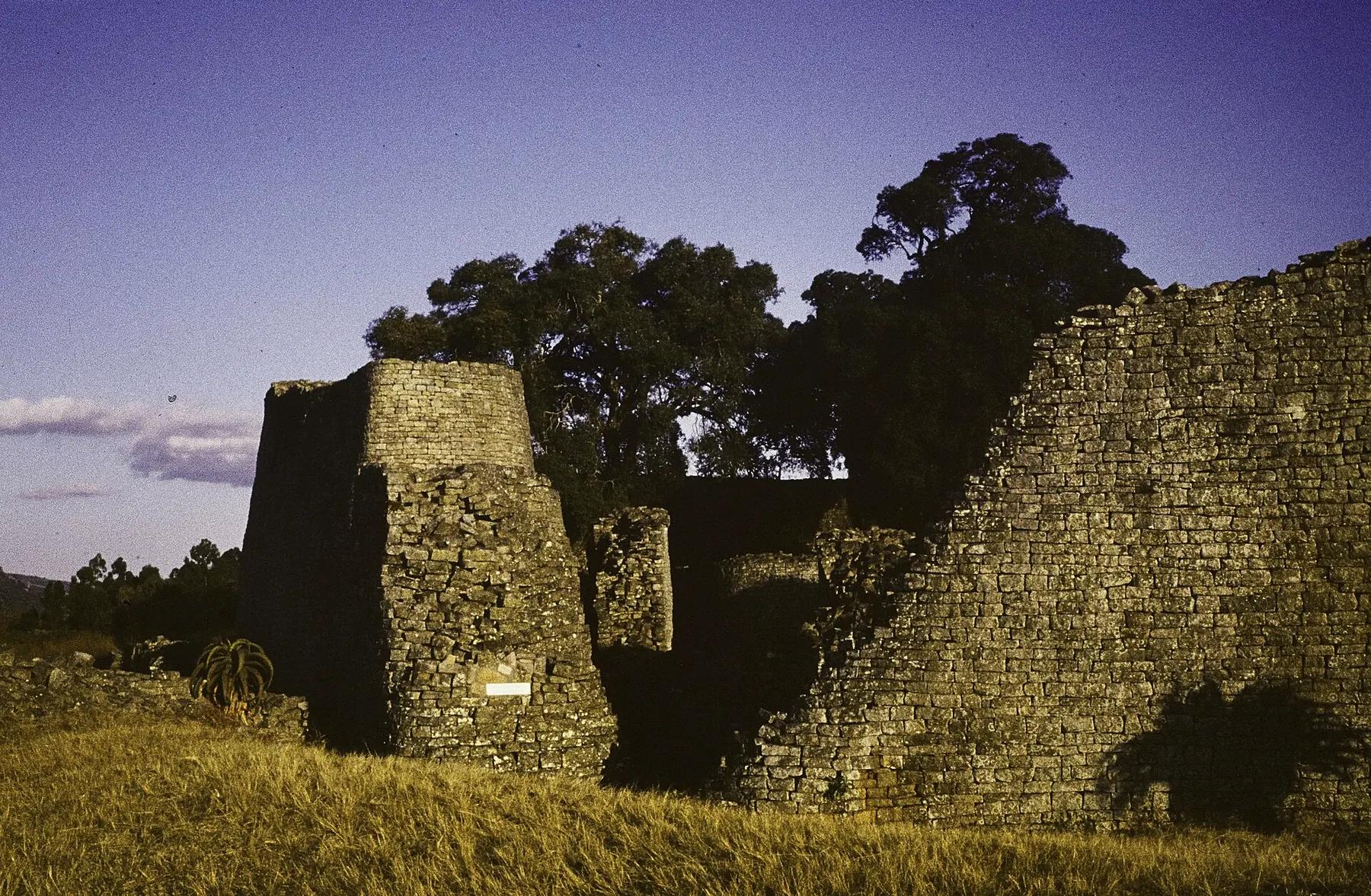
British rule in the country was eight years old when she died. In October 1888 agents of Cecil Rhodes had obtained a mining concession from Lobengula, king of the Ndebele, partly, by George Houser's account, on a verbal promise that only 10 white men would come to work the mines. Lobengula soon repudiated it. Britain gave Rhodes's British South Africa Company a royal charter in 1889 regardless, and on September 12, 1890, a Pioneer Column of about 200 settlers and several hundred armed men raised the flag at what they called Fort Salisbury. Company volunteers invaded Matabeleland in 1893 and occupied Bulawayo, which the retreating Ndebele had set on fire. Lobengula died the following year.
Ndebele and then Shona communities rose against the company in 1896. About 500 of some 4,000 settlers were killed, by Houser's count, before British and company forces put the risings down. Company rule outlasted them by a quarter century. In a 1922 referendum European electors chose self-government over union with South Africa by 8,774 votes to 5,989, and in 1923 Southern Rhodesia became a self-governing colony. Britain kept a legal right to protect African interests. By Houser's account it chose not to use it.
Smith declares independence
1930 to 1965
The Land Apportionment Act of 1930 divided the country by race and reserved the best farmland for Europeans. Reissued as the Land Tenure Act of 1969, the arrangement gave about 45 million acres to Europeans and 45 million to Africans, with another 6 million as national land. Those equal halves served some 277,000 whites and about 6 million Africans. Houser, an American campaigner against white rule, calculated that whites held 71 percent of the best land.
The country at the center of the war
- About 277,000
- White residents at their peak, in 1975 and 1976
- International Commission of Jurists
- About 6 million
- African population in the mid-1970s
- International Commission of Jurists
- Under 5%
- White share of the population
- Australian government history
- Landlocked
- Dependent on routes through Mozambique and South Africa
Money, property and schooling decided who could vote. The law contained no written color bar and produced much the same result: in 1962 only about 60,000 of more than 3.5 million Africans were eligible, and after a nationalist boycott almost none of them voted. The 1961 constitution offered Africans 15 of 65 parliamentary seats. The National Democratic Party answered with an unofficial referendum of its own, which recorded 372,546 votes against the constitution and 471 for it. Its leader, Joshua Nkomo, put the demand this way.
“We don't want to swim with you in your swimming pools. We want to swim with you in Parliament.”
The government banned each party as it formed: the African National Congress in February 1959, when some 500 of its leaders and members were arrested; the National Democratic Party in December 1961; its successor, the Zimbabwe African People's Union (ZAPU), in September 1962. Britain had joined Southern Rhodesia to Northern Rhodesia and Nyasaland in a Central African Federation in 1953. When it dissolved at the end of 1963, the two northern territories went on to independence as Zambia and Malawi under African governments, while Southern Rhodesia stayed under its white-led government and its politics hardened. The nationalists split the same year. Ndabaningi Sithole, Robert Mugabe and others left Nkomo in August 1963 and founded the Zimbabwe African National Union (ZANU). By the end of 1964 about 2,000 Africans were in detention, and Nkomo and Sithole each went on to spend more than 10 years there.
Ian Smith, a former Royal Air Force pilot, became Prime Minister at the head of the Rhodesian Front in 1964. An electorate that was overwhelmingly white backed independence in a referendum by 58,091 votes to 6,906. The purpose, as the Oxford historian Blessing-Miles Tendi describes it, was to forestall a British plan for Black majority rule.
At 11 a.m. on November 11, 1965, during the two minutes' silence of Armistice Day, Smith signed a Unilateral Declaration of Independence beneath the Queen's portrait, followed by his deputy, Clifford Dupont, and 10 other ministers. The timing was chosen to recall Rhodesia's wartime service to Britain. The text borrowed from the American declaration of 1776 and closed with "God Save The Queen." The governor, Sir Humphrey Gibbs, called the act treason and dismissed the government, and the ministers ignored him. Ken Flower, the head of Rhodesian intelligence, remarked afterward that "the rebellion was made to appear as though it was not a rebellion."
First shots near Sinoia
1965 to 1972
Five months after the declaration, seven men of the Zimbabwe African National Liberation Army (ZANLA), ZANU's armed wing, came in from Zambia and were tracked near the town of Sinoia, now Chinhoyi. On April 28, 1966, police supported by helicopters fought them through the day and killed all seven. Rhodesia recorded a small police action. Zimbabwe remembers the Battle of Chinhoyi and the opening of the Second Chimurenga. White Rhodesians came to call what followed the Bush War. The government called the men terrorists and their supporters called them freedom fighters; this page calls them guerrillas.
Britain had declared Smith's act illegal and declined to use force against people many Britons regarded as kin. It turned to economics and the United Nations. From March 1966 the Royal Navy kept the Beira Patrol off Mozambique to stop tankers reaching the pipeline to Rhodesia, a task it did not end until 1975. On December 16, 1966, the Security Council took a step it had never taken and imposed mandatory sanctions on chrome, tobacco, oil and other goods. Resolution 253 of May 1968 extended them to nearly all trade. Harold Wilson met Smith aboard HMS Tiger in 1966 and HMS Fearless in 1968, and neither meeting produced a deal.
“Determines that the present situation in Southern Rhodesia constitutes a threat to international peace and security”
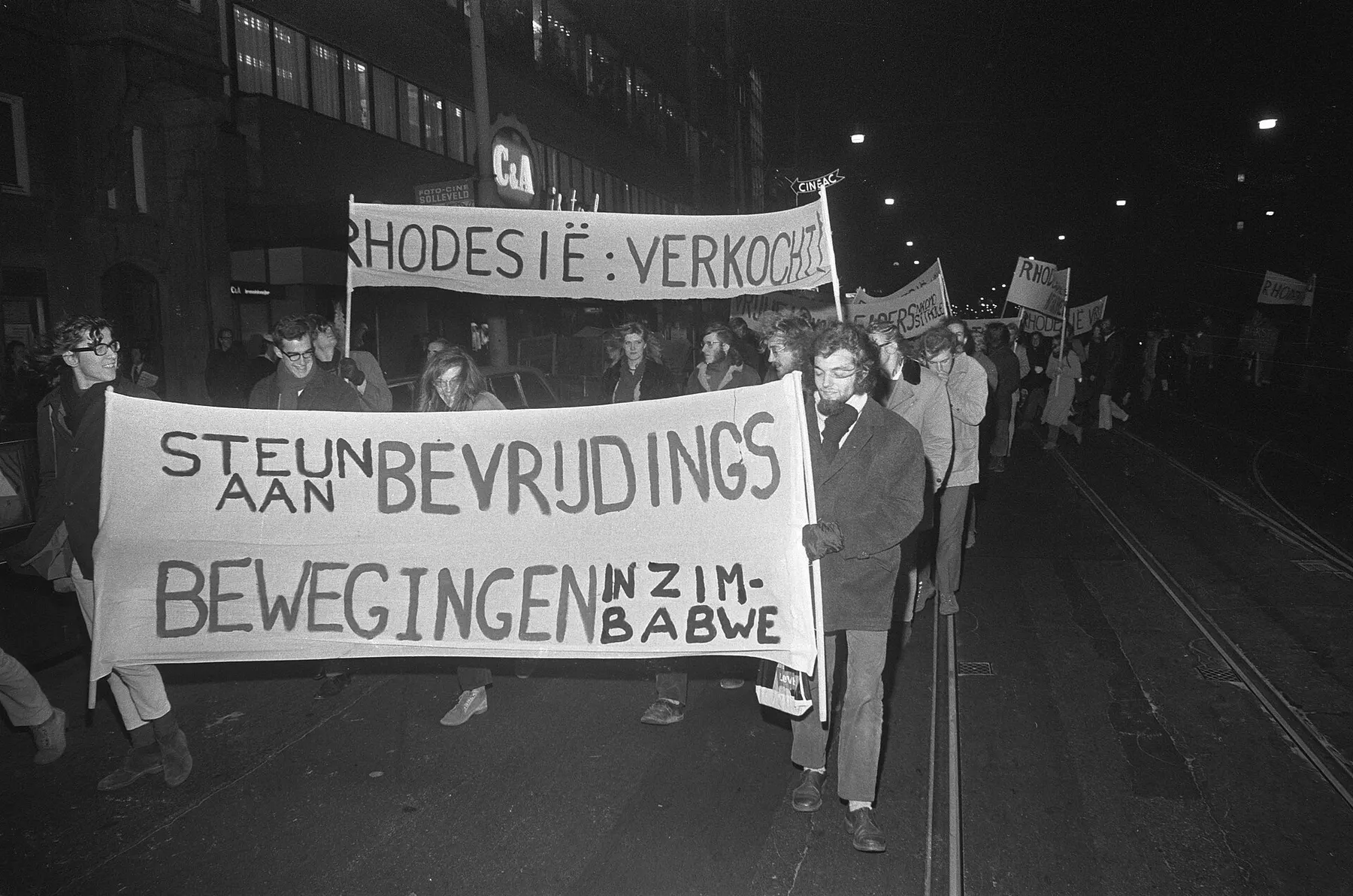
ZAPU tried something larger in 1967. Its army, the Zimbabwe People's Revolutionary Army (ZIPRA), joined fighters from the African National Congress of South Africa, and several hundred men crossed the Zambezi into the Wankie area and the northwest in a campaign that ran into 1968. Pretoria sent police units to help Rhodesia, and South Africa's Truth and Reconciliation Commission later recorded that they stayed for eight years. Until the early 1970s the security forces had little difficulty defeating such groups.
“We are good friends (with Rhodesia) and good friends know what their duty is when the neighbors house is on fire.”
Each movement drew its own lesson from those failures, and its patrons reinforced the difference. ZIPRA built on Soviet training that stressed conventional forces and technology, and eventually held tanks and heavy weapons ready in Zambia. ZANLA, whose Chinese patronage became substantial around 1970 according to the analyst William Turner, moved toward the Maoist model of slow political work among peasants. Its war council, the Dare re Chimurenga, was dominated at first by civilians. Tanzania and Zambia gave both movements room to train, and the Organization of African Unity's Liberation Committee in Dar es Salaam gave them recognition and money.
- Rhodesia
- South Africa, Rhodesia's backer
- Host states for the guerrillas
- Neighbors
Modern borders and names are shown; Zimbabwe was then Rhodesia. Arrows are simplified. Zambia hosted ZIPRA and, for a time, ZANLA. Mozambique became ZANLA's main base after 1975. South Africa was Rhodesia's lifeline and its main backer.
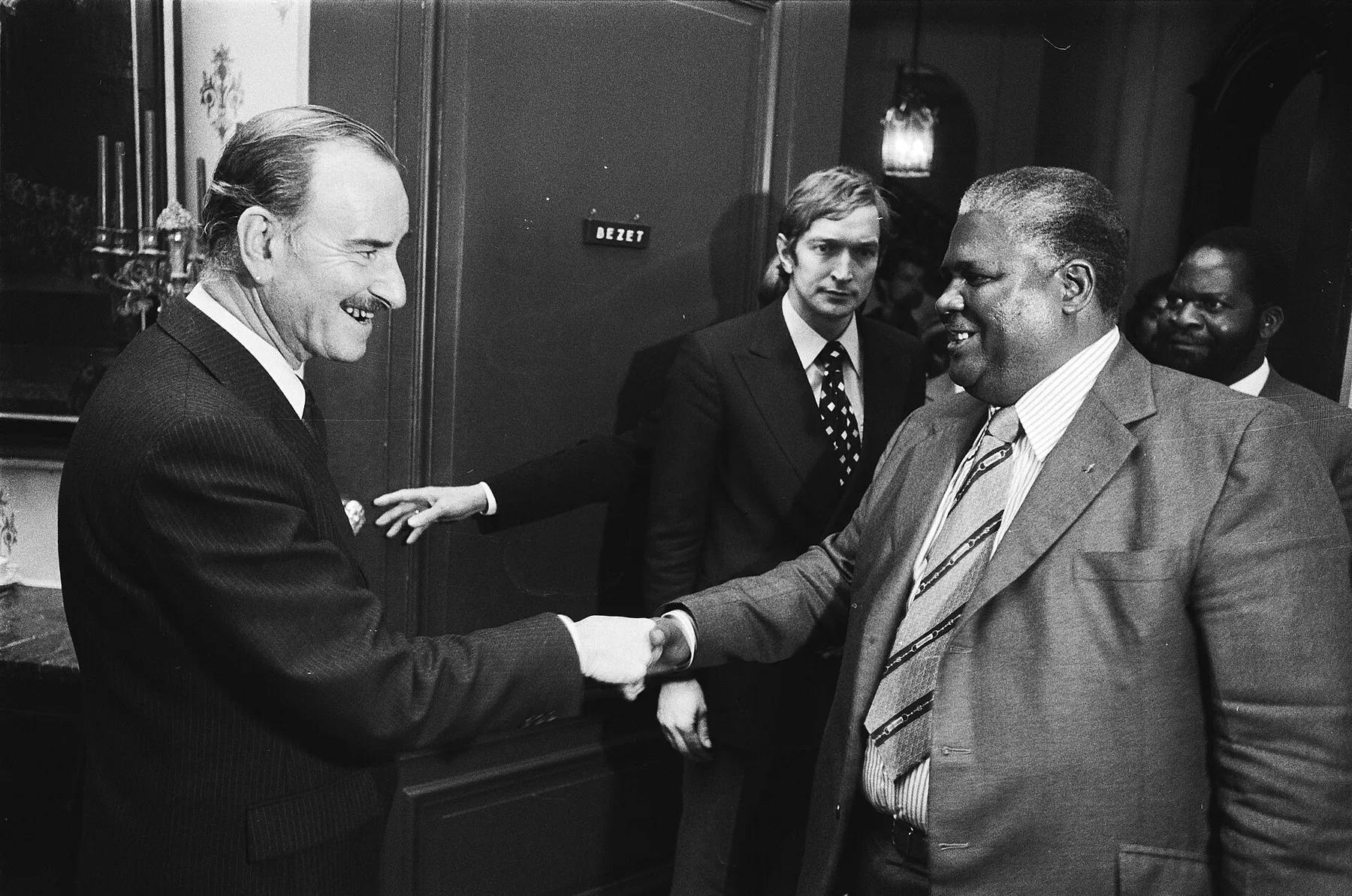
Britain made one more attempt at a settlement in 1971, when Foreign Secretary Sir Alec Douglas-Home and Smith agreed terms that would have led to an African majority at some unspecified date. London had promised to test acceptance among the whole population. Lord Pearce's commission traveled the country in early 1972 and reported that Africans rejected the deal, with Bishop Abel Muzorewa's new African National Council leading the opposition.
By then the geography of the war had changed. The Mozambique Liberation Front, known as FRELIMO, was fighting the Portuguese and opened Tete Province to ZANLA. Guerrillas no longer had to cross the Zambezi into an empty valley where patrols could find them. They could walk over the unmarked northeastern border into the densely settled Tribal Trust Lands, the reserves set aside for Africans, and build support among villagers before any shot was fired, the method FRELIMO had used against the Portuguese.
The raid on Altena Farm
1972 to 1975
At about 3 a.m. on December 21, 1972, ZANLA fighters led by Rex Nhongo cut the telephone lines at Altena, a tobacco farm in the Centenary district north of Salisbury, and opened fire on the house with rifles and grenades. Nobody died, but the owner's 8-year-old daughter, Jane de Borchgrave, was injured. Rhodesian accounts say the guerrillas had drawn up a list of local farmers and picked Marc de Borchgrave for his poor reputation among farmworkers. Two nights later they mortared Whistlefield Farm, where the family had taken shelter, and de Borchgrave was slightly wounded. The security forces answered with Operation Hurricane, which gave its name to the northeastern war zone, and in January 1973 the government closed the border with Zambia. It soon reopened its side, and Zambia refused to reciprocate.
The guerrillas were living among people the state could not reach, and the state's answer fell on those people collectively. On January 19, 1973, it imposed collective fines on many inhabitants of the Chiweshe and Mzarabani Tribal Trust Lands and the Chesa purchase area, arguing that communal societies should answer as communities for what their members did. A strip along the border about 5 miles wide was emptied and declared a no-go area, where anyone found could be shot on sight. By the end of 1973, 8,000 people had been moved out, most of them through a transit camp at Gutsa that had three water taps and two African orderlies. The International Commission of Jurists reported that at one point four or five children were dying there each day of cholera and measles.
Early in 1974 officials fenced sites of about 100 acres in Chiweshe with chain link, barbed wire and outward-facing lights and ordered the entire population inside. In three weeks 49,960 people were moved into 21 villages, many of them left to build their own huts. A curfew from 6 p.m. to 6 a.m. kept them from the fields at the cool hours when they normally worked, and they were barred from carrying food or water out in case it reached the guerrillas. At the center of each camp, behind its own fence, sat the fortified Internal Affairs Keep of the district officer and his staff, and the word came to be used for whole camps.
Protected villages, in opposing terms
Rhodesian security forces
A staff officer quoted in the Rhodesia Herald in 1974 said that insulating the population would deny guerrillas supplies, information and recruits, while protecting villagers from fear and intimidation and letting the authorities register every inhabitant.
International Commission of Jurists
Its 1976 report called the term a euphemism, said the real purpose was military and asked who was being protected when the huts lay against the wire and the officials at the center.
The fences made it harder for guerrillas to reach food and information, though the jurists reported fighters getting into camps and obtaining food there, and the movements pointed to the removals as proof of what the war was about. Counts of the people behind the wire vary with the date and the source. The jurists put the figure at about 100,000 by 1975. A U.S. government country study later gave about 150 villages with more than 350,000 inhabitants, and Zimbabwe's Research and Advocacy Unit puts the total at 750,000.
Life inside depended on the men who ran each keep. In December 1975 a magistrate described a 22-year-old district officer, Sean Hundermark, as sadistic and cruel after he and four African district assistants were convicted of beating another assistant at Keep 20 in Chiweshe for most of a day. Hundermark was fined 250 Rhodesian dollars and given a suspended sentence. The jurists noted that the assault matched complaints from villagers and that such cases rarely reached a court. Resettlement also closed what the villages had built: in Chiweshe alone, 30 missions and African council schools shut their doors, among them the Salvation Army's Howard Institute.
- Rhodesia
- South Africa, Rhodesia's backer
- Guerrilla rear areas
- Botswana
Modern borders and names are shown, with wartime names on the labels. Locations are approximate for districts. ZANLA pressed in from the northeast and east; ZIPRA crossed from Zambia in the northwest.
Menaced by both
1974 to 1978
On December 12, 1974, three brothers were at Shopo protected village in Chiweshe: Cosmas Chiwandire, 18, Weston, 15, and Kudakwashe, 9. Villagers said the boys were stopped for an identity check as they left for their fields. One leaned against a bench, and a gun propped there fell to the ground. A district assistant picked it up, pointed it at them and cocked it, and it went off. By their account one bullet passed through two of the brothers and struck the third in the leg. Cosmas and Kudakwashe died, and Weston went to the hospital.
A government spokesman said the rifle had fired by accident as the assistant picked it up. The district commissioner offered 100 Rhodesian dollars for each dead boy, from the Terrorist Victims Relief Fund, "to offset funeral expenses and any inconvenience caused to the parents." A man appeared in a Salisbury magistrate's court over the shooting, behind closed doors. Seven months later, on the night of July 11, 1975, a schoolteacher named Makaya was out after curfew with his wife, going back for a friend who had passed out on the way home from drinking, when a patrol challenged them. They ran and the patrol opened fire. Makaya died at once. His wife, eight months pregnant, was shot through the stomach, and surgeons delivered by caesarean section a baby with a bullet wound of its own, reported in critical condition. Security Force Headquarters announced the death of an African male curfew-breaker.
Mr. Sadomba, the independent African member for Nemakonde, objected in Parliament on July 31 that soldiers were firing on people out after dark. The Minister of Defence replied without apology.
“As far as I am concerned, the more curfew-breakers that are shot the better and the sooner that is realized everywhere the better.”
Some incidents held the violence of both sides in one night. On June 14, 1975, the security forces announced that a patrol near Mount Darwin, hearing a man being clubbed at Karima kraal two nights earlier, had come under guerrilla fire and that 20 people died in the fight. The Catholic Commission for Justice and Peace published another version. Eight guerrillas had called about 50 villagers to a meeting, accused the kraal head of being a sell-out and beaten him. As they left, a grenade exploded and security forces opened fire from about 10 meters, shooting into a hut where people had run for cover and firing on and off until daylight. The commission counted more than 200 spent cartridges, all of the security forces' type. Nine of the 20 dead were children and four were women. The government called this "completely untrue." The commission demanded a judicial inquiry and said it would welcome prosecution as a way to get one. By the jurists' 1976 report there had been no inquiry and no prosecution.
“What they are not aware of is the frequency and seriousness of assaults committed by some members of the security forces and the effect that these are having upon the civilian population in the tribal areas, caught as they are between the two contending forces and menaced by both.”
Sadomba had moved for a commission of inquiry on March 27, 1974, telling Parliament among other cases that two white South African policemen had cut the throat of a baby on its mother's back while questioning her in December 1973. The motion failed by 35 votes, all white, to 15, all Black. The Indemnity and Compensation Act of 1975 then shielded security personnel from liability for acts against terrorism, retroactive to 1972. Donal Lamont, the Catholic bishop of Umtali, had condemned guerrilla killings in the Rhodesia Herald in January 1973 as "wholly and entirely reprehensible." In 1976 he was tried for allowing nuns in his diocese to give medical aid to guerrillas and advising them not to report it. He received 10 years at hard labor, cut to four on appeal, and in 1977 he was stripped of citizenship and deported.
Villagers faced the other armed side at night. The U.S. country study reports guerrilla intimidation of Africans accused of working with the government. The all-night political meetings called pungwes rallied support, and the Research and Advocacy Unit, a Zimbabwean human rights group, records that they were also occasions for torture and killings without trial. Rhodesian veterans' accounts describe people branded sell-outs killed or mutilated before their neighbors; those accounts are partisan, but a 1978 report in Christianity Today also described Black civilians maimed by guerrillas. The same report said that in June 1978 a guerrilla band marched four staff members of the Salvation Army's Usher school down a trail and shot them, killing two British teachers. Terence Ranger records that ZANLA killed the spirit medium Muchetera in January 1977 and called him a sell-out. The historian David Caute, reviewing Ranger's work in 1985, wrote that guerrillas shut schools, clinics and cattle dips to show that the government had no real power, that young fighters often made local women pregnant, and that local girls were taken as hostages to keep their elders from alerting the security forces. By mid-1978 Paul Burrough, the Anglican bishop of Mashonaland, was saying that guerrillas were working to break down community structures across the country, and Christianity Today put African civilian deaths at between 2,000 and more than 3,500 to that point.
What those villagers wanted is a matter on which two leading scholars part. Ranger, working from evidence gathered after the war, concluded that peasants with long grievances over land found common cause with ZANLA, which offered them land reform. Norma Kriger, in a 1992 study built on peasants' own testimony, argued that the bond between villagers and guerrillas had been overestimated. Her informants said they were often coerced into supporting the insurgents, and she found that divisions of generation, gender and status inside the villages shaped what individuals did.
How Fireforce worked
1973 to 1979
Rhodesia's forces were small and its frontier was long, so its commanders set out to find the enemy with very few men and then bring everything to one spot quickly. Fireforce, first deployed in January 1974 and first in action that February, was the best known result. A typical group waited at a forward airfield with a command helicopter, three troop-carrying helicopters, a Dakota transport and a light attack plane. When an observation post, tracker or patrol reported a sighting, a siren sounded and the first wave of 32 men ran for the aircraft.
The command helicopter, the K-car, was an Alouette III with a 20mm cannon, flown by a senior pilot with the Fireforce commander aboard. The troop carriers, called G-cars, each lifted a four-man stick: a leader with a radio, a machine gunner and two riflemen. The Alouette could carry no more, and that limit set the size of the basic unit of the Rhodesian infantry. The Rhodesian Light Infantry became a parachute battalion in 1976, and the Dakota dropped its five sticks from about 400 to 600 feet, low enough that men were sometimes under fire for the few seconds they were in the air. Most troops still went in by helicopter.
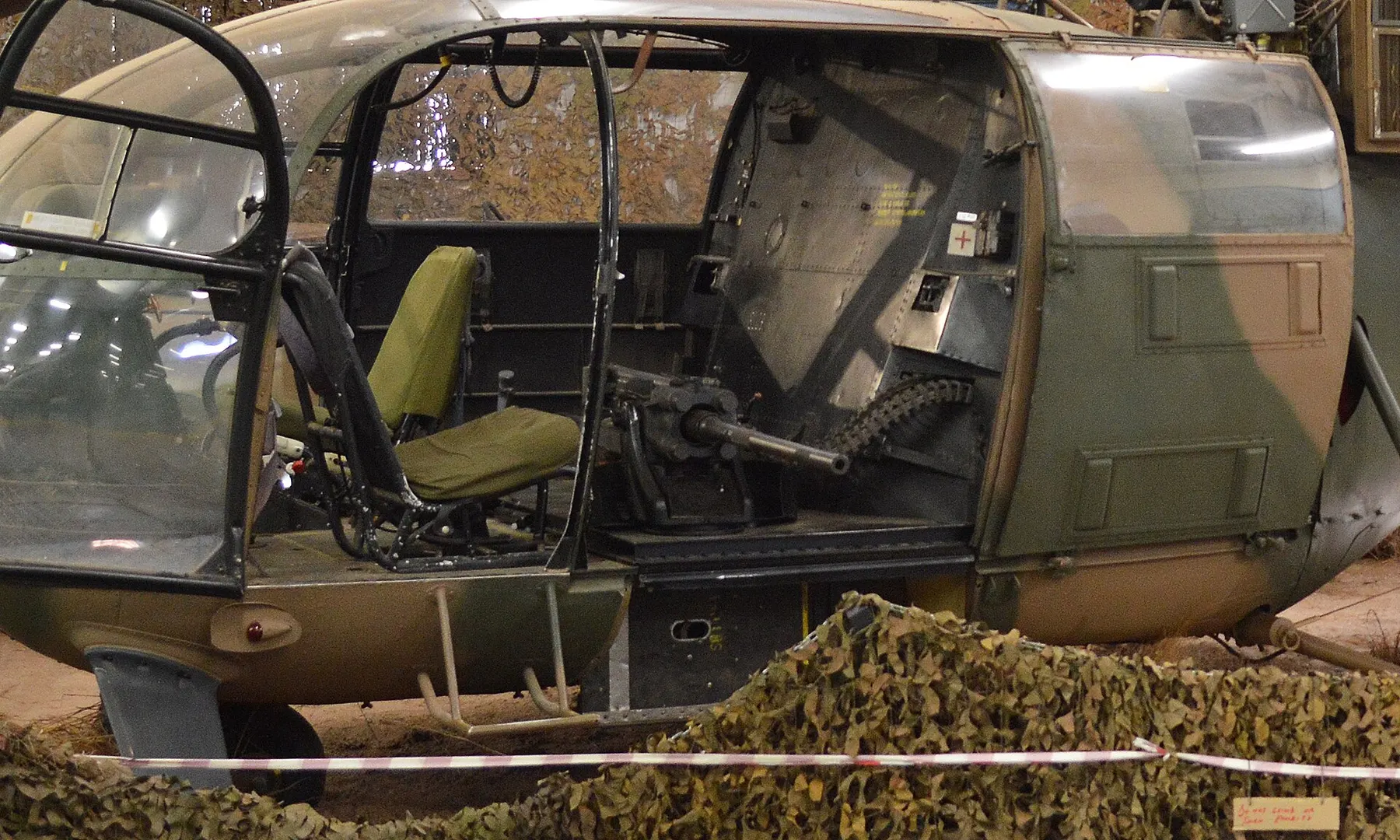
Everything depended on the sighting, and the army built a unit to get it. The Selous Scouts, formed under Major Ronald Reid-Daly from November 1973, absorbed the army's tracking wing in 1974 and specialized in pseudo-operations. Small teams, mostly Black and often including captured guerrillas who had been turned, posed as insurgents, moved through villages and called in Fireforce when they made contact. Rhodesian military intelligence credited the unit in a 1978 assessment with 68 percent of guerrilla deaths inside the country, a figure repeated in a U.S. Army War College case study. The kills themselves were mostly made by the units the Scouts summoned, and the figure is an internal claim that outsiders have no means of testing.
Villagers could not know whether armed men at the door were guerrillas or Scouts, and feeding the wrong ones could be fatal either way. Michael Evans, in a 2007 study, wrote that significant numbers of the Scouts were implicated in torture and executions. Jephias Dzimbanhete wrote in 2017 that they were probably responsible for killing rural Black business owners who supported the insurgents, and that Rhodesian propaganda often blamed their atrocities on the guerrillas. The historians Paul Moorcraft and Peter McLaughlin judged the unit's notoriety only partly deserved while holding senior officers complicit in at least some atrocities. Ken Flower called creating it "the worst mistake I made." South Africa's Truth and Reconciliation Commission recorded a former Security Branch officer's statement that the branch secretly funded the Scouts.
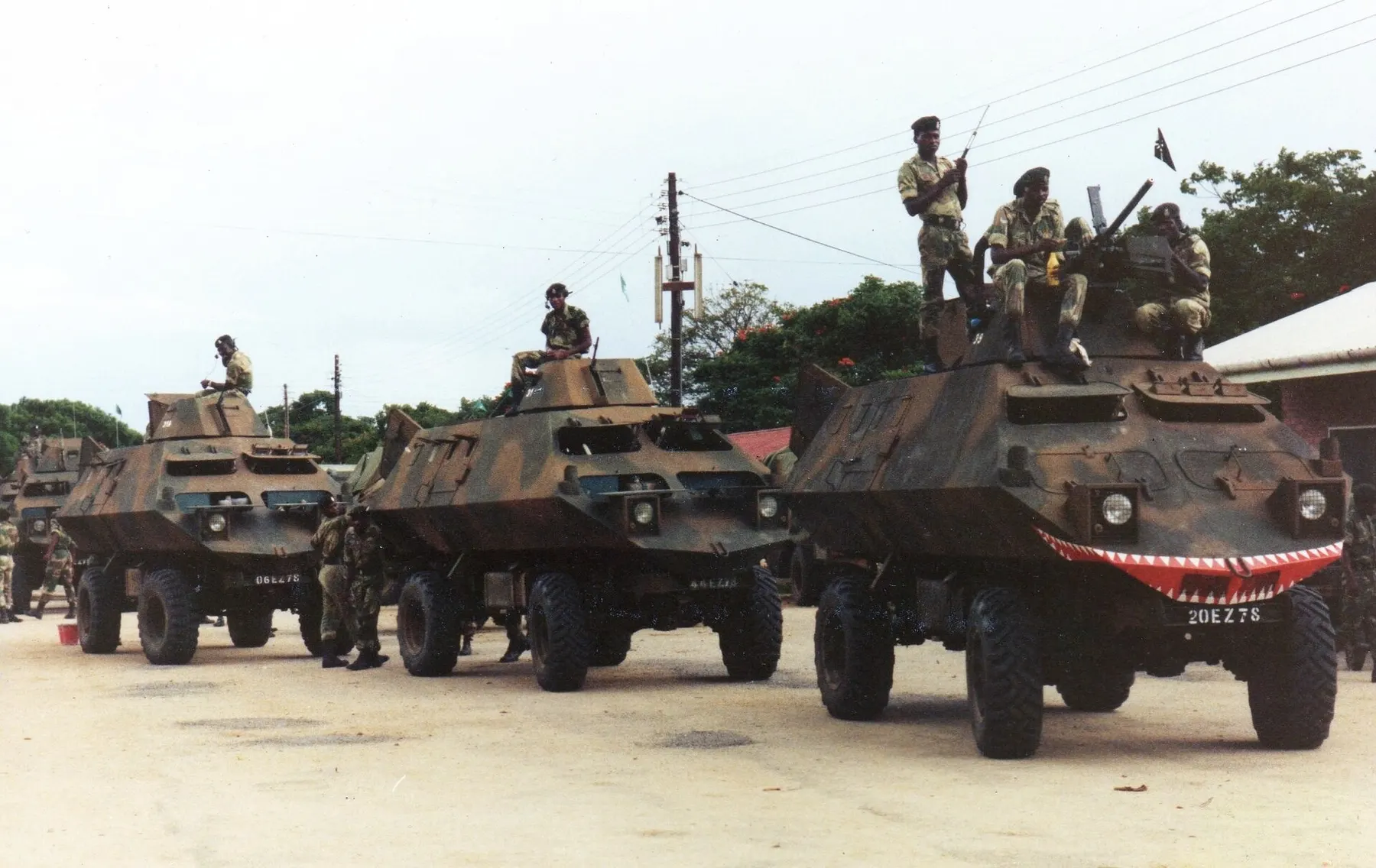
The guerrillas' answer on the roads was the buried anti-tank mine, many of them Soviet designs, and the U.S. country study notes that many African civilians killed by guerrilla action died this way. Rhodesian engineers responded with some of the first purpose-built mine-protected vehicles anywhere, setting sloped hulls on commercial running gear. Sanctions pushed that industry along, because the country could not simply buy what it needed.
Who filled the ranks
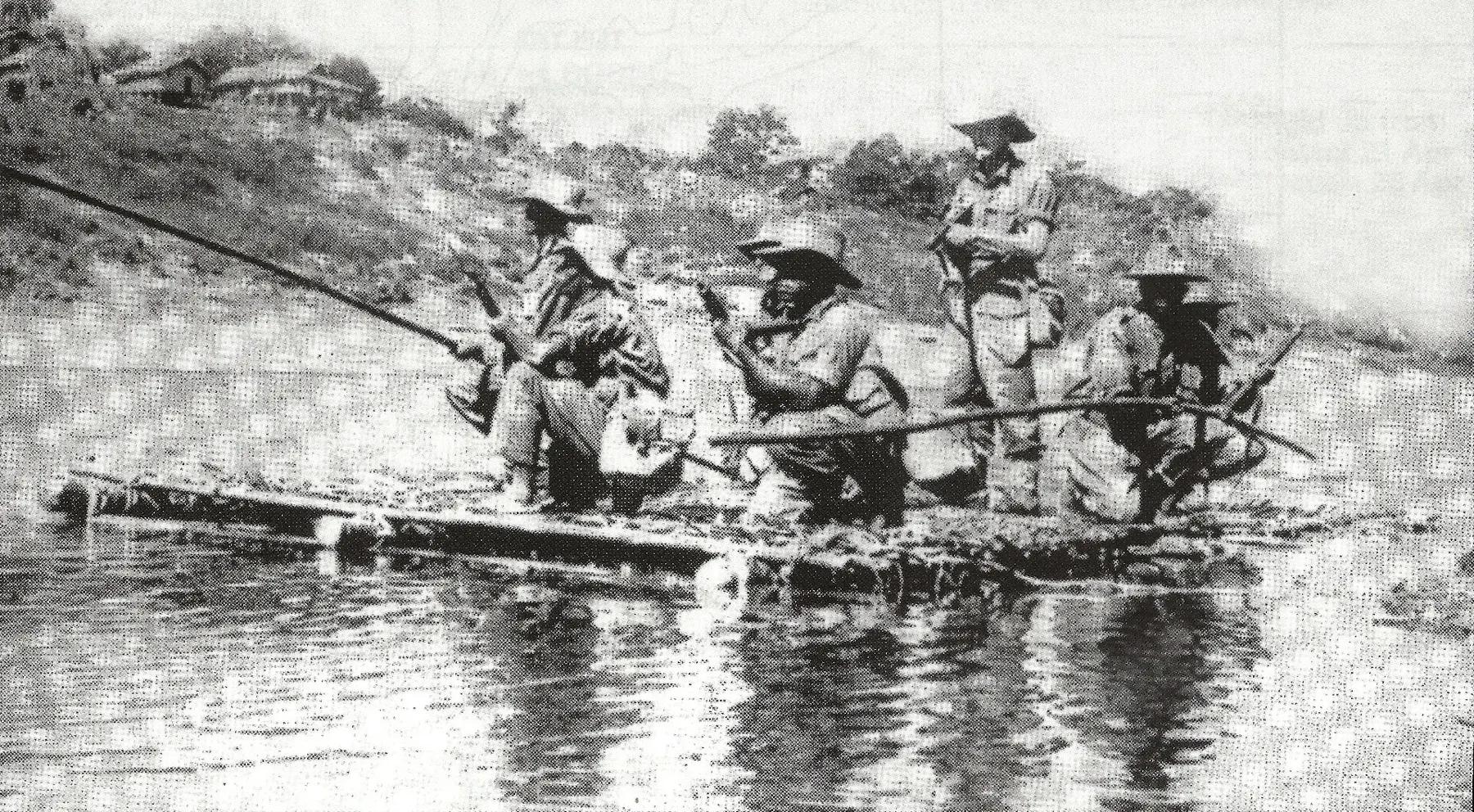
The popular image of the Rhodesian soldier is a young white man in camouflage, and the regular army does not match it. In 1972, according to the U.S. country study, about 80 percent of a regular army of 3,400 was Black, as were about two-thirds of the 6,400 regular police. The Rhodesian African Rifles, with roots in a First World War regiment and a battalion that fought the Japanese in Burma in 1945, grew from one battalion to three during the war. Its officers were generally white and its men were volunteers, since conscription did not reach Black men until the war's final year. Time reported in February 1978 that the army was more than two-thirds Black, that the first 13 Black officers had been commissioned and that a Black soldier earned $87 a month, about a quarter of a white soldier's pay.
Time found that many recruits came from the Tribal Trust Lands where the guerrillas operated, some from army or police families marked as pro-government, and a few for the money alone. It also recorded what service could cost. Rifleman Arimando Changadeya, 27, had lost his father to guerrillas the previous March. An uncle was beaten in June and died a month later. In December his wife, his mother and two of his children were shot and mutilated, and he learned of it when he went home on leave. Time did not say who was responsible for those last deaths. "I won't go home again," he said. "I still have seven years to serve."
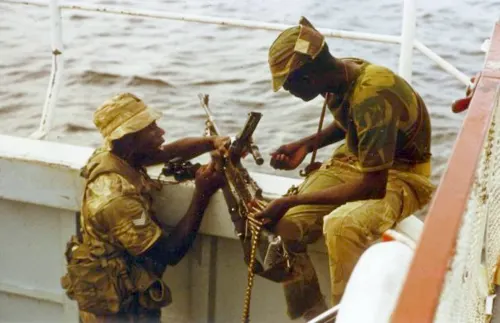
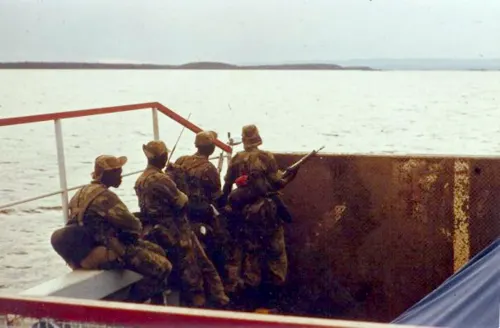
Timothy Stapleton's work shows how the colony's African police and soldiers were drawn early in the century from migrant workers from neighboring territories, and how recruiting later shifted to local men, with the Masvingo and Gutu area a dependable source. Some still came from abroad: Wilson Banda, born in Malawi, joined the police Support Unit at 18 in 1976 and was killed in action in March 1978. A roll compiled by Rhodesian veterans lists 1,863 security force members killed in action or on active service from 1964 to April 1980, and says 40 percent of army losses and 64 percent of police losses were African. Nationalists called these men collaborators. Scholars of the regiment point to loyalty to comrades and a strong professional identity among those who served through the war.
White manpower was the tighter limit. Compulsory service grew from four and a half months at independence to nine months by 1972 and a full year in 1975, and from 1976 reservists faced continuous call-up. From 1977 those under 38 could be called up for 190 days a year, and in 1979 men of 50 to 60 were told to serve as urban guards, though only about 20 percent reported. Many eligible men avoided service; in 1973 half of those called up managed to. When Black conscription began in January 1979, only about 300 of the 1,544 men called up reported. Foreign volunteers filled some gaps, particularly in the Rhodesian Light Infantry. British officials estimated about 800 in late 1978, while historians' figures run from about 1,000 to 2,000, most of them British, with Americans, Australians and veterans of the French Foreign Legion among the rest. Rhodesia enlisted them as regular soldiers, and the nationalist movements denounced them as mercenaries.
The guerrilla armies filled their ranks from the same countryside, with young people who crossed the borders to join. In 1977 ZIPRA flew 180 men from Zambia to Simferopol in the Soviet Union for six months of training as platoon, company and battalion commanders, commissars, intelligence officers and weapons specialists, according to the veteran Vincent Ndlovu and a former instructor who spoke to Chakawa as Comrade Khumalo. Fifteen of them studied surface-to-air missiles. Young women joined as well: of the 600 people Chakawa reports killed at ZIPRA's Mkushi camp in Zambia in 1978, most were girls and women.
The parade ground at Nyadzonya
1975 to 1977
On March 18, 1975, a bomb in a Volkswagen Beetle in Lusaka killed Herbert Chitepo, ZANU's chairman in exile, along with his bodyguard Silas Shamiso, and a neighbor died of injuries hours later. ZANU blamed Rhodesia. A commission appointed by Zambia's President Kenneth Kaunda blamed rivalry inside ZANU between Karanga and Manyika factions. Ron Reid-Daly later wrote that Rhodesia's Central Intelligence Organisation had planned the killing and planted evidence against ZANU men, and the Rhodesian author Peter Stiff named a former British soldier, Hugh Hind, as the bomber. Who planted the bomb has never been established.
Mozambique's independence that year handed ZANLA a frontier hundreds of miles long. Samora Machel closed the border in March 1976, cutting Rhodesia's rail links to the Indian Ocean, and the number of young people crossing to join the guerrillas or to escape the war rose sharply. British sources in 1976 put guerrilla strength at 12,000 to 14,000, of whom 3,000 to 4,000 were fully trained. General Peter Walls announced that his forces would cross borders in pursuit, and the camps became the main objective.
On August 9, 1976, a column of about 85 Selous Scouts in 14 vehicles, painted to look like FRELIMO's and carrying men in FRELIMO uniforms, drove into the camp at Nyadzonya in Mozambique. The white soldiers wore black ski masks. They drove to the parade ground, where a large crowd had assembled, and opened fire. Hundreds of people died, and the two sides have never agreed on who they were.
Nyadzonya, August 1976
Rhodesian government and commanders
A ZANLA training and staging base. Ron Reid-Daly, the Scouts' commander, spoke of about 300 killed. Rhodesian sources later cited a captured ZANU count of more than 1,000 as proof that the raid had hit a guerrilla concentration.
ZANU and Mozambique
A refugee camp. ZANU documents list 1,049 dead and 1,000 missing by one report. Zimbabwe commemorates the victims as refugees, including children.
Outside accounts fall between those two. The UN refugee agency reported 675 deaths, according to a Rhodesian veterans' compilation, and Amnesty International later described nearly 1,000 killed, mostly unarmed refugees. Moorcraft and McLaughlin wrote in 1982 that the camp held trained guerrillas and recruits along with many old people, women and small children. In 2008 they stressed that nearly everyone was unarmed but that many were trained or in training.
- Rhodesia
- Host states
- Neighbors
Modern borders and names are shown. Raid locations are approximate, and arrows are schematic. Rhodesian forces also struck in southern Mozambique and Botswana.
The raid cost Rhodesia abroad. The Security Council condemned its attacks on Mozambique and Zambia in a series of resolutions, and South Africa, whose goodwill it could not do without, moved to press Salisbury harder. Pretoria had withdrawn its police units in 1975 as part of its diplomacy while leaving their helicopters, Dakotas, small arms and ammunition behind, and the Truth and Reconciliation Commission found that it met half of Rhodesia's defense budget for 1975 to 1976. Its patronage gave it leverage. Five months before Nyadzonya, Smith had told Rhodesians where he stood.
“We never have had a policy in Rhodesia to hand over our country to any black majority and, as far as I am concerned, we never will.”
In September 1976, with Henry Kissinger shuttling through southern Africa and B. J. Vorster pushing, Smith announced that he accepted majority rule within two years. The Geneva conference that followed collapsed, but the principle had been conceded, and ZANU and ZAPU formed their alliance as the Patriotic Front that October. The nationalist side kept losing leaders outside the country: on January 22, 1977, a parcel bomb in Lusaka killed Jason Moyo of ZAPU. A ZAPU inquiry cleared the woman in Botswana whose name it appeared to carry.
Operation Dingo came that November. On the 23rd Canberras, Hunters and Vampires struck the complex near Chimoio known as New Farm, while paratroopers and helicopter troops closed in on three sides, and Alouette gunships did most of the killing. Two days later the force hit Tembue, far to the north. Rhodesia lost two men. Its claims for enemy dead ran from 1,200 to about 3,000, in a camp population given as 8,000 to 10,000 that included refugees, guerrillas and ZANLA's political staff. The war kept growing, and the analyst William Turner titled his account of the raid and its aftermath the illusion of victory. Bishop Muzorewa, then negotiating with Smith, called a week of mourning, saying the camps held many civilian refugees. Little more than three months later he signed an agreement with Smith.
Viscounts shot down near Kariba
1978 to 1979
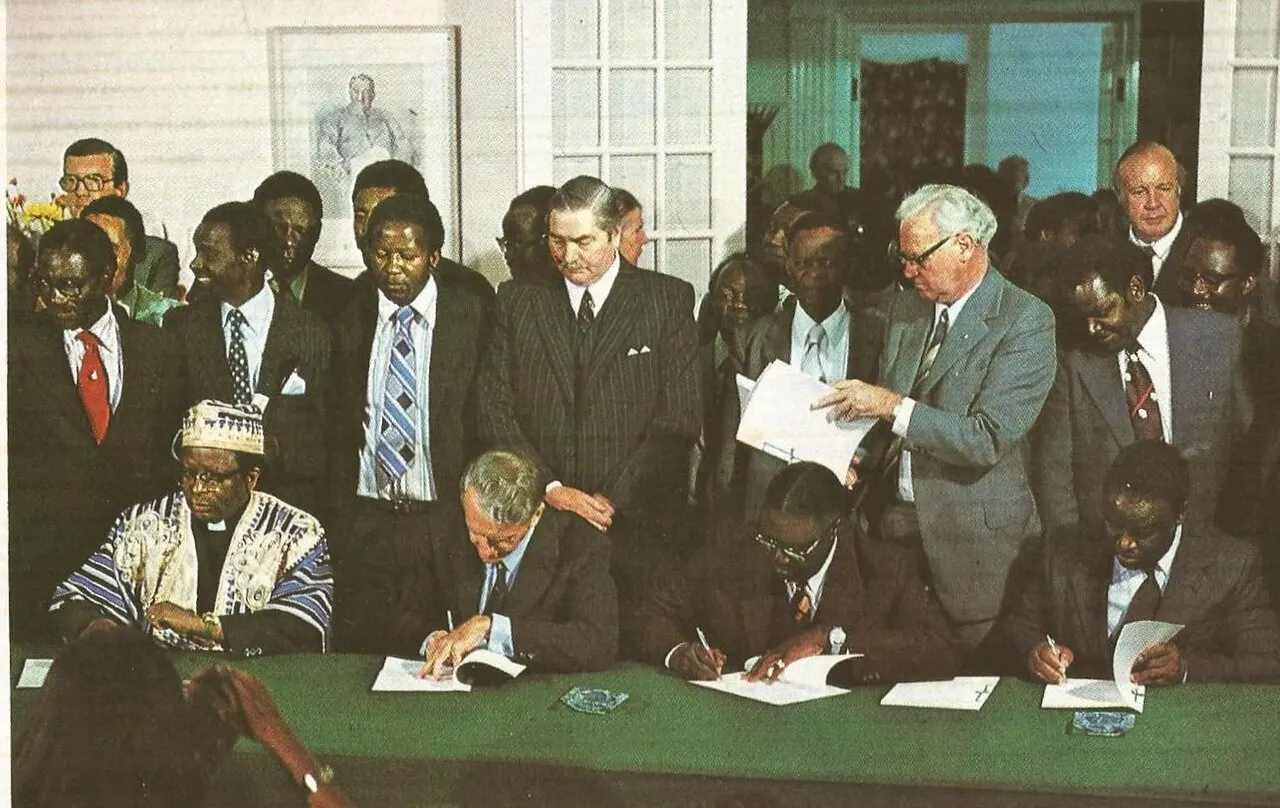
Smith's answer to the war by 1978 was a settlement without the men holding the guns. On March 3 he signed with Muzorewa, Sithole and Chief Jeremiah Chirau. The agreement created a transitional government with Africans in senior posts, and the constitution that followed kept 28 of 100 parliamentary seats for whites while leaving the civil service, judiciary, police and army independent of the new ministers. Critics said real power stayed where it had been. The Patriotic Front rejected it and the fighting went on.
Civilians at the missions were among those it reached. On the night of June 23, 1978, attackers came to the Emmanuel school at Vumba, in the mountains near the Mozambique border, where British Pentecostal missionaries of the Elim church had moved for safety. Eight adults, five of them women, and four children were killed with axes, clubs and bayonets, and another teacher died later. The government and the mission's director in Umtali, Ronald Chapman, blamed ZANU guerrillas who had crossed from Mozambique. Nationalist organizations denied responsibility, Mugabe accused the Selous Scouts of killing priests and missionaries, and some church figures suspected the security forces. The New York Times noted in 1979 that no evidence had been provided for that accusation, and ZANLA remains the most common attribution.
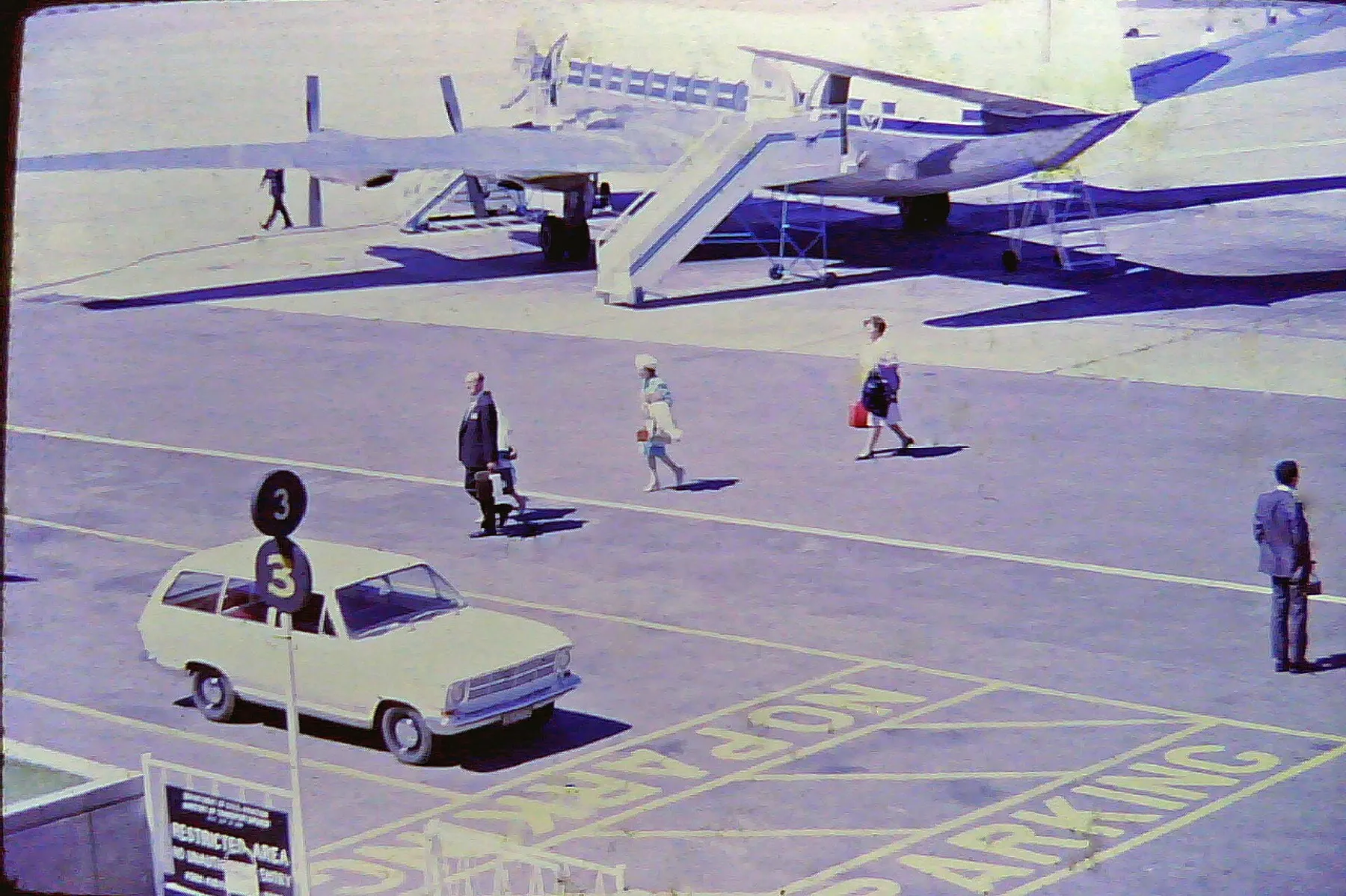
On Sunday, September 3, 1978, a little after five in the afternoon, Air Rhodesia Flight 825, a four-engine Vickers Viscount named Hunyani, climbed away from Kariba with 56 people aboard, most of them returning to Salisbury from a weekend by the lake. Within minutes, about five by some accounts and about 10 by others, a heat-seeking Strela missile fired from the bush struck it. Captain John Hood tried to put the airliner down on its belly, and a gully broke it in two. Thirty-eight people died and 18 lived. Five of the survivors walked off to look for help, among them Sharon Cole and her 4-year-old daughter, Tracey. Three more ran. The 10 who stayed under a tree near the wreck were shot by armed men about half an hour after the crash. At first light an Air Force Dakota found the site and parachutists dropped in, and eight people came out alive.
Joshua Nkomo acknowledged that ZIPRA had brought the plane down, called the airline a legitimate target because it carried troops and denied that his men had killed the survivors. A laugh during his BBC interview the next day was taken in Rhodesia as contempt for the dead. The Very Reverend John da Costa, Anglican dean of Salisbury, preached a sermon titled "The Silence Is Deafening," though Chakawa notes that he kept silent when the reprisal raids came. The journalist Geoff Nyarota, then at the Rhodesia Herald, remembered white sub-editors that night cursing themselves hoarse and threatening dire consequences in racial terms. A police ballistics report matched cartridge cases from the killings to four weapons used in an August 1978 attack on the Nyamhunga police base, within 10 kilometers of the crash. The historian Joshua Chakawa, who has interviewed former ZIPRA men, calls the evidence for ZIPRA's responsibility for both shootdowns overwhelming. Eliakim Sibanda has argued that Selous Scouts shot the survivors in order to wreck the Internal Settlement. Chakawa considers that unlikely.
The Viscounts and the reply
Rhodesian government
The downing of Hunyani and the killing of survivors were murders of civilians, and the raids into Zambia answered them.
ZAPU and ZIPRA
Nkomo argued that the airline carried military personnel. After the second crash he said his men had been aiming at General Walls, who was on a later flight, and held Walls responsible. ZIPRA veterans have told researchers that their crews were trained to avoid civilian aircraft unless they had military value.
“Security forces have hunted down and exterminated 165 communist terrorists on Rhodesian soil.”
Forty-six days after the crash, on October 19, Rhodesian Canberra bombers and Hunter jets crossed into Zambia at low level. Their lead pilot, Squadron Leader Chris Dixon, radioed the control tower at Lusaka under the call sign Green Leader and told it to keep Zambian aircraft on the ground. The target was Westlands Farm, a ZAPU camp 10 miles from the center of the capital, known to its occupants as Freedom Camp. A second force struck the camp at Mkushi. Rhodesia claimed about 1,500 guerrillas killed across the operation, a figure Moorcraft and McLaughlin call considerably exaggerated. Nkomo said most of the dead were innocent civilians, and ZIPRA's figure for civilians killed was 351. Chakawa gives 800 to 1,000 dead at Westlands and 600 at Mkushi, mainly girls and women. Moorcraft and McLaughlin concluded that hundreds of unarmed refugees died and that the attackers could not have told them from young recruits.
On February 12, 1979, a second Viscount, Umniati, was hit after leaving Kariba, and all 59 aboard died. Among them were Regina Chigwada, 23, Air Rhodesia's fourth Black air hostess, and a family of Indian descent known to Nkomo. General Walls took off in another aircraft about 15 minutes later. A ZIPRA veteran told Chakawa that his deputy had read in the Rhodesia Herald that Walls was at Kariba, and Nkomo said his men believed the general was on the plane they hit. Chakawa adds what Rhodesians left out at the time: between 12 and 15 of Air Rhodesia's roughly 32 pilots also flew for the Air Force, Hood had served with it as a volunteer, and several Hunyani passengers were off-duty air force and police personnel. Strela trainees, he reports, had been taught that the Geneva Conventions discouraged firing on civilian aircraft. British pilots' representatives took the matter to Moscow in 1979 and no further airliner was attacked, though Chakawa says it is unclear whether that visit was the reason. James Chikerema, a former guerrilla leader now in the transitional government, warned that if Nkomo's people were responsible, Nkomo should not weep at retaliation.
“if the plane was fired on, it can only have been our chaps.”
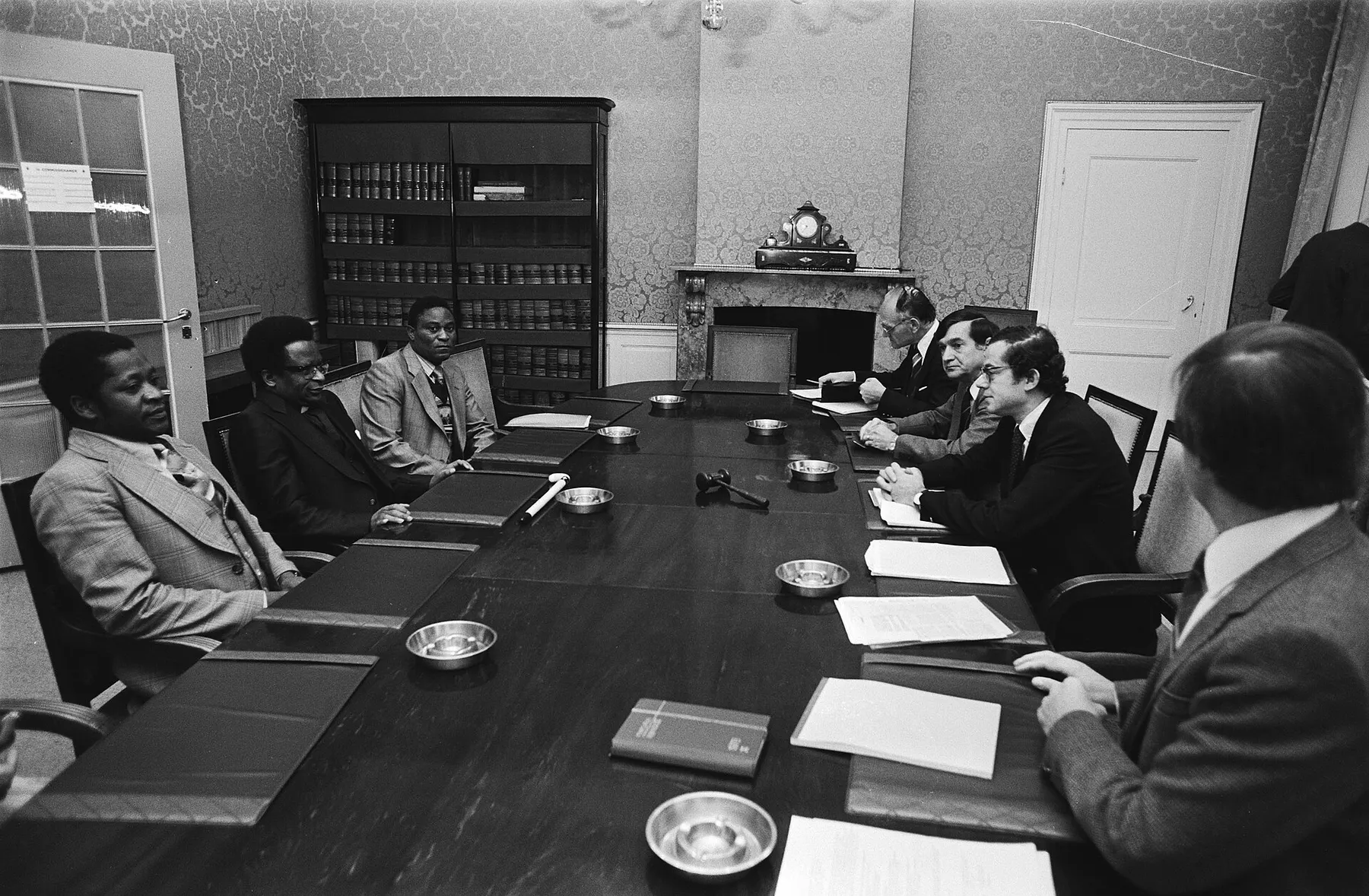
The army remained intact in early 1979 and, by its own counts, was winning most of its firefights, while the state ran short of nearly everything else. Time reported in February that 90 percent of the country was under some form of martial law and estimated 12,000 guerrillas inside Rhodesia, about as many men as the government had on active duty. Farms stood empty, rural schools and clinics had closed and white emigration was draining the pool of reservists. In April 1979 voters, Black and white, went to the polls under heavy guard while the Patriotic Front called for a boycott. Muzorewa's United African National Council won 51 of the 72 African seats on a reported turnout of about 64 percent, and on June 1 the country became Zimbabwe Rhodesia, with a Black prime minister.
Was the 1979 election a transfer of power?
Muzorewa and Smith
A majority of Black voters had taken part in the country's first election under universal adult suffrage. On that basis, sanctions should end and the new government should be recognized.
The Patriotic Front
The constitution left real power with whites, the main nationalist movements were excluded, and voting took place under martial law. The war would continue.
Britain and the United States had called the 1978 settlement a step in the right direction but inadequate, because ZANU and ZAPU were left out. London declined to recognize the new government and moved toward one more conference, this time with the guerrilla leaders at the table.
Talks at Lancaster House
September 1979 to April 1980
Foreign Secretary Lord Carrington opened the conference at Lancaster House on September 10, 1979. Muzorewa's delegation, with Smith in it as a minister without portfolio, sat across from Nkomo and Mugabe. After 47 plenary sessions the parties agreed on a constitution, a transition under a British governor and a cease-fire. Twenty of 100 seats went to voters on a white roll, protected for seven years. Property could be compulsorily acquired, including underused land for farming settlement, only with prompt and adequate compensation, which left the land question that had driven so much of the war to be settled later. The agreement was signed on December 21. Lord Soames had already landed in Salisbury on December 12, and for a few months Rhodesia was legally a British colony again.
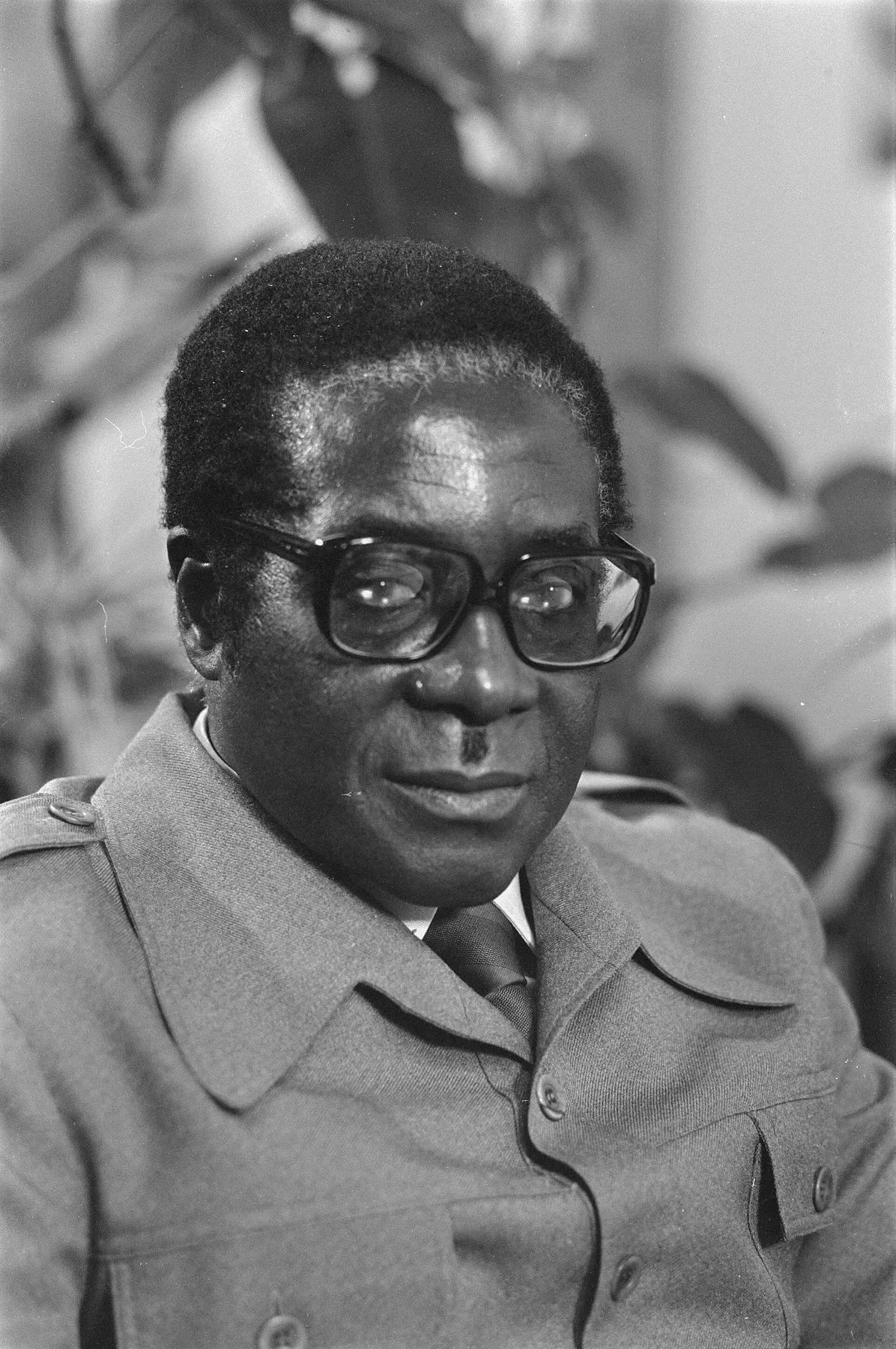
Josiah Tongogara, ZANLA's commander, had played what Carrington called a moderating role in London. On December 26, 1979, five days after the signing, he died in Mozambique when his car struck an abandoned military vehicle on a dark road, and Josiah Tungamirai, traveling in a lead vehicle, said he died in his arms. Mugabe announced an accident. An American embassy report from Zambia said almost nobody in Lusaka accepted that, and Smith wrote in his memoirs that Rhodesian police chiefs had assured him Tongogara's own people killed him.
The cease-fire nearly failed in its first week. Many ZIPRA men had not reached the assembly points by the January 4 deadline, and Dumiso Dabengwa protested that the points lay far from where his fighters were. Walls said they had put themselves outside the law and that his forces had the right to, in his word, "clobber" them. The British commander, Major General John Acland, persuaded Soames to extend the deadline, which infuriated the Rhodesian command. Acland had his own grievance. The press revealed in January 1980 that South African troops were in southern Rhodesia in breach of the cease-fire terms, and he said nobody had told him. Walls replied that Carrington and the Foreign Office had agreed they could stay.
Mugabe's party ran as ZANU-PF and Nkomo's as the Patriotic Front. The campaign was violent. Rhodesian statistics, which one Zimbabwean history calls not wholly reliable, counted 290 people killed between the end of December and the February vote. The Cease-fire Commission's final tally attributed 99 breaches to ZANLA, 24 to ZIPRA and 2 to the Rhodesian forces, a count nationalists rejected because the reports came largely from Rhodesian sources. Attempts were made on Mugabe's life. Churches in Salisbury were bombed around the day whites voted, and anti-Christian literature purporting to come from ZANU was found with another bomb, which that history treats as an attempt by the security forces to discredit the party. The magazine Moto, the one paper backing Mugabe, had its presses blown up. South Africa raised more than 12 million rand for Muzorewa's party, about half of it from state funds, the Truth and Reconciliation Commission found.
The 1980 election
- 2,702,275
- Ballots cast on the common roll
- Including 52,746 spoiled
- 93%
- Estimated turnout
- Dominick Graham, Journal of Conflict Studies; there was no voters' roll
- 657
- Polling stations, many of them mobile
- 20
- White-roll seats, all won by Smith's Rhodesian Front
- ZANU-PF (Mugabe), 57 seats62.99%
- Patriotic Front (Nkomo), 20 seats24.11%
- UANC (Muzorewa), 3 seats8.28%
Share of 2,649,529 valid votes, with seats won out of 80. Parties below 3 percent are omitted. Source: Results table in A Dream to be Deferred, Centre for Innovation and Technology (CITE).
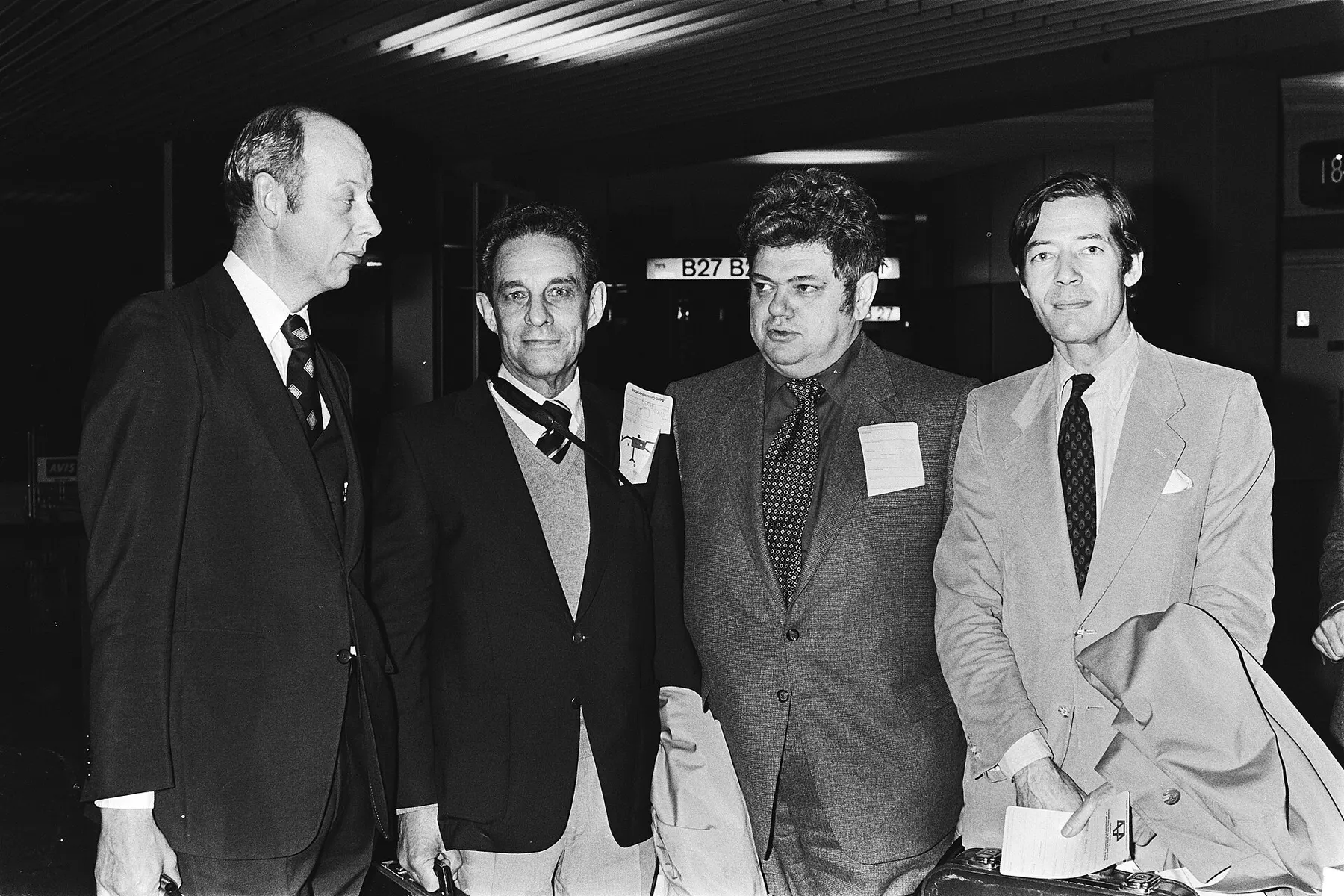
British election officials told voters, through pamphlets and broadcasts, to promise the bullies whatever they demanded and then follow their consciences. Each polling station had a single ballot box and the ballots were counted elsewhere, so no village's vote could be traced. Commonwealth observers, who visited 409 of the 657 stations, reported widespread intimidation and concluded that it had not undermined the validity of the result. In the judgment of one contemporary account, Mugabe's supporters were the worst offenders and Muzorewa's auxiliaries nearly as bad, while the government used its control of broadcasting and telephones against the Patriotic Front. The governor threatened to disfranchise some Mugabe supporters, and Zambia and Mozambique made clear that they wanted the vote to succeed.
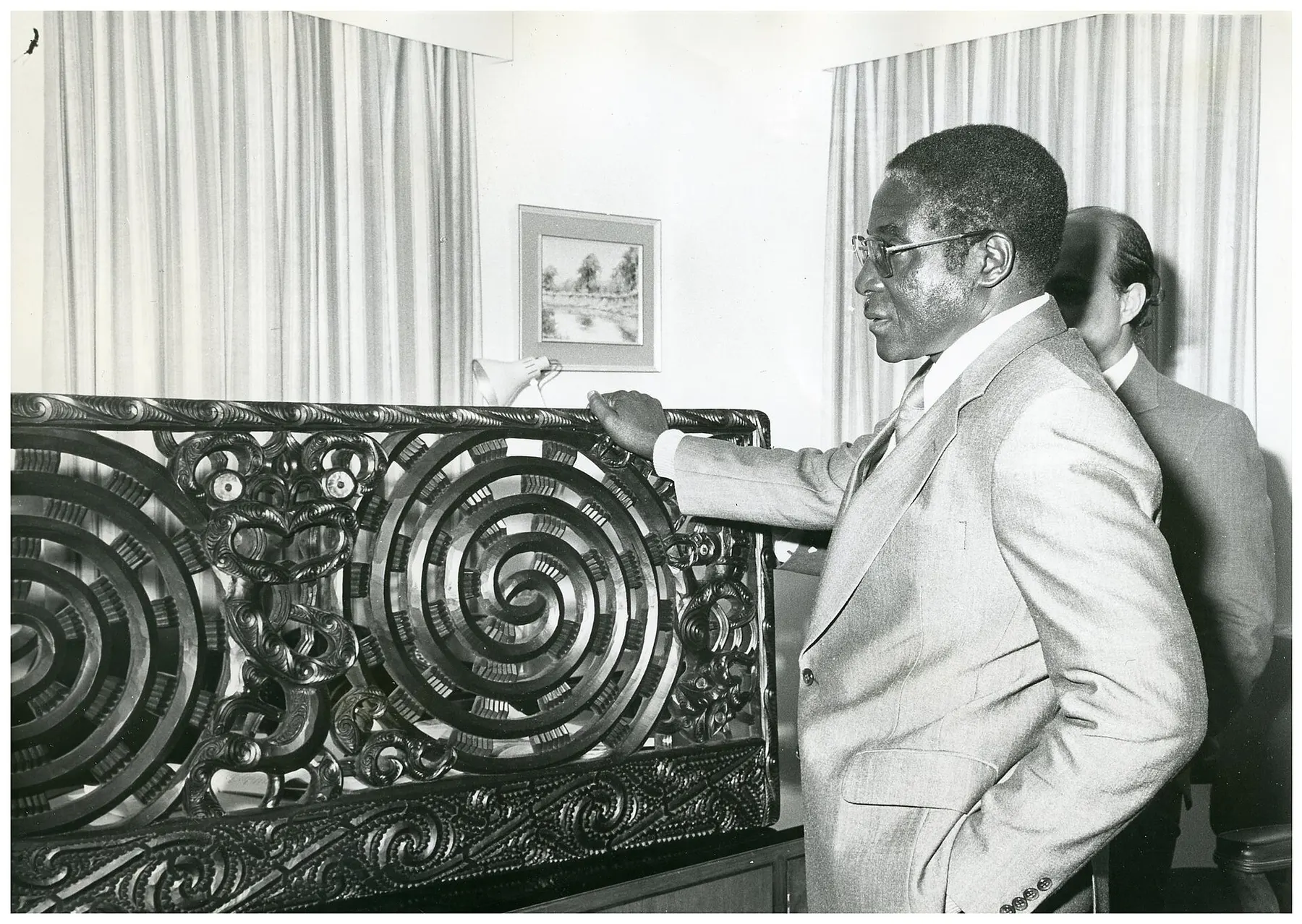
When the count was announced on March 4, ZANU-PF had won outright. Acland reported that much of the Rhodesian command and the Foreign Office were in shock. General Walls had earlier exclaimed that it would be better to get back to the war and bring in the South Africans, and officers talked of a coup that never came. The British diplomat Robin Renwick later said his side had to contain an incipient revolt by the Rhodesian military, and that it told Walls to go and see Mugabe.
“If yesterday I fought as an enemy, today you have become a friend and ally with the same national interest, loyalty, rights and duties as myself.”
Fifth Brigade in Matabeleland
1980 to 2024
Zimbabwe became independent at one minute after midnight on April 18, 1980, and former enemies began to be folded into one army. Refugees came home in large numbers from Mozambique, Zambia and Botswana. The white population, 232,000 in mid-1979, fell to about 80,000 by 1990. Many Black soldiers of the Rhodesian African Rifles served on in the Zimbabwe National Army, and the regiment fought for the new government when former ZANLA and ZIPRA men clashed at Entumbane in Bulawayo in 1981. By April of that year the regiment's name and insignia had been replaced by numbers.
ZAPU leaders were pushed out of government after arms caches were found on party properties in 1982, and some former ZIPRA soldiers took to the bush as dissidents. In August 1981, 106 North Korean instructors had begun training a new Fifth Brigade, made up mostly of Shona-speaking former ZANLA fighters. At the end of January 1983, under Colonel Perence Shiri, it was sent into Matabeleland North.
The Catholic Commission for Justice and Peace in Zimbabwe and the Legal Resources Foundation documented what followed in their 1997 report, Breaking the Silence, based on testimony from about 1,000 people. Within six weeks, the report said, more than 2,000 civilians had died, most of them in public executions, hundreds of homesteads had been burned and thousands of people had been beaten. The campaign extended to Matabeleland South and parts of the Midlands, and detainees were held and tortured at the Bhalagwe camp. Estimates of the total dead commonly run from 10,000 to 20,000. The killings took the name Gukurahundi, a Shona term for the early rain that washes away chaff, and they ended with the Unity Accord of December 22, 1987, which merged ZAPU into ZANU-PF. The report of an official inquiry under Justice Simplicius Chihambakwe was never published. At a memorial for Nkomo on July 2, 2000, Mugabe spoke of a moment of madness.
- Zimbabwe
Modern borders and names are shown. The named places are among those most associated with the killings and detentions; locations are approximate.
The war's mines remain in the ground. Between 1976 and 1979 the Rhodesian Army laid belts along the borders with Zambia and Mozambique, an estimated 3 million anti-personnel mines by the Zimbabwean government's reckoning, in what it called a cordon sanitaire, including rows of the locally made Ploughshare fragmentation mine. Zimbabwe told the Mine Ban Treaty's members that about 12 square kilometers remained to be dealt with at the end of 2024. The HALO Trust observes that there is little evidence the belts ever stopped fighters from crossing. People herding cattle and fetching water still lose limbs to them.
- Guerrillas, as claimed10,050
- Black civilians7,790
- Security forces1,361
- White civilians468
Deaths inside Rhodesia as reported by the government. The guerrilla figure is a claim that cannot be independently confirmed and may include civilians. Deaths in camps abroad are not counted. Source: Rhodesian government figures as reproduced at rhodesians.co, a veterans' site.
- U.S. country study, its most conservative figureNearly 20,000
- Blessing-Miles TendiAbout 30,000
- International Crisis Group, by 1979More than 40,000
- Research and Advocacy Unit, by 1980About 60,000
These cover different periods and use different methods, and none is a full count. The two highest are estimates by a conflict-analysis group and a Zimbabwean human rights research group. Source: U.S. country study text; Tendi; International Crisis Group; Research and Advocacy Unit.
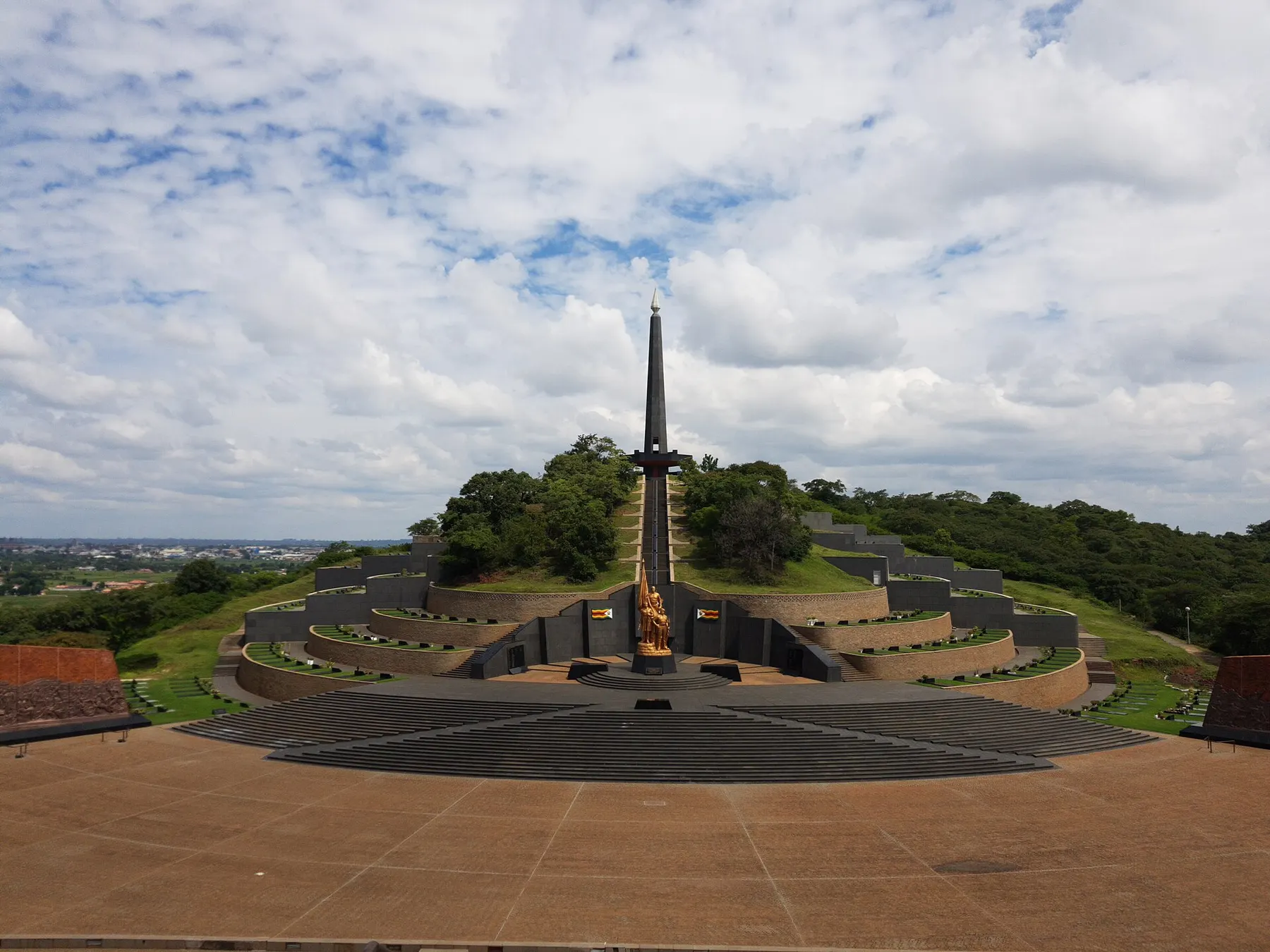
The state honors its liberation dead at Heroes Acre, and monuments and graves mark the New Farm site near Chimoio in Mozambique. Former ZIPRA fighters complain that their part has been played down, and some of those linked to the Viscounts still give researchers only their war names. Veterans of the Rhodesian forces, many now abroad, keep regimental associations and a large memoir literature, some of it nostalgic for the state they served. The Black soldiers who fought for that state appear comfortably in neither story. The villagers who made up most of the dead, whether shot by soldiers, killed by guerrillas as sell-outs, blown up on a bus or lost to disease in a camp, left few records and have few monuments. Researchers who went to Mount Darwin district nearly two decades after the war found that one adult in 10 over the age of 30 had survived organized violence, mostly torture, and was living with a clinically significant psychological disorder.
The arsenal
The soldier
Both sides carried Cold War rifles from opposite blocs, and small arms decided little in a war where finding the enemy was the hard part. Sanctions pushed Rhodesia to get small arms from South Africa, Portugal and the black market and to reissue what it captured. The guerrillas relied on Soviet and Chinese supply delivered through host countries, which gave them a common rifle and ammunition across both armies.
Rhodesian government
FN FAL
7.62mm battle rifle. Rhodesian Army and police
The main infantry rifle, in Belgian, South African R1 and other versions. A Fireforce rifleman carried it with about 100 rounds.
Heckler & Koch G3
7.62mm battle rifle. Rhodesian Security Forces
Portuguese-made versions arrived from 1966, supplied by a sympathetic neighbor that was still running colonies in Africa.
FN MAG
General-purpose machine gun. Rhodesian Army
Each four-man stick had one, with about 400 rounds. It replaced the older Bren.
Nationalist movements
AK-47 and Type 56
Assault rifle. ZANLA and ZIPRA
Soviet, Chinese and other Eastern Bloc versions became the standard guerrilla rifle. Rhodesia reissued captured examples late in the war.
SKS and Type 56 carbine
Semi-automatic carbine. ZANLA and ZIPRA
Carried before AK-type rifles became general.
Tokarev TT-33 and Type 54
Pistol. ZANLA and ZIPRA
The Soviet service pistol and its Chinese copy, also taken as captured weapons by Rhodesian troops.
RPD and Type 56 machine gun
Light machine gun. ZANLA and ZIPRA; captured examples used by Rhodesian special units
Rhodesian SAS, Selous Scouts and Light Infantry men used captured RPDs on cross-border raids.
RPG-7 and Type 69
Rocket-propelled grenade launcher. ZANLA and ZIPRA
The standard guerrilla anti-armor weapon, fired at the de Borchgraves' bedroom window at Whistlefield Farm in December 1972. Rhodesian units adopted captured launchers from 1978.
Land
Buried mines made every dirt road a danger, and Rhodesia's most original equipment was its answer: the mine-protected vehicle, often built on commercial chassis because sanctions closed off normal purchases. The guerrillas needed only a mine and a road to force that expense. ZIPRA alone assembled conventional heavy equipment, held in Zambia and never committed in a large offensive.
Rhodesian government
Hyena
Mine-protected personnel carrier. British South Africa Police
An early design supplied from South Africa, with 146 listed in police service.
Leopard
Mine-protected light vehicle. Civilians and Rhodesian Security Forces
Designed in 1974 by Ernest Konschel and built from 1975 to 1979 around a Volkswagen engine, partly to protect civilian travelers.
Pookie
Mine-detecting vehicle. Rhodesian Army engineers
A light one-man vehicle on wide racing tires, with low ground pressure. Its maker said 76 were built, none detonated a mine by pressure, and 12 were lost, with two drivers killed.
Crocodile, MAP45 and MAP75
Mine-protected troop carriers. Rhodesian Army and police
Armored bodies on commercial running gear, used for convoy escort, Fireforce missions and raids.
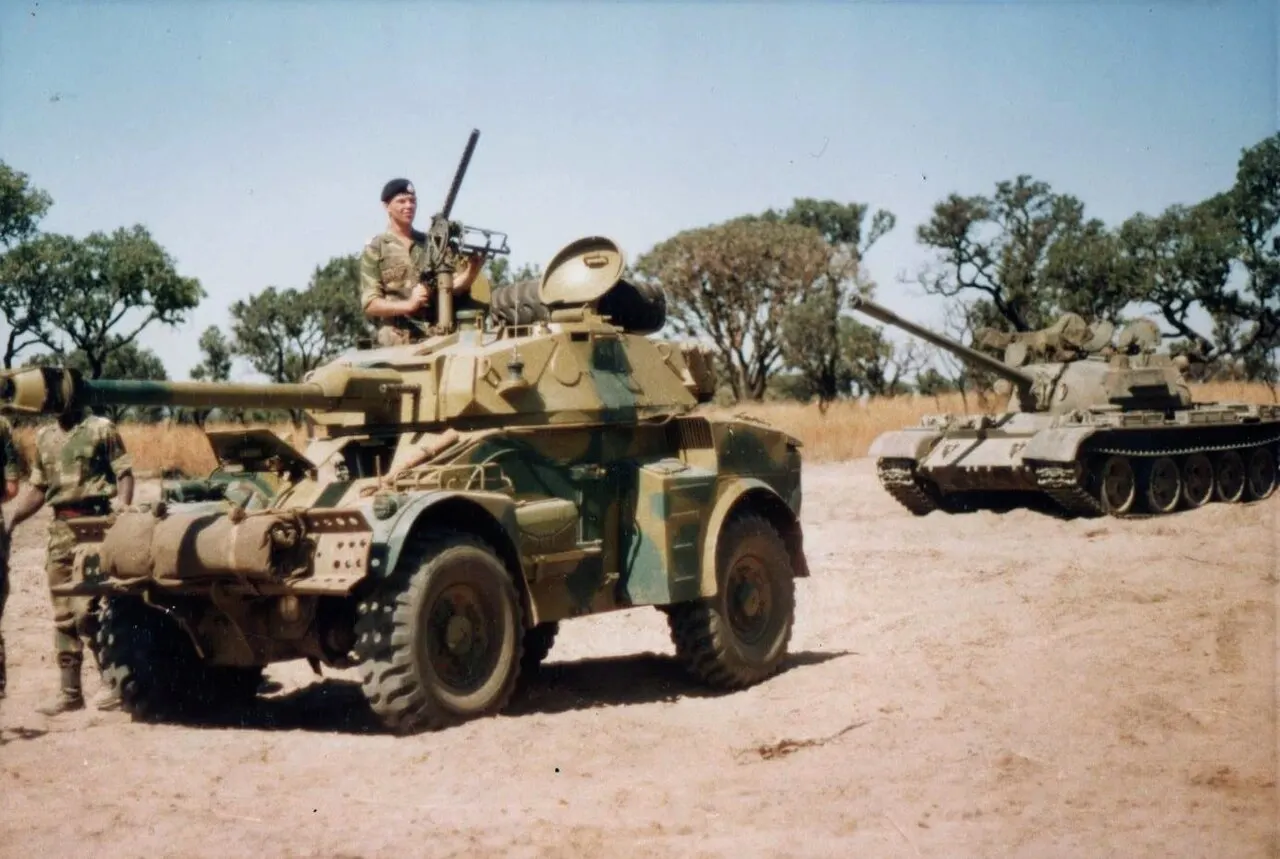
Eland 90
Armored car. Rhodesian Armoured Corps
South African-built, reportedly about 60 on loan, a mark of how much the army's heavy equipment depended on Pretoria.
John Wynne Hopkins, Wikimedia Commons. CC BY 4.0. SourceFerret
Scout car. Rhodesian Army
About 20 in service for convoy escort. Four went with the column to Nyadzonya.
Nationalist movements
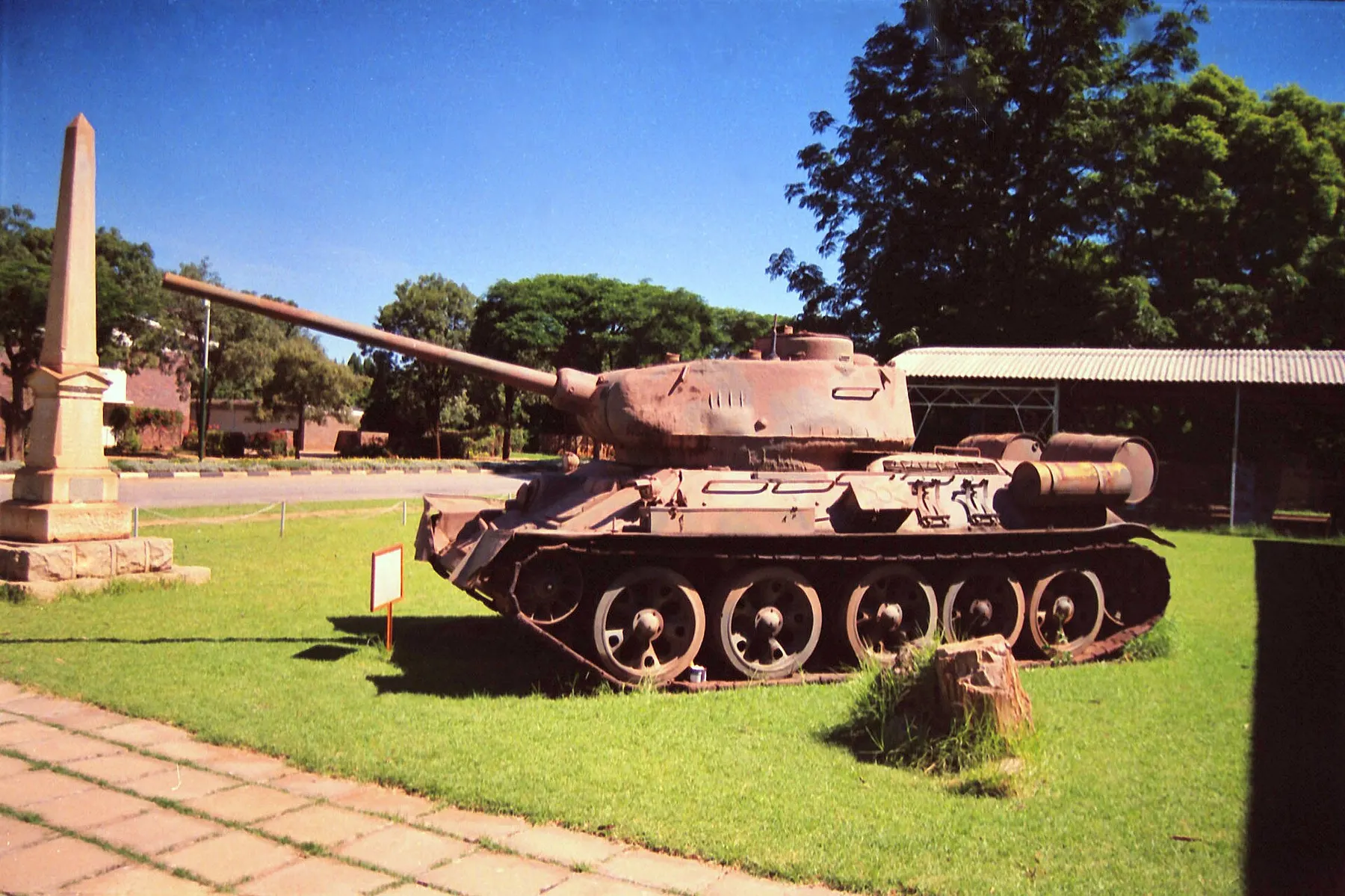
T-34-85
Medium tank. ZIPRA
Part of ZIPRA's conventional force in Zambia, which was preparing for a larger war. Surviving tanks are displayed at Gweru.
Bob Adams, via Wikimedia Commons. CC BY-SA 2.0. SourceTM-46 and TMN-46
Anti-tank mine. ZANLA and ZIPRA
Laid on rural roads, where they killed many African civilians as well as soldiers. A TMN-46 was also used in the Salisbury Woolworths bombing.
Mortars
Indirect-fire weapon. ZANLA and ZIPRA
ZANLA mortared Whistlefield Farm in December 1972, and guerrillas fired on police posts such as Madziwa. ZIPRA sent men to the Soviet Union for 82mm mortar training.
Air
Air power let a small force cover a large country and reach camps abroad, and it set the tempo of Fireforce. Most of the combat fleet predated independence, and sanctions forced Rhodesia to buy spares and replacements through third parties. The guerrillas had no air force. Shoulder-fired missiles arrived late and brought down two airliners, and the reprisal raids that followed reached the edge of Lusaka.
Rhodesian government
Alouette III
Light helicopter. Rhodesian Air Force
The K-car and G-car of Fireforce. Eight were bought from 1962 to 1966, and 34 are listed on strength late in the war, a number of them reportedly South African machines.
Alan Wilson, via Wikimedia Commons. CC BY-SA 2.0. Source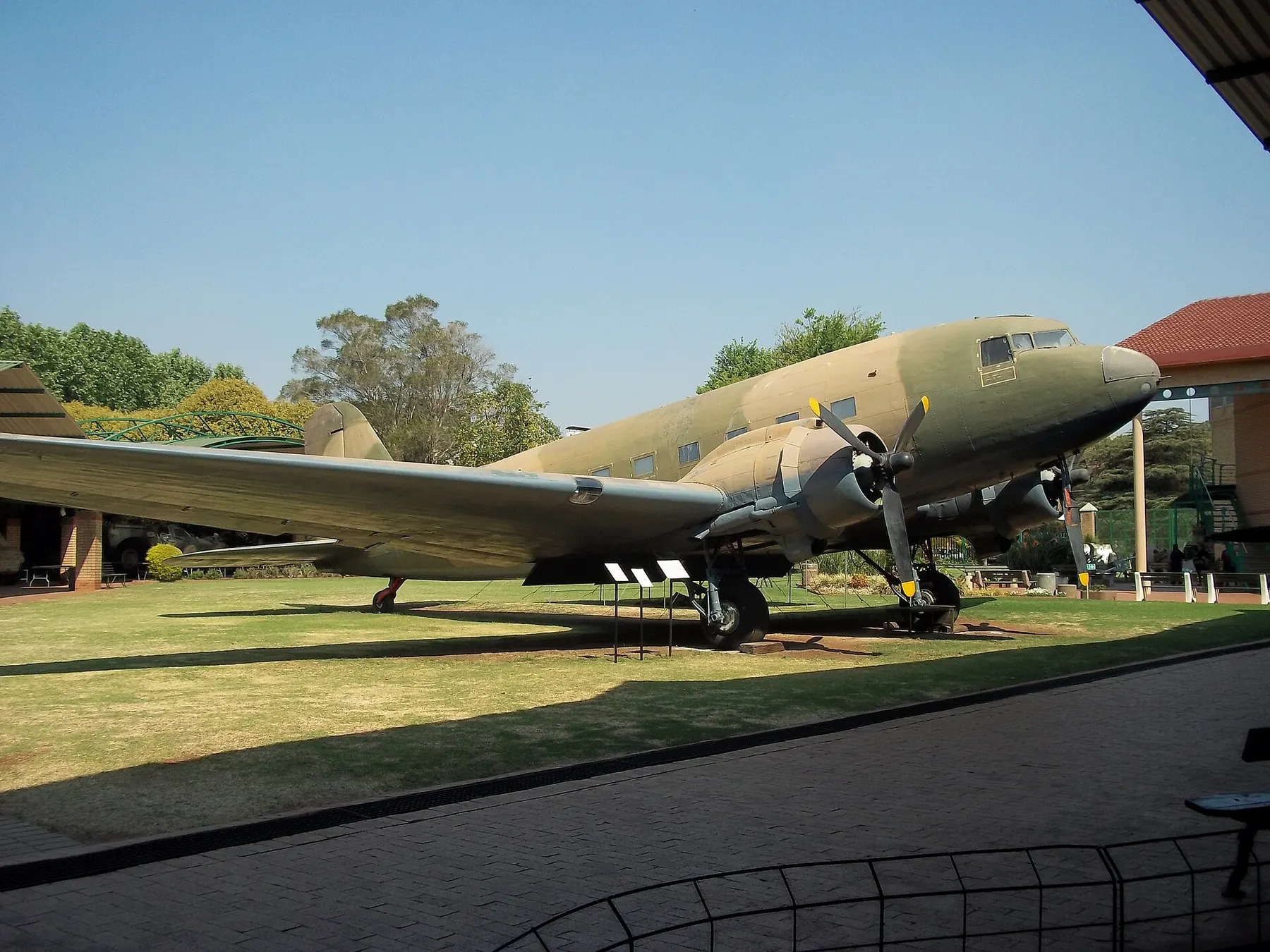
Douglas C-47 Dakota
Transport and paratroop aircraft. Rhodesian Air Force
About 13 in service. Each could drop five sticks at low level, some flown by Air Rhodesia pilots, and one served as an electronic intelligence platform.
Nolween, Wikimedia Commons. CC BY-SA 3.0. SourceHawker Hunter FGA.9
Ground-attack jet. Rhodesian Air Force
A squadron of 12, delivered in 1962 and kept flying under sanctions. Used in strikes on Zambian and Mozambican camps.
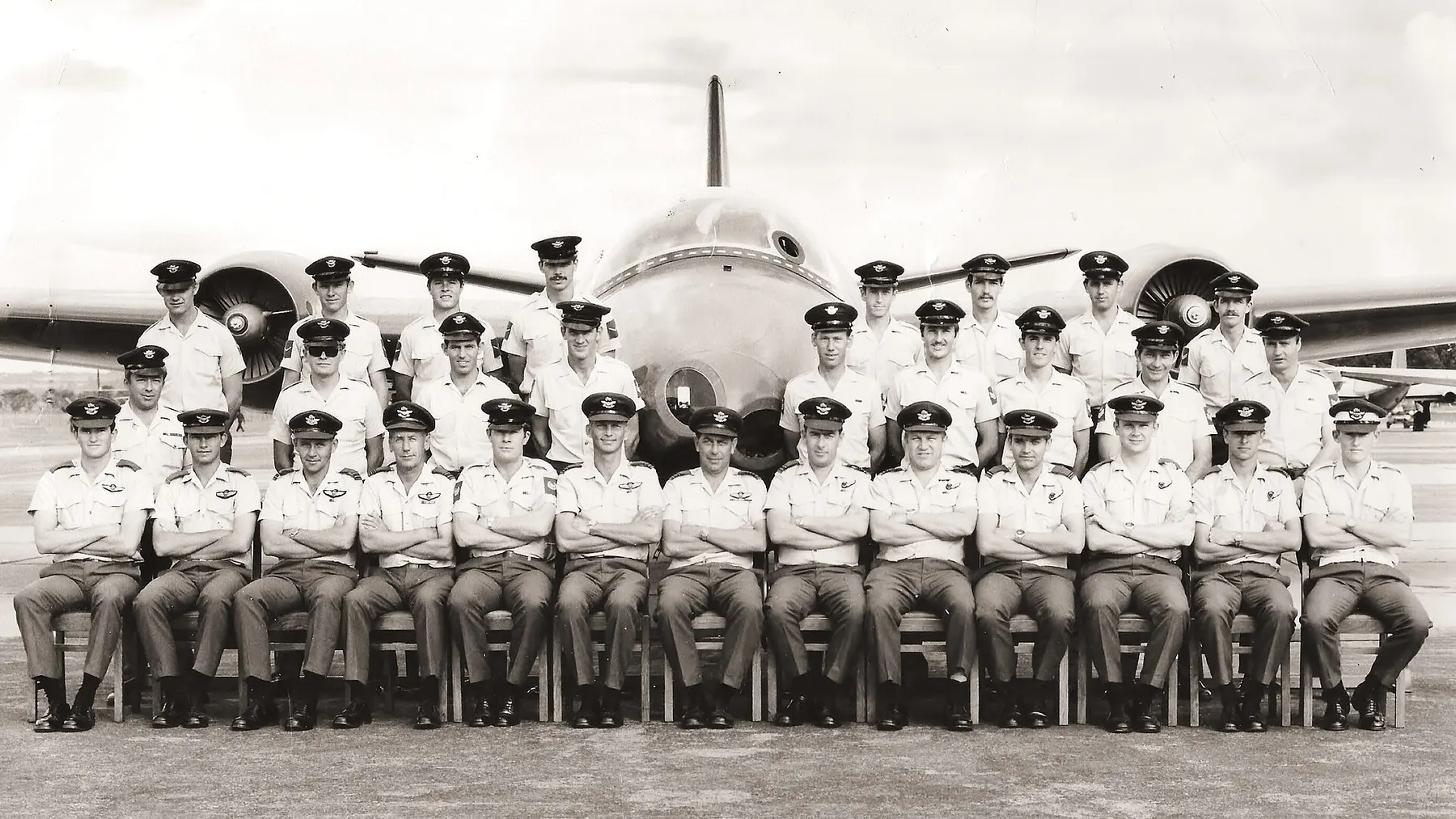
English Electric Canberra
Light bomber. Rhodesian Air Force
Eight B.2 bombers and two T.4 trainers, flown on the raids on Chimoio and Westlands.
Gooders2011, via Wikimedia Commons. CC BY 2.0. Sourcede Havilland Vampire
Jet fighter-bomber and trainer. Rhodesian Air Force
First-generation jets kept in service, some on loan from South Africa. One was lost on the Chimoio raid.
Reims-Cessna FTB 337 Lynx
Light attack and spotter aircraft. Rhodesian Air Force
About 21 were obtained despite sanctions. The Lynx usually opened Fireforce air strikes.
Agusta-Bell 205 Cheetah
Utility helicopter. Rhodesian Air Force
Eleven arrived late in the war, reportedly from Israel through Lebanese intermediaries.
Nationalist movements
Strela-2 (SA-7)
Shoulder-fired anti-aircraft missile. ZIPRA
Crews trained at Simferopol in the Soviet Union, by the account of ZIPRA veterans. Strelas downed the two Air Rhodesia Viscounts in 1978 and 1979, killing 107 people including those shot on the ground.
Support and strategic
Much of the war turned on intelligence, supply and barriers. Rhodesia built a munitions industry under sanctions with South African technical help and strung mines along its borders. The guerrillas drew on arms shipped through their host countries and on village helpers who served as their scouts.
Rhodesian government
Ploughshare mine
Directional fragmentation mine. Rhodesian Army
Locally made and set along the border minefields. Guerrillas also lifted some for reuse.
R2M2 mine
Anti-personnel blast mine. Rhodesian Army
South African-made and among the most sensitive in the belts that deminers still clear.
A63 and A76 radios
VHF radio. Rhodesian ground forces
Every stick leader carried one, linking the men on the ground to the K-car overhead.
Contaminated supplies
Chemical and biological sabotage. Rhodesian Special Branch and Selous Scouts
Poisoned clothing, food, drink and medicine were put into guerrilla supply lines from about 1975. One study estimates that hundreds died.
Nationalist movements
Mujibas
Civilian scouts and helpers. ZANLA
Mujibas, usually young people, acted as eyes and ears, part of a network of village committees that outsiders underestimated.
Grad-P rocket launcher
Light rocket launcher. ZIPRA
Twenty of the 180 ZIPRA men sent to Simferopol in 1977 trained on it, part of the army's preparation for conventional war.
Timeline
1888
October. Rudd Concession
Lobengula, the Ndebele king, grants mining rights to agents of Cecil Rhodes and soon repudiates the deal, but a royal charter for the British South Africa Company follows in 1889.
1890
September 12. Pioneer Column reaches Salisbury
About 200 settlers and several hundred armed men raise the British flag at Fort Salisbury in Mashonaland.
1893
War on the Ndebele
Company forces invade Matabeleland and occupy Bulawayo, which the retreating Ndebele have set on fire.
1896
1896 to 1897. First Chimurenga
Ndebele and Shona risings kill about 500 settlers before they are crushed, and the medium Charwe is hanged on April 27, 1898.
1923
Self-government
Southern Rhodesia becomes a self-governing colony after European electors reject union with South Africa in a 1922 referendum.
1930
Land Apportionment Act
The law divides land by race and reserves the best farmland for Europeans.
1953
1953 to 1963. Central African Federation
Southern Rhodesia is joined to Northern Rhodesia and Nyasaland until the northern territories move toward African rule.
1961
December. ZAPU founded
Joshua Nkomo leads the new party days after the National Democratic Party is banned, and ZAPU itself is banned in September 1962.
1963
August. ZANU splits away
Ndabaningi Sithole, Robert Mugabe and others break with Nkomo to form the Zimbabwe African National Union.
1965
November 11. Unilateral Declaration of Independence
Ian Smith's cabinet declares independence from Britain to block a move toward majority rule.
1966
April 28. Sinoia
Police kill seven ZANLA men in a day-long fight, the event Zimbabwe marks as the start of the Second Chimurenga.
December 16. UN mandatory sanctions
Security Council Resolution 232 orders selective sanctions, and Resolution 253 widens them in May 1968.
1972
December 21. Altena Farm
ZANLA attacks a farm in the Centenary district and Rhodesia answers with Operation Hurricane.
1974
January. Fireforce and protected villages
The helicopter reaction force first deploys as nearly 50,000 people in Chiweshe are moved into fenced villages within three weeks.
1975
March 18. Herbert Chitepo killed
A car bomb in Lusaka kills ZANU's chairman in exile, and a Zambian inquiry later blames rivalries inside his own party.
Mozambique independent
FRELIMO takes power, ZANLA gains a long eastern border, and Samora Machel closes the frontier with Rhodesia in March 1976.
1976
August 9. Nyadzonya
Selous Scouts disguised as FRELIMO troops drive into a camp in Mozambique and open fire on a crowd that Rhodesia calls guerrillas and ZANU calls refugees.
October. Geneva talks
The conference follows Smith's acceptance of majority rule in principle under American and South African pressure, and it fails.
1977
November 23 to 25, 1977. Operation Dingo
Air and ground forces strike the Chimoio and Tembue camps in Mozambique.
1978
March 3. Internal Settlement
Smith signs with Muzorewa, Sithole and Chief Chirau, and the Patriotic Front rejects the deal.
June 23. Elim Mission killings
Eight British missionaries and four children are killed at Vumba near Umtali.
September 3. Viscount Hunyani shot down
A ZIPRA missile brings down Air Rhodesia Flight 825 near Kariba, and 10 survivors are then shot on the ground.
October 19. Raids into Zambia
Operation Gatling strikes Westlands Farm near Lusaka and the Mkushi camp.
1979
February 12. Viscount Umniati shot down
Air Rhodesia Flight 827 is hit after leaving Kariba, and all 59 aboard die.
April to June 1979. Zimbabwe Rhodesia
Muzorewa's party wins 51 of 72 African seats in an election the Patriotic Front boycotts, and he takes office on June 1.
September 10 to December 21, 1979. Lancaster House
Talks in London produce a constitution, a transition under a British governor and a cease-fire.
December 28. Cease-fire
Guerrillas begin moving to assembly points under Commonwealth monitors.
1980
February 27 to 29, 1980. Common-roll election
About 2.7 million ballots are cast and ZANU-PF wins 57 of 80 common-roll seats.
April 18. Independence
Rhodesia becomes Zimbabwe with Robert Mugabe as Prime Minister.
1983
1983 to 1987. Gukurahundi
The army's Fifth Brigade kills thousands of civilians in Matabeleland before the Unity Accord of December 1987.
After action report
The nationalist movements won the political contest.
They gained majority rule, independence and, in the 1980 election, power for ZANU-PF. Government forces remained intact at the cease-fire and, by accounts resting largely on their own counts, won most engagements, so neither side was beaten in the field.
- On the battlefield
- No decisive battlefield result. Rhodesian forces stayed intact until the cease-fire and, by accounts resting largely on their own counts, won most engagements. By 1979, however, guerrillas operated across much of the countryside, about 90 percent of the country was under martial law, and white manpower was close to its limit.
- In the political outcome
- White minority rule ended. ZANU-PF won 57 of 80 common-roll seats in 1980, and Robert Mugabe became Prime Minister. The Rhodesian Front kept 20 reserved white seats for a limited time. Nkomo's party came second, and Muzorewa's collapsed to three seats.
- How it ended
- A negotiated settlement: the Lancaster House Agreement of December 21, 1979, a cease-fire from December 28 under Commonwealth monitors, a temporary return to British rule, elections in February 1980 and independence on April 18, 1980.
A white minority government declared independence in 1965 to avoid a transfer to majority rule, and two rival nationalist movements took up arms against it.
The government's forces, most of whose regulars were Black, stayed intact and raided deep into neighboring states, while guerrillas spread through the countryside and sanctions, emigration and South African pressure wore the state down.
A British-chaired conference ended the war in 1979 and ZANU-PF won the election that followed. Most of the dead were rural Black civilians, and every armed party killed civilians.
Within three years the new state's own army was killing thousands of civilians in Matabeleland.
Objectives, side by side
Rhodesian government
Not achieved
Preserve white-led government and avoid majority rule
It delayed the change for 14 years after the declaration of independence, but conceded majority rule in principle in 1976.
Not achieved
Defeat the insurgency or hold long enough for a favorable settlement
Intact at the cease-fire, but neither aim was met.
Not achieved
A moderate transition recognized abroad
Won in 1979, failed to gain British recognition, and took three seats in 1980.
Not achieved
A friendly buffer on its northern frontier
Its aid prolonged white rule for years, but the 1980 result produced an independent Black government to the north.
Nationalist movements
Achieved
Majority rule, power and land reform
Won power outright in 1980. The land question was deferred by the Lancaster House terms.
Partly achieved
Majority rule with ZAPU in power or sharing it
Majority rule came, but ZAPU finished a distant second and was then suppressed and absorbed by 1987.
Achieved
End white rule in Rhodesia
Achieved at heavy cost to Zambia and Mozambique in raids and lost trade.
Also involved
Achieved
Legal independence on an acceptable basis without fighting white Rhodesians
Achieved at Lancaster House, 14 years after the declaration and after a long war it had chosen not to prevent by force.
Estimated deaths
- Military
- Roughly 11,000 to 12,000 Rhodesian forces and guerrillas inside Rhodesia, on largely Rhodesian figures, plus about 3,400 to 5,500 fighters and refugees killed in three external raids, who cannot be separated.
- Civilian
- At least 7,500 to 10,500 in official and veteran counts. Broader estimates imply tens of thousands.
The most commonly quoted total for the whole war is about 20,000 to 30,000. The U.S. country study calls nearly 20,000 its most conservative figure, and Tendi gives about 30,000. The International Crisis Group says more than 40,000 had died by 1979, and Zimbabwe's Research and Advocacy Unit estimates 60,000 by 1980, the vast majority civilians. Rhodesian official counts of guerrilla dead and of collaborator civilians are disputed and cannot be independently verified. Each bar spans the low and high estimates on a logarithmic scale, where every step is ten times the last, so small and very large losses fit one chart.
Military
Rhodesian government
Rhodesian Security Forces
1,120 to about 1,860
A former Rhodesian officer gives about 2,500, an unsourced approximation.
How this was counted
The U.S. country study gives 1,120. The Rhodesian government reported 1,361 from December 1972 to December 1979. A veterans' roll of names counts 1,863 killed in action or on active service from 1964 to April 1980, including the Guard Force and Internal Affairs; 40 percent of army losses on that roll were African.
Zimbabwe country study text at GlobalSecurity; Rhodesian veterans' roll at rhodesians.co
Nationalist movements
Guerrillas killed inside Rhodesia
About 10,000, by Rhodesian count
How this was counted
This is the Rhodesian government's own claim for December 1972 to December 1979. It is disputed and cannot be independently confirmed. People reported as guerrillas, and those labeled collaborators or recruits, may include civilians.
Rhodesian government figures as reproduced by Steve Bennett at rhodesians.co
Fighters and refugees killed in three external raids (cannot be separated)
About 3,400 to 5,500
Fighters and refugees cannot be separated in these counts.
How this was counted
Calculated by adding the published ranges for Nyadzonya (675 to 1,049), Chimoio and Tembue (1,200 to 3,000) and the October 1978 Zambian raids (about 1,500, a Rhodesian claim that Moorcraft and McLaughlin call considerably exaggerated; Chakawa gives 800 to 1,000 at Westlands and 600 at Mkushi). Many of the dead may have been unarmed or civilians. All other raids are excluded.
Compilation at rhodesians.co; Time, February 26, 1979; Chakawa, 2025
Civilian
Black civilians inside Rhodesia
About 7,000 to 10,000 in official and veteran counts; probably many more
How this was counted
The government reported 7,790, about half attributed to guerrillas, many by land mines, and half listed as crossfire. The category of crossfire and the government's counts of collaborators killed are disputed, because security force killings could be recorded under them. Human rights researchers believe the true toll was much higher.
Zimbabwe country study text at GlobalSecurity; rhodesians.co
White civilians
About 470 to 500
How this was counted
The government reported 468 for December 1972 to December 1979. The figure of about 500 includes many of the 107 people killed in the two Viscount shootdowns, though not all of those victims were white.
Zimbabwe country study text at GlobalSecurity; rhodesians.co
Civilians in Matabeleland and the Midlands, 1983 to 1987 (after the war)
About 10,000 to 20,000
Not part of the war totals below.
How this was counted
Killed mainly by the Zimbabwean army's Fifth Brigade. The 1997 Catholic Commission report documented more than 2,000 deaths in the first six weeks alone. Wider totals are estimates.
Kill and loss ratios
A ratio compares reported losses. It depends on who did the counting, it does not measure who was right, and it often says little about who won.
About 7.4 to 1
Calculated here
Rhodesian official count inside Rhodesia, December 1972 to December 1979
Guerrillas the government said it killed inside the country for each member of its security forces it reported killed.
10,050 claimed guerrilla dead divided by 1,361 reported security force dead = 7.38.
Caution: Both numbers are Rhodesian government figures. The guerrilla total may include civilians and cannot be independently confirmed. It leaves out deaths in camps abroad. It says nothing about which side fought better or had the better cause.
15 to 1, or about 19 to 1 with those labeled collaborators and recruits
Calculated here
Rhodesian communique for two weeks, September 1978
Dead attributed to the guerrilla side for each security force member reported killed in action.
165 claimed guerrilla dead divided by 11 security force dead = 15. Adding 33 people labeled collaborators and 8 labeled recruits gives 206 divided by 11 = 18.7.
Caution: A propaganda statement issued after the first Viscount shootdown. The collaborator category shows how civilians could enter a kill count. No independent check exists.
80 to 1, claimed
Published figure
Fireforce operations, Rhodesian claim
Enemy dead claimed for each Rhodesian soldier lost in Fireforce actions.
Stated by Peter Macdonald in Military Operations, 2013, without a footnote for the figure. The surrounding passage relies on J. R. T. Wood's Rhodesian-focused history of Fireforce.
Caution: This is widely repeated and comes from one side's own counts. Those counts may include civilians and cannot be independently confirmed. Fireforce chose its engagements, so the number would not describe the war as a whole even if it were accurate.
Peter Macdonald, Rhodesia: Lessons Learned, Military Operations 1, no. 4
What it cost
- About 350,000 to 750,000
- Displaced into protected villages
- U.S. country study and Research and Advocacy Unit estimates
- Up to about 1.5 million
- Refugees
- Tendi's estimate of the displacement generated by the insurgency; other counts are lower
- About 3 million
- Anti-personnel mines laid
- Zimbabwean government estimate of the original border minefields
- About 12 square kilometers
- Mined land still to clear
- Reported at the end of 2024
- 232,000 in 1979, about 80,000 by 1990
- White population
- U.S. Army War College study
- More than 17,000 human cases
- Anthrax epidemic
- PeerJ reanalysis; Glenn Cross finds a natural outbreak spread by wartime collapse most likely
Lessons drawn
- Rhodesian forces: battlefield results did not secure the state
- Later military studies admire Fireforce, tracking and mine-protected vehicles, and many also conclude that success in firefights could not hold a state most of its people rejected. Forced removals and reprisals handed the guerrillas recruits.
- ZANLA: organization came before firepower
- Turner's analysis credits ZANLA's political work in the villages and its committee structure for its eventual standing. Kriger's interviews show that the same system rested in part on coercion of the people it organized.
- ZIPRA: specialists without mass
- Turner's analysis finds that ZIPRA's Soviet-style preparation produced skilled specialists and heavy weapons but lacked manpower and organization. Its missile crews showed what small trained teams could do.
- Mine-protected vehicles
- Rhodesian and South African designs of the 1970s became a starting point for the mine-resistant vehicles later used by many armies.
- Cease-fire monitoring
- A small, lightly armed force managed the assembly of more than 20,000 guerrillas. Its success depended on the willingness of the parties and on officers such as Acland, who were prepared to act on their own judgment.
Still disputed
- How many people died?
- The U.S. country study's most conservative figure is nearly 20,000 and Tendi gives about 30,000, totals that lean heavily on Rhodesian counts. The International Crisis Group says more than 40,000 by 1979 and the Research and Advocacy Unit estimates 60,000 by 1980, without itemizing them.
- Were the camps military or civilian?
- Rhodesian accounts describe training bases. ZANU, Zimbabwe and Amnesty International describe refugee camps. Moorcraft and McLaughlin find both fighters and civilians, nearly all unarmed at the moment of attack.
- Did villagers back the guerrillas freely?
- Terence Ranger traced peasant support to grievances over land that ZANLA promised to answer. Norma Kriger's interviews point to coercion and to struggles of generation, gender and status inside the villages.
- Who killed Herbert Chitepo?
- ZANU blamed Rhodesia. A Zambian commission blamed factions inside ZANU. Ron Reid-Daly wrote that Rhodesian intelligence planned it, and Peter Stiff named Hugh Hind as the bomber.
- Who shot the Hunyani survivors?
- Nkomo denied that ZIPRA did. Eliakim Sibanda blames the Selous Scouts. Joshua Chakawa cites the police ballistics match to weapons used at Nyamhunga and holds ZIPRA responsible.
- Who killed the Elim missionaries?
- The Rhodesian government, the mission's local director and most later accounts name ZANLA. Nationalist leaders denied involvement and accused the Selous Scouts, without producing evidence.
- Did Rhodesia spread anthrax deliberately?
- Some researchers have suggested it. Glenn Cross finds the evidence consistent with a natural epidemic worsened by war. The 2016 PeerJ reanalysis offers no firm conclusion.
- What ended the war?
- Rhodesian veterans stress betrayal by Britain and South Africa. Nationalists stress the armed struggle. Analysts such as Turner point to guerrilla expansion, manpower exhaustion, sanctions and South African pressure acting together.
- Was the 1980 election fair?
- Commonwealth observers accepted the result despite widespread intimidation, which Dominick Graham attributes most heavily to ZANU-PF's supporters and next to Muzorewa's auxiliaries. Renwick called polling in Victoria province very unfair. Some Rhodesians and Nkomo's supporters never fully accepted the outcome.
Sources
Figures for wars are estimates, and many are disputed. Where credible sources differ, this page gives the range and says who counts what. Maps are drawn from Natural Earth country shapes, which show today's borders.
- Racial Discrimination and Repression in Southern Rhodesia (1976), International Commission of Jurists
- Rhodesia to Zimbabwe: A Chronology, 1830 to 1976, George M. Houser, via Michigan State University
- The downing of Air Rhodesia Viscounts by ZIPRA in Zimbabwe's armed struggle, Joshua Chakawa, Southern Journal for Contemporary History
- Soldiers contra Diplomats: Britain's role in the Zimbabwe/Rhodesia Ceasefire (1979-80) Reconsidered, Blessing-Miles Tendi, Oxford University Research Archive
- Review of Dirty War: Rhodesia and Chemical Biological Warfare, 1975-1980, Ryan Shaffer, CIA Studies in Intelligence
- Reanalysis of the anthrax epidemic in Rhodesia, 1978-1984, Wilson and others, PeerJ
- Organised Violence and Torture in Zimbabwe and the Liberation War, Research and Advocacy Unit
- Zimbabwe in Crisis: Finding a Way Forward, International Crisis Group
- Rhodesian Bush War (Zimbabwe country study text), GlobalSecurity.org
- Rhodesian Bush War 1965-80, Study of Internal Conflict, U.S. Army War College, Strategic Studies Institute
- Truth and Reconciliation Commission of South Africa Report, volume 2, chapter 2, South African Truth and Reconciliation Commission, via SABC and SAHA
- The Effectiveness of UN Sanctions Against Rhodesia (1977), CIA, in Foreign Relations of the United States
- Security Council Resolution 232 (1966), United Nations
- Written answers on the Commonwealth Monitoring Force, January 1980, UK Parliament, Hansard
- Written answer on assembly point medical services, March 1980, UK Parliament, Hansard
- Zimbabwe Joins the Commonwealth, Dominick Graham, Journal of Conflict Studies
- A Dream to be Deferred: Zimbabwe's First Elections and Independence Celebrations, 1980, Centre for Innovation and Technology (CITE)
- Australian peacekeepers in Southern Rhodesia, Anzac Portal, Australian Government
- Accountability for the Gukurahundi atrocities in Zimbabwe thirty years on, Killander and Nyathi, CILSA
- Report on the 1982-1987 Matabeleland campaign, Inter Press Service
- Article 5 extension request, Republic of Zimbabwe, Anti-Personnel Mine Ban Convention
- Zimbabwe's minefields: a visual explainer, The HALO Trust
- Rhodesia: Again, Death on Flight SAM-7, Time, February 26, 1979
- The Man Who Cried Uncle, Time, October 11, 1976
- Here to Stay, Time, February 27, 1978
- Missionaries and Other Christians Are Dying in Rhodesia, Christianity Today, 1978
- Independence message, April 17, 1980, Robert Mugabe, via Marxists Internet Archive
- The Rhodesian Bush War/Zimbabwe War of Liberation, William B. Turner, Small Wars Journal
- Extra-territorial African Police and Soldiers in Southern Rhodesia, Timothy Stapleton, Scientia Militaria
- The Road to Independence (review of Ranger and Lan), David Caute, London Review of Books, November 21, 1985
- Review of Zimbabwe's Guerrilla War: Peasant Voices, by Norma Kriger, Journal of Conflict Studies, Summer 1993
- Insights into Independent Zimbabwe: Some Historiographical Reflections, Tinashe Nyamunda, Strategic Review for Southern Africa
- An Innocent Woman, Unjustly Accused? Charwe, Medium of the Nehanda Mhondoro Spirit, D. N. Beach, History in Africa, 1998
- Rhodesia: Lessons Learned, Peter Macdonald, Military Operations
- Casualties during the Rhodesian Bush War (partisan veterans' compilation), rhodesians.co
- Selected history of Rhodesian conflict 1970-1980 (former Rhodesian officer's account), Fabian Cohnen, Royal United Services Institute of New South Wales
- Report of the Constitutional Conference, Lancaster House, 1979, Southern Rhodesia Constitutional Conference, via Uppsala Conflict Data Program
- Zimbabwe's genocide: an open wound, FairPlanet
- Mbuya Nehanda (reference, reproducing Richartz's report in the Zambesi Mission Record), Wikipedia
- Rhodesia's Unilateral Declaration of Independence (reference), Wikipedia
- Attack on Altena Farm (reference), Wikipedia
- Donal Lamont (reference), Wikipedia
- Herbert Chitepo (reference), Wikipedia
- Jason Moyo (reference), Wikipedia
- Josiah Tongogara (reference), Wikipedia
- Conscription in Rhodesia (reference), Wikipedia
- Foreign volunteers in the Rhodesian Security Forces (reference), Wikipedia
- Selous Scouts (reference), Wikipedia
- Rhodesian African Rifles (reference), Wikipedia
- Operation Eland (reference), Wikipedia
- Operation Dingo (reference), Wikipedia
- Operation Gatling (reference), Wikipedia
- Internal Settlement (reference), Wikipedia
- Gukurahundi (reference for non-casualty details), Wikipedia
- 1922 Southern Rhodesian government referendum (reference), Wikipedia
- First Matabele War (reference), Wikipedia
- Air Rhodesia Flight 825 (reference), Wikipedia
- List of weapons of the Rhodesian Bush War (equipment reference), Wikipedia
- Rhodesian Air Force (equipment reference), Wikipedia
- Fireforce (tactical reference), Wikipedia