Articles & BlogBy Trapper W. Brown7 min read
For anyone who has opened a message that begins "We are writing to inform you". By the end you will know what the notice means, what to change first, and how a credit freeze differs from a fraud alert.
A company you trusted with your details has lost control of them. You did nothing wrong, and there was nothing you could have done to stop it. What you can do is make the stolen information worth less, and that takes an evening.
The Federal Trade Commission (FTC) opens its own advice on this with four words: "First, take a deep breath." That is the right start. Then work through the steps in order, because the order matters. The stakes are real: the FBI's 2025 Internet Crime Complaint Center report puts the losses people reported from personal data breaches that year at more than $1.3 billion.
 An Army information security manager briefs his unit during Cyber Awareness Month in 2022. Every organization that holds your details runs on people, and people can be fooled. Photo by Natalie Weaver, US Army, public domain, via Wikimedia Commons.
What does a breach notice mean?
It means someone got into a company's systems and copied records, or the records were left exposed by mistake, and yours were among them. A proper notice says which kinds of information were involved. Read that list first. What you do next depends on it.
| What leaked | What a thief can do with it | Your first move |
|---|---|---|
| Email address or phone number | Send you convincing fake messages | Expect them, and read the last section here |
| Password | Sign in there, and anywhere else you used it | Change it everywhere it was used |
| Card number | Try to make purchases | Ask your bank or card company for a new card |
| Social Security number | Try to open new credit in your name | Check your credit reports and freeze your credit |
Before anything else, make sure the notice is real. Do not click its links. Open the company's website by typing the address yourself and look for the announcement there. The FTC points people to IdentityTheft.gov/databreach for steps matched to each kind of information.
What do you change first?
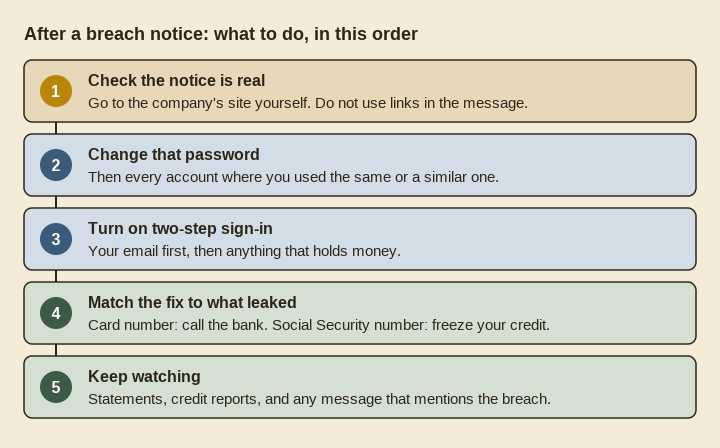 The order of operations. Steps one to three fit into the first evening.
Passwords. In a 2022 consumer alert on data breaches, the FTC says to change them right away, on the breached account and on any other account where you used the same or a similar one.
If that is more than one account, start with your email. Password reset links for almost everything else arrive there, so whoever holds your email can walk into the rest.
Then turn on multi-factor authentication, a second step after the password such as a code from an app. The FTC's reason is worth quoting: "This helps secure your account even if your password is exposed."
When you choose the new passwords, the Cybersecurity and Infrastructure Security Agency (CISA) asks for two things: at least 16 characters, and a different one for each account. Nobody can remember that many, which is what a password manager is for. It is a program that creates and stores them, so, as CISA puts it, you only need to remember one strong password. Phones and web browsers have one built in, and there are separate ones too.
How does one leaked password open other accounts?
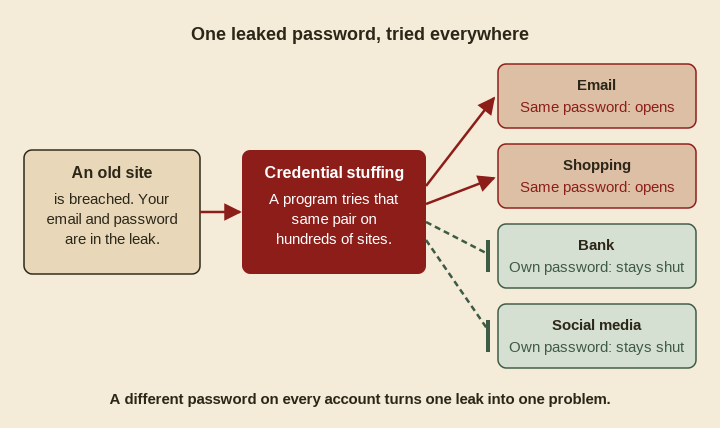 The leak is one password. The damage depends on how many places that password was used.
The trick has an ugly name, credential stuffing, and a simple idea behind it. A breach gives thieves a long list of email addresses with the passwords that went with them. They do not sit and type. A program takes each pair and tries it on other sites, one after another: mail, shops, banks, games.
It only works on people who reuse passwords, and most of us have. CISA tells the story of a woman whose bank and email were both taken over. The cause turned out to be one password, used on both, that had been part of a company breach posted online.
So the forum you joined ten years ago and forgot about can be the reason someone is in your email today. A different password on every account turns one leak into one problem.
Credit freeze or fraud alert?
If your Social Security number was in the breach, the worry is someone opening a loan or a card in your name. There are two free tools for that, and the FTC explains both. The three credit bureaus named below are the companies that keep your credit history: Equifax, Experian and TransUnion.
| Credit freeze | Fraud alert | |
|---|---|---|
| What it does | Nobody can open a new credit account in your name, including you | Tells businesses to check with you before opening new credit in your name |
| Cost | Free | Free |
| How long | Until you lift it | One year, and you can renew it |
| Who to contact | All three bureaus, one by one | One bureau, which must tell the other two |
| The catch | You lift it before you apply for credit | A lender can still see your report |
The freeze is the stronger of the two, and it is the one I would choose after a Social Security number leaks. The alert is quicker to set up. People who have already had their identity stolen can get an extended fraud alert that lasts seven years.
The FTC gives these pages for the bureaus: equifax.com/personal/credit-report-services, experian.com/help and transunion.com/credit-help. Type them in yourself.
Then look at your credit reports for accounts you do not recognize. The FTC says the bureaus have made it permanent that you can check each report once a week for free at AnnualCreditReport.com, or by phone on 1-877-322-8228. If the breach notice offers free credit monitoring, the FTC's advice is to take it.
Tip
When you need to borrow, ask the lender which bureau it will check, and lift the freeze at that one only. The FTC suggests this, and it leaves the other two shut the whole time.
Why is the next message the dangerous one?
Because a breach is news, and criminals read the news. In the weeks after one, expect messages that mention it by name: claim your compensation, confirm your account, enroll in protection. Some will come from people holding the stolen list, so they may use your real name and other true details.
Treat every one the same way. Do not click. Go to the company's site yourself.
The FTC makes a point of this for credit reports. Other sites pretend to be linked to AnnualCreditReport.com, and the real one, like the credit bureaus, will not email you asking for your Social Security number or account details.
Watch out
The common mistake is to change one password and stop. The breached site is rarely where the harm happens. It happens at the other accounts that share the password, and through the fake follow-up messages. Finish the list.
If you do find an account or a charge that is not yours, the FTC's place to report it and get a recovery plan is IdentityTheft.gov.
Six things to do today
- Read the notice for the list of what leaked, on the company's own site
- Change that password, starting with your email if it shared one
- Change every other account that used the same or a similar password
- Turn on a second sign-in step for your email and your bank
- Order your free credit reports at
AnnualCreditReport.comand read them - If your Social Security number leaked, place a freeze at all three bureaus
What to remember
- A breach is the company's failure. Your job is to make the stolen details worth less.
- What leaked decides what you do. Read that part of the notice first.
- Change the password everywhere it was used, email first, and add a second sign-in step.
- One reused password is how a small breach becomes a big one.
- A freeze blocks new credit until you lift it. A fraud alert asks lenders to check with you for a year.
- Expect fake messages about the breach, and never use their links.
The longest job on this list is giving every account its own password, and it is the one that pays back most. Passwords, Passkeys and MFA: Identity Done Right goes further into password managers, passkeys and the kinds of second step, and it is the place to go next.