Articles & BlogBy Trapper W. Brown11 min read
A SCADA system is the set of computers that watches and steers a physical process spread over a wide area: a water system, a power grid, a pipeline. The letters stand for supervisory control and data acquisition. "Data acquisition" means collecting readings from the field, such as a tank level or a line voltage. "Supervisory control" means a person in a control room can see those readings and send commands back, such as start that pump or open that breaker.
Why should you care? Because these systems sit between you and things you cannot do without. When an office network fails, people lose email. When a control system is misused, the result can be dry taps, dark streets or a chemical dose that is wrong. The computers involved are often old, hard to patch and more reachable from the outside than their owners believe.
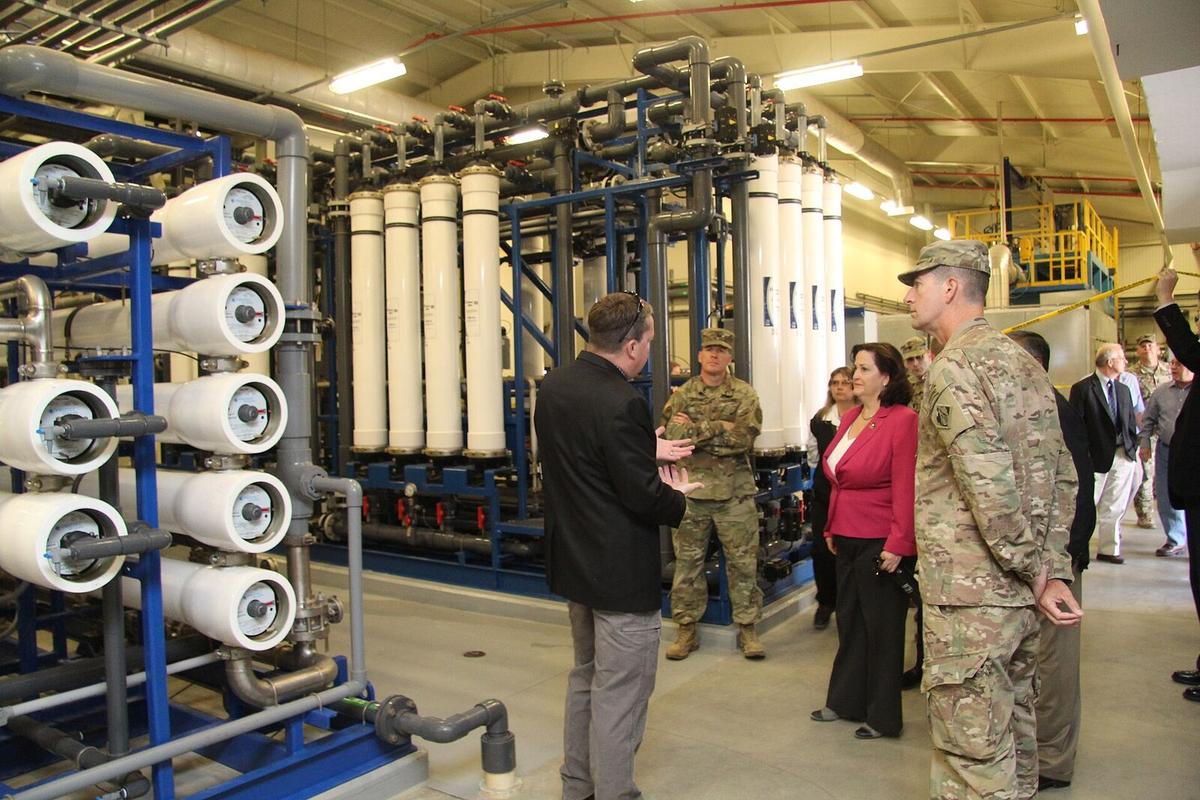 A new water treatment plant at Fort Irwin, California. Every pump and valve feeding these filters takes its orders from a control system. Photo by Brooks Hubbard IV, U.S. Army Corps of Engineers, public domain, via Wikimedia Commons.
What does a SCADA system do?
Picture a water utility for a town of 15,000 people. It has a river intake, a treatment plant, two storage tanks on hills and four pumping stations, spread over 30 square miles. Nobody can stand next to all of that at once.
So the utility puts small computers at each site and connects them to one control room. The computers at the sites take readings and run the local equipment. The control room gathers everything onto screens, keeps a record and lets one operator supervise the whole system from a chair.
NIST, the US standards agency, describes the same arrangement in its Guide to Operational Technology (OT) Security, Special Publication 800-82 Revision 3, published in September 2023. Operational technology is NIST's umbrella term for programmable systems that interact with the physical world. SCADA is the kind built for equipment that is spread out.
What are the parts?
There are fewer than the jargon suggests. Each one has a plain job.
| Part | What it is | Its job in the water plant |
|---|---|---|
| Sensor | A device that measures something | Reads tank level, flow, pressure, chlorine |
| Actuator | A device that moves something | Runs a pump motor, turns a valve |
| PLC | Programmable logic controller: a rugged small computer | Reads sensors and drives actuators, many times a second |
| RTU | Remote terminal unit: a controller built for far-off sites | Runs a distant pump station and reports in by radio or phone line |
| HMI | Human-machine interface: the operator's screen | Shows the plant as a diagram, with buttons and alarms |
| Historian | A database of readings over time | Keeps years of levels, flows and doses for reports and troubleshooting |
| Control server | The central SCADA computer | Polls every site and passes operator commands down |
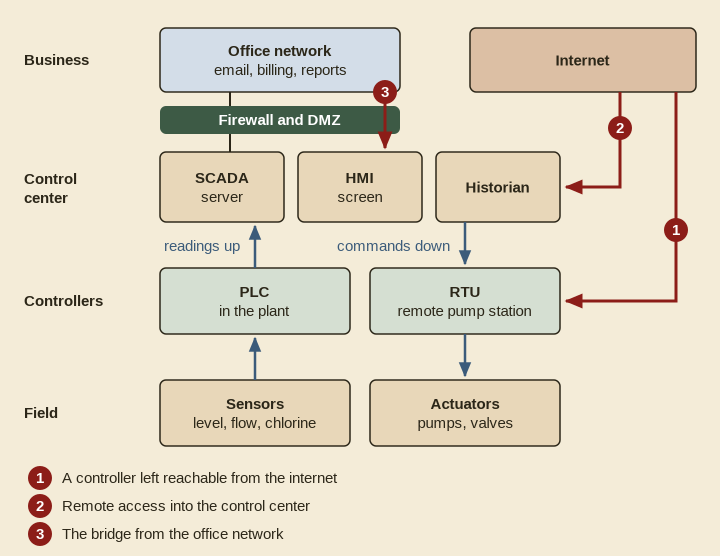 Readings travel up and commands travel down. The red arrows are the three common ways in.
Two details matter for security. First, the PLC does the real work. It keeps the process running even if the control room goes quiet, which is good for reliability. It also means that whoever can change the PLC's program or its target values controls the process. Second, the HMI is a window with a steering wheel attached. Anyone who can reach that screen, from the chair or from across the internet, can do what the operator can do.
Following a glass of water through the plant
Here is one worked example, with made-up but realistic numbers.
River water enters through an intake. A flow sensor reports 1,400 gallons per minute to the plant PLC. The PLC adds a coagulant, a chemical that makes fine dirt clump, in proportion to that flow. The water settles, then passes through filters. A turbidity sensor (turbidity is cloudiness) reads 0.1 units after the filters, and the PLC is programmed to raise an alarm at 0.3.
Next comes disinfection. The operator has typed a target, called a set point, of 1.2 milligrams of chlorine per liter into the HMI. A chlorine sensor downstream reads 1.1, so the PLC speeds up the dosing pump slightly. That loop of measure, compare and adjust repeats all day with nobody touching anything.
Treated water is pumped to a hilltop tank four miles away. An RTU at the tank reports the level by radio every few seconds: 28 feet. The program says start the pumps at 24 feet and stop them at 31. Every reading lands in the historian.
Now read that again as an attacker would. The set point is a number on a screen. The pump start level is a number in a program. Change the numbers and the equipment obeys, because obeying is what it was built to do.
How is this different from office IT?
The priorities are reversed. In an office, protecting information comes first, and a server can be restarted on a Tuesday night. In a plant, safety and keeping the process running come first, and "turn it off and on again" may mean a town without water pressure for firefighting.
| Office IT | Control systems | |
|---|---|---|
| First priority | Keeping data private | Safety and staying up |
| Typical life of equipment | 3 to 5 years | 10 to 15 years, sometimes longer |
| Patching | Monthly, often automatic | Planned around shutdowns, tested first |
| A failure means | Lost data or lost time | Physical harm is possible |
The lifetimes in that table are NIST's. The same guide notes that a whole OT system can stay in service for more than 20 years, and that old systems may contain hardware and software the vendor no longer supports and nobody can patch.
The languages these devices speak are old as well. Two common ones are Modbus and DNP3, which carry readings and commands between controllers and the control room. They were designed for private wires inside a fence, where every device was assumed to be a friend. NIST puts it bluntly: many OT protocols have no authentication at any level, so a message can be replayed, altered or faked. Authentication means proving who is speaking. Without it, a controller that receives "open the valve" has no way to ask who wants to know. If the idea of protocol layers is new to you, the article The OSI Model: Seven Layers, One Web Page covers it.
Why are these systems vulnerable?
None of the weaknesses is exotic. In May 2025, CISA, the FBI, the EPA and the Department of Energy published a short list of primary mitigations for OT, and the list reads as a catalog of what keeps going wrong.
- Devices on the public internet. A PLC or HMI that answers to the whole internet can be found by anyone who looks. The agencies' first instruction is to remove those connections.
- Default passwords. Many devices ship with a password printed in the manual. If nobody changes it, the manual is the key.
- Flat networks. If the office and the plant share one network, a bad email attachment in accounting is one hop from the pumps.
- Remote access. Operators and engineers want to check the plant from home. Every remote door they use is a door.
- Old operating systems. The HMI is often an ordinary PC, and it may run a version of Windows that stopped getting fixes years ago. The article Running End-of-Life Software Is Driving Without Insurance explains why that matters.
- Vendor access. The company that installed the system often keeps a way in for support. Its security is now part of yours, a point made in Trust but Verify: Vetting Vendors and Contracts.
- The IT to OT bridge. The historian feeds reports to the business side, so some path between the two networks nearly always exists.
The EPA has put a number on the basics. In an enforcement alert issued in May 2024, it said that more than 70% of the water systems it had inspected since September 2023 were in violation of basic requirements of the Safe Drinking Water Act's section on risk assessments and emergency plans. Some had never changed default passwords. Some shared a single login among all staff. Some had not removed former employees' access.
What has actually happened?
Four cases, each as official sources describe it.
Ukraine, 23 December 2015. According to the alert published by the US government's industrial control systems response team, attackers cut power to about 225,000 customers of three regional electricity distributors. They had obtained legitimate credentials in advance. On the day, they logged in remotely and opened breakers through the companies' own remote administration and control software, with the three attacks falling within 30 minutes of one another. Then they wiped computers and corrupted the firmware of communication devices in substations to slow the recovery. The US government attributes the campaign to Russian state actors. In October 2020 the Department of Justice announced an indictment of six officers of Russian military intelligence that includes these attacks. An indictment is an accusation, not a conviction.
Oldsmar, Florida, 5 February 2021. A joint federal advisory said unidentified actors gained access to a water plant's SCADA system and used it to raise the dose of sodium hydroxide, a caustic chemical used in treatment. An operator noticed and corrected it before the water was affected. The advisory said the plant likely had poor password security and an outdated operating system. The story later became less clear. In April 2023, CyberScoop reported that a former city manager had called the event a "non-event" caused by an employee, and it quoted an FBI statement that the bureau "was not able to confirm that this incident was initiated by a targeted cyber intrusion." Whichever account is right, the weaknesses in the advisory were real.
US water systems, from 22 November 2023. A joint advisory by the FBI, CISA, the NSA, the EPA and partner agencies described a group calling itself CyberAv3ngers, which it tied to Iran's Islamic Revolutionary Guard Corps. The group took over PLCs made by Unitronics, a model with a built-in screen, and left a political message on the display. The advisory counted at least 75 compromised devices, at least 34 of them in US water and wastewater systems. The devices were reachable from the internet and had a default password or none.
Volt Typhoon, advisory of 7 February 2024. CISA, the NSA and the FBI reported that a group sponsored by the People's Republic of China had broken into IT networks of communications, energy, transportation and water organizations. The agencies assessed that the aim was to pre-position for disruptive attacks, by getting into place on IT networks and then moving across to OT. In some victims the group had kept its foothold for at least five years.
Read together, the cases share a theme. Nobody needed a secret weapon, only a way in and a system that trusted whoever arrived.
What does defense look like?
Start with a map. The Purdue model, in one sentence, sorts a plant into levels from the physical equipment at the bottom to the business network at the top, so you can decide what is allowed to talk to what. Segmentation means enforcing that map with firewalls. NIST's guidance is that traffic should pass only between neighboring levels, and that the office should never talk directly to a controller. Data the business needs goes through a buffer network between the two, called a DMZ. The article Firewalls, NAT and Port Forwarding explains the mechanics.
After that, the 2025 mitigation list is a fair plan of work: take OT off the public internet, change every default password, lock down remote access with multifactor authentication, segment IT from OT, and keep the ability to run the plant by hand. That last item is the one office security never needs. A water operator who can still open a valve with a wrench has a backup no software provides.
For a fuller checklist, CISA's Cross-Sector Cybersecurity Performance Goals are a voluntary baseline that covers both IT and OT, updated to version 2.0 in December 2025. NIST SP 800-82 is the long manual behind them. Vendors and large operators also work to an international standards series, IEC 62443.
What to remember
- SCADA is how one control room watches and steers equipment spread over miles: sensors and actuators in the field, PLCs and RTUs running them, an HMI and a historian in the middle.
- The controller obeys whatever valid command reaches it. Many of the protocols involved were built with no way to check who is asking.
- Control systems put safety and uptime first, and their equipment stays in service for 10 to 15 years or more, so patching is slow.
- The usual ways in are plain: a device left on the internet, a default password, remote access, and the link to the office network.
- The official record shows real intrusions, and at least one famous case that is less certain than first reported.
- Defense is mostly separation: off the internet, behind a firewall, with a tested way to run by hand.
If you want to see where this is heading, the companion article New and Emerging Technologies in Critical Infrastructure looks at what happens as smart meters, batteries and AI are added to the systems described here.