Articles & BlogBy Trapper W. Brown5 min read
 Illustration generated for Warhawk Division.
WordPress released version 7.1.4 on 28 October 2026 and told site owners to "update your sites immediately." Among its fixes is a flaw in the way WordPress upgrades itself. According to the National Vulnerability Database, it lets "unauthenticated attackers to execute code on the server during the upgrade window." On 3 November the Cybersecurity and Infrastructure Security Agency (CISA) added it to its list of flaws attackers are actually using. Fixed versions go all the way back to the 4.7 branch. If you run WordPress, check your version today.
What is the flaw?
It is tracked as CVE-2026-119977. The National Vulnerability Database (NVD), run by the National Institute of Standards and Technology, describes it this way:
"WordPress Core is vulnerable to Remote Code Execution in versions 4.7 through 7.1.3. This is due to predictable, web-accessible staging paths used during full-package core upgrades. This makes it possible for unauthenticated attackers to execute code on the server during the upgrade window."
Here is that in plain terms.
Remote code execution means an attacker can make your server run their commands from somewhere else on the internet. It is about as serious as a web flaw gets. The site's article "Web Shells and Remote Code Execution: How a Website Gets Taken Over" explains what usually follows.
Unauthenticated means the attacker does not need a login.
Staging paths are the temporary folders WordPress unpacks new files into while it upgrades. The NVD says those folders are "predictable" and "web-accessible," so someone on the internet could find and reach them.
The upgrade window is the stretch of time between the start of an upgrade and its end.
CISA's catalog calls it a "Time-of-check Time-of-use (TOCTOU) Race Condition Vulnerability." A race condition is a bug where the outcome depends on timing. The software checks something, then acts on it a moment later, and an attacker who gets in between those two steps wins the race.
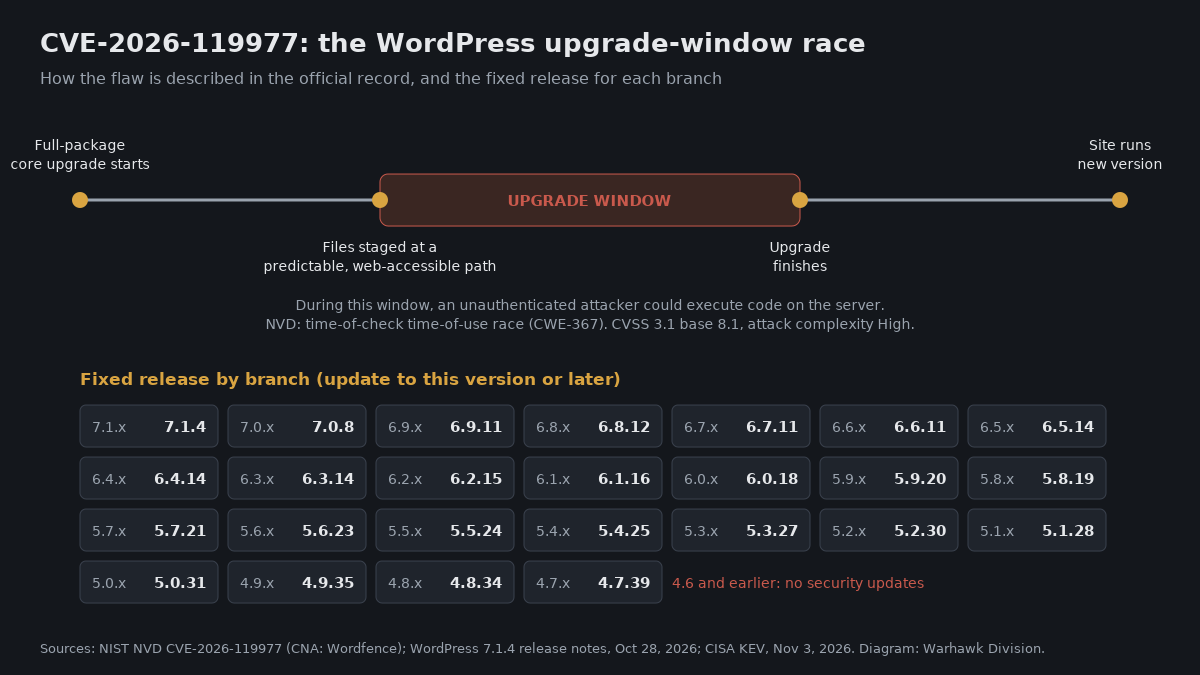 How the official record describes the flaw, and the fixed release for each supported branch. Data: NIST NVD CVE-2026-119977; WordPress 7.1.4 release notes, 28 October 2026; CISA KEV Catalog. Diagram by Warhawk Division.
How serious is it?
The record gives it a CVSS 3.1 base score of 8.1, rated "High." CVSS, the Common Vulnerability Scoring System, is the industry's standard 0-to-10 severity scale. The score comes from Wordfence, the security company that issued the CVE.
The score breaks down into a few parts. The attack works over the network, needs no privileges and needs no one to click anything. Its one limiting factor is "attack complexity: high." That fits a timing attack, because the attacker has to hit a short window.
The more important fact is CISA's listing. On 3 November 2026 CISA added the flaw to its Known Exploited Vulnerabilities (KEV) Catalog "based on evidence of active exploitation." The catalog gave federal agencies until 6 November to fix it, three days later. It also marks this entry for CISA's "Forensics Triage Requirements." CISA's alert says its directive "establishes basic expectations for when agencies must check whether threat actors compromised the system before the patch was applied." In other words, patching alone may not be enough.
CISA lists "Known Ransomware Campaign Use" as "Unknown." Neither CISA nor WordPress names who is exploiting it or which sites were hit, and I will not either.
Who found it, and what else was fixed?
The WordPress.org announcement credits the report to Umut Bayram, describing it as "a weakness in the WordPress upgrade process which can lead to remote code execution during the upgrade window."
It was one of many fixes. The 7.1.4 release notes say the WordPress 7.0 and 6.9 branches are "affected by all 22 vulnerabilities." Most of the others are cross-site scripting (XSS) issues, flaws that let someone with an account plant malicious script in a page. Several also need the attacker to have at least a contributor account. The upgrade race is the one that needs no account at all.
The release also updated WordPress's bundled root certificates "due to the eMudhra revocation." Root certificates are the built-in list of authorities a program trusts for secure connections.
Which versions are fixed?
WordPress released fixes for every branch back to 4.7. The release notes say, "As a courtesy, these fixes are also available in older affected branches of WordPress," and add, "only the most recent version of WordPress is actively supported."
The fixed versions include 7.1.4, 7.0.8, 6.9.11, 6.8.12 and so on down to 4.7.39. The chart above lists every one. The release notes are blunt about the oldest sites: "WordPress 4.6 and earlier no longer receive security updates."
 Every WordPress site runs on a server like these, and remote code execution means control of that machine. Photo by NASA (Glenn Research Center, C-2006-1850), public domain, via Wikimedia Commons.
Does updating put my site at risk?
That is a fair question for a flaw that lives in the upgrade process. The official record does not answer it, and I will not guess. What the record does say is that the flaw affects versions "4.7 through 7.1.3." Once you are on a fixed version, you are outside the affected range the record lists.
WordPress's announcement says sites with automatic background updates "will begin automatically." Many sites may already be patched without the owner doing anything. Check anyway.
What to do
- Check your version. In the dashboard, go to Dashboard, then Updates. You want 7.1.4 or the fixed release for your branch from the chart above.
- Update now if you are behind. WordPress's instructions: "visit your WordPress Dashboard, click 'Updates', and then click 'Update Now'."
- If you are on 4.6 or earlier, plan a migration. Those versions get no security fixes.
- Look for signs you were hit before you patched. CISA flagged this one for forensic triage. Look for files you do not recognize, new admin accounts and unexpected scheduled tasks. "Web Shells and Remote Code Execution" covers what to look for.
- Ask your host. If a hosting company manages your updates, ask in writing which version you are on and when it was applied.
- Read the advisory, not the headlines. "How to Read a Security Advisory Without Panicking" shows how to pull the version numbers and the exploited status out of a notice like this one.
Where I land
- This is a no-login, run-code-on-your-server flaw, and CISA says it is being exploited.
- The fix exists for every branch back to 4.7. There is no excuse to wait.
- Automatic updates may have already handled it. Verify, because assuming is how sites get taken over.
- Nothing official names the attackers or the victims, and I am not going to fill that gap.
The irony is that the bug lives in the update process, and updating is still the fix. Update, check, and then look for anything that got in before you did.
Sources (6)
- CISA, "CISA Adds One Known Exploited Vulnerability to Catalog," 3 November 2026: https://www.cisa.gov/news-events/alerts/2026/11/03/cisa-adds-one-known-exploited-vulnerability-catalog
- CISA, Known Exploited Vulnerabilities Catalog: https://www.cisa.gov/known-exploited-vulnerabilities-catalog
- WordPress.org Documentation, "Version 7.1.4," 28 October 2026: https://wordpress.org/documentation/wordpress-version/version-7-1-4/
- WordPress.org News, "WordPress 7.1.4," 28 October 2026: https://wordpress.org/news/2026/10/wordpress-7-1-4/
- NIST National Vulnerability Database, CVE-2026-119977: https://nvd.nist.gov/vuln/detail/CVE-2026-119977
- MITRE, CWE-367: Time-of-check Time-of-use (TOCTOU) Race Condition: https://cwe.mitre.org/data/definitions/367.html