Articles & BlogBy Trapper W. Brown11 min readCurrent to 12 November 2026Both sides
Ransomware is software that locks an organization's files, or copies them, so that criminals can demand money to unlock them or to keep them private. The victim then faces a short, ugly choice: pay strangers and hope, or refuse and rebuild. The site's article "Ransomware: What It Is and What to Do in the First Hour" covers the attack itself and what the FBI says about paying. This piece is about a different question: whether the law should take that choice away.
Why should you care? Because the answer decides who carries the cost of the next attack. If paying is legal, some victims pay and the money funds more attacks on other people. If paying is banned, a victim with no working backup has no fast way out. That victim might be the hospital you use or the town that runs your water. Serious people who have spent years on this problem disagree, and both sides have evidence. What follows lays out each case without picking one.
 A ward runs on screens like this one, which is why a locked hospital network is the hardest case in the ransom debate. Photo by Jackhsiao, public domain, via Wikimedia Commons.
What does the law say today?
As of 12 November 2026, none of the places covered here bans every ransom payment. Each one draws the line somewhere different.
| Place | The rule | Source |
|---|---|---|
| United States, federal | Paying is discouraged, not forbidden across the board. Paying a person or group under sanctions is prohibited, and the payer can be liable without knowing | Treasury (OFAC) advisory, 21 September 2021 |
| United States, federal | Critical infrastructure firms will have to report a payment within 24 hours. The rule that turns this on is not yet in force | 6 U.S.C. 681b; CISA's CIRCIA page |
| North Carolina | State agencies, cities, counties, public schools and the state university may not pay or even communicate with the attacker | N.C. General Statutes 143-800 (2021) |
| Florida | A state agency, county or municipality "may not pay or otherwise comply with a ransom demand" | Florida Statutes 282.3186 (2022) |
| Australia | Businesses over a turnover threshold must report a payment within 72 hours | Cyber Security Act 2024, section 27 |
| United Kingdom | Proposed: a ban for the public sector and regulated critical infrastructure, and a duty on others to notify before paying | Home Office response, 22 July 2025 |
Two details matter. First, the Treasury advisory says penalties can rest on "strict liability," meaning a payer "may be held civilly liable even if such person did not know or have reason to know" that the recipient was sanctioned. Criminals do not sign their real names, so a victim cannot always tell. The same advisory says reporting the attack to law enforcement promptly counts as "a significant mitigating factor."
Second, the British proposal is still a proposal. The Home Office wrote that it "will continue to develop" the ban. Its consultation page shows no later step, and whether a bill has since been introduced could not be confirmed from Parliament's own site.
In November 2023 the 50 members of the International Counter Ransomware Initiative, a group of governments, agreed on a joint statement "declaring that member governments should not pay ransoms." That covers the governments themselves. It does not bind the hospitals and companies inside their borders.
How much money is involved?
Nobody has a complete count, and each source measures something different.
| 2024 | $892M |
|---|---|
| 2025 | $820M |
Chainalysis, a firm that traces cryptocurrency, estimates that ransomware crews received more than $820 million in 2025, down about 8 percent from its updated 2024 figure of $892 million, even as the number of attacks the crews claimed rose 50 percent. It puts the median payment at nearly $60,000.
Coveware, a firm that handles ransomware cases for victims, reported an average payment of $1,025,278 and a median of $400,000 for the third quarter of 2026. Those are its own cases, where the median victim had 1,121 employees. It also reported that when the attackers only stole data and did not lock anything, nearly 80 percent of cases ended with no payment.
The FBI's Internet Crime Complaint Center logged 3,611 ransomware complaints in 2025 with reported losses of about $32.3 million. The FBI itself warns that this figure is "artificially low." It leaves out lost business and repair costs, and some victims report no amount at all.
So the trend in two private data sets is that fewer victims pay and less money moves. Both sides of the debate cite that trend, and they draw opposite lessons from it.
The case for making payment illegal
Ransomware is a business, and payment is its revenue. Even the best-known critics of a ban grant this. The co-chairs of the Ransomware Task Force, a group convened by a think tank, wrote in April 2024 that the crews "are inherently profit-motivated, and therefore a ban on payments could eventually result in less criminal activity."
Each payment pays for the next attack. The Treasury advisory says firms that help victims pay "encourage future ransomware payment demands," and that money reaching sanctioned groups can fund activity against national security. A payment solves one victim's problem by adding to everyone else's.
No victim can fix that alone. For a single organization on its worst day, paying can be the rational move. A law is the ordinary tool for a situation where each person's sensible choice harms the group. Supporters add that a ban hands the victim a simple reply: "We are not allowed to." There is nothing to negotiate.
What the money buys is thin. Coveware's report says the attackers' "promises to delete stolen data cannot be verified." The FBI's position, quoted in the site's earlier article, is that payment guarantees nothing.
Refusing is survivable, and governments already ask it of themselves. North Carolina and Florida bind their own agencies. The British Library, attacked in October 2023, wrote in its review that it "has not made any payment to the criminal actors responsible for the attack, nor engaged with them in any way," and warned future attackers that national policy is "unambiguously clear." Supporters read the falling payment figures the same way: most victims who refuse get through it.
Most people who answered one government's consultation backed it. Of the 273 responses the Home Office received, 72 percent of those surveyed agreed with a targeted ban and 23 percent disagreed. Sixty-eight percent thought it would cut the money flowing to criminals, and 60 percent thought it would deter attacks on the bodies covered.
The case against a ban
It punishes the victim of a crime. A ban does nothing to the attacker, who is usually abroad. It lands on the organization that was just robbed, and it lands hardest on the one with the fewest resources. The task force co-chairs wrote that "a ban on payments under current circumstances will likely worsen the harms both for direct victims and, in turn, for society and the economy," because most organizations are not prepared to recover on their own.
The limited bans have not shown results. The same memo says that where governments have barred themselves from paying, "there has not been a clear decrease in ransomware attacks against these entities." No official evaluation of the North Carolina or Florida law turned up in the research for this article.
Payments may go underground. A firm facing closure may pay anyway and tell no one. The co-chairs warn that a ban with no exceptions "could drive payments 'underground,' putting them outside the view of investigative authorities."
Exceptions are a trap as well. If hospitals are exempt, the co-chairs argue, attackers "will preferentially target organizations in the excepted categories." The British consultation split on this: 43 percent wanted exceptions and 40 percent did not.
Some decisions involve more than money. When Change Healthcare, a company that processes medical claims and payments, was attacked in February 2024, the chief executive of its parent company told the Senate Finance Committee in written testimony: "the decision to pay a ransom was mine. This was one of the hardest decisions I've ever had to make." The testimony gives the reason as an "overriding priority" to protect people's personal health information. Opponents say a legislature cannot weigh that in advance for every case.
Refusing has a price. The British Library's review also records that about 600 gigabytes of files, including personal data of users and staff, were auctioned and then dumped online once it was clear no ransom would come. And opponents read the falling payment figures their own way: victims are already paying less, without a ban.
What would a ban do to a clinic and to a hospital system?
Here is a worked example. The numbers are invented for illustration and are not from any report.
A 12 person clinic loses $6,000 for each day it is closed. The attackers demand $60,000. Outside help costs $20,000 on any path.
An 800 bed hospital system loses $1.5 million a day while ambulances are sent elsewhere and staff work on paper. The demand is $4 million.
| Path | Clinic | Hospital system |
|---|---|---|
| Refuse, backups work | 9 days closed: $54,000 + $20,000 = $74,000 | 21 days: $31.5 million |
| Pay, key works | $60,000 + 4 days ($24,000) + $20,000 = $104,000 | $4 million + 10 days ($15 million) = $19 million |
| Refuse, no usable backup | 30 days: $180,000 + $20,000 = $200,000 | Months of rebuilding |
For the clinic with good backups, refusing is cheaper and a ban changes nothing. For the clinic without them, a ban removes the $104,000 path and leaves the $200,000 one, which may close the practice. For the hospital system, a ban costs about $12.5 million more in this example, plus eleven more days of delayed care.
A supporter of a ban looks at this table and says: these are the payments that keep the crews in business, and if nobody could pay, the hospital would stop being worth attacking. An opponent looks at the same table and says: you are asking this clinic and these patients to bear a certain cost today for a benefit that is not proven. The table cannot tell you which of them is right.
Are there options between no rule and a full ban?
Yes, and most real law sits in between.
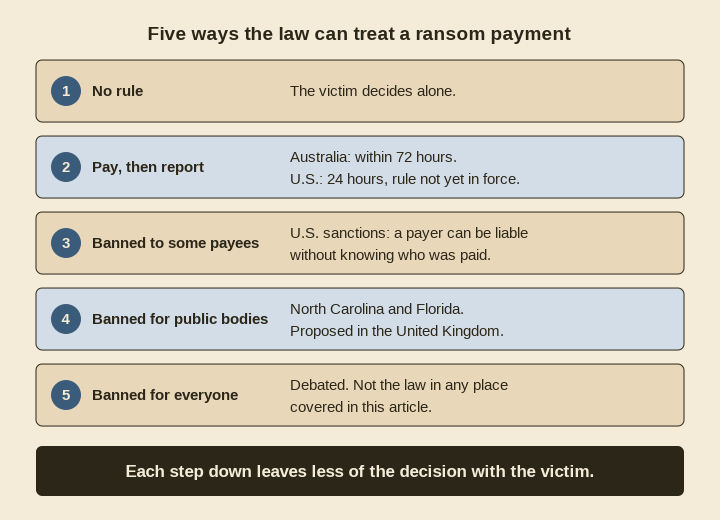 The choice is a ladder with five rungs, and most governments stand on the middle ones.
Reporting rules let a victim pay but make sure investigators hear about it. The British government's second proposal goes one step further: a victim outside the ban would have to tell the authorities before paying, and the authorities could block the payment. In the consultation that idea drew 47 percent agreement in its widest form, and respondents asked how long a decision would take. The task force co-chairs proposed 16 milestones, such as better preparation and more help for victims, to reach before any ban is considered. They expect that to take "several years."
What is known, what is disputed and what is a value judgment?
Known. Payments fund criminal groups. Paying guarantees nothing. Two private data sets show fewer victims paying. Some governments forbid their own agencies to pay.
Disputed. Whether a ban reduces attacks or moves them to whoever is exempt. Whether banned payments would stop or go quiet. How many organizations could survive a refusal today. On each of these the evidence is thin, and both sides say so.
Value judgments. Whether today's victim should bear a cost so that tomorrow's might be spared. Whether the state should tell the victim of a crime what it may do to recover. Whether a hospital should be held to the same rule as a retailer. More data will sharpen these questions and will not answer them.
What to remember
- Both sides agree that ransom money funds more attacks and that paying comes with no guarantee.
- Both sides agree that working, tested backups make the whole question smaller for any one victim.
- Both sides agree that prompt reporting helps, and United States sanctions rules already reward it.
- They divide on whether a ban would cut attacks, or only push payments out of sight and attackers toward the exempt.
- They divide on exceptions: who gets one, and whether listing them paints a target.
- They divide on who should carry the cost of a refusal, which is a question about values.
As of this writing the law in the United States, the United Kingdom and Australia sits on the middle rungs: report, check the sanctions list, and in a few places keep public money out of it. Whether to climb further is in front of legislators now. On the hardest part of it, who gets an exception, the people who answered the British consultation split almost evenly.
Sources (14)
- U.S. Treasury, Office of Foreign Assets Control, "Updated Advisory on Potential Sanctions Risks for Facilitating Ransomware Payments", 21 September 2021
- 6 U.S.C. 681b, Cyber Incident Reporting for Critical Infrastructure Act of 2022
- CISA, "Cyber Incident Reporting for Critical Infrastructure Act of 2022 (CIRCIA)"
- North Carolina General Statutes 143-800
- Florida Statutes 282.3186
- Australia, Cyber Security Act 2024, Part 3, section 27
- UK Home Office, "Ransomware legislative proposals: reducing payments to cyber criminals and increasing incident reporting. Government response", 22 July 2025
- International Counter Ransomware Initiative, "2023 Joint Statement", 1 November 2023
- Chainalysis, 2026 crypto crime report, ransomware chapter, February 2026
- Coveware by Veeam, "The Silent Ransom Group Leak Shows Why Paying for Silence Fails", 28 October 2026
- FBI Internet Crime Complaint Center, "2025 Internet Crime Report", April 2026
- Ransomware Task Force co-chairs, Institute for Security and Technology, "Roadmap to Potential Prohibition of Ransomware Payments", 10 April 2024
- British Library, "Learning Lessons from the Cyber-Attack: British Library cyber incident review", 8 March 2024
- UnitedHealth Group chief executive officer, written testimony before the Senate Finance Committee, 1 May 2024