Articles & BlogBy Trapper W. Brown10 min read
A quantum computer is a machine that calculates using the odd rules that govern very small things, such as single atoms and particles of light. For most tasks it offers no advantage over the computer you already own. For a few specific math problems it could be dramatically faster, and two of those problems happen to be the ones that protect nearly every key exchange and digital signature on the internet.
That is the whole risk in one sentence, and it deserves a calm look, because the subject attracts a lot of noise. No machine that can break today's encryption has been built. The standards to replace the vulnerable parts already exist and are being switched on. The reason to care now is that data stolen today can be stored and unlocked later. This guide explains each of those points from published sources, as of November 12, 2026. It assumes the basics from Encryption and Hashing in Plain Terms.
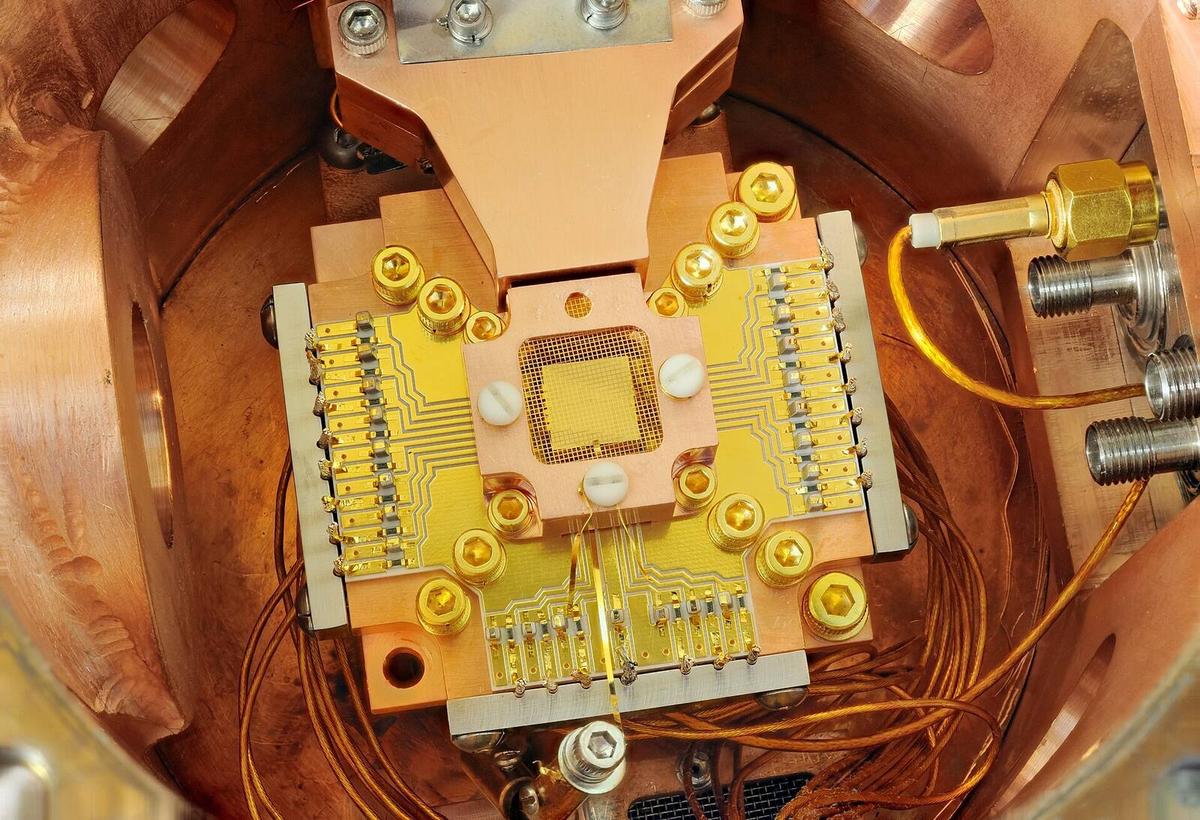 An ion trap used in quantum computing research at NIST. The atoms that act as qubits are held just above the small gold square in the middle. Photo by the National Institute of Standards and Technology, public domain, via Wikimedia Commons.
What is a qubit?
An ordinary computer stores information in bits. Each bit is a switch that is either 0 or 1.
A quantum computer uses qubits. A qubit can be set up in a blend of 0 and 1 at once, a condition called superposition. When you measure the qubit, it gives a plain 0 or 1, and the blend is gone.
Qubits can also be linked, so that the state of one depends on the others. A group of linked qubits holds a blend over every combination of their values. An algorithm for such a machine is a careful sequence of nudges that makes the wrong answers cancel each other out and the right answer reinforce itself, so that when you finally measure, the right answer is the likely one.
Two cautions follow. A quantum computer does not "try every answer at once" and hand you the best one. It only helps on problems with the right hidden structure, and few are known. And qubits are fragile. Heat, vibration and stray fields knock them out of their blend, which causes errors. Fixing that requires error correction: spreading one reliable "logical" qubit across many imperfect physical ones.
What can today's machines not do?
They cannot break encryption, and the gap is large.
The US National Institute of Standards and Technology (NIST) said so in the transition report it finalized in October 2026. The move to new cryptography, it wrote, "is starting before a cryptanalytically relevant quantum computer has been built." That long phrase is the official term for a quantum computer big and stable enough to attack real keys.
How far off is one? Nobody knows, and anyone who gives you a year is guessing. What can be compared is the published size of machines against published estimates of what an attack needs.
- In December 2024, Google described a chip named Willow with 105 qubits. Its headline result was about error correction: errors fell as more qubits were grouped together, which is the behavior a large machine will need. The company's post said the benchmark it ran "has yet to demonstrate practical commercial applications."
- In May 2025, the researcher Craig Gidney posted an estimate that a 2,048-bit RSA key "could be factored in less than a week by a quantum computer with less than a million noisy qubits." This is a preprint, a paper posted before formal review, and it describes a machine that does not exist.
Counting qubits is a crude measure, because quality matters as much as quantity. Still, the scale is plain: 105 qubits on that chip against something under a million in the estimate, with strict assumptions about error rates. That is a gap of nearly ten thousand times.
The honest complication is the trend. The same author's 2019 estimate for the same job was 20 million qubits. The requirement dropped at least twentyfold in six years through better methods alone. If the hardware keeps growing while the requirement keeps shrinking, the two lines meet, and nobody can say when. That uncertainty is why standards bodies decided not to wait.
Shor's algorithm: what does it break?
In 1994 the mathematician Peter Shor presented a method for a quantum computer to solve two problems efficiently: finding the prime factors of a large number, and a related problem called the discrete logarithm. His paper described the machine as "a hypothetical quantum computer." It still is.
Those two problems are the foundations of asymmetric cryptography, the kind that uses a public key and a private key.
- RSA is safe only while factoring is hard.
- Diffie-Hellman key exchange and elliptic curve methods, including the X25519 exchange and ECDSA signatures used across the web, are safe only while the discrete logarithm is hard.
A machine able to run Shor's algorithm at full scale would derive a private key from its public key. Longer keys do not help much, because the method scales well. The only fix is different math. NIST's report states that all of these schemes are "vulnerable to Shor's Algorithm."
What depends on them? The key agreement at the start of every HTTPS connection, the signatures on software updates, the certificates that identify websites, and the keys in messaging apps. Symmetric and Asymmetric Encryption: One Key or Two explains how those pieces work.
Grover's algorithm: what does it not break?
Grover's algorithm, presented in 1996, speeds up a blind search. To find one item among N by trial, an ordinary computer needs about N divided by 2 tries on average. Grover's method needs about the square root of N steps.
Applied to guessing a secret key, that sounds alarming. The square root of 2 to the 128th power is 2 to the 64th, so a 128-bit key would seem to offer 64 bits of protection. In practice the threat is much smaller. NIST's guidance explains that the full speedup requires all the steps to run one after another on a single machine, and it cannot be divided across many machines the way ordinary guessing can. Its conclusion is that it is "quite likely that Grover's algorithm will provide little or no advantage in attacking AES," and that "current applications can continue to use AES with key sizes 128, 192, or 256 bits."
So symmetric encryption (AES, ChaCha20) and hash functions such as SHA-256 survive. The ciphers described in Block Ciphers and Stream Ciphers: Two Ways to Scramble Data and Galois/Counter Mode: Encryption That Notices Tampering are not the problem.
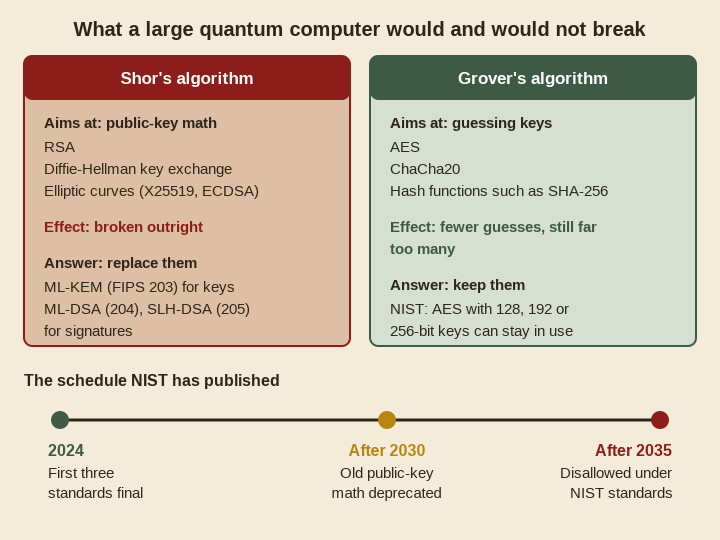 Two algorithms, two very different outcomes. The fix is to replace the key exchange and signatures, and keep the ciphers.
What is "harvest now, decrypt later"?
If the machine does not exist, why act now? Because an attacker does not need it yet. They need only a copy of your encrypted traffic and patience.
NIST describes the threat as one "in which adversaries collect encrypted data now with the goal of decrypting it once quantum technology matures." A recorded HTTPS session contains the public half of the key exchange. Break that exchange years later and the session key falls out, along with everything it protected.
Whether this matters to you depends on how long your secrets stay secret. NIST's report offers a simple test, known as Mosca's theorem. Take three numbers:
- X: how many years the data must stay confidential.
- Y: how many years it will take you to switch to new cryptography.
- Z: how many years until a capable quantum computer exists.
If X plus Y is greater than Z, you are already late. For example, say a hospital system must protect patient records for 25 years and needs 5 years to upgrade everything. X plus Y is 30. Unless it is confident that Z is more than 30 years, it should have started. Now take a family's streaming password, changed every year or two. X is tiny, and a recording of it would be worthless long before anyone could open it.
Signatures are a different case. A signature cannot be harvested and broken later to any effect, because it only has to hold at the moment it is checked. NIST still calls that migration urgent, because replacing signature systems takes longer and involves more parties.
What are the new standards?
The replacements are called post-quantum cryptography: methods that run on ordinary computers but rest on math problems that no known quantum algorithm solves quickly. NIST chose them through a public, multi-round evaluation, and the first three standards were approved on August 13, 2024.
| Standard | Name | Job | Status in November 2026 |
|---|---|---|---|
| FIPS 203 | ML-KEM | Agreeing on a key | Final since August 2024 |
| FIPS 204 | ML-DSA | Signatures | Final since August 2024 |
| FIPS 205 | SLH-DSA | Signatures, built on hash functions | Final since August 2024 |
| (planned as FIPS 206) | Based on FALCON | An additional signature option | In development |
| (not yet numbered) | HQC | Backup for agreeing on a key | Selected March 2025, in development |
NIST recommends the middle strength of ML-KEM, called ML-KEM-768, as the default. It chose HQC in March 2025 as insurance: it rests on a different kind of math, so a flaw found in one would not sink both. The agency said then that it expected to finish that standard in 2027.
The new methods cost space. An X25519 public value is 32 bytes. An ML-KEM-768 key is 1,184 bytes. Networks can carry that, but it is one reason the change needs testing.
Deployment has started. In August 2026 the internet's standards body published RFC 10024, which lets TLS 1.3 run X25519 and ML-KEM-768 together, so that a connection is safe as long as either one holds. NIST's report describes such paired designs as a reasonable hedge during the transition and expects them to be temporary.
What deadlines have been published?
NIST's report, "Transition to Post-Quantum Cryptography Standards" (NIST IR 8547), was released in final form on October 27, 2026. Its dates apply to US federal systems, and the report says it is also meant as a blueprint for other organizations making the same shift.
- After 2030: RSA, Diffie-Hellman and elliptic curve methods are deprecated. In NIST's terms that means they may still be used, but the data owner must weigh the risk.
- After 2035: They are disallowed under NIST standards.
- December 31, 2030: Under an executive order and an Office of Management and Budget memo cited in the report, the government's most sensitive systems must use post-quantum key agreement.
- December 31, 2031: The same systems must use post-quantum signatures.
The report also gives a sobering baseline: past changes of this kind have taken "10 to 20 years" from standard to full adoption.
What should a family and a company do now?
A family has a short list.
- Keep phones, computers and browsers updated. The new key exchange arrives through updates, with nothing to switch on.
- Do not buy anything because it says "quantum safe." Ask which standard it uses. The honest answers are FIPS 203, 204 or 205.
- Keep using long, unique passwords and multi-factor sign-in. A quantum computer does nothing for a criminal that a reused password does not do today, far more cheaply.
A company has real work, and NIST names the first steps: "cryptographic inventories, migration planning, and early deployments."
- Make an inventory. List every place RSA, Diffie-Hellman or elliptic curves are used: web servers, VPNs, code signing, certificates, embedded devices.
- Rank by how long the data lives. Anything that must stay confidential past 2030 goes first, per the Mosca test above.
- Turn on TLS 1.3 everywhere. It is the base the new key exchange is built on.
- Ask every vendor for a dated plan, and write post-quantum support into new contracts.
- Leave the symmetric ciphers alone. AES is not what needs replacing.
What to remember
- No quantum computer can break today's encryption. The chip described here has 105 qubits, and a published attack estimate calls for close to a million.
- Shor's algorithm would break RSA, Diffie-Hellman and elliptic curves. Those are the parts being replaced.
- Grover's algorithm does little against AES. NIST says 128, 192 and 256-bit AES keys can stay in use.
- "Harvest now, decrypt later" means long-lived secrets are at risk from recordings made today.
- The first three replacement standards have been final since August 2024, and NIST will disallow the old public-key methods after 2035.
- Families should update and ignore the marketing. Companies should inventory, prioritize long-lived data and press their vendors.
For a view of where these algorithms sit among everything else that protects you, read Modern Encryption: A Map of What Protects You Today.