Articles & BlogBy Trapper W. Brown9 min readCurrent to 13 November 2026Facts only
As of 13 November 2026, three government agencies have put their names to a list of questions any organization can put to the companies it buys technology from. The subject is post-quantum cryptography: the replacement for the encryption that a future quantum computer is expected to break. The Cybersecurity and Infrastructure Security Agency (CISA) posted the list on 5 November 2026 under the title "Post-Quantum Questions to Ask Your Vendors."
The reason for the list is in CISA's announcement: "Reliance on vendors means that effective PQC transition depends on vendor readiness." Most organizations do not write their own encryption. It comes inside the software, cloud services and devices they buy. So the question "are we ready?" turns into "are they ready?" This article explains how the list is organized and what it asks. The agencies may revise it, so check the official page.
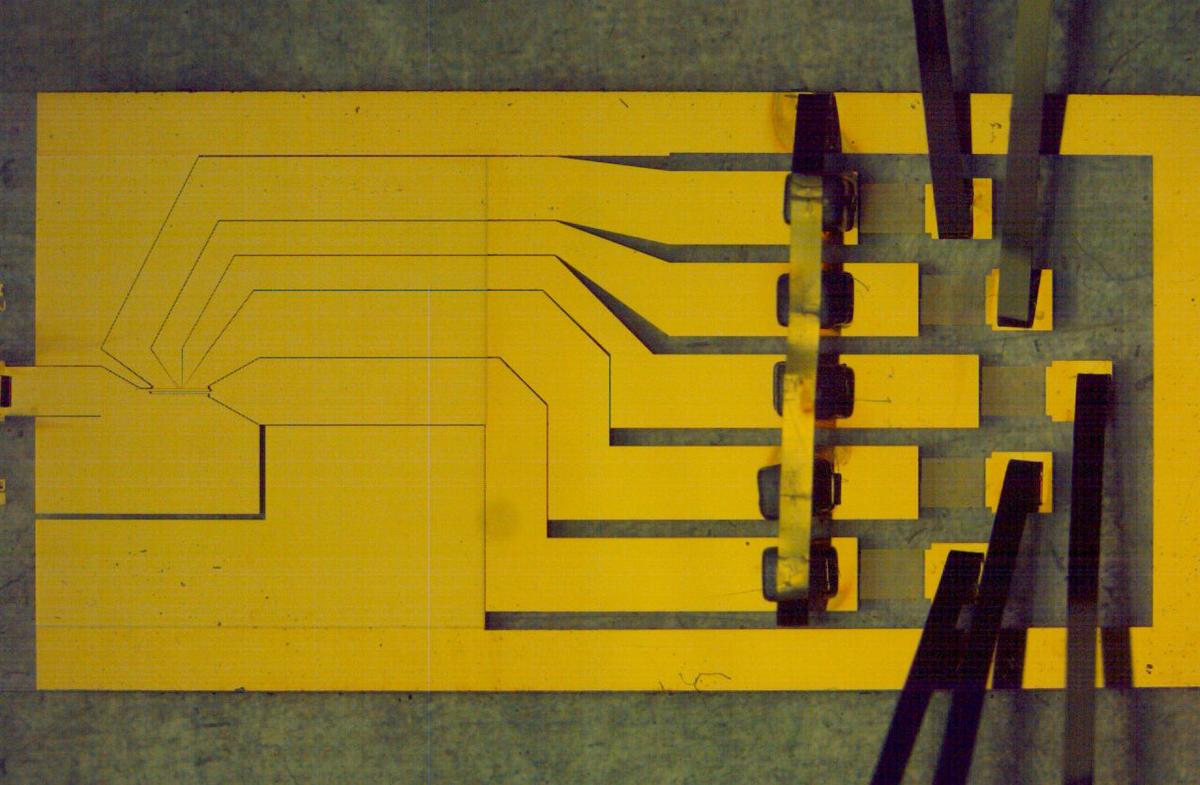 A planar ion trap built at NIST for quantum computing research, photographed in 2006. Photo by the National Institute of Standards and Technology (credit: Signe Seidelin and John Chiaverini), public domain, via Wikimedia Commons.
What was published, and by whom?
The publication sits on the website of the Australian Signals Directorate's Australian Cyber Security Centre (ASD's ACSC). It says the centre "authored this publication in partnership with the United States' Cybersecurity and Infrastructure Security Agency (CISA) and National Security Agency (NSA)." CISA's page links to it and describes it as "joint guidance and an accompanying quick-reference list."
The Australian page shows two dates: "Published 16 Jul 2026" and "Last reviewed 05 Nov 2026." CISA's page shows a publish date of 5 November 2026.
The publication says who it is for: "cyber security leaders, procurement and vendor management teams, and technical stakeholders." It defines a vendor as "a third-party supplier of products or services." The questions are described as "vendor-neutral," and the document names no company.
Why would a quantum computer be your vendor's problem?
The site's article "Quantum Computing and the Risk to Encryption" explains the threat, and "Symmetric and Asymmetric Encryption: One Key or Two" explains the kind of encryption at risk. This article does not repeat them. Three terms from the publication are enough to follow the list.
- CRQC. A cryptographically relevant quantum computer. The publication says traditional asymmetric cryptography "will be vulnerable to attacks from" one. CISA's Post-Quantum Cryptography Initiative page adds that such a machine "does not yet exist."
- PQC. Post-quantum cryptography, which the publication says "includes algorithms designed to remain secure against both quantum-enabled and classical computing threats."
- Harvest now, decrypt later. The publication's name for the risk to "data with long-lived confidentiality requirements": data copied today could be read once a CRQC exists.
The publication then makes the point about suppliers. Many organizations rely on products and services "where the vendors choose and implement the cryptographic mechanisms." It adds that in "industrial control, access control and network devices, cryptography is often embedded, difficult to update and tied to long asset lifecycles." Its examples include legacy systems, operational technology, Internet of Things devices and building management systems.
For example, a company may have a careful plan and still be stuck if the badge readers on its doors or the cloud service holding its records cannot change their cryptography. That example is this article's illustration. The publication's own wording is that "weaknesses or delays in the supply chain can affect progress and introduce residual risk."
How is the list organized?
The questions follow five phases that the publication takes from a framework ASD's ACSC calls LATICE. A footnote says the framework is used "as an organising construct" and that the authoring agencies "include similar transition activities in their PQC guidance."
The phases, in the publication's words:
- "Locate and inventory cryptographic dependencies."
- "Assess risk to individual systems."
- "Triage and prioritise systems for transition."
- "Implement PQC algorithms."
- "Communicate with vendors and educate relevant stakeholders."
By my count the five tables hold 31 questions: 8, 6, 5, 6 and 6. Each question comes with two notes, "Why it matters" and "Key response considerations." The second note tells you what a useful answer looks like.
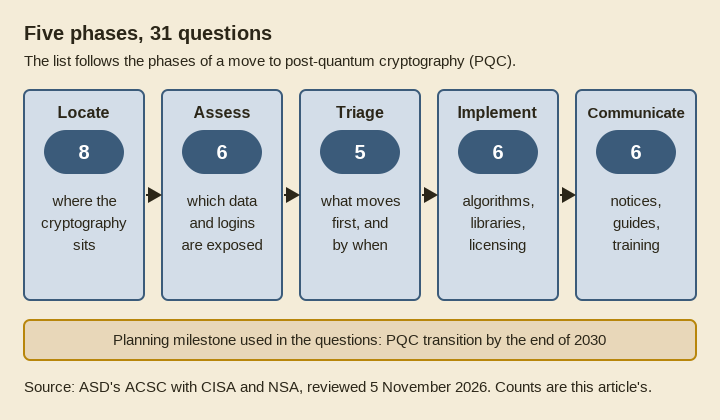 The five phases of the question list and the number of questions in each. Source: ASD's ACSC with CISA and NSA, last reviewed 5 November 2026; the counts are this article's. Diagram by Warhawk Division.
What do the questions actually ask?
The table gives one question from each phase, with the publication's own note on what to look for in the answer. The full list is on the official page.
| Phase | A question from the list | What the publication says to look for |
|---|---|---|
| Locate | "Is any cryptography hardcoded, fixed or hardware bound?" | Confirmation that none exists, or the affected components "along with a feasible remediation roadmap such as patching, firmware upgrades or replacement." |
| Assess | "Which customer data flows rely on traditional asymmetric cryptography?" | "Clear mapping of customer data flows" across interfaces and protocols. |
| Triage | "Which components require hardware replacement or re-architecture?" | "Transparent disclosure" of those components, the reasons, and "any resulting impacts on delivery timelines." |
| Implement | "Is PQC included in base licensing?" | Confirmation that it is included "without additional licensing fees or premium add-ons." |
| Communicate | "How are customers notified of cryptographic changes?" | "Formal and predictable communication mechanisms, such as security advisories, pre-release notes and transition notices." |
A few terms in the list need a plain definition.
A cryptographic bill of materials (CBOM) is an inventory of the cryptography inside a product. The first question on the list asks whether the vendor keeps one. A footnote calls it "an extension of a software bill of materials."
A hardware root of trust is a chip or module that a device relies on to prove its software is genuine. The publication warns that "hardware trust anchors can lock in cryptographic choices."
A PQ/T hybrid runs a post-quantum method and a traditional method together. The publication says hybrid schemes "may support short-term interoperability or resiliency, but are not recommended as a long-term solution," and it asks vendors "how and when will you transition to PQC-only?"
One question addresses a common assumption. "Can customers choose stronger cryptographic settings today?" The publication's note says larger key sizes "may offer only marginal, short-term risk reduction" and "are not a substitute for transitioning to PQC."
The 2030 date. Several questions carry a date. One asks: "Which products or services will be PQC-ready early enough to support customer rollout before the end of 2030?" Another asks whether the vendor's roadmap supports "PQC transition by the end of 2030."
A footnote explains where the date comes from. References to 2030 "reflect PQC transition objectives set out in ASD's Information security manual and Planning for post-quantum cryptography, and are included as a planning milestone for vendor readiness discussions." The footnote continues: "Align transition activities with guidance applicable to your organisation's jurisdiction, sector and risk environment."
So the 2030 date in the list is an Australian planning milestone used as a talking point. CISA's Post-Quantum Cryptography Initiative page lists U.S. executive orders and budget office memoranda that direct its work with federal agencies. I could not confirm from the pages I read a single date that applies to every U.S. organization, and this article gives none.
Which answers call for a closer look?
The publication lists "common concerns in vendor responses":
- "limited visibility of cryptographic use"
- "reliance on general assurances"
- "unclear or deferred transition timelines"
- "use of proprietary or opaque cryptography"
- "treatment of PQC as an optional or premium function"
- "over-reliance on compensating controls"
- "lack of governance or ownership"
It then adds a caution of its own: "These concerns do not necessarily indicate unacceptable risk." It says to weigh them against the vendor's risk level, the sensitivity and lifetime of the data, and "the vendor's willingness to engage transparently." It also notes that "some vendors may not be able to provide detailed responses initially."
What does the publication not say?
- It names no vendor, product or service, and it ranks none.
- It gives no date for when a CRQC will exist.
- It sets no pass mark. There is no score that makes a vendor "ready."
- It is not contract language. It says the questions can be used "during procurement activities, contract renewals or ongoing vendor assurance processes," and leaves the drafting to the reader.
- It does not say which algorithms to demand. It asks for "standards-based algorithms, approved by the appropriate authoring agency for your organisation."
- It is guidance. It does not say that any law requires an organization to ask these questions. Whether a law or contract requires your organization to act is a question for your own counsel.
What to do
This section repeats the publication's own "Key actions" and its instructions for using the list. It is general information, not professional advice for any particular organization.
The four key actions, as published:
- "Understand your organisation's cryptographic dependencies and vendor-related risks."
- "Assess vendor readiness for PQC using the recommended questions."
- "Engage suppliers and service providers early to support PQC transition planning."
- "Incorporate PQC considerations into procurement, contract renewal and vendor assurance activities."
On how to use the questions, the publication says to "tailor depth based on the risk level of the product or service, the degree of cryptographic control exercised by the vendor, data sensitivity and longevity, and the organisation's current stage of PQC transition."
On timing, it says to prioritize the Locate questions "before entering long-term contracts or cloud service agreements where cryptographic choices may be difficult to change."
For more, it points U.S. readers to CISA's Post-Quantum Cryptography Initiative page and to NSA's quantum-readiness guidance. The site's article "Trust but Verify: Vetting Vendors and Contracts" covers supplier questions in general, and "Modern Encryption: A Map of What Protects You Today" shows where this cryptography sits.
What to remember
- CISA posted the list on 5 November 2026. ASD's ACSC wrote it in partnership with CISA and NSA.
- It holds 31 questions by my count, in five phases: locate, assess, triage, implement, communicate.
- Each question comes with a note on what a useful answer contains.
- The 2030 date in the questions is an Australian planning milestone; the publication says to follow the guidance that applies where you are.
- The publication lists seven warning signs in vendor answers and says they "do not necessarily indicate unacceptable risk."
- It names no vendor and sets no pass mark.
The list is free, and the publication's stated read time is 15 minutes. The official page is the version to work from, since the agencies last reviewed it on 5 November 2026 and may do so again.
Sources (3)
- CISA, "Post-Quantum Questions to Ask Your Vendors", 5 November 2026
- Australian Signals Directorate's Australian Cyber Security Centre, with CISA and NSA, "Post-quantum questions to ask your vendors", published 16 July 2026, last reviewed 5 November 2026
- CISA, "Post-Quantum Cryptography Initiative", read 13 November 2026