Articles & BlogBy Trapper W. Brown12 min read
For anyone who has flipped a light switch and wondered what is on the other end of the wire. By the end you will be able to trace the path from a power plant to an outlet and say what 60 hertz has to do with keeping the lights on.
You flip a switch and the light comes on. Nothing was waiting in the wall. The electricity that lit the bulb was made a fraction of a second earlier, at a power plant that may be several states away, and it was made because you asked for it.
The machine that does this is called the grid. The U.S. Energy Information Administration (EIA) describes it as the "electricity substations, transformers, and power lines that connect electricity producers and consumers." In a 2016 article the agency counted more than 7,300 power plants, nearly 160,000 miles of high-voltage lines and 145 million customers on it. This article follows the electricity from one end to the other and then explains the part most people never hear about: the balancing act that keeps it all running.
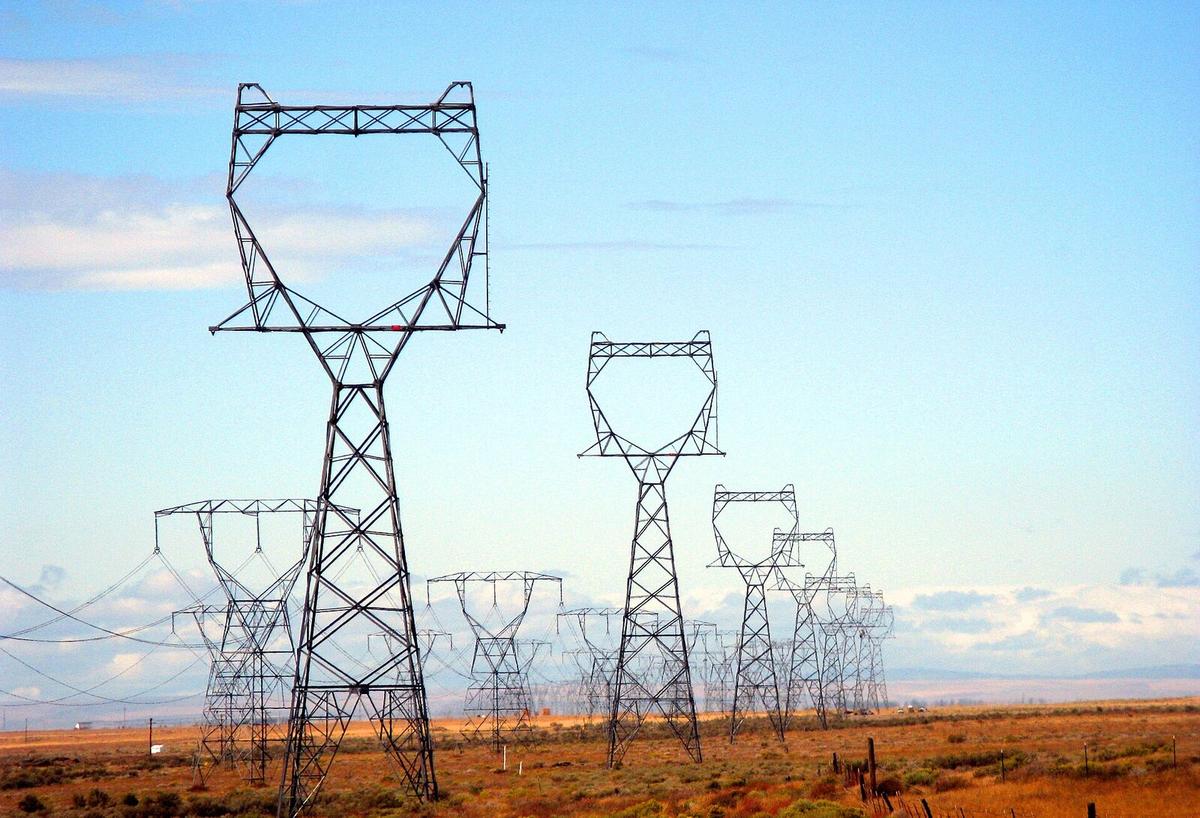 Transmission towers on the McNary to John Day line in Washington State, the long-haul part of the grid. Photo by the Bonneville Power Administration via the U.S. Department of Energy, public domain, via Wikimedia Commons.
Where does the electricity come from?
Almost all of it comes from something spinning. In 1831 the scientist Michael Faraday found, in the EIA's words, "that moving a magnet inside a coil of wire makes (induces) an electric current flow through the wire." A power plant generator is that discovery built large: a magnet on a shaft, called the rotor, turning inside fixed coils of wire, called the stator.
Something has to turn the shaft. In most plants that job belongs to a turbine, a wheel of blades pushed by a moving fluid. The EIA lists the fluids: water, steam, combustion gases or air. A coal plant and a nuclear plant both boil water and send the steam through a turbine. They differ only in how they make the heat. A hydroelectric dam uses falling water, and a wind turbine uses moving air. Solar panels are the main exception, since they make electricity from light with no moving parts, and "Solar Panels on a Home: The Pros and Cons" covers how.
The EIA puts total U.S. generation at large plants in 2025 at about 4.43 trillion kilowatthours. Here is where it came from.
| Natural gas | 41% |
|---|---|
| Nuclear | 18% |
| Coal | 17% |
| Wind | 11% |
| Solar | 7% |
| Hydropower | 6% |
Source: U.S. Energy Information Administration, Electricity in the United States
Why is the voltage raised so high?
A generator does not make electricity at the voltage in your wall. A U.S. Department of Energy primer on the industry says electricity "is generally produced at 5 to 34.5 kilovolts (kV)", is transmitted at 69 to 765 kV, and is distributed at 15 to 34.5 kV. A kilovolt is 1,000 volts. So the first stop outside the plant is a step-up transformer, a device that trades current for voltage.
Voltage is the push behind the electricity and current is the amount flowing. The primer compares voltage to water pressure and current to the flow of water. Power, the thing you are trying to deliver, is the two multiplied together. The same power can travel as a small push with a large flow or as a large push with a small flow.
The wire cares which one you pick. Every wire resists current a little, and that resistance turns some of the power into heat. The heat lost depends on the current squared, so halving the current cuts the loss to a quarter.
Here is a worked example. The numbers are made up for easy arithmetic and treat the line as one simple wire.
| Sent at 34.5 kV | Sent at 345 kV | |
|---|---|---|
| Power to deliver | 100 megawatts | 100 megawatts |
| Current needed (power divided by voltage) | about 2,899 amps | about 290 amps |
| Wire resistance | 5 ohms | 5 ohms |
| Lost as heat (current squared times resistance) | about 42 megawatts | about 0.42 megawatts |
| Share of the power lost | 42 percent | 0.42 percent |
Ten times the voltage means one tenth the current and one hundredth of the loss. That is the whole reason for the tall towers. The EIA says it plainly: "Higher-voltage electricity makes long-distance electricity transmission more efficient and less expensive."
Real losses are small as a result. The EIA estimates that transmission and distribution losses together "averaged about 5% of the electricity transmitted and distributed in the United States in 2018 through 2022."
What happens between the tower and the outlet?
High voltage is good for wires and bad for toasters, so the voltage comes back down in stages.
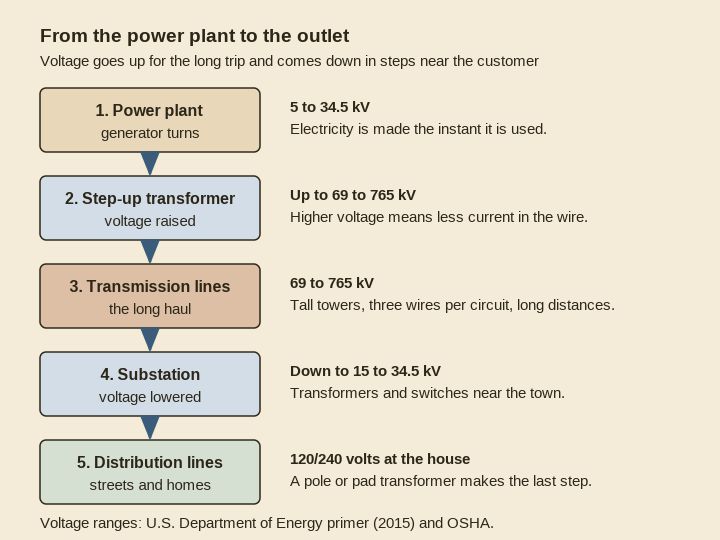 The voltage goes up once for the long trip and comes down in steps near the customer.
Transmission lines are the long haul. The Energy Department primer says typical lines run at 765, 500, 345, 230 and 138 kV, and that higher voltages need larger towers. Look closely at a tower and you will see the wires come in threes. Grid power is made in three overlapping waves, called phases, and each circuit carries one wire per phase.
Substations are the fenced yards full of gray equipment at the edge of town. Inside are transformers that step the voltage down, plus switches and breakers that can cut a damaged line out of the network.
Distribution lines are the ones on wooden poles along the street. The Occupational Safety and Health Administration (OSHA) says these systems "typically deliver voltages as high as 34,000 volts (34 kV) and as low as 120 volts."
The last transformer is the gray can on the pole or the green box on a concrete pad in the yard. OSHA describes it: the electricity "is reduced to the end use voltage (120/240 volts single phase) via a pole mounted or pad-mounted transformer." From there a service line runs to your meter and your breaker panel.
Why does supply have to match demand every second?
A water system has tanks, and a gas system has pipes that can be packed with extra gas. The wires of the grid hold nothing. The electricity going in at the power plants has to equal the electricity coming out at the outlets, plus the losses, all the time. Batteries and pumped water storage exist on the grid, but they are plants that take power in and give it back. The lines themselves are not a tank.
The EIA states the rule: "For the electricity grid to remain stable, the amount of electricity supplied must match electricity demand." It also names the price of failure: "If electricity demand and supply fall out of balance, local or even widespread blackouts can happen."
The work falls to organizations called balancing authorities. Most are electric utilities. Each one watches its own area, forecasts demand, and tells power plants to raise or lower output. The EIA's 2016 article counted 36 balancing authorities in the eastern grid, 37 in the western grid and a single one in Texas.
What does 60 hertz have to do with it?
The grid's current is alternating current: it reverses direction in a steady rhythm. In North America the rhythm is 60 full cycles a second, written 60 hertz (Hz). A generator built so that one turn of its rotor makes one cycle would spin 60 times a second, which is 3,600 turns a minute.
Here is the part that surprises people. Every generator connected to the same grid turns in step with every other one. The North American Electric Reliability Corporation (NERC), which writes the grid's reliability standards, puts it this way: each interconnection "can be viewed as a single large machine with every generator pulling together to supply electricity to all customers."
That makes frequency a gauge. NERC again: "When the total Interconnection supply exceeds customer demand, frequency increases beyond the scheduled value (typically 60 Hz) until energy balance is achieved." When supply falls short, frequency drops. An operator can read one number and know whether the whole machine is ahead or behind.
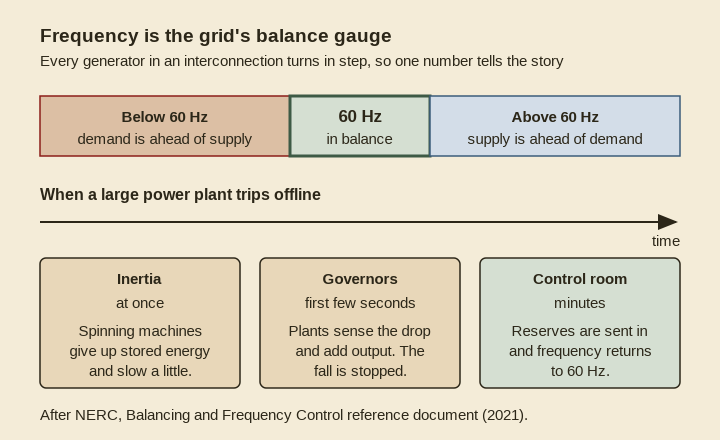 Frequency rises and falls with the balance of supply and demand, and three layers of response pull it back.
When a big plant trips offline, three things happen in order, according to NERC's reference document on balancing. First, the heavy spinning rotors across the grid give up a little of their stored energy and slow slightly. NERC compares it to a bicycle wheel giving its energy to the brake. Second, within the first few seconds, devices called governors act. NERC says they "are like cruise controls for cars": they sense the drop and add output on their own. That stops the fall but does not undo it. Third, over minutes, control rooms send in reserve power and bring the frequency back.
The balance is never perfect. NERC notes that "frequency is never maintained at exactly 60 Hz for any appreciable length of time." Its own example: if the grid runs at 60.002 Hz, a clock that keeps time by counting the grid's cycles gains 1.2 seconds in 10 hours.
Tip
Two units get mixed up on every electric bill. A kilowatt (kW) is a rate, how fast power is flowing right now. A kilowatthour (kWh) is an amount: one kilowatt flowing for one hour. Balancing authorities match kilowatts second by second. Your bill counts kilowatthours.
Why are there three grids and not one?
The EIA says that at the start of the 20th century "more than 4,000 isolated electric utilities operated in the United States." They linked up over time to share plants and cover for each other, and "three large, interconnected systems evolved."
| Interconnection | What it covers, per the EIA |
|---|---|
| Eastern | The area east of the Rocky Mountains and part of the Texas panhandle |
| Western | The area from the Rocky Mountains to the west |
| Texas (ERCOT) | Most of Texas |
The Eastern and Western grids also reach into Canada. NERC counts a fourth in North America, in Quebec.
Inside each one, every generator turns in step. Between them, they do not. The EIA says the three "mostly operate independently from each other and rarely transfer electricity among them." The Energy Department primer explains how any power crosses at all: through a few stations that convert alternating current to direct current and back, since direct current has no rhythm to match.
Who makes sure it keeps working?
For most of the grid's history the rules were voluntary. The Federal Energy Regulatory Commission (FERC) traces the change to two blackouts. The first, on November 9, 1965, cut power to over 30 million people in the Northeast and Canada, FERC says, and led the industry to form NERC. The second came on August 14, 2003. The joint U.S. and Canadian task force that investigated it reported that it "affected an area with an estimated 50 million people" in eight states and Ontario.
Congress then passed the Energy Policy Act of 2005. Under it, FERC certified NERC in 2006 to write reliability standards that carry the force of law once FERC approves them. FERC says there are now more than 80 of those standards and that penalties "can be over $1 million per day, per violation." One standard requires line owners to keep trees away from transmission lines, which FERC calls "historically a major cause of cascading blackouts."
Watch out
A common mistake is to treat a fallen wire as dead because the lights are out. OSHA's fact sheet on downed wires says: "Do not assume that a downed power line is safe simply because it is on the ground or it is not sparking." Its rule is "Never go near a downed or fallen electric power line."
What do people get wrong?
"The grid stores electricity." It does not. Storage plants are connected to it, but the wires hold nothing, which is why balance matters every second.
"My power comes from the nearest plant." On an interconnected grid, electricity from every running generator flows into one shared network and follows the wires. Your outlet draws from the pool.
"The United States has one national grid." It has three that barely exchange power.
"A blackout means there were not enough power plants." Sometimes. Often the trouble is in the wires. FERC names trees touching transmission lines as a major cause of cascading blackouts in the past, which is why trimming them is now a federal standard.
What to remember
- Electricity is made the instant it is used. The wires store nothing.
- Nearly all of it comes from a turbine spinning a magnet inside coils of wire.
- Voltage is raised for the long trip because loss depends on current squared. Ten times the voltage means one hundredth of the loss.
- It comes back down in steps: substation, street, and the last transformer outside your home.
- Frequency is the balance gauge. Above 60 Hz means too much supply, and below means too little.
- The lower 48 states have three interconnections, and reliability rules have been mandatory since the 2005 law.
The grid is also a control problem, and the computers that run substations and power plants are a subject of their own. "What SCADA Systems Are and How They Are Vulnerable" picks up there. For what the grid charges you, see "The Cost of Home Energy Over the Last 50 Years", and for the days it fails, "Winter Power Outages: Generators, Heaters, Food and Pipes".
Sources (11)
- U.S. Energy Information Administration, "Electricity explained: How electricity is delivered to consumers", read 15 November 2026
- U.S. Energy Information Administration, "U.S. electric system is made up of interconnections and balancing authorities", 20 July 2016
- U.S. Energy Information Administration, "Electricity explained: Electricity in the United States", read 15 November 2026
- U.S. Energy Information Administration, "Electricity explained: How electricity is generated", read 15 November 2026
- U.S. Energy Information Administration, "How much electricity is lost in electricity transmission and distribution in the United States?", last updated 7 November 2023
- U.S. Department of Energy, Office of Electricity Delivery and Energy Reliability, "United States Electricity Industry Primer", July 2015
- Occupational Safety and Health Administration, "Electric Power Generation, Transmission, and Distribution eTool: Distribution System", read 15 November 2026
- Occupational Safety and Health Administration, "Working Safely Around Downed Electrical Wires" fact sheet, February 2018
- North American Electric Reliability Corporation, "Balancing and Frequency Control: Reference Document", 11 May 2021
- Federal Energy Regulatory Commission, "Reliability Explainer", last updated 16 August 2023
- U.S.-Canada Power System Outage Task Force, "Final Report on the August 14, 2003 Blackout in the United States and Canada: Causes and Recommendations", April 2004