Articles & BlogBy Trapper W. Brown10 min readBoth sides
For a homeowner who keeps getting the knock on the door. By the end you will be able to work out whether solar fits your house, and read a quote without being rushed.
Rooftop solar is a small power plant bolted to your house. It turns sunlight into electricity, you use that electricity before you buy any from the utility, and your bill goes down. About 5.3 million such systems are tracked in the national lab data, so this is no longer an experiment.
Whether it is a good deal is a separate question, and the honest answer is that it depends on your roof, your utility's rules and how you pay. This guide lays out both sides and takes neither. One thing changed recently that every reader should know first: the federal tax credit that paid 30 percent of the cost is gone for systems installed after 2025.
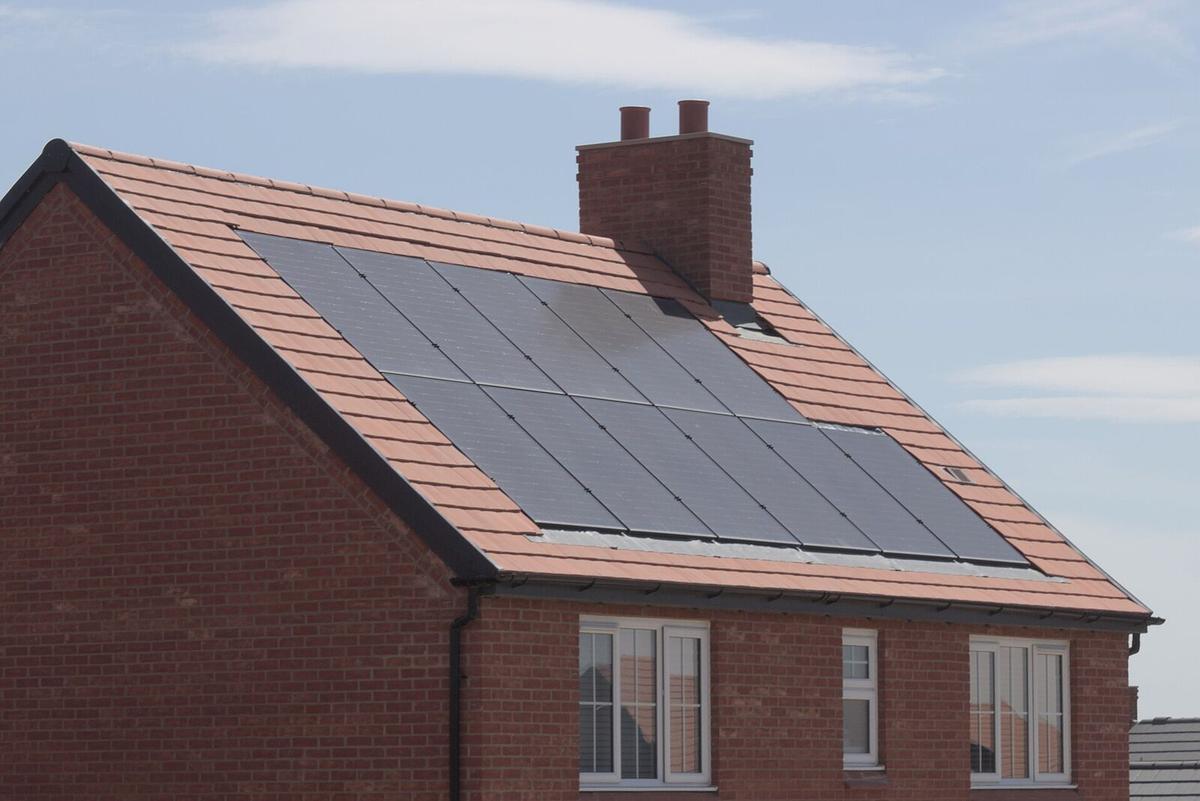 Panels on one slope of an ordinary pitched roof. Which way that slope faces decides much of what follows. Photo by Aethonatic, CC0, via Wikimedia Commons.
How does a home system work?
There are four parts, and one optional one.
Panels make direct current (DC), the kind of electricity a battery gives. An inverter changes it to alternating current (AC), the kind your outlets use. The power flows into your breaker panel and runs the house. When the panels make more than the house needs, the extra flows out through the meter to the grid. At night, power flows in as usual. A battery, if you buy one, stores some of the daytime extra for later.
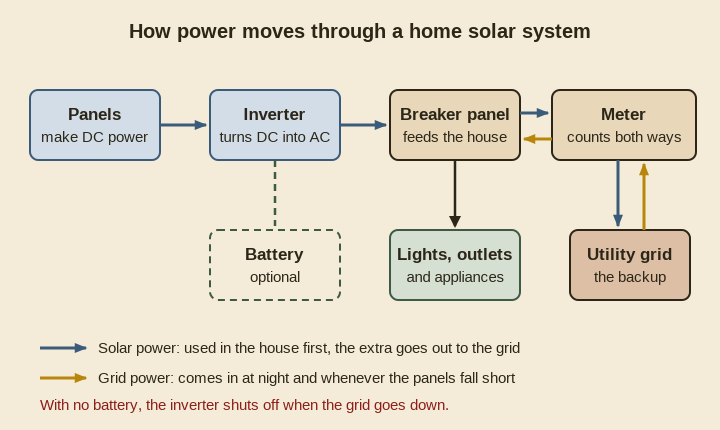 Solar power is used in the house first. The meter counts what goes out and what comes in.
One fact surprises people. In a power outage, a standard system turns itself off. The Department of Energy explains that many systems are built to detect an outage and disconnect, so they do not push power into lines that crews are repairing. To keep the lights on in an outage you need a battery and equipment that can separate the house from the grid.
What does it cost, and what does it make?
The best price data comes from Lawrence Berkeley National Laboratory, which tracks actual installs. Its August 2026 update, covering systems installed in 2025, reports:
- A median price of $3.60 per watt for a system the homeowner owns, before incentives. Cash buyers paid a median of $3.00. Loan buyers paid $4.50.
- A median size of 7.7 kilowatts. Most systems were between 5 and 12.
- A wide spread: the typical price charged by large installers ran from $2.40 to $6.30 per watt.
- A battery on 37 percent of new systems: 74 percent in California, 17 percent in all other states. The median battery held 13.5 kilowatt-hours.
So the median system cost 7,700 watts times $3.60, or about $27,700. A separate federal benchmark, which models what a system should cost, puts an 8 kilowatt system at $2.95 per watt in early 2025, and $4.59 per watt with a battery.
What it makes depends on your sun. The free PVWatts calculator, run by the National Laboratory of the Rockies (the federal lab long known as NREL), estimates a year's output for your address and roof. For scale, the average American home used 863 kilowatt-hours a month in 2024, or about 10,400 a year, at an average price of 16.48 cents.
The tax credit. The Residential Clean Energy Credit was 30 percent of the cost. The IRS now says it cannot be claimed for expenditures made after 31 December 2025, and that an expenditure counts as made when the installation is completed, not when you pay. A system finished in 2026 gets no federal credit of this kind. Leased systems fall under different business credits that belong to the company and follow their own deadlines. Ask your state energy office and your utility whether either offers an incentive of its own.
Why does net metering matter so much?
Because a house rarely uses solar power at the moment it is made. Panels peak at midday. Many households peak in the evening. The rule for the extra you send out decides what that power is worth.
Under classic net metering, a kilowatt-hour you export earns a credit equal to one you buy. The grid acts like a free battery. Under net billing and similar plans, exports earn a lower credit than the retail price.
The rules are set state by state, sometimes utility by utility, and they keep changing. Hawaii's regulator closed its net metering program to new customers in October 2015 and replaced it with options that paid less for exports. California moved new customers to a net billing tariff for applications filed on or after 15 April 2023. In the first three months of 2026 alone, a university center that tracks these cases counted policy actions in 44 states, 61 of them on net metering. Hawaii let existing customers keep their old terms. Whether that happens is decided case by case, so ask what protects you if the rule changes after you sign.
Does it pay back? A worked example
Payback is the number of years until the savings equal the price. Here is the arithmetic with example numbers. Only the size and price come from the lab data. The rest is assumed.
- System: 7.7 kilowatts at $3.60 per watt, paid in cash. Cost: $27,720.
- Output (example): 1,300 kilowatt-hours per kilowatt each year, so 10,010 a year.
- Half is used in the house as it is made. Half is exported.
| Case | Electricity price | Credit for exports | Saved per year | Years to pay back |
|---|---|---|---|---|
| A | 17.3 cents | Full retail | $1,732 | 16 |
| B | 17.3 cents | One third of retail | $1,154 | 24 |
| C | 32 cents | Full retail | $3,200 | 9 |
| D | 32 cents | One third of retail | $2,133 | 13 |
Same roof, same panels, and the answer runs from 9 years to 24. The variables that move it most are your electricity price, the export credit, how much power you use while the sun is up, the price you pay per watt, and loan interest. Rising utility rates shorten the payback. A shadier roof or a loan lengthens it. A battery raises the cost and, under net billing, raises the share you use yourself.
Is your roof a good candidate?
The Department of Energy's homeowner guide says panels do best on south-facing roofs with a slope between 15 and 40 degrees. East and west faces work, with less output. Shade from trees or a neighbor's house cuts production, and it changes as trees grow.
Roof age matters as much. Panels are expected to last 25 to 35 years, by the department's figures. If the shingles under them have ten years left, you will pay to take the panels off and put them back. As a rule of thumb, replace an aging roof first.
Panels wear slowly. The lab's long-running test program says modules often lose less than 1 percent of their output a year. At a full 1 percent, a panel would still make about 78 percent of its first-year power after 25 years. The inverter is electronics, and it may need replacing sooner than the panels do. Ask what its warranty covers.
At the end, disposal is still an unsolved cost. The Department of Energy says recycling a panel generally costs more than sending it to a landfill. The Environmental Protection Agency notes that some panels can count as hazardous waste, depending on how much lead or cadmium leaches out in testing, and that a handful of states have their own rules.
Buy, lease or sign a power agreement?
There are three ways to pay.
- Buy with cash or a loan. You own the system and keep all the savings. A loan may hide a cost: the Consumer Financial Protection Bureau found in 2024 that lenders' "dealer fees" typically added 10 to 30 percent to the cash price.
- Lease. A company owns the panels on your roof and you pay a monthly fee.
- Power purchase agreement (PPA). A company owns the panels and you pay for each kilowatt-hour they make.
In 2025, 40 percent of new home systems were owned by a third party under a lease or PPA. These cost little or nothing up front. The Federal Trade Commission warns that the payments can rise each year and that the contracts are costly to end.
Ownership also decides what happens when you sell. A federal guide cites a 2015 lab study in which buyers paid about $15,000 more for a home with an average-sized owned system. That study is old, so treat the figure as a sign of direction and not a promise. Leased panels are different: Fannie Mae, which sets rules for many mortgages, does not let leased or PPA panels count toward the appraised value, and in most cases counts the monthly payment among the buyer's debts. The Consumer Financial Protection Bureau also cites reports that solar lenders commonly file a lien notice on the equipment, which can complicate a sale or a refinance.
On insurance, the National Association of Insurance Commissioners says not every insurer extends coverage to panels and that they can raise your premium. Call your insurer before you sign, not after.
What should make you careful about a sales pitch?
The US Treasury published a consumer advisory on solar sales in August 2024, and the Federal Trade Commission issued an alert the same month. The practices they describe:
- Claims that the panels are "free" or part of a government or utility program.
- Pressure to sign today because an offer is about to end.
- Promised tax credits or savings that the seller cannot put in writing. In 2026, any pitch that still counts on the 30 percent federal credit for a new purchase is out of date.
- A low first payment that jumps later.
- Being told you cannot cancel. For a sale made at your home, the FTC's Cooling-Off Rule gives you until midnight of the third business day.
Watch out
Do not sign on a tablet at the door. Ask for the full contract on paper or by email, read the total price, the payment schedule and the cancellation terms, and get two more quotes. A real offer will still be there next week.
The two sides, and the questions that decide it
| In favor | Against |
|---|---|
| Lower electric bills for 25 years or more | High cost up front, or a long contract |
| Protection from part of future rate increases | No federal tax credit for systems installed after 2025 |
| Panels wear slowly | Payback depends on rules a regulator can change |
| With a battery, power in an outage | Without a battery, no power in an outage |
| An owned system may add to sale value | A leased system can complicate a sale |
| Uses a roof that otherwise earns nothing | Roof work, insurance and disposal are your problem |
The questions for your own house:
- How much do you pay per kilowatt-hour, and how many do you use in a year?
- What does your utility credit for exported power today, and are current customers protected if it changes?
- Which way does the roof face, how much shade does it get, and how old is it?
- How long will you stay in the house?
- Will you pay cash, borrow, or sign a lease or PPA? What is the total paid over the full term?
- Do outages matter enough to you to pay for a battery?
- What do three quotes say, in dollars per watt?
Solar tends to suit a household with high electricity prices, a sunny roof in good condition, a favorable export rule, cash or cheap credit, and plans to stay a decade or more. It tends not to suit a household with cheap power, a shaded or aging roof, low export credits, a move on the horizon, or a need to finance at a high rate. Many houses sit in between, and for them the worked example above, redone with their own numbers, is the answer.
What to remember
- A home system is panels, an inverter, your breaker panel and a two-way meter. A battery is optional.
- The median owned system installed in 2025 was 7.7 kilowatts at $3.60 per watt, about $27,700 before incentives.
- The federal residential credit does not apply to systems completed after 31 December 2025.
- What your utility pays for exported power can double or halve the payback.
- Without a battery, a standard system shuts off in an outage.
- Leases and PPAs cost less up front, and more care is needed when the house is sold.
A good next step costs nothing: gather twelve months of electric bills, look up your utility's current solar tariff, and run your address through PVWatts. With those three things in hand, the table in the payback section stops being an example and becomes your own.