Articles & BlogBy Trapper W. Brown11 min read
For anyone who has seen a headline about half the internet going dark and wondered how that is even possible. By the end you will know what an autonomous system is, how one bad announcement can pull traffic the wrong way, and what the fix checks.
No one runs the internet. It is a collection of separate networks, each owned by a different company, university or government, joined at their edges. When you load a page from a server on another continent, your packets cross several of them. None of those networks has a map of the whole thing.
What they have is a protocol for telling their neighbors, "I can reach these addresses." It is called the Border Gateway Protocol, or BGP. It was built on trust, it still mostly runs on trust, and when the trust is misplaced, traffic for a bank, a video site or a whole country can end up in the wrong place. This article explains how it works and what is being done to check the claims.
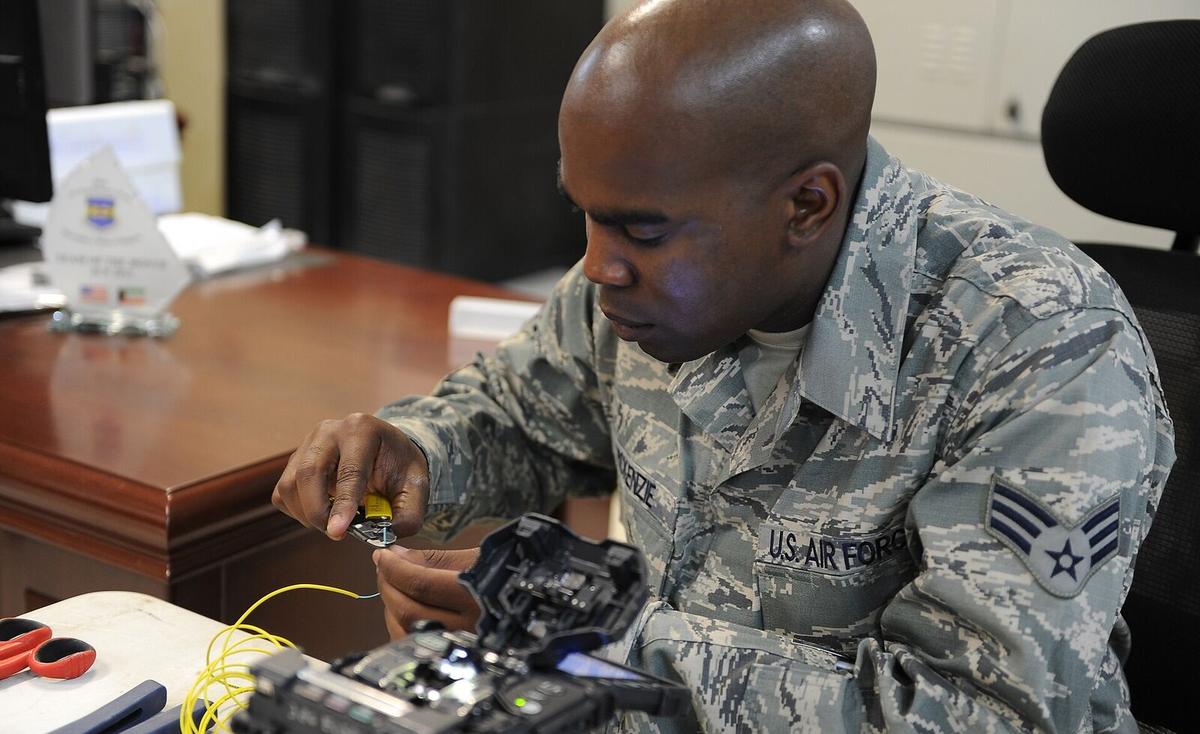 Paths between networks are glass fibers that someone joined by hand. BGP decides which of them your packets take. U.S. Air Force photo by Master Sgt. Marelise Wood, public domain, via Wikimedia Commons.
What is an autonomous system?
An autonomous system, or AS, is one of those separate networks. The BGP standard, RFC 4271, gives the classic definition as "a set of routers under a single technical administration." The Federal Communications Commission (FCC) describes the internet as "tens of thousands" of them, "independently administered and managed."
Each one has a number. Your internet provider has one. So do large companies, universities and the big content and cloud firms.
For example, take a family and a college. The family's home network is not an autonomous system. It sits inside its provider's, uses addresses the provider lends it, and has one way out. The college is different. It has its own block of addresses and buys service from two providers, so that losing one does not take it offline. To tell both providers "these addresses are mine, send their traffic to me," it needs its own AS number and it needs to speak BGP.
How does BGP spread the news?
RFC 4271 says the main job of a BGP router is "to exchange network reachability information with other BGP systems." Reachability information means a block of addresses, called a prefix, plus "the list of Autonomous Systems" the news has passed through. The article "The Magic Number: Subnetting in Your Head" explains how a prefix such as 203.0.113.0/24 names a block of 256 addresses.
The college announces its prefix to its provider. The provider adds its own AS number to the front of the list and passes the announcement to its neighbors. They do the same. In a short time, networks all over the world have an entry that says: to reach those addresses, hand the packet to this neighbor, and here is the chain of networks it will cross.
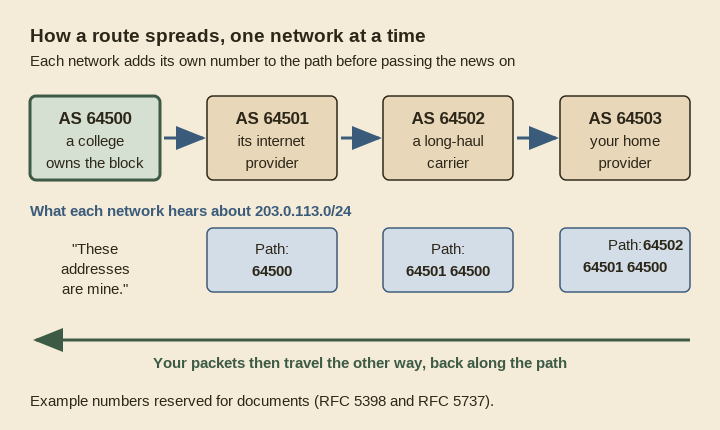 An announcement travels outward and grows a longer path at each step. Traffic flows back the other way.
Three details matter for what follows.
- BGP rides on TCP. The standard says BGP "listens on TCP port 179." Two routers open an ordinary connection and keep it open. The article "TCP, UDP and the Handshake: How Two Computers Agree to Talk" covers what that means.
- Only changes are sent. After the first exchange, "incremental updates are sent as the routing tables change." A router can also withdraw a route, which tells its neighbors "I can no longer reach this."
- The most specific prefix wins. If a router hears about both a large block and a smaller block inside it, traffic for the smaller block follows the smaller block's route. Among routes for the same prefix, each network applies its own policy, and a shorter path is commonly preferred.
Why is it built on trust?
A BGP router has no built-in way to check that a neighbor's announcement is true. If a network says "these addresses are mine," the protocol passes it on.
The FCC put it plainly in 2024: BGP's "initial design, which remains widely deployed today, did not include security features to ensure trust in the information that it is used to exchange." The FCC notes that when BGP made its debut about 30 years earlier, its users were "mostly academic and research organizations."
Two kinds of failure follow from that. One is a claim to addresses that belong to someone else. The other is a true announcement repeated to the wrong neighbors.
What is a hijack?
A hijack is an announcement of someone else's addresses. It can be deliberate or a mistake. The effect on traffic is the same.
The textbook case was documented by RIPE NCC, one of the regional registries that hand out internet addresses. On 24 February 2008, YouTube was announcing the prefix 208.65.152.0/22. RIPE NCC's case study says that at 18:47 UTC "Pakistan Telecom (AS17557) started an unauthorised announcement of the prefix 208.65.153.0/24," a smaller block inside YouTube's. The study adds that "Pakistan aimed to block the YouTube website." One of the carrier's providers passed the announcement on to the rest of the world.
Because the most specific prefix wins, routers around the world began sending that slice of YouTube's traffic toward Pakistan. YouTube answered about 80 minutes later by announcing the same /24 itself, and then two /25 blocks, each more specific still. The upstream provider withdrew the bad route at 21:01 UTC. RIPE NCC sums it up: "all the major events finished after about two hours."
It still happens. Cloudflare reported that on 27 June 2024 its public DNS service at 1.1.1.1 was unreachable or slow for "a small number of users globally," and gave the root cause as "a mix of BGP (Border Gateway Protocol) hijacking and a route leak" that began outside its own network.
What is a route leak, and what is a withdrawal?
A route leak involves no false claim of ownership. RFC 7908 defines it as "the propagation of routing announcement(s) beyond their intended scope." The usual shape: a network that buys service from two providers learns routes from one and repeats them to the other. It has now offered itself as a shortcut between two giants. If they believe it, traffic pours through a network that was never sized to carry it.
RFC 7908 says leaks "can be accidental or malicious but most often arise from accidental misconfigurations." A later standard, RFC 9234, describes them as "usually the result of misconfigured or absent BGP route filtering."
A third kind of event involves no bad announcement at all. On 4 October 2021, Facebook and its other services vanished for hours. The company's engineers explained that during routine maintenance, "a command was issued with the intention to assess the availability of global backbone capacity, which unintentionally took down all the connections in our backbone network." Their DNS servers, cut off from the data centers, did what they were designed to do and withdrew their BGP announcements. "The end result was that our DNS servers became unreachable even though they were still operational." The FCC later called it a "five-hour global outage." The article "DNS: The Internet's Phone Book" explains why losing those servers made every name stop working.
| Event | What is announced | Typical cause, per the sources above |
|---|---|---|
| Hijack | Addresses the announcer has no authority over | Deliberate, or an error |
| Route leak | Real routes, repeated to neighbors that should not get them | Most often misconfiguration |
| Withdrawal | Nothing: a network's own routes are taken back | An internal failure or change |
How does RPKI check an announcement?
The main fix in use today is the Resource Public Key Infrastructure, or RPKI, described in RFC 6480. The holder of a block of addresses publishes a digitally signed record, called a Route Origin Authorization (ROA). In the standard's words it is "an explicit authorization by an address holder that a given AS is permitted to originate routes to a set of addresses." The record can also set the longest prefix allowed.
A router that does route origin validation compares each announcement with those records. RFC 6811 gives three results:
- Valid: a record matches the prefix and the originating AS.
- Invalid: a record covers the prefix, but the AS or the length does not match.
- NotFound: no record covers the prefix.
A network can then refuse Invalid routes. In the 2008 pattern, a signed record for the larger block would make the smaller, unauthorized one Invalid.
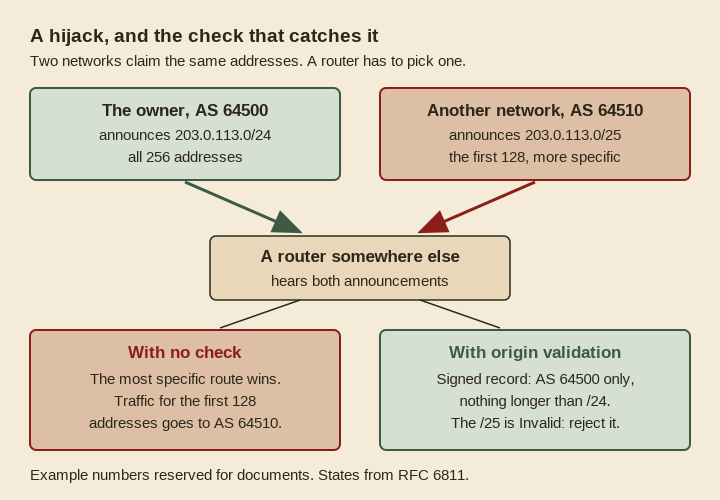 Without a check the smaller block wins. With a signed record, the router can see it is not authorized.
How much of the internet is covered? The National Institute of Standards and Technology (NIST) runs a public RPKI Monitor. Its data stamped 15 November 2026 counts the unique pairs of IPv4 prefix and originating AS that it sees:
| Valid | 911,326 |
|---|---|
| Not found | 346,114 |
| Invalid | 17,423 |
By my arithmetic that is about 71 percent valid and 27 percent with no record at all.
Watch out
Origin validation is not a full cure. RFC 6811 says so itself: the mechanism "does not protect against 'AS-in-the-middle attacks' or provide any path validation. It only attempts to verify the origin." It adds that the system "should be thought of more as a protection against misconfiguration than as true" security. A record also does nothing unless other networks check it. Cloudflare noted that its 1.1.1.0/24 was a signed resource and the 2024 incident still reached some users.
Who is pushing networks to do this?
MANRS. Mutually Agreed Norms for Routing Security is, in its own words, "a global initiative, supported by the Global Cyber Alliance." Network operators that join commit to a short list of actions: filter announcements so their own and their customers' are correct, stop traffic with forged source addresses, keep contact details current so someone can be reached during an incident, and publish routing data "so others can validate" it.
NIST. Its guidance for operators is Special Publication 800-189, published in December 2019, which recommends RPKI, origin validation and prefix filtering. A draft revision was released for comment on 3 January 2025.
The FCC. In June 2024 it proposed that broadband providers "prepare and update confidential" BGP security plans "at least once a year," with the largest providers filing theirs with the agency, and proposed quarterly reporting of some routing data. That is a proposal. I did not find a final rule.
Is there anything to do at home?
Not much, and that is worth saying plainly. Routing between networks is decided far above a home router.
Two things are within reach. First, encryption still protects you when routing goes wrong. A network that receives traffic by mistake cannot read the contents of a properly encrypted connection, and "HTTPS and Certificates: What the Padlock Means" explains why a certificate warning is a reason to stop. Second, if you buy internet service for a business, ask the provider two questions: do you publish ROAs for your addresses, and do you reject Invalid routes?
Tip
When a big service goes down, look for the operator's own incident report a few days later. The two quoted here, from Facebook and Cloudflare, each give a timeline and a cause in the company's own words.
What to remember
- The internet is tens of thousands of autonomous systems. BGP is how each tells its neighbors which addresses it can reach.
- An announcement carries the list of networks it has crossed. The most specific prefix wins.
- BGP was designed without a way to check claims. A hijack announces someone else's addresses. A leak repeats real routes to the wrong neighbors.
- RPKI lets an address holder publish a signed record of which AS may originate its prefixes. Routers can then mark announcements Valid, Invalid or NotFound.
- On 15 November 2026, NIST's monitor showed about 71 percent of IPv4 prefix and origin pairs as Valid.
- Origin validation checks only the origin, and only helps when other networks enforce it.
The next time a routing story is in the news, read it for three things: which prefix, who announced it, and whether a signed record existed. Those three facts usually tell you which row of the table above it belongs in.
Sources (15)
- IETF, RFC 4271, "A Border Gateway Protocol 4 (BGP-4)", January 2006
- FCC, "Reporting on Border Gateway Protocol Risk Mitigation Progress; Secure Internet Routing", Notice of Proposed Rulemaking, FCC 24-62, released 7 June 2024
- NIST, Special Publication 800-189, "Resilient Interdomain Traffic Exchange: BGP Security and DDoS Mitigation", December 2019
- NIST, Special Publication 800-189 Revision 1, initial public draft, 3 January 2025
- NIST, "NIST RPKI Monitor", data stamped 15 November 2026
- IETF, RFC 6480, "An Infrastructure to Support Secure Internet Routing", February 2012
- IETF, RFC 6811, "BGP Prefix Origin Validation", January 2013
- IETF, RFC 9582, "A Profile for Route Origin Authorizations (ROAs)", May 2024
- IETF, RFC 7908, "Problem Definition and Classification of BGP Route Leaks", June 2016
- IETF, RFC 9234, "Route Leak Prevention and Detection Using Roles in UPDATE and OPEN Messages", May 2022
- IETF, RFC 5398, "Autonomous System (AS) Number Reservation for Documentation Use", December 2008
- MANRS, "About MANRS"
- RIPE NCC, "YouTube Hijacking: A RIPE NCC RIS case study", 17 March 2008
- Meta Engineering, "More details about the October 4 outage", 5 October 2021
- Cloudflare, "Cloudflare 1.1.1.1 incident on June 27, 2024"