Articles & BlogBy Trapper W. Brown10 min read
For anyone who has stared into the front of an airliner engine from the boarding bridge and wondered what all those blades are doing.
The fan at the front of an airliner's engine turns lazily in the breeze while the airplane sits at the gate. An hour later the same machine is pushing a full airplane through thin air at most of the speed of sound, and it will do that for hours without a pause.
A jet engine is easier to understand than its appearance suggests. There is a well-worn four-word summary for it: suck, squeeze, burn, blow. Air is drawn in, compressed, heated by burning fuel and shot out the back. This article follows the air through the engine, then explains why the engines on airliners, fighters and commuter planes look so different when they all work the same way.
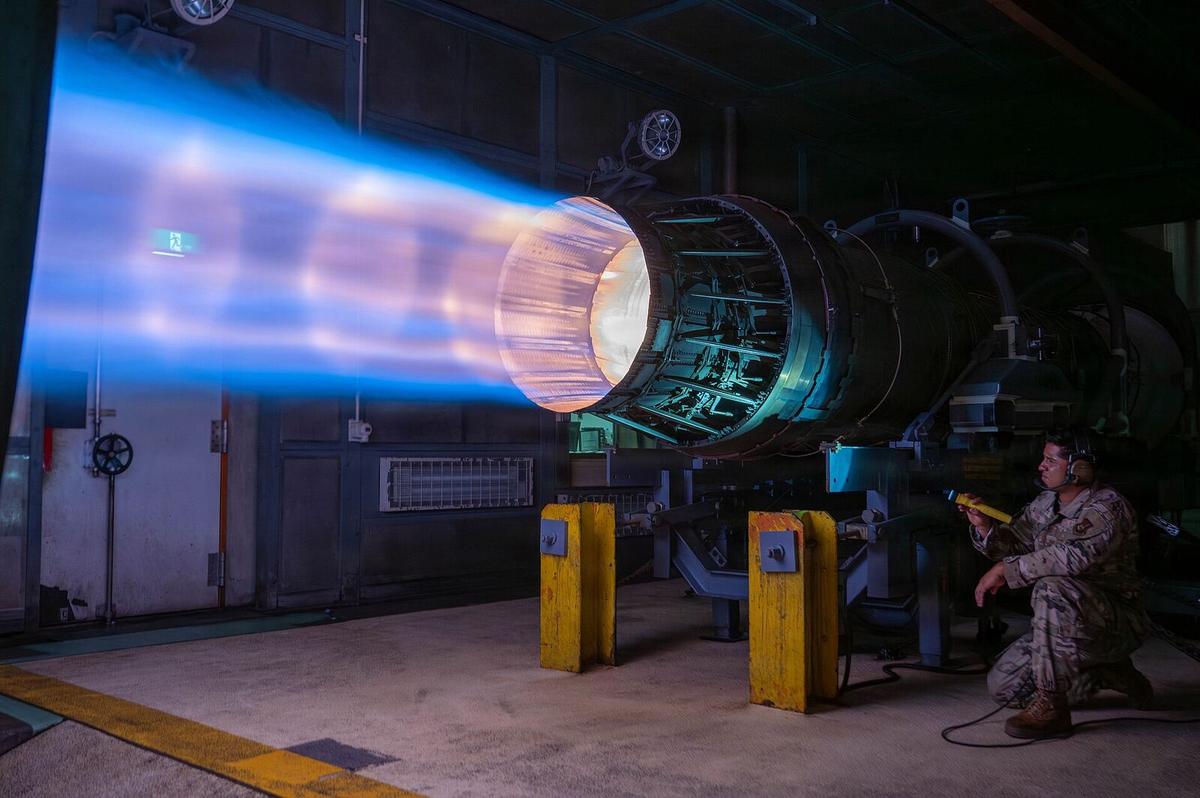 An F-15E engine runs in afterburner on a test stand at Kadena Air Base, Japan, in August 2025. Photo by Airman 1st Class Nathaniel Jackson, U.S. Air Force, public domain, via Wikimedia Commons.
What is a jet engine?
The proper name is gas turbine engine. NASA's Glenn Research Center says the type was developed independently in Germany and in England around the Second World War. A NASA history page credits Frank Whittle, a British pilot, with patenting a turbojet design in 1930, and gives the first turbojet-powered flight to the German Heinkel He 178 in August 1939. Whittle's own engine first flew in May 1941.
All of them make thrust, the force that pushes an airplane forward, the same way. The engine takes in air and throws it out the back faster than it came in. Newton's third law says every action has an equal and opposite reaction, so the engine is pushed forward. NASA's thrust equation puts numbers on it:
thrust = mass of air per second × (exit speed − entry speed)
Two things about that equation are worth holding onto. Thrust is a reaction to speeding the air up. And there are two ways to get more of it: move more air, or speed the air up more. That choice explains every engine type further down.
What happens to the air inside?
Start with the simplest kind, the turbojet, and follow the air from front to back.
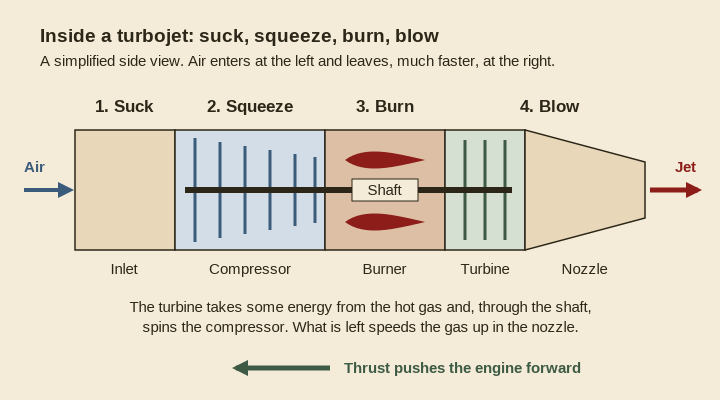 Four jobs, done in four places, all at the same time.
Suck. The inlet is the open front of the engine. Its job is to deliver a smooth, steady stream of air to the machinery behind it.
Squeeze. The compressor is a stack of bladed wheels on a central shaft, with rows of fixed blades between them. Each blade is a small wing. NASA says each row of an axial compressor (one where air flows straight along the shaft) raises the pressure by a factor of only about 1.2, but the stages multiply. Eight of them give 1.2 multiplied by itself eight times, which is a factor of about 4.3. High-compression engines link many stages together.
Burn. The burner, or combustor, is a ring-shaped chamber around the shaft. Fuel is sprayed into the compressed air and burned. Less fuel goes in than you might guess: NASA's typical figure is 2 pounds of fuel for every 100 pounds of air each second. The burning does not explode anything. It heats the air, and hot air wants to expand. The Federal Aviation Administration's powerplant handbook describes extra air being fed in around the flame, which cools the gas from about 3,500 degrees Fahrenheit to near 1,500.
Blow. The hot gas rushes out through the turbine, which NASA compares to a windmill: the gas spins its blades. The turbine sits on the same shaft as the compressor, so this is where the engine gets the power to keep squeezing. The FAA handbook says the turbine that drives the compressor absorbs roughly 60 to 70 percent of the pressure energy in the gas. What remains goes out through the nozzle, a narrowing duct that speeds the gas up. That fast jet is the thrust.
So the engine feeds itself. Once it is lit and spinning, the turbine drives the compressor, the compressor feeds the burner, and the burner drives the turbine.
How is this different from a car engine?
A piston engine does the same four jobs. "How a Gasoline Car Engine Works" walks through them as intake, compression, power and exhaust, and "How Diesel Engines Work" and "How Rotary (Wankel) Engines Work" cover two other ways to arrange them.
The difference is where and when. A piston engine does all four jobs in one place, the cylinder, one after another. It makes power in separate pulses. A gas turbine does each job in a different place, and all four happen at once, continuously. Nothing slides back and forth. Everything that moves just spins.
Why is an airliner's engine mostly fan?
A pure turbojet makes thrust by blasting a modest amount of air out very fast. That works, but it is loud and thirsty. The FAA handbook says turbojets have problems with noise and fuel consumption at the speeds airliners fly, and that almost all airliners now use a different arrangement: the turbofan.
A turbofan is a turbojet core with a large fan bolted to the front, driven by an extra turbine at the back. Some of the air the fan pulls in goes through the core and is squeezed, burned and blown as before. The rest never enters the core. It goes around the outside, pushed rearward by the fan like air through a propeller. NASA explains that because the fan adds very little to the fuel burned in the core, a turbofan makes more thrust for nearly the same fuel.
A worked example shows why moving more air gently beats moving less air violently. Take two imaginary engines on a test stand, so the entry speed is zero.
| Engine A | Engine B | |
|---|---|---|
| Air moved each second | 100 kg | 500 kg |
| Exit speed | 600 m/s | 120 m/s |
| Thrust (mass × speed) | 60,000 newtons | 60,000 newtons |
| Energy left in the moving exhaust each second (half × mass × speed squared) | 18 million joules | 3.6 million joules |
Both engines push equally hard. Engine A leaves five times as much energy behind in its exhaust, and that energy came from fuel. Thrust grows with the speed of the jet, but the energy cost grows with the speed squared. Engine B is the turbofan idea. Course notes from the Massachusetts Institute of Technology make the same point about real aircraft: transports, which need efficiency, use engines with large inlets and low thrust for each unit of air, and fighters do the opposite.
What is bypass ratio?
Bypass ratio is the amount of air that goes around the core divided by the amount that goes through it. The FAA handbook gives an example: 100 pounds of air per second around the core and 20 pounds per second through it is a bypass ratio of 5 to 1.
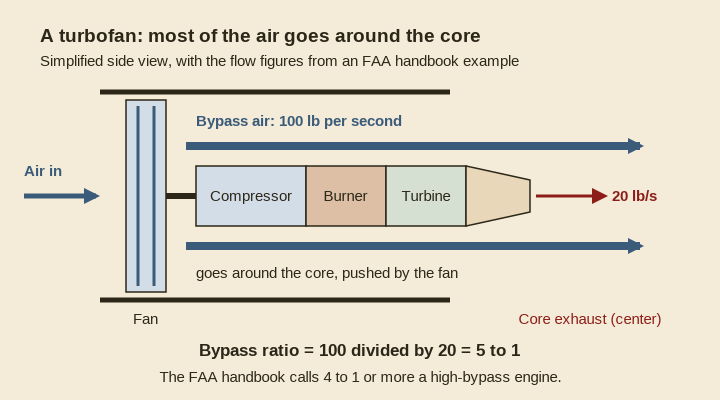 In the FAA's example, five-sixths of the air never goes near the flame.
The same handbook sorts turbofans by this number: under 2 to 1 is low bypass, 2 to 1 up to 4 to 1 is medium, and 4 to 1 or more is high. It says the fan on an airliner-type engine produces about 80 percent of the thrust. The FAA's pilot handbook adds that the bypass air also cools the engine and helps quiet the exhaust.
This is why the engine you see from the boarding bridge is so wide. Most of what you are looking at is fan. The part that burns fuel is the small core hidden behind the hub.
What are the other kinds?
The same core, used four ways:
| Type | Where the thrust comes from | Where you find it |
|---|---|---|
| Turbojet | All of it from the hot jet | Early jets; little used today |
| Turbofan | Partly the hot jet, mostly the fan on an airliner engine | Airliners (high bypass) and fighters (low bypass) |
| Turboprop | Mostly from a propeller driven through a gearbox | Commuter and cargo aircraft |
| Turboshaft | None directly; the shaft drives something else | Helicopters, and the small auxiliary engines on large aircraft |
A turboprop takes the fan idea further. Its turbine pulls most of the energy out of the exhaust and uses it to turn a propeller through a reduction gearbox, because a propeller works best turning far more slowly than the engine does. The FAA's pilot handbook says turboprops are most efficient between 250 and 400 miles per hour. NASA notes that propellers lose efficiency as speed rises, which is why faster airplanes use turbofans.
A turboshaft is the same thing with the propeller removed: all the power goes down a shaft to a helicopter's rotor or some other machine.
Fighter engines add one more part, the afterburner. Extra fuel is sprayed into the exhaust behind the turbine and burned there. The FAA handbook says this gives large increases in thrust for short periods. It also gives the long flame in the photograph at the top of this article.
What do people get wrong?
- "A jet pushes against the air behind it." It does not need anything to push on. Thrust is the reaction to throwing mass backward. A rocket works the same way in empty space, which is the subject of "How Rockets Reach Orbit: Sideways Speed and the Rocket Equation".
- "Jet engines run on a continuous explosion." The fuel burns steadily, like a gas burner, in a stream that is mostly air: about 2 pounds of fuel per 100 pounds of air in NASA's example.
- "Propeller planes have old-fashioned piston engines." NASA says most private airplanes still do. A turboprop airliner has a gas turbine inside, the same kind of core as a jet.
- "The fan is just there to feed the engine." On an airliner the fan is most of the engine. It makes about 80 percent of the thrust, per the FAA.
- "Flame from the tailpipe is normal." A long visible flame like the one in the photograph belongs to an afterburner, which the FAA handbook describes as a feature of military engines.
What to remember
- Suck, squeeze, burn, blow: inlet, compressor, burner, then turbine and nozzle.
- The turbine takes energy from the hot gas to spin the compressor. The engine feeds itself.
- Thrust is a reaction: mass of air per second times how much it was sped up.
- Moving a lot of air a little is more efficient than moving a little air a lot. That is why airliner engines are mostly fan.
- Bypass ratio is air around the core divided by air through it. The FAA calls 4 to 1 or more high bypass.
- Turbojet, turbofan, turboprop and turboshaft are one core used four ways.
Next time you board, look into the engine before you step through the door. The big blades at the front are the fan, and the part that actually burns fuel is tucked in the middle behind the hub. Why the wing it hangs from stays up is covered in "How Airplanes Fly: Lift, the Four Forces and the Stall".
Sources (14)
- NASA Glenn Research Center, "Gas Turbine Propulsion"
- NASA Glenn Research Center, "Thrust Equation"
- NASA Glenn Research Center, "Turbojet Engines"
- NASA Glenn Research Center, "Turbofan Engine"
- NASA Glenn Research Center, "Turboprop Engine"
- NASA Glenn Research Center, "Gas Turbine Parts"
- NASA Glenn Research Center, "Compressors"
- NASA Glenn Research Center, "Combustor - Burner"
- NASA Glenn Research Center, "Types of Gas Turbines"
- NASA Glenn Research Center, "Power Train"
- NASA Glenn Research Center, Ultra-Efficient Engine Technology student site, "Engines"
- Federal Aviation Administration, "Aviation Maintenance Technician Handbook - Powerplant" (FAA-H-8083-32B), 2023
- Federal Aviation Administration, "Pilot's Handbook of Aeronautical Knowledge" (FAA-H-8083-25C), Chapter 7, "Aircraft Systems"
- Massachusetts Institute of Technology, "Thermodynamics and Propulsion" course notes, section 11.3, "Implications of propulsive efficiency for engine design"