Articles & BlogBy Trapper W. Brown10 min read
For anyone who drives, rides in or pays for a car and has never been told what happens under the hood. By the end you can follow the four strokes, read an engine advert and tell which maintenance is worth the money.
A gasoline engine is a machine that burns a little fuel in a closed space, thousands of times a minute, and turns each small burn into a push on a spinning shaft. The US Department of Energy counts more than 250 million highway vehicles in the United States that rely on internal combustion engines, and most of them work the way this guide describes.
Why should you care? Because the engine is the most expensive part of the car to get wrong. Knowing how it works tells you which fuel to buy, what the numbers in an advert mean, and why a cheap oil change protects an expensive machine. This is the first of three guides. The other two, How Diesel Engines Work and How Rotary (Wankel) Engines Work, lean on the basics explained here.
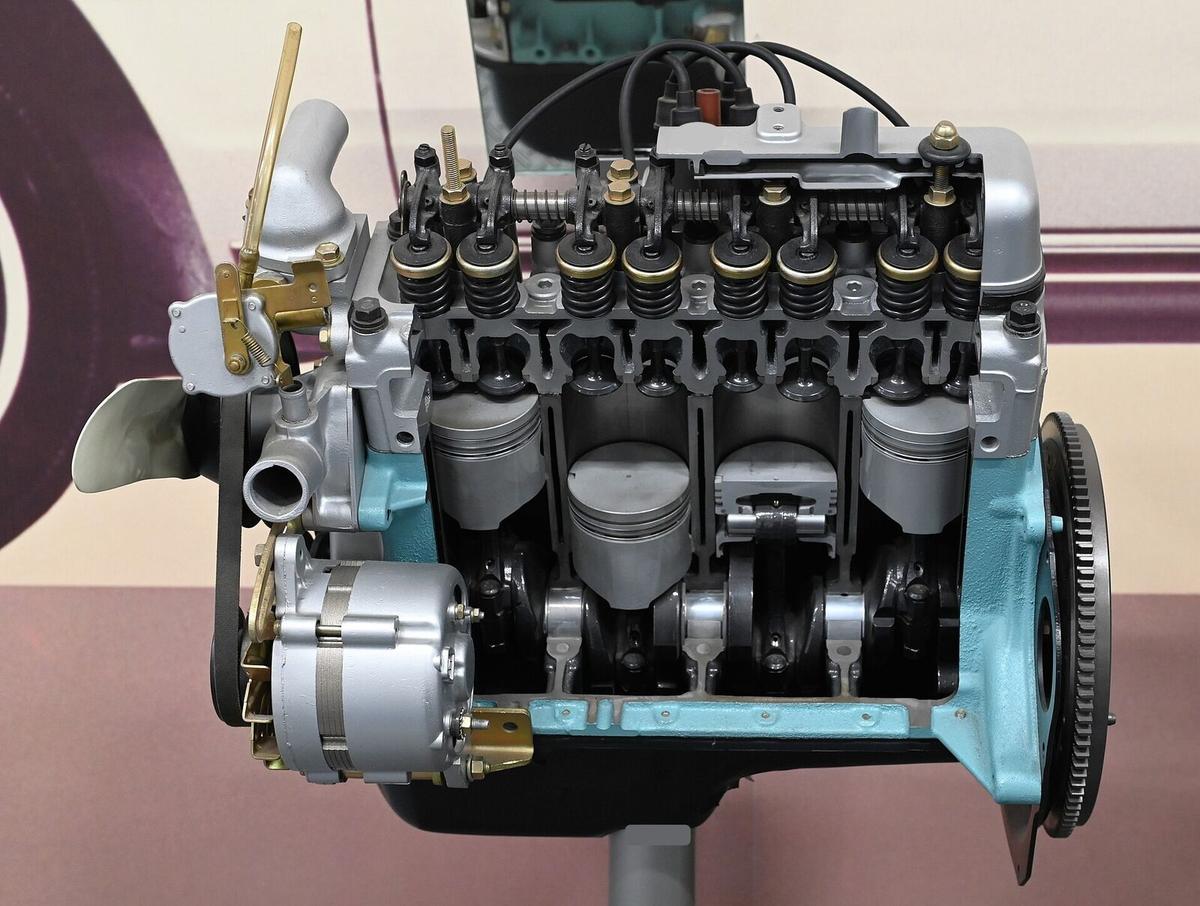 A cutaway inline four. The pistons sit at different heights because each cylinder is on a different stroke. Photo by TTTNIS, CC0, via Wikimedia Commons.
What happens inside one cylinder?
A cylinder is a smooth round hole bored into a block of metal. A piston is a metal plug that slides up and down inside it, sealed against the wall by springy rings. The top of the cylinder is closed by the cylinder head, which holds the valves and the spark plug.
Under the piston, a connecting rod joins it to the crankshaft: a shaft with offset sections, like the pedal crank on a bicycle. Your leg goes up and down and the chainring goes round. The crankshaft does the same job, turning the piston's up-and-down into the round-and-round that drives the wheels.
One trip of the piston from top to bottom, or from bottom to top, is called a stroke. A full cycle takes four of them.
- Intake. The piston moves down with the intake valve open, and draws in air mixed with fuel.
- Compression. Both valves close. The piston comes up and squeezes the mix into a small space.
- Power. The spark plug fires. The mix burns fast, the hot gas expands, and it shoves the piston down. This is the only stroke that makes power.
- Exhaust. The exhaust valve opens. The piston comes up and pushes the burned gas out.
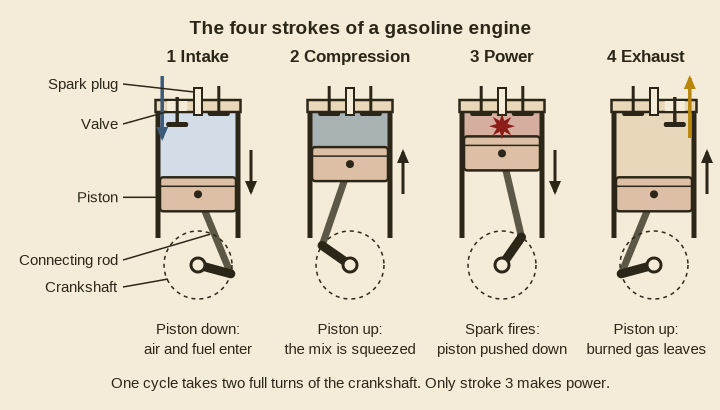 The four strokes. Three of them cost energy and one pays for all four.
Four strokes take two full turns of the crankshaft. For example, at 3,000 revolutions per minute (rpm), each cylinder fires 1,500 times a minute, which is 25 times a second. A four-cylinder engine at that speed makes 100 power strokes every second. That is why it hums instead of banging. A heavy wheel on the end of the crankshaft, the flywheel, carries it through the three strokes that make no power.
Why is the mix 14.7 parts air to 1 part fuel?
Fire needs fuel and oxygen in the right proportion. For gasoline, a complete burn takes about 14.7 parts of air to 1 part of fuel by weight. Engineers call this the stoichiometric ratio, a long word meaning that neither fuel nor oxygen is left over.
That is a lot of air. A tank holding 80 pounds of gasoline needs 80 times 14.7, or 1,176 pounds of air, to burn it all. An engine is mostly an air pump that happens to sip fuel.
More fuel than that is called a rich mix. Less is a lean one. A sensor in the exhaust pipe, the oxygen sensor, measures the leftover oxygen, and the engine's computer trims the fuel many times a second to stay on target. One sensor maker's handbook explains the goal: at 14.7 to 1, the engine produces the least amount of harmful gases. The catalytic converter, a device in the exhaust that cleans up what remains, is designed to work at that same mix.
Lighting the mix is the spark plug's job. It has a small gap at its tip. A coil sends a high-voltage pulse, a spark jumps the gap, and a flame spreads from that point across the cylinder. The spark comes slightly before the piston reaches the top, because the burn takes time.
How do the valves know when to open?
A camshaft tells them. It is a shaft with egg-shaped bumps called lobes. As it turns, each lobe pushes a valve open, and a spring snaps the valve shut when the lobe moves on. You can see those springs along the top of the engine in the photo.
A toothed belt or a chain links the camshaft to the crankshaft, and a Department of Energy engine handbook gives the gearing: in a four-stroke engine the camshaft turns at half the speed of the crankshaft. That makes sense, since each valve opens once in every two turns.
Most modern engines have two intake valves and two exhaust valves for each cylinder. That is the "16 valve" on the back of a four-cylinder car. Several small valves let the engine breathe more easily at high speed than two large ones. Many engines can also shift the valve timing while running. The government site fueleconomy.gov puts the gain from valve timing and lift technology at 3 to 4 percent.
How did fuel injection and turbochargers change things?
For most of the last century, a carburetor mixed the fuel. Air rushing through a narrow throat sucked gasoline out of a small jet. It needed no computer, but it could not hold 14.7 to 1 on a cold morning, on a mountain pass and under hard acceleration.
Fuel injection replaced it. Electrically operated nozzles spray a measured amount of fuel, and the computer decides the amount from its sensors. In port injection, the spray goes into the intake passage just ahead of the valve. In direct injection, it goes straight into the cylinder. Fueleconomy.gov credits direct injection with about a 1 percent gain by itself.
A turbocharger attacks a different limit. An engine can only burn as much fuel as it has air for. Fueleconomy.gov describes turbochargers as compressors that force additional air into the cylinders. The exhaust gas, on its way out, spins a small turbine, and that turbine drives the compressor. More air in each stroke means more fuel burned in each stroke, so a small engine can do the work of a larger one. The same site puts the gain from turbocharging with a smaller engine at up to 8 percent.
What is octane, and what is knock?
The US Energy Information Administration (EIA) defines the octane rating as a measure of fuel stability: how much squeezing and heat the fuel will take before it ignites without a spark.
Knock is what happens when it fails that test. Part of the mix lights itself before the flame from the spark plug arrives. Pressure spikes at the wrong moment, and you may hear a metallic pinging. Left alone, heavy knock can damage the engine.
In the United States, EIA lists regular as generally 87, midgrade as 89 to 90 and premium as 91 to 94. The number on the pump is the average of two laboratory test methods.
Higher octane is not extra power in a can. It lets an engine that was designed for it squeeze the mix harder, or run more turbocharger pressure, without knock. Fueleconomy.gov is plain about the rest. Most gasoline vehicles are designed for 87. Using a higher octane than the maker requires brings little to no benefit in normal driving. Using a lower one than required can make the engine run poorly and can damage it over time. Modern engines have knock sensors that delay the spark to protect themselves, and EIA notes that this costs efficiency.
My rule: read the fuel door. If it says premium is required, buy premium. If it says recommended, the choice is yours.
Why does most of the fuel's energy leave as heat?
Fueleconomy.gov says only about 12 to 30 percent of the energy in the fuel moves the car down the road, depending on the kind of driving. Most of the rest is lost in the engine, primarily as heat.
| Where the energy goes | Combined | City | Highway |
|---|---|---|---|
| Engine losses | 68% to 72% | 71% to 75% | 64% to 69% |
| Parasitic losses (water pump, alternator and the like) | 4% to 6% | 5% to 7% | 3% to 4% |
| Drivetrain losses (gearbox and axles) | 3% to 5% | 4% to 5% | 3% to 5% |
Put another way, about $35 of a $50 fill-up warms the air around your car.
Hot gas gives up only part of its heat as push on the piston. The rest leaves through the tailpipe or soaks into the metal, and that second part has to be removed or the engine would melt.
Two systems handle it. The cooling system pumps coolant, a mix of water and antifreeze, through passages around the cylinders and out to the radiator, where moving air carries the heat away. The oil system pumps oil under pressure into every bearing, so metal parts ride on a thin film instead of touching. Oil also carries heat away and holds dirt until the filter catches it.
How do I read an engine advert?
Take "2.0 liter, 16 valve, turbo inline four". You know the valves and the turbo now. The rest breaks down as follows.
Displacement is the volume all the pistons sweep in one stroke. A cylinder 86 millimeters across with a piston that travels 86 millimeters sweeps just under 500 cubic centimeters. Four of them make 2.0 liters.
Compression ratio is the volume above the piston at the bottom of its stroke divided by the volume at the top. If those are 550 and 50 cubic centimeters, the ratio is 11 to 1. A harder squeeze gets more work from the same fuel and raises the risk of knock, which is where octane comes back in.
Torque is twisting force. One pound pushing on the end of a one-foot wrench is one pound-foot. Torque is the shove you feel at low speed.
Horsepower is how fast the engine does work: torque times rpm, divided by 5,252. An engine making 300 pound-feet at 2,000 rpm is making 114 horsepower. Hold the same 300 at 6,000 rpm and it is 343. Same shove, three times as often.
| Layout | How the cylinders sit | What it is known for |
|---|---|---|
| Inline (straight) | In one row | Simple and narrow, with one cylinder head |
| V | In two rows that meet at an angle | Short, so six or eight cylinders fit |
| Flat (boxer) | In two rows lying on their sides | Low and wide, which keeps weight low |
Which maintenance matters, and why?
- Oil and filter, on schedule, in the grade the manual names. Oil is the film between moving parts, and it wears out. Fueleconomy.gov says the right grade can improve mileage by 1 to 2 percent.
- Coolant. Check the level and change it when the schedule says. If the temperature gauge climbs, stop. Overheating ruins engines quickly.
- Air filter. All 14.7 parts of air pass through it. On a fuel-injected engine a clogged filter does not hurt mileage, according to fueleconomy.gov, but it can hurt acceleration.
- Spark plugs. The gap wears wider with every spark. Worn plugs misfire.
- Timing belt, if your engine has one. It keeps valves and pistons in step. Replace it at the stated interval, because in many engines a broken belt lets them collide.
- The check engine light. It means the computer saw a reading out of range. Have the code read soon.
Watch out
Never open the radiator cap on a hot engine. The coolant is under pressure and hot enough to scald, and it can spray out. Let the engine cool first.
What to remember
- Four strokes: intake, compression, power, exhaust. Two turns of the crankshaft, and only one stroke makes power.
- Gasoline burns completely at about 14.7 parts air to 1 part fuel, and the oxygen sensor keeps the engine there.
- The camshaft opens the valves at half crankshaft speed. A turbocharger uses exhaust to push in more air.
- Octane is resistance to knock. Buy what the maker requires and no more.
- Roughly 70 percent of the fuel's energy is lost in the engine, mostly as heat, which is why coolant and oil matter.
- Displacement is size, torque is shove, and horsepower is shove multiplied by speed.
Open the hood this weekend and find the oil dipstick, the coolant tank and the air filter box. Then read How Diesel Engines Work, which keeps the same four strokes and throws away the spark plug.