Articles & BlogBy Trapper W. Brown10 min read
For anyone who has heard that some cars have "no pistons" and wondered how that could work. By the end you will know what spins inside a rotary engine, why engineers loved it, and why almost every carmaker gave up on it.
A rotary engine burns gasoline to turn a shaft, like the engine in most cars. It gets there by a different route. In place of pistons going up and down, it has a fat, three-sided rotor that spins inside a housing. There are no valves, no camshaft and no connecting rods.
Why care about an engine most people will never own? Because it is the clearest lesson there is in engineering trade-offs. The rotary is smaller, lighter and smoother than a piston engine of the same power, and those gifts are real. So are the costs, which is why it nearly vanished from cars, and why it has come back in a very different job.
This guide assumes you know the four strokes (intake, compression, power, exhaust), spark ignition, torque and displacement. They are explained in How a Gasoline Car Engine Works. Read that first if any of those are new.
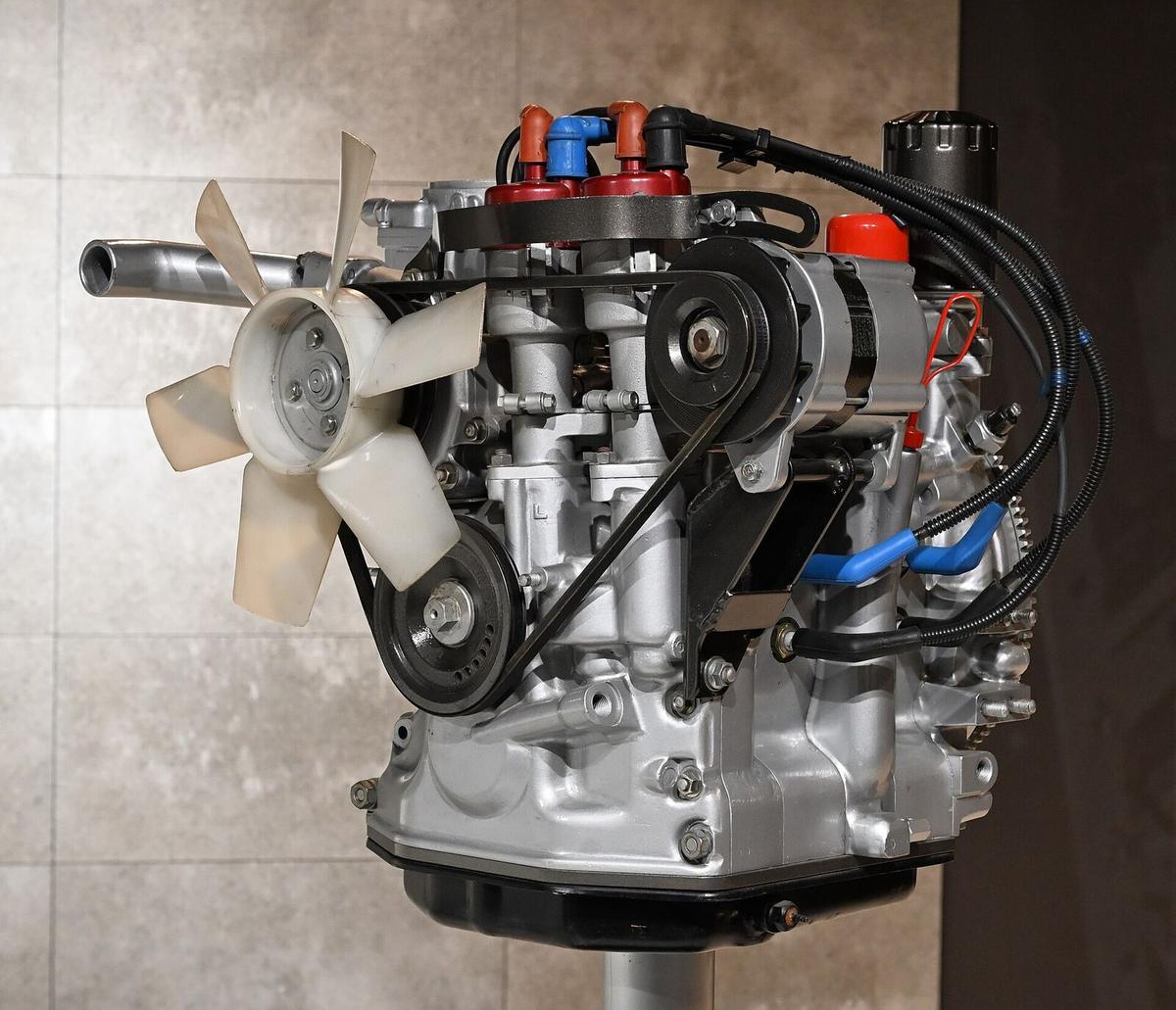 An early two-rotor rotary engine with its fan, belt and alternator attached. There is no tall block of cylinders, only a short stack of housings. Photo by TTTNIS, CC0, via Wikimedia Commons.
What is inside a rotary engine?
Three main parts, and only two of them move.
The housing is the fixed outer shell. Its inner wall is shaped like an oval pinched slightly at the waist, a little like a peanut shell.
The rotor sits inside. It looks like a triangle with bulging sides. As it turns, all three of its corners stay in contact with the housing wall. That divides the space into three separate chambers, one against each face of the rotor, and each chamber grows and shrinks as the rotor moves around.
The eccentric shaft runs through the middle and carries the power out, doing the job a crankshaft does. Eccentric means off-center. The rotor rides on a round lobe that is offset from the shaft's centerline, so when burning gas pushes on a face of the rotor, the rotor pushes that lobe around and the shaft turns.
Two smaller details matter later. Each corner of the rotor carries a thin strip called an apex seal, which is all that keeps gas from leaking between chambers. And there are no valves. The air and fuel enter, and the exhaust leaves, through simple holes in the housing called ports. The rotor uncovers and covers them as it sweeps past.
How does one rotor do four jobs at once?
Follow one face of the rotor, marked A in the diagram.
- Intake. As face A passes the intake port, the space between it and the housing grows. Air and fuel are drawn in.
- Compression. The rotor carries that charge around. The housing wall closes in, the space shrinks, and the mix is squeezed.
- Power. At the tightest point, the spark plug fires. The burning gas expands and pushes face A onward, which turns the shaft.
- Exhaust. Face A reaches the exhaust port and sweeps the burned gas out.
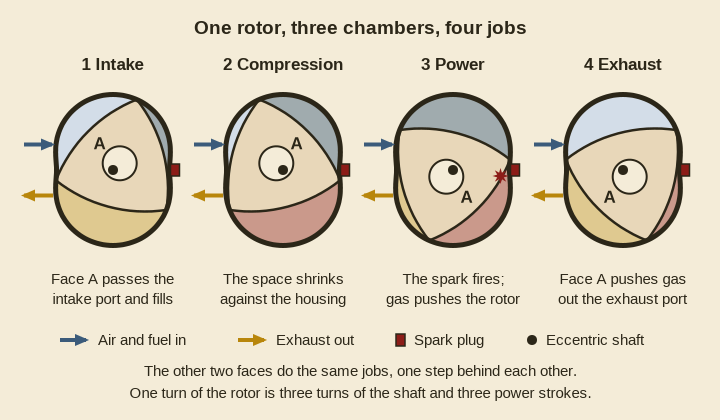 Each face of the rotor runs the full four-stroke cycle, and all three are always at work.
Here is the clever part. The other two faces are doing the same thing, one step behind each other. While one chamber is taking in air, another is compressing and the third is pushing out exhaust. The four jobs that a piston does one after another, in the same place, a rotor does at the same time, in different places.
The gearing between rotor and shaft is fixed: the shaft turns three times for each turn of the rotor. One turn of the rotor gives three power strokes, one from each face. So the engine delivers one power stroke for every turn of the shaft. A single piston delivers one for every two turns. A one-rotor engine therefore fires as often as a two-cylinder piston engine.
Why is it small, light, smooth and high revving?
Each strength follows from the layout.
Small and light. There is no valve gear and no row of cylinders. The engine is a few thick slices bolted together. Makers of small aircraft engines publish numbers that show what this buys. One British maker lists an air-cooled rotary for drones that gives 40 horsepower from an engine core weighing 25 pounds. An Austrian maker lists a 294 cubic centimeter single-rotor aircraft engine at 50 horsepower and 54 pounds.
Smooth. A piston has to stop and reverse direction twice in every turn of the crankshaft, and that shakes the engine. A rotor only spins. When NSU, the German company that first built these engines, put a single-rotor engine in a small sports car in 1963, it claimed the engine ran as quietly as a six-cylinder, according to the history kept by Audi, its successor.
High revving. With nothing reversing direction and no valves to keep up, a rotary is happy at speeds that would strain a piston engine. The gearing helps: when the shaft turns at 9,000 rpm, the rotor itself is turning at only 3,000.
What are the honest weaknesses?
Four, and they are stubborn.
Sealing. A piston ring seals against a simple round wall. An apex seal has to slide along a curved wall at changing angles while hot gas tries to get past it. When the first rotary engine ran on NSU's test bench in 1957, sealing problems appeared after 15 hours, Audi's history records. Mazda, the Japanese company that later adopted the engine, says its engineers found marks on the inner wall of the housing that they called "nail marks of the Devil". Their fix was a seal made of carbon infused with aluminum. Seals improved over the years, yet sealing remains the hardest part of the design.
Fuel and oil use. The combustion chamber is long, thin and moving, with a lot of metal surface for its volume. More heat escapes into the metal, and some fuel fails to burn. The seals also need oil, which is fed into the engine and burned with the fuel. For a real figure, look at the last rotary sports car sold in the United States. The Environmental Protection Agency rated the 2011 Mazda RX-8 with a manual gearbox at 16 miles per gallon in the city, 22 on the highway and 18 combined, on premium fuel. Its engine was rated at 1.3 liters.
Emissions. Unburned fuel and burned oil both end up in the exhaust, so meeting clean-air rules is harder than with a piston engine.
Low-speed torque. A rotary makes its power at high revs and has little pull at low speed. In daily driving that means more gear changes and more revs, which costs still more fuel.
| Rotary | Piston | |
|---|---|---|
| Main moving parts | Rotor and eccentric shaft | Pistons, rods, crankshaft, camshaft, valves |
| Power strokes per shaft turn | One for each rotor | One for every two cylinders |
| Size and weight for the power | Small and light | Larger and heavier |
| Fuel and oil use | Higher | Lower |
| Pull at low speed | Weak | Stronger |
Who invented it, and when did it first run?
The engine is named for Felix Wankel, born in Lahr, Germany, in 1902. Audi's history describes him as largely self-taught. He began his working life as an apprentice clerk at a publishing house and started experimenting with engine ideas in the late 1920s. In 1951 he signed a contract with NSU, a maker of motorcycles and small cars, and joint development began.
On 1 February 1957, the first prototype ran on a test bench at NSU in Neckarsulm. That design was not the one that reached the road. In Wankel's version, the housing spun as well as the rotor. NSU's engineers reworked it so that the housing stood still, which was far easier to build, and that version first ran in early 1959. Every production rotary since has followed it.
NSU showed its single-rotor sports car in September 1963, the first production car with a Wankel engine, and built 2,375 of them by July 1967. A twin-rotor sedan followed in 1967. Neither sold as hoped. Meanwhile much of the industry bought licenses to try the idea. Audi lists General Motors, Daimler-Benz, Porsche, Nissan, Toyota and Mazda among them.
Which cars used it, and what happened at Le Mans?
One company stayed with the rotary after the others walked away, and the story cannot be told without it. Mazda's own timeline says it entered technical cooperation with NSU and Wankel in July 1961. On 30 May 1967 it launched the Cosmo Sport, its first rotary car, with two rotors and 110 metric horsepower. Rotary sedans and coupes followed, and then the RX-7 sports car in 1978. By November of that year the company had built one million rotary vehicles. The RX-8 arrived in 2003, and its production ended in June 2012. In October 2023 Mazda announced that its total had passed two million.
The high point came on a race track. On 22 and 23 June 1991, at the 59th running of the 24 Hours of Le Mans in France, the number 55 Mazda 787B won outright. Volker Weidler, Johnny Herbert and Bertrand Gachot shared the driving. Mazda says its four-rotor engine made 700 metric horsepower. It was the first overall win for a Japanese manufacturer. The race organizer calls it the first and only success for a rotary-engined prototype, and a Mazda statement from June 2026 says the same: no other rotary car has won Le Mans overall.
A 24-hour race suits a rotary well. The engine spends nearly the whole time at high revs, where it is strongest, and nobody is asking it for good mileage in town.
Where is the rotary engine now?
In jobs that play to its strengths and hide its weaknesses.
As a generator in a hybrid car. In June 2023 Mazda began mass production of a plug-in hybrid version of its MX-30. It was the company's first production rotary in 11 years. Its engine is a single rotor of 830 cubic centimeters, and Mazda's press material is specific about its role: there is no mechanical connection between the engine and the wheels. An electric motor always drives the car. The rotary only turns a generator to recharge the battery. Mazda's Japanese site, in content dated 31 August 2026, still lists the car for sale.
The logic is neat. A generator can run at one steady speed chosen by the engineers, so weak low-speed pull stops mattering. And a small, smooth engine is easy to tuck in beside an electric motor. In February 2024 Mazda re-formed a rotary development group of 36 engineers to keep working on rotaries as generators, including on emissions rules and carbon-neutral fuels.
In drones and small aircraft. In the air, weight counts for more than almost anything else, and vibration shakes cameras and airframes. An engine also spends most of a flight at steady high power. That is the rotary's best case, which is why specialist firms build rotaries for unmanned aircraft. The Austrian maker mentioned earlier says its engine has flown in both manned and unmanned aircraft.
What to remember
- A rotary engine has a three-sided rotor spinning in a pinched-oval housing, with no pistons and no valves.
- The rotor forms three chambers. Each runs intake, compression, power and exhaust, all at the same time in different places.
- The shaft turns three times for each turn of the rotor, giving one power stroke per shaft turn.
- It is small, light and smooth, and it likes high revs.
- Its weaknesses are seal wear, fuel and oil use, emissions and weak pull at low speed.
- It first ran in 1957, won Le Mans in 1991, and now works mainly as a generator and in drones.
If you ever get the chance, listen to one. A rotary at full speed sounds like nothing else on the road, a smooth, rising buzz with no thump in it. For the engine that took the opposite approach, heavy and slow-turning with enormous pull, read How Diesel Engines Work.