Articles & BlogBy Trapper W. Brown11 min read
For anyone who has stood next to a charging car and wondered what is going on inside it. By the end you will know the parts, the kinds of hybrid, and what the numbers on the charger and the window sticker mean.
A gasoline car burns fuel to make heat, turns some of that heat into motion, and throws the rest away. An electric car skips the burning. It stores electricity in a battery and feeds it to a motor that turns the wheels. A hybrid carries both systems and uses each where it does best.
That is the whole idea, and the rest is detail. The detail matters if you are shopping, because "hybrid" covers at least three different machines, and because the charger at home, the charger at the mall and the one on the highway are not the same thing. This guide follows the electricity from the plug to the road, using the U.S. Department of Energy's descriptions throughout.
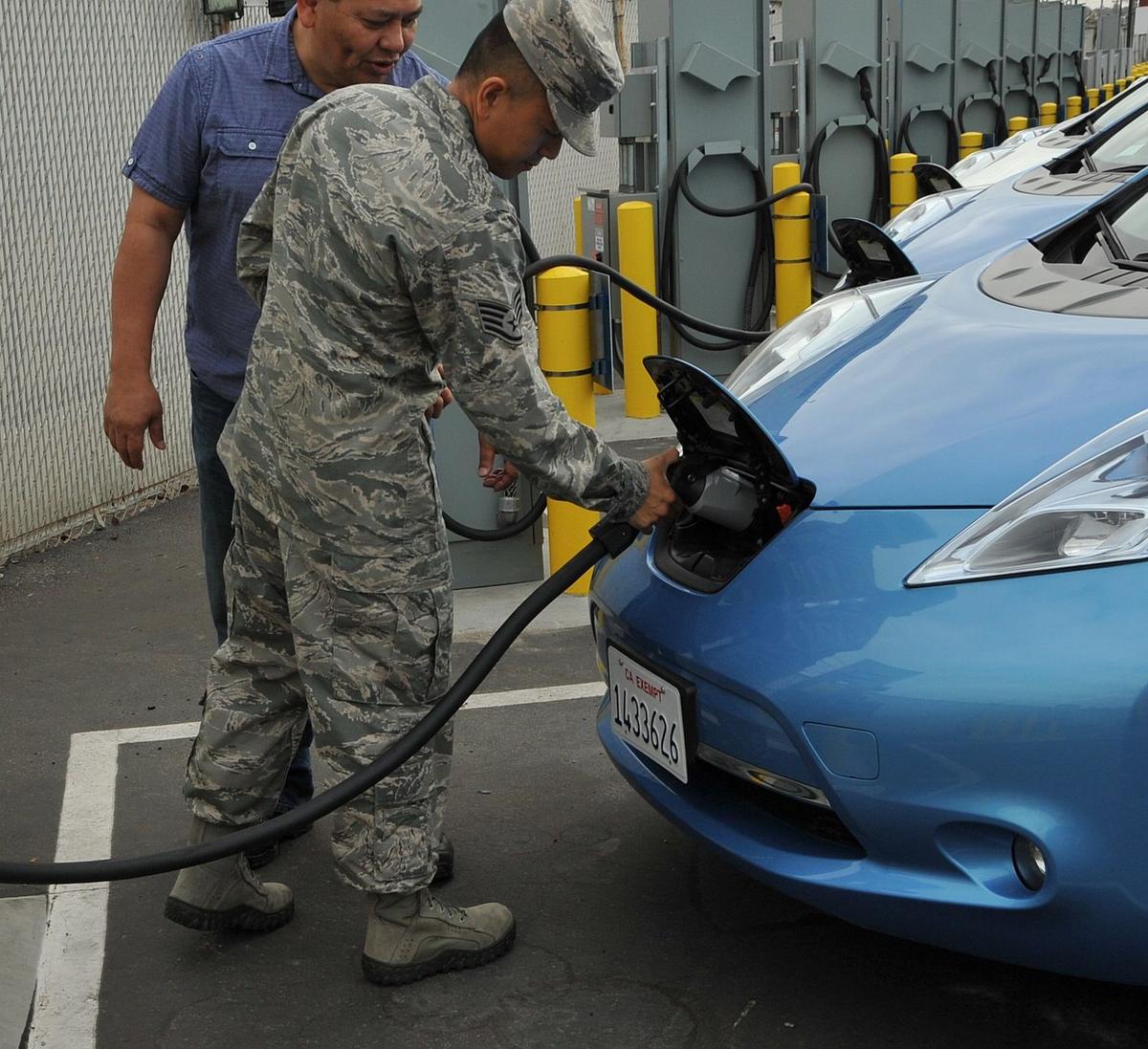 An airman learns to charge one of a fleet of plug-in electric vehicles at Los Angeles Air Force Base, California, in October 2014. U.S. Air Force photo by Tech. Sgt. Sarah Corrice, public domain, via Wikimedia Commons.
What replaces the engine?
Four parts do the work that an engine and a fuel tank do in a conventional car. The Department of Energy's Alternative Fuels Data Center (AFDC) names them this way:
| Part | What it does |
|---|---|
| Traction battery pack | Stores electricity for the motor |
| Power electronics controller | Manages the flow of energy from the battery and controls the motor's speed and torque (twisting force) |
| Electric traction motor | Drives the wheels using power from the battery |
| Onboard charger | Turns the AC power coming in through the charge port into DC power the battery can store |
There are two smaller players. A DC/DC converter steps the battery's high voltage down to the low voltage that runs the lights, the radio and the windows. And an ordinary low-voltage auxiliary battery, like the one in any car, powers those accessories.
What is missing is as telling. AFDC notes that an all-electric car "does not contain the typical liquid fuel components, such as a fuel pump, fuel line, or fuel tank," and it emits no exhaust. The articles "How a Gasoline Car Engine Works", "How Diesel Engines Work" and "How Rotary (Wankel) Engines Work" cover the machinery an electric car leaves out.
What is in the battery?
The traction battery is a large pack of rechargeable cells. AFDC says most all-electric cars and plug-in hybrids use lithium-ion batteries, the same family as the cells in phones and laptops, chosen for "their high energy per unit mass and volume." Many ordinary hybrids have used nickel-metal hydride batteries instead.
Two numbers describe a pack. Its capacity, in kilowatt-hours (kWh), is how much energy it holds: the size of the tank. Its voltage is how hard it pushes. AFDC says the high-voltage systems in these cars "typically range from 400 to 1,000 volts," which is why the high-voltage cables are insulated and marked, "usually orange."
Batteries wear out slowly. FuelEconomy.gov, the site the Department of Energy and the Environmental Protection Agency (EPA) run together, says a Department of Energy study "suggests these batteries may last 12 to 15 years in moderate climates and 8 to 12 years in severe climates." AFDC adds that "many manufacturers offer 8-year/100,000-mile warranties for their EV batteries," and it is candid that a replacement outside the warranty "is expected to be a significant expense."
Why does the car need an inverter?
Because the battery and the motor speak different electrical languages.
A battery stores and delivers direct current, or DC: electricity that flows one way. The wall outlet supplies alternating current, or AC: electricity that reverses direction many times a second. The drive motor in an electric car also runs on AC. So the car has to translate twice.
- Charging: AC from the wall goes through the onboard charger and becomes DC for the battery.
- Driving: DC from the battery goes through the inverter and becomes AC for the motor.
The Department of Energy describes the second step plainly: "An inverter is needed in an electric drive system to convert the DC energy from a battery to AC power to drive the motor." The inverter is the heart of the box AFDC calls the power electronics controller. It does more than convert. By shaping the AC it sends out, it sets how fast the motor spins and how hard it pushes, so it is also the throttle.
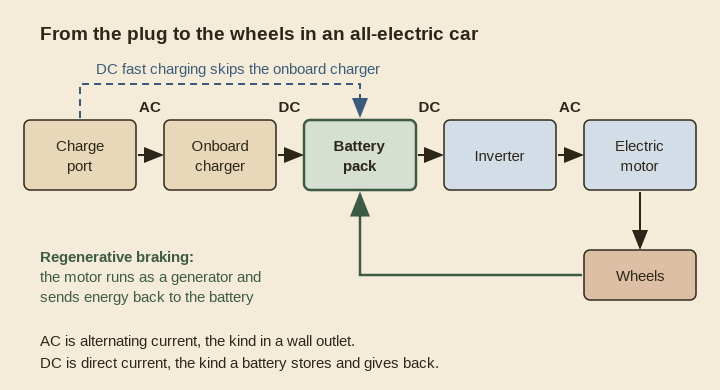 AC comes in from the wall, the battery holds DC, and the inverter turns it back into AC for the motor.
How does the car get energy back when it brakes?
An electric motor and a generator are the same machine run in opposite directions. Feed it electricity and it turns. Turn it by force and it makes electricity.
Regenerative braking uses that. When you lift off the accelerator or press the brake, the wheels keep turning the motor, and the motor becomes a generator. FuelEconomy.gov explains that this "uses the forward motion of the wheels to turn the motor. This generates electricity and helps slow the vehicle." The electricity goes back into the battery. In a conventional car the same energy "is lost as heat through friction at the brakes."
The ordinary friction brakes are still there. They just do less work, and AFDC says brake systems on these cars "generally last longer than those on conventional vehicles because of regenerative braking."
Two things make electric cars frugal. The drive system wastes far less to begin with: FuelEconomy.gov says it "is only responsible for a 15% to 20% energy loss compared to 64% to 75% for a gasoline engine." And braking gives some energy back. Put together, the site says electric vehicles "convert over 77% of the electrical energy from the grid to power at the wheels," while conventional gasoline vehicles convert only about 12 to 30 percent of the energy in gasoline. It also explains why AFDC rates electric cars as more efficient in city driving than on the highway: more stops mean more braking energy to recover, and "regenerative braking offers little advantage" at a steady highway speed.
Cold weather cuts the other way, because the cabin is heated from the battery. FuelEconomy.gov says that in very cold conditions, heating and other accessories "can account for more than 40% of energy use in city driving."
What are the kinds of hybrid?
A hybrid has an engine and at least one electric motor. The differences are in how big the battery is and whether you can plug it in. AFDC sorts them like this.
Mild hybrid. A small battery and motor help the engine and let it shut off at a stop. In AFDC's words, mild hybrid systems "cannot power the vehicle using electricity alone."
Full hybrid. A bigger battery and a stronger motor, "which can power the vehicle for short distances and at low speeds." It never plugs in. The battery is charged "through regenerative braking and by the internal combustion engine."
Plug-in hybrid. A still larger battery that charges from the wall. AFDC puts the electric range of current models at "about 15 to 60-plus miles." After that the engine takes over.
All-electric. No engine at all.
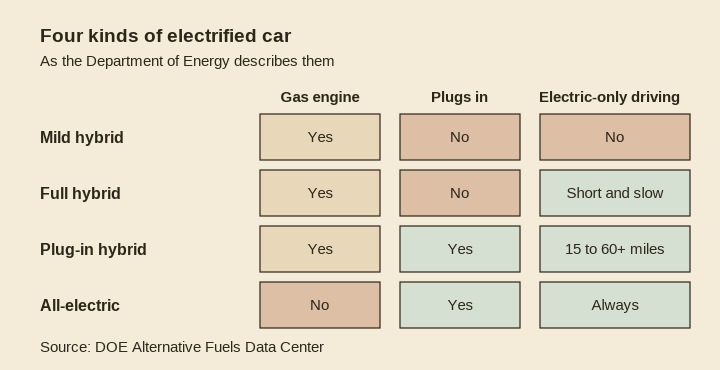 The four kinds differ in whether there is an engine, whether the car plugs in, and how far it can go on electricity alone.
There is one more split, in how the two power sources reach the wheels. In a parallel hybrid, which AFDC calls "the most common" design, both the engine and the motor can drive the wheels directly. In a series hybrid only the motor drives the wheels, and the engine's job is to make electricity. Series plug-ins are often referred to as extended-range electric vehicles.
A plug-in hybrid is only as good as its owner's habits. AFDC is blunt: "if the vehicle is never plugged in to charge, fuel economy will be about the same as a similarly sized hybrid electric vehicle."
Take two households as an example. The first drives 30 miles a day, round trip, and can plug in overnight. A plug-in hybrid with 40 miles of electric range could do that commute without starting its engine, and still take a 500-mile trip on gasoline. The second household parks on the street with no outlet. For them the plug is dead weight, and a full hybrid gets about the same fuel economy with a smaller battery to carry.
What do the charging levels mean?
Charging equipment is sorted by how fast it fills the battery. AFDC gives these rough rates.
| Level | Power source | Range added | Connector in North America |
|---|---|---|---|
| Level 1 | 120-volt household outlet | About 5 miles per hour of charging | J1772 |
| Level 2 | 240 volts at home, 208 volts at many businesses | About 25 miles per hour of charging | J1772 or J3400 |
| DC fast charging | Dedicated station, up to 500 kW | About 100 to 200 or more miles per 30 minutes | CCS, CHAdeMO or J3400 |
Level 1 sounds hopeless and often is not. AFDC's own example: "8 hours of charging at 120 V can replenish about 40 miles of electric range for a mid-size EV." For the 30-mile commuter above, a plain outlet covers the day. Level 2 is what most people install at home when they want more. AFDC says most residential units deliver 7.2 kW and need a dedicated 40-amp circuit, which is a job for an electrician and may need a permit.
DC fast charging is different in kind. The station does the AC-to-DC conversion itself and sends DC straight to the battery, so the car's onboard charger is not the limit. That is the dashed line in the first diagram.
The connector names are less confusing than they look. SAE International is the engineering body that writes the standards. J1772 is its standard plug for Level 1 and Level 2. CCS, the Combined Charging System, is the J1772 plug with, in AFDC's words, "two additional bottom pins" for DC fast charging. CHAdeMO is another DC fast connector that AFDC says is common among Japanese automakers. J3400 is the connector SAE is now standardizing, also known as NACS, and it "works for all charging levels." Adapters exist between several of these. Check which port a car has before you plan a trip around a particular station.
How do you read the window sticker?
A gallon is a poor unit for a car that uses none, so the label uses a different one. MPGe means miles per gallon of gasoline-equivalent. EPA's definition: "A gallon of gasoline has the energy equivalent of 33.7 kilowatt-hours of electricity." A car that uses 33.7 kWh to go 100 miles is rated at 100 MPGe.
The more useful number is printed nearby: kilowatt-hours per 100 miles. Lower is better, and it converts directly to money. AFDC works one through: "If electricity costs ¢10.7 per kWh and the vehicle consumes 27 kWh to travel 100 miles, the cost per mile is about $0.03." Put your own rate in. At 16 cents per kWh, by my arithmetic, the same car costs about 4.3 cents a mile.
EPA notes that its MPGe figures "include charging losses," measured at a Level 2 charger, so the sticker reflects what you pay for at the wall and not only what reaches the battery.
Plug-in hybrids get two ratings: one for running on electricity (or electricity and gasoline together) and one for gasoline alone. Which one you live with depends on how often you plug in.
What to remember
- An electric car has a battery that stores DC, an inverter that turns it into AC, and a motor that turns the wheels. The onboard charger does the reverse conversion when you plug in.
- Regenerative braking runs the motor as a generator and puts energy back in the battery. It helps most in stop-and-go driving.
- Mild hybrids cannot move on electricity alone. Full hybrids can, briefly. Plug-in hybrids can for roughly 15 to 60 or more miles. All-electric cars have no engine.
- Level 1 is a household outlet at about 5 miles of range per hour. Level 2 is about 25. DC fast charging adds roughly 100 to 200 or more miles in half an hour.
- On the sticker, 33.7 kWh equals one gallon of gasoline for MPGe, and kWh per 100 miles is the number that turns into dollars.
- Cold weather and highway speeds both cost range.
A good next step is to look up two or three cars you are curious about on FuelEconomy.gov and compare their kWh per 100 miles, then multiply by the rate on your own electric bill. "The Cost of Home Energy Over the Last 50 Years" has the background on what that rate has done over time.
Sources (15)
- U.S. Department of Energy, Alternative Fuels Data Center, "How Do All-Electric Cars Work?"
- U.S. Department of Energy, Alternative Fuels Data Center, "How Do Hybrid Electric Cars Work?"
- U.S. Department of Energy, Alternative Fuels Data Center, "Hybrid Electric Vehicles"
- U.S. Department of Energy, Alternative Fuels Data Center, "Plug-In Hybrid Electric Vehicles"
- U.S. Department of Energy, Alternative Fuels Data Center, "All-Electric Vehicles"
- U.S. Department of Energy, Alternative Fuels Data Center, "Batteries for Electric Vehicles"
- U.S. Department of Energy, Alternative Fuels Data Center, "Electric Vehicle Charging Stations"
- U.S. Department of Energy, Alternative Fuels Data Center, "Charging Electric Vehicles at Home"
- U.S. Department of Energy, Alternative Fuels Data Center, "Maintenance and Safety of Electric Vehicles"
- U.S. Department of Energy, "Power Electronics Research and Development"
- FuelEconomy.gov, "All-Electric Vehicles"
- FuelEconomy.gov, "How Hybrids Work"
- FuelEconomy.gov, "Plug-in Hybrids"
- FuelEconomy.gov, "Where the Energy Goes: Electric Cars"
- U.S. Environmental Protection Agency, "Fuel Economy and EV Range Testing", last updated 1 July 2026