Articles & BlogBy Trapper W. Brown10 min readCurrent to 12 November 2026Both sides
Some of the most capable AI models in the world can be downloaded like any other file. Once you have the file, you can run the model on your own computer, change how it behaves, and build products on it, and nobody can take it back. Other models never leave their maker's data centers. You reach them through a website or an app, and the company decides what you may ask.
Why should you care which kind wins? Because the choice shapes two things at once: who is able to misuse powerful AI, and who is able to control it. One camp sees downloadable models as a hazard with no off switch. The other sees them as the main thing standing between the public and a market run by a handful of firms. This guide gives each case at full strength and says what the evidence does and does not show, as of 12 November 2026.
 A lock with its works on show: easier to study, and easier to pick. Photo by the Metropolitan Museum of Art, CC0, via Wikimedia Commons.
What does "open" mean here?
A trained AI model is, at bottom, a very large set of numbers called weights. The International AI Safety Report 2026, written by more than 100 experts and backed by over 30 countries and international organizations, describes weights as the mathematical parameters that let a model turn inputs into outputs. Whoever holds the weights holds the model.
A company has three broad choices, and the labels get mixed up constantly.
| Kind of release | What you get | Who can change its safety settings |
|---|---|---|
| Closed | Access through an app or a programming connection called an API. The weights stay with the company | Only the company |
| Open-weight | The weights, free to download and run | Anyone with a copy |
| Open source, in the strict sense | The weights plus the training code and detailed information about the training data, under terms that let anyone use, study, modify and share | Anyone with a copy |
The strict definition comes from the Open Source Initiative, whose Open Source AI Definition 1.0 lists those four freedoms. The safety report notes that most publicly released models are "more accurately described as 'open-weight,'" because the makers publish the weights without the training code or data. This article uses "open" for both and says so where the difference matters. Three earlier guides on this site describe particular open families: "DeepSeek: The Company, the Models and the Questions," "Qwen AI: The Model Family From Alibaba Cloud" and "Hermes: The Open AI Models and Agent From Nous Research."
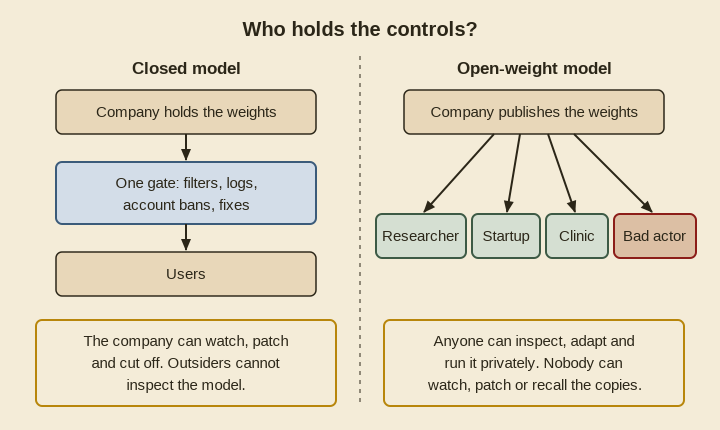 A closed model has one gate and one gatekeeper. An open one has neither.
How far behind are the open models?
Not far, and that is why the argument has heated up. The safety report says the abilities of the leading closed models are "now estimated to be less than one year ahead" of the leading open ones on well-known tests. It lists the releases that narrowed the gap: DeepSeek's R1 in January 2025, Alibaba's Qwen models, and in August 2025 OpenAI's first open-weight models since 2019.
So a rule of thumb follows. Whatever the best closed model can do today, a downloadable one can probably do within about a year. Each side reads that sentence differently.
The case that open models are a safety risk
Here is the argument at its strongest.
A closed model has a gate. The company can filter requests, keep logs, spot a pattern of abuse and close an account. If a flaw turns up, it can fix every user's copy at once, because there is only one copy. An open model has none of that. The safety report states that safeguards "are much easier to remove for open-weight models." A person with the file can retrain it on harmful examples, strip out the code meant to block misuse, or undo the safety training.
The second point is permanence. "Once released, model weights cannot be recalled," the report says. Hosting sites can take a model down, which the report calls a significant barrier for casual misusers, but a motivated person can still get a copy that was saved or reposted elsewhere. If a model turns out to be more dangerous than its maker believed, there is no recall notice to send.
Third, the harm is already visible in one area. The Internet Watch Foundation, the British charity that finds and removes child sexual abuse imagery, reports that it identified 3,443 AI-generated abuse videos in 2025, against 13 in 2024. It describes a fine-tuning technique that lets a user customize an image model with as few as 20 pictures in as little as 15 minutes. Fine-tuning of that kind is done on a model the user holds a copy of. The safety report adds that tracing such content back to whoever made it is harder when open-weight models are used.
Fourth, the worst cases have not happened yet, and waiting for proof has a cost. The report notes that most biological AI tools are open-weight, which makes it hard to limit harmful uses without hampering legitimate research. The U.S. Commerce Department's own 2024 study warned that evidence strong enough to justify restrictions "might arise only after" models with dangerous abilities have already been released. On this view, a one-year lag means every safety problem found in a frontier model becomes, a year later, a problem with no gate at all.
The case that open models are the check on a few companies
Here is the other argument at its strongest.
Building a frontier model is beyond almost everyone. The safety report puts the cost of leading models at "hundreds of millions of dollars." Stanford's 2026 AI Index reports that industry produced over 90 percent of notable frontier models in 2025, and that private AI investment in the United States reached $285.9 billion that year. A Federal Trade Commission staff report in January 2025 studied three partnerships between the largest cloud companies and two leading AI developers. It warned that such deals could affect access to computing power and engineering talent, raise switching costs, and give the cloud partners sensitive information that others cannot get.
If the only way to use advanced AI is through those firms' gates, then they decide what it costs, what it will discuss, and who is cut off. Open models are the alternative supply. America's AI Action Plan, published by the White House in July 2025, says startups can use open models "without being dependent on a closed model provider," and that many businesses and governments "have sensitive data that they cannot send to closed model vendors."
There is a safety argument on this side too. A closed model can be tested by outsiders only as far as its maker allows. With open weights, the safety report says, a wider pool of researchers can study the model, measure what it can do and look for flaws, which makes it "more likely" that problems are found, though "this is not guaranteed." The Action Plan calls open models "essential for academic research." Science that cannot be repeated by anyone else is weaker science.
Then there is the question of marginal risk: how much danger an open release adds beyond what is already out there. Much of what a model can tell a wrongdoer sits in libraries and on the internet. The safety report grants that many users "will not have the skill or incentive" to remove safeguards. And closed models are not sealed: the report's update on safeguards says sophisticated attackers can often get around current defenses. On this view, the gate provides less safety than it appears to, at the price of handing a few companies the keys to a basic technology.
What have governments and expert bodies said?
None of the major official reviews has called for a ban, and none has declared open models safe.
| Body and date | What it said |
|---|---|
| U.S. Commerce Department (NTIA), 30 July 2024 | Evidence was not sufficient to decide that restrictions on open-weight models "are warranted, or that restrictions will never be appropriate in the future." It advised the government to collect evidence, monitor risks and be ready to act |
| White House, America's AI Action Plan, July 2025 | The release decision "is fundamentally up to the developer," and the federal government "should create a supportive environment for open models" |
| European Union, AI Act | Makers of general-purpose models released under a free and open-source license, with weights published, are excused from some paperwork duties. The exception does not apply to models classed as posing systemic risk |
| International AI Safety Report, 3 February 2026 | Open-weight models help research and innovation, but their safeguards are more easily removed and releases are irreversible. It names the real-world effectiveness of technical fixes as a key evidence gap |
One model, four users
For example, picture one capable open-weight model, published on a Tuesday, and four people who download it.
A 12-person clinic runs it on a computer in the back office to draft visit summaries. Patient notes never leave the building, which is the sensitive-data case the Action Plan describes. A two-person startup adapts it for a language the big providers serve poorly; the safety report gives minority languages as a use for exactly this. A university lab probes it for hidden flaws and publishes what it finds.
The fourth person removes the safeguards over a weekend and uses the model to write fraud messages in bulk. If this were a closed model, the provider might notice thousands of similar requests and close the account. Here there is no account. If the maker ships a safer version on Friday, the first three may install it. The fourth will not, and the report says as much: open developers "cannot guarantee that updates will be adopted by users."
The same file did all four things. Any rule strict enough to stop the fourth user at the source also stops the first three. Any rule loose enough to serve the first three leaves the fourth alone. That trade is the whole debate.
What is known, what is disputed, and what facts cannot settle
Known. Safeguards come off open models more easily than closed ones. A release cannot be undone. The gap between open and closed has shrunk to under a year. A small number of companies build nearly all frontier models. Open models are already used both for ordinary work and for abuse imagery.
Disputed, and answerable with evidence. How much does an open release add to real-world harm beyond what closed models and the internet already allow? The safety report says measuring this is "complex in practice," and warns that small increases can add up. Do new methods that make models resist tampering actually hold? The report calls that unproven. Does open release really loosen the big firms' grip when running the best models still takes costly chips? The sources here do not answer that.
Value judgments. Is it better to trust a few companies with a gate, or millions of people with a copy? How should a small chance of a very large harm weigh against steady, widespread benefits? Who should decide what a model refuses to do: its maker, a government, or the person running it? People who agree on every fact above still split on these.
What to remember
- Both sides agree that open weights are easier to strip of safeguards, cannot be recalled, and trail the best closed models by less than a year.
- Both sides agree that open models bring real benefits for research, privacy and smaller firms, and that a few companies build nearly all frontier models.
- They divide on marginal risk: how much harm an open release adds that would not have happened anyway.
- They divide on which failure is worse: a dangerous model nobody can pull back, or a basic technology that a handful of firms control.
- They divide on timing: act before clear evidence of catastrophic misuse, or wait for it.
- As of 12 November 2026, the official reviews cited here advise watching the evidence, and none calls for a ban.
"Open" and "closed" are two ends of a range, and the safety report describes release options at many points between them. The practical questions for the next few years are narrower than the slogans: which abilities, if any, should trigger extra testing before a release, and who gets to run that test.
Sources (8)
- International AI Safety Report 2026, 3 February 2026
- Open Source Initiative, "The Open Source AI Definition", version 1.0
- Internet Watch Foundation, "How AI is being abused to create child sexual abuse imagery"
- NTIA, U.S. Department of Commerce, "Dual-Use Foundation Models with Widely Available Model Weights", 30 July 2024
- Stanford HAI, "AI Index Report 2026"
- Federal Trade Commission, "FTC Issues Staff Report on AI Partnerships & Investments Study", 17 January 2025
- The White House, "America's AI Action Plan", July 2025
- European Union, Regulation (EU) 2024/1689 (AI Act)