Articles & BlogBy Trapper W. Brown8 min readCurrent to 13 November 2026Facts only
As of 13 November 2026, the release notes that software makers publish with their security updates show much larger numbers than they did a year ago. Microsoft's notes for November 2026 say the release "consists of 1094 Microsoft CVEs." Its notes for November 2025 said 63. A CVE is a public ID number for one security flaw, so the count is a count of flaws fixed.
The question in the title has a short answer and a longer one. The short answer is that one project, OpenSSH, has said in writing that many of its bug reports now come from artificial intelligence (AI) tools. The longer answer is that most of the vendor notes I read give the numbers and no reason at all. This article keeps those two things apart. The figures below are each vendor's own, read on its own page on 13 November 2026, and they can be revised.
 Sorting a large volume one item at a time: an Army Post Office in England, 1944. Photo by a Ministry of Information Photo Division photographer, public domain, via Wikimedia Commons.
How big are the releases now?
Three vendors state a count in their own notes.
Microsoft. The company titles its security release notes by month. They state these totals:
| Release | Microsoft's stated count |
|---|---|
| November 2025 | "63 Microsoft CVEs" |
| October 2026 | "1474 Microsoft CVEs" |
| November 2026 | "1094 Microsoft CVEs" |
The November 2026 notes break the 1,094 down by product family, with 726 under Windows and 174 under Office. They mark one flaw, CVE-2026-124194 in Outlook, as "Exploitation Detected." The site's article "The Outlook Bug Attackers Used Before the Patch" covers that one.
Oracle. Oracle releases what it calls a Critical Patch Update four times a year, in January, April, July and October. Each advisory opens with a count in the same sentence form: "This Critical Patch Update contains 1295 new security patches across the product families listed below." That is the October 2026 figure. The earlier advisories give 374 for October 2025, 337 for January 2026, 481 for April 2026 and 1,448 for July 2026.
Google Chrome. The Chrome team's post for the desktop update of 11 November 2026 says: "This update includes 83 security fixes."
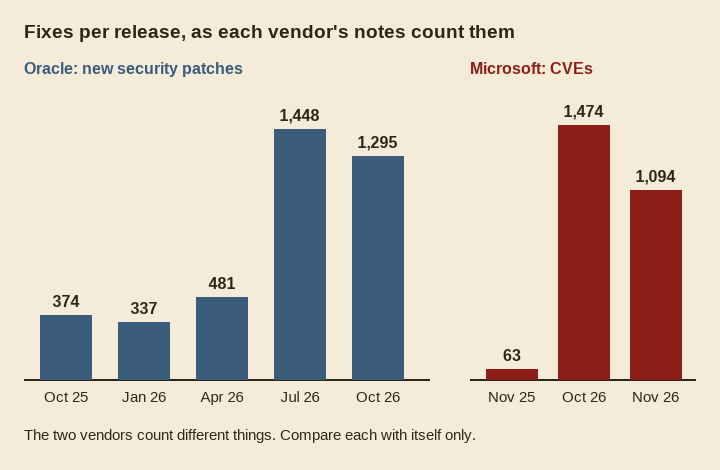 Counts as stated in each vendor's own release notes. Data: Oracle Critical Patch Update advisories; Microsoft Security Response Center release notes. Diagram by Warhawk Division.
These numbers are not the same kind of thing. Oracle counts "security patches," and its advisory says the patches cover "vulnerabilities in Oracle code and in third party components included in Oracle products." Microsoft counts CVEs. Chrome counts "security fixes." Compare each vendor with its own earlier releases, not with the others.
What does OpenSSH say is happening?
OpenSSH is an implementation of SSH, the protocol used to log in to another computer over a network. Its release notes for version 10.6, dated 6 October 2026, open with a statement that is unusual for release notes:
"Recently the OpenSSH team have received a large number of security bug reports, many of which are findings from AI models or made with AI assistance."
The project does not treat every report as serious. The same paragraph says "many AI reports are determined not to have security impact when considered in the context of a realistic threat model," and adds that the team welcomes the reports, "especially when combined with human triage, analysis, test-cases and particularly when accompanied by proposed fixes."
Then it gives a reason for changing how it ships software. The notes say the team has "seen a number of cases where a security bug identified by AI tools is subsequently independently discovered by a different researcher." Their conclusion, in their words: "This suggests that adversaries who do not report bugs to OSS projects are likely to be able to discover these bugs too." OSS means open source software. As a result, the project says it "will, for now, be making more frequent releases to get bugfixes into users' hands more quickly rather than batching them until the next planned release."
The release notes page shows the dates. It lists four releases in 2025: on 18 February, 9 April, 6 October and 10 October. For 2026 so far it lists five: on 2 April, 6 July, 11 August, 6 October and 5 November. The last three came within three months of one another.
The 5 November release, 10.6p2, carried one security fix, which the notes call "critical." In a mailing list post that day, OpenSSH developer Damien Miller wrote that the project had "recently observed multiple cases of rapid bug rediscovery by AI agents, sometimes within hours," and so now considers "long embargo periods to be a dangerous practice." An embargo is the quiet period between a private report and the public fix. The site's article "The OpenSSH Password Bypass: Who CVE-2026-123158 Affects" covers that release.
Do the large vendors say AI is the reason?
Not in the notes I read. The Microsoft release notes, the five Oracle advisories and the Chrome post give counts and lists. None of them states why the count is what it is, and none says how many of the flaws were found with AI tools.
Individual credits do appear. One fix in the OpenSSH 10.6 notes is credited to a researcher "in collaboration with Claude and Anthropic Research." That is one entry in that release's security list, and it is the project's wording.
The site's article "A Critical Linux Flaw, and What 'Found With AI' Actually Means" looks at one such case in detail, including what the phrase covers and what it does not.
Are more flaws being used in attacks?
Fixing a flaw and seeing it used in an attack are different events. CISA, the Cybersecurity and Infrastructure Security Agency, keeps a public list of the second kind, the Known Exploited Vulnerabilities (KEV) Catalog. It adds a flaw, in its words, "based on evidence of active exploitation."
The catalog's data file, version 2026.11.13, holds 1,781 entries, each with the date it was added. Counting those dates is my own arithmetic, not a CISA statistic:
| Year added | Entries (my count from CISA's file) |
|---|---|
| 2023 | 187 |
| 2024 | 186 |
| 2025 | 245 |
| 2026, through 13 November | 297 |
The catalog counts flaws CISA has listed. It does not count attacks, and it does not say how any flaw was found.
How has the federal rule changed?
On 10 June 2026 CISA issued Binding Operational Directive 26-04, "Prioritizing Security Updates Based on Risk." A binding operational directive is, in the directive's words, "a compulsory direction" to federal agencies. CISA says this one "applies only to FCEB agencies," meaning Federal Civilian Executive Branch agencies.
The directive's background section says: "Cyber threat actors exploit unpatched vulnerabilities, and their use of AI may further narrow the time defenders have to react between patch release and possible exploitation." Note the word "may."
Its answer is to sort. The directive says it "focuses patching efforts on the areas of highest risk rather than treating all vulnerabilities and systems equally." It sets urgency by four questions: whether the asset is publicly exposed, whether the flaw is in the KEV Catalog, whether an adversary can automate the attack, and whether the adversary gains partial or total control. Where an entry is marked for "forensic triage," the directive says the agency must act "within the timeline (three days)" and assess "whether the system is compromised."
What is not known?
- The vendor notes I read do not say what share of their fixes came from AI tools, from their own staff, or from outside researchers.
- OpenSSH's statement describes OpenSSH. It does not claim to explain any other vendor's numbers.
- A higher count of fixes does not, by itself, show that software has more flaws than before or fewer. The notes do not address that.
- I could not confirm from an official source whether attacks have risen in step with the fix counts. The KEV figures above count listings only.
- The Microsoft notes for November 2026 show a revision dated 13 November 2026, so the totals can change after release day.
What to do
These points repeat official guidance. They are general information, not professional advice for your systems.
- Keep automatic updates on and check monthly. NIST's guide for one-person businesses, CSWP 50, says: "Enabling automatic updates can help manage updates. Make a habit of routinely checking for available updates at least monthly."
- Retire what no longer gets fixes. The same NIST guide says to "remove unsupported systems and replace devices or services that no longer receive security updates."
- Stay on supported versions. Oracle's advisory "strongly recommends that customers remain on actively-supported versions and apply security patches without delay."
- If you manage many systems, sort by risk. CISA "encourages all organizations to adopt risk-based vulnerability management and prioritize remediation of KEV Catalog vulnerabilities."
- Read the vendor's notes. The count matters less than the entries marked as exploited. The site's article "How to Read a Security Advisory Without Panicking" shows where to look.
What to remember
- Microsoft's notes count 1,094 CVEs for November 2026 and counted 63 for November 2025.
- Oracle's quarterly count went from 374 in October 2025 to 1,295 in October 2026, by its own advisories.
- OpenSSH says many of its security bug reports are AI findings or AI assisted, and that it is releasing more often because others can find the same bugs.
- The Microsoft, Oracle and Chrome notes I read give no reason for their counts.
- CISA's directive for federal agencies sorts flaws by exposure, exploitation, automation and impact.
The figures here are a snapshot dated 13 November 2026. Each vendor's page is the authority on its own numbers, and each is linked below.
Sources (18)
- OpenSSH, "Release Notes", read 13 November 2026
- OpenSSH, "OpenSSH 10.6" release announcement, 6 October 2026
- Damien Miller, openssh-unix-dev mailing list, "urgent security release: 10.6p2", 5 November 2026
- Microsoft Security Response Center, "November 2026 Security Updates" release notes (machine-readable), 10 November 2026, revised 13 November 2026
- Microsoft Security Response Center, "October 2026 Security Updates" release notes (machine-readable), 13 October 2026
- Microsoft Security Response Center, "November 2025 Security Updates" release notes (machine-readable), 11 November 2025
- Oracle, "Critical Patch Updates, Critical Security Patch Updates, Security Alerts and Bulletins", read 13 November 2026
- Oracle, "Oracle Critical Patch Update Advisory - October 2026"
- Oracle, "Oracle Critical Patch Update Advisory - July 2026"
- Oracle, "Oracle Critical Patch Update Advisory - April 2026"
- Oracle, "Oracle Critical Patch Update Advisory - January 2026"
- Oracle, "Oracle Critical Patch Update Advisory - October 2025"
- Google, Chrome Releases, "Stable Channel Update for Desktop", 11 November 2026
- CISA, "Known Exploited Vulnerabilities Catalog", version 2026.11.13
- CISA, "Known Exploited Vulnerabilities Catalog" data file (JSON), released 13 November 2026
- CISA, "CISA Adds Four Known Exploited Vulnerabilities to Catalog", 9 November 2026
- CISA, "BOD 26-04: Prioritizing Security Updates Based on Risk", 10 June 2026
- NIST, "Small Business Cybersecurity: Non-Employer Firms" (NIST CSWP 50), 2 November 2026