Articles & BlogBy Trapper W. Brown10 min read
For anyone who keeps seeing the name Qwen in lists of AI models and is not sure what it is. By the end you will be able to read a Qwen model name, tell the free downloads from the paid service, and ask the right questions about your data.
Qwen is the family of artificial intelligence (AI) models built by Alibaba Cloud, the cloud computing arm of the Chinese company Alibaba Group. It is a whole shelf of models: small ones and enormous ones, some for text, some that also take pictures, video and sound.
It matters to an ordinary reader for two reasons. First, many Qwen models are given away as downloads, so they turn up inside other products, often without the name on the box. Second, Qwen is also sold as an online service, which makes it a good case for a question that applies to every AI company: when you type into a hosted assistant, where do your words go?
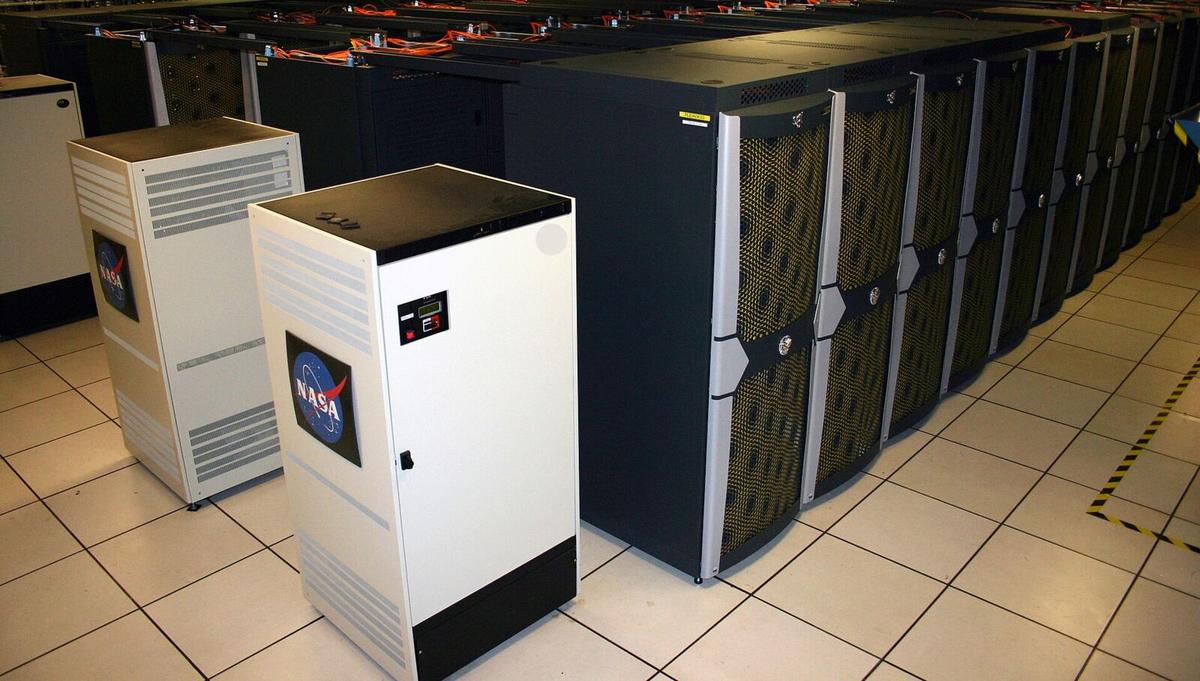 A supercomputer hall at NASA's Ames Research Center. The largest AI models need rooms like this, and the smallest fit on a laptop. Photo by Marco Librero, NASA Ames Research Center, public domain, via Wikimedia Commons.
What is Qwen, and who makes it?
The Qwen page on Hugging Face, the site where most downloadable models are shared, describes it as "the large language model family built by Alibaba Cloud." A large language model is a program that has read a huge amount of text and learned to predict what comes next, well enough to answer questions, write and summarize.
The name is short for the Chinese name Tongyi Qianwen. Alibaba Group's press release of 11 April 2023 announced a large language model under that name, and the team's original code page gives both names side by side. The first downloadable models listed there, Qwen-7B and Qwen-7B-Chat, are dated 3 August 2023.
Since then the releases have come quickly. In 2026 alone the team's code page lists three series: Qwen3.5 in February and March, Qwen3.6 in April, and Qwen3.8 in August.
How do you read a model name?
Qwen names look like part numbers, and they are. Once you can read one, you can read most model names from any maker.
Take Qwen3.8-2.4T-A95B. The first part is the family and version. The second is the total size: 2.4 trillion parameters, the adjustable numbers inside the model that hold what it has learned. The third, starting with "A", is how many of those are active at once: 95 billion.
Why two numbers? Because the biggest models are built as a mixture of experts. Picture a hospital with 500 specialists on staff. No patient sees all of them. A front desk sends each case to the few who fit. The model card for this one says it holds 512 experts and sends each small piece of text to 10 of them, plus one shared expert that always takes part. You pay to store all 2.4 trillion numbers, but only 95 billion do work at any moment.
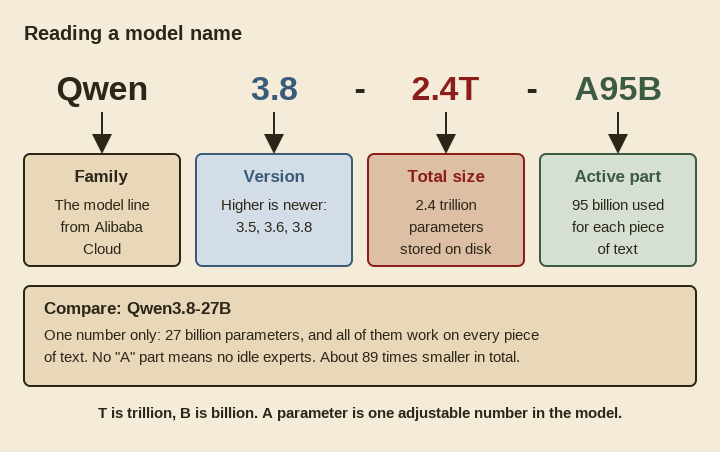 The name tells you the family, the version, the total size and how much of it works at once.
A name with one number, such as Qwen3.8-27B, is a dense model: 27 billion parameters, all working every time.
Size tells you what hardware you need. Each parameter takes 2 bytes at full precision, so the arithmetic is simple. The 27B model is about 54 gigabytes. The 2.4T model is about 4,800 gigabytes, which is a room of specialized machines, not a desktop.
What are the current models, and what is each for?
Here is what the team's own pages showed on 12 November 2026. The first four rows are downloads. The last three are sold through Alibaba Cloud's Model Studio service, described in its own words.
| Model | Released | What the maker says it is for |
|---|---|---|
| Qwen3.5-0.8B, the smallest of its series | 2 March 2026 | Prototyping, fine-tuning for one task, research |
| Qwen3.6-27B | 22 April 2026 | Coding |
| Qwen3.8-27B | 14 August 2026 | Coding, professional work, research, long tasks; reads images and video |
| Qwen3.8-2.4T-A95B | 12 August 2026 | First open release of what the team calls a "Qwen-Max-class" model; text only |
| qwen3.8-flash (hosted) | Listed in November 2026 | "Fast and cost-effective" |
| qwen3.7-plus (hosted) | Listed in November 2026 | "Balanced performance, speed, and cost" |
| qwen4-max-preview (hosted) | Listed in November 2026 | "Complex reasoning and coding" |
A few terms from that table. Thinking is a mode in which the model writes out its working before it answers. The Qwen3.8 cards say it is on by default, and on the 27B model you can turn it down or off. Context is how much text the model can keep in view at once. The 27B card gives 262,144 tokens, where a token is a piece of a word, and says that can be stretched to 1,000,000.
There are also models for other jobs: speech, image generation, and "omni" models that take text, images, audio and video together. The table covers the main text line.
Open weights or the hosted service?
Qwen comes two ways, and the difference is the most important thing in this article.
Open weights means the model itself is published as files. Anyone can download them and run them on their own hardware. Nothing you type goes to Alibaba, because Alibaba is not involved once you hold the files. The article Hermes: The Open AI Models and Agent From Nous Research walks through how a person runs a downloaded model, and one of the Hermes models is in fact built on a Qwen base.
Hosted means the model stays on Alibaba Cloud's computers and you reach it over the internet. The team's code page lists the doors in: Qwen Studio, a free chat assistant on the web. An API (a connection that lets software talk to the model) for developers. And Qwen Code, an open source coding helper that runs in a programmer's terminal.
The two versions are not always the same model. The card for the 2.4 trillion parameter download says the hosted version, Qwen3.8-Max, adds picture input and a non-thinking mode that the download lacks. And the newest name in the table, qwen4-max-preview, appears only on the hosted list. As a rule of thumb with any maker, the newest and largest model is rented first and given away later, if at all.
What do the licenses allow?
"Open" covers several different deals. Qwen uses at least three.
Most of the downloads, including Qwen3.8-27B and the small Qwen3.5 models, carry the Apache 2.0 license. It is a standard open source license. You may use the model at work, change it and sell things built on it.
The flagship download has its own document, the Qwen3.8-Max License. It also grants free use, including commercial use, but adds conditions at very large scale. A product with more than 100 million monthly users or 20 million US dollars in monthly revenue must show the model's name in its interface. A company that runs a model-as-a-service or AI work assistant business on it and takes in more than 50 million US dollars in a year needs a separate agreement. Purely internal use is exempt.
A third model, an experimental preview called Qwen3.8-Flash-Next, is tagged with yet another license, "qwen-community-1.0".
None of those thresholds will trouble a family or a small firm. They do show why the word "open" settles nothing. The license file that ships with the weights is the real answer, and the team's own code page tells readers to look there.
How do people actually use it?
In four ways, roughly from easiest to hardest.
- Chat in a browser. Sign up for the hosted assistant and type. No hardware needed.
- Inside another product. A developer connects an app to the API, and you use Qwen without knowing it.
- A download on your own computer. A free runner app loads one of the smaller models. For the Qwen3.5 series, the team's code page mentions llama.cpp and MLX, among others.
- As raw material. Other labs take a Qwen download and train it further for their own purposes. Because of the Apache license, they do not need permission.
Take two examples. A student wants help outlining an essay. The browser chat does that in a minute, and the only thing at stake is an essay outline. A 40-person engineering firm wants an assistant that can read its design documents. Those documents are the company's value, so the choice between a download on its own server and a rented service has become a business decision.
Where does your data go?
This section is about Qwen, but every question in it applies just as much to a provider in California, Paris or anywhere else. If the company running the model is in a different country from you, your words cross a border, and a different country's laws apply to them once they arrive. That is a fact to weigh. It is not an accusation.
For open weights on your own machine, the answer is short: nowhere.
For a hosted service, here is what Alibaba Cloud's documentation says about its business platform, Model Studio. It lists six regions where a customer can set up: China (Beijing), Singapore, Germany (Frankfurt), Japan (Tokyo), China (Hong Kong) and US (Virginia). It says "Regions determine the access point and data storage location." A second setting decides where the model actually runs. One choice, called Global, uses a bigger pool of machines, and the page says to pick it when you have no data compliance requirements. So storage and processing can be in different places, and the customer chooses.
The same documentation, in a privacy notice last updated on 11 October 2026, says Alibaba Cloud "will never use your data for model training."
Two cautions. That notice covers the business platform. The free chat app is a different product with its own privacy policy, and that is the one to read if the chat app is what you use. And terms change, so read the current version, not an article about it.
Here are the questions I would put to any hosted AI service, whatever flag is on the building.
| Question | Why it matters |
|---|---|
| Which company runs it, and where is that company based? | That country's courts and agencies can make demands of it |
| Where is my data stored, and where is it processed? | These can be two different countries |
| Is what I type used to train future models? Can I switch that off? | Training can carry your words into a product others use |
| How long is it kept, and can I delete it? | Old chats are a liability you forgot about |
| Does my employer, school or regulator have a rule about this? | Some data may not legally leave a country at all |
The articles What Is the Cloud, and Whose Computer Is It? and AI Assistants at Work: What Not to Paste In go deeper on both halves of that table.
What to remember
- Qwen is Alibaba Cloud's family of AI models. Some are free downloads and some are rented over the internet.
- A model name is a parts label: family, version, total size and, on the largest models, the active size.
- The newest downloads on 12 November 2026 are the Qwen3.8 series from August 2026. The newest hosted name is qwen4-max-preview.
- Licenses differ. Most downloads are Apache 2.0, and the flagship has its own license with conditions at very large scale.
- A downloaded model sends your words nowhere. A hosted one sends them to the provider, in the region its terms describe.
- Ask the same five questions of every hosted AI service, foreign or domestic.
Next time a product says it is "powered by" some model, look the name up on Hugging Face. You can now read what the name means, and the license tag on the same page tells you who was allowed to put it there.