Articles & BlogBy Trapper W. Brown9 min readCurrent to 13 November 2026Facts only
As of 13 November 2026, the Internal Revenue Service (IRS) has published the main federal income tax and retirement plan figures for tax year 2027. Two announcements carry them. On 5 November 2026 the IRS released the yearly inflation adjustments for what it called "almost 70 tax provisions." On 12 November 2026 it released the 2027 limits for 401(k) plans, Individual Retirement Accounts (IRAs) and related accounts.
These numbers decide how much of your income is taxed at each rate and how much you can put into a retirement account. The 2027 tax figures, the IRS says, "generally apply to tax returns filed in 2028." This article reports the figures as published. It is general information and not tax advice. Check the IRS pages listed at the end for changes, and take questions about your own return to a tax professional.
 The Internal Revenue Service headquarters building in Washington, D.C., where the yearly figures are issued. Photo by Carol M. Highsmith, Library of Congress, public domain, via Wikimedia Commons.
Why do these numbers change every year?
Many dollar amounts in the tax code are tied to inflation by law. Each fall the IRS recalculates them and publishes the results in a document called a revenue procedure. For 2027 that document is Revenue Procedure 2026-35. Retirement plan limits follow a separate cost-of-living formula and arrive in a notice, this year Notice 2026-66.
The press releases are summaries. The revenue procedure and the notice are the documents that hold the full tables. Where this article gives a 2027 number, it comes from one of those four pages.
What is the standard deduction for 2027?
The standard deduction is a flat amount you subtract from your income before tax is figured, if you do not list (itemize) your deductions one by one. The 2026 figures in the table come from the IRS release of 9 October 2025. The last column is my arithmetic.
| Filing status | 2026 | 2027 | Change |
|---|---|---|---|
| Married filing jointly | $32,200 | $33,200 | $1,000 |
| Single, or married filing separately | $16,100 | $16,600 | $500 |
| Head of household | $24,150 | $24,925 | $775 |
Revenue Procedure 2026-35 adds two details. For 2027 the additional standard deduction "for the aged or the blind is $1,700," and it "is increased to $2,100 if the individual is also unmarried and not a surviving spouse." For a person who can be claimed as a dependent on someone else's return, the standard deduction "cannot exceed the greater of (1) $1,400, or (2) the sum of $500 and the individual's earned income."
What are the 2027 tax brackets?
The United States taxes income in layers, called brackets. Each layer has its own rate, and the rate applies only to the dollars inside that layer. This is what "marginal rate" means: the rate on your next dollar, not on all your dollars.
The brackets apply to taxable income, which is income after deductions. The IRS release lists these thresholds for 2027:
| Rate | Single: taxable income over | Married filing jointly: over |
|---|---|---|
| 10% | $0 | $0 |
| 12% | $12,800 | $25,600 |
| 22% | $52,025 | $104,050 |
| 24% | $109,125 | $218,250 |
| 32% | $208,325 | $416,650 |
| 35% | $264,550 | $529,100 |
| 37% | $661,375 | $793,650 |
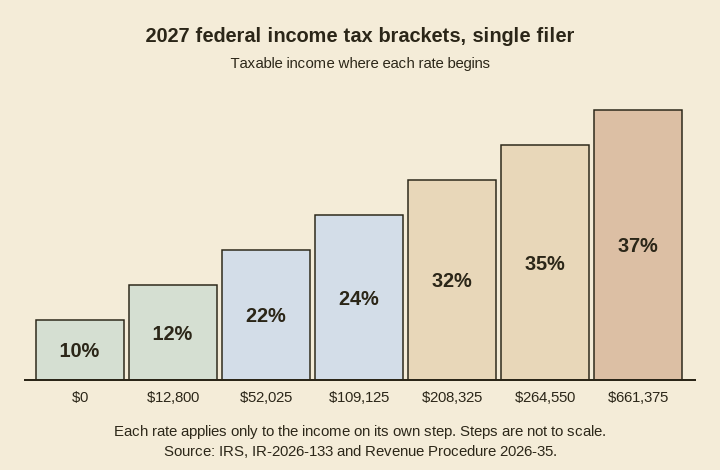 The 2027 brackets for a single filer. Each rate applies only to the income on its own step. Steps are not drawn to scale. Data: IRS news release IR-2026-133 and Revenue Procedure 2026-35. Diagram by Warhawk Division.
Here is how the layers work with the revenue procedure's own tables. These are illustrations of how to read a table, not a calculation of anyone's tax.
One person. Take a single filer with $60,000 of taxable income in 2027. Table 3 of the revenue procedure says that for income over $52,025 but not over $109,125, the tax is "$5,987.00 plus 22% of the excess over $52,025." The excess is $7,975. Twenty-two percent of that is $1,754.50. By my arithmetic the table gives $7,741.50. The person is "in the 22% bracket," but only $7,975 of the $60,000 is taxed at 22%.
A household. Take a married couple filing jointly with $120,000 of taxable income. Table 1 says that for income over $104,050 but not over $218,250, the tax is "$11,974.00 plus 22% of the excess over $104,050." The excess is $15,950. Twenty-two percent of that is $3,509. By my arithmetic the table gives $15,483.
Credits, other taxes and special rates for some kinds of income change the final figure on a real return. The tables alone do not.
What else changed for families and savers?
The IRS release and the revenue procedure give these 2027 figures:
- Child tax credit. The maximum is $2,300, "an increase of $100 from 2026." The amount that may be refundable is $1,800.
- Earned income tax credit. The maximum is $8,496 for taxpayers with three or more qualifying children, up from $8,231 for 2026. The revenue procedure's table gives $7,552 for two children, $4,573 for one and $685 for none.
- Long-term capital gains. The revenue procedure sets the top of the zero percent rate at $51,050 for single filers and $102,100 for married couples filing jointly, and the top of the 15 percent rate at $563,200 and $633,600.
- Health flexible spending arrangements. The limit on employee salary reductions is $3,500, up $100. Where a plan allows a carryover, the maximum is $700.
- Commuter benefits. The monthly limit for transit and for qualified parking is $350, up $10.
- Gifts. The annual exclusion is $20,000 per recipient for calendar year 2027, up from $19,000.
- Estates. The basic exclusion amount for people who die in 2027 is $15,480,000, up from $15,000,000.
Some amounts are not indexed. The IRS notes that personal exemptions "remain at 0" for 2027, and that the income range that phases out the Lifetime Learning Credit, $80,000 to $90,000 ($160,000 to $180,000 for joint returns), has not been adjusted since 2020.
How much can you put in a 401(k) or IRA in 2027?
A 401(k) is a retirement account offered through an employer. An IRA is one you open yourself. Both have yearly contribution caps, and people aged 50 and over get an extra allowance called a catch-up contribution. The 2027 limits from the IRS release of 12 November 2026:
- 401(k), 403(b), governmental 457 plans and the federal Thrift Savings Plan: $25,500, "up from $24,500 for 2026."
- Catch-up, age 50 and over, in those plans: $8,500, up from $8,000. The IRS says these participants "generally can contribute up to $34,000 each year, starting in 2027."
- Higher catch-up, ages 60 to 63: $11,750 "instead of the $8,500." By my arithmetic that is $37,250 with the base limit.
- IRA: the limit "remains $7,500." The IRA catch-up for age 50 and over "remains $1,100."
- SIMPLE retirement accounts: $17,500, up from $17,000.
Two examples, using only those figures. A 52-year-old in a 401(k) plan has a ceiling of $34,000 for 2027, the IRS figure above. A 61-year-old in the same kind of plan has a ceiling of $37,250, my arithmetic from the IRS figures. The IRS words these limits with "generally" and "most" plans, so the plan itself is where a worker finds what applies.
Notice 2026-66 carries one more number that affects higher earners. It says the "Roth catch-up wage threshold for 2026," which is used to determine whether a person's catch-up contributions for 2027 "must be designated as Roth contributions, is increased from $150,000 to $155,000." A Roth contribution is made with money that has already been taxed.
Income limits for IRAs. Income limits decide two things: whether a traditional IRA contribution is deductible when you or your spouse has a retirement plan at work, and whether you can contribute to a Roth IRA at all. Each limit is a range. Inside the range the benefit shrinks, and above it the benefit is gone. The IRS calls this a phase-out.
For 2027 the IRS lists these phase-out ranges:
- Traditional IRA deduction, single filer covered by a workplace plan: $83,000 to $93,000.
- Traditional IRA deduction, married filing jointly, contributor covered by a workplace plan: $133,000 to $153,000.
- Traditional IRA deduction, contributor not covered but married to someone who is: $250,000 to $260,000.
- Roth IRA contributions, singles and heads of household: $158,000 to $173,000.
- Roth IRA contributions, married filing jointly: $250,000 to $260,000.
The IRS adds that if neither spouse is covered by a retirement plan at work, "the phase-outs of the deduction do not apply."
What do these documents not tell you?
- They cover federal income tax only. State taxes are not in them.
- They do not include every figure a household may need. I did not find the 2027 Social Security wage base or health savings account limits in these four documents, so they are not in this article.
- They reflect the law as written when they were released. The revenue procedure says that if amendments to the tax code are enacted for 2027 after its release, "taxpayers should consult additional guidance to determine whether these adjustments remain applicable for 2027."
- They do not tell you what to do. Nothing in them says how much any person should save or which account to use.
What to do
These steps come from the IRS documents themselves.
- Use the right year. The 2027 figures are for income earned in 2027 and, in the IRS's words, "generally apply to tax returns filed in 2028." Returns filed in early 2027 use the 2026 figures.
- Read the full tables if a summary does not cover you. The IRS points readers to Revenue Procedure 2026-35 for the complete tax tables and to Notice 2026-66 for "these and other retirement-related cost-of-living adjustments."
- Check your plan. The IRS describes the contribution limits as what participants "generally" can contribute in "most" plans. Your plan administrator can say what your plan allows.
- Ask a professional about your own case. A tax professional or the IRS's own tools can apply these figures to your income. This article cannot.
What to remember
- The 2027 standard deduction is $33,200 for married couples filing jointly, $16,600 for single filers and $24,925 for heads of household.
- The seven rates, 10% to 37%, are unchanged. The income thresholds moved up.
- A bracket rate applies only to the income inside that bracket.
- The 401(k) limit is $25,500. The IRA limit stays at $7,500.
- Catch-up limits are $8,500 at age 50 and over, and $11,750 at ages 60 to 63, in most workplace plans.
Every figure here is from an IRS page read on 13 November 2026. If the IRS revises a page, the IRS page is right and this one is out of date.
Sources (5)
- Internal Revenue Service, "IRS releases tax inflation adjustments for tax year 2027; taxpayers continue to benefit from the Working Families Tax Cuts", IR-2026-133, 5 November 2026
- Internal Revenue Service, "Revenue Procedure 2026-35", November 2026
- Internal Revenue Service, "401(k) limit increases to $25,500 for 2027, IRA limit remains $7,500", IR-2026-136, 12 November 2026
- Internal Revenue Service, "Notice 2026-66: 2027 Amounts Relating to Retirement Plans and IRAs, as Adjusted for Changes in Cost-of-Living", 12 November 2026
- Internal Revenue Service, "IRS releases tax inflation adjustments for tax year 2026, including amendments from the One, Big, Beautiful Bill", IR-2025-103, 9 October 2025