Articles & BlogBy Trapper W. Brown8 min readCurrent to 13 November 2026Facts only
As of 13 November 2026, the Internal Revenue Service (IRS) is reminding taxpayers of a deduction that is new on the returns most people will file in early 2027. In a news release dated 10 November 2026, the IRS said: "Beginning with tax year 2026, individuals who do not itemize may deduct up to $1,000 of qualifying cash contributions made to certain qualified charitable organizations, or $2,000 for married taxpayers filing jointly."
This matters because of how the old rule reads. The IRS's Tax Topic 506 still says: "Currently, you can only deduct charitable contributions if you itemize deductions on Schedule A (Form 1040)." To itemize is to list your deductions one by one. People who take the flat standard deduction do not. This article reports what the IRS and the law say about the change. It is general information and not tax advice. Check the IRS pages listed at the end, and take questions about your own return to a tax professional.
 Volunteers serve meals at a soup kitchen in New York in May 2007. The deduction described here covers cash gifts only. U.S. Navy photo by Mass Communication Specialist 2nd Class Keith L. Darby, public domain, via Wikimedia Commons.
What changed, and when?
The change comes from Public Law 119-21, dated 4 July 2025. Section 70424 of that law is headed "Permanent and expanded reinstatement of partial deduction for charitable contributions of individuals who do not elect to itemize." It is two lines long. It amends section 170(p) of the tax code "by striking '$300 ($600' and inserting '$1,000 ($2,000'," and "by striking 'beginning in 2021'."
Read plainly, the tax code already held a smaller version of this deduction, with limits of $300 and $600, tied to tax years beginning in 2021. The new law raises the limits and removes the words that tied it to one year. The law says the change applies "to taxable years beginning after December 31, 2025." For most people that means the 2026 tax year, with the return filed in 2027.
The IRS calls the deduction "permanent." In tax law that word means the provision has no end date written into it. Congress can still change it.
Who can take the deduction?
The IRS release is direct: "The deduction is available only to taxpayers who do not itemize deductions."
IRS Publication 6196, a one-page guide dated October 2026, adds a detail. Taxpayers "qualify if they do not itemize. They may take the standard deduction but are not required to do so." It gives the example of people who cannot take the standard deduction, such as someone who files as married filing separately and whose spouse itemizes.
For scale, the IRS announced on 9 October 2025 that the 2026 standard deduction is $16,100 for single filers, $32,200 for married couples filing jointly and $24,150 for heads of household. The new deduction is for people who use those amounts, or who otherwise do not itemize.
What counts as a qualifying gift?
The IRS release lists three conditions and two exclusions. In its words:
- "Only qualifying cash contributions are eligible for this deduction. Noncash contributions do not qualify."
- "Contributions generally must be made to qualified charitable organizations that are eligible to receive tax-deductible contributions."
- "Not every payment to a nonprofit organization qualifies as a charitable contribution for tax purposes."
- "Cash contributions made either to supporting organizations or to establish or maintain a donor advised fund do not qualify."
Two terms need a line each, and the IRS defines both. A donor advised fund is, in the IRS's words, "a separately identified fund or account that is maintained and operated by a section 501(c)(3) organization," where the donor "retains advisory privileges" over how the money is given out. A supporting organization is "a charity that carries out its exempt purposes by supporting other exempt organizations, usually other public charities." The IRS release says cash gifts to either one do not qualify for this deduction.
IRS Tax Topic 506 adds two general rules about charitable gifts. First, "Gifts to individuals are not deductible." Second, if you get something back for your gift, "such as merchandise, goods or services, including admission to a charity ball, banquet, theatrical performance, or sporting event, you can only deduct the amount that exceeds the fair market value of the benefit received."
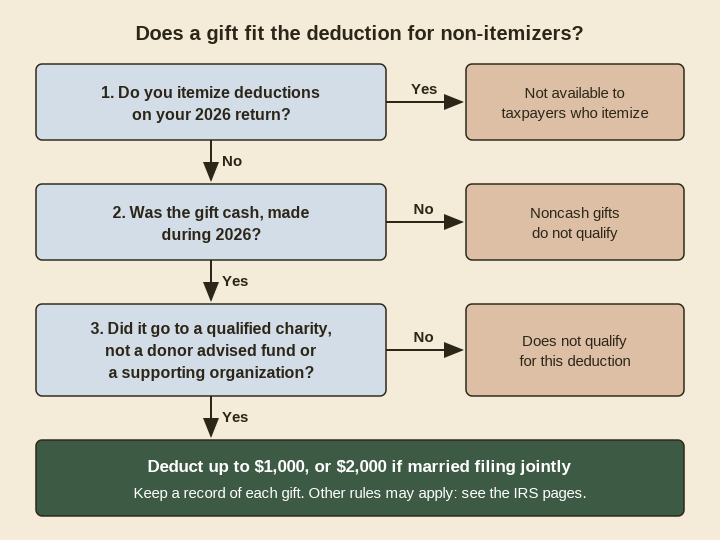 The three tests the IRS release describes, in order. Other rules may apply. Data: IRS news release IR-2026-135 and Publication 6196. Diagram by Warhawk Division.
How do you check that a charity qualifies?
The IRS runs a free lookup called the Tax Exempt Organization Search. Publication 6196 gives the steps: go to the tool on IRS.gov, select "Pub. 78 Data" from the first drop-down menu, enter the organization's name or its Employer Identification Number (EIN, an organization's federal tax ID), and look at the deductibility code.
The publication's footnote reads: "Generally, organizations with deductibility codes such as 50% (60% for cash contributions), PC, POF or FED are eligible to receive deductible charitable contributions. If you see another code, additional rules may apply."
It also warns against reading too much into a failed search: "If you can't find an organization in the search tool, it doesn't necessarily mean your contribution isn't deductible. Some eligible organizations - such as certain churches, government organizations and organizations covered by a group exemption - may not appear separately in the search results."
How much is it worth?
The limit is on the deduction, not on your giving. Two examples, using only the limits the IRS published. They show how the cap works. They do not compute anyone's tax.
One person. A single filer who does not itemize gives $600 in cash to qualified charities during 2026. That is under the $1,000 limit, so the whole $600 fits within it.
A household. A married couple filing jointly, who do not itemize, give $2,500 in cash to qualified charities during 2026. The limit for a joint return is $2,000. By my arithmetic, $500 of their giving is above the limit.
A deduction lowers the income that is taxed. It does not lower the tax bill dollar for dollar. The federal rates for 2026 run from 10% to 37%, according to the IRS release of 9 October 2025. As an illustration, and by my arithmetic, a $1,000 deduction for income that would have been taxed at 12% works out to $120 of tax. At 22% it works out to $220. Your own figure depends on your whole return.
What does the IRS not say?
- Where it goes on the return. The release does not name the form line. I did not read the 2026 Form 1040 instructions for this article, so I cannot confirm it.
- What "cash" covers. The release says "qualifying cash contributions" without defining the term. Tax Topic 506 speaks of "contributions of cash, check, or other monetary gift" when it describes records. For the full definition, the IRS points to Publication 526, Charitable Contributions.
- Every rule. The release ends its list with a caution: "Additional eligibility requirements, contribution limits and recordkeeping rules may apply."
- Rules for itemizers. The same 2025 law added a separate provision, section 70425, headed "0.5 percent floor on deduction of contributions made by individuals." It is a separate rule, and it is outside this article.
- State taxes. The release covers federal income tax only.
What to do
These steps are the ones the IRS release and its publications give.
- Keep records. The IRS says taxpayers "should keep records of qualifying contributions, such as receipts, canceled checks, bank records or written communications from the charitable organization showing the organization's name, the date, and the amount of the contribution."
- Get an acknowledgment for larger gifts. Tax Topic 506 says that "for any contribution of $250 or more," you "must obtain and keep in your records a contemporaneous written acknowledgment from the qualified organization." Tax Topic 506 points to Publication 526 for more.
- Check the charity. Use the Tax Exempt Organization Search on IRS.gov, as Publication 6196 describes.
- Mind the calendar. Publication 6196 is headed "New for 2026 tax returns filed in 2027." It tells readers to save records "to support your deduction when you file your 2026 tax return during the 2027 filing season."
- Read the IRS pages, and ask a professional. The release tells tax professionals they "may want to discuss the new deduction with clients who generally claim the standard deduction." Your own tax professional is the person to ask how it applies to you.
What to remember
- Beginning with tax year 2026, people who do not itemize may deduct up to $1,000 of qualifying cash gifts, or $2,000 on a joint return.
- Only cash counts. The IRS says noncash contributions do not qualify.
- Gifts to donor advised funds and supporting organizations do not qualify.
- The charity must be a qualified organization. The IRS search tool is the place to check.
- Keep a record of every gift, and a written acknowledgment for any gift of $250 or more.
The figures and quotations here come from IRS pages and the text of the law, read on 13 November 2026. The IRS may add guidance before the filing season opens, so check its pages again before you file.
Sources (9)
- Internal Revenue Service, "IRS reminder: Permanent charitable contribution deduction begins for returns filed next year for taxpayers who do not itemize", IR-2026-135, 10 November 2026
- Internal Revenue Service, "Publication 6196, Charitable Contribution Deduction Tips for Non-Itemizers", October 2026
- Internal Revenue Service, "Topic no. 506, Charitable contributions", read 13 November 2026
- U.S. Government Publishing Office, "Public Law 119-21", sections 70424 and 70425, 4 July 2025
- Internal Revenue Service, "IRS releases tax inflation adjustments for tax year 2026, including amendments from the One, Big, Beautiful Bill", IR-2025-103, 9 October 2025
- Internal Revenue Service, "Search for tax exempt organizations", read 13 November 2026
- Internal Revenue Service, "About Publication 526, Charitable Contributions", read 13 November 2026
- Internal Revenue Service, "Donor-advised funds", read 13 November 2026
- Internal Revenue Service, "Section 509(a)(3) supporting organizations", read 13 November 2026