Articles & BlogBy Trapper W. Brown9 min readCurrent to 13 November 2026Facts only
As of 13 November 2026, the Federal Trade Commission (FTC) and four states have filed a complaint and a proposed settlement in federal court against Progress Residential, LLC and its owner, Pretium Partners, LLC. The FTC announced it on 6 November 2026. The companies would pay $49.75 million, and the FTC calls the case "the largest enforcement matter taken against a landlord in the Commission's history."
The claims in the complaint are allegations. No court has ruled on them. The proposed order says the defendants "neither admit nor deny any of the allegations in the Complaint," apart from facts needed for jurisdiction and two provisions about later proceedings. And the companies say they disagree with the FTC's claims. This article is general information and not legal advice. The FTC's case page, listed at the end, is the place to check for changes.
 A single-family house on a residential street in Cincinnati, Ohio. It has no connection to the companies or the case. Photo by Warren LeMay, CC0, via Wikimedia Commons, cropped.
What was filed, and by whom?
The plaintiffs are the FTC, the Attorney General of Arizona, the Attorney General of Colorado, the State of Indiana and the Utah Division of Consumer Protection. They filed in the U.S. District Court for the Northern District of Georgia, as case number 1:26-cv-06782-VMC. Two documents went in on 6 November 2026: a complaint of 125 pages with 32 counts, and a "Stipulated Order for Permanent Injunction, Monetary Judgment, and Other Relief." Stipulated means agreed: the order says "Plaintiffs and Defendants stipulate to the entry of this Stipulated Order" to "resolve all matters in dispute in this action between them."
The FTC's press release describes the defendants this way: "Progress, which was founded by and is wholly owned by the private equity investment firm Pretium, touts itself as the nation's largest property manager of single-family rental homes. Progress manages over 90,000 homes across 17 states, which Pretium owns through its investment funds."
What does the complaint allege?
Everything in this section is an allegation from the complaint or the FTC's summary of it.
The press release says the FTC and the states "allege Progress and Pretium advertised false rental prices, charged hidden fees, failed to inspect homes before residents moved in, improperly deducted amounts from renters' security deposits, restricted negative reviews, and failed to provide adequate customer service."
On pricing, the complaint alleges that the advertised "Per Month" price left out mandatory monthly fees. Paragraph 29 alleges that "since at least 2021, Progress has added undisclosed mandatory fees to residents' monthly rental cost, including: smart home fee ($17-$30/month), utility management fee ($7.95-$9.99/month), air filter fee ($9.99/month), pool fee ($100-$175/month), septic tank fee ($40/month), resident benefit package fee ($15/month), landscaping fee ($35-$120/month), and pest control fee ($10/month)." Paragraph 37 alleges that, as a result, "consumers typically pay between $30 and $330 or more per month than the advertised monthly rental price."
The complaint also lists what it calls one-time and situational fees, including holding fees, a $125 lease administration fee, a $14.95 per month "renter's insurance exemption fee" and a $45 fee per homeowners association violation notice. It alleges the company misrepresented or did not adequately disclose them.
On security deposits, the press release says the complaint alleges Progress "routinely withheld some or all of consumers' security deposits for normal wear and tear, for preexisting conditions and for renovations and repairs that were the companies' responsibility." On reviews, it says the FTC and the states allege the companies used form contracts with "nondisparagement provisions," which are clauses that bar a customer from saying negative things about a business.
The press release adds one more point: "The complaint alleges that the majority of the conduct occurred under prior management, and that new management has moved to remedy the issues."
Is it $48.5 million or $49.75 million?
Both numbers appear on FTC pages, and they do not match. The FTC's consumer alert of 6 November 2026 says the companies "will pay $48.5 million in redress to affected renters." The FTC's press release of the same day says they "will pay $49.75 million."
The proposed order settles it. Section VIII has two money judgments:
- "Judgment in the amount of Forty-Eight Million Five Hundred Thousand Dollars ($48,500,000.00) is entered in favor of Plaintiffs against Defendants, jointly and severally, as monetary relief." The order directs that this be paid to the Commission.
- "Judgment in the amount of One Million Two Hundred Fifty Thousand Dollars ($1,250,000.00) is entered in favor of the State of Arizona against Defendants, jointly and severally, for attorney's fees and costs."
By my arithmetic, $48.5 million plus $1.25 million is $49.75 million. The alert gives the first part. The press release gives the total.
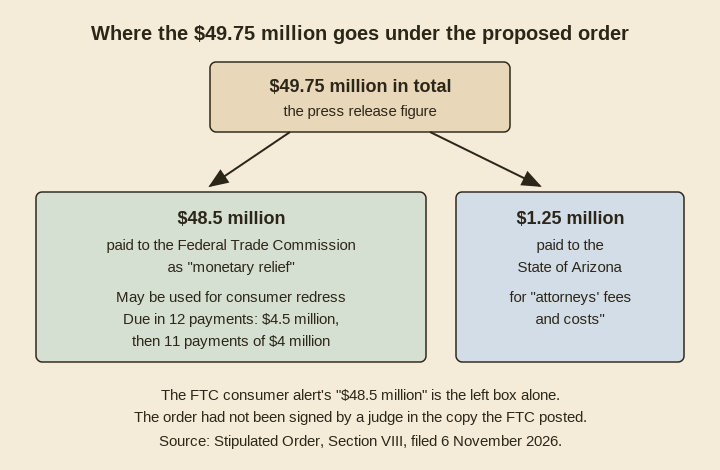 How the two published figures fit together. Data: Stipulated Order, Section VIII, filed 6 November 2026. Diagram by Warhawk Division.
The $48.5 million is not due at once. The order sets 12 payments: $4.5 million within 10 days of the order's entry, then $4 million every 30 days, with the last one due 330 days after the first payment date. By my arithmetic, $4.5 million plus eleven payments of $4 million is $48.5 million.
One smaller mismatch: the consumer alert names "utility maintenance" fees. The complaint and the press release call the fee "utility management."
What does each side say?
Here is each side's stated position, in its own words and at the same length.
The FTC. Christopher Mufarrige, Director of the FTC's Bureau of Consumer Protection, said in the press release: "Consumers searching for housing should have access to straightforward information about the costs associated with renting a home." He added that "transparency regarding rental prices and fees helps consumers compare options."
The companies. Progress Residential said in a statement on its website: "The agreement contains no admission of wrongdoing, and we maintain Progress' practices have been transparent, fair, and consistent with industry practice." Its next sentence begins, "Although we disagree with the FTC's claims," and goes on to say the resolution lets the company move forward.
Pretium posted a statement dated 6 November 2026 with nearly the same wording. Both statements describe the agreement as resolving "the Commission's Civil Investigative Demand related to certain aspects of our resident experience during the period of 2021 to 2025." Progress's statement also lists changes it says its current management team has made to fee disclosures, to its move-out and security deposit process, and to move-in inspection standards. Both companies say they welcome the FTC's efforts to set industry-wide standards for fee disclosures.
What would the order require?
The order's terms apply to the two companies. They are not rules for every landlord.
- One all-in price. The order defines "Total Monthly Rental Price" as "the entire recurring monthly amount to lease a Property, including all recurring mandatory fees or recurring mandatory charges associated with the Property, and excluding variable utility costs and optional fees." The companies must disclose it clearly in any ad that shows a price and display it "more prominently than any other Pricing Information."
- Deposit deductions. They may not withhold deposit money for damage unless, among other conditions, "the consumer caused damage to the Property beyond normal wear and tear," nor for conditions "that existed at the Property on the date the consumer took possession."
- An itemized statement. It is due "no later than thirty (30) days after a consumer moves out, or within the time period required by state law or lease, whichever is sooner."
- Records on request. The companies must keep inspection records and photographs and deliver copies "to a current or former resident of the Property at issue at the consumer's request."
- Reviews. They may not use or enforce any "Review-Limiting Contract Term."
What is not known?
- Whether the judge has signed the order. The copy the FTC posted ends with a blank signature date. The FTC's case page, last updated 6 November 2026, lists the case status as "Pending." The press release notes that such orders "have the force of law when approved and signed by the District Court judge." I could not confirm the court's docket directly.
- Who will get money, how much, and when. The order says the money "may be deposited into a fund administered by the Commission or its designee to be used for consumer relief, such as redress." It says the defendants "represent that they have provided this redress information to the Commission." None of the documents I read gives a claims process, an eligibility rule or a payment date.
- Whether the allegations are true. No court has decided that.
What to do
The FTC's consumer alert gives these steps, in its words, for anyone looking for a rental.
- Ask for the full price in writing. "Before you spend money on application or holding fees for a rental, ask the leasing agent to confirm in writing the monthly rent you'll pay, including any mandatory fees."
- Document the home when you move in. "Take photos as soon as you move in and send them to your landlord right away, especially if there's any damage. Also report appliances or systems that don't work."
- Document it again when you leave. "When you move out, take pictures again." The alert also says to "request a pre-moveout inspection" and to "ask the landlord to include an itemized list of anything deducted from your security deposit refund."
- Report problems. "If you see or experience hidden fees or other deceptive rental practices, tell the FTC: ReportFraud.ftc.gov."
If you rent or rented from these companies and have questions about a refund, the FTC is the authority. For a dispute over your own lease or deposit, this article cannot tell you where you stand. A lawyer or your state's consumer protection office can.
What to remember
- The FTC and four states filed a complaint and a proposed settlement on 6 November 2026. The claims are allegations, and the companies neither admit nor deny them.
- The total is $49.75 million: $48.5 million to the FTC as monetary relief and $1.25 million to Arizona for attorney's fees and costs.
- The companies say they disagree with the FTC's claims and that their practices were "transparent, fair, and consistent with industry practice."
- The order would require one advertised monthly price that includes mandatory recurring fees.
- As of 13 November 2026, the documents I read give no refund process or date.
The FTC's case page is where a signed order or refund news would appear. Until then, these are the figures in the filed documents.
Sources (7)
- Federal Trade Commission, "Progress Residential and Owner Pretium Partners to Pay $49.75 Million to Settle FTC and States' Charges Over Deceptive Rental Pricing Practices and Other Unlawful Conduct", 6 November 2026
- Federal Trade Commission, "FTC says Progress Residential charged renters hidden fees", consumer alert, 6 November 2026
- Federal Trade Commission, "Progress Residential, LLC", case page, last updated 6 November 2026
- Federal Trade Commission and others, "Complaint for Permanent Injunction, Monetary Judgment, and Other Relief", filed 6 November 2026
- Federal Trade Commission and others, "Stipulated Order for Permanent Injunction, Monetary Judgment, and Other Relief", filed 6 November 2026
- Progress Residential, "Progress Residential Statement Regarding Agreement with the Federal Trade Commission", read 13 November 2026
- Pretium, "Pretium Statement Regarding Agreement with the Federal Trade Commission", 6 November 2026