Articles & BlogBy Trapper W. Brown11 min readCurrent to 12 November 2026Facts only
SARS-CoV-2 is the virus that causes COVID-19. The first known cluster of cases appeared in Wuhan, China, in December 2019. Nearly seven years later, the question of how the virus first got into a human being has no agreed answer. Health agencies, intelligence agencies, a congressional panel and several research teams have each published a conclusion, and those conclusions do not match.
This piece does not add another opinion to that pile. It lists what each named body said, when it said it, and how sure it said it was. Everything is as of 12 November 2026. Where two bodies disagree, both positions are shown. The reason a reader should care is practical: the answer shapes how countries police wildlife markets, how they regulate laboratories, and how much they share with one another the next time a new disease appears.
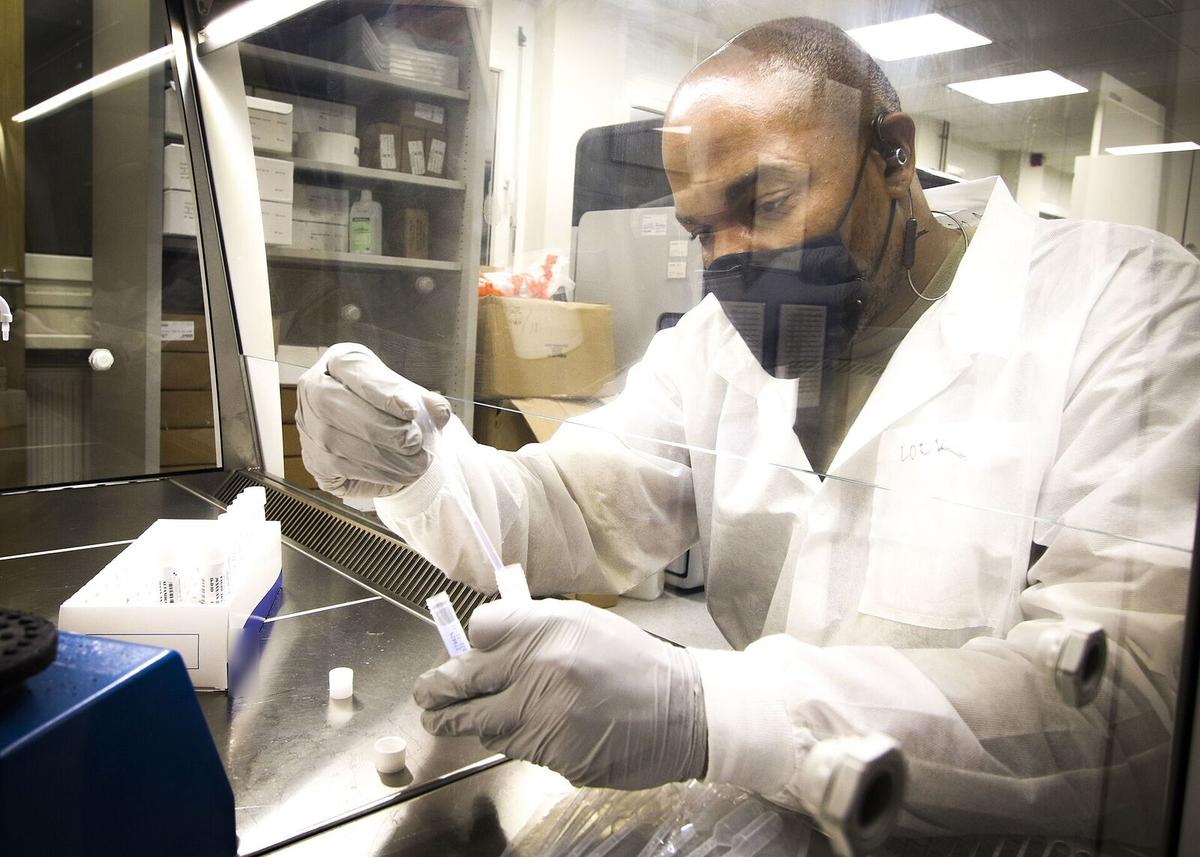 A U.S. Army laboratory technician prepares a COVID-19 sample for testing at Landstuhl Regional Medical Center on 3 November 2020. Photo by Marcy Sanchez, public domain, via Wikimedia Commons.
What are the two main explanations?
Every body listed here treats two explanations as the serious ones.
Natural spillover. A virus circulating in animals infected a person, either straight from bats or through another animal that carried it. Scientists call this zoonotic spillover. A zoonosis is a disease that passes from animals to people.
A laboratory-associated incident. Someone was infected in the course of research: while collecting samples from animals, handling animals, or working with a virus in a laboratory. The U.S. intelligence community counts an infection picked up during field sampling for research as a laboratory-associated incident, not as natural contact.
A third idea, that the virus was built as a weapon, is the one point on which the record is nearly unanimous. In its June 2023 report the Office of the Director of National Intelligence (ODNI) wrote that "all IC agencies assess that SARS-CoV-2 was not developed as a biological weapon." IC means intelligence community, the group of U.S. spy agencies.
What did the World Health Organization's teams conclude?
March 2021: the joint study. A team of international and Chinese experts visited China in January and February 2021 and published a joint report that March. It rated four pathways on a scale the report itself calls "an arbitrary Likert opinion scale." Spread through an intermediate animal host was "likely to very likely." Direct spread from an animal was "possible to likely." Arrival on frozen food was "possible." A laboratory incident was "extremely unlikely."
June 2025: the advisory group. In July 2021 the WHO Director-General set up a new panel, the Scientific Advisory Group for the Origins of Novel Pathogens, or SAGO. Its report of 27 June 2025 reached a more guarded position. The key sentence reads: "The weight of available evidence reviewed by SAGO suggests zoonotic spillover of SARS-CoV-2 into the human population, either directly from bats or through an intermediate host." The next sentence says SAGO "cannot conclude with certainty where and when this occurred."
On the laboratory explanation, SAGO wrote that it had not been able to examine laboratory practices or staff health records in Wuhan. It noted that "no evidence has been presented, other than speculation from scientific or intelligence reports," for a laboratory incident, and then added: "Without the requested information, this hypothesis can however not be ruled out." It did set aside one idea. Claims of deliberate manipulation of the virus, it said, "are not supported by accurate science."
The WHO Director-General, Tedros Adhanom Ghebreyesus, summed up the agency's position the same day: "As things stand, all hypotheses must remain on the table, including zoonotic spillover and lab leak."
Two details about that report belong in the record. The WHO said it had asked China for hundreds of early genetic sequences, more detail on animals sold in Wuhan's markets, and information on laboratory work and safety, and that "to date, China has not shared this information." And the report's own footnote says three members asked not to be listed as authors, and that a fourth resigned on 13 June 2025.
What did the U.S. intelligence agencies conclude?
The agencies have never agreed with one another, and they have said so in public twice.
| Date | Most likely natural | Most likely a laboratory incident | Unable to say |
|---|---|---|---|
| Assessment based on information through August 2021 | Four agencies and the National Intelligence Council, "with low confidence" | One agency, "with moderate confidence" | Three agencies |
| Report of 23 June 2023 | The National Intelligence Council and four other agencies | The Department of Energy and the FBI, "although for different reasons" | The CIA and one other agency |
Both documents state that "all agencies" see both explanations as plausible. The 2021 assessment explains why confidence is low across the board: the agencies lack clinical samples and full data from the earliest cases, and they wrote that China's cooperation "most likely would be needed to reach a conclusive assessment."
The 2023 report adds findings that bear on the laboratory explanation in both directions.
- The Wuhan Institute of Virology ran "extensive research on coronaviruses."
- The agencies "continue to have no indication" that the institute held SARS-CoV-2 or a close ancestor before the pandemic, "nor any direct evidence that a specific research-related incident occurred."
- Several institute researchers were ill in the fall of 2019. Their symptoms were "consistent with but not diagnostic of COVID-19," and the agencies judged that this "neither supports nor refutes either hypothesis."
- "Almost all" agencies assessed that the virus was not genetically engineered.
The CIA in January 2025. The Associated Press reported on 25 January 2025 that the CIA now believed the virus "most likely originated from a laboratory," and that the agency had "low confidence" in that conclusion. This is a news report of an agency statement. SAGO noted later that year that the CIA's report "is not publicly available."
ODNI in June 2026. On 18 June 2026 the ODNI issued News Release No. 11-26 together with a set of declassified documents, 67 by its index. The release states that research at the Wuhan institute "is now widely viewed as the source of the unintentional lab leak that sparked the pandemic." It gives no confidence level and does not set out a new agency-by-agency assessment like those of 2021 and 2023. Most of the release concerns how the earlier assessments were written, and it makes allegations about the conduct of named officials. Those are outside the scope of this piece, which covers only what bodies concluded about the origin.
What have peer-reviewed studies found?
Four papers are cited most often. All four concern the Huanan Seafood Wholesale Market in Wuhan. Three argue the pandemic began there. The fourth, from China's own disease control agency, reports its sampling and says the origins "remain uncertain."
- Worobey and colleagues, Science, 2022. The earliest known cases from December 2019, "including those without reported direct links, were geographically centered on this market." The authors also write that "there is insufficient evidence to define upstream events."
- Pekar and colleagues, Science, 2022. Early virus genomes fell into two lineages, A and B, which the authors conclude "were the result of at least two separate cross-species transmission events into humans," the first around 18 November 2019.
- Liu and colleagues, Nature, published online 2023. The China CDC team reported on samples taken after the market closed. The virus was found in 74 of 923 environmental samples and in none of 457 animal samples. The animal samples were unsold frozen goods, strays and the contents of a fish tank.
- Crits-Christoph and colleagues, Cell, 2024. A reanalysis of the market data found wildlife DNA, including from raccoon dogs, civets and bamboo rats, "in all SARS-CoV-2-positive samples" from one wildlife stall. The authors describe the result as "a shortlist of potential intermediate hosts" to test.
What these papers do not contain is an infected animal. SAGO, which reviewed them, concluded that the market "appears to be" the place where infections multiplied, and that it could not tell whether the market was "the first instance of spillover" or "the site of further spillover and amplification."
What did Congress conclude?
The House Select Subcommittee on the Coronavirus Pandemic published a 520-page final report on 2 December 2024. Its summary states: "COVID-19 most likely emerged from a laboratory in Wuhan, China." It lists arguments including that Wuhan is home to "China's foremost SARS research lab," that institute researchers were sick in the fall of 2019, and that "all COVID-19 cases stem from a single introduction into humans." A White House web page titled "Lab Leak: The True Origins of Covid-19," read on 12 November 2026, repeats these points and credits the committee as its source.
Two published responses disagree with the report.
SAGO wrote that the subcommittee's report "made claims" about a laboratory accident "without providing any new evidence." The subcommittee's minority staff issued its own report. As SAGO summarizes it, that report concludes that a natural origin and a laboratory accident "are both plausible," as is a mix of the two.
One specific conflict is visible on the page. The subcommittee says the data show a single introduction into humans. The Pekar paper says at least two.
What have other national bodies said?
- France. The National Academy of Medicine published a report on 2 April 2025. Its English summary opens: "Five years after the beginning of the pandemic, the origin of SARS-CoV-2 remains unknown." SAGO's description is that the academy "did not reach any firm conclusions."
- China. The State Council Information Office released a white paper in April 2025. According to SAGO's summary, it says China considers its origin work finished, "which is not the opinion of SAGO," and that the infection reached China on frozen products from abroad, "without citing any new evidence."
- Requests still open. SAGO wrote that it and the WHO had asked "the Governments of China, Germany and the United States of America" for the data behind their government reports, and that "all of the required information had not been provided."
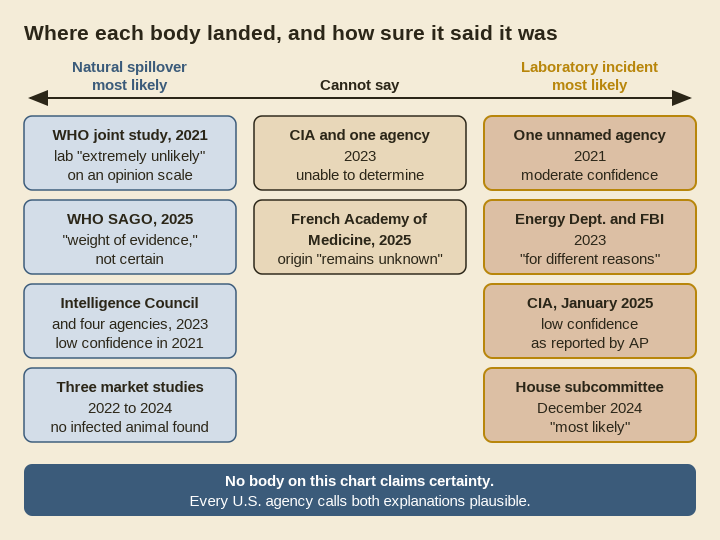 Each body's published position, placed by the words it used.
Where do the bodies disagree, side by side?
| Body and date | Conclusion in its own words | Certainty it stated |
|---|---|---|
| WHO and China joint study, March 2021 | Laboratory incident "extremely unlikely"; intermediate host "likely to very likely" | An opinion scale the report calls arbitrary |
| WHO SAGO, June 2025 | "Weight of available evidence" suggests spillover; laboratory origin "not ruled out" | "Cannot conclude with certainty" |
| U.S. National Intelligence Council and four agencies, 2021 and 2023 | Natural exposure most likely | Low confidence (2021) |
| FBI and Department of Energy, 2023 | Laboratory-associated incident most likely | One agency at moderate confidence in 2021; none given in the 2023 summary |
| CIA, 2023 | Unable to determine | Not applicable |
| CIA, January 2025 | Laboratory origin most likely | Low confidence, as reported by the Associated Press |
| House Select Subcommittee, December 2024 | "Most likely emerged from a laboratory" | "Most likely" |
| French National Academy of Medicine, April 2025 | Origin "remains unknown" | No firm conclusion |
What to remember
- No agency or scientific body has claimed certainty. The strongest words used are "extremely unlikely" (the 2021 joint study, about a laboratory) and "most likely" (several bodies, in both directions).
- Every U.S. intelligence agency says both explanations are plausible. Every one says the virus was not built as a weapon.
- The WHO's advisory group says the weight of the evidence it could review points to spillover, and that it could not assess the laboratory explanation because the data were not provided.
- The published market studies show early cases and virus-positive samples clustered at one market. They do not include an infected animal.
- The U.S. agencies reported in 2023 that they had no indication the Wuhan institute held the virus before the pandemic and no direct evidence of a specific incident there.
- The missing items are named in the reports: early case sequences, market animal records, and laboratory and staff health records from Wuhan.
Each document named here is public and dated. If a new assessment appears, the useful questions are the same ones used above: who is saying it, what they looked at, and what confidence they attach in their own words.
Sources (14)
- ODNI, "Potential Links Between the Wuhan Institute of Virology and the Origin of the COVID-19 Pandemic", 23 June 2023
- WHO, "WHO-convened global study of origins of SARS-CoV-2: China Part", joint report, March 2021
- WHO Scientific Advisory Group for the Origins of Novel Pathogens (SAGO), "Independent assessment of the origins of SARS-CoV-2", June 2025
- WHO, "WHO Scientific advisory group issues report on origins of COVID-19", 27 June 2025
- ODNI, "Updated Assessment on COVID-19 Origins", declassified 2021
- Associated Press, "The CIA believes COVID most likely originated from a laboratory but has low confidence in its own finding", 25 January 2025
- ODNI, News Release No. 11-26, 18 June 2026
- Worobey and others, Science, 2022
- Pekar and others, Science, 2022
- Liu and others, Nature, 2024
- Crits-Christoph and others, Cell, 2024
- House Select Subcommittee on the Coronavirus Pandemic, final report release, 2 December 2024
- The White House, "Lab Leak: The True Origins of Covid-19"
- Académie nationale de médecine, Rapport 25-06, 2 April 2025