Articles & BlogBy Trapper W. Brown9 min readCurrent to 13 November 2026Facts only
As of 13 November 2026, the U.S. Food and Drug Administration (FDA) website carries a company recall announcement for certain lots of kale chips. The announcement is dated 2 November 2026 and was published by the FDA on 3 November 2026. The stated reason is short: "Product may contain thallium."
Thallium is a metal. It is not an ingredient, and the announcement says the manufacturing process did not add it. So how does a metal end up in a bag of dried kale? This article reports what the announcement says, then what agencies and peer-reviewed studies say about thallium, soil and plants in the cabbage family. Recall pages can change, so check the FDA page under Sources for updates.
This is general information, not medical advice. Talk to your own clinician before changing anything about your diet or health care because of what you read here.
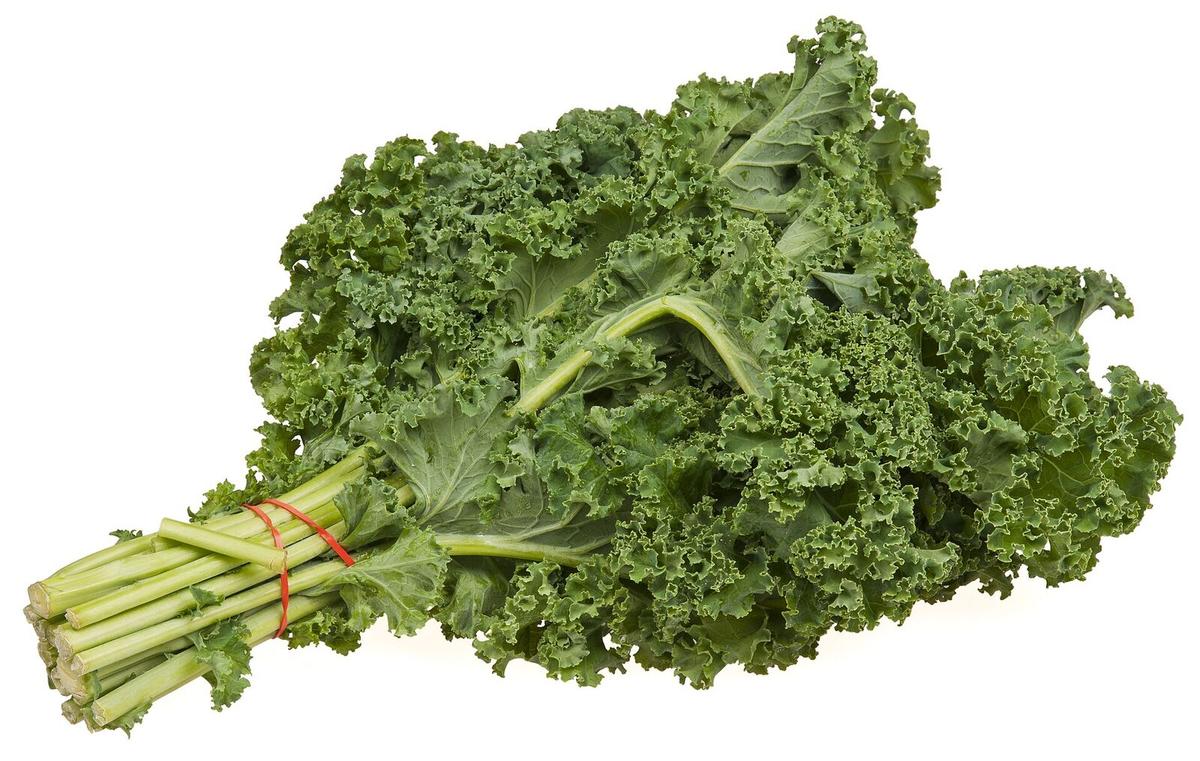 Fresh curly kale, the leafy member of the cabbage family that kale chips are made from. Photo by Evan-Amos, CC0, via Wikimedia Commons.
What does the recall announcement say?
The FDA notes at the top of the page that it posts a company's announcement "as a public service" and that "FDA does not endorse either the product or the company." What follows is the company's announcement as the FDA posted it.
The company is named as Snack Right Super Foods, Inc., doing business as Brad's Raw Chips, of Coral Gables, Florida. It "is recalling certain Brad's Plant Based Crunchy Kale (2 oz) and Brad's Veggie Chips Kale (3 oz) products because they may contain thallium."
| Product | UPC | Lots and Best By dates |
|---|---|---|
| Brad's Crunchy Kale, Original, 2 oz | 813104021679 | 33525-1, 33525-2, 33525-3 (1 February 2027); 34525-1 (11 February 2027); 35125-2 (17 February 2027) |
| Brad's Crunchy Kale, Cheeze It Up, 2 oz | 813104021877 | 35025-3 (16 February 2027) |
| Brad's Crunchy Kale, Radical Ranch, 2 oz | 813104020726 | 29425-1 (21 December 2026) |
| Brad's Veggie Chips Kale, 3 oz | 854615002054 | 33225-3 (28 January 2027); 33325-2 (29 January 2027); 33425-1 (30 January 2027); 33525-1 (1 February 2027) |
The announcement says the products "were distributed nationwide through KeHE Distributors and United Natural Foods, Inc. (UNFI), and sold directly to five individual consumers," between October 2025 and December 2025. It estimates that about 25,000 bags ("about 2,097 cases") are in commerce.
It also gives the background. In May 2026, it says, the California Department of Public Health (CDPH) "advised consumers not to eat certain Brad's Plant Based products after it investigated an inquiry from one individual with elevated thallium levels." CDPH collected samples at retail stores in the Sacramento area, "and laboratory testing found elevated thallium levels in multiple varieties." The announcement then says: "The recall was initiated after the U.S. Food and Drug Administration (FDA) advised the firm of thallium in tested products." It closes by calling this a "voluntary recall" conducted "with the knowledge of" the FDA.
What is thallium?
The Agency for Toxic Substances and Disease Registry (ATSDR), a federal public health agency, describes it this way: "Thallium is a naturally occurring metal in the earth's crust." ATSDR adds that it "can be absorbed by plants grown in contaminated soil" and that "since it is an element, it cannot be transformed or broken down."
The FDA's own page on thallium says it "can also be released into soil, air, and water from pollution caused by industrial activity, such as coal-burning power plants, smelting, and cement making activities."
On health, the recall announcement states: "Acute or chronic exposure to thallium at relatively high levels can result in serious adverse health effects, including gastroenteritis, damage to peripheral nerves, and alopecia (hair loss)." Acute means over a short time and chronic means over a long time. Gastroenteritis is inflammation of the stomach and intestines, and peripheral nerves are the nerves outside the brain and spinal cord.
The FDA's thallium page puts that in context: "Thallium is toxic, but exposure to levels of thallium that cause adverse health effects from food is uncommon." ATSDR says: "The levels of thallium found in the environment are lower than levels known to cause adverse health effects." The FDA adds: "Testing results that detect low levels of thallium in food do not necessarily mean the food should be avoided."
How does a metal get into a leaf?
The route is the soil. ATSDR says: "You are most likely to be exposed to thallium from eating fruits and vegetables grown in soil that contains thallium."
Not every crop does this to the same degree. The FDA says "researchers have found variations in the uptake of thallium by different crops." The recall announcement says thallium "can be taken up by plants and vegetables, particularly those in the Brassicaceous family (i.e., cabbage, radish)." That is the cabbage family, which also includes kale.
A 2016 peer-reviewed review by B. Karbowska in the journal Environmental Monitoring and Assessment says the same: "Plants of the Brassica genus display a notable tendency to accumulate thallium." It reports that vegetables from uncontaminated regions of Poland contained 0.02 to 0.3 milligrams of thallium per kilogram.
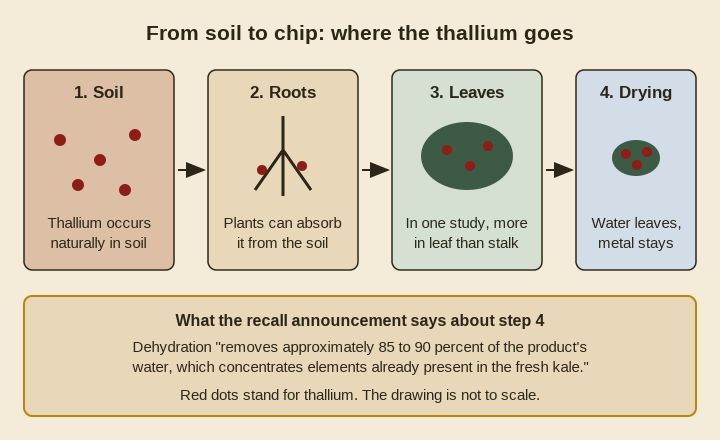 The path from soil to chip as the sources describe it. The quoted sentence is from the company announcement posted by the FDA on 3 November 2026. Diagram by Warhawk Division.
What did the kale experiment find?
One study tested kale directly. J. Pavlíčková and colleagues published it in 2006 in the journal Plant, Soil and Environment. It was a pot experiment: 90 pots of kale grown in three kinds of soil, to which the researchers added thallium on purpose at five levels, from none up to 5.88 milligrams per kilogram of soil.
The abstract reports these findings:
- "Kale was found to be able to accumulate Tl without any influence on yield." (Tl is the chemical symbol for thallium.)
- The highest concentration was in the leaves in the first year and "reached 326 mg/kg dry matter."
- In the third year, thallium in the leaves "was found to be 7 to 10 times higher than in the stalks."
- Soil type mattered. "Neutral soils high in CEC and organic matter are able to bind thallium more effectively than poor acid soils," so less moved into the plants. CEC, cation exchange capacity, is a measure of how well a soil holds on to charged particles.
- Uptake fell over time as the added thallium settled into the soil.
The soil in this study was contaminated on purpose, in pots, with one variety of kale. Its numbers describe that experiment. They are not measurements of any farm or of the recalled chips. Karbowska's review reports a similar soil effect for cabbage: thallium in the plants "is increased with the decrease of soil pH value," meaning more acidic soil.
Why would drying matter?
The announcement addresses this in one sentence: "The manufacturing process did not introduce the contaminant; however, the dehydration process removes approximately 85 to 90 percent of the product's water, which concentrates elements already present in the fresh kale."
Here is a made-up example of the principle, with my own arithmetic and no figures from the announcement. If 100 grams of fresh leaf dried down to 10 grams and only water left, the metal in the leaf would sit in one tenth of the weight, so its concentration by weight would be ten times higher. The amount of metal would be unchanged. The announcement does not give the weights of fresh or dried kale, so I could not confirm the real factor for these products.
What is not known?
- The measured levels. The announcement says thallium was found "in tested products" and that CDPH's testing found "elevated thallium levels." It gives no numbers.
- Where the kale was grown, and why it contained thallium. The announcement says only that brassica crops "are known to accumulate certain elements from soil."
- Whether anyone was harmed by the recalled lots. The announcement mentions one individual's inquiry to CDPH. It does not say whether any illness has been linked to the recalled lots.
- A legal limit for thallium in food. I could not find a published FDA limit for thallium in food, and the FDA's thallium page does not state one. It does state one for bottled water: "The allowable level for thallium is 2 parts per billion." The Environmental Protection Agency's drinking water table lists 0.002 milligrams per liter. The FDA says thallium is on its "List of Select Chemicals in the Food Supply Under FDA Review."
- The effect of small amounts over years. The FDA says: "Adverse health effects from low levels of environmental exposure are unknown." Karbowska's review says the effects of chronic exposure to low concentrations "are currently unknown." The FDA says it is reviewing the science and that the U.S. National Toxicology Program is running studies.
What to do
These are the instructions in the announcement and on the agency pages.
- Check the lot and Best By date against the table above or the FDA page.
- Stop eating it and throw it away. The announcement says consumers "should stop consuming them immediately and discard the product."
- Do not take it back to the store. The announcement says: "Refunds are not being offered, and the product should not be returned to the place of purchase."
- Health questions go to a clinician. The announcement says consumers "who believe they may have experienced adverse health effects from consumption of these products should contact their health care provider." ATSDR says: "If you think you have been exposed to thallium, call your doctor, nurse, or poison control center."
- Know what a test can and cannot show. ATSDR says thallium "can be measured in urine, blood, and hair," and adds: "Elevated levels of thallium in urine or hair cannot predict whether you will have health problems from thallium." Whether a test makes sense is a question for your clinician.
- Product questions go to the company. The announcement lists Alexa Olvera at Snack Right Super Foods, Inc., by email at alexandra@thesnackright.com, Monday through Friday, 10:00 a.m. to 4:00 p.m. Eastern Time.
What to remember
- The recall covers specific lots of four Brad's kale chip products, announced 2 November 2026 and posted by the FDA on 3 November 2026. The reason given is that they "may contain thallium."
- Thallium occurs naturally in soil, and plants can absorb it. The recall announcement and a published review single out the cabbage family, which includes kale.
- In a 2006 pot experiment with deliberately contaminated soil, kale took up thallium, mostly into its leaves, and kept growing normally.
- Drying removes water and leaves metal behind, which the announcement says "concentrates elements already present in the fresh kale."
- The announcement gives no measured levels, and the FDA says the health effects of low-level exposure "are unknown."
The FDA's recall page and its thallium page are the places to watch for anything new, and your own clinician is the person to ask about your own health.
Sources (7)
- U.S. Food and Drug Administration, "Snack Right Super Foods, Inc. dba Brad's Raw Chips Recalls Brad's Crunchy Kale & Veggie Chips Due to Potential Thallium Contamination", company announcement 2 November 2026, published 3 November 2026
- U.S. Food and Drug Administration, "Thallium", content current as of 9 November 2026
- California Department of Public Health, "CDPH Warns Consumers Not to Eat Brad's Plant Based Products", NR26-021, 19 May 2026
- Agency for Toxic Substances and Disease Registry, "ToxFAQs for Thallium", page last reviewed 5 November 2024
- U.S. Environmental Protection Agency, "National Primary Drinking Water Regulations", last updated 31 August 2026
- Pavlíčková and others, "Uptake of thallium from artificially contaminated soils by kale (Brassica oleracea L., var. acephala)", Plant, Soil and Environment 52(12), 2006
- Karbowska, "Presence of thallium in the environment: sources of contaminations, distribution and monitoring methods", Environmental Monitoring and Assessment 188, 2016