Articles & BlogBy Trapper W. Brown10 min readCurrent to 13 November 2026Facts only
As of 13 November 2026, federal wildland firefighting is exempt from water pollution control requirements for one year. A presidential determination posted by the White House grants the exemption "for the 1-year period beginning November 10, 2026, and ending November 10, 2027." It names one activity in particular: "the aerial use, deployment, and discharge of fire retardants."
The determination arrives in the middle of a lawsuit. A federal court in Montana ruled in 2023 that the U.S. Forest Service was violating the Clean Water Act when retardant dropped from aircraft landed in waterways without a permit, and the same court said in 2025 that the agency must get one. This article sets out what each document says. It takes no position on who is right. The documents are linked under Sources, and any of them may be followed by a newer one.
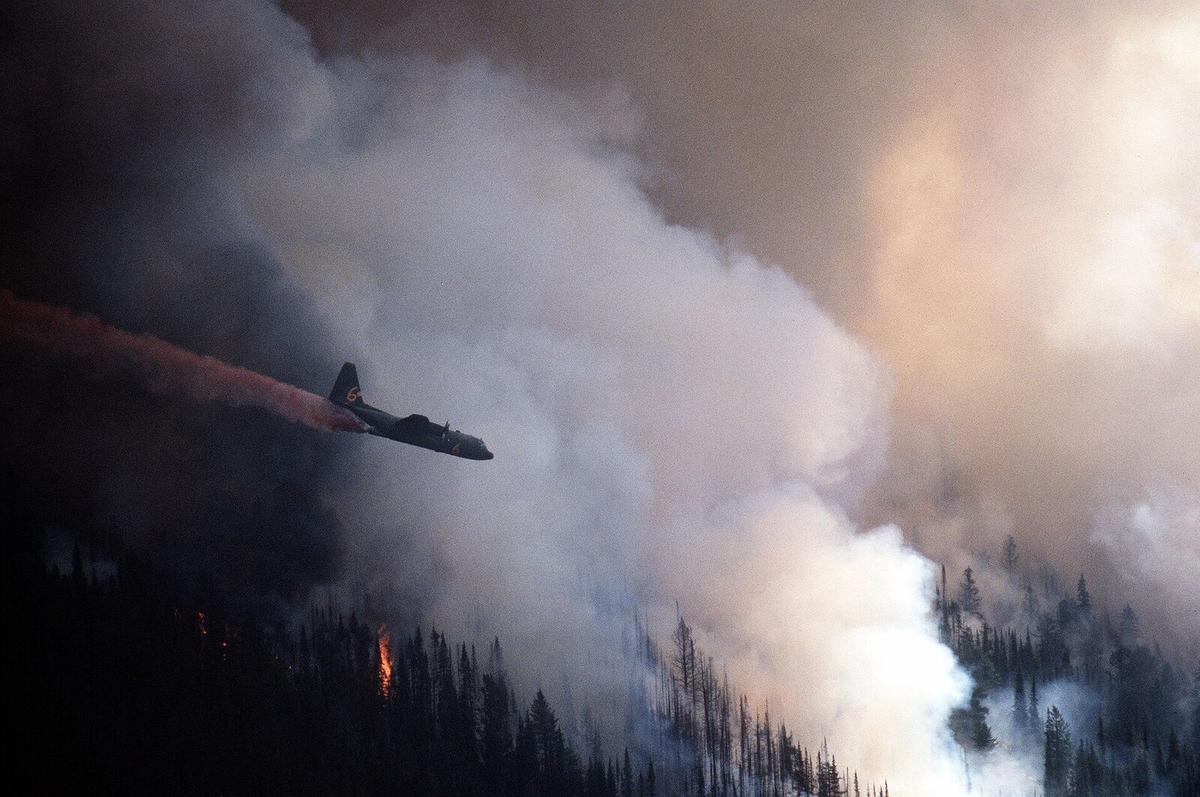 A U.S. Air Force C-130 fitted with a modular airborne firefighting system drops retardant on the White Mountain complex fire near Spokane, Washington. Photo by Staff Sgt. Michael E. Best, U.S. Air Force, public domain, via Wikimedia Commons.
What is fire retardant, and why is water the issue?
Fire retardant is the red slurry that air tankers drop ahead of a wildfire. The Forest Service's policy page says it "reduces wildfire intensity and rate of spread, decreasing risks to firefighters, enabling them to construct fireline safely."
In the Montana case, the court recorded the Forest Service's own description: retardants in use "are primarily inorganic fertilizers (ammonium phosphates) or other inorganic salts (magnesium chloride)." The court also recorded the agency's acknowledgment that if retardant enters a waterway the direct effects "could include, in certain circumstances, lethal and sub-lethal effects in aquatic species."
The Forest Service page says the agency prohibits drops "in waterways" and in mapped avoidance areas, and that the rate of intrusion into avoidance areas "remains low, at much less than 1%." The same page says its retardants fall into the Environmental Protection Agency's "practically non-toxic" category "for mammals, including humans, and aquatic species."
What does the Clean Water Act require?
The Clean Water Act is the main federal law on water pollution. The Montana court summarized its core rule: the Act "prohibits the discharge of any pollutant from a point source into navigable waters of the United States unless permitted" through a National Pollutant Discharge Elimination System permit, usually shortened to NPDES.
A point source is a single identifiable outlet. The law's definition, quoted by the court, is "any discernible, confined and discrete conveyance," such as a pipe or a vessel. The court noted that the Forest Service conceded "in certain circumstances an aircraft can be a point source."
Federal agencies are covered. Section 313 of the Act, codified at 33 U.S.C. 1323, says each federal department "shall be subject to, and comply with, all Federal, State, interstate, and local requirements" on water pollution "in the same manner, and to the same extent as any nongovernmental entity."
What did the court rule?
The case is Forest Service Employees for Environmental Ethics v. United States Forest Service, No. CV 22-168-M-DLC, in the U.S. District Court for the District of Montana. The plaintiff, known as FSEEE, is a nonprofit organization.
26 May 2023. The court declared that the Forest Service's "unpermitted aerial discharges of fire retardant into navigable waters" in ten western states were "in violation of the Clean Water Act." The states were Oregon, California, Montana, Idaho, Wyoming, Colorado, Nevada, Arizona, New Mexico and Alaska. The court refused to order the drops stopped. It wrote that such an order "could conceivably result in greater harm from wildfires" and ordered status reports every six months on the agency's progress toward a permit.
The two sides counted past drops differently. FSEEE alleged "at least 459 occasions" between 2012 and 2019, "totaling 761,282.5 gallons." The Forest Service answered that the number of recorded drops into navigable waters was 213. The court held that the exact number did not decide the case.
19 May 2025. FSEEE asked the court to order the agency to get a permit by 30 June 2026 or stop discharging into navigable waters. The court denied that request and again declined to stop the drops. It also wrote that "USFS is required to obtain an NPDES permit to discharge aerial deployment of fire retardant into the navigable waters of the United States." The order notes that the Environmental Protection Agency (EPA), which issues the permit, had withdrawn its draft permit and later sent it back for interagency review. "The authority to grant a NPDES permit belongs to the EPA," the court wrote, "not to USFS."
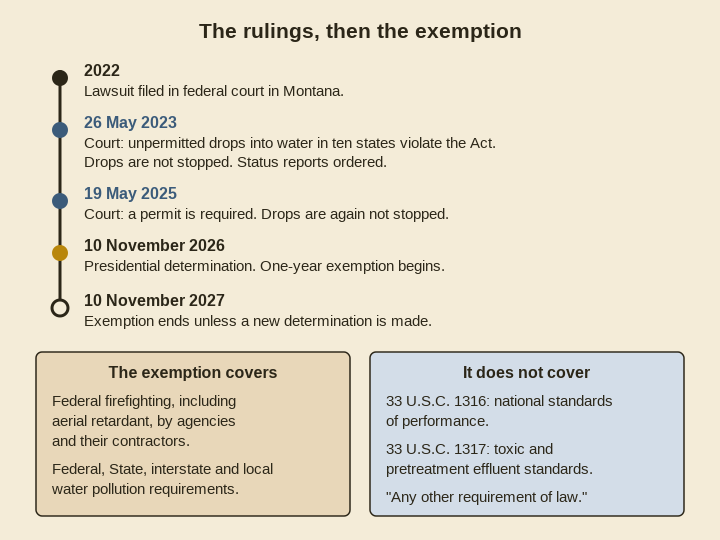 The court rulings and the determination in order, and the scope of the exemption as its text states it. Sources: U.S. District Court for the District of Montana; the White House; 33 U.S.C. 1323.
What does the determination do?
The same Section 313 that binds federal agencies also lets the President release them. The sentence reads: "The President may exempt any effluent source of any department, agency, or instrumentality in the executive branch from compliance with any such a requirement if he determines it to be in the paramount interest of the United States to do so."
The determination uses that sentence. Its text does five things.
- It exempts firefighting. The exemption covers "firefighting activities conducted by the United States Forest Service, the Department of the Interior, and any other agencies and their contractors."
- It names what they are exempt from: "Federal, State, interstate, and local requirements, administrative authority, and process and sanctions respecting the control and abatement of water pollution."
- It keeps two parts of the Act in force. No exemption is granted "from the requirements of 33 U.S.C. 1316 and 1317." Those sections are titled "National standards of performance" and "Toxic and pretreatment effluent standards." The statute itself bars a President from waiving them.
- It lasts one year. The statute allows no more: "Any exemption shall be for a period not in excess of one year, but additional exemptions may be granted" on "a new determination."
- It reserves two points. The text says it is not intended to "imply that in the absence of such a Presidential exemption" the agencies would need permits, or to "limit the applicability or enforcement of any other requirement of law" that applies to their firefighting.
The determination refers to the Montana lawsuit by name, describing the exempted activities as ones "aspects of which are the subject of litigation." It directs the Secretary of Agriculture to publish it in the Federal Register.
The statute adds one duty the determination does not mention. The President "shall report each January to the Congress all exemptions from the requirements of this section granted during the preceding calendar year, together with his reason for granting such exemption."
What does each side say?
Each position below is given in the party's own published words, in 95 words apiece.
The government. The White House fact sheet says the action will "ensure wildland firefighters have the necessary tools to protect America's rural communities and natural resources." It says that under "an adverse district court decision" aerial retardant "now requires a Clean Water Act permit," and that the Forest Service "has been unsuccessful in securing a permit due to significant regulatory hurdles." In court, the Forest Service said recorded drops into water happened only "to protect human life or public safety" or "due to accident," and that lethal retardant intrusions "are expected to be extremely rare."
The plaintiff. FSEEE's lawsuit says unpermitted retardant discharges from aircraft into waterways "violate the CWA," and it asked the court to bar aerial retardant "unless and until" the agency obtains a permit. It offered a scientist's declaration that accidental drops during salmon outmigration "would have adverse impacts that extend beyond acute mortality." In an April 2026 briefing on its website, opposing a bill it said would exempt retardant by statute, FSEEE wrote that a permit "authorizes operations in a manner that maintains water quality" and that "the court has not issued a 'stop work' order."
The court has not decided every disputed fact. It noted, for example, that FSEEE "claims that fire retardant is an ineffective tool in fighting wildfires," and that "this fact is disputed."
What is not known
- The effect on the lawsuit. I read no court order that addresses the determination. A public copy of the docket lists status reports filed on 2 February and 3 August 2026 and an order dated 8 October 2026. I could not read those documents.
- The permit. I could not confirm the current status of the EPA permit from an EPA page.
- FSEEE's response. I read FSEEE's website on 13 November 2026 and it carried no statement about the determination.
- A deadline. FSEEE's April 2026 briefing refers to "a May 26, 2026, federal court deadline." The 2023 and 2025 orders I read set no such date. I could not confirm where it comes from.
- Federal Register publication. I could not confirm publication in the Federal Register as of 13 November 2026.
- Practice on the ground. None of the documents says whether drops near water will change. The Forest Service page, as read on 13 November 2026, still states the waterway and avoidance-area prohibitions.
What to do
None of these documents gives instructions to the public. For readers who want to follow the matter, the official places to look are these.
- The determination, on the White House site and, once published, in the Federal Register.
- The court's orders, which the Government Publishing Office posts free on govinfo.gov under the case number.
- The Forest Service's page on aerial fire retardant, for the agency's current rules on where retardant may be dropped.
- Your water supplier or state environmental agency, for any question about a specific stream or drinking water source. This article is general information and not legal advice.
What to remember
- The determination exempts federal firefighting, including aerial retardant, from water pollution requirements from 10 November 2026 to 10 November 2027.
- It rests on 33 U.S.C. 1323(a), which allows a one-year exemption when the President finds it "in the paramount interest of the United States."
- It does not waive sections 1316 and 1317 of the Act or "any other requirement of law."
- A federal court ruled in 2023 that unpermitted drops into navigable waters in ten states violated the Act, and said in 2025 that a permit is required. Both times it declined to stop the drops.
- The government says firefighters need the tool and a permit could not be obtained. FSEEE says a permit protects water without grounding aircraft.
How the court will treat the determination had not been published in anything I could read by 13 November 2026. The docket and the Federal Register are where that will appear.
Sources (11)
- The White House, "Presidential Determination Concerning Wildfire Suppression Activities in the United States", 10 November 2026
- The White House, "Fact Sheet: President Donald J. Trump Advances Wildfire Suppression", 10 November 2026
- U.S. Government Publishing Office, "33 U.S.C. 1323: Federal facilities pollution control" (United States Code, 2024 edition), read 13 November 2026
- U.S. District Court for the District of Montana, "Forest Service Employees for Environmental Ethics v. United States Forest Service, Order (Doc. 45)", 26 May 2023
- U.S. District Court for the District of Montana, "Forest Service Employees for Environmental Ethics v. United States Forest Service, Order (Doc. 64)", 19 May 2025
- U.S. Government Publishing Office, "Forest Service Employees for Environmental Ethics v. United States Forest Service" (list of the court's published orders), read 13 November 2026
- U.S. Forest Service, "Interagency Wildland Fire Chemicals Policy and Guidance", read 13 November 2026
- Forest Service Employees for Environmental Ethics, "Fire Retardant, Section 408 of the Energy Permitting Reform Act, and the Clean Water Act" (briefing), April 2026
- CourtListener (Free Law Project), "Forest Service Employees for Environmental Ethics v. United States Forest Service" (docket copy from the court's electronic records), read 13 November 2026
- U.S. Government Publishing Office, "33 U.S.C. 1316: National standards of performance" (United States Code, 2024 edition), read 13 November 2026
- U.S. Government Publishing Office, "33 U.S.C. 1317: Toxic and pretreatment effluent standards" (United States Code, 2024 edition), read 13 November 2026