Articles & BlogBy Trapper W. Brown10 min read
SD-WAN stands for software-defined wide area network. It is a way of connecting an organization's locations to each other, and to the internet, over whatever mix of links each location can get, with one piece of central software deciding which kind of traffic uses which link. The links can be ordinary business broadband, a private circuit from a carrier, a cellular modem, or all three at once.
Why should you care? If you work anywhere with more than one location, such as a clinic with a second office, a school district or a chain of stores, your phone calls, your records system and your video meetings ride on a network like this or soon will. If you run a small business, someone will try to sell it to you.
 A satellite dish is one more link a site can add, and SD-WAN is the software that decides what travels over which link. Photo by Tech. Sgt. Christopher Thornbury, U.S. Air Force, public domain, via Wikimedia Commons.
What is a WAN?
Start with the smaller thing. A LAN, or local area network, is the network inside one building: the computers, printers and Wi-Fi in your office or house. A WAN, or wide area network, is what joins LANs that are far apart. The internet is the largest WAN there is. A company WAN is the private arrangement that lets the office in one town reach the file server, the phone system and the people in another.
Building a LAN is mostly a matter of buying equipment, because you own the building. A WAN is different. You do not own the miles between your sites, so you rent a path across them from someone who does. The whole history of the WAN is the story of what kind of path you rent and who controls it.
How did branch offices connect before?
Leased lines. For decades the answer was a circuit rented from the telephone company: a dedicated connection between two fixed points, with a fixed capacity, billed every month whether you filled it or not. It was private and predictable. It was also costly, slow to order and tied to one pair of addresses.
MPLS. Later, carriers offered a shared private network based on Multiprotocol Label Switching. The idea, set out in the internet standard RFC 3031 in January 2001, is that a packet is classified once, as it enters the carrier's network, and given a short label. Routers inside the network forward it by that label and do not examine the packet's own address again at every hop. This let a carrier run many customers over the same equipment, keep them apart and promise each one a level of performance in a contract.
MPLS works well, and plenty of organizations still use it. It came with a habit, though. The usual design was a hub and spokes: every branch connected to headquarters, and anything bound for the internet went to headquarters first, through the security equipment there, and then out. That made sense when the applications lived in the headquarters data center. It makes less sense now that the records system, the email and the meeting software are run by someone else on the internet (the article "What Is the Cloud, and Whose Computer Is It?" covers that shift). A branch that sends its video call hundreds of miles to headquarters so it can turn around and come back to a server down the road is paying for the scenic route.
| Leased line | MPLS | SD-WAN | |
|---|---|---|---|
| What you rent | One dedicated circuit between two points | A place on a carrier's private network | Any links you choose, often plain broadband |
| Who decides the path | The carrier, once | The carrier | Your policy, continuously |
| Links per site | Usually one | Usually one, sometimes a spare | Two or more, all in use |
| Performance promise | In the contract | In the contract | Depends on the links underneath |
| Changing something | An order to the carrier | An order to the carrier | A setting in the controller |
What does "software-defined" change?
Three things.
One central policy. In a traditional network, each router at each site is configured by hand, one at a time. In an SD-WAN, the deciding is separated from the forwarding. A central controller holds the rules. A small edge device at each site carries them out. You write a rule once, in terms a person can read ("video visits get the best link available"), and every site receives it. A new site can be as simple as shipping a box, having someone plug it in, and letting it call the controller for its instructions.
Several links at once. The edge device can use two or more connections at the same time: for example, a fiber line from one provider, a cable line from another and a cellular modem. It builds encrypted tunnels across each of them to the other sites. If one link fails, traffic is already flowing on the others.
Steering by application. The edge device recognizes what kind of traffic it is carrying, and it constantly measures each link for three things: loss (how many packets go missing), latency (how long they take) and jitter (how much that time wobbles). Then it matches the two. A phone call, which cannot wait, goes on the steadiest link. A nightly backup, which is large and patient, goes on the cheapest.
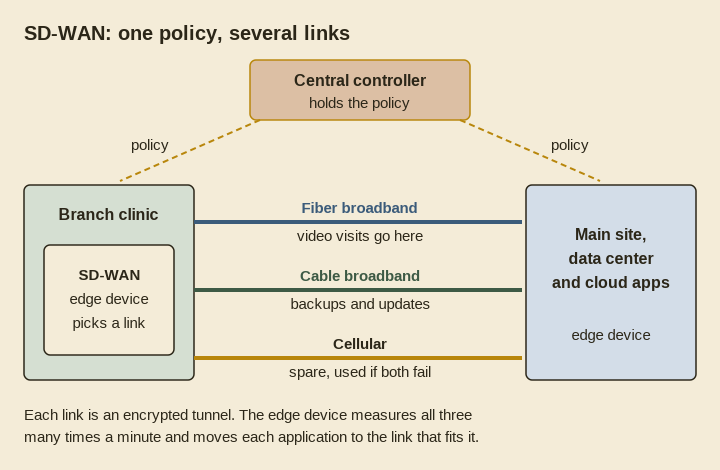 The controller holds the rules, and the edge device at each site applies them across every link it has.
There is a published standard for what counts as an SD-WAN service: MEF 70.2, issued in October 2023 by the industry body now called Mplify Alliance (formerly MEF Forum). Its summary says it defines the service by its externally visible behavior and by what the buyer and the seller agree on. That is a useful habit for a buyer too. Judge the service by what it does at your sites, whatever the box is called.
A small clinic and a hospital system
Here are two worked examples. The numbers are invented to show the reasoning.
A 12 person clinic with two sites. The main office and a satellite office are 15 miles apart. The patient records system is hosted by its maker on the internet. The phones run over the network. Each site has one cable internet line, and when that line drops, the phones go quiet and nobody can open a chart.
With SD-WAN, each site gets a second link from a different provider, a cellular modem as a spare and a small edge device. The clinic's IT provider writes three rules:
- Phone calls and video visits use whichever link currently has the least loss and delay.
- The records system uses any healthy link and goes straight to the internet from each site.
- Backups and software updates use the cable line and wait if it is busy.
One Tuesday the fiber line starts dropping 4 percent of its packets for ten minutes. The edge device sees the loss, moves calls to the cable line and moves them back when the fiber recovers. In a well-tuned setup, the people on those calls do not notice.
An 800 bed hospital system. Now picture one main campus, three smaller hospitals, 40 outpatient clinics and 6,000 staff. The system already has MPLS to all 44 sites. Its records system and its medical imaging archive have moved to cloud hosting.
The network team keeps MPLS at the four hospitals and adds two internet links beside it, a mix often called a hybrid WAN. The clinics move to two broadband links each. The policy sorts traffic into classes: clinical applications, voice and video, medical devices, building systems and guest Wi-Fi. Each class gets its own set of tunnels, so the patient in the waiting room streaming a movie never shares a path with an infusion pump.
The arithmetic shows why clinicians notice. A 500 megabyte imaging study is 4,000 megabits. Over a clinic's old 50 megabit per second MPLS circuit, that is 80 seconds of waiting. Over a 500 megabit per second broadband link, it is 8.
Scale also cuts the other way. A policy change reaches 44 sites in minutes, and so does a mistake. The hospital team tests each change at two clinics before it goes everywhere. "Change Management Is a Security Control" in this set makes that case in full.
Is SD-WAN secure?
It encrypts traffic between sites, which is good, and it changes where the risks sit, which deserves attention.
- The tunnels. Traffic between your sites is encrypted across whatever links carry it. In effect these are VPN tunnels built and managed in bulk. "VPNs: What They Do and What They Do Not" explains what a tunnel protects and what it does not.
- Every branch now faces the internet. In the old hub design, one set of security equipment at headquarters inspected everything. When each site sends traffic directly to the internet, each site needs filtering and firewalling, either in the edge device or in a cloud service it passes through.
- The controller holds the keys. Whoever can log in to the controller can redirect traffic at every site at once. That login needs multi-factor authentication, a short list of administrators and a record of every change.
- Edge devices are computers on the internet. They need security updates on a schedule, like anything else exposed to the outside.
- Segmentation is a setting, and settings can be wrong. Keeping guest traffic apart from clinical traffic works only if someone checks that the rules do what was intended.
NIST, the U.S. standards agency, treats SD-WAN as one part of the modern enterprise network in its Special Publication 800-215 (November 2022), which is a sound, vendor-neutral starting point for the security side.
Where does SASE fit?
SASE, said "sassy," stands for secure access service edge. It answers the question the last section raised: if branches and remote workers go straight to the internet, where does the security inspection happen?
The SASE answer is to combine the SD-WAN with security services delivered from the cloud. Traffic from a branch, or from a nurse's laptop at home, goes to a nearby point run by the provider, where it is filtered and checked against policy, and then on to its destination. One of those checks is usually zero trust network access, which grants a user access to one application at a time after verifying who they are, where a classic VPN would have handed them the whole network. "CIA, AAA and Zero Trust Without the Buzzwords" covers that idea. NIST's publication names SASE as an example of this kind of combined security framework.
As a rule of thumb: SD-WAN is the networking half, SASE is that half plus the security half sold as one service. You can have the first without the second.
What are the honest limits?
- It cannot make bad links good. The software chooses among the links you have. Two poor links are still poor.
- Two links are not always two paths. If both providers' cables share the same pole or the same trench, one backhoe takes out both. Ask how each link physically enters the building.
- The internet makes no end-to-end promise. A broadband contract rarely guarantees performance the way an MPLS contract does. That is why some organizations keep a private circuit for the traffic that matters most.
- The complexity moves. It does not vanish. Someone has to own the policy, watch the reports and decide what "best link" means for each application.
- Mixing makers is hard. As a rule of thumb, assume an edge device from one maker will not join another maker's controller, and ask before you assume otherwise.
- It costs money every year. Most offerings are subscriptions on top of the links themselves.
- A single site may not need it. One office with two internet lines can get automatic failover from a far simpler router.
If you are the buyer, ask who manages the controller, who can log in to it, how the two links differ physically, what happens to calls during a failover (ask to see it tested), how updates are applied and what leaving would involve.
What to remember
- A WAN joins an organization's sites across distance, over paths rented from carriers.
- Leased lines and MPLS gave private, predictable paths at a high price, usually with all traffic passing through headquarters.
- SD-WAN adds central policy, several active links per site and steering of each application to the link that suits it.
- It encrypts traffic between sites, but each site now meets the internet directly, and the controller becomes the most sensitive login in the network.
- SASE is SD-WAN plus cloud-delivered security, sold together.
- It cannot fix weak links, and it still needs a person who owns the policy.
If your organization is considering it, draw your sites on one page, list the three applications that must never drop and write down which link each would use on a bad day. Bring that page to the first meeting with any seller, along with the questions above.