Articles & BlogBy Trapper W. Brown11 min readCurrent to 12 November 2026Both sides
To build a chatbot or an image generator, a company first collects an enormous pile of human work: books, news stories, forum posts, song lyrics, photographs, drawings. Software then studies the pile and adjusts billions of internal numbers until it can produce new text or pictures of its own. This step is called training. For much of that material, nobody asked the people who made it, and nobody paid them.
Was that theft? You should care about the answer for two reasons. Something you wrote or drew is probably in one of those piles. And the tools built from them are now in your phone, your office and your child's homework. This guide lays out the strongest case on each side, what the courts have decided as of 12 November 2026, and which parts of the argument no court can settle.
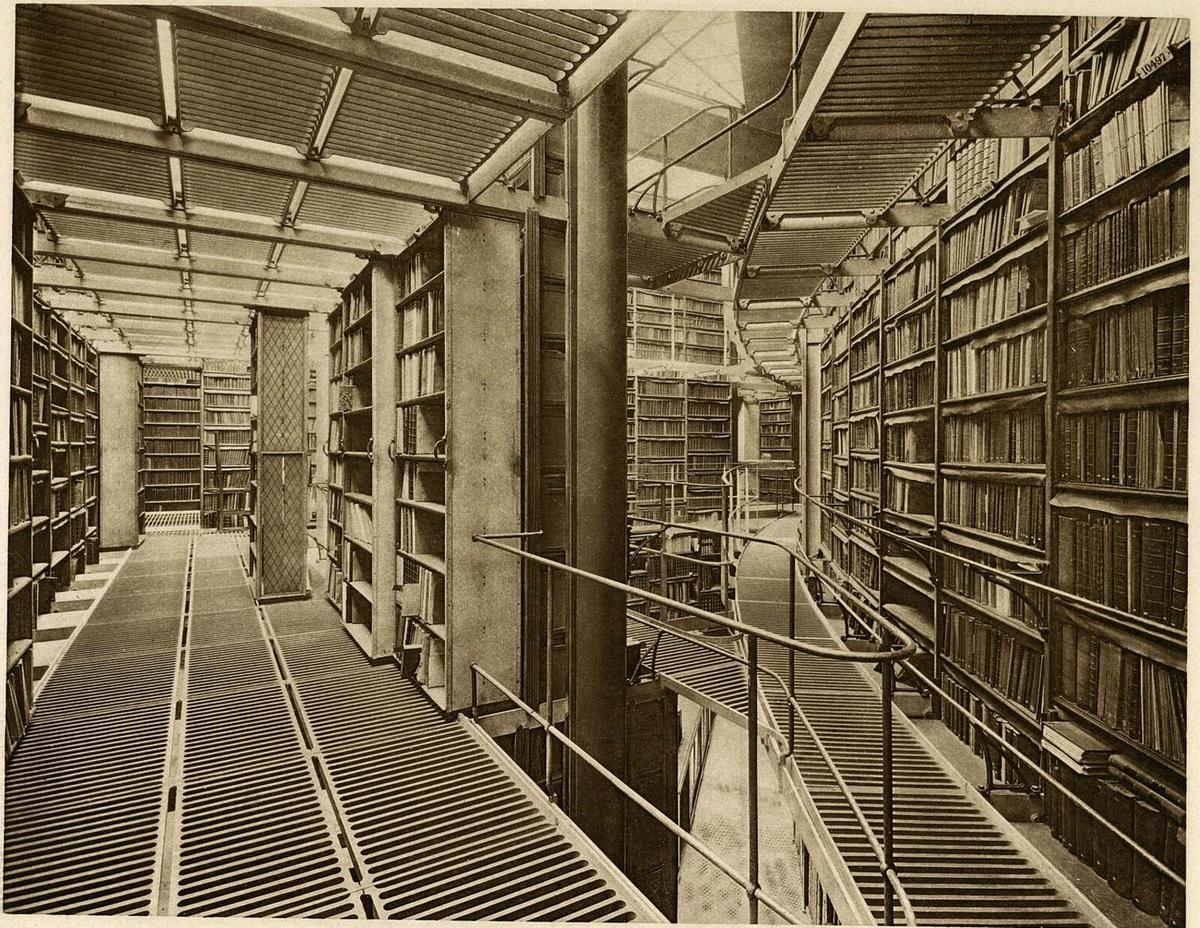 A 1906 print titled More than forty miles of shelves, two millions of books. One of the lawsuits covered more than three times that many copies. Photo by Donald Macbeth, public domain, via Wikimedia Commons.
What actually happened to the books and pictures?
The plain facts are not much in dispute. The U.S. Copyright Office studied the question and released a report, Part 3 of its series on copyright and artificial intelligence, in pre-publication form on 9 May 2025. Its page still lists that version today. The report walks through the steps: works are gathered, often by programs that crawl the web; they are copied into a collection called a dataset; and they are copied again, many times, during training. The Office's conclusion is that several of these stages involve using copyrighted works in ways that touch the owners' exclusive rights. In plain words: copies were made.
Where the copies came from varies. Some were scraped from public websites. Some were bought. Some came from pirate sites. In one case, a federal judge in San Francisco found that an AI company had downloaded over seven million pirated copies of books, and had also bought print books, cut off the bindings and scanned them.
What comes out the other end is not a folder of those books. It is a model: a very large file of numbers, called weights, that encode patterns found across the whole pile. The fight is over what the law should make of that.
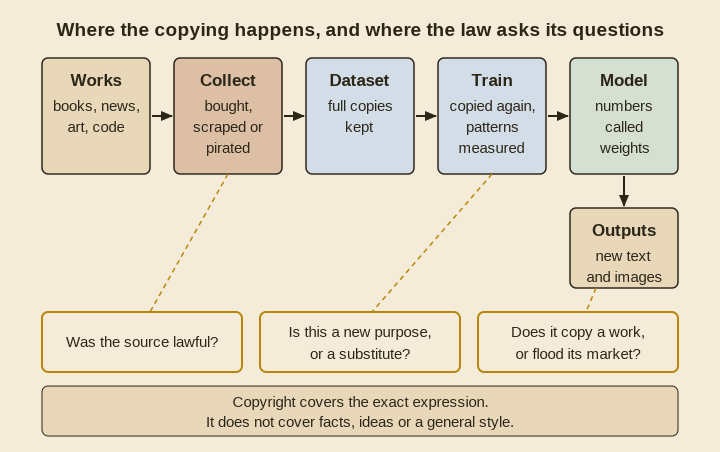 Copies are made at several stages, and each stage raises a different legal question.
What does the law ask?
Lawyers do not use the word theft here. The question in an American court is whether the copying was infringement, and the usual defense is fair use. Fair use is the part of copyright law that lets people copy without permission in some situations, such as quoting a book in a review. Section 107 of the Copyright Act tells judges to weigh four factors.
| Factor in Section 107 | The question in AI training cases |
|---|---|
| Purpose and character of the use, including whether it is commercial | Is training a new purpose (courts say "transformative"), or does it serve the same purpose as the original? |
| Nature of the copyrighted work | Is the work creative, like a novel, or mostly factual? |
| Amount used in relation to the whole | Entire works were copied. Was that much needed for the purpose? |
| Effect on the potential market for the work | Do the model or its outputs replace the original, or a market for licensing it? |
Other countries start from different rules. In the European Union, a 2019 directive allows copying for "text and data mining" unless the rights holder has expressly reserved that use, for example with a machine-readable notice on a website. The EU's AI Act then requires makers of general-purpose AI models to have a policy for honoring those notices. So an author in Europe has an opt-out written into law. An author in the United States has a lawsuit.
The case that it was taking
Here is the argument at its strongest.
Whole works were copied, by the million, by companies that sell the result. The people who made the works were not asked and were not paid. For example, a novelist with three books in a pirate library had all three copied, start to finish, by a business that sells access to the result. If a person did that with a photocopier to stock a for-profit school, nobody would call it research.
The source matters too. The Copyright Office wrote that knowingly using pirated or illegally accessed works "should weigh against fair use," though it would not decide a case by itself. The San Francisco judge held that the company "had no entitlement to use pirated copies for its central library."
Then there is the market. The older fair use cases involved search engines and plagiarism checkers, which do not write novels. A generative model does. The Copyright Office warned that the "speed and scale" at which AI systems produce content pose a serious risk of diluting markets for works of the same kind as their training data. A second federal judge, in a case against another AI company, wrote that generative AI "has the potential to flood the market with endless amounts of images, songs, articles, books, and more," and called market dilution the authors' "potentially winning argument."
Finally, there is a way to pay. Publishers and AI firms have signed licenses. The Copyright Office describes licensing for AI training as "fast emerging." A federal appeals court noted in September 2026 that the market for licensing a legal publisher's case summaries as text to train AI "is rapidly developing." On this view, companies skipped a market that was available to them because skipping it was cheaper.
The case that it was fair use
Here is the other argument at its strongest.
Copyright has never covered facts, ideas or a general style. It covers particular expression: these words in this order, this picture. A model does not sell copies of the books. It measures patterns across millions of them, such as which words tend to follow which, and stores the measurements. In a British case, the High Court in London found in November 2025 that an image model "does not store or reproduce any Copyright Works."
People learn the same way, the argument runs. Every writer has read other writers. The San Francisco judge put it this way: "Like any reader aspiring to be a writer," the company's models trained on works "not to race ahead and replicate or supplant them" but "to turn a hard corner and create something different." He called the use "exceedingly transformative."
There is precedent for copying whole works for a new purpose. The Copyright Office's report itself recounts that scanning books to build a full-text search tool was held to serve a "highly transformative purpose." The Office also concluded that various uses of copyrighted works in AI training "are likely to be transformative."
Then comes the practical point. A large model draws on work by millions of people, most of whom cannot be found. If training required a signed license from each one, supporters argue, only the very largest companies could afford to build models, and many useful ones would not exist. When a model does spit out a copy of a protected work, that output can be sued over by itself. On this view, the remedy for a bad output is a lawsuit about that output, and training is left alone.
Where do the court cases stand today?
As of 12 November 2026, American courts have issued three main rulings on training and fair use, and they do not line up neatly. No Supreme Court decision exists.
| Case and court | Date | What the court decided |
|---|---|---|
| Bartz v. Anthropic, federal district court, San Francisco | 23 June 2025 | Training on books was fair use. Scanning bought books was fair use. Keeping pirated copies in a permanent library was not |
| Kadrey v. Meta, same district, different judge | 25 June 2025 | The AI company won, because the 13 authors did not build a record of market harm. The judge added that the ruling "does not stand for the proposition" that the training was lawful |
| Thomson Reuters v. Ross Intelligence, U.S. Court of Appeals for the Third Circuit | 29 September 2026 | Not fair use. A startup copied a legal publisher's case summaries to train a rival search tool. The court called the use "minimally transformative, at best" |
| Getty Images v. Stability AI, High Court, London | 4 November 2025 | The claim about training was dropped, because there was no evidence the training took place in the United Kingdom. The model itself was held not to be an "infringing copy" |
Two details matter. First, the appeals court pointed out that the legal search tool "was not a generative AI," and said its reasoning might not carry over to chatbots. So the only appeals ruling so far is about a different kind of system. Second, the Bartz case ended in a settlement, covered below, so no higher court will review that judge's reasoning.
The largest open case is the group of lawsuits by news publishers and authors against OpenAI and Microsoft, gathered in federal court in New York. On 4 September 2026 OpenAI asked the judge to rule that training on the articles was fair use. Three days earlier the U.S. Department of Justice had filed a statement in that case arguing that training a large language model is a transformative use; the Third Circuit's opinion describes the filing. No ruling on those motions appeared in the sources checked for this piece on 12 November 2026.
What does the money look like?
The Bartz settlement gives the only hard numbers so far. A judge gave it final approval on 20 July 2026. The fund is $1.5 billion, and the list of covered books runs to about 482,000 works.
Do the division. $1.5 billion over roughly 482,000 works comes to a little over $3,100 each, and the court's order describes the payment as about $3,000 per work before costs and fees. The novelist with three books on the list is looking at around $9,000, shared with a publisher where the contract says so. The settlement site says first payments are expected on or before 15 November 2026.
Now compare the range a jury could have used. The order states that statutory damages run from $200 to $150,000 per work. At the top figure, 482,000 works would come to $72.3 billion. The court noted that $3,000 is four times the statutory minimum, which puts that minimum at $750 and the floor for the whole list at about $360 million.
Notice what the money paid for. The settlement covers the pirated downloads, which the judge had ruled were not fair use. It releases claims about past conduct only, and says authors keep any claims about what the models put out. The company must also destroy the pirated files. It is a payment for how the books were obtained. It is not a price for training.
What is known, what is disputed, and what facts cannot settle
Known. Copies were made, in the millions, mostly without permission. Some came from pirate sources. Models do not hold a tidy copy of each work, though the Copyright Office's report has a section on "memorization," where a model can reproduce chunks of some training material.
Disputed, and answerable with evidence. How often do models reproduce what they were trained on? Do AI-written books, articles and images actually cut into sales and commissions for human ones, and by how much? Could a licensing system work at the scale of millions of small rights holders? The Copyright Office looked at that last question and said government intervention "would be premature at this time."
Value judgments. Some questions have no factual answer. Is a machine studying a book like a person reading it, or is the difference in scale a difference in kind? Does a creator have a moral claim to say no, even when the law would allow the use? How much should a society give up in new tools to protect the income of the people whose work made them possible, or the other way around? Two readers can agree on every fact in this article and still answer those differently.
What to remember
- Both sides agree that works were copied in bulk without permission, and that a model which reproduces a protected work in its output can be sued for that output.
- Both sides agree that the source matters. One court ruled that keeping pirated books was not fair use, and that case settled for $1.5 billion.
- They divide on whether training is a new purpose or a substitute for the originals. Two district judges ruled for AI companies on training, for different reasons, and one of them wrote that his ruling does not make the practice lawful. An appeals court ruled the other way for a system that was not generative.
- They divide on market harm: whether a flood of AI-made work counts as damage the law should weigh, and how to prove it.
- They divide on consent, which is a question of values as much as law.
- No Supreme Court ruling exists as of 12 November 2026, and the largest case, against OpenAI and Microsoft, is still undecided.
The word "theft" carries a verdict inside it, which is why one side uses it and the other avoids it. The courts are working with narrower words: copy, purpose, amount, market. The next rulings to watch are the summary judgment decision in New York and any appeal that reaches a court above the Third Circuit.
Sources (12)
- U.S. Copyright Office, "Copyright and Artificial Intelligence, Part 3: Generative AI Training", pre-publication version, May 2025
- U.S. Copyright Office, "Copyright and Artificial Intelligence" page
- Bartz v. Anthropic, N.D. Cal., Order on Fair Use, 23 June 2025
- 17 U.S.C. 107, fair use
- European Union, Directive (EU) 2019/790, Article 4
- European Union, Regulation (EU) 2024/1689 (AI Act)
- Kadrey v. Meta, N.D. Cal., Order, 25 June 2025
- Thomson Reuters v. Ross Intelligence, 3d Cir., Opinion, 29 September 2026
- Getty Images v. Stability AI, High Court of England and Wales, 4 November 2025
- In re OpenAI, Inc. Copyright Infringement Litigation, S.D.N.Y., OpenAI memorandum in support of summary judgment, 4 September 2026
- Bartz v. Anthropic, N.D. Cal., Order Granting Final Approval of Class Action Settlement, 20 July 2026
- Bartz v. Anthropic settlement website