Articles & BlogBy Trapper W. Brown7 min read
 Illustration generated for Warhawk Division.
On 5 November 2026, the White House issued NSTM-6, a national policy for screening orders of synthetic DNA and RNA. Federally funded labs will have to buy from suppliers that screen every order, check who the customer is, and report suspicious orders to federal authorities. Desktop DNA printers will have to refuse unapproved jobs. I read the full policy. Here is what it requires, on what schedule, and what it does not cover.
What is synthetic DNA, and why screen it?
DNA and RNA are nucleic acids, the molecules that carry genetic instructions. Labs no longer have to extract them from living things. They can order a sequence online from a company that builds it letter by letter, called synthesis. They can also print it in their own lab on a "benchtop" synthesizer.
The policy's cover memo puts the risk in one line: "If misused, however, synthetic nucleic acids can also supply the raw materials for biological threats." Screening is the check that a dangerous sequence is not going to someone who should not have it.
What is NSTM-6?
NSTM-6 is a memorandum dated 5 November 2026 from Marco Rubio, the National Security Advisor, and Michael J. Kratsios, Director of the Office of Science and Technology Policy. It is addressed to nine department and agency heads.
It implements Executive Order 14292, "Improving the Safety and Security of Biological Research," signed on 5 May 2025. That order directed the science office to "revise or replace the 2024 'Framework for Nucleic Acid Synthesis Screening'" within 90 days.
The memo says the new policy "replaces the 2024 Framework for Nucleic Acid Synthesis Screening and, on full implementation, the 2023 HHS Screening Framework Guidance." It gives its reason: "Existing Federal guidance has relied on self-attestation rather than independent verification." Self-attestation means a company says it screens, and no one checks.
Who has to follow it?
The policy "applies to all recipients and subrecipients of Federal funds (i.e., Customers) that procure synthetic nucleic acids or Benchtop Nucleic Acid Synthesis Equipment." As a condition of federal research funding, those customers must buy "only from Adherent Suppliers."
It screens orders of "50 or more nucleotides in length." A nucleotide is one letter of the genetic code. The policy says that matches "the baseline recommended in the 2023 HHS Screening Framework Guidance."
The policy also says it "should be implemented in a streamlined and scalable way that encourages its applicability to all synthetic nucleic acid orders." Encouraging is not requiring.
What makes a supplier "adherent"?
The policy lists five conditions. A supplier must:
- Send every order to a Screener verified by the National Institute of Standards and Technology (NIST).
- Conduct know-your-customer (KYC) checks, which the policy defines as verifying "the Customer's identity," "institutional affiliation and authorization," and that "the Customer's stated use is consistent with the activities of the purchasing organization."
- Report Flagged Orders to "Appropriate Federal Authorities (e.g., the Federal Bureau of Investigation)."
- Keep screening records and customer interactions "for a period of no-less-than 8 years."
- Provide those records to NIST or federal authorities "on lawful request."
A "Screener" is a tool or service that checks an order for "sequences of concern." The policy defines those as sequences matching a regulated agent or toxin, or that otherwise contribute "to pathogenicity or toxicity, biological weapons agents, or drug resistance."
For an order with a sequence of concern, the policy says customer legitimacy "is verified at two distinct points": once by the supplier when the relationship starts, and again by the Screener for that specific order. The supplier still makes the final call. The policy says "the final disposition of every order rests with the Supplier."
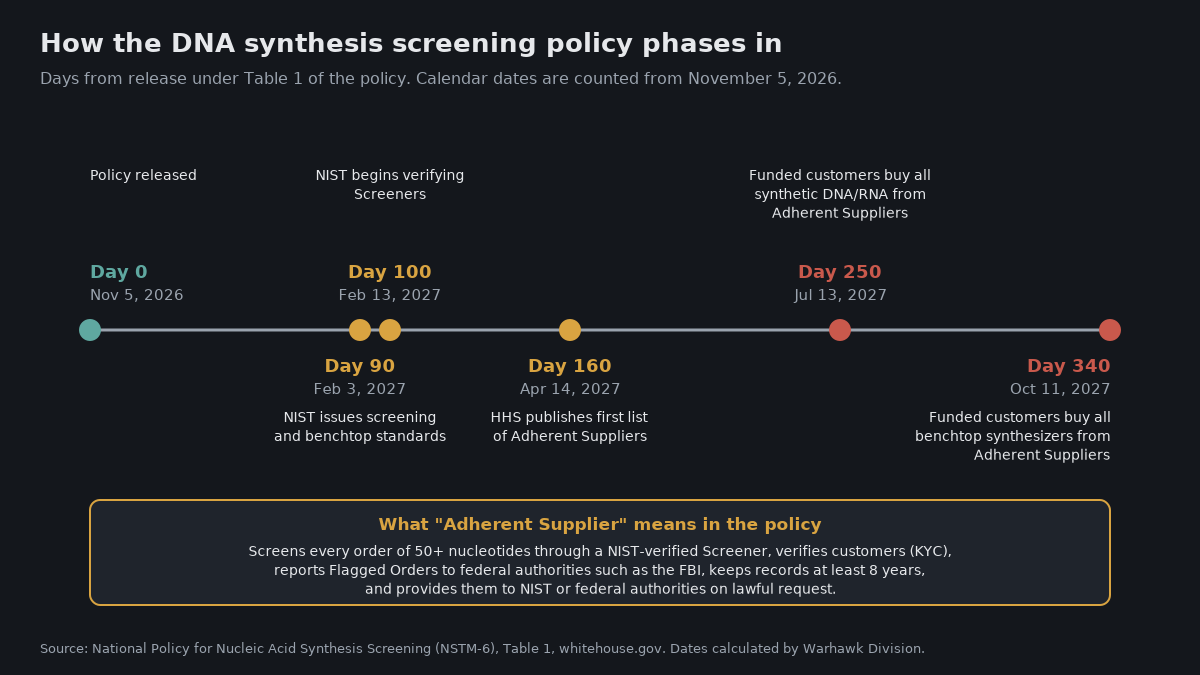 Source: National Policy for Nucleic Acid Synthesis Screening (NSTM-6), Table 1. Calendar dates are counted by Warhawk Division from 5 November 2026; the policy itself lists days. Diagram by Warhawk Division.
What changes for benchtop DNA printers?
The policy says benchtop equipment "operates outside the physical and procedural controls of a centralized synthesis facility." So "screening is therefore enforced by the equipment itself."
There are two tiers:
- Tier 1: networked authorization. The machine starts synthesis "only when a valid authorization is issued by that Screener for the request presented." This is the default.
- Tier 2: bounded offline operation. A machine that cannot reach a Screener "does not initiate synthesis," except within limits NIST verifies. It must keep records and reconcile them when it reconnects.
Manufacturers must build equipment that keeps "tamper-resistant records" and syncs records and screening software "on at least a quarterly basis." The policy encourages makers of older machines "to buy back or offer trade-in opportunities." The site's article "Why Change Management Is a Security Control" makes a similar point about IT controls.
When does it take effect?
Table 1 in the policy sets the schedule in days from release:
- Day 90: NIST issues screening standards, benchtop equipment standards and test protocols.
- Day 100: NIST begins testing and verifying Screeners.
- Day 160: HHS publishes the first list of Adherent Suppliers.
- Day 250: Funded customers buy all synthetic nucleic acids from Adherent Suppliers.
- Day 340: Funded customers buy all benchtop equipment from Adherent Suppliers.
Until then, the policy says parties "should continue to draw from" the 2023 HHS guidance. NIST's duties are "subject to the availability of funding," according to the policy.
 Photo by Rhoda Baer, National Cancer Institute, public domain, via Wikimedia Commons.
What did outside experts say?
Science magazine reported reactions on 9 November 2026. Drew Endy, a synthetic biology researcher at Stanford University, said "Screening moves from voluntary to verified," calling it "a real step forward."
Kevin Esvelt, a biosecurity expert at MIT, praised the policy but flagged the 50-nucleotide threshold. Science reported his argument that someone could stitch a dangerous sequence together from smaller pieces ordered from different suppliers. The policy itself asks NIST to consider "split orders" in its research.
Endy also raised resources: "NIST is being asked to do a lot of work here, on a short clock, only if money is available."
What are the penalties?
The policy ties compliance to federal money. It says compliance "is material to the Government's payment decisions for purposes of 31 U.S.C. 3729(b)(4)." That section is part of the False Claims Act, the federal law against false claims for government money.
A recipient, employer or institution "found to be in violation may be subject to immediate revocation of ongoing Federal funding, to a period of ineligibility of up to 5 years for Federal funds." The policy also allows award terms under which one researcher's violation "may be considered a violation of such term by the recipient's employer or institution."
An agency head may grant "a case-by-case exception" when needed "for a health or national security mission."
What does it not cover?
The policy's reach comes from federal funding. The Nuclear Threat Initiative (NTI), a nonprofit security group, made the point in a 12 November analysis. It wrote that "privately funded labs, companies, and individuals aren't covered." It called the policy's language about all orders "an aspiration with no implementation detail or enforcement mechanism behind it."
NTI urged Congress to pass a law covering all suppliers. That is NTI's recommendation, not something the policy says.
The policy also leans on future technology. The cover memo says that, "powered by SI," meaning super intelligence, "screening will shift from list-based to risk-based." How well that works depends on standards NIST has not yet published.
What to do
- If you work at a federally funded lab, ask your research office how it will track the day-250 and day-340 deadlines. Check that your suppliers plan to be on the HHS list.
- If you manage a benchtop synthesizer, ask the manufacturer whether the unit can meet Tier 1 networked authorization, and about trade-in options.
- If you are a supplier, watch for NIST's standards, due at day 90, and plan for eight-year record retention.
- Keep records of any exchange of sequences of concern. The policy requires a material transfer agreement or similar contract for those exchanges.
Where I land
- NSTM-6 replaces honor-system screening with NIST-verified screening, customer checks, FBI reporting and eight-year records for federally funded buyers.
- Benchtop DNA printers will have to refuse jobs a verified Screener has not authorized.
- Deadlines run from February to October 2027, and much depends on NIST standards not yet written.
- The gap is scope. Privately funded buyers are not required to follow it, which is the point NTI raised.
Sources (6)
- The White House, NSTM-6, "Implementing the National Policy for Nucleic Acid Synthesis Screening in Accordance with Executive Order 14292," and the attached National Policy for Nucleic Acid Synthesis Screening, 5 November 2026 (PDF): https://www.whitehouse.gov/wp-content/uploads/2026/11/NSTM-6-NASS-Policy.pdf
- The White House, Executive Order 14292, "Improving the Safety and Security of Biological Research," 5 May 2025: https://www.whitehouse.gov/presidential-actions/2025/05/improving-the-safety-and-security-of-biological-research/
- 31 U.S.C. 3729, False claims (Cornell Legal Information Institute): https://www.law.cornell.edu/uscode/text/31/3729
- Nuclear Threat Initiative, "New U.S. DNA screening policy covers federal grantees. What about everyone else?," 12 November 2026: https://www.nti.org/risky-business/new-u-s-dna-screening-policy-covers-federal-grantees-what-about-everyone-else/
- Science, "To deter bioterrorism, U.S. imposes new rules on ordering synthetic DNA," 9 November 2026: https://www.science.org/content/article/deter-bioterrorism-u-s-imposes-new-rules-ordering-synthetic-dna
- Photo file page, Wikimedia Commons: https://commons.wikimedia.org/wiki/File:Researcher_uses_pipettes.jpg