Articles & BlogBy Trapper W. Brown10 min readCurrent to 13 November 2026Facts only
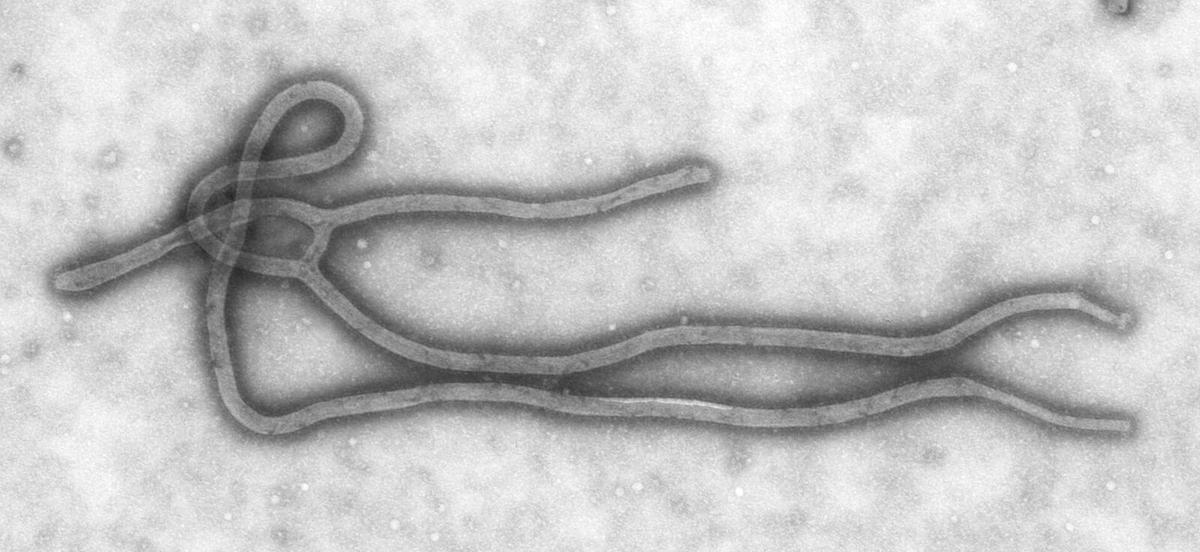 An Ebola virus particle seen through a transmission electron microscope. Bundibugyo virus belongs to the same group of viruses. Photo by Cynthia Goldsmith, CDC, public domain, via Wikimedia Commons.
As of 13 November 2026, the Democratic Republic of the Congo (DRC) "has reported a total of 11 197 confirmed cases, including 5 471 related deaths (from data up until 11 November)." That sentence is from the European Centre for Disease Prevention and Control (ECDC), the European Union's disease agency, in an update dated 13 November 2026. The illness is Bundibugyo virus disease, a form of Ebola disease.
The World Health Organization (WHO) calls this "the largest Ebola disease outbreak ever recorded in the Democratic Republic of the Congo irrespective of virus species." The U.S. Centers for Disease Control and Prevention (CDC) describes it as "the second-largest Ebola outbreak on record." This article lays out the counts, each with its date and its source. The numbers change daily. Check the agency pages listed at the end for the current ones.
What is Bundibugyo virus disease?
WHO describes it as "a severe Ebola disease caused by the Bundibugyo virus, one of the Orthoebolavirus species." Orthoebolavirus is the scientific name for the group of viruses that cause Ebola disease. WHO uses the short form BVD.
On how it spreads, WHO says human infection "is thought to initially occur through close contact with the blood or secretions of infected wildlife, such as bats or non-human primates," and that it then "spreads from person-to-person through direct contact with the blood, secretions, organs, or other bodily fluids of infected individuals or contaminated surfaces and materials." The CDC's basics page says Ebola disease "doesn't spread through the air."
WHO gives the incubation period, the time between infection and first symptoms, as "two to 21 days," and says "infected individuals are not infectious until symptom onset." That 21-day figure is why so many of the rules below use 21 days.
Two more facts from WHO set this outbreak apart. First, "no approved vaccines or specific treatments currently exist for BVD." The CDC's basics page says the approved Ebola vaccine and the two approved treatments cover a different species, Orthoebolavirus zairense. Second, there have been only two earlier Bundibugyo outbreaks, in Uganda in 2007 and in the DRC in 2012. WHO gives their case fatality ratios as "30% and 50%, respectively." A case fatality ratio (CFR) is deaths divided by cases.
How many cases and deaths, and who is counting?
The DRC's Ministry of Health counts the cases. WHO, ECDC and CDC each republish those counts on their own schedules, so their numbers differ mainly because their dates differ.
| Data as of | Confirmed cases in the DRC | Deaths | Published by |
|---|---|---|---|
| 23 September 2026 | 7,890 | 3,799 | WHO Disease Outbreak News, 25 September |
| 6 October 2026 | 8,728 | 4,205 | WHO Disease Outbreak News, 8 October |
| 20 October 2026 | 9,704 | 4,687 | WHO Disease Outbreak News, 23 October |
| 3 November 2026 | 10,668 | 5,198 | WHO Disease Outbreak News, 6 November |
| 10 November 2026 | 11,114 | 5,433 | CDC situation page, updated 12 November |
| 11 November 2026 | 11,197 | 5,471 | ECDC update, 13 November |
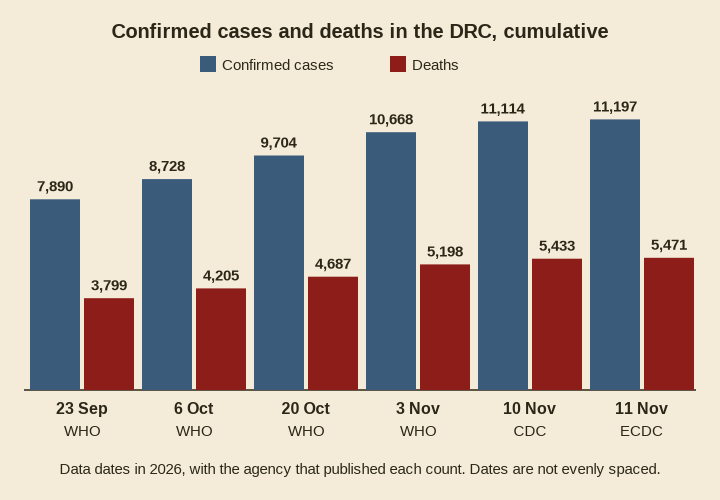 Cumulative confirmed cases and deaths in the DRC at six dates. Data: WHO Disease Outbreak News, CDC and ECDC, as listed in the table. Diagram by Warhawk Division.
For the 3 November figures, WHO gives a crude CFR of 48.7%. "Crude" means it is simple division, with no adjustment for cases still under treatment. WHO also reports 2,881 recoveries as of that date.
Three cautions come from the agencies themselves. ECDC says: "Data reported by DRC on confirmed cases and deaths are under continuous review and harmonisation." CDC says: "The DRC MoH does not include probable cases in their official reporting." And ECDC says "it is likely that the outbreak in DRC is larger than currently reported."
Where in the DRC are the cases?
ECDC's 13 November update says eight provinces have been affected, and that "68 of 178 health zones have been affected across the eight provinces since the beginning of the outbreak." A health zone is a local health district. ECDC gives these provincial totals:
| Province | Cases | Deaths | Health zones reporting cases |
|---|---|---|---|
| Ituri | 7,765 | 3,667 | 28 of 36 |
| Nord-Kivu | 2,802 | 1,547 | 17 of 34 |
| Haut-Uélé | 504 | 218 | 8 of 13 |
| Tshopo | 98 | 32 | 7 of 23 |
| Bas-Uélé | 13 | 4 | 4 of 11 |
| Nord Ubangi | 10 | 1 | 2 of 11 |
| Sud-Kivu | 3 | 1 | 1 of 34 |
| Sud Ubangi | 2 | 1 | 1 of 16 |
By my arithmetic, Ituri and Nord-Kivu together hold 10,567 of the 11,197 confirmed cases, about 94%. Both are in the east of the country.
WHO says the response is working "in a challenging humanitarian environment, where conflict, insecurity, displacement, and limited access to basic services continue to affect outbreak control." It also reports that many deaths happen outside treatment centers: "Of the 512 deaths reported since 21 October, 335 occurred in communities and 177 in treatment centres."
Which other countries have reported cases?
WHO's 6 November report says: "Cases have been reported in five countries since the declaration of the outbreak on 15 May 2026: the Democratic Republic of the Congo, France, Kenya, Nigeria, and Uganda." The counts outside the DRC are small by comparison.
- Uganda. CDC lists 20 confirmed cases and 2 confirmed deaths. ECDC says WHO declared the end of the outbreak in Uganda on 27 August 2026.
- Kenya. ECDC reports "a cluster of nine cases," including two deaths, all linked to one imported case. It says the last patient under treatment was discharged on 11 November 2026 and all remaining contacts finished quarantine.
- Nigeria. One case, reported on 20 October 2026. ECDC says the patient was medically evacuated to Switzerland on 26 October, and that 52 of 62 identified contacts had completed 21 days of quarantine as of 11 November.
- France. CDC lists 1 confirmed case and no deaths.
ECDC also lists patients flown to Europe for care, including a British health worker evacuated from the DRC to the United Kingdom on 5 November 2026. CDC says: "To date, no cases of Ebola disease have been confirmed in the United States because of this outbreak."
What do the agencies say about risk?
Each agency assesses risk for its own population, in its own words.
- WHO, in an assessment dated 14 August 2026: risk in the DRC "very high," risk for countries sharing land borders with the DRC "high," and risk for the rest of the African region and at the global level "low." WHO's 6 November report says this assessment "is currently being revised."
- ECDC, on 13 November 2026: the likelihood of infection for people from the EU and European Economic Area living in or traveling to affected areas "is estimated to be low," and for people living in the EU and EEA "very low."
- CDC, on its page updated 12 November 2026: "The overall risk to the American public and travelers remains low."
WHO declared the outbreak a public health emergency of international concern, its formal alarm for events that need a coordinated international response, on 17 May 2026.
What is not known?
The agency pages leave real gaps, and they say so. ECDC writes that "information regarding transmission chains and affected population groups is currently limited." WHO says Nord Kivu has the highest provincial CFR, 54.8% as of 3 November, and its 25 September report said "investigations are ongoing to better understand the factors contributing to this elevated mortality rate." WHO has not yet published its revised risk assessment. A vaccine trial that WHO describes as a "Phase 2/3 clinical trial of vaccine candidates" began enrolling in Bunia on 23 October 2026; none of the pages I read reports a result from it. I did not find a total for infections among health workers in the pages I read.
What to do
For most readers the answer is to know the rules, not to change anything. The points below are the agencies' instructions, as of the dates shown. This is general information, not medical or legal advice.
- Check before you travel. CDC's travel notices, as its situation page lists them on 12 November 2026, say to avoid all travel to Ituri and Nord-Kivu provinces and to reconsider nonessential travel to Haut-Uélé and Tshopo provinces.
- Know the U.S. entry rules. CDC says travelers, including U.S. citizens, who have been in the DRC within 21 days "will not be allowed to board commercial flights with U.S. destinations." U.S. citizens and nationals who have been in Uganda or South Sudan within 21 days must enter through designated airports. CDC's page for returning travelers names them as Washington-Dulles, Atlanta and New York JFK.
- Expect a form. Under a CDC order that took effect on 3 November 2026 at 11:59 pm Eastern, air travelers boarding international flights to the United States must attest that they have not been in the DRC in the previous 21 days.
- If you have returned from an affected area, CDC says: "Monitor your health for 21 days." If symptoms develop, its instructions begin "Separate yourself from others (isolate)," and go on to say to contact the health department and to call ahead before going to a healthcare facility.
- About trade and travel bans, WHO "advises against any restriction of travel to, or trade with" the countries responding to the outbreak. Individual governments have set their own rules, so check the entry requirements of any country on your route.
- For a health question about yourself, talk to your own clinician.
Update: Late November 2026
By mid-to-late November 2026, WHO and regional health authorities reported that cumulative confirmed cases in the Democratic Republic of the Congo had climbed past 11,600 to 11,700, with approximately 5,600 to 5,700 deaths (a crude case fatality ratio of roughly 48.9%). Active transmission continues across affected eastern health zones, with community deaths outside treatment centers and regional insecurity remaining the largest operational barriers.
Outside the DRC, the picture improved: neither Kenya nor Nigeria reported any new cases for several weeks, and all primary contacts completed their 42-day monitoring periods, placing both countries on track to officially clear their outbreak status. WHO-backed clinical research trials for candidate Bundibugyo vaccines and therapeutics are also scaling up.
What to remember
- ECDC's 13 November 2026 update gives 11,197 confirmed cases and 5,471 deaths in the DRC, from data up to 11 November.
- About 94% of confirmed cases are in two eastern provinces, Ituri and Nord-Kivu (my arithmetic from ECDC's figures).
- WHO says no approved vaccine or specific treatment exists for Bundibugyo virus disease. A trial of vaccine candidates began on 23 October 2026.
- Cases have been reported in five countries. CDC says none has been confirmed in the United States.
- WHO rates the risk "very high" in the DRC and "low" globally, and says that assessment is being revised. ECDC and CDC rate the risk to their own general publics as very low or low.
- ECDC says the outbreak is likely larger than reported.
WHO publishes a Disease Outbreak News report on this outbreak about every two weeks, ECDC posts dated updates to its event page, and CDC dates its count table. Any figure in this article will be out of date soon, and those three pages are where the new ones will appear.
Sources (10)
- European Centre for Disease Prevention and Control, "Ebola disease outbreak caused by Bundibugyo virus, Multi-country, 2026", update of 13 November 2026
- European Centre for Disease Prevention and Control, the same event page, update of 9 November 2026
- World Health Organization, Disease Outbreak News, "Ebola disease caused by Bundibugyo virus, Democratic Republic of the Congo, Kenya and Nigeria", 6 November 2026
- World Health Organization, Disease Outbreak News, "Ebola disease caused by Bundibugyo virus, Democratic Republic of the Congo, Kenya and Nigeria", 23 October 2026
- World Health Organization, Disease Outbreak News, "Ebola disease caused by Bundibugyo virus, Democratic Republic of the Congo", 8 October 2026
- World Health Organization, Disease Outbreak News, "Ebola disease caused by Bundibugyo virus, Democratic Republic of the Congo", 25 September 2026
- Centers for Disease Control and Prevention, "Ebola Outbreak: Current Situation", updated 12 November 2026
- Centers for Disease Control and Prevention, "Information for Travelers Returning from Ebola-Affected Areas", updated 30 October 2026
- Centers for Disease Control and Prevention, "Order: Requirement for Attestation by All Persons Traveling by Air to the United States", updated 3 November 2026
- Centers for Disease Control and Prevention, "Ebola Disease Basics", updated 2 June 2026