Articles & BlogBy Trapper W. Brown9 min readCurrent to 13 November 2026Facts only
As of 13 November 2026, the U.S. Consumer Product Safety Commission (CPSC), the federal agency that oversees consumer product safety, lists a recall of lithium-ion battery packs made for two portable speakers: the Bose S1 Pro and the Bose S1 Pro+. The notice is dated 5 November 2026 and carries recall number 27-065. It gives the number of units as "About 634,759 (In addition, about 35,400 were sold in Canada)."
The notice also carries a note on disposal that applies well beyond one speaker. A recalled lithium-ion battery, it says, does not go where ordinary used batteries go. This article reports what the notice says and what the CPSC and the U.S. Environmental Protection Agency (EPA) say about getting rid of one. Notices change, so check the official pages under Sources before you act.
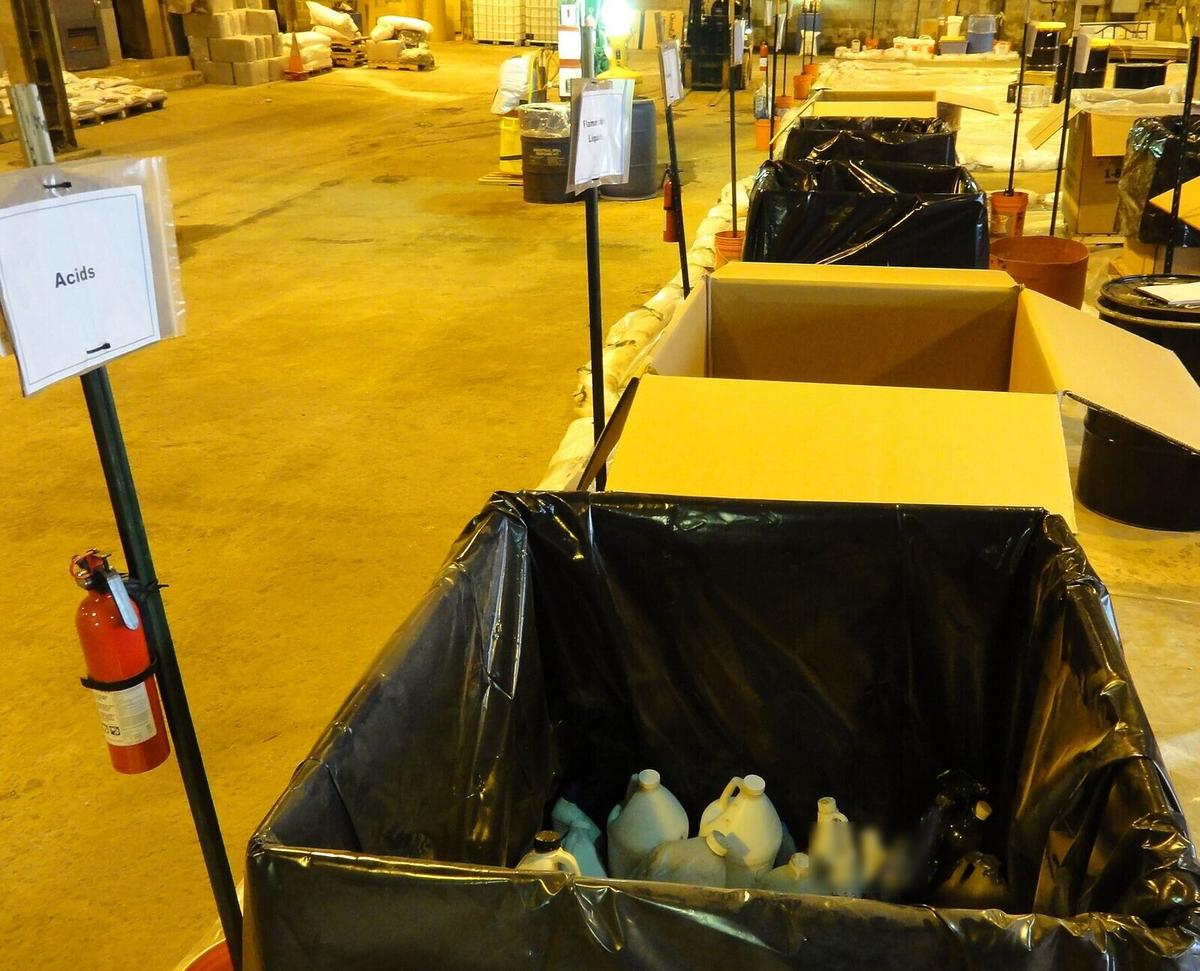 Household hazardous waste sorted by category at an EPA collection area in 2012. Photo by the U.S. Environmental Protection Agency, public domain, via Wikimedia Commons.
What does the recall notice say?
The hazard, in the notice's words: "The recalled lithium-ion battery packs can overheat and ignite, posing a risk of injury from fire and overheating hazards."
The incidents, also in its words: "The firm has received seven reports of the battery packs melting, producing smoke or catching fire, including six reports of property damage. No injuries have been reported."
A lithium-ion battery is the rechargeable kind found in phones, laptops and cordless tools. The EPA explains why it is so common: lithium batteries "can be smaller and lighter than other types of batteries while holding the same amount of energy."
| Item | What the CPSC notice says |
|---|---|
| Recall number and date | 27-065, 5 November 2026 |
| Product | "Bose S1 Pro System Battery Pack and S1 Pro+ System Battery Packs" |
| Remedy | Replace |
| Sold | December 2017 through July 2026 |
| Price | Between $100 and $160 for a pack alone; the speaker systems "were sold with the battery packs for $700" |
| Importer | Bose Corporation, of Framingham, Massachusetts |
| Manufactured in | China |
The notice says the packs "were sold with S1 Pro and S1 Pro+ Portable Bluetooth Speaker Systems and sold separately as accessories or replacement parts." It lists the sellers as "Bose, Best Buy and other retail stores and distributors nationwide and online at Amazon.com, Bose.com, BestBuy.com, Walmart.com and other websites."
How do you check whether your pack is included?
The recall is defined by serial number. The notice says the serial number of a recalled pack begins with one of these sets of six digits:
- 083723
- 078352
- 084105
- 078591
- 078592
- 084106
- 086409
The notice says where to find it: "The 17-digit serial number for the battery pack is printed on a label placed at the bottom of the battery pack."
Bose's own recall page adds the steps for reaching the pack. It says to power off the speaker and disconnect it from power, loosen the two screws on the bottom, remove the bottom plate, and take the pack out using the pull tabs. The serial number is "printed below the bar code." The page also warns that the speaker and the battery pack "both have separate serial numbers," and that the one to check is the 17-digit number on the pack.
Bose's page states that if the serial number does not begin with one of the listed sequences, "your battery pack is not included in this recall and is safe to continue using." That is the company's statement, quoted from its page.
Do the U.S. and Canadian notices agree?
The recall is joint. Health Canada published its own notice, which calls it a "Joint recall with Health Canada, the United States Consumer Product Safety Commission (US CPSC) and Bose Corporation." The two notices differ in a few details, so both are given here.
| Detail | CPSC notice | Health Canada notice |
|---|---|---|
| Units in Canada | "about 35,400" | 35,399 |
| Units in the United States | "About 634,759" | 634,759 |
| When sold | December 2017 through July 2026 | April 2020 to May 2024 for S1 Pro packs, June 2025 to July 2026 for S1 Pro+ packs |
| Incidents | Seven reports, six with property damage, no injuries | "7 reports of incidents globally and no report of injuries," none in Canada as of 5 October 2026 |
I could not confirm from either page why the sale dates differ, or whether Health Canada's dates describe sales in Canada only.
Health Canada describes the issue in more detail than the CPSC does. Its notice says: "The continued operation of the affected battery packs as they age exposes the lithium-ion cells to potentially damaging operating conditions, posing potential fire and burn hazards." The CPSC notice does not include that sentence.
Why can't a recalled battery go in the trash or a store drop box?
The CPSC notice ends with a note. It reads, in part:
"Do not throw this recalled lithium-ion battery pack in the trash, the general recycling stream (e.g., street-level or curbside recycling bins), or used battery recycling boxes found at various retail and home improvement stores. Recalled lithium-ion batteries must be disposed of differently than other batteries because they present a greater risk of fire."
The EPA explains what can happen to any lithium-ion battery in household waste. If a battery is put in the trash or in a recycling bin with paper, plastic or glass, the EPA says, "it may become damaged or crushed in transport or from processing and sorting equipment, creating a fire hazard." The EPA's frequent questions page says such batteries "can cause fires during transport or at landfills and recyclers."
The EPA also points out a common misreading. The chasing arrows symbol on a battery, it says, "does NOT mean you can put Li-ion batteries in the municipal/household recycling bin."
On store drop boxes, the recall note is stricter than the general guidance.
For an ordinary used lithium-ion battery, the EPA's page says consumers can send batteries "to specialized battery recyclers or retailers that are participating in takeback services." For a recalled one, the CPSC note rules out "used battery recycling boxes found at various retail and home improvement stores."
The EPA's page gives a reason that recalled batteries are treated as their own group. Describing guidance from the U.S. Department of Transportation, it says that damaged, defective or recalled lithium batteries "are more likely to catch fire during transportation" than other lithium batteries.
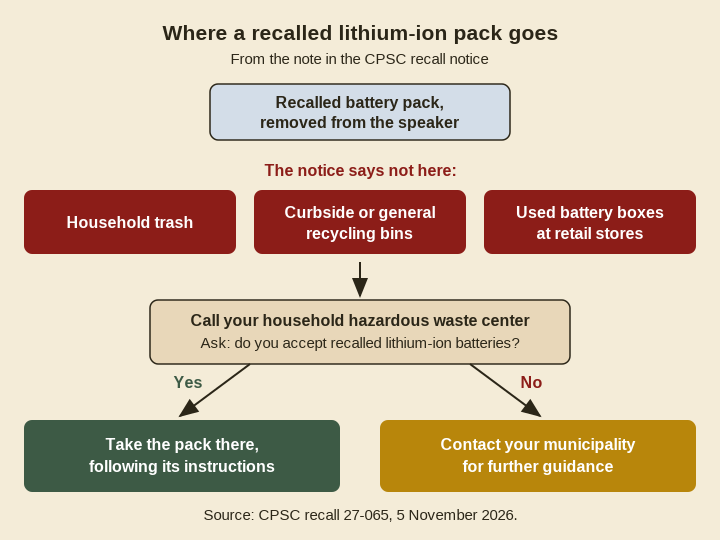 The disposal path in the note on CPSC recall 27-065, dated 5 November 2026. Diagram by Warhawk Division.
Where does it go, then?
The CPSC note names one place and one fallback: "Your municipal household hazardous waste (HHW) collection center may accept this recalled lithium-ion battery pack for disposal. Before taking your battery pack to a HHW collection center, contact that office ahead of time and ask whether it accepts recalled lithium-ion batteries. If it does not, contact your municipality for further guidance."
Household hazardous waste is the EPA's term for leftover household products "that can catch fire, react, or explode under certain circumstances, or that are corrosive or toxic." The EPA lists batteries among its examples. It says many communities run collection programs and tells readers to contact "your local environmental, health, or solid waste agency to learn about permanent or periodic HHW collections near you."
Note the word "may" in the CPSC's sentence. The notice does not promise that any given center takes recalled batteries, which is why it tells owners to call first.
What the sources do not say
- The CPSC notice does not state a cause. Health Canada's sentence about aging packs and "potentially damaging operating conditions" is the only description of the issue I read on an official page.
- Neither notice says which of the seven reports involved which speaker model.
- The CPSC notice does not give instructions for storing a recalled pack while you arrange disposal. The EPA's frequent questions page has storage guidance for a different case, a battery that has swelled: it suggests "a bucket full of a fire suppressant such as sand or kitty litter or in another location away from flammable materials," and adds, "If you think you have an imminent risk of fire, you may need to call 911." I could not confirm that the CPSC or Bose gives that guidance for this recall.
- Rules differ by city and state. The notice says to dispose of the pack "in accordance with local and state regulations," and I have not read yours.
What to do
These steps are the instructions in the CPSC notice and on Bose's recall page.
- Remove the pack and stop using it. The notice says consumers "should remove the recalled battery packs" and "stop using the battery packs immediately."
- Keep using the speaker on wall power if you wish. The notice says that once the pack is removed, consumers "may continue to use" the speakers "while connected to AC power." AC power is power from a wall outlet.
- Register for the replacement. The notice says consumers "will be asked to register and provide the affected battery pack's serial number at www.support.bose.com/s1-battery-recall to receive a free replacement battery pack."
- Dispose of the pack the way the note describes. Not in the trash, not in curbside recycling, not in a store battery box. Call your household hazardous waste center first and ask whether it accepts recalled lithium-ion batteries. If it does not, the notice says to contact your municipality.
- Contact the company with questions. The notice lists Bose toll-free at 800-278-1083 from 9 a.m. to 9 p.m. ET Monday through Friday and 9 a.m. to 7 p.m. ET on Saturday, or online at www.bose.com, where it says to click "Product Recalls" at the bottom of the page. Health Canada's notice lists a different number for consumers in Canada, 1-800-869-2114.
What to remember
- CPSC recall 27-065, dated 5 November 2026, covers battery packs for the Bose S1 Pro and S1 Pro+ whose 17-digit serial numbers begin with one of seven listed sets of six digits.
- The notice reports seven incidents, six with property damage, and no injuries.
- The remedy is a free replacement pack. The speaker can run on AC power with the pack removed, according to the notice.
- The notice says a recalled lithium-ion pack does not go in the trash, in curbside recycling or in a retail battery box.
- The notice's route is a household hazardous waste center that confirms it accepts recalled lithium-ion batteries, or your municipality if it does not.
The CPSC notice and your local waste agency are the authorities on this. Read the notice at the link below, and make the phone call before you carry a recalled battery anywhere.
Sources (6)
- U.S. Consumer Product Safety Commission, "Bose Recalls Lithium-Ion Battery Packs for S1 Pro and S1 Pro+ Bluetooth Speaker Systems Due to Risk of Injury from Fire and Overheating Hazards", 5 November 2026
- Health Canada, "Bose S1 Pro and S1 Pro+ System Battery Packs recalled due to fire and burn hazards", published 5 November 2026
- Bose Corporation, "Recall of S1 Pro System Battery Packs and Bose S1 Pro+ System Battery Packs", read 13 November 2026
- U.S. Environmental Protection Agency, "Used Lithium-Ion Batteries", last updated 20 March 2026
- U.S. Environmental Protection Agency, "Frequent Questions on Lithium-Ion Batteries", last updated 14 April 2026
- U.S. Environmental Protection Agency, "Household Hazardous Waste (HHW)", last updated 1 June 2026