Articles & BlogBy Trapper W. Brown10 min readCurrent to 12 November 2026
For anyone who has read that there is a spoonful of plastic in the human brain and wants to know whether that is true. By the end you will know what has been measured, how sure anyone is, and what is worth doing at home.
Microplastics are small pieces of plastic, and they are now found nearly everywhere scientists look: in oceans and rivers, in indoor air, in bottled water, and by several reports in human blood, arteries and brains. That much is solid. Plastic does not rot away. It breaks into smaller and smaller pieces, and those pieces travel.
What is not solid is the part people most want to know: how much is in us, and whether it does harm. The measurements in human tissue are being disputed by other scientists as this is written, and no health agency has concluded that the amounts found so far make people sick. Both things can be true at once. The exposure is real, and the risk is not yet measured.
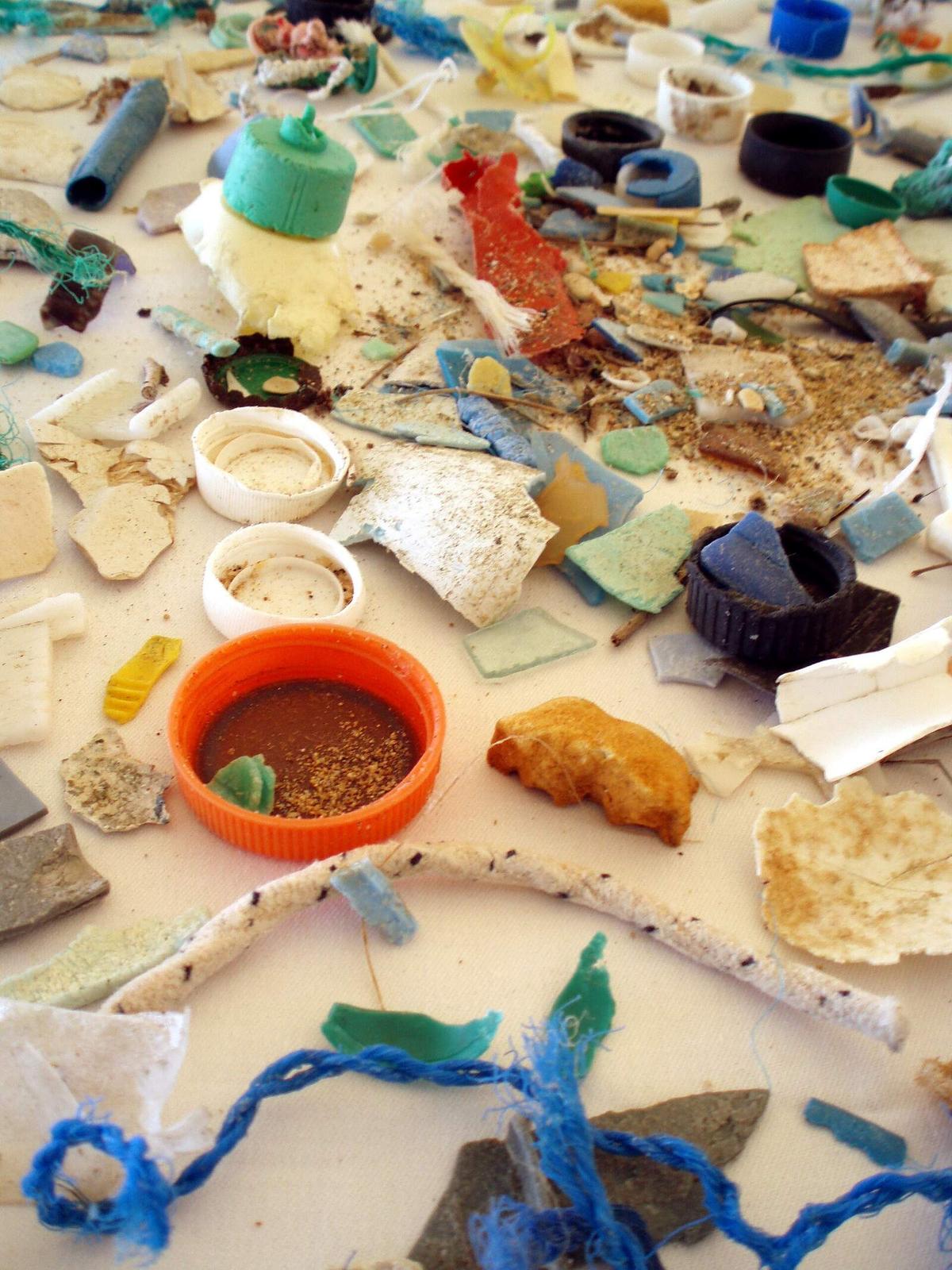 Plastic debris sorted by a marine debris survey. Pieces like these keep breaking down into fragments too small to see. Photo by NOAA Marine Debris Program, public domain, via Wikimedia Commons.
What are microplastics and nanoplastics?
The US National Oceanic and Atmospheric Administration (NOAA) defines microplastics as plastic pieces less than five millimeters long, about the size of a pencil eraser at the top end. The European Food Safety Authority (EFSA) sets the lower end at one micrometer, which is a thousandth of a millimeter. Anything smaller is a nanoplastic, down to one nanometer. The US Food and Drug Administration (FDA) notes that there are no standard definitions yet, which is the first sign of how young this science is.
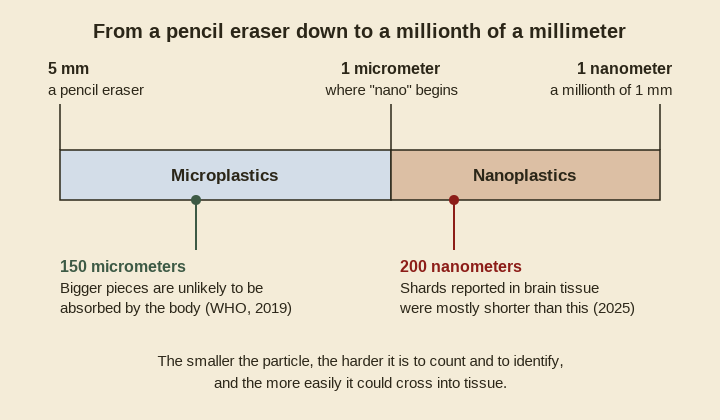 The size range covers more than six powers of ten. The smallest particles are the hardest to measure and the most likely to get into the body.
Size is the whole story here. A 2019 World Health Organization (WHO) report said particles larger than 150 micrometers are not likely to be absorbed by the human body, and that uptake of smaller ones is expected to be limited. The particles that could plausibly reach tissue are the tiniest, and those are the ones laboratories find hardest to count.
Where do they come from?
There are two kinds of source. Secondary microplastics are what is left when bottles, bags, nets and packaging break apart. Primary microplastics are small when they are released.
A 2017 report from the International Union for Conservation of Nature (IUCN) tried to size up the second kind. It estimated that between 15% and 31% of the plastic in the oceans could come from primary sources, and that nearly two-thirds of those releases come from two everyday activities: washing synthetic clothes (34.8%) and tires wearing down on roads (about 28%). City dust came third at about 24%. Personal care products, the source most people have heard of, accounted for 2%.
The laundry figure has a lab study behind it. In 2016, researchers writing in Marine Pollution Bulletin washed polyester, polyester-cotton and acrylic fabrics and estimated that one 6 kilogram load of acrylic could release over 700,000 fibers. The polyester-cotton blend shed consistently fewer.
One source has been dealt with by law. Microbeads, the tiny plastic scrubbing beads once put in face washes and toothpaste, were prohibited in cosmetics and personal hygiene products in the United States by the Microbead-Free Waters Act, signed on 28 December 2015.
Where have they been found?
Outdoors, the answer is close to everywhere. For a household, three routes matter: what you drink, what you eat and what you breathe.
- Water. A 2024 study in the Proceedings of the National Academy of Sciences used a new laser imaging method on bottled water and estimated about 240,000 plastic particles per liter, roughly 90% of them nanoplastics. Earlier methods could not see particles that small, so older counts were far lower.
- Food and drink together. A 2019 analysis of 26 studies estimated that Americans take in 39,000 to 52,000 particles a year from food and drink, on data covering only about 15% of calories. It estimated that a person drinking only bottled water would take in about 90,000 more particles a year, against 4,000 for tap water only.
- Air. A 2017 study of two apartments and one office measured 1 to 60 fibers per cubic meter in indoor air, against 0.3 to 1.5 outdoors. About a third of the indoor fibers were plastic. The authors thought most were too large to inhale and pointed to household dust, swallowed by small children, as the likelier route.
Every one of these numbers is an estimate from a handful of samples. They are useful for comparing sources. They are not precise doses.
What has been found inside people?
This is the part that made headlines, and the part where caution is most needed.
| Study | What was examined | What was reported |
|---|---|---|
| Ragusa and colleagues, 2021 | 6 placentas | 12 particles, 5 to 10 micrometers, in 4 of the 6 |
| Leslie and colleagues, 2022 | Blood from 22 healthy volunteers | Four plastics detected. Average total of 1.6 micrograms per milliliter |
| Marfella and colleagues, 2024 | Artery plaque removed from 257 patients, followed about 34 months | Polyethylene in the plaque of 150 patients (58.4%). Those patients had about 4.5 times the risk of heart attack, stroke or death |
| Nihart and colleagues, 2025 | Brain, liver and kidney from autopsies, 20 to 28 people per time point | Brain median of 3,345 micrograms per gram in 2016 samples and 4,917 in 2024 samples. Liver and kidney near 400 |
The artery study, in the New England Journal of Medicine, is the strongest link to illness so far, and its authors were careful about it. They wrote that the results "do not prove causality." People with plastic in their plaque may differ in other ways the study could not measure. The authors also wrote that laboratory contamination "cannot be firmly ruled out."
The brain study, in Nature Medicine, produced the most striking number. Its authors called their data "associative" and said they do not establish that the particles affect health. They also found higher readings in 12 people who had died with dementia, and warned that dementia itself, which shrinks brain tissue and weakens its barriers, would be expected to raise the reading.
Why are scientists arguing about the measurements?
Because the main measuring method may be counting fat as plastic.
The artery and brain studies both relied on a technique called pyrolysis gas chromatography-mass spectrometry. In plain terms, a sample is heated until it breaks into fragments, and the fragments are identified by weight. Polyethylene, the most common plastic, is a long chain of carbon atoms. So is fat. Heated, the two give overlapping signals.
In December 2025, nine researchers published a formal critique of the brain study in the same journal. They argued that the tissue was not fully digested before testing, that leftover fat likely produced false polyethylene signals, that the study did not report key contamination checks, and that the brain, which is rich in fat, would be the organ most prone to this error. They also questioned whether the totals are physically plausible. The arithmetic shows why: 4,917 micrograms per gram is about 0.5% of the tissue by weight, or nearly 5 grams of plastic in every kilogram of brain.
Independent work supports the worry about the method. A 2025 Australian study tested the technique on human blood and concluded that it "is currently not a suitable analysis method" for polyethylene and PVC in biological samples, because of interference that could not be removed.
None of this shows the brain study is wrong, and its authors backed it up with microscope images of tiny shards. It means the headline quantity is contested, and the claim that levels are rising over time is contested with it. As a rule of thumb, treat any single number for plastic in a human organ as provisional until different laboratories, using different methods, agree.
What do WHO, EFSA and the FDA conclude?
All three say the same thing in different words: no demonstrated harm at measured levels, and not enough data to rule harm out.
- WHO. Its 2019 report on drinking water concluded that microplastics "don't appear to pose a health risk at current levels," and stressed that this rested on limited information. It also noted that wastewater treatment can remove more than 90% of microplastics. A second WHO report in 2022 reviewed studies published up to December 2021 on food and air, and set out the research still needed.
- FDA. Its page on the subject says "current scientific evidence does not demonstrate that levels of microplastics or nanoplastics detected in foods" pose a risk to human health, and that there are no standardized methods for detecting or counting them.
- EFSA. Its 2016 statement found too many gaps to assess risk. A review it published in October 2025 concluded that particles do shed from food packaging and utensils, but "at much lower levels than some earlier studies suggested." EFSA has been asked for a full opinion on health risks from food, water and air, due by the end of 2027, and says it cannot conclude before then.
For a reader, the fair summary is "unknown, under study." Nobody credible is saying it is harmless, and nobody credible has shown that it is hurting you.
What are governments doing?
Mostly cutting the sources they can identify.
The European Union's restriction on microplastics added on purpose to products began to apply on 17 October 2023. Loose plastic glitter was banned from that date. Other products have time to change: rinse-off cosmetics until October 2027, leave-on cosmetics until 2029 and make-up until 2035. The European Commission estimated that the rule would keep about half a million tonnes of microplastics out of the environment.
A global treaty is slower going. In March 2022 the United Nations Environment Assembly agreed to negotiate a legally binding agreement on plastic pollution. As of 12 November 2026, the United Nations Environment Programme (UNEP) reports that the fifth negotiating session has been held in three parts: in Busan, South Korea, in late 2024, in Geneva in August 2025, and for one day in Geneva on 7 February 2026. That last meeting elected a new chair and, in UNEP's words, held "no substantive negotiations." UNEP's page lists preparations for a fourth part. The negotiations have not concluded.
What can a household reasonably do?
A few cheap habits follow the evidence. None needs to be done perfectly.
| Habit | Why | How strong the reason is |
|---|---|---|
| Drink tap water where it is safe | The 2019 estimate put bottled water far above tap for particle counts | Moderate. Counts vary a lot by study |
| Heat food in glass or ceramic, not plastic | A 2023 study found microwaving released the most particles from plastic containers, up to millions per square centimeter in 3 minutes | Moderate for the release. Unknown for health |
| If plastic baby bottles worry you, ask your pediatrician about glass ones before changing how you prepare formula | A 2020 study found polypropylene bottles shed up to 16.2 million particles per liter, more with hot water and sterilizing | Moderate for the release. EFSA's 2025 review suggests some early counts ran high |
| Vacuum and wet-dust regularly | Indoor air and dust carry more fibers than outdoor air | Modest |
| Wash synthetics less often and in full loads | Laundry is a leading primary source for the oceans | Good for the environment. No direct health data |
For example, one person can cover the first two rows today at no cost by refilling a glass at the tap and moving leftovers onto a plate before microwaving. A family with a baby and a carpeted home has more reason to pay attention to bottles and dust, because the 2017 air study singled out dust swallowed by young children.
What I would not do is buy tests, cleanses or supplements sold to "remove microplastics" from the body. I found no trial supporting any of them, and nobody can yet measure reliably what is there to remove.
What to remember
- Microplastics are plastic pieces under 5 millimeters. Nanoplastics are under one micrometer and are the hardest to measure.
- Synthetic laundry and tire wear are the two largest sources of primary microplastics reaching the oceans.
- Particles have been reported in human blood, placenta, artery plaque and brain. The quantities are disputed because the main method can mistake fat for plastic.
- The 2024 artery study found an association with heart attack and stroke. Its authors said it does not prove cause.
- WHO, the FDA and EFSA have found no demonstrated harm at measured levels and say the data are too thin to rule it out.
- Tap water, glass for heating, and regular dusting are reasonable low-cost steps.
EFSA's full review is due by the end of 2027, and laboratories are still working out how to count the smallest particles. Until those arrive, cutting the easy exposures costs little, and the numbers in the headlines remain estimates.