Articles & BlogBy Trapper W. Brown10 min readCurrent to 12 November 2026
For anyone who has read that an AI "solved" a famous math problem and wondered what that means. By the end you will know the real cases, what each one did and did not do, and four questions to ask of the next headline.
Artificial intelligence (AI) has started to produce real results in mathematics. Machines have found faster ways to multiply, beaten records that stood for decades, earned medal-level scores at the hardest school contest in the world and, in 2026, settled questions that professional mathematicians had left open.
It matters because math is the one field where "it sounds right" counts for nothing. A proof is correct or it is not. That makes it a clean test of whether these systems can reason, and it also makes it easy to overstate what happened. A new record is not a solved problem. A solved contest question is not a discovery. This guide sorts the verified cases by what was done.
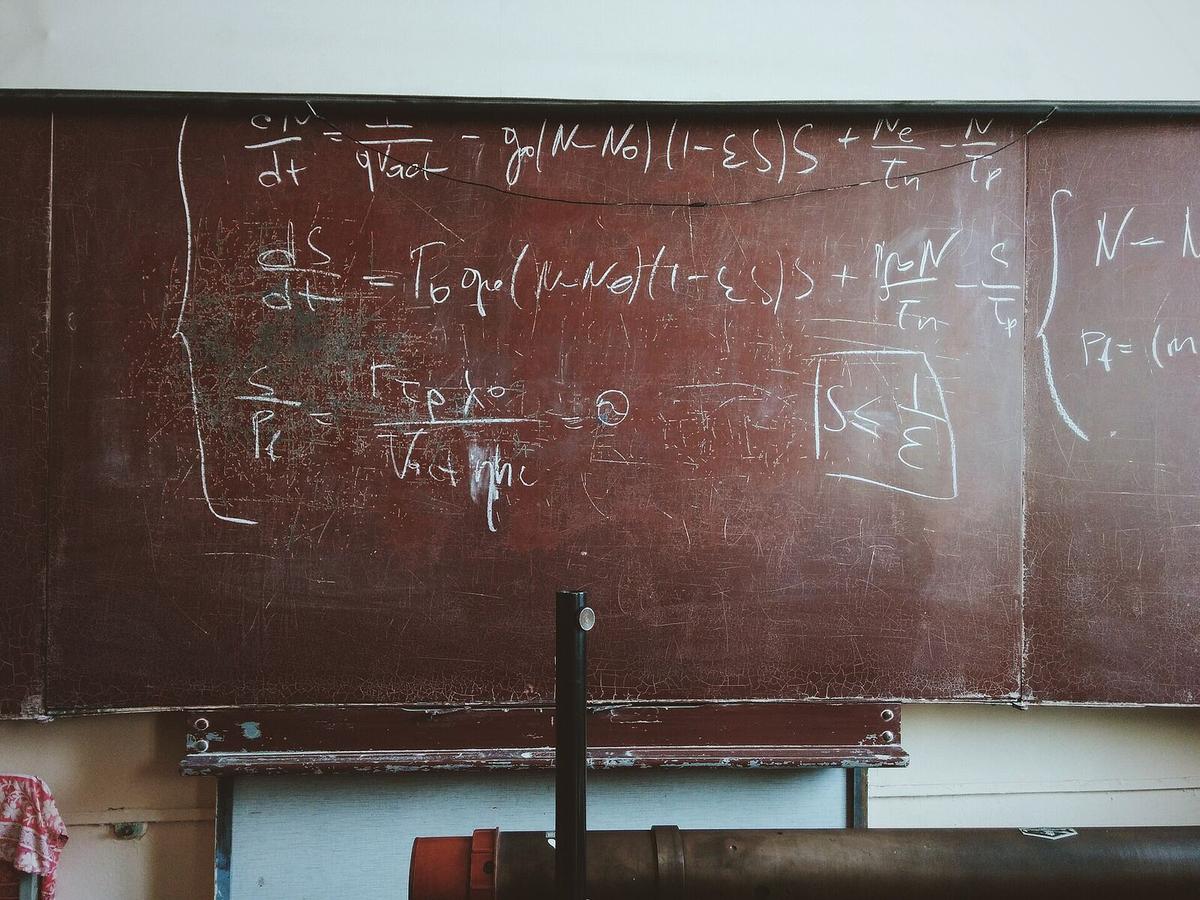 For most of history a proof lived on a board like this one and was checked by other people reading it. Photo by Roman Mager, CC0, via Wikimedia Commons.
What counts as "solved"?
Four different things get reported under the same headline.
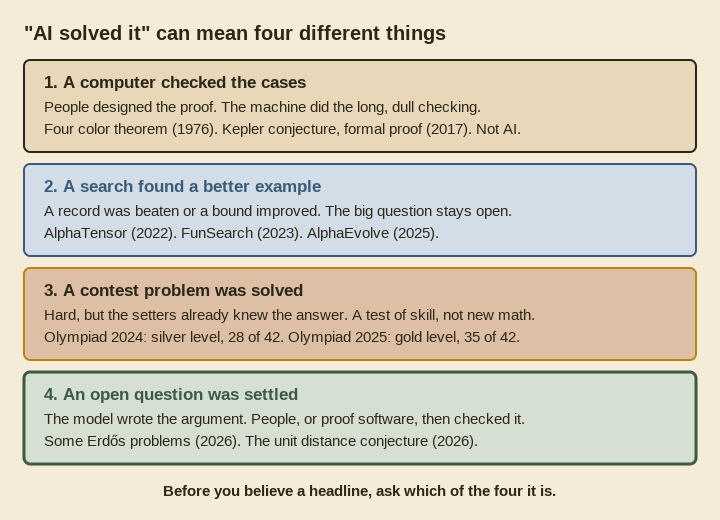 Four kinds of result. Only the last one is what most people picture when they read that AI solved a problem.
Three terms will come up.
A conjecture is a statement mathematicians believe is true but nobody has proved.
A bound is a limit on an unknown number. If the true answer is somewhere between 500 and 900, then 500 is the lower bound and 900 the upper. Raising the lower bound to 512 is progress. It is not the answer.
A proof assistant is software that checks a proof line by line, accepting nothing on trust. Lean is the one most often used with AI. If Lean accepts a proof, the logic holds.
Were computers proving theorems before AI?
Yes, for fifty years, and it helps to see how different that was.
The four color theorem says any map can be colored with four colors so that no two neighboring regions match. Francis Guthrie raised the question in 1852 while coloring a map of English counties. Two mathematicians, Appel and Haken, confirmed it in 1976 with a computer. Mathematician Robin Thomas, who later co-wrote a shorter proof, describes theirs on his university page: the argument came down to 1,476 special map fragments, and part of it "cannot be verified by hand." His own team's version cut the list to 633.
The Kepler conjecture says the densest way to stack equal spheres is the way a grocer stacks oranges. Thomas Hales published a proof in 2005. He then led a project called Flyspeck to rebuild the whole thing inside two proof assistants. The finished formal proof was published in the journal Forum of Mathematics, Pi on 29 May 2017.
Neither of these was AI in today's sense. People had the ideas and designed the method. The computer did a huge amount of careful, boring checking that no person could finish. Nothing in the machine was learning or guessing.
What did the search systems find?
The first modern results came from programs that search for better examples. They do not prove grand theorems. They hunt, very fast, for a construction that beats the best one known.
AlphaTensor, 2022. Multiplying two tables of numbers, called matrices, is among the most common jobs a computer does. The school method for two 2 by 2 matrices takes 8 multiplications. In 1969 Volker Strassen found a way to do it in 7. Apply his trick twice and two 4 by 4 matrices take 7 times 7, or 49. On 5 October 2022, Google DeepMind published a paper in Nature reporting that its system, AlphaTensor, had found a way to do it in 47. The paper says that was the first improvement on Strassen's method in that setting in 50 years.
The small print matters. The 47-step method works in arithmetic modulo 2, a system where the only numbers are 0 and 1. It is not a general speedup for every calculation. The paper also describes its methods as "provably correct": each one can be checked exactly.
FunSearch, 2023. The cap set problem asks how many points you can pick on a certain kind of grid so that no three fall in a line. Nobody knows the answer for large grids. On 14 December 2023, DeepMind reported in Nature that FunSearch had found a cap set of 512 points in 8 dimensions, larger than any known before, and had raised the lower bound on a related number from 2.2180 to 2.2202.
The design is worth knowing. A language model writes small programs. A separate, ordinary piece of code runs each one and scores it. Bad ideas and made-up answers fail the test and are thrown away. Good ones go back in as starting points. The paper is plain that the problem remains open, saying the new bound "is still far from the upper bound."
AlphaEvolve, 2025. On 14 May 2025, DeepMind announced a successor. It found a way to multiply 4 by 4 matrices of complex numbers in 48 multiplications, one fewer than Strassen's 49. The company said it tried the system on more than 50 open problems. In about 75 percent of them it rediscovered the best known answer, and in about 20 percent it improved on it. One example was the kissing number in 11 dimensions, which is how many equal spheres can touch one central sphere. The lower bound rose to 593.
A paper posted in November 2025 by four authors, among them the mathematician Terence Tao, tested the same system on 67 problems. Their summary is measured: it "rediscovered the best known solutions in most of the cases and discovered improved solutions in several."
| Year | System | What it did | What kind of result |
|---|---|---|---|
| 1976 | Appel and Haken's program | Checked 1,476 cases for the four color theorem | Computer-assisted proof, not AI |
| 2017 | Flyspeck | Formally verified the Kepler conjecture proof | Machine-checked proof, not AI |
| 2022 | AlphaTensor | 4 by 4 matrices in 47 steps, modulo 2 | Better method in one setting |
| 2023 | FunSearch | Cap set of 512 points in 8 dimensions | Improved bound, problem still open |
| 2025 | AlphaEvolve | Kissing number in 11 dimensions raised to 593 | Improved bound, problem still open |
| 2026 | Several language models | Some open Erdős problems; unit distance conjecture | Open questions settled, then checked |
What happened at the Math Olympiad?
The International Mathematical Olympiad (IMO) is a yearly contest for the best pre-university students in the world. There are six problems worth 7 points each, for a total of 42.
In January 2024, DeepMind published AlphaGeometry, which solved 25 of 30 past Olympiad geometry problems. The previous best method had solved 10.
At the 2024 contest, the company reported that two of its systems together solved four of the six problems for 28 points. That is silver-medal level, one point short of the 29 needed for gold that year. Two caveats come from the company's own account. People first translated the problems by hand into formal language the systems could read. And while students get two sessions of four and a half hours, the systems solved one problem in minutes and "took up to three days" on the others. Two mathematicians, Timothy Gowers and Joseph Myers, graded the work.
At the 2025 contest, a newer system solved five of six for 35 points, a gold-medal score. This time it read the problems in plain language and finished inside the four and a half hour limit. DeepMind reported that the contest's own coordinators graded and certified the answers, and quoted the IMO president, Gregor Dolinar, confirming the score.
That is fast progress in one year. Keep the category straight, though. Olympiad problems are hard, but every one has a known solution that fits on a few pages. Solving them shows skill. It adds nothing new to mathematics.
Did AI really solve open problems?
In 2026, yes, with footnotes.
Paul Erdős was a Hungarian mathematician who left behind hundreds of unsolved problems, from fairly minor to famously hard. A public website catalogs them. That makes them a natural target: clearly stated, numbered and open.
A wiki kept alongside that catalog, in a repository belonging to Terence Tao, tracked AI contributions through 30 June 2026. It lists more than a dozen problems where an AI system produced a full solution with no significant human help, several of them checked in Lean. One early entry is problem 205, dated 10 January 2026.
The same page is the best guide to reading its own tables. It warns: "This page is not a benchmark." It notes that many of the problems had never had a thorough search of earlier papers, and it keeps a separate table of cases where an AI wrote a full solution and a relevant older paper turned up afterward. One line deserves to be remembered: "Absence of past progress may reflect obscurity rather than difficulty." A problem can sit open for 40 years because it is hard, or because nobody looked.
Scale matters too. A DeepMind paper posted on 21 May 2026 describes an agent that writes proofs in Lean. Pointed at 353 open Erdős problems, it resolved 9. That is under 3 percent. Each one is a real result, checked by software, and the paper puts the cost at a few hundred dollars per problem.
What about the unit distance conjecture?
This is the strongest case so far.
Scatter some points on a flat sheet. Count the pairs that sit exactly one unit apart. How large can that count get as you add points? Erdős conjectured a ceiling on how fast it can grow.
On 20 May 2026, nine mathematicians, including Noga Alon, Thomas Bloom, Timothy Gowers and Melanie Matchett Wood, posted a note titled "Remarks on the disproof of the unit distance conjecture." They describe it as "a short, digested, human-verified version of the recent OpenAI-generated counterexample." In plain words: a model produced arrangements of points that break through the ceiling, and people who work in the field checked the argument and vouched for it.
The same note says the argument relies on ideas that can be traced, in hindsight, to earlier work by other mathematicians. The model combined known tools in a way nobody had tried on this question. Most human mathematics works the same way.
Two limits apply to this account. The note is a preprint, and as of 12 November 2026 no journal publication of the result could be confirmed. No official statement about AI entries at the 2026 Olympiad could be confirmed either, so that contest is not covered here.
How do you read the next headline?
Ask four questions.
- Which kind of result is it? A case check, a better example, a contest answer or an open question settled.
- Who checked it? Proof software, named mathematicians, a journal, or only the company that built the system.
- Was the problem open because it was hard? Or had it simply been ignored?
- What did people do? Translating a problem, choosing what to try and spotting which output matters are all real work.
Tip
When a claim says a proof was "verified in Lean," that settles whether the logic is valid. It does not settle whether the statement typed into Lean matches the original question. The Erdős wiki notes cases where a problem had been written down incorrectly.
What to remember
- Computers have helped prove theorems since 1976, but the four color and Kepler proofs were human ideas with machine checking, not AI.
- AlphaTensor, FunSearch and AlphaEvolve beat records and improved bounds. The underlying problems are still open.
- At the Olympiad, AI went from silver level in 2024 (28 of 42) to gold level in 2025 (35 of 42). Those are contest problems with known answers.
- In 2026, AI systems settled some open Erdős problems, and a model's disproof of the unit distance conjecture was checked by nine mathematicians.
- Success is still rare: one agent resolved 9 of 353 open problems it tried.
- "Solved" has four meanings. Find out which one before you repeat the headline.
The fair summary on 12 November 2026 is that AI has become a working tool in mathematics and an occasional author of new results, with people still deciding what is worth asking and whether the answer holds up.