Articles & BlogBy Trapper W. Brown10 min read
A paycheck that covered the month two years ago may not cover it now. That is not a character flaw. It is arithmetic: prices went up, and most of the things that went up are things nobody can skip, such as rent, power and groceries.
This guide is a method for a tight budget in the United States. It starts with what the government's own price numbers say, then walks through finding where the money goes, where real savings hide, which debt to pay first, and what to do in the month when a bill cannot be paid at all. It is general education, not personal financial advice, and it recommends no product, company or investment.
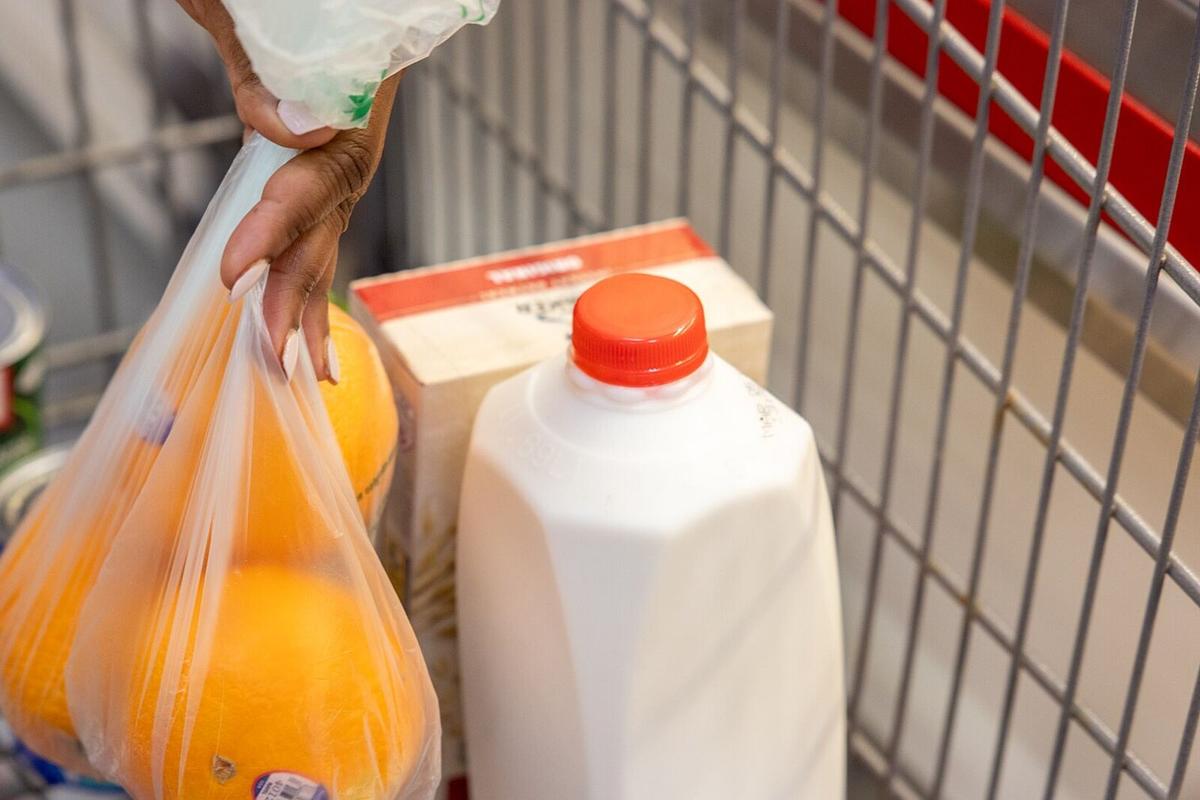 Food is one of the three places where a household budget can actually move. Photo by the US Department of Agriculture, public domain, via Wikimedia Commons.
Where do prices actually stand?
The official measure is the Consumer Price Index, or CPI, published each month by the Bureau of Labor Statistics (BLS). It tracks the price of a fixed basket of things households buy.
The latest release came out on 10 November 2026 and covers October 2026. It says prices overall rose 0.4 percent in that one month, after seasonal adjustment. Food at home (groceries) rose 0.4 percent, shelter rose 0.3 percent and energy rose 0.7 percent.
There is a gap in that release worth knowing about. BLS did not collect October 2025 data because of a lapse in government funding, so it could not publish most year-over-year figures for October 2026. The last full set of 12-month numbers is from the September 2026 release, published 14 October 2026. Over those 12 months, all items rose 3.7 percent.
| All items | 3.7% |
|---|---|
| Food at home | 1.8% |
| Food away from home | 3.5% |
| Shelter | 3.2% |
| Electricity | 4.4% |
| Energy overall | 20.4% |
| Gasoline | 34.2% |
Source: Bureau of Labor Statistics, Consumer Price Index, September 2026 release
Read the chart twice. Groceries rose more slowly than the average over that year. Energy did not: the energy index rose 20.4 percent and gasoline 34.2 percent. So if it feels like the car and the power bill are eating the budget, the national numbers agree with you. Your own mix will differ, which is why the next step is to look at your own month.
Where does the money go?
Before cutting anything, look back. Pick the last full calendar month and pull every statement: checking, credit cards, payment apps, cash withdrawals. Write down each charge in one of a dozen plain categories. It takes about an hour and it is usually a surprise.
Do not judge the numbers yet. The job is only to see them. The Federal Trade Commission's guide to getting out of debt (December 2025) says the same thing in one line: "A budget might help you see where you spend your money."
Then sort every line into one of two piles.
- Fixed costs are the same every month and hard to change quickly: rent or mortgage, car payment, insurance, child care, minimum payments on debt.
- Flexible costs change with what you do: groceries, eating out, gas, entertainment, clothes, subscriptions.
Flexible costs can be changed this week. Fixed costs can only be changed by a decision, such as a move, a different car or a phone call. Both matter, but they work on different clocks.
The big three: housing, transport and food
Skipping coffee is the classic advice, and it is the weakest. As a rule of thumb, most of a household's spending sits in three places, and so does most of the room to move.
Housing. It is the largest line and the slowest to change. Options that exist for some people: asking the landlord about a longer lease in return for a smaller increase, taking a roommate, or moving at the end of the lease. For homeowners, the levers are the property tax assessment (which can be appealed) and the homeowner's insurance quote. None of these is quick, and none is guaranteed.
Transport. With gasoline up 34.2 percent over the year ending in September, this is where many budgets broke. A car costs far more than its payment: add insurance, fuel, repairs and parking to see the real monthly number. Insurance can be requoted once a year. Trips can be combined. A two-car household can ask whether the second car earns its keep.
Food. Groceries rose 1.8 percent over that same year while restaurant and takeout prices rose 3.5 percent. The gap between cooking and buying prepared food is the single most flexible line in most budgets. Our guide Easy Meals to Prep at Home, for One Person and for a Family covers the method.
Can you really call and get a bill lowered?
Sometimes, yes. It costs one phone call to find out. Internet, phone, insurance and some medical bills have more give than rent does.
A short script helps. Say how long you have been a customer, say the bill is more than you can keep paying, and ask one direct question: "What can you do to lower this?" Then stop talking. If the first answer is no, ask whether there is a cheaper plan, a promotion for existing customers, or a hardship option. Write down the date, the name of the person and what was promised.
While the statements are still out, audit the subscriptions. List every charge that repeats: streaming, apps, cloud storage, gym, delivery memberships, free trials that quietly turned into paid ones. For each, ask one question: would I sign up for this today at this price? Cancel the ones that fail. A paused subscription can be restarted, so the cost of being wrong is small.
A cushion that starts small
An emergency fund is, in the Consumer Financial Protection Bureau's words, "a cash reserve that's specifically set aside for unplanned expenses." The CFPB is the federal agency that oversees consumer financial products. Notably, its guide gives no magic number. It says the right amount depends on your situation and suggests looking at what past surprises cost you.
That is freeing. On a tight budget, a sensible first goal is the cost of one flat tire, so that the tire does not go on a credit card at 28 percent. Six months of expenses can wait. Twenty dollars a paycheck, moved automatically on payday, is a start. The CFPB also points to one-time money, such as a tax refund, as the easiest way to begin when a budget has no slack.
Which debt do you pay first?
Always pay the minimum on everything, because a missed minimum usually brings a fee. The question is where any extra dollar goes. The CFPB describes two common methods.
- Highest interest rate first (often called the avalanche). Extra money goes to the debt with the highest rate. This costs the least interest.
- Smallest balance first (often called the snowball). Extra money goes to the smallest debt. When it is gone, its payment rolls to the next smallest. The CFPB notes you may pay more over the long run, but you see progress sooner.
Here is a worked example with made-up debts and $400 a month in total to pay toward them.
| Debt | Balance | Interest rate | Minimum payment |
|---|---|---|---|
| Store card | $600 | 22% | $25 |
| Credit card | $2,500 | 28% | $75 |
| Car loan | $5,000 | 9% | $150 |
The minimums add up to $250, which leaves $150 extra each month.
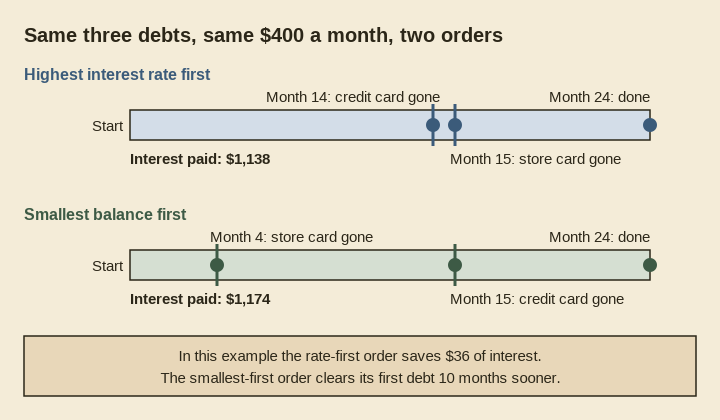 Both orders finish in the same month here. They differ in interest paid and in how soon the first debt disappears.
Both orders finish in 24 months. Rate-first pays about $1,138 in interest and smallest-first about $1,174, a difference of $36. But smallest-first wipes out a whole bill in month 4, while rate-first takes until month 14 for its first win.
With other debts the gap can be much wider, so run your own numbers. My rule: if the interest difference is small, pick the order you will actually stick with. The CFPB says much the same, and it offers a free worksheet for this.
What if you cannot pay a bill this month?
Call before the due date, not after. The CFPB's guidance on credit card bills (reviewed September 2026) opens with "Contact your credit card company immediately." It says many card companies will change a payment for a customer facing a financial emergency. Be ready to say why you cannot pay the minimum, how much you can afford, and when you could go back to normal payments. Utilities, landlords, hospitals and lenders often have hardship arrangements too, but usually only for people who ask.
If the choice is between bills, my order is the roof, the power and the food first, then everything else.
Then use the public programs. They exist for this.
- 211. Dial 211 or visit 211.org to reach a local referral service for help with housing, food, transportation and health care. The 211 network says its calls are confidential and that it made more than 19 million connections to help in 2025.
- SNAP, the Supplemental Nutrition Assistance Program, loads money for groceries onto a card each month. You apply through your state agency. The USDA says states generally decide within 30 days, or within 7 days for households with almost no money. For applications from 1 October 2026 through 30 September 2027, the gross monthly income limit in most states is $1,729 for one person and $3,575 for a household of four, and many states use broader rules.
- LIHEAP, the Low Income Home Energy Assistance Program, can help pay heating or cooling bills or respond to an energy crisis. USA.gov explains how to find your state's office.
- Nonprofit credit counseling. The CFPB says these organizations can work with you on managing money. Ask about fees first.
Money stress also draws scammers. The FTC's warning signs for debt relief offers are blunt: only a scammer collects fees before settling anything, guarantees to make debts disappear, or tells you to stop talking to your creditors without explaining the consequences. The same pressure shows up as fake bank texts and fake government grants. Three of our guides cover those: Text and Phone Scams: The Fake Bank, the Fake Delivery, the Fake Grandchild; Phishing: How to Read an Email Before You Click; and Your Account Was in a Breach: What to Do Next.
One person and a family of four
These two budgets are invented, with round numbers, to show the method. They are examples, not targets.
| Monthly line | Single person | Family of four |
|---|---|---|
| Take-home pay | $3,200 | $6,500 |
| Housing | $1,300 | $2,100 |
| Utilities | $150 | $320 |
| Phone and internet | $110 | $190 |
| Transport | $520 | $950 |
| Groceries | $350 | $1,100 |
| Eating out | $180 | $300 |
| Child care and school | $0 | $650 |
| Subscriptions | $60 | $90 |
| Debt minimums | $150 | $250 |
| Everything else | $280 | $400 |
| Left over | $100 | $150 |
The single person has $100 of slack. A subscriptions audit (down to $25), a cheaper phone plan (down to $85) and eating out half as often (down to $90) free $150 without touching the rent. Now there is $250 a month: $50 to the cushion and $200 extra toward debt.
The family's levers are bigger and slower. Requoting insurance on two cars and combining trips might bring transport from $950 to $870. Planning meals for the week might move $120 from eating out into a smaller rise in groceries, a net $70. Add $40 from subscriptions and the slack grows from $150 to $340. That will not fix everything. It is still more than double the room they had.
Neither household would qualify for SNAP at these incomes. A layoff changes that in a month, which is why it is worth knowing the programs before you need them.
What to remember
- The September 2026 CPI showed prices up 3.7 percent over 12 months, with energy up far more than groceries. October's release showed another 0.4 percent in one month.
- Look back one full month before cutting anything, and sort fixed costs from flexible ones.
- Housing, transport and food hold most of the savings. Subscriptions and phone calls hold the quick ones.
- Start a cushion with any amount. The CFPB sets no minimum.
- Rate-first costs less interest. Smallest-first gives an earlier win. Run the numbers for your own debts.
- When a bill cannot be paid, call first, then use 211, SNAP and LIHEAP. Anyone who wants a fee up front to erase debt is not help.
Pull last month's statements this weekend and do the look-back. Every other step in this guide starts from that one page of numbers.