Articles & BlogBy Trapper W. Brown11 min read
By the end you will know how the parts fit, who pays whom, and what to ask when the bill arrives.
A hospital looks like one building. Behind the sign there is usually a much larger organization: a health system that owns several hospitals, dozens of clinics, a group of physicians and a billing office you will hear from later. Knowing how it is built explains why the bill arrives in pieces, why the list price is nothing like what anyone pays, and why the emergency room must see you even if you cannot pay.
Americans spent $1,634.7 billion on hospital care in 2024, according to the federal National Health Expenditure accounts. That is close to a third of the $5.3 trillion spent on health that year.
 Walter Reed National Military Medical Center in 2011. A big hospital is a small city of connected departments, and this one is federal, one of the ownership types described below. U.S. Army photo, public domain, via Wikimedia Commons.
What is a hospital system?
A hospital is a licensed place with beds, nurses on duty around the clock and physicians who can admit you overnight. A hospital system, also called a health system, is an organization that owns or runs more than one of them, usually with clinics and doctors' offices attached. The American Hospital Association (AHA), the industry's trade group, defines a system as "either a multihospital or a diversified single hospital system."
The AHA's Fast Facts for 2026, from its 2024 survey, counts 6,100 hospitals in the United States with 907,216 staffed beds and about 35.7 million admissions a year. Of those, 5,121 are community hospitals, the general hospitals most people mean by the word. And 3,567 of the community hospitals, about seven in ten, belong to a system.
Two invented examples will run through this guide.
| A 25 bed critical access hospital | An 800 bed system flagship | |
|---|---|---|
| Where | A rural county, more than 35 miles from the next hospital | A large city |
| Typical stay | Short. The yearly average must be 96 hours or less | From one night to several months |
| What it offers | Emergency room open 24 hours, a few inpatient beds, basic lab and imaging | Trauma, heart surgery, intensive care, cancer care, physician training |
| Harder cases | Stabilized, then transferred | Received from smaller hospitals |
| How Medicare pays | Its reasonable costs | A fixed amount per stay |
"Critical access hospital" is a federal label. The Centers for Medicare and Medicaid Services (CMS), the agency that runs both programs, requires no more than 25 inpatient beds, an annual average stay of 96 hours or less for acute care, emergency care 24 hours a day and seven days a week, and in general a location more than 35 miles from the nearest hospital. About 1,400 rural hospitals qualify, according to the Medicare Payment Advisory Commission (MedPAC), which advises Congress.
Who owns it, and does that matter?
There are three kinds of owner, and the AHA counts them among community hospitals this way.
| Nonprofit | 2,984 |
|---|---|
| For-profit | 1,224 |
| State or local government | 913 |
Source: American Hospital Association, Fast Facts on U.S. Hospitals, 2026
- Nonprofit. No shareholders. In return for its tax exemption, the hospital must follow extra Internal Revenue Service (IRS) rules, which matter to you at billing time.
- For-profit, which the AHA calls investor-owned. Owned by investors, and it pays taxes.
- Public. Owned by a county, a city, a hospital district or a state university.
Outside that count sit 210 federal hospitals, such as those run for veterans and the military.
Nonprofit does not mean free, and it does not mean small. The emergency care duty and the federal safety standards described below apply to any hospital that takes Medicare, whoever owns it. The written financial assistance policy required by the IRS applies only to nonprofits.
What is inside, and who runs it?
- Emergency department. The front door for anything urgent, open at all hours.
- Inpatient units. The floors with beds: medical, surgical, intensive care, maternity.
- Operating rooms, with recovery beds beside them.
- Laboratory and pharmacy. One tests blood and tissue, the other checks every medicine ordered.
- Imaging. X-ray, ultrasound, CT and MRI. The guide CT Scans and MRI: How Each Works and How They Differ covers the two big machines.
- Outpatient clinics. Visits and procedures that send you home the same day.
- Physician groups. Doctors employed by the system or working independently inside it, which is why a doctor's bill can arrive separately.
KFF, a nonprofit health policy research group, reports that the share of physicians working for a hospital, or in a practice at least partly owned by one, rose from 29% in 2012 to 41% in 2022.
Four groups share the running of the place. The board of trustees hires the chief executive, approves the budget and is legally answerable for quality. The executives run daily operations: a chief executive, a chief financial officer, a chief medical officer and a chief nursing officer. The medical staff is the organized body of physicians, with its own bylaws. It grants "privileges," permission for a named doctor to perform named procedures here. Nursing is the workforce at the bedside around the clock, reporting up to the chief nursing officer.
How does the money come in?
From four kinds of payer. Medicare covers people 65 and older and some younger people with disabilities. Medicaid covers people with low incomes and is run by each state with federal money. Private insurers are mostly employer plans. Self-pay patients have no coverage for the visit. Across all US health spending in 2024, the federal accounts put private insurance at 31%, Medicare at 21%, Medicaid at 18% and out-of-pocket payments at 11%.
Every hospital keeps a chargemaster: an internal price list with thousands of lines, from a night in a bed to a single bag of saline. The figure on it is the gross charge. Almost nobody pays it. Medicare and Medicaid set their own rates, private insurers negotiate theirs, and a patient with no coverage may be offered a cash discount.
For an inpatient stay, Medicare pays a fixed amount per stay, set in advance, according to what was wrong with you. The category is a DRG, a diagnosis-related group. MedPAC's October 2026 summary says about 3,100 hospitals are paid this way and that each stay is assigned to one of 768 groups, based on the main diagnosis, other conditions and any procedures. Each group has a weight, which is multiplied by a national base rate, which for fiscal year 2027 is $6,848 for operating costs, plus $540 for buildings and equipment.
Here is a worked example with an invented weight. A pneumonia stay falls in a group weighted 1.2. Multiply 1.2 by $6,848 and you get about $8,218, before adjustments for local wages, physician training and the hospital's share of low-income patients. The payment is the same whether you stay three days or six. The hospital is paid for the problem, not for each day. For a stay that turns out extraordinarily costly, Medicare adds an "outlier" payment covering 80% of costs above a set threshold.
Now put the payers side by side for that stay, again with invented numbers. The chargemaster total is $38,000. Medicare pays about $8,200. A private insurer's negotiated rate is $13,500. The hospital's cash price is $11,000. All four numbers describe the same care.
The 25 bed hospital is paid differently. MedPAC notes that critical access hospitals are paid on a reasonable-cost basis and not by DRG. Averages work across thousands of stays and poorly for a handful of patients a day.
What does a stay look like, from the door to discharge?
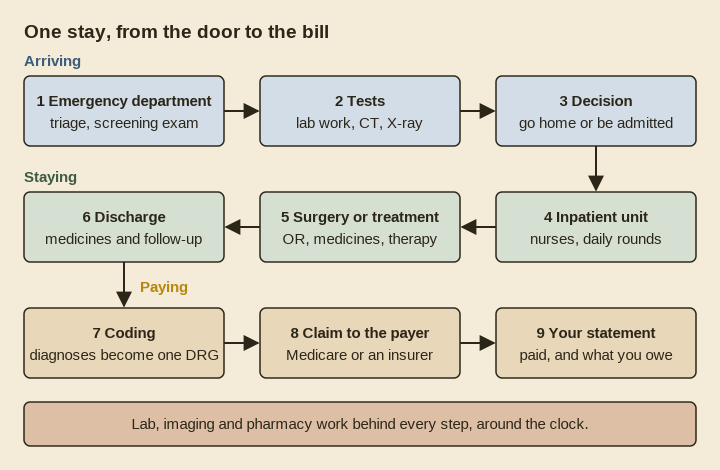 The care ends at step six. The paperwork keeps going for weeks.
A triage nurse in the emergency department sorts patients by urgency, not by arrival time, which is why a sprained ankle waits. A clinician examines you and orders tests. Then comes the decision that shapes everything after: go home with instructions, or be admitted.
If you are admitted, you move to an inpatient unit. A hospitalist, a physician who treats only hospital inpatients, may take over your care, and nurses carry out the plan hour by hour. A case manager starts planning your discharge early, because a safe trip home needs a medicine list, instructions and follow-up appointments.
After you leave, coders turn your chart into standard codes, the codes go to your payer as a claim, and the hospital sends you a statement for whatever the payer does not cover.
Why do hospitals keep merging?
KFF reports that the share of community hospitals belonging to a larger system rose from 53% in 2005 to 68% in 2022, and the AHA's newer count puts it near 70%. The reasons usually given are practical: a bigger system can bargain harder with insurers and suppliers, share costly things such as a records system, and find money to keep a struggling small hospital open.
The evidence on results is less flattering. KFF's April 2024 review says a substantial body of research shows that consolidation has led to higher prices, and it cites a 2022 RAND review in which estimated price increases after hospital mergers ranged from 3% to 65%. On quality of care, KFF calls the evidence "unclear."
For the 25 bed hospital, joining a system can mean staying open. It can also mean that decisions about its services are made a long drive away.
Who watches the hospital?
- CMS writes the Conditions of Participation, the health and safety rules a hospital must meet to be paid by Medicare and Medicaid. They sit in federal regulation at 42 CFR Part 482.
- State agencies, usually the health department, license hospitals and inspect them against the federal rules. You can file a complaint with the state agency about any hospital.
- Accrediting organizations are private bodies that CMS has approved to do those inspections in the state's place. A hospital that passes is treated as meeting Medicare's rules, which CMS calls deemed status. The Joint Commission is one of nine organizations on the CMS list.
Two federal rules matter directly to patients. One is EMTALA, the Emergency Medical Treatment and Labor Act, which Congress passed in 1986. A Medicare-participating hospital with an emergency department must give a medical screening exam to anyone who asks, regardless of ability to pay. If it finds an emergency condition, it must stabilize you or arrange an appropriate transfer. EMTALA does not make the care free.
The other is price transparency. Since January 1, 2021, CMS has required every hospital to post its prices online in two forms: a machine-readable file covering all items and services, and a consumer-friendly display of at least 300 "shoppable" services you can schedule in advance. The file must show gross charges, discounted cash prices and the rates negotiated with each payer.
How do you read the bill and ask for help?
This is general education, not legal or financial advice for your case. Four lines on a statement carry most of the meaning.
| Line on the statement | What it means |
|---|---|
| Total or gross charges | The chargemaster price. A starting point, not what is owed |
| Adjustment or contractual allowance | The discount your payer negotiated. The hospital writes it off |
| Insurance payment | What your plan paid |
| Patient responsibility | What the hospital says you owe |
In order:
- Wait for your insurer's explanation of benefits and compare it with the hospital's statement. The guide How Insurance Works explains deductibles and coinsurance, which decide your share.
- Ask for an itemized bill, which lists each charge on its own line.
- Ask for the financial assistance policy before you pay or agree to a payment plan.
That third step has federal backing at nonprofit hospitals. Under section 501(r) of the tax code, the IRS requires each one to have a written financial assistance policy that states who qualifies for free or discounted care and how to apply. The hospital must post the policy, the application and a plain language summary on its website and print a notice about it on billing statements. A patient who qualifies may not be charged more than the amounts generally billed to insured patients for emergency or medically necessary care.
The rule also buys you time. A nonprofit hospital must wait at least 120 days after your first bill following discharge before it takes "extraordinary collection actions," a list that includes selling the debt, reporting it to credit bureaus, suing, placing a lien and garnishing wages. It must accept an assistance application for at least 240 days from that first bill. Section 501(r) does not cover for-profit and public hospitals. Ask them anyway.
What to remember
- About seven in ten community hospitals belong to a system, and most are nonprofit.
- The chargemaster price is a list price. Medicare, Medicaid, insurers and cash patients each pay something different for the same care.
- Medicare pays most hospitals a fixed amount per stay by diagnosis group, and pays critical access hospitals their reasonable costs.
- An emergency department at a Medicare hospital must screen and stabilize you regardless of ability to pay. The bill comes later.
- Hospitals must post their prices. Before paying a large bill, get the itemized version and ask for the financial assistance application.
The other half of the bill is your insurance plan, with its own vocabulary and its own appeals. How Insurance Works covers that side, and When the Insurance Machine Argues With the Hospital Machine looks at what happens when the two sides automate their paperwork.