Articles & BlogBy Trapper W. Brown13 min read
For anyone who has heard "that's a HIPAA violation" and wondered whether it was. The rules below were read on eCFR.gov, HHS.gov and FTC.gov on 15 November 2026, and each one carries its section number. This article is general information and is not legal advice.
HIPAA is the Health Insurance Portability and Accountability Act of 1996. The part most people mean when they say the name is a set of federal regulations, in Title 45 of the Code of Federal Regulations, Parts 160 and 164, that control how certain organizations handle health information. The U.S. Department of Health and Human Services (HHS) enforces them through its Office for Civil Rights (OCR).
Two things about HIPAA surprise people. First, it follows the organization, and not the information: the same blood pressure reading is protected in your doctor's chart and unprotected in most phone apps. Second, it gives you rights you can use, including a right to a copy of your own records with a deadline attached.
 Paper charts at a Navy hospital in 2004: records like these, held by a provider, are what HIPAA protects. Photo by Rod Duren, U.S. Navy, public domain, via Wikimedia Commons.
Who has to follow HIPAA?
The regulation names two groups.
The first is the covered entity. Under 45 CFR 160.103 that means a health plan, a health care clearinghouse, or "A health care provider who transmits any health information in electronic form in connection with a transaction covered by this subchapter." In HHS's plainer terms, health insurance companies, HMOs, company health plans, Medicare and Medicaid are health plans. Doctors, clinics, dentists, nursing homes and pharmacies are providers, "but only if they transmit any information in an electronic form in connection with a transaction for which HHS has adopted a standard", such as billing an insurer electronically. A clearinghouse is a company that converts health data between formats.
The second is the business associate. The same section defines it as a person or company that "creates, receives, maintains, or transmits protected health information" on behalf of a covered entity, and it includes subcontractors. HHS gives examples: billing companies, companies that process claims, outside lawyers, accountants and IT specialists, and companies that store or destroy medical records.
HHS states the boundary in one sentence: "If an entity does not meet the definition of a covered entity or business associate, it does not have to comply with the HIPAA Rules."
For example, a family clinic that bills insurers electronically is a covered entity. The outside company that sends its bills is a business associate. A hospital system with forty clinics is in the same position, with more of each. The landlord is neither.
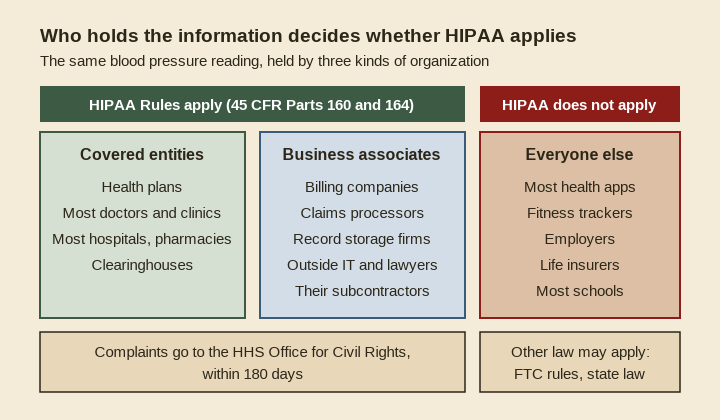 HIPAA attaches to two kinds of organization, and the same fact about your health can sit on either side of the line.
What information is protected?
The protected thing is called protected health information, or PHI. Under 45 CFR 160.103 it is individually identifiable health information: information that relates to a person's "past, present, or future physical or mental health or condition", to the care they received, or to payment for that care, and that identifies the person or could reasonably be used to. HHS says the Privacy Rule applies to it "whether electronic, written, or oral."
The definition also says what PHI leaves out:
- education records covered by the Family Educational Rights and Privacy Act
- "employment records held by a covered entity in its role as employer"
- information about a person "who has been deceased for more than 50 years"
What do the Privacy and Security Rules require?
HIPAA's regulations come in parts that people call Rules. Three matter here.
| Rule | What it does, in plain terms | Where to read it |
|---|---|---|
| Privacy Rule | Limits how PHI in any form is used and shared, and gives you rights over it | 45 CFR Part 164, Subpart E |
| Security Rule | Requires safeguards for PHI held in electronic form | 45 CFR Part 164, Subpart C |
| Breach Notification Rule | Requires notice to you after a breach of unsecured PHI | 45 CFR Part 164, Subpart D |
The Privacy Rule starts from a ban. Section 164.502(a) says a covered entity or business associate "may not use or disclose protected health information, except as permitted or required" by the rule. A covered entity may share PHI with you, and may use it "For treatment, payment, or health care operations" without asking you each time.
Other uses need your written authorization. Section 164.508(a) requires one for marketing, for the sale of PHI, and for most uses of psychotherapy notes. Section 164.502(b) adds the minimum necessary standard: an organization "must make reasonable efforts to limit protected health information to the minimum necessary to accomplish the intended purpose."
The rule also gives you a right to a notice of privacy practices (164.520), to ask for a correction, which must be acted on within 60 days (164.526), and to an accounting of certain disclosures from the past six years (164.528).
The Security Rule covers electronic PHI. Section 164.306(a) requires covered entities and business associates to "Ensure the confidentiality, integrity, and availability" of it and to protect against "reasonably anticipated threats." The detail sits in three lists:
- administrative safeguards (164.308), which begin with a required risk analysis and a named security official
- physical safeguards (164.310), such as facility access controls and rules for workstations, devices and media
- technical safeguards (164.312), such as a unique user ID for each person, audit controls, and authentication
Section 164.306(b) lets an organization weigh its "size, complexity, and capabilities" and "The costs of security measures." Each item is marked "Required" or "Addressable". Encryption, for example, is marked addressable in 164.312. HHS proposed changes to the Security Rule on December 27, 2024. The sections described here are the ones on eCFR today.
The Breach Notification Rule sets a clock. Under 164.404(b), a covered entity must notify each affected person "without unreasonable delay and in no case later than 60 calendar days after discovery of a breach." The site's article "Your Account Was in a Breach: What to Do Next" covers what to do next.
How do you get a copy of your own records?
Section 164.524(a) gives you "a right of access to inspect and obtain a copy" of your PHI in what the rule calls a designated record set, which HHS describes as your medical records and billing records. Two things are carved out: psychotherapy notes, and information compiled for a legal proceeding.
The deadline is in 164.524(b)(2). The covered entity "must act on a request for access no later than 30 days after receipt of the request." If it cannot, it "may extend the time for such actions by no more than 30 days", but only if, inside the first 30 days, it gives you "a written statement of the reasons for the delay and the date by which the covered entity will complete its action on the request." It gets "only one such extension."
For example, if a clinic receives your request on March 3, thirty days later is April 2, and with one extension the last day is May 2. Those dates are my count from the rule's numbers.
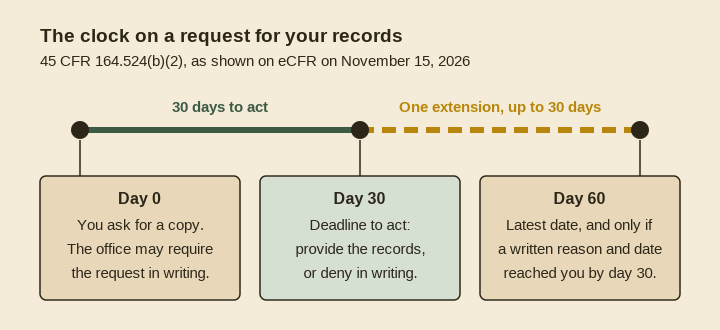 Thirty days is the rule, and sixty is the outer limit with a written explanation.
Two more details from the same section:
- Format. If the records are kept electronically and you ask for an electronic copy, the office must provide it in the form you request "if it is readily producible in such form and format."
- Cost. The office "may impose a reasonable, cost-based fee" limited to labor for copying, supplies, postage, and a summary if you agreed to one. HHS adds that a provider "cannot charge you a fee for searching for or retrieving your records" and cannot refuse you a copy "because you have not paid for the services you have received."
HHS notes on its pages that a federal court vacated parts of its older access guidance on January 23, 2020 (Ciox Health, LLC v. Azar). The regulation text above is what eCFR shows today.
What about fitness apps, employers and schools?
Apps and wearables. HHS says: "The HIPAA Rules generally do not protect the privacy or security of your health information when it is accessed through or stored on your personal cell phones or tablets." It adds that, in most cases, unless an app "is provided to you by a covered entity or its business associate", the rules do not protect data you entered into it. The Federal Trade Commission (FTC) agrees: many companies that collect health information, and it names a fitness tracker, a diet app and a connected blood pressure cuff, "aren't covered by HIPAA."
The FTC enforces a separate regulation, the Health Breach Notification Rule, at 16 CFR Part 318. It applies to vendors of personal health records and related companies and, by its own terms, "does not apply to HIPAA-covered entities" (318.1). After a breach of unsecured health information, a covered company must notify each affected person and the FTC, and the media when 500 or more residents of a state are affected (318.3), "without unreasonable delay and in no case later than 60 calendar days" (318.4). The FTC says amendments in July 2024 "make clear that makers of health apps, connected devices, and similar products must comply with the Rule." The FTC also enforces the FTC Act's ban on deceptive and unfair practices.
The sections cited here are about notice after a breach. They do not copy HIPAA's access rights.
Employers. HHS says: "The Privacy Rule does not protect your employment records, even if the information in those records is health-related." It also says your employer "can ask you for a doctor's note or other health information" for sick leave, workers' compensation, wellness programs or health insurance. The limit falls on the other party: if your employer asks your provider directly, "your provider cannot give your employer the information without your authorization unless other laws require them to do so."
Watch out
HIPAA governs what covered organizations disclose. It is not a rule about who may ask you a question. HHS says the Privacy Rule "applies to the disclosures made by your health care provider, not the questions your employer may ask." Whether another law limits the question is a separate matter. HHS points to the Department of Labor and the Equal Employment Opportunity Commission.
Others. HHS lists more organizations that "do not have to follow" the Privacy and Security Rules: life insurers, workers compensation carriers, most schools and school districts, many state agencies like child protective service agencies, most law enforcement agencies, and many municipal offices.
| Situation | Does HIPAA apply? | Basis |
|---|---|---|
| Your clinic sends your lab result to a specialist who is treating you | Yes, and the sharing is permitted for treatment | 45 CFR 164.502(a)(1)(ii) |
| Your clinic takes 45 days to answer a records request and sends no written reason | Yes, and the rule's clock is 30 days | 45 CFR 164.524(b)(2) |
| A step-counting app you installed yourself shares your data | Generally no, per HHS. FTC rules may apply | HHS and FTC pages |
| Your manager asks for a doctor's note | Generally no. HHS says the rule applies to the provider's disclosures, not the employer's questions | HHS, "Employers and Health Information in the Workplace" |
| Your clinic gives your chart to your manager without your authorization | Yes. HHS says the provider cannot, unless other laws require it | Same HHS page |
How do you file a complaint?
Section 160.306 gives the right: "A person who believes a covered entity or business associate is not complying" may file a complaint with the Secretary of HHS. The complaint must be in writing, on paper or electronically. It must name the organization and describe what happened. And it must be filed "within 180 days of when the complainant knew or should have known" of the act, unless HHS waives the limit "for good cause shown."
HHS's page on the process adds the practical parts:
- You can file by mail, fax or email, or through the OCR Complaint Portal on HHS.gov.
- OCR "does not investigate complaints filed without a name and contact information", though you may ask on the consent form that your name be kept confidential.
- OCR "can only investigate the covered entities that must comply with these rules." A complaint about an app that HIPAA does not reach is outside its authority.
Retaliation is addressed in 160.316, which says a covered entity or business associate "may not threaten, intimidate, coerce, harass, discriminate against, or take any other retaliatory action" against a person for filing.
What to remember
- HIPAA binds covered entities (health plans, clearinghouses, and providers who bill electronically) and their business associates. See 45 CFR 160.103.
- HHS says an organization outside those two definitions "does not have to comply with the HIPAA Rules." Most apps, employers acting as employers, life insurers and schools are outside.
- You have a right to a copy of your records. The organization has 30 days to act and may take one extension of up to 30 more with a written reason (45 CFR 164.524).
- Health apps outside HIPAA may fall under the FTC's Health Breach Notification Rule (16 CFR Part 318), which requires notice after a breach.
- A complaint to HHS OCR must be in writing and within 180 days (45 CFR 160.306), and retaliation for filing is prohibited (45 CFR 160.316).
- This is general information, not legal advice. State law can add protections this article does not cover.
A useful next step is small: ask one of your providers for a copy of your record, in writing, and note the date.
Sources (25)
- eCFR, 45 CFR 160.103, "Definitions", read 15 November 2026
- eCFR, 45 CFR 164.502, "Uses and disclosures of protected health information: General rules", read 15 November 2026
- eCFR, 45 CFR 164.508, "Uses and disclosures for which an authorization is required", read 15 November 2026
- eCFR, 45 CFR 164.520, "Notice of privacy practices for protected health information", read 15 November 2026
- eCFR, 45 CFR 164.524, "Access of individuals to protected health information", read 15 November 2026
- eCFR, 45 CFR 164.526, "Amendment of protected health information", read 15 November 2026
- eCFR, 45 CFR 164.528, "Accounting of disclosures of protected health information", read 15 November 2026
- eCFR, 45 CFR 164.306, "Security standards: General rules", read 15 November 2026
- eCFR, 45 CFR 164.308, "Administrative safeguards", read 15 November 2026
- eCFR, 45 CFR 164.310, "Physical safeguards", read 15 November 2026
- eCFR, 45 CFR 164.312, "Technical safeguards", read 15 November 2026
- eCFR, 45 CFR 164.404, "Notification to individuals", read 15 November 2026
- eCFR, 45 CFR 160.306, "Complaints to the Secretary", read 15 November 2026
- eCFR, 45 CFR 160.316, "Refraining from intimidation or retaliation", read 15 November 2026
- eCFR, 16 CFR 318.1, "Purpose and scope", read 15 November 2026
- eCFR, 16 CFR 318.3, "Breach notification requirement", read 15 November 2026
- eCFR, 16 CFR 318.4, "Timeliness of notification", read 15 November 2026
- HHS, "Covered Entities and Business Associates", last reviewed 21 August 2024
- HHS, "Your Rights Under HIPAA", last reviewed 30 May 2025
- HHS, "Your Medical Records", last reviewed 30 May 2025
- HHS, "Employers and Health Information in the Workplace", last reviewed 2 November 2020
- HHS, "Protecting the Privacy and Security of Your Health Information When Using Your Personal Cell Phone or Tablet", last reviewed 29 June 2022
- HHS, "2025 HIPAA Security Rule Notice of Proposed Rulemaking (NPRM)", 27 December 2024
- HHS, "How to File a Health Information Privacy or Security Complaint", last reviewed 20 February 2026
- FTC, "Complying with FTC's Health Breach Notification Rule", July 2024