Articles & BlogBy Trapper W. Brown11 min readCurrent to 15 November 2026Facts only
As of 15 November 2026. Every date and dollar figure below was read today on HealthCare.gov, Medicare.gov or CMS.gov, and each one names its plan year. This is general information. It does not say which plan to pick.
Open enrollment is the stretch of weeks each year when you can sign up for health coverage or change it. Miss it and, in most cases, you wait until the next one. Two federal windows are open right now. One is for Medicare. The other is for the Health Insurance Marketplace, the government-run site at HealthCare.gov where people buy their own coverage.
This article gives the dates as the official pages show them today, explains the handful of words that decide what a plan costs you, and lists what the official pages tell shoppers to compare. Dates and rules can change, and some states use their own, so check the official page before you act.
 Whether a plan covers the medicines you take is one of the checks the official pages list. Photo by Sgt. Anthony Ortiz, U.S. Marine Corps, public domain, via Wikimedia Commons.
What are the Medicare dates?
Medicare.gov gives the yearly window as October 15 to December 7. It says the changes you make "are effective January 1 of next year (the plan must get your enrollment request by December 7)." A CMS press release dated September 28, 2026 gives the years: "Medicare Open Enrollment begins October 15, 2026, and ends December 7, 2026."
Two terms first. Medicare.gov calls Part A "Hospital Insurance" and Part B "Medical Insurance", and the two together are Original Medicare. A Medicare Advantage Plan, also called Part C, is a plan that must cover the medically necessary services Original Medicare covers and may use a network of doctors. Part D is Medicare drug coverage.
During the window, Medicare.gov says you can:
- join, drop or switch a Medicare Advantage Plan
- join, drop or switch a Medicare drug plan if you are in Original Medicare
- switch from Original Medicare to a Medicare Advantage Plan, or back
There is a second, narrower window. Medicare.gov lists a Medicare Advantage Open Enrollment Period from January 1 to March 31, "only if you're already in a Medicare Advantage Plan." In it you can switch to another Medicare Advantage Plan or return to Original Medicare, and the change starts the first of the month after the plan gets your request.
Medicare.gov adds a caution for people going back to Original Medicare. They "may need to join a separate drug plan and may want to add Medicare Supplement Insurance (Medigap)", which is extra insurance sold by private companies, and the page says "There are limits on when you can add it."
What are the Marketplace dates?
HealthCare.gov lists five dates for 2027 coverage. A CMS fact sheet dated October 30, 2026 gives the same window with its years: it "begins on November 1, 2026, and runs through January 15, 2027."
| Date | What HealthCare.gov says happens |
|---|---|
| November 1, 2026 | Open Enrollment starts |
| December 15, 2026 | Last day to enroll or change plans for coverage that starts January 1 |
| January 1, 2027 | Coverage starts for people who enrolled by December 15 and paid their first premium |
| January 15, 2027 | Open Enrollment ends |
| February 1, 2027 | Coverage starts for people who enrolled December 16 through January 15 and paid their first premium |
After January 15, the page says, you can enroll or change plans "only if you qualify for a Special Enrollment Period." That is a window opened by a life event, and the page's examples are getting married, having a baby, moving, or losing other coverage. Medicaid and the Children's Health Insurance Program (CHIP) take applications at any time of year.
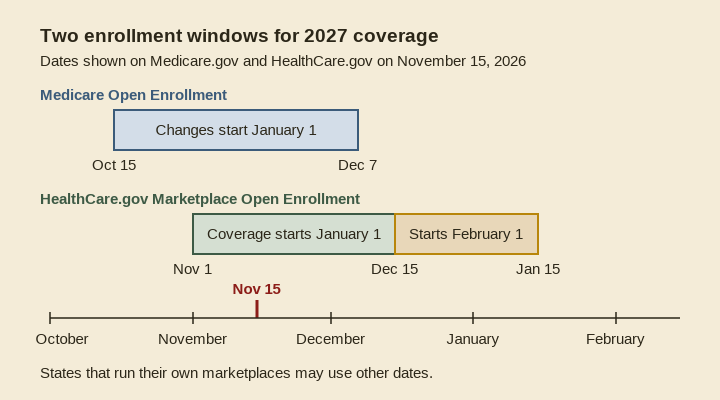 The two federal windows overlap for five weeks, and the Marketplace window has a cutoff inside it.
Does my state use the same dates?
Not always. HealthCare.gov says "How you apply depends on if your state has its own Marketplace", and asks you to pick your state. The same page carries a notice that Oregon residents use a state site, ExploreHealthOR.gov, for 2027 coverage starting November 1.
State dates can differ. Connecticut's official marketplace announced on July 15, 2026 that its window for 2027 coverage opens October 23 and runs through January 15. The home page of California's official marketplace today tells visitors to "apply by Dec. 31." I did not find one official page that lists every state's dates for 2027, so this article does not offer such a list. Your state's own marketplace page is the authority for your state.
Coverage through a job runs on its own calendar. HealthCare.gov's glossary says: "Job-based plans may have different Open Enrollment Periods. Check with your employer."
What do the plan terms mean?
The site's article "How Insurance Works" explains these ideas and works a health claim in numbers. Here they are as HealthCare.gov's glossary defines them.
| Term | HealthCare.gov's definition |
|---|---|
| Premium | "The amount you pay for your health insurance every month." |
| Deductible | "The amount you pay for covered health care services before your insurance plan starts to pay." |
| Copayment | "A fixed amount ($20, for example) you pay for a covered health care service after you've paid your deductible." |
| Coinsurance | "The percentage of costs of a covered health care service you pay (20%, for example) after you've paid your deductible." |
| Out-of-pocket maximum | "The most you have to pay for covered services in a plan year." |
| Network | "The facilities, providers and suppliers your health insurer or plan has contracted with to provide health care services." |
The out-of-pocket maximum has edges. The glossary says it does not include your monthly premiums, anything you spend on services the plan does not cover, out-of-network care, or costs above the allowed amount for a service. It also gives the limit for a Marketplace plan by plan year:
- plan year 2026: no more than $10,600 for an individual or $21,200 for a family
- plan year 2027: no more than $12,000 for an individual or $24,000 for a family
By my subtraction, the 2027 individual figure is $1,400 above the 2026 one. The glossary's wording is "No more than", so these are ceilings, and each plan states its own limit.
HealthCare.gov works an example with a person it calls Jane. Her plan has a $1,500 deductible, 20% coinsurance and a $5,000 out-of-pocket maximum. Before she has paid $1,500, a $125 office visit costs her $125. After that, the same visit costs her $25 and the plan pays $100. Once she has paid $5,000 in the year, the plan pays the whole $125.
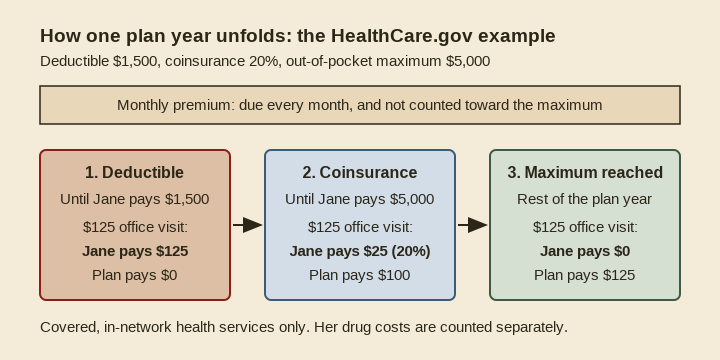 The same $125 visit costs three different amounts depending on where Jane is in her plan year.
Medicare uses the same words with its own numbers. Medicare.gov's costs page today is headed "What you pay in 2026" and lists a Part B premium of $202.90 a month, a Part B deductible of $283 a year, and a Part D out-of-pocket limit of $2,100. The page did not show 2027 amounts when I read it, so none appear here. It also says that in Original Medicare "There's no yearly limit on what you pay out-of-pocket, unless you have supplemental coverage", while Medicare Advantage plans have a yearly limit that varies by plan.
What do the official pages say to compare?
For Marketplace plans, HealthCare.gov's main point is total yearly cost: twelve premiums plus what you pay when you get care. Its glossary says "the plan with the lowest monthly premium may not be the best match for you." The pages also say:
- Metal categories describe cost sharing only. Bronze, Silver, Gold and Platinum plans pay an estimated 60%, 70%, 80% and 90% of covered costs. HealthCare.gov says the categories "have nothing to do with quality of care."
- Extra savings attach to Silver. People who qualify for extra savings on deductibles and copayments "only get those extra savings if you enroll in a Silver plan."
- Plan type sets the network rules. HMO, PPO, EPO and POS plans differ in whether they cover care outside the network and whether you need a referral.
- Your own doctors and drugs. Each plan has a summary of benefits, a provider directory and a list of covered drugs, and the comparison tool can show whether a plan covers the ones you enter.
- Quality. Plans carry a star rating from 1 to 5.
People who already have a Marketplace plan should have received two letters by November 1, one from the insurer and one from the Marketplace. HealthCare.gov says "Plans and prices change every year", and that if you do not act by December 15 "you may be automatically re-enrolled" for January 1.
For Medicare plans, Medicare.gov's list is shorter: check that the plan covers your prescriptions, "Ask your doctors and pharmacies if they're in network with the plan", review premiums, deductibles and the estimate of your yearly drug costs, and talk to your benefits administrator first if you have other coverage. CMS's September release says plan costs and benefits can change from year to year and that it "encourages beneficiaries to review their current coverage and compare their options for 2027."
Where is the free official help?
- Marketplace Call Center: 1-800-318-2596 (TTY 1-855-889-4325). HealthCare.gov lists it as "Available 24 hours a day, 7 days a week (except holidays)."
- Marketplace local help: HealthCare.gov's Find Local Help directory lists two kinds of helper. Assisters are "Required to provide fair, impartial, and accurate information." Agents and brokers are "Generally paid by insurance companies whose plans they represent."
- Medicare: 1-800-MEDICARE (1-800-633-4227), TTY 1-877-486-2048, 24 hours a day, 7 days a week, except some federal holidays.
- State Health Insurance Assistance Programs (SHIPs): Medicare.gov says they give "free personalized health insurance counseling" and "aren't connected to any insurance company or health plan."
What to do
These steps come from the official pages above.
- Work out which window is yours: Medicare, HealthCare.gov, a state marketplace, or an employer's.
- Read the letters about next year's coverage. HealthCare.gov sends people without them to their insurer and to the Marketplace Call Center.
- Compare total yearly cost, the network, and whether your drugs are covered, using the plan's own documents.
- For a January 1 start, Medicare plans must get your request by December 7, 2026, and HealthCare.gov's last day is December 15, 2026. HealthCare.gov says "You must pay your first premium for coverage to start."
- Use the free help lines if anything is unclear.
Before you make a coverage change that could affect a treatment or a medicine you take, talk to your own clinician.
What to remember
- Medicare Open Enrollment for 2027 runs October 15 to December 7, 2026, per Medicare.gov and CMS.
- HealthCare.gov Open Enrollment for 2027 runs November 1, 2026 to January 15, 2027, and December 15 is the last day for a January 1 start.
- Some states run their own marketplaces with their own dates. Employers set their own too.
- The premium is what you pay every month. The deductible, copayments and coinsurance are what you pay when you get care. The out-of-pocket maximum caps the second group for covered, in-network care.
- HealthCare.gov's ceiling on that maximum is $12,000 for an individual and $24,000 for a family for plan year 2027.
- The official help is free: 1-800-318-2596 for the Marketplace, 1-800-MEDICARE for Medicare.
These figures are a snapshot of the official pages on 15 November 2026. The pages listed below are the place to confirm them on the day you enroll.
Sources (25)
- HealthCare.gov, "When can you get health insurance?", read 15 November 2026
- CMS, "Plan Year 2027 Marketplace Plans and Prices Fact Sheet", 30 October 2026
- Medicare.gov, "Open Enrollment", read 15 November 2026
- Medicare.gov, "Joining a plan", read 15 November 2026
- CMS, "Medicare Advantage and Medicare Prescription Drug Programs Expected to Remain Stable in 2027", 28 September 2026
- HealthCare.gov, "The Marketplace in your state", read 15 November 2026
- Access Health CT, "Access Health CT Announces 2027 Open Enrollment Dates", 15 July 2026
- Covered California, home page, read 15 November 2026
- HealthCare.gov, Glossary, "Open Enrollment Period", read 15 November 2026
- HealthCare.gov, Glossary, "Premium", read 15 November 2026
- HealthCare.gov, Glossary, "Deductible", read 15 November 2026
- HealthCare.gov, Glossary, "Copayment", read 15 November 2026
- HealthCare.gov, Glossary, "Coinsurance", read 15 November 2026
- HealthCare.gov, Glossary, "Out-of-pocket maximum/limit", read 15 November 2026
- HealthCare.gov, Glossary, "Network", read 15 November 2026
- HealthCare.gov, "Your total costs for health care: Premium, deductible & out-of-pocket costs", read 15 November 2026
- HealthCare.gov, "Health plan categories: Bronze, Silver, Gold & Platinum", read 15 November 2026
- HealthCare.gov, "Health insurance plan & network types: HMOs, PPOs, and more", read 15 November 2026
- HealthCare.gov, "3 things to know before you pick a health insurance plan", read 15 November 2026
- HealthCare.gov, "Renew, change, update, or cancel your plan", read 15 November 2026
- Medicare.gov, "Costs", read 15 November 2026
- Medicare.gov, "Compare Original Medicare & Medicare Advantage", read 15 November 2026
- HealthCare.gov, "Get help applying & more", read 15 November 2026
- HealthCare.gov, "Contact us", read 15 November 2026
- Medicare.gov, "Contact Medicare", read 15 November 2026